

PART 1 — The Calls I Was Never Supposed to Miss
My quiet rebellion began with the metallic residue of anesthesia on my tongue and a heart monitor chirping above my hospital bed. For a single mother, waking after surgery is less a gentle return to awareness than an abrupt return to responsibility. Before I could separate the pale blue curtain from the fluorescent ceiling at St. Jude’s Memorial, I was searching the sheets for my phone. An IV tugged at my left wrist. Beneath my gown, fresh abdominal stitches pulsed with a dull ache, but neither discomfort held my attention. I needed to know where my children were. When I finally brought the screen close enough to read, fourteen missed calls appeared. Every one came from Margaret Doyle, my seventy-three-year-old next-door neighbor. In four years on Elmwood Drive, Margaret had called only twice: once about a fallen live power line, once about a stray dog digging under my fence. She did not telephone over trifles. Fourteen calls meant something had gone terribly wrong.
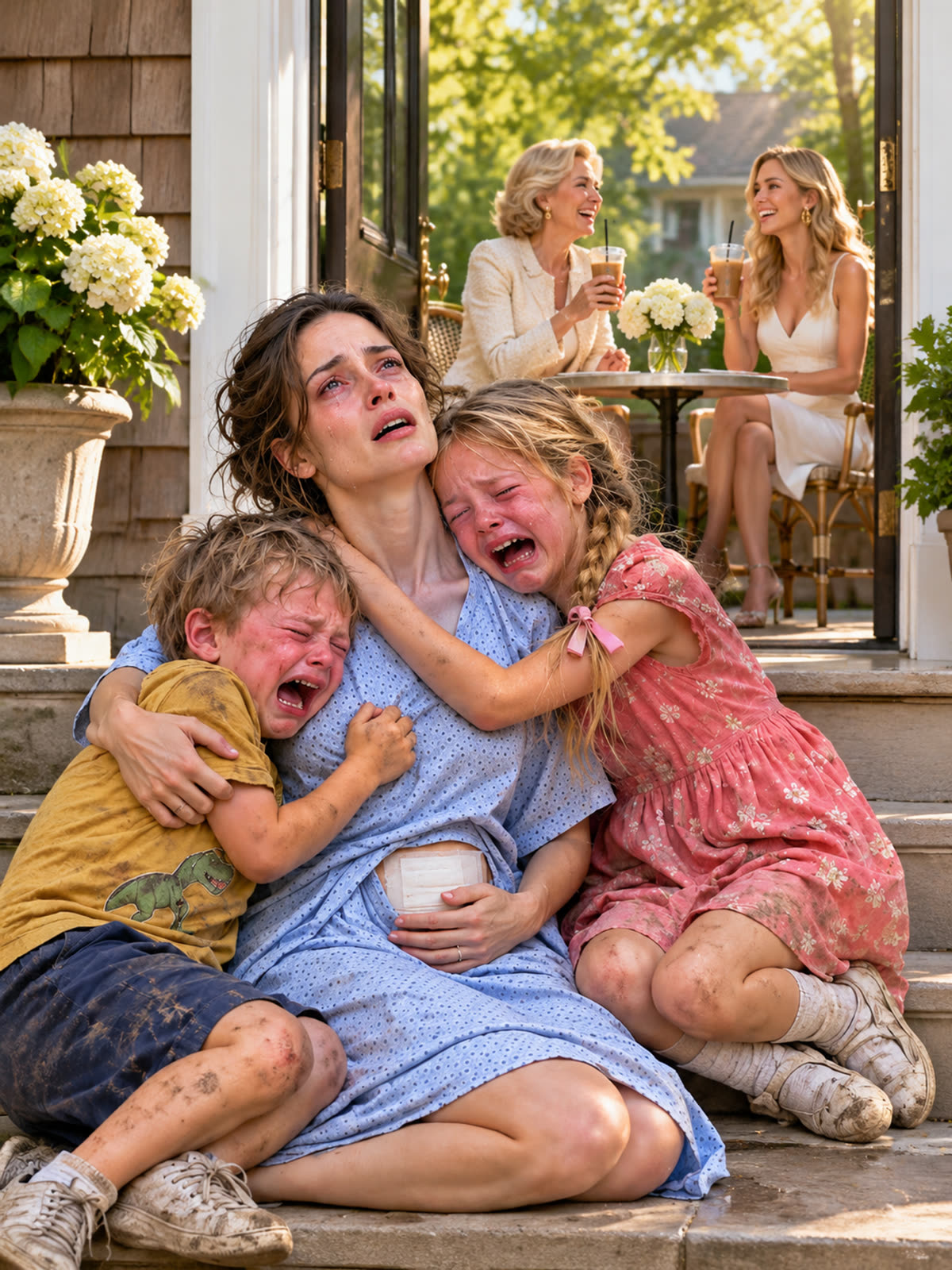
My hand shook so badly that I missed her name twice before connecting. She answered immediately. “Whitney,” Margaret breathed into the receiver. “Thank God. Your children are with me. They are safe. Oliver is watching an old nature documentary in the den, and Sophie just drifted off on my sofa.” I clenched the bedrail, trying to steady the room around me. “Margaret, what happened? Where are my parents?” A deliberate silence followed, with her grandfather clock ticking faintly behind her. “Your parents drove away at eleven-thirty this morning, Whitney. I was out by the property line trimming my boxwood hedges when I heard their sedan pull out of your driveway. Something made me glance over through the gap in the branches. I don’t know what instinct prompted it, truly, I don’t. I just looked, and there they were. Sitting side by side on your front porch steps. Completely alone.”
The digital clock opposite my bed read 2:42 p.m. My procedure had been scheduled for eleven-fifteen; I had entered the operating room at eleven-ten. My parents had left scarcely fifteen minutes after I went under. “Sophie was weeping silently,” Margaret continued, her voice tight with controlled fury. “She had her little face buried in her knees. And Oliver —bless that boy—had his arm wrapped tightly around her shoulders, trying to shield her from the breeze. When I hurried across the lawn to ask where your mother was, Oliver looked up at me with those big serious eyes and said, ‘Grandpa told us they were just running a quick errand and would be back in an hour.’ “ Margaret released a sharp breath. “That was over three hours ago, Whitney. Seven years old. He is seven years old, and he was left in charge of a five-year-old on an open porch while traffic rolled down the street.”
“Are you alright?” Margaret asked softly. “You sound remarkably pale, even over the telephone.” My throat felt scraped raw. “I just woke up from surgery, Margaret,” I whispered. The silence that followed was horrified. “Oh, Whitney. My dear girl.” After ending the call, I watched the green line jump on the monitor and forced myself to breathe through eight slow beeps. I was thirty-six, a senior project coordinator at a civil engineering firm, and had spent nine years managing timelines, structural integrity, and the consequences of failed obligations. I could identify dangerous weaknesses in bridges and foundations. Yet I had spent most of my life refusing to examine the instability inside my own family. Lying in that recovery bay, with my children safe only because a neighbor had happened to look through a hedge, I could no longer pretend the cracks were harmless.
My mother, Diane Walsh, was sixty-two and effortlessly charming whenever charm cost her nothing. Her garden club, church committee, and neighbors knew a generous matriarch. I knew the conditions attached to that generosity. The moment kindness became inconvenient, somebody else inherited the responsibility, usually me. My younger sister, Amber, received the benefits. At thirty, living twelve minutes from our parents, she still occupied the position of the family’s permanent dependent. They attended her trivia nights, watched her miniature goldendoodle, and financed her lifestyle as though independence were perpetually just around the corner. My father, Ray, a sixty-five-year-old retired insurance adjuster, rarely challenged any of it. He accepted my mother’s decisions with the resignation of a man watching the weather change. He enjoyed being regarded as a devoted grandfather without confronting the choices that title should have required of him.
Six weeks earlier, I had opened my calendar at the kitchen table and asked for one Tuesday of help. With school in session that May, the arrangement included the morning bus, the three-fifteen pickup, dinner, and an overnight stay while I recovered. Both parents had agreed enthusiastically. Two days before surgery, Mom had reinforced the promise. “Stop fretting, Whitney. Everything is handled. You just focus on getting well, and leave the kids entirely to us.” I had trusted her enough to sign the consent forms. Now I selected her number with a deliberately steady finger. She answered on the third ring, cheerful and untroubled. “Hello, sweetheart! How did everything go? Are you all patched up?” I settled against the thin pillow. “Where are my children, Mom?” Her hesitation was familiar: not confusion, but calculation.
“Oh,” Diane said, abruptly practical. “I see Mrs. Doyle called you.” I lowered my voice. “Where are my children?” She began speaking quickly. “Your father and I had to run Amber into the city,” my mother explained. “Listen, she got a last-minute cancellation slot at Maison Lumière . You know how impossible it is to get an appointment with Ricardo —his waitlist is four months long, and she has that charity gala on Friday. She was practically in tears, Whitney. She needed a ride because her car is making that funny clicking noise.” I stared at the curtain while numbness spread through me. “They were sitting on my front porch, Mom. For three hours. Sophie was crying.” My mother sounded irritated that I had interrupted the justification with the consequences.
“Oh, don’t be so dramatic,” Diane scoffed. “Mrs. Doyle was right next door trimming her bushes! She had eyes on them the entire time. She’s retired, she has nothing else to do, and she was right there.” My grip tightened around the phone. “She is seventy-three years old, Mom! She didn’t even know you had left until she happened to look through a hedge! You didn’t knock on her door. You didn’t call me. You didn’t call my neighbor. You literally walked out of my house and left a seven-year-old and a five-year-old unattended on the steps.” Nothing in my mother’s response suggested that the image troubled her. Her concern was that I had named what she had done instead of accepting the gentler version she preferred.
“Nobody abandoned anyone, Whitney, stop twisting things!” my mother snapped. “Why are you always making everything so difficult? We were only going to be gone for a little while, and traffic on the interstate was backed up.” I had heard that defensive anger throughout my life. It always arrived when the facts became difficult to explain away. This time I would not let the conversation drift toward my tone, my supposed sensitivity, or the inconvenience of highway traffic. There had been a promise. There had been two small children. There had been adults who had decided to leave. “Why did you leave at all?” I asked quietly. “You promised me six weeks ago you would stay with them.” The pause lengthened. When she finally answered, she sounded patiently certain that I was the one failing to understand.
“Your sister needed us more.” The words seemed to linger in the sterile air. I watched the monitor and counted another eight mechanical beeps, letting each one settle me further into a cold, unfamiliar calm. There was nothing left to misunderstand. My surgery, my children’s safety, and the promise she had made had all been weighed against Amber’s salon appointment. In my mother’s mind, the decision required no apology. “Do not come to my house,” I said, my voice stripped of emotion. “Do not call my phone, and do not attempt to contact my children.” I disconnected before she could object. For several minutes I lay beneath the thin blanket, motionless, feeling the arrangement that had governed my entire life come apart. Then I reached for the nurse call button. I needed to get home.

When the discharge nurse appeared, I told her Margaret was waiting downstairs to drive me. It was a lie. Margaret had surrendered her license two years earlier because of macular degeneration, and I knew the instructions prohibited driving for twenty-four hours after general anesthesia. Fear and desperation overruled that knowledge. At five o’clock, I left through the sliding doors, climbed into my SUV, and drove home. Every left turn pulled sharply at my stitches; residual sedation blurred the edges of my vision. At five-forty, I reached Margaret’s driveway. The smell of braised beef and roasted vegetables greeted me inside her house. While comforting my children and monitoring my driveway, she had somehow prepared a pot roast. Oliver sprang up from the rug and wrapped his arms around me, instinctively careful of my dressing. Sophie slept beneath a handmade quilt, her lashes still damp.
I sat at Margaret’s oak kitchen table and ate warm stew while Oliver eagerly described the wildlife documentary. I kept my voice cheerful and level, knowing how closely children measure danger by their mother’s reaction. Once both children were in the den with vanilla ice cream, Margaret leaned toward me. A small yellow legal pad lay beside her cutting board. “I took the liberty of documenting the exact timeline,” she murmured, sliding it across. “Just in case you ever find yourself needing an accurate record.” Her precise cursive read: 11:28 a.m. — Gray sedan (Walsh) departed driveway at high speed. Two minor children observed sitting unattended on front porch steps. Both visibly distressed. I studied the entry as something cold and clear settled inside me. “May I take a photograph of this, Margaret?” She answered gently. “Take the whole page, sweetheart,” she replied softly. “And take the rest of the pot roast for tomorrow.”
By seven-thirty, I had taken the children the fifty yards home, bathed them, and read Sophie an extra bedtime story because she clutched my sleeve when I reached for the lamp. Oliver was beneath his dinosaur comforter when he spoke into the dimness. “Mom? I wasn’t scared today.” My throat tightened. “I know you weren’t, buddy. You were incredibly brave. You took such good care of your sister.” He studied the glowing stars on his ceiling. “Grandpa promised they’d come right back,” Oliver said softly. “He told me to watch the clock.” I answered with the certainty he deserved. “I know, sweetheart. They broke their promise. That was wrong of them, and it will never happen again.” After they fell asleep, I eased into the living-room armchair and opened Amber’s public Instagram profile.
Her newest post was a boomerang video showing her beneath a sleek black salon cape while a silver-haired stylist stood behind her with a round brush. The upload time was 10:48 a.m. The caption read: Emergency glam sesh! Bless my mom for dropping everything last minute to chauffeur me into the city so Ricardo could work his magic!! #BestMomEver #GalaReady. Downtown was forty-five minutes away in light traffic. Margaret had seen Dad’s sedan depart at eleven-twenty-eight, but Mom had evidently gone earlier. Perhaps they had arrived separately; perhaps she had left Ray responsible before he abandoned the children to join them. Either way, she had broken her commitment before I entered the operating room. Beneath the post, Diane had left three red hearts and the words: Anything for my girl! My children had apparently belonged to a different category.
Amber’s active story was timestamped 1:35 p.m. A marble bistro table held iced caramel macchiatos and flaky croissants. Mom smiled into the camera, lifting her glass. The overlay announced: Post-salon brunch with my bestie!! Love our spontaneous girl days! While she celebrated, I had been alone in recovery and Oliver had been helping his hungry sister in a neighbor’s kitchen. I set the phone down gently. The rage I expected did not come. Instead, I felt the concentrated stillness that preceded a structural-failure presentation at work. At my desk, I opened the laptop, created a folder named May, and typed six numbered actions into a blank document. My mother had taught me something after all: locks offered no protection when the people holding the keys considered my family an inconvenience. Tomorrow, I would begin changing every one. My parents had no idea what their keys were about to stop opening.
PART 2 — The Door They Could No Longer Open
Wednesday morning brought clear light, damp earth, and the smell of freshly cut grass through my bedroom window. At six-thirty, I rose carefully, protecting the incision while my mind worked without hesitation. Before the children woke, I reviewed the list over black coffee. At eight-thirty, I called Sandra Klein, the family-law and estate attorney whose charcoal suits and precise manner had guided me through my divorce three years earlier. “Klein Law. Whitney, good morning. I wasn’t expecting to hear from you until next month for your annual trust review.” I looked toward Margaret’s hedge. “Good morning, Sandra,” I said. “I need an emergency overhaul of my entire estate and family protection portfolio. Specifically, I need to revoke my current durable power of attorney, rewrite my advance healthcare directive, amend the standby guardianship designation in my will, and update the primary and contingent beneficiary structures on my life insurance policies and retirement accounts. I need the documents executed and notarized before the end of this week.”
Sandra paused only briefly. “Understood,” she said, clicking her pen. “Who are we removing from authority?” My answer came without qualification. “Diane Walsh and Ray Walsh. Both of them, in every capacity. Not even as secondary backups.” She offered neither gossip nor empty consolation. “And who are we naming as the new standby guardian and healthcare proxy?” I already knew. “Claire Walsh,” I replied without hesitation. Claire was my ex-husband Marcus’s younger sister. After his move to Seattle, Marcus had become an occasional holiday-and-summer father, but Claire had remained firmly present. She lived twenty minutes away in Oakridge, had two children, and possessed the reliability my parents claimed without practicing. When I had texted about Thursday grocery help the previous evening, she called within ninety seconds, upset that I had not asked her to sit beside my hospital bed.
“Claire Walsh,” Sandra repeated, warmth briefly entering her businesslike voice. “Smart choice. She’s local, she’s stable, and she has an established bond with the kids. I will have my paralegal draft the revocations and new instruments today. Come to my office tomorrow afternoon at two. Bring two forms of government ID, and we’ll have the witnesses and notary ready.” By nine-fifteen, Dale from Ridgeview Lock and Key knelt on my porch beside an open tool bag. “Two high-security Grade-1 deadbolts on the front and back entries,” I told him. “Re-key the side garage entry to match, wipe all existing keypad memory codes, and program a new six-digit master code. I need three physical brass keys cut on-site.” He began removing the old housing. “Can do,” Dale grunted. “Want the old cylinders boxed up?” I answered, “You can toss them in your scrap bin, Dale.”
Forty-five minutes later, the new bolts settled into place with a satisfyingly solid sound. Margaret received one key when she brought sourdough at noon; another went into an envelope for Claire; the third joined my own keyring. The old spare my mother had demanded “just in case you ever lose yours or have an emergency, darling.” went beneath expired menus and rubber bands in the junk drawer. For two years, she had treated that key as permission to enter without warning, rearrange my pantry, and leave critical notes about my lawn. Now it was only useless metal. Thursday morning, I reached Ridgeview Elementary before the bell. Mrs. Holt, the longtime secretary, looked up from her computer. “Morning, Mrs. Walsh,” she greeted me. “Everything alright? You look like you ought to be resting.” I rested my hands on the counter. “I’m getting there, Mrs. Holt,” I said. “I need to pull Oliver and Sophie’s emergency contact and authorized pickup files immediately.”
Mrs. Holt retrieved two folders and offered a pen. “Make your edits right on the master forms, and I’ll update the digital dismissal system before the buses roll in.” I crossed out Diane Walsh and Ray Walsh with firm black strokes, added Claire and Margaret with their contact details, and marked Restricted Access. In the special-instructions box, I prohibited my parents from signing out, visiting, or contacting either child at school. Mrs. Holt initialed the deletions, stamped the paperwork, and put it away. “Done,” she said softly. “Nobody leaves this building with your kids unless they’re on that list, Whitney. Have a restful weekend.” At two that afternoon, I sat across Sandra’s conference table, signing fourteen times while witnesses watched and a notary pressed seals into heavy paper. Every signature removed another piece of authority my parents had treated as an entitlement.
Diane would no longer direct my medical care if I became incapacitated. Neither parent would be named to take Oliver and Sophie if I died, nor control the four-hundred-thousand-dollar trust funded by my life insurance. Mom had once described that money at Thanksgiving as “the nest egg that will keep us all comfortable if tragedy strikes.” Now Claire would administer it exclusively for my children’s education and welfare. Friday morning, I uploaded the beneficiary forms to my insurer’s secure portal. By evening, all six items in my May folder were crossed out. My parents had not called about my recovery or offered groceries, medication, or help with the children. Their silence was familiar strategy: wait until I felt guilty enough to restore peace myself. Saturday brought Amber’s text instead: Hey, Mom mentioned you were super stressed after your procedure and snapped at her. Everything cool? Wanna grab coffee tomorrow? I left it unanswered and watched my children blow bubbles across the deck.
On Sunday at one, Oliver and Sophie colored at the dining table while I rinsed strawberries. I wore a white linen blouse and dark jeans, not the clothes of a patient waiting to be managed. When Dad’s Buick entered the driveway, I dried my hands and collected the manila folder beside the fruit bowl. Inside were certified copies of everything signed during the previous seventy-two hours. Through the foyer window, I watched my family approach. Mom led in a pastel floral cardigan, looking serenely forgiving. Dad carried her familiar Dutch oven beneath a checkered towel. Amber followed in designer athleisure, holding a bakery box tied with pink twine. They had come bearing the props of reconciliation without the inconvenience of an apology. Mom expected comfort food and an audience to make refusal impossible.
She stepped to the door, took her brass key from her handbag, and inserted it without knocking. The deadbolt did not move. Her brows drew together. She adjusted the key and tried again, pressing harder. Dad shifted the heavy pot. “Is it jammed, Diane? Here, let me—” I unlocked the door from inside before he could advance. For an instant, Mom looked startled by my composure. Then she opened her arms and produced her brightest smile. “Whitney, darling! Surprise! We brought pot roast and—” I interrupted quietly. “That key doesn’t work anymore, Mom,” I said. Her arms lowered, the obsolete key still between her fingers. The warmth in her expression vanished. “Excuse me?” she said. “Did you have the locks changed? Whitney, what on earth is going on? Why didn’t you tell us the lock was broken?”
“The lock wasn’t broken,” I replied, holding the door so the threshold remained blocked. “It was compromised. There’s a difference.” Amber stepped alongside her, sighing theatrically. “Seriously, Whit? Are you still mad about Tuesday? Mom told me you were super groggy from the meds and got all worked up, so we came over to bring you dinner and smooth things over. You don’t need to act like we committed a felony.” I kept my attention on Diane. My family had arrived expecting tears, a quarrel, or a daughter who could be shamed into serving dinner. Instead, I opened the folder. I had spent years trying to explain my hurt in language they could dismiss as oversensitivity. This time, I would speak in records, signatures, and restrictions. The first sheet rose between us in the sunlight.
“This is the updated student release and emergency contact roster for Ridgeview Elementary School ,” I stated. “You will notice two thick black lines drawn through your name and Dad’s name, initialed by the school registrar on Thursday morning. Beneath them is a restricted-access directive. Neither of you is permitted to pick up Oliver or Sophie , visit them during lunch, or receive any information from the school administration.” Color crept into Mom’s cheeks. “Whitney, you are being completely irrational! Have you lost your mind? We are their grandparents!” I moved the page behind the next document, exposing the notary seal. Her title had always been the end of the discussion before. This time, it changed nothing. Behind her, Dad’s attention fixed on the paperwork, and Amber’s bored expression began to falter.
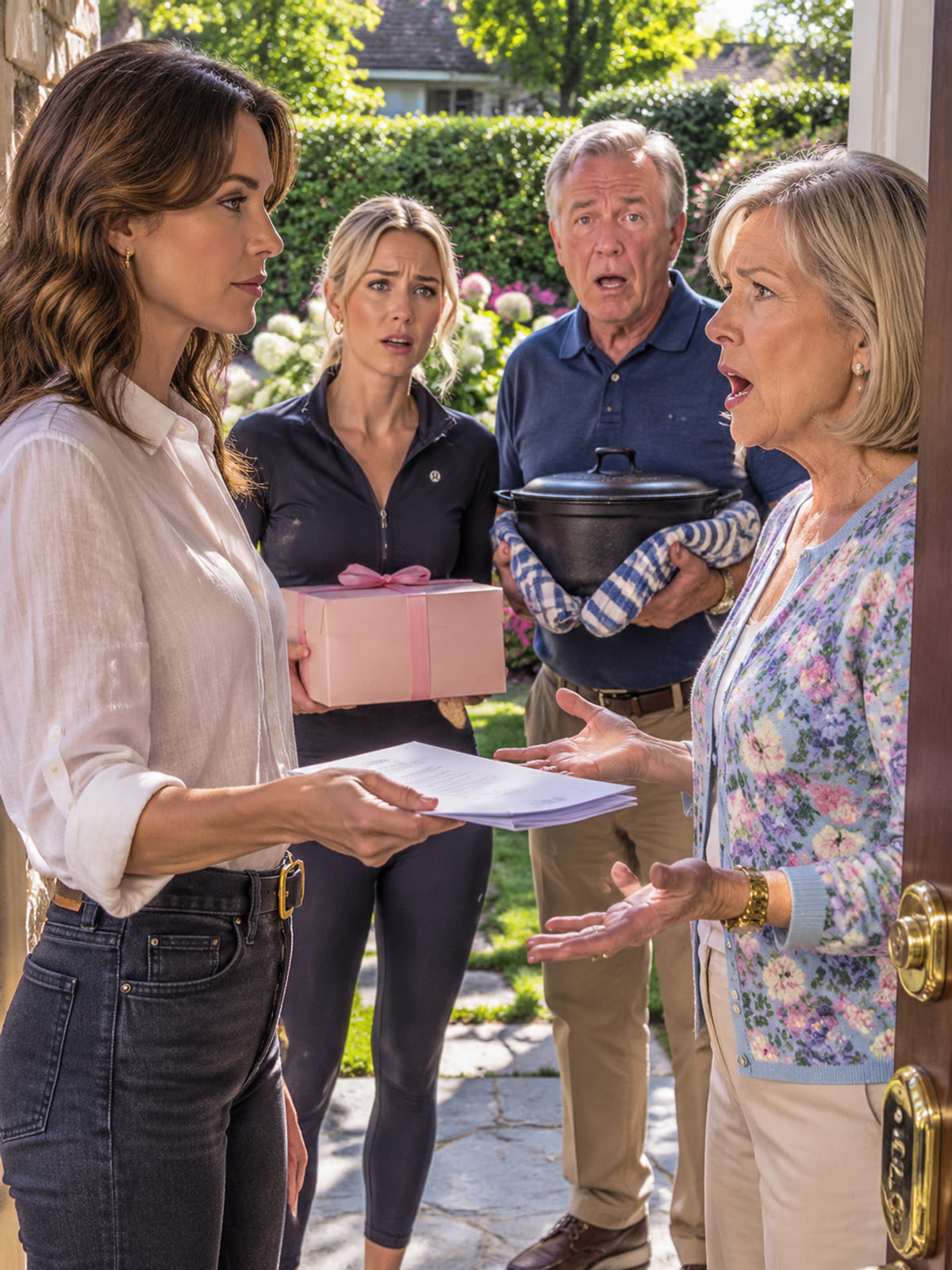
“This is a legally executed codicil to my last will and testament, along with a revised standby guardianship designation,” I continued. “In the event that anything happens to me, custody of Oliver and Sophie passes immediately and irrevocably to Claire Walsh . You and Dad have been removed entirely from the line of succession.” Dad stiffened. “Claire? Marcus’s sister? You’re telling me you’d hand our grandchildren over to your ex-husband’s family instead of your own flesh and blood?” I met his eyes. “I am handing my children over to the adult who responds to a text message in four minutes instead of leaving them unattended on a front porch for three hours,” I replied. “You know Claire , Dad. You know she shows up.” His gaze dropped to the towel around the pot. For once, he seemed unable to find refuge in saying nothing.
I presented the remaining pages. “Revocation of durable power of attorney and updated advance healthcare directive—naming Claire as my sole medical proxy. And finally, confirmation from my life insurance carrier that you and Dad have been removed as contingent trustees of my children’s estate. Every single legal, medical, and financial tie connecting you to my household has been severed.” Amber stared. “Wait a minute—you changed your life insurance beneficiaries? Because of one afternoon? Whitney, you’re insane! Mom has done everything for you since you got divorced!” Mom’s practiced composure disappeared. “I am your mother!” Diane hissed, moving closer. “I raised you! I have sacrificed for you your entire life, and you dare to stand there waving legal papers in my face like I’m some kind of criminal? Because we stepped away for a short errand? Mrs. Doyle was watching them! Nobody got hurt!”
I took out my phone and displayed Amber’s salon post, its 10:48 a.m. timestamp plainly visible. “You posted this forty-five minutes before my surgery even began, Mom,” I said quietly. “You commented ‘Anything for my girl’ beneath it while I was being prepped for anesthesia, believing my children were safely inside my house under your supervision.” Mom’s eyes darted toward Amber. I swiped to the bistro photograph. “At one-thirty in the afternoon, while you and Amber were celebrating your salon morning over brunch, I was waking up alone in a hospital recovery bay with an IV in my arm, trying to focus my eyes enough to read fourteen missed calls from a seventy-three-year-old neighbor,” I said. “And my seven-year-old son was standing on a kitchen stool in a neighbor’s house making a peanut butter sandwich for his crying five-year-old sister because you left them stranded on concrete steps without lunch, without water, and without an adult.”
For once, Diane had no ready explanation. “And just in case you feel tempted to rewrite history for your church group or your friends,” I added softly, “Margaret Doyle documented the exact time Dad’s car sped out of my driveway at eleven-twenty-eight on a dated, signed log sheet. I have a high-resolution copy backed up in my attorney’s vault. If either of you ever steps foot on my property uninvited again, or attempts to approach my children at their school, I won’t argue with you. I will simply hand that notarized statement to child protective services and file for a formal restraining order.” A distant lawnmower filled the silence. Dad studied the concrete, his face heavy with shame. Amber clutched the bakery box to her chest. I stepped backward. “I am going to close my door now,” I said calmly. “You don’t need a key for a house you are no longer welcome to enter.”
The oak door closed, and the new deadbolt slid home. I listened to their retreating footsteps, the car doors, and the Buick backing down the driveway. In the dining room, sunlight still covered the children’s crayons. Oliver bent over a drawing of our house: sturdy walls, a triangular roof, windows bright yellow with warmth. Four figures held hands inside. One had my brown hair; two were small; the fourth had curls and glasses unmistakably belonging to Claire. Far outside, at the edge of the paper, stood a lone figure outlined faintly in gray. A broad blank space separated her from the front door. Beside her, Oliver had printed one word in careful capitals: GRANDMA. I stopped behind his chair. I had changed the locks to protect my children, but my son’s drawing revealed something I had not yet understood about what they already knew.
PART 3 — The Birthday Ambush
The tightness in my chest was not grief. Looking at Oliver’s drawing, I felt a fierce certainty that I had made the right decision. He had placed dependable love inside the house and uncertainty outside it without needing any explanation from me. “Hey, buddy,” I murmured, taking the chair beside him. “Can I borrow the blue crayon?” He slid it over without lifting his head. Together we colored the sky while a cold cast-iron pot sat abandoned on the welcome mat. For three weeks afterward, my parents maintained complete silence. I knew better than to mistake it for acceptance. In my work, a high-pressure pipe that suddenly stops leaking is not necessarily repaired; sometimes the pressure is merely collecting somewhere hidden. I did not spend those weeks waiting for a rupture. I concentrated on making our home steadier.
Claire became part of that steadiness without fuss. On Tuesdays and Thursdays, her silver Subaru appeared in Ridgeview Elementary’s pickup lane, its bent, corkscrew-like antenna still making Oliver laugh. She sent photographs of Sophie attempting cartwheels, celebrated Oliver’s spelling results, and brought homemade lasagna without presenting the groceries as a debt. Watching my children was not a performance for her. Across town, however, Mom’s carefully maintained image had begun to loosen. I learned how she was managing the story in early June, when Patricia Vance stopped me beside the organic apples at the grocery store. Patricia belonged to the garden club and knew exactly the version of Diane that Diane wanted admired. Her lowered voice and sympathetic expression told me that a version of my life had already circulated without my participation.
“Whitney!” Patricia exclaimed. “I am so glad I bumped into you. Listen, we’ve all been so worried about you! Your mother told the club last week that you’ve been suffering from severe post-operative depression and have completely isolated yourself from the family. She said she’s been heartbroken because you won’t even let her bring meals over to help with the children.” I held my bag of Honeycrisp apples and resisted a bitter laugh. Mom had converted my boundary into an illness and herself into its wounded victim. I answered pleasantly. “That’s certainly a creative interpretation of events, Patricia. Actually, I recovered ahead of schedule and have been back at work full-time for two weeks. As for my mother, I simply had to hire a new childcare arrangement after she and my father drove off during my surgery to take Amber to a hair salon in the city, leaving my seven-year-old and five-year-old unattended on my front porch for three hours until my elderly neighbor rescued them.”
Patricia’s fingers tightened around her cart. “She… what? During your surgery?” I placed the apples in my basket. “At eleven-twenty-eight in the morning,” I confirmed pleasantly. “My neighbor Margaret Doyle kept a timestamped log, and Amber helpfully posted photos of their salon visit and champagne brunch on Instagram while I was still in the recovery room. Anyway, Claire Walsh helps me out now, and the kids couldn’t be happier. Give my best to your husband, Patricia!” I walked away, leaving her motionless beside the produce. I knew that within forty-eight hours the garden club, church committee, and book group would hear the timeline. Mom had built her standing on devoted-grandmother credentials. The unembellished truth threatened that standing more effectively than any shouting match. But the deeper trouble gathering in my parents’ house was not social. It was financial, domestic, and centered on Amber.
Dad called on a rainy Wednesday in mid-June. I let four rings pass before stepping onto the covered patio to answer away from the children. “Hello, Dad.” His voice sounded thin, with a television and the clatter of dishes behind him. “Whitney,” my father said. “I just… I wanted to check in. Make sure your incision healed up alright.” I watched rain fall beyond the roof. “It healed fine, Dad. Thank you.” I did not rescue him from the silence. Eventually he sighed. “I messed up, Whit. On that Tuesday. Your mother called me from the city saying Amber was having a panic attack because she needed a ride back and her car wouldn’t start, and she told me to come meet them right away because Mrs. Doyle was home next door anyway. I knew it wasn’t right. When I saw Oliver sitting on that porch step holding Sophie’s hand while I backed out of the driveway… it’s haunted me every single night since.”
“Then why did you keep driving, Dad?” I asked softly. “You’re a grown man. You retired after thirty-five years of assessing risk for a living. You knew leaving two small children alone on a porch was reckless.” His answer lacked his usual evasiveness. “Because it was always easier to just go along with your mother than to fight her,” Ray admitted quietly. “For forty years, keeping the peace in my house meant letting Diane have her way. And now… well, the peace is gone anyway.” The exhaustion in his voice prompted my next question. “What’s going on over there?” He hesitated, then lowered his voice. “Your mother is beside herself, Whitney. Not just about the kids—though she realizes now that everyone at the club knows what happened, and she hasn’t gone to a single meeting in two weeks. It’s Amber . Since you cut ties, your mother has been obsessing over the future, and she finally sat down to look at our retirement accounts. Turns out, she’s been quietly pulling thousands of dollars out of our home equity line over the past two years to cover Amber’s credit card bills, her car lease, and that boutique studio rent she couldn’t afford. When I found the statements yesterday, we had the worst fight of our marriage.”
I closed my eyes. Mom’s panic over the insurance documents suddenly made sense. She had enabled Amber with money my parents could not spare while quietly treating my stability as a future safety net. “I’m sorry to hear that, Dad,” I said steadily. “Truly, I am. You worked hard for your retirement, and you deserve to enjoy it. But Amber is thirty years old, and Mom’s financial choices are not my responsibility to fix.” He answered quickly. “I know that, sweetheart. I’m not asking you for a dime,” Ray said. “I just… I needed to say out loud that I failed you. I failed Oliver and Sophie . You were right to change the locks, Whitney. If I’d been in your shoes, I’d have done the exact same thing.” Afterward, I remained outside listening to the rain. My feelings toward him softened cautiously—not enough to surrender a key, only enough to see whether regret would become action. Mom and Amber, however, were not preparing to accept defeat.
Their next move came on the last Friday of June, at Riverfront Park. Sophie was turning six, and I had arranged a small picnic beneath the oak pavilion beside the splash pad. Oliver, Claire and her two children, Margaret, and three kindergarten friends made up the party. Pink and gold balloons decorated the posts. A homemade strawberry cake waited on the table while children shrieked through drifting fountain mist. Margaret sat comfortably in a folding chair beneath a broad sun hat. At four-fifteen, as I began lighting six candles, Claire touched my elbow and looked toward the parking-lot path. “Whitney,” Claire murmured quietly. “Heads up. Seven o’clock.” I turned with the lighter still in my hand. Diane and Amber were approaching the pavilion together.
Mom wore a crisp white sundress and carried an enormous present beneath a shimmering silver bow. Her brilliant smile looked fixed in place. Beside her, Amber held her smartphone upright, openly recording. I understood the trap immediately: accept them and dissolve every boundary, or object loudly and supply a video of myself ruining my daughter’s birthday. Adrenaline sharpened my thoughts. I passed the lighter to Claire. “Keep lighting the candles, Claire. Don’t let the kids stop singing.” Then I crossed the grass, intercepting them twenty feet from the table beside the public trash receptacles, beyond the children’s hearing. Mom raised her voice for both the pavilion and the microphone. “Happy birthday to our sweet Sophie !” Diane projected loudly. “Look what Grandma brought for her favorite girl!” I moved directly into her path.
Looking into Amber’s lens, I kept my voice even. “Stop right there,” I said evenly. “You were not invited to this party, and you are not permitted near my children.” Mom’s smile wavered, then returned alongside sudden tears. “Whitney, please, don’t do this today. Not on Sophie’s birthday. Put the past behind us! Every family has little misunderstandings, darling, and I just want to hug my grandbabies!” I made certain the microphone could hear my answer. “You mean the grandbabies you abandoned on a concrete porch for three hours during my surgery so you could take Amber to a hair salon?” I asked clearly. “The grandbabies you told me mattered less because ‘your sister needed us more’ ?” Amber’s thumb jerked against the screen. The recording she had meant to use against me was capturing the facts she wanted hidden.
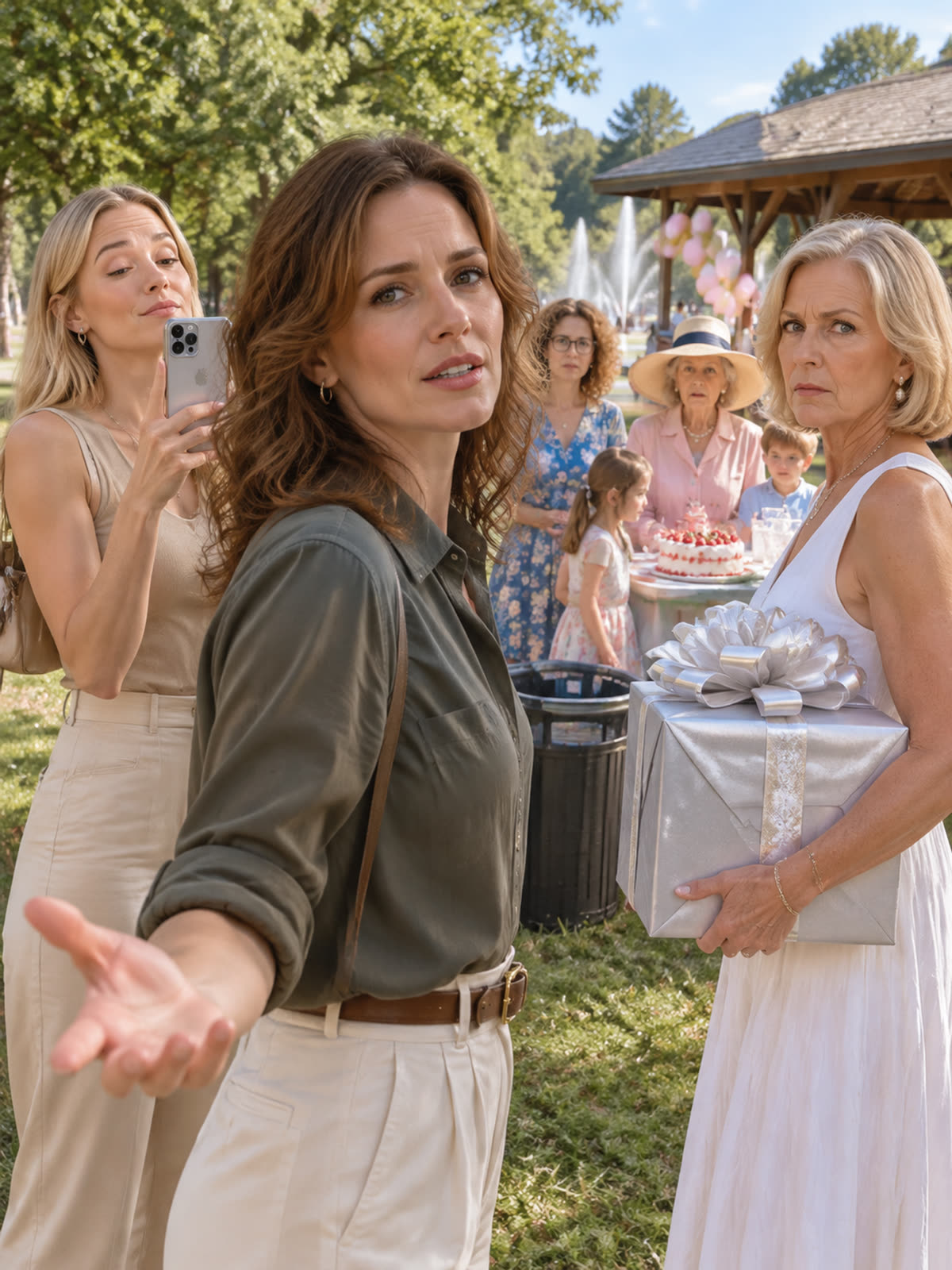
“Shut up, Whitney, stop trying to make Mom look bad—” Amber began. “I don’t need to make her look bad, Amber,” I interrupted calmly. “You already posted the timestamps yourself. And speaking of public records, how is your boutique studio doing? Dad mentioned Mom finally realized you’ve been draining their home equity line to pay your rent.” The color left Amber’s face. She turned toward Mom. “Mom! You told Dad?! You promised you wouldn’t tell him until my fall line launched!” The grandmotherly performance vanished. “I didn’t tell him, he found the bank statements!” Diane snapped. Then she faced me with her voice reduced to a venomous whisper. “You have some nerve, Whitney! Turning your father against me, turning my friends at the club against me—everyone in town is whispering behind my back because of you! You’re vindictive and cold, just like your ex-husband!”
An extraordinary calm settled over me. “I haven’t told anyone anything that wasn’t the absolute truth, Mom,” I replied. “And right now, you have two choices. Either you and Amber turn around, get back into your car, and leave this park quietly, or I will walk over to Margaret Doyle , take out the timestamped abandonment log she brought in her purse today, and call the local police non-emergency line to report an unauthorized contact violation by two individuals barred from my children’s school and medical records. Which would you prefer?” Twenty feet away, Margaret rose slowly from her chair and adjusted her wide-brimmed hat. Her stare settled on Diane with formidable precision. Claire stood nearby with her arms crossed and her phone ready. Neither woman needed to raise her voice or move closer. Their presence made clear that my children and I were no longer standing alone.
Mom looked from Margaret to Claire and finally back to me. There was no sympathetic audience waiting to reward her tears, no husband stepping forward to excuse her, no guilty daughter retreating beneath the demand to keep the peace. Her leverage was gone. She drew a sharp, humiliated breath and pushed the enormous present toward me. “Fine! Keep your bitterness, Whitney! At least give her the present!” I did not reach for it. The box fell onto the grass between us with a muted thud. “My daughter already has everything she needs,” I said quietly. “Have a safe drive home.” For three long seconds, Diane stood trembling, her chest rising and falling. She looked smaller and older than I had ever seen her. Then she turned and marched toward the parking lot, with Amber hurrying after her and clutching the darkened phone.
I watched until their car left the lot and disappeared onto the boulevard. Only then did I lift the unopened present and place it beside the park’s community toy-drive donation bin. Under the oak pavilion, the people who had shown up without conditions were still gathered around my daughter. Claire and Margaret had kept the party moving. The balloons shifted in the warm air, and Sophie waited before her strawberry cake, surrounded by the voices of people who made her feel safe. I returned in time to join the final chorus of Happy Birthday. She blew out all six candles in one triumphant breath. This time, my mother had left when I told her to. Whether she would finally accept the boundary—or come looking for another way around it—remained unanswered.
Four months passed, and October arrived with brilliant amber maple leaves and the refreshing chill of autumn mornings.
Along Elmwood Drive, the turmoil that had consumed our lives in May had gradually given way to a steady, reassuring routine. What remained was something lasting, dependable, and profoundly healing.
Claire Walsh still carries the brass key to my front door on a silver key ring alongside the keys to her Subaru. Every Tuesday and Thursday at three-thirty in the afternoon, she lets herself into my house, transforming the kitchen into a lively gathering place where four cousins sit around the island working on their homework.
Throughout those afternoons, my phone fills with her cheerful updates. She tells me about Oliver’s newest soccer goal, Sophie’s passionate objections to eating broccoli, and countless other ordinary moments from their day.
Most of these details are things I never thought to ask about. Yet I have come to realize how desperately I had missed having someone who cared enough to share them.
Claire doesn’t send those messages to prove her dedication, collect praise, or establish evidence that she has been a responsible caregiver. She does it for the simplest and most meaningful reason imaginable.
She genuinely loves my children.
Margaret Doyle also continues to keep her brass key safely hidden inside the porcelain teacup resting on her kitchen windowsill.
She has needed to use it only once.
In late September, I accidentally locked myself outside on the back deck while gathering patio cushions during a heavy downpour. Three minutes after I called for help, Margaret appeared at my back entrance wearing her plaid housecoat and a pair of rain boots.
She opened the deadbolt with an expression of such glorious, unmistakable satisfaction that I could practically hear the words she was too courteous to say.
I told you so.
Once we were both safely inside, I prepared a pot of Earl Grey tea. We spent the next hour sitting together at my kitchen table, listening to the rain beat steadily against the windows.
The little yellow notepad she keeps in her kitchen drawer is still there, undisturbed and thankfully unnecessary. It remains a quiet precaution, a form of protection I sincerely hope we will never need to rely upon.
As for the relatives I was born into, the consequences of that summer followed the divisions that had already been forming for years.
Without Ray continuing to provide unquestioning financial support, and with my mother no longer able to freely access the equity in their house, Amber’s boutique studio could not survive.
By the end of August, the business had closed, leaving numerous unpaid supplier bills and a completely exhausted credit line behind it.
For the first time in her adult life, Amber had to find conventional employment. She accepted a nine-to-five administrative position to afford the rent on a small studio apartment.
Since then, she has largely disappeared from public attention, retreating into a quiet existence marked by resentment. Her carefully polished Instagram account, once overflowing with photographs of luxury spa visits and champagne-filled brunches, abruptly stopped receiving updates.
My mother contacted me twice during the summer.
The first text arrived in July, and the second came toward the end of August.
Both messages were constructed with the same calculated restraint. Their wording was polished, cautiously sentimental, and seemingly designed for the possibility that someone else might read them later.
Each one subtly presented her as a mother who had made a sincere effort to repair the relationship, only to be met with cold rejection.
I read both messages while enjoying my morning coffee.
Neither stirred anger in me. Neither awakened the guilt that once would have compelled me to respond.
I simply deleted them.
There are doors that, once securely locked for good reason, do not need to be reopened merely to explain why they remain closed.
My father, however, did something I hadn’t expected.
On a cool Sunday afternoon in early October, Ray called.
Our conversation lasted eleven minutes.
He made no attempt to defend Diane’s behavior, and he never suggested that I should forget what had happened or pretend the past was insignificant.
Instead, he explained the practical steps he had begun taking.
He had hired an independent financial adviser to separate and protect his pension accounts. He had placed a strict freeze on their home equity line of credit, preventing further unauthorized use. He had also made it clear that Diane would need to attend individual counseling if their marriage had any chance of continuing.
Near the end of our conversation, his voice grew quieter.
“I should have spoken up in that driveway at eleven-twenty-eight, Whitney. I knew better, and I let you down. I don’t expect a key, and I don’t expect forgiveness overnight. I just wanted you to know I’m finally doing the work.”
For a moment, I let his words settle.
“I appreciate that, Dad,” I told him softly. “Take care of yourself.”
That was everything I could honestly give him at the time.
Perhaps when spring arrives, we might arrange to meet at a café somewhere neither of us considers home. Just the two of us, sharing a brief cup of coffee and cautiously discovering whether a relationship rebuilt on genuine accountability can support even a little trust.
I haven’t made that decision yet.
For now, I am willing to leave the possibility open, much like opening a window just a crack during the first days of March. You don’t do it because you know the winter cold has disappeared forever. You do it because, after months of keeping everything sealed shut, you finally feel ready to let some fresh air inside.
Last week, Oliver returned home from second grade with a new piece of construction paper carefully tucked into his backpack.
He pulled it out and presented it to me with an enormous, proud smile while I was preparing vegetables for dinner.
I dried my hands and lifted his drawing toward the kitchen light.
Once again, he had drawn our home.
It had four strong walls, a cheerful red roof, and broad yellow windows glowing warmly beneath an evening sky.
Inside stood four happy figures, their hands linked together.
There was me, Oliver, Sophie, and Claire.
Outside, in the driveway, he had even included Claire’s familiar Subaru, complete with its distinctive curly antenna.
I examined the picture carefully, allowing my eyes to travel across the green crayon grass and the empty area beside the front porch.
Something important was missing.
There was no solitary figure left uncolored in the cold beyond the house.
No shadowy person waiting outside the entrance.
No suggestion that someone unwanted still had a claim on the life we had created.
There were only four smiling people, safely gathered within the sturdy walls of a home I had fought to protect, behind doors secured by locks that finally served their purpose.
I reached for two magnets on the kitchen counter and attached Oliver’s drawing directly to the center of the refrigerator, positioning it at eye level.
It was exactly where it belonged.
Because when you have spent so long rebuilding your life from its very foundations, the picture of everything you worked to create deserves to be the first thing that greets you each morning.
Disclaimer: This story is a work of fiction inspired by real-life themes. Names, characters, places and events are fictionalized, and any resemblance to real persons is purely coincidental. Images are for illustration purposes only.
