


PART 1: THE SETTLEMENT HE THOUGHT I WOULD SIGN
At eight months pregnant, I stood in a Minneapolis courtroom ready to give up nearly everything my husband and I had gathered over the course of our marriage. Our house, the money in our joint accounts, both cars, and any remaining claim I held in the company he managed were listed in the proposed agreement. My name is Hannah Gallagher. Until that morning, I had convinced myself that walking away from those things was the price of a quieter life for my children. I wanted an end to the humiliation, not another year spent fighting over the remains of a marriage.
Across the room, Gavin Gallagher wore an expensive charcoal suit and no wedding ring. Miranda Bennett, the woman with whom he had betrayed me, sat beside him. She bent toward his ear, whispered, and earned a smile. At the bench, Judge Harriet Foster studied the agreement before raising her eyes to mine. “Mrs. Gallagher, are you confirming that you intend to relinquish your claims to the marital residence, joint savings, vehicles, and disputed business interests?” Judge Foster asked clearly. Hearing the entire list spoken aloud made the scope of my decision impossible to ignore, but I had already resolved to go through with it.
My attorney moved uneasily beside me. I understood the concern, yet exhaustion had made peace seem more valuable than any possession. “Yes, Your Honor, because I want this marriage to end without another year of constant arguments and public humiliation,” I replied. A quiet laugh came from Miranda behind the defense table. Judge Foster immediately made it clear that one more interruption would get her removed. I looked at Gavin and remembered the occasions when my prenatal appointments had provided him with opportunities to bring Miranda into our home. Even here, with everything almost finished, the memory still hurt.
“I do not want to live in a house where my husband entertained another woman, and I do not want money he secretly spent buying her expensive gifts,” I stated firmly. Gavin shoved his chair backward and turned an angry stare toward me. “She is manipulating this entire proceeding because she refuses to accept that our marriage is finished,” he argued loudly. The judge ordered him back into his seat. I rested a hand over my belly as my unborn daughter shifted beneath my maternity dress. I had come prepared to leave him, yet he was still trying to describe my departure as a refusal to let go.
Judge Foster shut the leather folder with an abrupt snap. “Before this court approves anything today, serious concerns have been raised involving a six year old child who may have been exposed to severe emotional pressure,” she announced. Gavin’s assurance disappeared behind a guarded expression. The child she meant was Owen Gallagher, his six-year-old son from an earlier relationship. Owen’s biological mother lived out of state and seldom came to see him. Since he was three, I had been the person making his meals, attending school activities, and sitting beside him through the nights when fear kept him awake.
Gavin regularly reminded Owen that I was not his real mother, as if those words could erase the daily life we had shared. Now a court-appointed child specialist brought him into the room. He wore a navy cardigan and gripped his old plush bear against himself. His reddened eyes showed that he had already been crying in the hallway. “Daddy, do I have to tell them what happened, even though you said everyone would be angry with me?” Owen asked in a trembling voice. Hearing that question hurt more than anything said about our property. Whatever had frightened him had followed him into court.
Gavin immediately stood. “Owen, you do not need to explain anything to these people, because none of this adult business concerns you,” he said quickly. Judge Foster told him to sit and remain silent, then assured Owen that he was not in trouble. Nobody would make him answer something that scared him. He searched the courtroom with uncertain eyes before finding me. “Can Aunt Camille come inside with me, because I feel much safer when she is sitting right next to me?” he pleaded. His need for her was plain, and the judge allowed her to join him.
Camille Gallagher, Gavin’s younger sister, had been waiting beyond the double doors. She came in wearing a trench coat still damp from the rain and immediately lowered herself beside her nephew. Owen threw both arms around her neck. Watching how tightly he held on, I understood that his fear had begun well before that morning. Camille settled close while the child specialist continued with gentle, age-appropriate questions. Judge Foster explained that his statements would be considered carefully before any decisions about his welfare became final. For once, the adults around him were being required to listen instead of telling him what he ought to feel.
Owen hugged the bear harder. “Daddy told me to wait near the vending machines outside, but I could not find my school backpack anywhere,” he explained softly. Gavin promptly said Miranda had been supposed to keep the boy occupied during his private meeting with his lawyer. The accusation visibly startled her. “I put his backpack inside Gavin’s trunk because I honestly thought his grandmother would collect him afterward, ” Miranda protested. Each of them seemed eager to explain away the missing backpack. Owen, however, had been carrying something far heavier than uncertainty over where his school things had gone.
He slowly shook his head and looked toward Miranda. “You told me not to tell Mommy where my things were hidden, because she was not going to live with us anymore,” he said clearly. Mommy. The word tightened my throat before I could draw another steady breath. Owen had never felt able to call me that in front of everyone. Whenever he had tried as a younger child, Gavin had corrected him immediately. “She is Hannah, Owen, and you already have a biological mother, so please stop confusing everybody,” Gavin used to scold. Eventually, Owen had stopped saying it where anyone could hear.
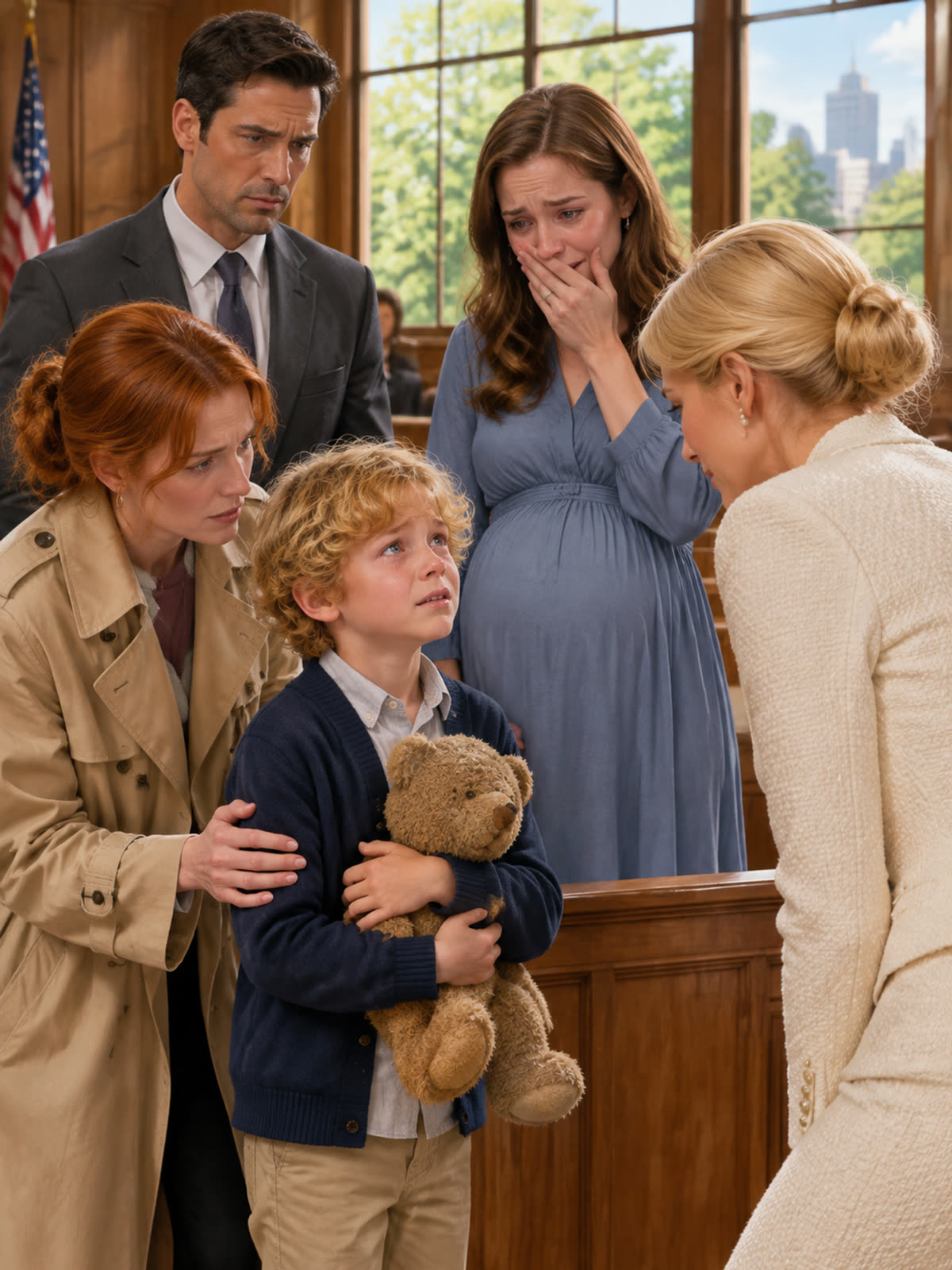
Now he raised his face and held my gaze across the courtroom. “I still call you Mommy when I am thinking quietly in bed, because you are the person who always stays when I am scared,” he confessed. Tears slipped down my cheeks before I could stop them. Camille steadied him with a hand on his shoulder, and Judge Foster leaned closer to ask what else had happened. “Miss Miranda said Daddy was keeping the big house, and the new baby would have a special room that belonged to our real family,” Owen continued. Miranda objected at once, insisting that she had only been trying to protect the freshly painted nursery.
Owen described a heavy brass lock on that nursery door, one that kept him from going inside. Gavin acknowledged knowing about it but called it a temporary precaution for safety. Then his son explained what had made him believe the separation meant something far more frightening than two adults ending their marriage. “Daddy told me Mommy was giving everything away because she did not want us anymore, and I wrote down all the days he said she was leaving,” he revealed. The atmosphere changed. My willingness to surrender possessions had been turned into a story of abandonment and handed to a child who trusted his father.
Judge Foster fixed her attention on Gavin. “Mr. Gallagher, did you actually discuss financial settlements and your wife’s legal intentions with your six year old son?” she demanded. He hesitated, moving the papers in front of him. “I was deeply frustrated and mentioned some household changes that might happen soon, though I never intended to frighten him,” he mumbled. Owen looked down at his shoes. “I wrote everything down inside my little green notebook because Daddy kept telling me different days when Mommy would finally disappear,” he whispered. His careful record of those dates revealed how seriously he had believed every warning.
Camille turned toward her brother, anger tightening her face. “Gavin, he is only six years old, and you have been making him responsible for understanding your messy divorce,” she snapped. The judge instructed the attorneys to obtain the notebook immediately through the appropriate legal process. She then gently asked whether anyone had told Owen that I meant to abandon him. I stepped toward the bench, my hands unsteady. “Owen, whatever happens between your father and me, I have never stopped loving you, and I never told anyone I wanted you gone,” I promised firmly. It was the truth he should never have needed a courtroom to hear.
His anxious eyes moved to my stomach. “Will you still love me after your little girl gets here, even though she really belongs to you?” he asked quietly. I waited for the specialist’s permission before approaching him. “You are a permanent part of my family because I love you dearly, sweetheart, and your little sister will never change that fact,” I assured him. He cried again, but this time he stretched his arms toward me instead of retreating behind his bear. His relief did not undo what he had been told. Still, he was finally reaching toward the person he had feared was leaving him.
As the hearing continued, Camille disclosed a troubling message sent from Gavin’s personal phone. It told her to collect Owen at once and never let him go home with Miranda. Gavin denied writing it. Owen remembered Miranda using his father’s phone the evening before, though he could not explain what she had done on it. Miranda quickly maintained that she had only checked the weather. Judge Foster ordered a formal examination of the message and its origin. She made clear that the child’s recollection alone would not establish who had sent it. There was already enough uncertainty without asking Owen to prove what he could not know.
Brenda Doyle, Gavin’s longtime office manager, arrived with confidential material requested through the lawyers. A composed woman in her forties, she had spent years handling schedules and financial correspondence at Gallagher Enterprises. Among the things she brought was Owen’s green notebook, discovered in Gavin’s locked office drawer. But the business documents she carried appeared to trouble him even more. “Two days ago, I discovered a hidden folder containing financial statements that did not match the official reports Mr. Gallagher prepared for these divorce proceedings,” Brenda testified calmly. His attorney objected immediately, and the judge emphasized that the corporate records would need independent verification.
Brenda chose her next words with care. “I was instructed to prepare summary documents showing almost no retained earnings, yet I also received written directions to transfer certain company accounts into a newly formed holding entity,” she explained. My stomach clenched. For the past year, Gavin had insisted that the business was close to insolvency. That was why I had assumed my share was worth almost nothing. “Are you saying there may be substantial assets Gavin has not disclosed in his sworn financial statements?” I asked aloud. Brenda nodded. “I am saying the accounting records need an immediate independent examination, because their official descriptions simply do not match the actual wire transactions I processed,” she confirmed.
Gavin finally turned to face me. “Hannah, I never wanted you to lose everything, and I honestly thought you preferred a clean separation without years of bitter fighting,” he pleaded quietly. I looked straight back at him. “I wanted to leave a marriage that had become completely unbearable, Gavin, though that certainly does not mean I agreed to be deceived about what I rightfully owned,” I answered coldly. Wanting the fighting to stop had never meant agreeing to be misled. Until Brenda spoke, I had not understood that the financial picture behind my decision might itself have been manufactured.
Judge Foster halted consideration of the settlement and required full financial disclosure from every relevant corporate entity. She also put temporary protections in place for Owen while his home circumstances were assessed. He would spend that evening with Camille unless the authorized parties approved another suitable arrangement in writing. Neither parent could discuss financial arguments or legal allegations around him. For the first time, Gavin looked truly frightened. I felt no pleasure in it. I had entered the courtroom believing I knew exactly what I was surrendering. Now I could not stop wondering how much he had made certain I would never see.
PART 2: MY MOTHER’S LETTER AND THE OWNERSHIP HE CONCEALED
When the courtroom emptied into the corridor, Miranda came toward me holding a creased cream-colored envelope. The smugness she had displayed earlier was gone. “I found this envelope tucked behind a loose wooden baseboard in the nursery yesterday afternoon, and I think Gavin may have been hiding it from you,” she admitted quietly. My full name was written across the front. I knew the handwriting immediately: it belonged to my mother, Dorothy Sinclair, who had died three years before. After everything that had already happened that morning, seeing her writing felt almost impossible. Yet the envelope was there in my hands.
I opened it carefully. Inside was a damaged letter with the bottom portion missing. Its first sentence made my breathing catch. “Hannah, if you are reading this note, Gavin may finally have done what your father and I always feared he would do,” the letter began. My mother’s warning reached me years after her death, on the very day I had nearly signed away my financial future. I read on, searching the remaining page for an explanation. What followed concerned Gallagher Enterprises, the business Gavin had always described as his responsibility and, by implication, his property.
According to my mother, my late father had placed the company’s controlling interest in an irrevocable trust created entirely for my benefit. Gavin had never owned it outright. I went over that statement several times, struggling to fit it beside everything I thought I knew. My father, Walter Sinclair, had built the logistics company himself before allowing Gavin to oversee its daily operations. I had assumed that arrangement eventually made my husband its owner. The letter revealed the distinction I had failed to understand: permission to manage a business was not the same thing as a legal right to possess it.
Miranda watched me absorb the news. “I did not know anything about a family trust, Hannah, and I never understood why Gavin became so nervous whenever someone mentioned the company’s founding records,” she said softly. Nothing she said could erase the betrayal that had taken place inside my home. I was not suddenly prepared to forgive her. Even so, I believed that this part of Gavin’s deception was new to her too. Her earlier certainty had vanished, replaced by the realization that the man she had defended had kept a much larger secret than either of us understood.
Camille appeared farther down the hallway with Owen’s hand in hers. He still held his worn bear. When he reached me, he carefully wrapped his arms around my waist, keeping clear of my pregnant belly. “Mommy, can I help choose my little sister’s name when she finally comes home from the hospital?” Owen asked hopefully. After hearing him ask whether I would still love him, that hopeful question brought fresh tears. “Of course you can, sweetheart, because she is going to be very lucky to have such a thoughtful big brother,” I promised. He was beginning to imagine himself included rather than pushed aside.
That evening, Camille drove Owen and me back to the house while Gavin stayed downtown with his lawyers. The nursery door stood open at the end of the hall. Its heavy brass lock had been removed. I went to the tall window and lowered myself beside the loose baseboard where Miranda said she had found the letter. The space behind it held more than torn paper. A small, tarnished key slipped from the narrow opening and landed on the hardwood. Attached to its ring was an old metal tag identifying a private storage room connected with my family’s records.
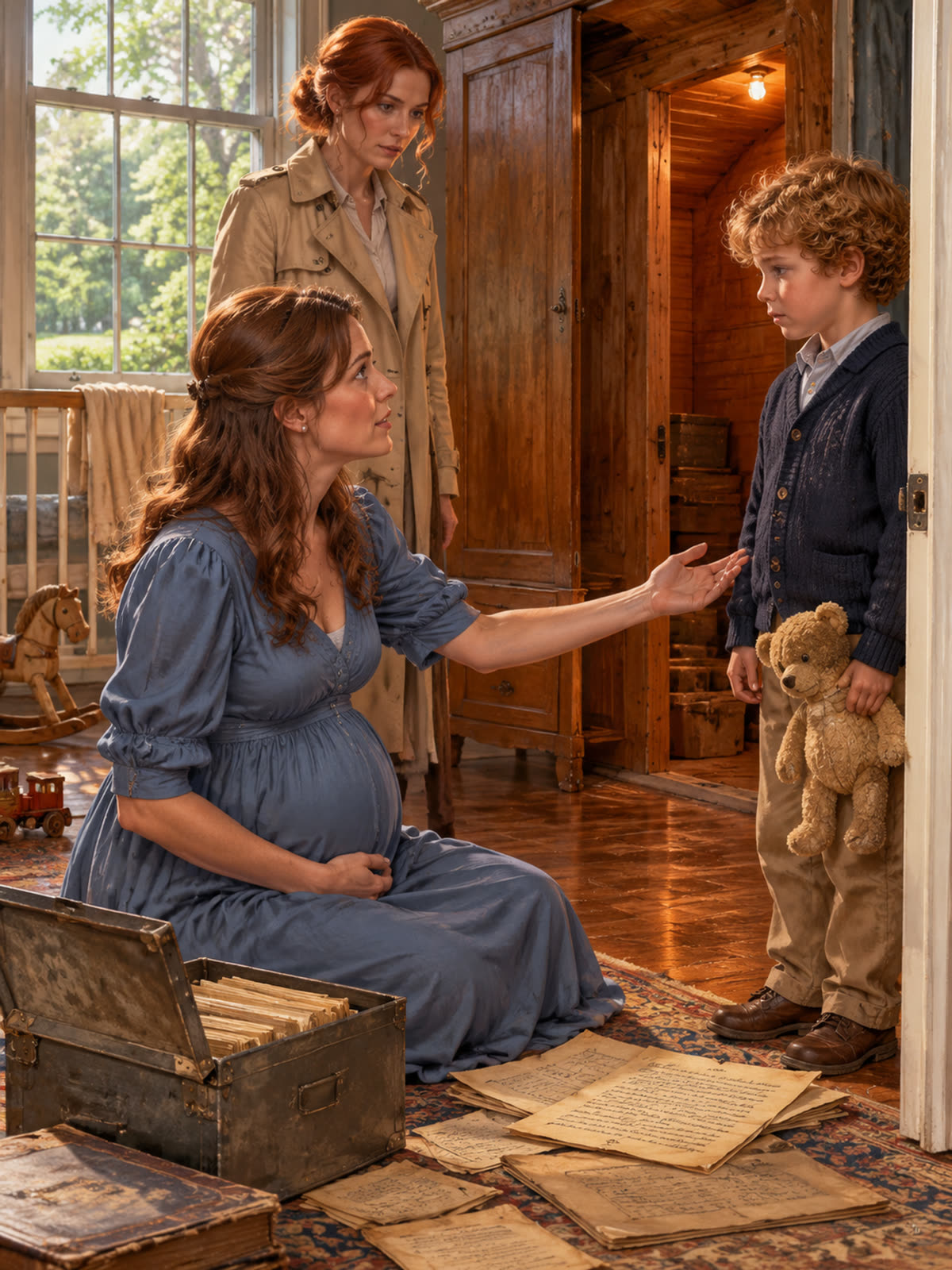
My father had adapted part of that upper storage space when we first prepared the nursery. The entrance had been concealed behind a tall oak wardrobe. Until then, it had belonged in my mind to the background of the house rather than to anything urgent in my own life. Now the key and my mother’s warning gave it a different meaning. Camille helped me shift the heavy wardrobe far enough to reach the narrow wooden door. I put the key into the old lock. It turned without resistance, opening a room that had been hidden in plain sight.
Dusty cedar shelves lined the confined space. Inside sat a sealed metal document box labeled with my maiden name. Its contents included original bank records, property deeds, and another letter from my mother, this one complete. The instructions were direct. “Before signing any legal document concerning Gallagher Enterprises, speak immediately to attorney Raymond Carter, who knows where your father’s original trust instruments are kept,” she had written. I had been hours away from agreeing to a settlement without following that instruction, without even knowing it existed. The papers before me offered something the damaged letter alone could not: a clear next step.
I sat on the nursery floor with the documents spread around me. Statements and deeds that concerned my own family seemed to describe a life I had never been allowed to understand. My husband had spoken with authority about what we possessed and what the business was worth. I had accepted his explanations while these records remained hidden nearby. I could not determine every legal consequence from the pages in my hands, and I knew better than to try. But I could read my mother’s instruction, and for the first time that day, I knew precisely whom I needed to find.
Owen waited in the open doorway, watching without interrupting. “Are those bad papers, Mommy, or did you find something good that will help us stay safe?” he asked softly. His question brought my attention back from company ownership to the child who needed reassurance. I held out my hand and smiled steadily at him. “I think they are very important papers, sweetheart, and tomorrow morning I am going to ask someone trustworthy to help me understand every single page,” I replied. I could not promise him answers I did not yet have. I could promise that I would no longer make decisions without understanding what lay in front of me.
The next morning, Camille came with me to the downtown firm named in my mother’s letter. Raymond Carter had retired two years earlier, but his trusted successor, Meredith Quinn, agreed to examine the archived material immediately. Meredith, a composed attorney in her fifties, already knew a great deal about the Sinclair family. After verifying my identity, she explained the structure my father had created. The trust held controlling shares in Gallagher Enterprises, multiple commercial properties, and a sizeable cash reserve. I was identified as its sole primary beneficiary. What I had found in the nursery was not merely an old family disagreement over intentions.
Meredith explained that Gavin’s appointment had been limited to managing the operating company for five years, with annual performance reviews and fiduciary responsibilities. “Your husband was given executive authority to run the daily business, Mrs. Gallagher, yet that temporary appointment never made him the beneficial owner of the underlying assets,” Meredith explained clearly. Sitting in her leather armchair, I felt unsteady. The distinction my mother’s letter had introduced was now being laid out in legal terms. Gavin had exercised control over the daily work, but that control had never given him unrestricted ownership of the property beneath it.
“Gavin has controlled that company for seven full years, and nobody ever told me his management appointment was supposed to expire,” I murmured. Meredith told me that Raymond had kept the original signed trust agreement secure in his personal vault. However, during a serious illness two years earlier, a certified copy of the beneficiary schedule had disappeared from the firm’s main archives. That missing copy had not destroyed the original trust, but its disappearance mattered. So did the fact that Gavin had continued acting as though his authority had no limit and my interest in the company required no explanation.
A local businessman, Ronald Mercer, had later gained unauthorized access to portions of the trust records while privately advising Gavin. Meredith said his involvement had immediately concerned the firm. “We do not yet know exactly who removed that certified copy from our files, though your husband’s recent asset transfers require an immediate independent investigation,” Meredith stated firmly. She did not pretend that suspicion was proof. Instead, she separated the known facts from the questions still requiring answers. After a morning spent hearing Gavin minimize and redirect, that careful distinction was reassuring. I needed evidence strong enough to withstand scrutiny, not another confident story.
The financial summaries Meredith laid out showed that some company debts were real. Others appeared tied to questionable loans among related shell businesses. Gallagher Enterprises had temporary cash-flow difficulties, but it was nowhere near the bankruptcy Gavin had led me to imagine. Its core assets had also been falsely characterized in his sworn divorce disclosures. I contacted my divorce lawyer immediately and requested a complete forensic examination of every business account. I was no longer prepared to treat Gavin’s explanation as the starting point. The records would have to establish what existed, where it belonged, and what had been moved.
Later that afternoon, Meredith arranged a visit to Raymond Carter’s home outside Saint Paul. Camille accompanied me. He lived in a peaceful brick house, with tall bookcases and family photographs around him. The moment we shook hands, he spoke of my father with warmth. “Walter wanted you to inherit the true freedom to make your own choices, Hannah, rather than become someone whose name simply appeared on paperwork while another person controlled everything,” he told me kindly. Until then, I had been thinking chiefly about ownership. Raymond’s words made clear that my father’s purpose had also been independence.
Raymond admitted that he regretted not explaining the trust to me sooner after my parents died. My mother had asked him to wait until I felt emotionally ready. She had worried that Gavin’s influence would keep me from acting for myself. What had been meant as protection had instead left me exposed during the divorce. I understood the intention, but I could also see what the delay had cost. While everyone waited for the right moment, Gavin had remained the person explaining my financial life to me. His account had filled the silence left by people who should have told me the truth.
Raymond went into his study and returned with a heavy steel lockbox. Inside was the original beneficiary schedule. It bore my father’s signature and the embossed seal of the trust. Beside the controlling ownership interest appeared my complete legal name. There was no need to guess whose future my father had meant to secure. A handwritten note attached to the schedule said the appointed company managers answered to me, not the other way around. I touched the crisp sheet with trembling fingertips. For years, I had accepted the reverse arrangement as if it were simply the natural order of things.
“He trusted me completely to protect his life’s work, yet everyone around me allowed Gavin to convince me that I held no authority at all,” I whispered. Raymond confirmed that Ronald Mercer had previously produced questionable authorization letters in attempts to reach confidential trust material. Another name entered the explanation: Dennis Wallace, a corporate accountant who had helped create the outside holding company receiving the disputed transfers. These were no longer isolated concerns about a missing document or inaccurate summary. The records connected questions of ownership with the movement of valuable assets beyond the view of the person entitled to them.
The evidence described a coordinated attempt to conceal who truly owned the business while placing its value beyond my scrutiny. I finally understood why the proposed settlement had seemed so easy for Gavin to accept. It would not merely have left him with more than his fair share. My signature could have finished the financial arrangement he had spent years constructing. The original documents were safe in front of me now, but the transfers had already happened. Knowing what my father had left me was only the beginning. Could I reclaim it before Gavin’s deception became the future I had almost agreed to?
PART 3: WHAT BELONGED TO ME—AND WHO BELONGED WITH US
The legal work continued for months after we uncovered the trust records. Independent forensic accountants studied the corporate books page by page. Attorneys examined the trust itself, the movement of commercial property, and the financial statements Gavin had sworn were accurate. The discovery of an original document had given us a foundation, but the full picture still had to be established carefully. Every questionable transaction needed to be traced rather than merely described. I had nearly made a permanent decision on incomplete information. This time, the decisions would rest on records that had been tested.
The findings confirmed that Gallagher Enterprises held substantially more net value than Gavin had disclosed at the first hearing. There were ordinary business debts, and those could not simply be ignored. Yet the company’s financial condition had been deliberately presented as far worse than it was. Temporary pressure on available cash had been used to disguise the continuing worth of its underlying assets. The distinction mattered enormously. I had believed I was surrendering an interest with little remaining value. The investigators showed that Gavin’s account had hidden the very value I was entitled to understand.
They also established that transactions involving the outside holding company had moved assets without permission from the trust’s sole beneficiary. Gavin had failed to disclose those arrangements intentionally, and that concealment became central to the court proceedings. What Brenda had first raised in the courtroom was now supported by a much broader examination. Her records had not answered every question on their own, but they had prevented my signature from ending the inquiry before it began. I often returned to that fact: the settlement had nearly been approved while the accounts behind it remained hidden.
Judge Foster rejected the original proposal. The replacement resolution recognized the ownership my father had lawfully established for me. I kept the controlling business shares, the commercial properties, and the untouched reserve funds held for my benefit. None of that meant the marriage had become less painful or the months of legal work had been easy. It meant the final arrangement would no longer be based on Gavin’s false description of what existed. The authority I recovered was not something he had decided to grant me. It was authority that should never have been concealed in the first place.
Gavin received the modest share of personal marital property to which he was legally entitled. His position was also subject to substantial repayment obligations arising from the disputed transfers. The outcome did not resemble the comfortable departure he had anticipated that first morning in court. His financial and professional decisions now carried consequences he could not wave aside by accusing me of bitterness. For so long, I had treated leaving the marriage and protecting myself as competing goals. The revised resolution made clear that ending the relationship did not require abandoning the rights he had misrepresented.
Ronald Mercer faced formal professional disciplinary proceedings as well as civil claims over his conduct. Dennis Wallace cooperated with state investigators after the accounting review uncovered discrepancies he could no longer explain. Their roles were examined alongside Gavin’s actions rather than disappearing behind the paperwork of the divorce. I had wanted a quiet ending, not a widening series of proceedings. Still, quiet could not mean leaving the records untouched or pretending the transfers were harmless. Once the evidence was uncovered, the people responsible had to answer for what it showed.
Recovering property and control of the company did not repair what Owen had endured. No financial judgment could erase his belief that I had stopped wanting him or that a new baby would take his place. For me, the arrangements for his care and counseling mattered more than any balance sheet. The company represented my father’s work and my future independence. Owen represented a responsibility I had already chosen in the everyday acts of loving him. I would not confuse the successful recovery of assets with the much slower work of helping him feel safe.
Camille continued giving him steady, dependable care while a licensed family counselor helped us form healthier boundaries around communication. Adult disagreements were no longer to be laid at his feet for him to interpret. Gavin gradually joined supervised therapy sessions focused on the harm his words had caused his son. Those meetings did not undo the past merely because he attended them. They offered a place where he could begin acknowledging it without placing the burden of understanding on Owen. The boy who had counted the days until I supposedly disappeared needed consistency, not another explanation that changed without warning.
One quiet afternoon in the counselor’s office, Gavin finally addressed his son directly. He did not begin with the property dispute or defend himself by describing how difficult the divorce had been. He spoke about what he had said and what those statements had done to a six-year-old child. I watched, aware of how often Owen had been corrected for expressing the wrong feeling or using the wrong name for me. This time, his father was the one who needed to say plainly that the frightening story had not been true.
“Owen, I said things about Hannah that were completely unfair and frightening, and you should never have been asked to carry those heavy adult worries,” Gavin said sincerely. Owen listened intently from his chair. “Does that mean Mommy was never trying to leave me because she did not want me anymore?” he asked softly. Gavin glanced toward me, remorse visible in his face, before answering. “She never said anything like that, Owen, and I was completely wrong to make you believe she did not love you,” he admitted. At last, Owen heard the correction from the person who had made him believe the lie.

It was the first time I had heard Gavin accept complete responsibility without attaching an excuse. I did not mistake that moment for proof that every wound had healed. But neither did I dismiss what it meant for Owen to hear an unqualified acknowledgment. He had needed more than my reassurance that I loved him. He had needed his father to stop contradicting it. That afternoon did not restore our marriage, and it was not intended to. Its importance belonged to a child who had been made to question a love that had never been withdrawn.
Miranda eventually moved to a modest apartment across the river in Saint Paul. She returned the expensive presents bought with disputed company money and answered questions honestly about private conversations she had overheard. We did not become friends. Her cooperation could not erase the choices that had hurt me inside my own home. Nevertheless, I appreciated that she stopped defending the deception once she understood its consequences. She had helped expose the letter, and afterward she chose not to keep shielding what she knew. That mattered without changing what had happened between us.
The divorce was finalized without another painful public confrontation. When the decree was signed, I felt profound relief rather than victory. I had recovered my home, financial security, and the rightful authority to guide my father’s company. Yet the comfort that mattered most was knowing Owen no longer believed he had caused our family to break apart. His place in my heart was not an issue for accountants or attorneys to settle. It had existed long before the hearing, through meals and school events and frightened nights. At last, he was being allowed to trust that it would remain.
Three weeks after the final legal arrangements were completed, my daughter arrived healthy and strong. Camille brought Owen to the quiet hospital room. He carried a bright bouquet of yellow tulips he had selected himself at the flower shop. He approached the bed cautiously, studying the tiny baby resting against my chest. After so much fear about whether there would still be room for him, he was now standing beside his little sister. I watched his careful movements and remembered his question in court about whether she would belong to me in a way he never could.
“I picked yellow tulips because they always push right up through the cold ground after winter storms, and I think our family has been through a very big storm,” he explained earnestly. I bent to kiss his forehead. “That is a wonderful reason, sweetheart, and your little sister will grow up hearing how much you wanted her to feel welcome,” I told him. He smiled and leaned over the bassinet rail. “Hello, little Clara, I am your big brother Owen, and I am going to help Mommy take very good care of you,” he whispered. His welcome held none of the exclusion he had once feared.
I had named her Clara because Owen had suggested it during one of our hardest evenings months earlier. The name was another small way his place in her life had already begun. Gavin came later that afternoon, having first asked Camille for permission to visit. He waited quietly near the doorway until I nodded for him to approach. Looking down at our daughter, he showed a tenderness I had not seen in many months. I could acknowledge that tenderness without forgetting why we were no longer husband and wife. The boundaries between us remained, even in that gentle moment.
“She is truly beautiful, Hannah, and I know I have caused far more pain than any simple apology can ever begin to repair,” Gavin said quietly. I studied his face before replying. “You can still become a much better father, Gavin, though that depends entirely on what you do consistently every day rather than what you promise today,” I answered calmly. He nodded. “I completely understand, and I intend to keep proving through my actions that I can treat both of our children with the care and honesty they deserve,” he promised. This time, his promise would have to be measured by what followed it.
After he left, Owen carefully climbed onto the padded chair beside my bed. For a while, he watched the closed doorway. “Is Daddy still part of our family, even though he does not live inside our house anymore?” Owen asked thoughtfully. I adjusted Clara’s soft cotton blanket before answering. “Some people remain connected to us in different ways, sweetheart, and real love is something they must always demonstrate through their daily actions,” I explained gently. I did not want him to believe that family could only survive in the shape it had held before, or that affection required us to ignore harmful behavior.
He thought about that for a few seconds. “Like Aunt Camille, because she always came whenever I was frightened and never made me feel like I was causing trouble?” he asked. His understanding brought a smile to my face. “Exactly like Aunt Camille, because she showed both of us that true family means choosing to care for one another even when things are hard,” I agreed. Camille had made that choice repeatedly. She had not allowed loyalty to her brother to silence her concern for his child. Owen had noticed not only that she came, but how she made him feel when she did.
He leaned his head against my shoulder beside the baby. “What about me, Mommy? Do I have to prove that I am part of the family too?” he whispered softly. I drew him securely against me with my free arm. “Never, Owen, because you have belonged safely inside my heart for years, and nothing about our changing family will ever take that away,” I promised him. He did not need to earn his place by being helpful with Clara, choosing the right flowers, or understanding adult decisions. His belonging was not another responsibility for him to carry. It was something he could simply have.
Beyond the tall window, light rain drifted across the city skyline. For years, I had imagined that losing my marriage would mean losing the future I had worked to build. Instead, I had discovered how much of that future had never depended on Gavin’s permission. My father had left a thriving business and the freedom to lead it. My mother’s warnings had finally helped me protect myself and the children. Neither inheritance could restore the years of misunderstanding, but both had given me a way to stop making decisions inside the limits Gavin had drawn.
Camille had shown me the strength of choosing what was right rather than what was easiest. Owen had reminded me that wealth could never replace the safety of knowing someone would come when you called. I looked from Clara’s sleeping face to the little boy resting beside me. I had not lost everything. I had stopped surrendering what mattered most, and the future no longer belonged to the man who had tried to define it for me. It was finally ours to shape. But what would we choose to build with the life we had fought so hard to keep?
Disclaimer: This story is a work of fiction inspired by real-life themes. Names, characters, places and events are fictionalized, and any resemblance to real persons is purely coincidental. Images are for illustration purposes only.
