

PART 1 — The Envelope That Weighed Nothing
Ron stood at the head of the Easter table, one broad palm resting on Judy’s chair. Three white legal envelopes leaned against the glass gravy boat beside the ham. “Before we pass the scalloped potatoes,” Ron says, his voice booming across the rim of his water glass, “your mother and I have an announcement to make.” He surveyed the faces around the lace tablecloth. “We sold the forty acres down by the creek last Tuesday,” Ron says, looking around the white lace cloth at his children. “The final land papers cleared through the bank yesterday morning.” Kim’s butter knife stopped above her dinner roll. “Your mother and I talked it over back in February,” Ron says, adjusting his collar. “We do not want you kids sitting around waiting for us to pass away before you see any benefit from the family land. We want to distribute the proceeds while we are still here to watch you enjoy it.”
He passed the first envelope over the green bean casserole. Kim opened it, drew out a blue check, and clapped a hand across her mouth. “Twenty thousand dollars,” Kim whispers, her breathless voice dropping into a tight, disbelieving quiet. “Mom. Dad. Oh my Lord.” Judy leaned toward her with the bright encouragement of a schoolteacher. “That will put a proper roof over those two boys of yours,” Judy says, leaning forward with her bright schoolteacher praise. “No more living in that rented trailer with water dripping through the ceiling every time it rains.”
Jeff received the second envelope. His grease-marked fingers unfolded the check, and he lowered his eyes toward his boots, scratching beneath his collar as his face reddened. “Twenty thousand for you, Jeff,” Ron says, holding Judy’s chair frame with his heavy hand. “That ought to put a down payment on one of those new ranch houses out in the west subdivision.” Jeff spoke toward his plate. “It gets us off the propane delivery truck shifts,” Jeff mutters to his plate, his slow halting speech quiet in the room. “Thank you, Dad.”
The third envelope went to Stacy, whose hands had been locked together in her lap beside Jeff. “And twenty thousand for Stacy,” Ron says, waving his broad hand. “To make sure that new place gets furnished properly.” She opened it, rested her forehead against Jeff’s shoulder, and quietly cried. Beneath the tablecloth, I pressed thumb to forefinger and added the figures. My work in hospital billing had trained me to check totals repeatedly. Three checks of twenty thousand dollars meant sixty thousand distributed in minutes. Beside the gravy boat, the stack was gone.
“Now then,” Ron says, reaching into his brown suit jacket pocket and pulling out a small, thin envelope. “This last one is for Nate and Emily.” Nate waited two seconds before reaching across the potatoes. I took the envelope from his rough hand and placed it on my napkin. It flexed easily beneath my fingers, unlike the stiff checks I handled at the hospital. Inside was a greeting card decorated with two glittered bluebirds. I searched both corners of the envelope. Nothing else was there. Judy had written one line in blue ink: “You two have always been so capable, we never worry about you,” I read silently to myself.
I reread the sentence, looking for an amount that did not exist. “Go on and open it, Nate,” Judy says cheerfully, beaming across at us from her chair. “We spent twenty minutes at the card shop picking out that exact bluebird card for you two.” I laid it under his thumb. He read without speaking, his ears reddening down toward his jaw. “We know how independent you two are,” Judy adds, her voice warm with praise. “Nate earns good money with his diesel repair work at the shop, and Emily is so sharp with the hospital financial records. You two do not need a boost like the others.” After a long pause, Nate answered. “Thank you, Mom,” Nate says, his voice flat and deliberate after a long pause. “You see?” Judy says, turning to Ron with a bright, satisfied smile. “I told you they would understand. Nate and Emily are built different. They do not need hand-holding.”
Ron nodded and reached for the serving fork. “That takes care of business,” Ron announces in his booming voice. “Pass your plates down. Let us eat while the food is warm.” Kim placed her check beside her glass, but kept glancing at our card. “Are you guys sure you are okay?” Kim asks, her breathless gratitude dropping into a hesitant, quiet question. “We are fine, Kim,” I state clearly, keeping my voice as even as an unpaid billing statement. “Pass the dinner rolls down this way.” When she turned toward the bread basket, I slipped the card into Nate’s flannel pocket.
“Dad,” Nate says, his voice quiet and low in his throat. “I will help you take those extra metal folding chairs down to the basement now.” Ron set down his fork. “Good,” Ron says, setting the fork down. “Get them out of the doorway so your mother does not trip over them in the morning.” Nate carried three chairs toward the kitchen. I followed with the empty bread platter, but Judy caught my wrist. “You two never give us one day of worry, Emily,” Judy whispers, squeezing my fingers with a warm pat. “Not one single day.” “I know, Judy,” I say, stepping through the kitchen doorway just as Nate takes his first step down into the dark basement stairwell.
The chairs knocked softly against Nate’s knee as his red ears disappeared into the cellar shadows. Behind me, Kim and Jeff tucked their checks away, their smiles wide with relief. My belief in Ron and Judy’s fairness broke beside those stairs. Would Nate and I ever have somewhere secure without pleading for money or waiting for generosity? Back at the table, Kim was buttering her roll. “Eat your dinner, Kim,” I say, pressing my thumb against my index finger under my apron fold. I passed the bread basket while the bluebird card made a slight rectangle against Nate’s chest.
Before three, Nate turned north onto Route 14. Harvested fields stretched dark on either side, with water standing in the low ground. He placed the card above the dashboard heater vents. “What do we have in the money market account at First National?” he asked. “Six thousand two hundred dollars,” I said. “And seven hundred twenty-five due for April rent next Friday.” His ears were still red. “That card cost two dollars and ninety-nine cents at the pharmacy in town,” Nate said. “They put three twenty-dollar bills in it,” I said. “No,” Nate said. “The bills were in Kim and Jeff’s envelopes. Our card had two signatures and a pre-printed bird.” I worked through our savings against rent and groceries. “Your dad said the land was meant to settle things while they were still alive,” I said. “My dad sold forty acres of creek bottom that my granddaddy spent thirty years paying on,” Nate said. “He gave twenty thousand to Kim, twenty thousand to Jeff, and twenty thousand to Stacy.” He shifted into overdrive. “That makes sixty thousand dollars,” I said. “Sixty thousand,” Nate agreed. “And we got a note saying we do not give them one day of worry.”
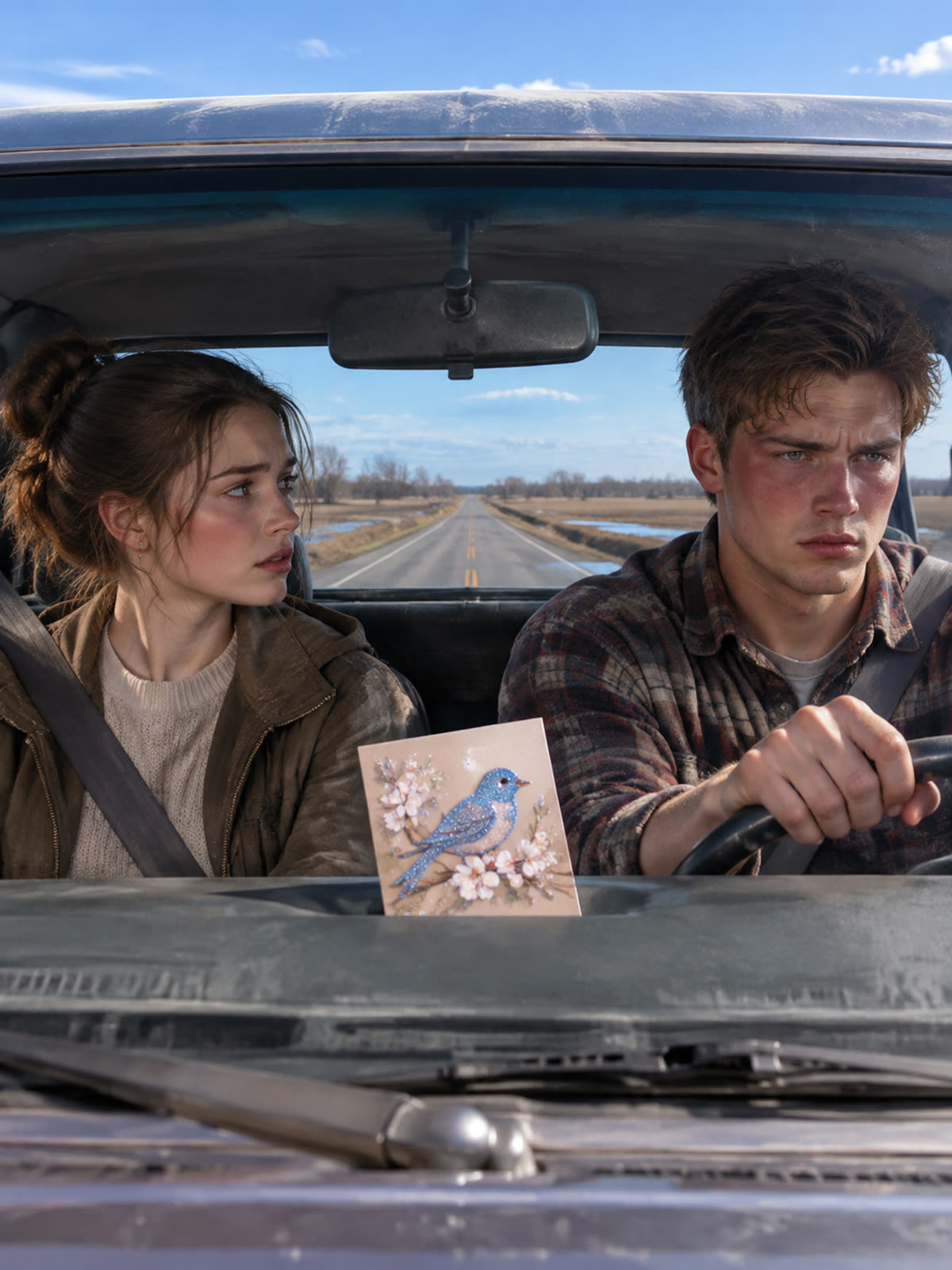
“Are you mad at your sister?” I asked. “Kim owes four months on her propane bill,” Nate said. “She was shaking so hard she could barely hold the paper. I am not mad at Kim.” “Jeff?” “Jeff has two kids in diapers and no shift work since the plant laid off forty men in November,” Nate said. “My brother needed the help.” Two miles passed in silence as a red tractor moved onto the shoulder. “I am not mad at my mother either,” Nate said softly. “She thinks she gave us a compliment.” “It felt like being left out,” I said. He glanced at me, then back at the road. “I would just like to be worried about one time, just to see what it is like,” he said.
A bump sent the card sliding toward the defrost vent. “We are going to buy a house,” I said. “We cannot buy a starter place in this county for less than eighty thousand dollars,” Nate said. “Not with four walls and a sound roof.” “Then we need forty thousand down,” I said. “Half.” “It will take us five years to save that much on my shop wage and your billing desk pay,” he said. “Not if we work four shifts instead of two,” I said. His fingers tightened around the wheel. “We do not tell my mother,” Nate said. “We do not tell anyone,” I said. “Not Kim, not Jeff, and not your dad.” “If they find out we are working nights, my dad will come over with five hundred dollars and think he fixed it,” Nate said. “He will not get the chance,” I said.
I took out my phone before the town limits. “Who are you calling on Easter Sunday?” Nate asked. “Patty,” I said. Her truck-stop diner stood on the bypass between diesel pumps and a gravel lot of semitrailers. Behind the kitchen, past three grease drums, Patty sat smoking on an overturned pickle bucket, her apron across her knees. Gray hair showed beneath her net. “You are late for a kitchen application, Emily,” Patty said without looking up. “We stopped serving the Easter turkey special at two o’clock.” “I am not applying for kitchen work,” I said. “I want the Friday night and Saturday late shifts.”
She blew smoke toward the gravel. “Those are twelve-hour stretches,” Patty said. “Eleven at night to eleven the next morning. It is mostly long-haul drivers and boys coming off the night shift at the wire mill.” “I know what the shift is,” I said. “I can balance four dinner plates up one arm and I do not make mistakes on guest tickets.” “Your husband works over at the tractor repair shop,” she said. “Does Nate know you are asking for night work?” “Nate is taking night calls,” I said. Her cigarette landed in a rusty can of rainwater. “I pay six dollars an hour cash plus whatever cash sits on the tables,” Patty said. “No payroll tax deductions, no paper trails, and no complaining about split shifts.” “When do I start?” I asked. “Friday at ten-thirty PM,” Patty said. “Bring non-slip shoes and two clean aprons. If you drop a tray of coffee mugs, it comes out of your tips.” “I will be here at ten-fifteen,” I said.
Nate waited with the heater running. “Did she take you?” he asked when I pulled the heavy door shut. “Friday night,” I said. “Cash in hand every Sunday morning.” He headed toward the industrial park. “Where are we going?” I asked. “The diesel shop,” Nate said. “Frank is usually in the office on Sunday afternoons doing his billing and inventory work.” Frank Miller’s steel repair building had three bays and broken machinery scattered behind its fence. I stayed in the truck while Nate went inside. Through dusty glass, I watched him stand before Frank’s crowded desk, still wearing his Easter pants, hands behind his back. Frank lowered his reading glasses, pointed toward the yard, and wrote Nate’s name and two telephone numbers on a yellow pad.
They shook hands. Nate returned with his shoulders squared. “What did Frank say?” I asked as he climbed back into the driver’s seat. “He put me first on the emergency call list for field repairs,” Nate said. “Whenever a combine breaks a drive chain or drops a header after nine o’clock at night, I get the call.” “How much does that pay?” I asked. “Fifty dollars just to turn the ignition key,” Nate said. “Plus twenty-five an hour cash from the farmer if I get his rig running before daylight.” “Farmers will pay that?” I asked. “Guys will pay cash to get a combine running at ten o’clock at night when rain is coming on a hundred acres of standing corn,” Nate said.
His hand settled on the gearshift, but he did not move it. The card rested against the dashboard trim, its glittered bluebird hovering above a printed nest. Inside was his mother’s assurance that we were capable enough not to need worrying about. Nate turned the card once between his thick fingers and returned it faceup. Our two extra jobs were arranged. Ahead of us lay the difference between six thousand two hundred dollars and a home of our own.
PART 2 — What Forty Thousand Dollars Cost
Six months after Easter, my heels burned at eleven on a Saturday night. Four ceramic plates balanced along my forearm, and beef gravy dripped onto my white apron sleeve. Patty pushed fried catfish through the pickup window and wiped her forehead. “Table four needs extra tartar sauce, Emily,” Patty said, her apron smelling of canola oil and bleach. “And put your feet up for two minutes before you collapse on my linoleum.” I delivered the plates and collected four greasy dollars.
“Jeff stopped by at six in his propane delivery truck,” Patty said when I walked back to the pass-through ledge. “Bought two ham sandwiches on credit and said his delivery hours got cut again.” I wiped spilled coffee from the counter. “Did he mention his mortgage payment?” I asked. “Said Ron and Judy paid his April property tax,” Patty said. At the pie case, I pressed my forehead against the cold chrome and closed my eyes. Forty seconds later, Patty touched my elbow. I was still gripping a pie server.
“You worked forty hours at the hospital billing desk this week,” Patty said, setting a fresh mug of dark coffee on the counter. “What are you two running from?” “We need thirty thousand dollars,” I said, pressing my thumb hard against my index finger as I calculated our savings total. “For a down payment on a subdivision house?” Patty asked. “For a place where nobody can tell us we owe them a thank-you,” I said, taking the four tip dollars and sliding them into my apron pocket. She watched me, nodded, and filled my mug without another question.
Twelve miles north, sleet swept an unpaved road near the county line. Nate lay on a rubber mat beneath a John Deere combine, surrounded by icy mud, a brass flashlight clenched between his teeth. Hank Vance held a work lamp above the open housing. “She snapped right as I hit the north quarter,” Hank shouted over the rattle of sleet on the tin barn roof nearby. “I have sixty acres of wet corn sitting out there in the dark.” Nate aligned the drive chain with scraped fingers and hammered a pin into its master link. “That will hold through the rest of your lower forty,” Nate said, spitting out the flashlight and wiping his chin with his shoulder. Hank peeled fifteen twenties from a rubber-banded roll. “Guys will pay cash to get a combine running at ten o’clock at night,” Hank said, peeling off fifteen twenty dollar bills. “My wife packed a pumpkin pie before she went to bed.”
At two-thirty, Nate entered our rented kitchen smelling of fuel, wet soil, and engine oil. He set the foil-covered pie beside the sink and ate half with a butter knife, still wearing muddy boots. “How much did you clear at Patty’s?” he asked, his voice gravelly from four hours in the cold wind. “Ninety-six dollars in tips,” I said, pulling my hair tie out and setting my leather ledger notebook beside the toaster. “Plus forty-two from the morning shift.” He placed three hundred dollars in damp twenties beside my earnings. “Feeder chain on the Vance place,” Nate said, taking a second bite of pie. “He was desperate to keep his head moving before the ground froze.”
I flattened the bills and opened our deposit book. “Where is the lockbox?” Nate asked, watching me write down the serial numbers. “In the tin behind the winter boots,” I said. “I write down every bill before I take it to the drive-up window.” Eight months after beginning with sixty-two hundred dollars, our ledger showed twenty-one thousand four hundred and ten. “Judy called while you were out in the field,” I said, watching him wash his black hands with lava soap at the basin. He stopped scrubbing. “What did she want?” he asked. “She asked if we wanted Kim’s old living room rug,” I said. “Since Kim bought new carpet for her ranch house with her land money.” Nate rinsed away the gray suds. “Tell her our floors are fine,” Nate said.
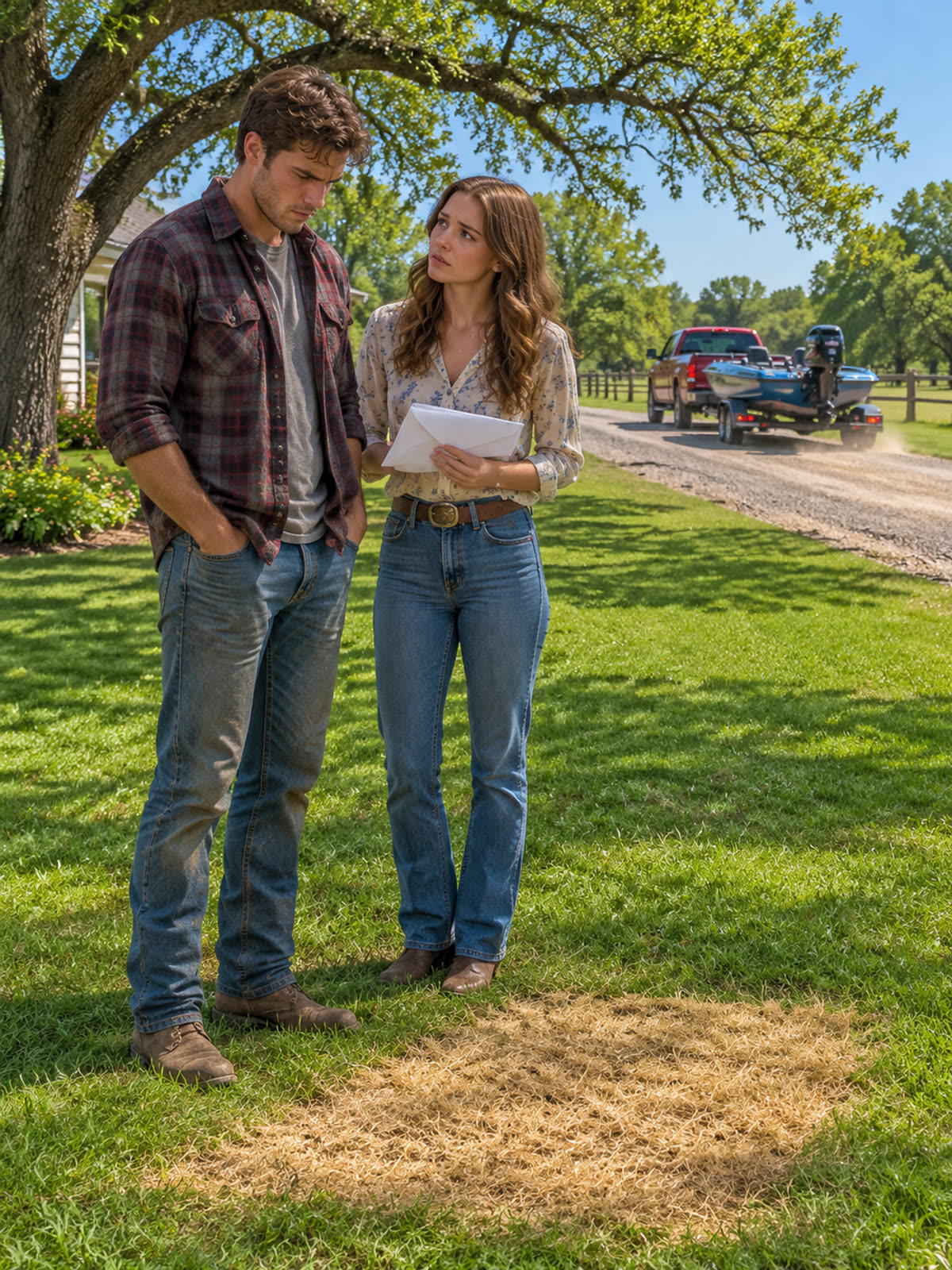
Eight months later, a red Ford stopped in our driveway on a bright Saturday morning. Its driver, wearing a brown hunting jacket, approached Nate beside the garage. Under the oak stood Nate’s sixteen-foot Tracker bass boat, its blue hull polished, its rebuilt Mercury motor ready. I watched through the porch screen with a damp towel in my hands. Four years earlier, he had brought that hull home from the river bottom. Three winters of spare hours had gone into the motor. I had never asked him to sell it.
The buyer circled the trailer. “Does the trolling motor come with the rig?” the buyer asked. “Foot pedal and two new marine batteries included,” Nate said, his ears turning slightly pink as he spoke. “Carburetor was rebuilt last May.” “She start up smooth on cold mornings?” the man asked. “First pull every time,” Nate said, holding his thumb pressed hard against his index finger. He kept his eyes away from the porch. “A boat sits when you work sixteen hours a day,” Nate added in his slow mechanical voice, not looking at me. Thirty-six hundred dollars changed hands across the motor casing. Nate pocketed it and handed over the signed title.
The buyer coupled the trailer to his pickup and fastened the safety chains. Nate remained motionless as the Ford carried the boat toward the blacktop. I crossed the yard to him. Without looking away from the empty space, he gave me the envelope. “Put this in the box under the bed,” he said. “Nate,” I said, holding the paper envelope against my palm. “You built that motor from spare parts on your winter weekends.” “We have forty thousand eight hundred dollars now,” Nate said softly, his voice steady and flat. “Counting your diner tip drawer and the hospital overtime.”
The envelope felt thick against my palm. I looked from the money to Nate, but he offered nothing more. His hands stayed buried in his pockets. In the May sunlight, he stared at the dry yellow rectangle where the trailer had sheltered the grass for four years. We had reached the amount we once thought impossible, and he could not stop looking at what was missing.
By May, a new chain-link fence enclosed Kim’s backyard. Nate unfolded his lawn chair and took his iced tea while she brought chips and barbecue sauce onto the fresh-smelling cedar deck. “The boys can run all the way to the alley now without touching the street,” Kim said. I placed my casserole beside the potato salads. At the grill, Ron turned pork chops. “Paid the fence crew in cash on Tuesday,” Ron said, speaking to the yard at large. Judy smoothed her yellow blouse. “That creek money did two good things at once,” Judy said from her lawn chair. “It put Kim in a safe place and it cleared out that brush lot,” Judy said.
Nate studied the grass. “How much was the auger rental for the post holes?” Nate asked. “Kim hired a crew out of Lincoln,” Ron said. “Didn’t need an auger.” “A contractor,” Nate said. “Full crew,” Kim said, passing out white paper plates. “They were done before noon.” I watched the ice in my glass. “That was forty-two hundred dollars for four hundred feet of chain link,” Kim said. “Worth every single nickel,” Ron said from the grill. Nate picked a piece of gravel from the lawn and tossed it into the alley ditch. “It looks sturdy,” Nate said. Only the charcoal answered.
Three months later, Jeff moved into a three-bedroom ranch on Birch Lane. His new driveway gleamed white in the afternoon sun. Judy held my elbow as we passed coworkers eating chips near the kitchen island. “Look at these oak cabinets,” Judy whispered, pulling me closer by the arm. “Jeff never could save a dime on his own,” Judy said softly to the kitchen. Jeff scratched his collarbone and looked down. “The down payment was twenty-two thousand,” Jeff told a man from his shop. “Dad handled the closing costs out of the creek lot check,” Jeff said.
Judy patted my shoulder. “You two will be next, you are so good with money,” Judy said. Two women turned and smiled. “We are working on it,” I said. “You and Nate never needed a hand,” Judy told the office workers. “They have always been so sensible.” Beside the closet, Nate hung two coats Jeff had handed him. “Where is the main breaker panel in this house?” Nate asked Jeff. “Basement stairwell,” Jeff said. “Why?” “Just checking,” Nate said. He went downstairs alone while Judy distributed napkins. I remained by the sink, watching sunlight fall across the kitchen wall.
In March of our second year, I ate lunch at my hospital desk with the county newspaper spread between insurance claims. A legal notice caught my eye. “Parcel 08-14-300-002,” the notice read. “Old Miller Farm. Two point three acres.” It listed a two-story frame house, barn, concrete cistern, and forty-eight hundred dollars in delinquent taxes. The auction was April 14, at ten on the courthouse steps. I copied the parcel number. Our savings and tip cash totaled forty-one thousand seven hundred dollars. I folded the notice into my purse.
After work, Nate drove us down the gravel lane. Four bare oaks stood before the farmhouse. Three siding boards were missing beside its front door; a rotted post let the porch roof sag. Weeds brushed the truck bumper. Nate retrieved his flashlight. “Nobody has lived here since Old Man Miller died in November,” Nate said. I followed him around the porch while he knelt at a crawlspace vent. “Foundation is stacked limestone,” Nate called out from under the porch frame. He moved his light along the sill. “Oak timber,” Nate said, his voice muffled behind the floorboards. “Eight by eight.”
From the lane, he sighted along the roof with one eye closed and his thumb raised. “Ridge is straight, foundation is limestone, and it has not moved,” Nate said. He looked toward the sagging porch. “Good bones, Em,” Nate said. “Really good bones.” We pushed through ragweed to the electrical service. “Sixty amps,” he said. “Old glass plug fuses inside. A dryer and an air conditioner would trip the main in five minutes.” “Can you rewire it yourself?” I asked. “I can pull the cable,” he said. “We will need a new panel and a county permit before they turn the power back on.”
He kicked dead grass away from the stonework. “Ridge is straight, foundation is limestone, and it has not moved,” he said, looking back up at the roofline. “The framing will hold whatever we put on it.” Beside the cracked cistern lid, I crouched over a tiny shoot. “Peonies,” I said, crouching down in the weeds to touch the tender red leaf tip. “My grandmother had red ones just like this by her pump house.” Nate tested the concrete beneath his weight. “Cistern holds water,” he said. “We need a deep well eventually, but the hand pump works for washing down floors while we clean.”
He took out a yellow pad and pencil. “We have forty thousand and five hundred in the savings account,” I told him. “Plus fifteen hundred in diner tip cash sitting in my dresser drawer.” “We keep five hundred for the county tax deed recording fee,” Nate said. “That leaves forty-one thousand five hundred maximum.” “What if someone bids forty-two?” Nate wiped his pencil against his thigh. “Then we let them walk away with it, and we go back to work.”
Thursday dawned cold and clear. At the bank, Mrs. Albright adjusted her spectacles. “You want a cashier check for forty thousand dollars exact?” she asked. “Yes,” I said. “Payable to the Ford County Treasurer.” “Leaving how much in the account?” “Five hundred and forty dollars.” The printer produced the check. Beside me lay a hospital envelope containing seventy-five saved twenty-dollar bills. “That check is for forty thousand,” Mrs. Albright said, sliding the check across the wood along with my savings passbook. “Are you two buying farm equipment?” “Property,” I said.
She waited for more, but I pocketed the check. “You count that cash before you walk out,” she added, nodding at the white envelope smelling faintly of fryer oil. “I counted it three times on the dresser,” I said. “Where is Nate this morning?” she asked, stacking her ledger sheets. “He is waiting for me on the courthouse steps,” I said.
Twenty people gathered outside the courthouse, their collars raised against the wind. A landlord in a quilted vest sat with a clipboard. “That is Vance,” Nate whispered, nodding toward the man in the quilted vest. “He owns twenty rental houses on the east side of town.” “Does he bid at tax sales often?” “He buys anything under thirty thousand,” Nate said. “He puts in cheap carpet and turns them into section eight rentals.” “We have forty-one thousand five hundred total,” I said. Nate watched an old green pickup stop at the curb.
Auctioneer Dobbs emerged with a battery horn and gavel. “County tax sale for parcel forty-two, sub-division three,” Dobbs announced into the horn. “The old Miller residence, two point three acres, sold as-is with clear deed to the highest bidder.” He scanned the crowd. “Opening bid is set by the county board at twenty thousand dollars,” Dobbs called out. “Who will give me twenty?” Vance raised his hand. “Twenty thousand from Mr. Vance,” Dobbs yelled. “Do I hear twenty-one?” “Twenty-one,” a farmer in a red seed cap called from three steps down. “Twenty-two,” Vance said, his voice flat and calm. “Twenty-three,” the farmer said. “Twenty-five,” Vance said immediately, raising the price two thousand in one breath. The farmer withdrew.
“Twenty-five thousand to Mr. Vance,” Dobbs shouted into his horn. “Do I hear twenty-six?” “Twenty-six,” Nate said. Vance examined Nate’s stained cuffs and boots. “Twenty-seven,” Vance said. “Twenty-eight,” Nate said. “Thirty,” Vance called out, turning his shoulder completely away from us toward the auctioneer. “Thirty-one,” Nate said. I gripped the check until it creaked. “Thirty-two,” Vance said, his tone sharpening. “Thirty-three,” Nate said. “Thirty-five,” Vance barked, standing up off his metal stool. “Thirty-six,” Nate said without taking a breath. “Thirty-eight,” Vance said, staring directly at Nate now. “Thirty-nine,” Nate said. “Forty thousand,” Vance snapped, folding his arms across his quilted vest.
Silence settled over the steps. Wind shook a loose courthouse window. “Forty thousand dollars,” Dobbs shouted into the horn. “Forty thousand once. Forty thousand twice.” Nate moved one step forward. “Forty-one thousand,” Vance called out, looking back toward his sedan at the curb. Nate kept his eyes on the gavel. “Forty-one thousand five hundred,” Nate said. Vance tapped his pencil, spat, and turned away. “Who will give me forty-two?” Dobbs yelled, scanning the faces on the steps. Nobody answered. A diesel truck changed gears down Main Street.
“Forty-one thousand five hundred once,” Dobbs yelled, lifting the wooden mallet high in the air. “Forty-one thousand five hundred twice.” The gavel cracked against brass. “Sold to Nathan and Emily Schafer for forty-one thousand five hundred dollars,” Dobbs shouted. Every extra shift, every wet banknote, and the empty patch beneath the oak had brought us to that sound.
PART 3 — The Name in the Ledger
By Sunday afternoon, we were on Ron and Judy’s floral sofa. Ron’s hand rested on Judy’s armchair as he watched the muted television. “We were down at the farm supply store in town on Friday morning,” Judy said, smoothing her linen skirt over her knees. “They had four-packs of waffle-weave dish towels on sale for three dollars.” “The blue ones?” I asked. “The blue ones with the white stripes,” Judy said, clasping her hands over her handbag. “I thought of your kitchen in the rental right away. A young couple starting out can always use extra linens.” “That was thoughtful of you, Judy,” I said.
Nate’s hands lay flat on his thighs, grease still beneath his nails despite his clean Sunday shirt. “You two have always been so independent,” Judy said, beaming brightly at us both. “You never gave us one day of worry, either one of you.” Ron nodded. “Nate knows how to stretch a dollar. Always has.” “Is Jeff coming over for dessert?” Nate asked. “Jeff is at the propane terminal working four hours of overtime,” Ron said, pulling his reading glasses from his shirt pocket. “His mortgage payment went up forty-eight dollars after the county reassessed his subdivision lot.”
“Did he talk to the assessor?” I asked. “He does not have time for administrative paperwork,” Ron said, settling his glasses on his nose. “He has enough on his mind trying to keep his driveway graveled.” Judy patted his hand. “We gave him that extra five hundred dollars last Tuesday so his bank account would not dip below the minimum balance.” I reached into my handbag to check my watch and touched the cashier’s-check stub. “Has Kim found a full-time babysitter yet?” Nate asked. “Not yet,” Judy said. “Her utility bill was ninety dollars higher than she expected this month.”
Later, I followed Judy into the kitchen carrying dessert plates. Coffee and canned peaches scented the warm air. “Kim called me crying on Thursday evening,” Judy said, scraping a pie crust crumb into the trash bin. “She bought new bedroom furniture for the boys with part of her money, but now her electric bill is two months behind.” “Has she asked the township assistance office about the winter heating voucher?” I asked, setting the plates on the counter. “Oh, no, Ron wrote her a check for three hundred dollars yesterday morning,” Judy said, turning around with a damp dishcloth in her hand. “She has so much on her shoulders with the divorce. She just cannot catch her breath.”
“It takes time to get settled,” I said. “It certainly does,” Judy said. “And Jeff was talking to Ron in the driveway before you arrived about taking out a bank loan for a new lawn tractor.” “Did Ron agree to sign for it?” I asked. “Of course he did,” Judy said. “A young man living in a subdivision needs proper equipment if he is going to keep up his property.” Her wedding ring tapped the sink as she washed a spoon. “Are you still working those late hours at the hospital billing desk, Emily?” she asked. “Just my regular desk shifts,” I said.
“That is good,” Judy said, wiping the chrome faucet with her cloth. “You do not want to burn yourself out for a landlord who will not even paint your front porch.” I folded my hands against the counter. “We manage.” “I know you do,” Judy said, smiling softly as she looked at me. “You two are the only ones who do not need a hand holding your balance sheet.” I said nothing about the forty-thousand-dollar bank check made payable to the county treasurer.
In the cold detached garage, Ron stood over his riding mower with a socket wrench. “She turns over fine, but she will not catch,” Ron said, looking down at the engine bay. “The dealer in town wants seventy-five dollars an hour just to pull the bowl off.” Nate crouched and disconnected the fuel line. “Hand me that tin can on the workbench,” Nate said. “You think the gas went bad?” Ron asked as he passed it over. “You have varnish sitting in the bowl,” Nate said, loosening the main solenoid bolt with three quick turns of his fingers. “Pass me the needle-nose pliers.”
Nate removed the float, cleared the jet, and wiped black rubber from the needle. “Try it now,” Nate said, setting the tool back on the workbench tray. The engine caught immediately. “That saved me a hundred dollars right there,” Ron said, shutting off the engine and setting his wrench down. “You always were quick with a small engine.” “The needle was just stuck,” Nate said, wiping his greasy thumbs on an oil rag. “Your brother Jeff tried fixing his own mower last summer and burned out the starter motor,” Ron said, shaking his head. “Cost him two hundred dollars to replace it.” Nate discarded the rag without mentioning his own midnight repairs. “Is the deck belt holding up?” Nate asked. “It slips a little in high grass,” Ron said. “Can you take a look at the tension pulley before next Sunday?” “I can look at it,” Nate said.
At six, I went to Patty’s for my schedule. “The county clerk’s deputy was in here for coffee at three o’clock,” Patty said, setting her pen down on the laminate counter. “She told me you and Nate bought the old Miller place on the courthouse steps.” “We got the deed,” I said, leaning against the counter rail. “Did the forty thousand cashier check cover the whole bid?” Patty asked, leaning closer over the glass case. “No,” I said. “The hammer fell at forty-one thousand five hundred. I had to pull fifteen hundred dollars out of my purse right there at the counter.” “Fifteen hundred in cash?” “One hundred and twenty twenty-dollar bills,” I said. “Every one of them smelled like deep-fryer oil from my tip envelope.”
Patty leaned across the glass case. “My cousin looked at that place during the estate appraisal,” Patty said. “He said the fuse box is six sixty-amp screw-in plugs with brittle knob-and-tube wire running through the attic.” “We know,” I said. “Nate is going to pull the electrical permit tomorrow.” “How much do you have left in your savings account right now?” Patty asked. “Eighty-four dollars,” I said. She opened her schedule toward me. “I have two full floor shifts open on Friday and Saturday nights. Seven to three.” “Put me down for both,” I said. “You are already working forty hours at the hospital billing counter,” Patty said, looking up at my eyes. “We need six hundred dollars for two hundred feet of copper wire and a breaker box,” I said. “I can work the floor.”
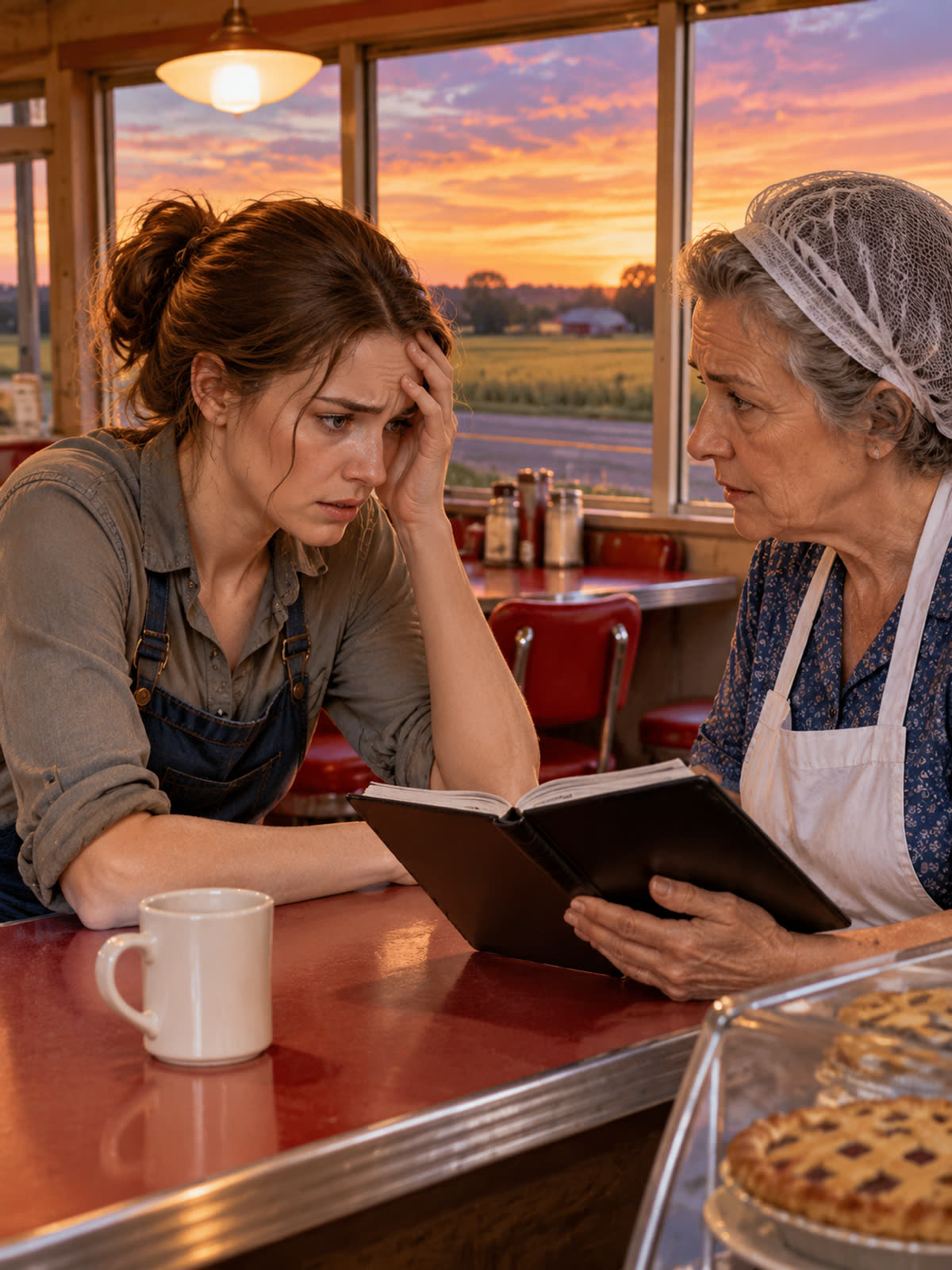
“I will put you on for twelve hours total,” Patty said, marking her ledger with red ink. “That will give you a hundred and twenty dollars plus tips by Sunday morning.” “Thank you, Patty,” I said. “You make sure Nate checks those rafters before he runs new wire,” Patty said, closing her book. “That old roof leaked back in ninety-six.” Back at Ron and Judy’s, the porch lamp cast a yellow square across the driveway. Judy waited with a blue-paper package. “Nate is just washing his hands down in the basement,” Judy said, stepping onto the top porch step as I walked up. “Did he get the mower finished?” I asked. “He got it running like new,” Judy said, holding the package out to me with both hands. “I did not want you leaving without these.”
Four folded dish towels felt soft through the wrapping. “I know how hard it is to keep up with kitchen supplies when you are renting,” Judy said, beaming brightly at me in the yellow porch light. “Thank you, Judy,” I said. Nate emerged, his scrubbed hands pink and his jacket zipped high. Judy leaned over the step and kissed my cheek.
At ten-thirty Monday morning, I placed our white bank envelope beneath the courthouse partition. Mrs. Gable’s brass nameplate shone beside the opening. I removed the check and the cash, held together with rubber bands from Patty’s. The bills were softened by eighty Saturday nights and faintly smelled of frying oil. “Forty thousand on the official bank check,” I said, pressing my thumb against my index finger as I calculated the total. “And fifteen hundred in paper.” Mrs. Gable fitted a rubber thumb stall and counted twice. “You have forty-one thousand five hundred dollars exact,” she said.
Her stamp struck the ledger. “The tax deed will come in the mail after sixty days,” Mrs. Gable said, reaching into a lower wooden drawer. “But nobody is going to mind if you start mowing.” A manila envelope slid through the tray. Inside hung seven unmarked skeleton keys on a rusted ring. Nate rubbed the largest key. “Do these go to the front door?” he asked. “They go to whatever locks are left on the place,” Mrs. Gable said. “The county took the property as-is.” I smoothed our receipt. “I want to check the historical parcel register while we are in the building,” I said. “I need to put another quarter in the truck meter,” Nate said, patting his coat pocket for change. “Meet me down in room 104.”
The archive occupied the end of a fluorescent basement corridor beyond the furnace room. Canvas-bound land ledgers filled steel shelves. Mr. Henderson sat near the window, cutting an apple with a pocketknife. “Looking for parcel fourteen,” I said, setting my notepad on his counter. “Section twelve along the creek.” He wiped his blade and indicated the third row. “Nineteen ninety-eight to present is on the lower shelf,” he said. “Volume forty-two.” I carried the heavy book to the reading table and found the Miller boundaries.
My eyes tracked the numbers as automatically as hospital billing codes. Parcel 14-B covered the farmhouse’s two point three acres. Beside it lay Parcel 14-A: forty acres of creek-bottom timber. I followed its transfer history to March 1998. Under a blue notary stamp, the original deed recorded Arthur Schafer’s gift to his grandson Nathan Schafer and his son Ronald Schafer, as joint tenants with right of survivorship. Nate had turned eighteen that March.
Six weeks later, a quitclaim had been recorded. For one dollar, Nathan Schafer had surrendered his title rights to Ronald Schafer. The blue signature had Nate’s youthful slant. Ron had filed the release that same afternoon. I kept my finger against the page until Nate appeared carrying two vending-machine coffees. “Meter has twenty minutes left,” he said, setting my cup on the oak table. I turned the ledger toward him without touching the cup. “Look at line four,” I said.
He bent over the handwriting and remained there, chin still above his coat. “That is my handwriting,” he said. “You signed this in April of nineteen ninety-eight,” I said. “Dad brought a clipboard out to the shop when I was working on the tractor,” Nate said slowly. “He told me it was equipment insurance for the farm.” “It was a quitclaim deed,” I said. “Your grandfather put the creek forty in your name when you turned eighteen.” He stared at the name he had written twenty-six months earlier. “Grandpa told me before he died that the creek ground was mine,” Nate said. “I thought he was just talking.”
“Your dad used that paper to sell the creek lot to the grain elevator company,” I said. “He got sixty thousand dollars for it,” Nate said. “He gave twenty thousand to Kim,” I said. “And twenty thousand to Jeff and Stacy.” Beneath the fluorescent lights, Nate’s ears turned dark red against his short brown hair. “He knew I would never check the courthouse ledger,” Nate said. “He knew you were capable,” I said. His mouth narrowed as the bluebird card’s message returned to him. “He did not leave us out by accident,” Nate said. “No,” I said.
Nate carried both untouched coffees to the trash and dropped them inside. “Let us go see our house,” he said. Wild mustard and dandelions crowded the gravel lane. The farmhouse stood quiet beneath the sky, its porch dipping toward the cistern. He parked beside the dead lilac and switched off the truck. We crossed knee-high grass to the steps, and he brought out the seven keys. “Which one first?” he asked. “Try the heavy one with the square tooth,” I said.
The porch boards complained beneath his boots. The first key stopped halfway into the iron lock. A flat, three-notched key turned partway and jammed. The third, copper and narrow, would not fit the slot. “Four left,” I said, standing on the step behind him. Nate chose a long iron key with two rounded notches. This one slipped smoothly to its collar. He turned his wrist. The latch struck inside the frame with a heavy metallic click.
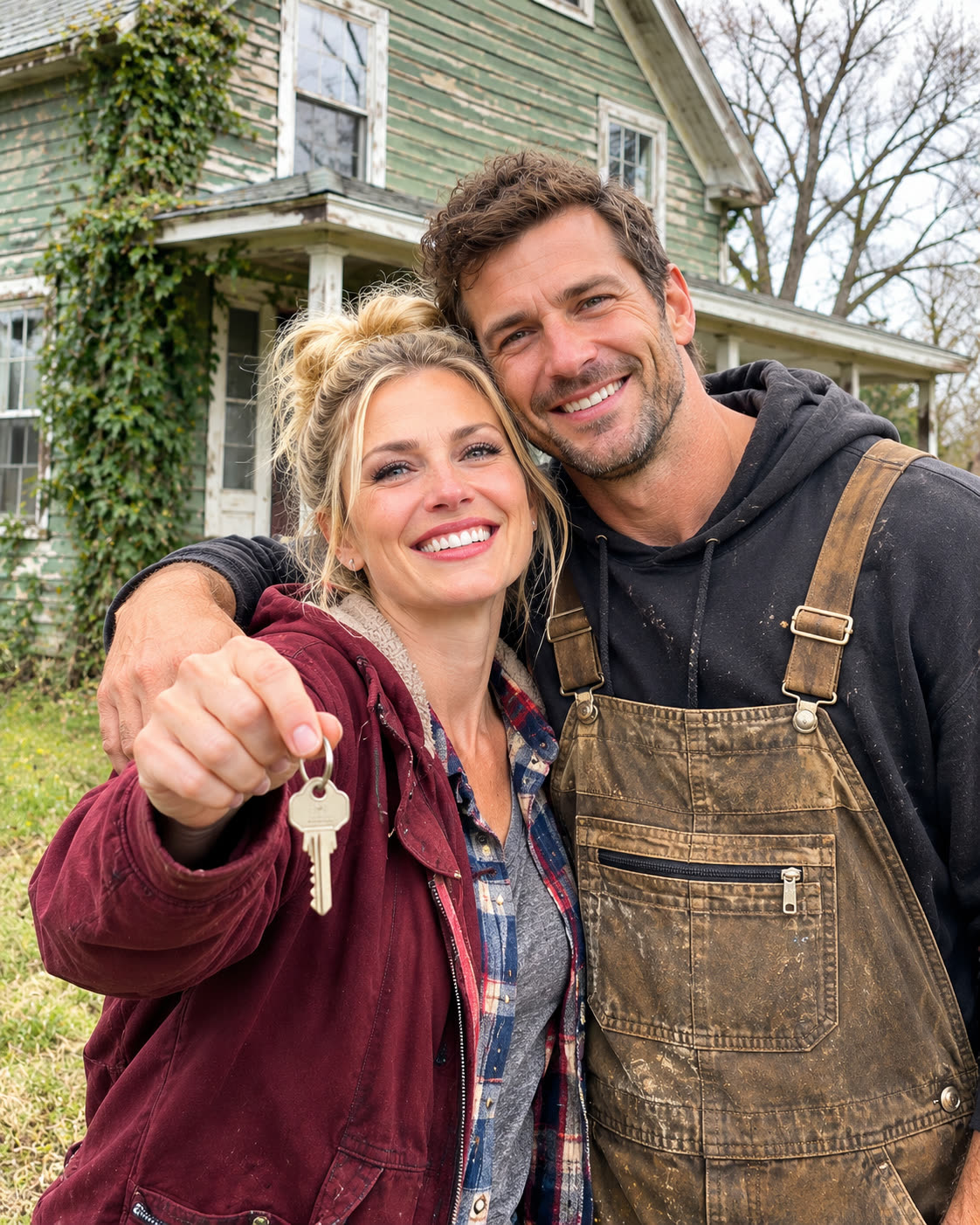
He pushed the oak door inward. Dry plaster, wallpaper paste, and cold pine scented the air that escaped. For five seconds, he stared down the dark hall. “Capable,” he said. Then he sat heavily on the top step, elbows on his knees, his shoulders sagging. I settled beside him and pulled my coat against the spring wind. Something ragged rose from his chest, halfway between a cough and a laugh. Looking at his red ears and set jaw, I began laughing too. Our front door finally stood open. But the ledger remained between us and everything we had believed about his father.
Disclaimer: This story is a work of fiction inspired by real-life themes. Names, characters, places and events are fictionalized, and any resemblance to real persons is purely coincidental. Images are for illustration purposes only.
