


PART 1 — Behind the Glass
Twenty-four years in the United States Army had taught me to recognize dishonesty before anyone admitted to it. As a Lieutenant Colonel, I had questioned inconsistencies in shipping manifests, heard uncertainty creep into junior officers’ explanations, and watched imposing men unravel when their invented reports collided with documented evidence. Lies had familiar movements: eyes turning away, a delayed clearing of the throat, indignation arriving precisely when a straightforward answer should have. Yet no training manual had warned me about the deception waiting beneath my own comforter.
November’s cold penetrated the wool of my Army Service Uniform outside the Scioto Valley Country Club. On the granite approach, I held a velvet-ribboned package containing a custom Italian leather portfolio. Finding the grain Daniel Mercer had admired in an architectural magazine had taken three weeks. I had paid extra for his initials, D.E.M., discreetly embossed in gold inside the flap. My husband’s firm had completed its most profitable quarter, and I wanted to celebrate him.
An unexpected operational matter had kept me at my post until almost eight. I had messaged Daniel that I was coming directly from base, without an opportunity to change into evening clothes. His answer had been abrupt and strangely hostile: Fine. Just don’t make a scene when you march in. Now, beyond the banquet salon’s mahogany doors, champagne glasses chimed beneath bright laughter. Holiday lights shimmered against brass and marble. Then Daniel’s unmistakable baritone carried through the jazz.
“Look, she’s probably still strutting around the barracks, adjusting her ribbons and medals to look important,” Daniel said, his amusement sharpened by contempt. “Honestly, pray she gets held up all night. The woman is exhausting.” The laughter that followed was neither embarrassed nor courteous. It was the comfortable laughter of people enjoying cruelty together. “Are you serious, Daniel?” Robert Hayes asked. His commercial partner had eaten Thanksgiving dinner at my table twelve months earlier and sought advice about his daughter’s career. “You really don’t want your own wife at your annual gala?”
“God forbid,” Daniel scoffed, turning his single-malt inside its crystal tumbler. “Believe me, gentlemen, the evening is ten times better without the drill sergeant hovering over us. Every single dinner conversation devolves into a sermon on operational integrity, discipline, or chain of command. I built a multi-million-dollar real estate firm. The last thing I need waiting for me in bed is an insufferable superior officer inspecting my perimeter.” Robert laughed into his drink. Not one of the four men surrounding that cocktail table defended me.
A terrible, glass-clear calm spread through me. My uniform represented twenty-four years of service, mud, deployments, missed holidays, and decisions carrying consequences far beyond anyone’s wounded pride. It was not something I had put on to impress strangers. Daniel had reduced that history to entertainment for men eager to please him. I remained outside the room. I neither threw open the doors nor hurled his expensive gift across the table.
Army service had taught me not to engage on ground chosen by an opponent while my own position remained exposed. First came withdrawal, then protection, then the selection of terrain. I turned on my polished black heels and crossed the foyer, passing the smiling valet before stepping into the Ohio frost. Inside my car, I lowered the gift onto the passenger-side floor and took out my phone.
I called Margaret Ellis. She answered on the second ring. “Claire?” Her voice was measured, as always. Through the windshield, the country club still glowed with holiday lights. Somewhere inside, Daniel was enjoying the company of people who knew nothing about the documents already gathered beyond his reach. I had arrived carrying a present. I would leave having finally stopped protecting him from the consequences of his own choices.
“Execute it, Margaret,” I said quietly. “File the petition, and send the formal demand tonight.” A brief silence followed. “You’re certain? Once this wire is tripped, there is no stepping backward.” I watched the bright windows without moving. “I have never been more certain of anything in my life. Drop the hammer.”
Eighteen minutes later, another congratulatory toast was still warming Daniel’s evening when his phone announced an email from Ellis & Vance. It carried a Notice of Legal Representation and Demand to Preserve Financial Records, an emergency preservation injunction, and an itemized audit challenging an initial $186,000 moved from our joint accounts into an unregistered shadow entity. Less than forty seconds afterward, Daniel called. I turned my screen facedown, put the car into drive, and left the man I had loved for seventeen years behind his glittering windows.

Daniel’s panic would have made little sense to anyone who believed the image he presented. My husband considered himself an accomplished illusionist. For nearly two decades, he had mistaken my loyalty for a weakness he could exploit. We had met when I was a young Captain at the defense logistics center outside Dayton. He was an ambitious real estate broker whose worn oxfords had not diminished his confidence in his future.
In those early years, my commission made him proud. He praised my ability to lead platoons and oversee inventory systems worth millions. “You finish what you start, Claire,” he would whisper, kissing my temple after a promotion ceremony. “You’re steady when the whole damn world is shaking.” We bought a large stone-and-cedar house outside Columbus. Our financial arrangement appeared sensible: my dependable officer’s salary supported our household and investments while Daniel handled property purchases and market decisions.
I maximized my Thrift Savings Plan and regularly transferred substantial sums into our joint portfolios. He was the financial specialist, or so I had permitted myself to believe. Meanwhile, affection did not disappear in one dramatic rupture. It hardened slowly into resentment. My promotions to Major and then Lieutenant Colonel brought increasingly bitter remarks. Late briefings prompted theatrical complaints about women placing flags ahead of families. Public salutes or the words Colonel Mercer made his jaw tighten.
“Sometimes, Claire,” he sneered over cold espresso one Sunday, “I think you’d rather command a battalion than be a real wife.” Eighteen months before the gala, I noticed the first financial irregularity while checking our retirement projections. Forty-two thousand dollars had left our joint portfolio for an account identified by a commercial routing prefix. “Daniel, what is this disbursement?” I asked, pushing the iPad across our white quartz kitchen island.
He scarcely looked away from his social media feed. “Just short-term mezzanine financing for the Northridge Commercial Hub. Routine liquidity repositioning. Don’t worry your head about it.” I kept my tone even. “The receiving entity isn’t Northridge LLC. It’s registered under an acronym I’ve never seen: Apex Ridge Holdings.” His mug struck the counter with deliberate force.
“Claire, I spend sixty hours a week dealing with zoning boards, structural engineers, and commercial lenders. I do not have the patience to be cross-examined in my own kitchen as if I’m some enlisted grunt who lost his night-vision goggles.” I answered without raising my voice. “I am not cross-examining you. I am asking why marital savings were moved without consultation.” His mouth formed a thin, patronizing smile. “When I make sixty percent returns on property flips, it’s our wealth. But the second I shift capital to secure a bridge loan, you pull rank. Stop treating me like your subordinate.”
I closed the iPad. Shouting would not clarify a transaction or recover a dollar. Instead, I recorded the date and began obtaining every archived statement available through our bank. During the next six months, a pattern emerged that no explanation about routine financing could conceal. Another $60,000 reached Apex Ridge Holdings four weeks after the first transfer. Smaller wires followed—$12,000, $18,500, $25,000—steadily draining the reserves intended to keep us secure.
Those withdrawals were not careless bookkeeping. They formed a methodical system for feeding Daniel’s struggling commercial ventures. One Tuesday afternoon, I searched the Ohio Secretary of State’s business registry. Apex Ridge Holdings LLC existed, and Daniel was its sole managing partner. Its secondary mailing address belonged to a private post office box two miles from our house. He had never mentioned that box. Behind my back, he had constructed a financial shelter with money drawn partly from my military pay.
Later, my laptop chimed with an encrypted message from Margaret. She had obtained the commercial loan packages subpoenaed from Daniel’s principal regional lender. I entered the decryption key and opened the primary disclosure for the Northridge redevelopment. By then, the unexplained transfers had already taught me to distrust the reassuring vocabulary Daniel used whenever money disappeared. I went directly to the guarantor signatures.
On page thirty-four, I found my name across the personal indemnity line. Beneath it was a representation pledging my entire federal military pension and survivors’ benefits as collateral for a speculative development loan of three million dollars. My breath caught. The money he had taken was no longer the worst thing on that screen. Someone had placed the life I had spent twenty-four years building beneath a signature I had never knowingly given.
PART 2 — The Signature He Could Not Explain
The handwriting was an ugly imitation of mine. Its C and M approximated my familiar loops and slant, but the pressure was wrong. My signature came from years of signing official military correspondence; this one looked slowly constructed. I stared until my eyes stung. Then I remembered a manila folder Daniel had placed on the counter two years earlier while I packed for three weeks of joint readiness training in Louisiana.
“Just standard administrative authorizations for the title company on the lake cottage refinance, honey,” he had murmured, kissing my neck while I checked my duffel’s manifest. “Sign on the yellow tabs so I can submit them while you’re in the field.” I had trusted him. In the hurry of departure, I had signed what he presented, believing he would never endanger my life’s work. Perhaps he had hidden something among those pages. Perhaps he had digitally transferred a genuine signature onto a corporate guarantee.
I called Margaret immediately. “Margaret,” I said, “Look at document exhibit D-4. The Northridge guarantee.” Her answer was grave. “I’m looking at it right now. Claire, if this signature was procured by fraud or forged outright, Daniel isn’t just facing an unequal division of marital property in domestic relations court. He is flirting with federal bank fraud and commercial document falsification.”
“I don’t care about ruining him, Margaret. I care about severing his hands from my neck. Can this bank attach my military pension?” She responded without hesitation. “Not if we formally repudiate the instrument immediately, alert their compliance department, and retain an independent forensic document examiner. We need to construct an iron wall between your assets and his collapsing house of cards before that development project goes into default.” I lowered my voice. “Do it. No quarter.”
The front door slammed downstairs. Daniel’s designer loafers struck the hardwood, then the staircase, with heavy, hurried force. He entered our bedroom without removing his coat. His face was scarlet, his silk tie dragged loose. “Are you insane?” he roared. “Are you entirely out of your goddamned mind, Claire?” I stayed at the mahogany writing desk, my laptop open and my hands resting on the leather blotter.
“Lower your voice in this house,” I said evenly. “Do not give me orders!” He waved his phone. “I was standing in the dining room with the regional president of Fifth Third Bank and my major private equity partners when an email drops from an aggressive divorce attorney demanding an asset freeze and forensic audit! Robert saw it! Everyone saw it! You humiliated me in front of the entire business community!”
I regarded him with the detachment I once reserved for hostile procurement contractors. “You humiliated yourself, Daniel. The only difference is that you did it behind my back at the country club, while I did it through the legal system.” Confusion interrupted his anger, but only briefly. “What are you talking about? The country club?”
“I was standing outside the salon doors at eight-fifteen,” I told him, my voice becoming quieter. “I was holding a twenty-four-hundred-dollar leather portfolio embossed with your initials to celebrate your success. And I stood there and listened to you call me a dictatorial parasite who ruined your life with her uniform.” His color vanished. His mouth opened and closed before he managed to speak.
“Claire… wait,” he stammered, stumbling half a step backward. “That… that was locker-room banter. The guys were drinking, we were blowing off steam—it didn’t mean anything—” There was no longer any pleasure in his performance, only the frantic search for an explanation I might accept. I had spent enough years listening to excuses to recognize one arriving too late.
“Locker-room banter is for adolescents, Daniel. You are a forty-eight-year-old man who subsists on my stability while mocking my service to strangers.” I turned the laptop toward him, revealing the high-resolution Northridge guarantee. “Now, let’s talk about felony bank fraud.” His eyes widened with naked terror. He looked from the document to my face, and his hands began shaking.
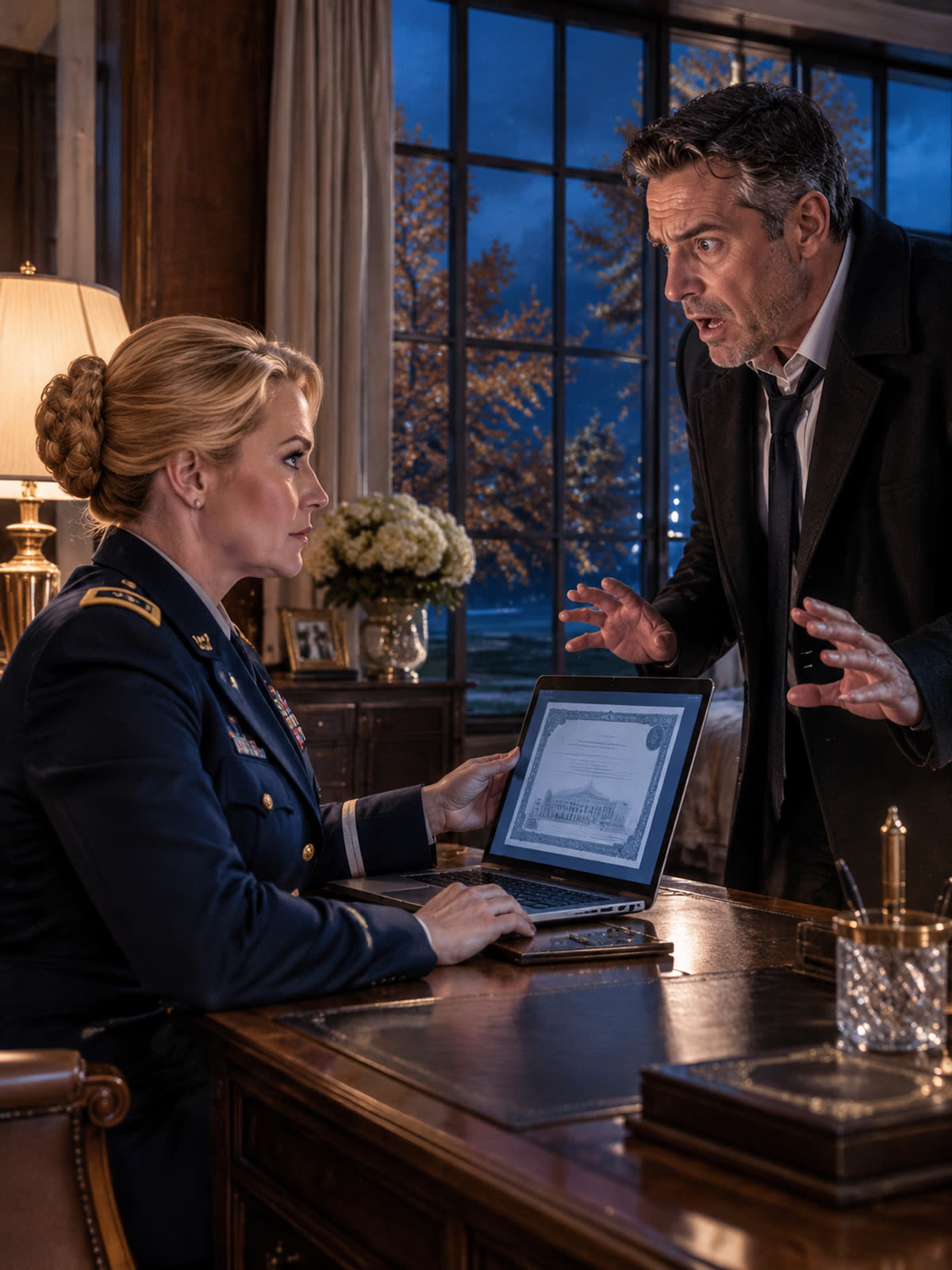
“You… you wouldn’t,” he whispered. “If you contest that signature, the bank will pull the line of credit on the entire Northridge plaza. The contractors will walk off site. The whole firm will go into receivership! I’ll be ruined!” His confidence had dissolved. What remained was a man asking me to preserve the very arrangement he had concealed from me.
I rose from the desk. “Then you had better find a very good criminal defense attorney. Because my forensic document examiner begins his analysis at nine tomorrow morning. Pack a suitcase. You have ten minutes to clear your personal items from this house before I call the local sheriff’s department to enforce the domestic exclusion order.” Tears gathered in his bloodshot eyes. “Claire, please! Think about our seventeen years! We built this together!” I opened the bedroom door and indicated the stairs. “No. I built my life. You merely embezzled it.”
The following sixty days became an exercise in dismantling concealment. A person who assumes his spouse will never investigate rarely protects his tracks well. Margaret engaged David Vance, a meticulous forensic accountant and former federal investigator who specialized in following money through corporate structures. Within three weeks, he had traced the machinery of Daniel’s hidden finances.
The original $186,000 was only the portion first visible. Across four years, Daniel had diverted more than $340,000 through Apex Ridge Holdings. He had not been financing healthy expansion. He was servicing punishing high-interest loans taken out secretly to keep failing commercial developments alive. Each transfer concealed another shortfall, with my pay and assets providing security I had never agreed to offer.
Then an unexpected call came from within his own circle. I was in Margaret’s downtown office, reading the document examiner’s preliminary twelve-page affidavit, when Robert Hayes appeared on my screen. I placed the call on speaker. “Robert. If this is regarding Daniel’s litigation, you need to contact my counsel.” His former country-club confidence was gone. “Claire, please don’t hang up. I’m calling from my lawyer’s conference room. I just saw the audit trail your team served on the partnership.”
“Then you know the truth,” I said coldly. His breathing caught. “I didn’t know he forged your pledge, Claire. I swear to Almighty God, I didn’t know. Daniel brought those executed loan documents to our executive closing two years ago. He told us that you were using your military pension and assets as collateral because you believed in the project. He said you were thrilled to be our silent partner.”
“And you believed him without ever confirming it with me?” I asked. “Why wouldn’t I?” Shame weighed on his answer. “He was my partner, and he was your husband! But Claire… that’s not why I’m calling. Daniel came to my office yesterday afternoon. He asked me to scrub our internal servers. He wanted me to purge two years of private correspondence regarding the collateral disclosures before your forensic team could serve a formal discovery subpoena.”
Margaret’s expression sharpened. She leaned toward the phone. “Mr. Hayes, this is Margaret Ellis. Did you alter or delete any of those files?” Robert answered immediately. “Not a single byte. My attorney has sequestered the entire mail server and preserved the metadata. We are issuing a complete evidentiary disclosure to your office this afternoon. Daniel is on his own. We’re voting to remove him as managing partner by Friday.”
After a prolonged silence, Robert spoke more softly. “Claire… about that night at the club. What Daniel said… and how I laughed. It makes me sick to my stomach to think about it. You’ve given your entire life to this country, and you were always nothing but generous to my family. I was a coward. I laughed because I wanted to stay on the good side of the man controlling the purse strings. I am truly, deeply sorry.” My answer remained steady. “I accept your apology, Robert. Now send the files to Margaret.”
I ended the call. Daniel’s remaining protection was disappearing: his partners were withdrawing, his banking relationships were failing, and preserved records now supported the trail of diverted funds. His defense crumbled within forty-eight hours. Three days later, he requested a settlement conference in Margaret’s office. The man who had laughed beneath the country club lights would have to sit across from me without that audience, without its approval, and without the comfort of believing he still controlled what I knew.
PART 3 — What Honor Cannot Buy
Daniel arrived looking hollowed out. Two months earlier, his expensive clothes had helped announce his success. Now a rumpled navy blazer hung from shoulders that had grown narrower. Sleeplessness had left purple shadows beneath his eyes, and his silver-threaded hair was untidy. He took the chair opposite mine at the long oak conference table. Beside him, an exhausted-looking attorney kept his briefcase closed.
“Claire,” Daniel whispered, placing trembling hands on the polished wood. “Please. If the bank moves forward with a formal fraud referral to the U.S. Attorney’s Office… I’m looking at federal prison time. You can’t do this to me. We loved each other once.” I looked at the stranger who had shared seventeen years of my life. “I loved an honorable man, Daniel. I don’t know who you are,” I said without malice. “The bank has already agreed to release me from every shred of personal indemnity based on the forensic handwriting analysis and Robert’s preserved communications. Your legal fate is between you, the lender, and the justice system. My only concern is excising your corruption from my life.”
Margaret leaned back. “Why did you do it, Daniel? You had a comfortable income. You had an accomplished, supportive wife who shouldered half the household expenses. Why steal from her?” He stared at his knuckles. For a long minute, downtown traffic twelve floors below supplied the only sound. When he finally raised his head, resentment and grief had twisted his face.
“Because everyone looked at her like she was a saint,” he spat. “Whenever we went to galas, whenever we went to dinner, it was always ‘Thank you for your service, Colonel Mercer’ and ‘You must be so proud of your wife, Daniel.’ I was just the guy who flipped office buildings while she was out saving the free world. I wanted something that was entirely mine. I wanted to prove that my intellect, my risks, and my empire were bigger than her damn uniform.”
He shook his head as a tear moved down his hollow cheek. “I hated that people respected you without you ever having to demand it. And I hated that no matter how much money I made, I couldn’t buy that kind of honor.” Beneath the transfers, corporate entities, and misleading explanations lay wounded vanity. He could not bear respect he had not arranged or purchased. I felt profound pity. “Honor isn’t something you buy, Daniel. It’s something you earn through sacrifice. And you wouldn’t know the meaning of the word if it were engraved upon your tombstone.”
Four weeks later, the final settlement was signed. The court-approved decree awarded me my entire federal military pension, survivors’ benefits, and Thrift Savings Plan, free of marital claims. Our suburban home was sold. The first $340,000 of diverted money came exclusively from Daniel’s share of its equity and returned to my private accounts. Every debt, judgment, and legal fee connected to Apex Ridge Holdings and Northridge became his sole responsibility.
His commercial firm dissolved through private restructuring. Robert and the remaining partners absorbed its viable assets. Daniel took an entry-level consulting role with a third-tier Dayton brokerage and moved into a rented garden apartment sixty miles from the social circles he had once worked so hard to impress. The outward signs of his success disappeared, while the obligations he had tried to hide remained his.
In April, white dogwood blossoms opened across Ohio as I completed the purchase of a modest craftsman house ten minutes from my post. Sunlight filled its rooms. There was a wraparound porch, a private garden for hydrangeas and heirloom tomatoes, and an office fitted with natural pine bookshelves. The Italian portfolio occupied the third shelf between framed promotions and command coins. I kept it as a quiet reminder that vigilance could not stop at the entrance to my own heart.
One evening, twilight spread violet and rose across the sky when my phone rang. The caller ID showed a Dayton landline belonging to Daniel’s seventy-four-year-old mother, Evelyn Mercer. I paused before answering. “Hello, Evelyn.” Her voice sounded frail beneath the weight of what she had come to understand. “Claire… I… I hope I’m not disturbing you.” I rested against the kitchen counter. “Not at all. Are you healthy?”
“As well as can be expected,” she sighed. “Daniel visited me last weekend. He spent two hours railing against the world, blaming the banks, the courts, Robert… and you. But Claire, I looked at his eyes, and for the first time in my life, I saw the deceit. I saw what he had become.” Beyond my kitchen window, the garden was blooming. “You don’t have to carry his sins, Evelyn.”

She began to weep softly. “I defended him to our family for months. When he told me you were cold, that you put your military career ahead of your marriage, I believed him. I made snide remarks about your deployments at our family dinners. I made you feel like an outsider because you were strong, and I thought my son was the victim. I was wrong, Claire. I raised a boy who never learned to respect the people who carried him. Can you ever forgive an old woman’s blind loyalty?”
I breathed deeply, feeling a weight lift that I had not known I still carried. “I forgave you the moment I walked out of that country club, Evelyn,” I said gently. “Forgiveness is easy when you no longer allow other people’s falsehoods to define your worth. Take care of yourself.” Her answer came in a whisper. “God bless you, Colonel.” Then she ended the call.
Several weeks afterward, an envelope appeared in my mailbox. Daniel’s handwriting crossed the front. There was no return address, only a Dayton postmark. Inside lay one sheet of lined paper. He had filled it with the surrender that neither his anger nor his pleas had managed to express when we were face-to-face.
He apologized for the gala, for turning my uniform into a joke, and for the financial betrayal that had destroyed our marriage. Losing his company and his standing among his peers, he wrote, was not his greatest punishment. That came every evening in the silence of his rented apartment. There, he had to acknowledge that the woman who had protected him for seventeen years finally understood how small he was.
I read the letter without crying. There was no rush of triumph, no satisfaction in the picture of his loneliness. I folded the sheet and carried it into the kitchen. With a match, I lit one corner and watched the flame consume his words over the cast-iron sink.
The paper blackened, curled, and settled into gray ash. When it had finished burning, I turned on the cold water and washed the remains down the drain. The letter did not belong on my shelves beside my command coins. The portfolio already reminded me of what I needed to remember. His apology required no place in the home I was making for myself.
The following month brought my official retirement ceremony in the installation headquarters’ grand auditorium. Men and women in uniform filled the hall: officers I had mentored, sergeants who had helped me overcome nearly impossible logistical demands, and comrades who had shared freezing command tents with me across three continents. Their faces carried the history no country-club joke could erase.
The presiding Major General pinned the Legion of Merit to my lapel and handed me my framed retirement certificate. The audience rose. Applause filled the vaulted hall, surrounding me with a force entirely different from the laughter I had heard outside those mahogany doors. I looked across saluting hands and proud faces bright with tears.
Daniel had mistaken my strength for an attempt to make him smaller. He had never understood that my uniform was not about exercising power over another person. It stood for the steady discipline of choosing truth, even when that choice brought the familiar structure of a life down to its foundations. I walked along the auditorium’s central aisle with my spine straight and my head raised.
Ahead, the wide brass doors opened onto warm, glorious sunlight. Behind me lay the service I had given, the marriage I had survived, and the explanations I no longer needed. I reached that bright threshold with a life entirely, unreservedly my own—and, for the first time, the question of what came next belonged to no one else.
Disclaimer: This story is a work of fiction inspired by real-life themes. Names, characters, places and events are fictionalized, and any resemblance to real persons is purely coincidental. Images are for illustration purposes only.
