

PART 1 — The Girl Beneath the Camera
My name is Adelaide Rowan. At twenty-nine, I could feel hope slipping beyond my reach. My mother’s kidneys were failing, the payment for her treatment would be due in seven days, and I had nothing valuable left to sell. Everything I had been able to turn into money was already gone.
Four years before that morning, I had buried my father. Walter Rowan had been deaf from birth, a gentle man who taught me to sign before I learned to read. From him, I understood something that would stay with me: silence was never proof that a person had nothing to say.
I waited at the bus stop, shivering inside a blue dress I had carefully mended. My shoes were secondhand. Two boiled eggs and some bread would have to serve as lunch, and my résumé rested in a folder held together with yellow tape. I was going to an interview I could not afford to lose.
The position was in Desmond Ashcroft’s household. At thirty-five, he controlled a shipping empire, and buildings in six cities carried his name. His mansion was so large that calling it a house seemed inadequate. Yet none of that wealth had prevented his wife, Rosalind, from dying two winters earlier.
After her death, Desmond had retreated into his work. His daughter, Pearl, had retreated somewhere harder to reach. The doctors described her silence as grief and trauma and advised patience. A year went by without a word, and each unsuccessful effort to help left her father feeling more powerless.
Desmond’s older sister, Vivian, had moved into the mansion after Rosalind died. She had promised to protect Pearl. Behind her severe manners, she appeared to be a frightened woman desperate for someone to reach her niece. That was how things looked when I entered the house at precisely ten.
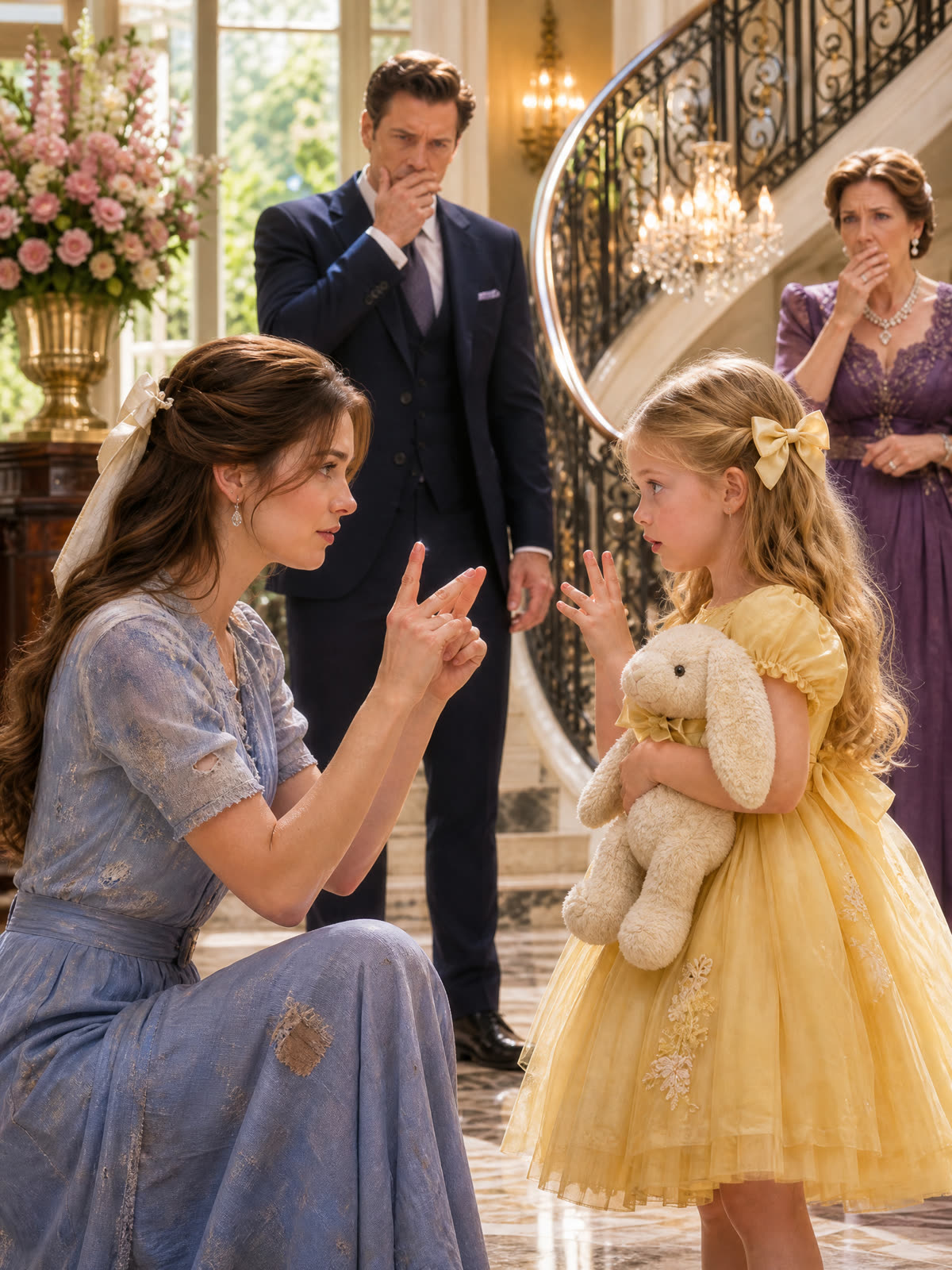
A maid brought me over polished marble and beneath a vast chandelier. Vivian waited near the staircase, looking over my clothes as if I had carried dirt inside. “No degree? No agency references?” she demanded, turning the pages in my repaired folder. Her gaze reached my shoes, and she laughed. “Did you think this was a charity house?”
Heat climbed into my cheeks. Remembering my mother’s hospital bill, I made myself remain composed. “I love children, ma’am, and I’m willing to work harder than anyone.” Vivian answered immediately. “Gratitude won’t raise an Ashcroft,” she snapped. Before I could reply, footsteps sounded behind us, and Desmond appeared, his expensive suit unable to disguise his exhaustion.
Then I saw Pearl at the top of the curved staircase. She wore a yellow dress and held a worn stuffed rabbit tightly against her chest. Although her face seemed distant, her eyes tracked everything below. “That’s my daughter,” Desmond said quietly. “She hasn’t spoken a word in a year.” Against the rabbit’s fur, her fingers formed a small, deliberate pattern.
Recognition tightened my chest. Those movements brought back evenings with my father. I lowered myself carefully onto my knees so I would not frighten her, raised my hands, and signed a simple greeting. Pearl’s eyes widened. Vivian gasped behind me, and Desmond moved closer. Then Pearl freed one hand from her rabbit and began answering me.
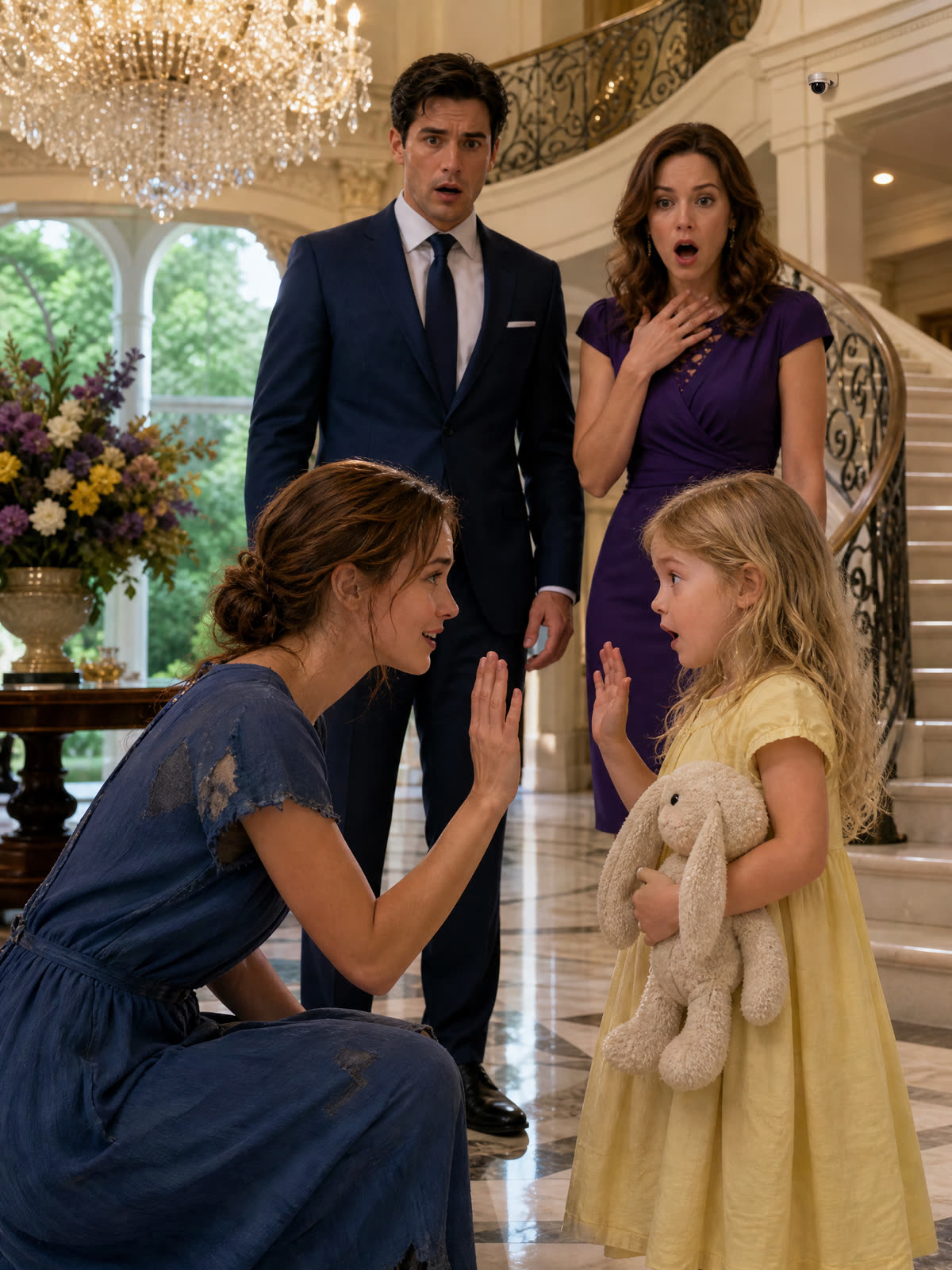
For a moment, nothing else in that enormous room mattered. I watched the little fingers moving, trying to understand what she was telling me. Just as their meaning became clear, I noticed something above the staircase: a small security camera, its light blinking in the corner.
Much later, at two in the morning, the executive floor of Ashcroft Logistics Tower in downtown Chicago stood under strict lockdown. A dozen security operators in charcoal suits watched the corridors outside the private elevators. Down the hall, six-year-old Pearl slept on a velvet sofa beneath a cashmere blanket, her rabbit under her chin and two pediatric nurses nearby.
I sat close to her in a high-backed armchair, holding chamomile tea. By then, my name was Adelaide Rowan-Ashcroft. The repaired blue dress had been replaced by a dark emerald suit, and I found myself sitting straighter in it than I ever had before. In the central study, the investigation was reaching its end.
Desmond waited around a long black granite table with senior corporate prosecutor Bridget Colton, security chief Gideon Pike, and two federal forensic accountants. In one corner, two guards watched Vivian Ashcroft. She was thirty-eight, her designer dress torn, her hair disordered. Horror had replaced her assurance as a scheme four years in the making fell apart around her.
Bridget opened three binders with red seals and spread out ledgers, wiretap logs, and toxicology reports. “Desmond, Adelaide,” she said, crisp and fast. “The forensic audit into Vivian Ashcroft, her accomplice Lawson Crane, and the Rowan Maritime Trust fraud is complete.” At the glass wall overlooking Lake Michigan, Desmond stood without his jacket, his sleeves rolled up. “Explain it.”
Bridget touched the first binder. “The Rosalind Ashcroft file. Exhumation toxicology and recovered medical records show that Vivian gave your late wife small, repeated doses of arsenic over roughly six months. The goal was control of the family estate and of this household.” Desmond remained motionless. Only his whitening knuckles, pressed against the window ledge, betrayed him.
“The second file is the Rowan Maritime Trust,” Bridget continued. “Adelaide’s father, Walter Rowan, was the sole beneficiary of a family shipping trust he walked away from decades ago, because he wanted a quiet life. He never touched it. Four years ago, after his death, Vivian and Lawson Crane used forged trustee documents to divert about one hundred and fifty million dollars into shell accounts in Panama.”
“My father didn’t know,” I said quietly. “He never knew it existed.” Bridget answered, “No,” then continued. “And neither did you. But you are his sole heir, and under the original charter, that makes you the controlling owner of the logistics network Vivian’s accomplice was about to absorb. The one at tomorrow’s assembly.” Silence settled over the room.
Vivian struggled weakly against her restraints. “Desmond, listen to me! She was a penniless nanny! She tricked that child! I did everything for this family!” Desmond approached until his shadow fell across her chair. “You did nothing for this family, Vivian,” he said. “You killed my wife. You frightened my daughter into a year of silence. And you stole from a woman who didn’t even know she’d been robbed.”
His voice was almost gentle, and that made it worse. “Tomorrow, it ends.” At ten the following morning, more than four hundred shipping directors, developers, judges, and board members filled the mahogany assembly hall on the Chicago Financial Center’s fortieth floor. Crystal chandeliers shone above the annual Midwest Logistics and Heritage Assembly.
Lawson Crane sat near the head of the raised table in a navy suit, holding a silver pen. His legal counsel waited beside him, smirking. The buyout documents would place the Rowan shipping berths inside Crane Equity. Lawson leaned toward the microphone. “Gentlemen,” he announced, “today we ratify the consolidation of the Rowan Berths into Crane Equity, in light of Mr. Ashcroft’s regrettable family instability…”
The heavy oak doors swung open, and the conversations stopped. Desmond came down the red-carpeted aisle in a charcoal suit, with Gideon and four federal marshals beside him. I walked on his arm in dark emerald, my hair loose over my shoulders. Between us, Pearl held both our hands, wearing yellow with a cream ribbon.
My father’s emerald signet pendant rested at my throat, the one possession he had kept from his family. Lawson’s pen slipped from his hand, struck the mahogany, and rolled to the floor. “What is this?” he stammered, retreating toward the stage. “This is an interruption! She is just a nanny!”
Desmond’s voice carried through the silent hall. “She isn’t just a nanny, Lawson,” he said. “She is the chairwoman of the Rowan Maritime Trust, my wife, and the owner of everything you came here to steal.”
PART 2 — What Her Silence Was Hiding
Bridget Colton came forward with a thick stack of court-stamped papers and placed them in Lawson’s trembling hands. “A federal order enforcing the Rowan Trust deeds and restoring full control to Adelaide Rowan-Ashcroft,” she read. “Arrest warrants for Lawson Crane and Vivian Ashcroft on charges of murder, conspiracy, wire fraud, and embezzlement. And an immediate freeze on every asset held under Crane Equity.”
Two marshals approached with handcuffs. “This is unlawful!” Lawson shouted. “Desmond, you can’t do this for a nanny!” Desmond slipped an arm around my waist. “I’m not doing it for a nanny,” he said. “I’m doing it because my wife was robbed, and because she gave my daughter back her voice.”
The handcuffs closed. Lawson called for lawyers who were already moving toward the exits. Vivian had been brought through a side entrance in restraints of her own; she said nothing. News cameras followed them out of the hall. To explain how I had arrived in that aisle, though, I have to return to the morning of my interview.
I was kneeling on the mansion’s marble floor when Pearl first answered me. My father had shown me that signing was more than a vocabulary formed by the hands. Expression mattered. Rhythm mattered. So did the movement of a face. Pearl’s gestures were hesitant and uneven, like those of a child who had learned something from a book and become afraid to use it.
Hello, she signed. Her gaze darted toward the camera. Then her fingers moved quickly: Don’t say. They trembled as she continued. Don’t say what I say. I kept my expression steady, remembering how my father had taught me to remain calm when strangers stared at him. Slowly, I answered: Okay. Our secret.
Tears filled Pearl’s eyes. The breath she released seemed to rise from somewhere deep inside her. Behind me, Vivian’s voice sharpened. “What is she doing?” she demanded. “Is she making gestures? Desmond, this woman is upsetting her.” When I turned, Desmond was watching his daughter’s hands as though something impossible had happened.
“She’s signing,” I said carefully. “She isn’t unable to communicate, Mr. Ashcroft. She’s choosing not to speak.” Vivian cut in. “The specialists said it was trauma,” she said sharply. “Selective mutism. It has nothing to do with sign language.” I answered, “Both can be true,” then added, “But she’s trying to talk. Someone just needs to listen.”
Desmond glanced at his sister and then back at me. “You’re hired,” he said. Vivian’s expression hardened. “Desmond…” He did not let her continue. “She’s hired, Vivian.” That was how I got the position. It had taken only a few moments for the interview to become something none of us could turn away from.
That evening, after Pearl’s bath, I sat on her bedroom floor with the lights low. She began telling me what had happened, pausing between signs, making each one slowly. Her mother had been unwell for months. Every afternoon, Aunt Vivian prepared a special tea for her. Once, Pearl had watched her aunt stir gray powder into the cup.
When Pearl had asked about the powder, Vivian had knelt in front of her and smiled. What she said afterward remained fixed in the child’s memory: If you tell anyone, they’ll take you away too. Just like Mommy. Pearl’s small hands gave me the words one at a time, while I sat beside her and understood why she had stopped speaking.
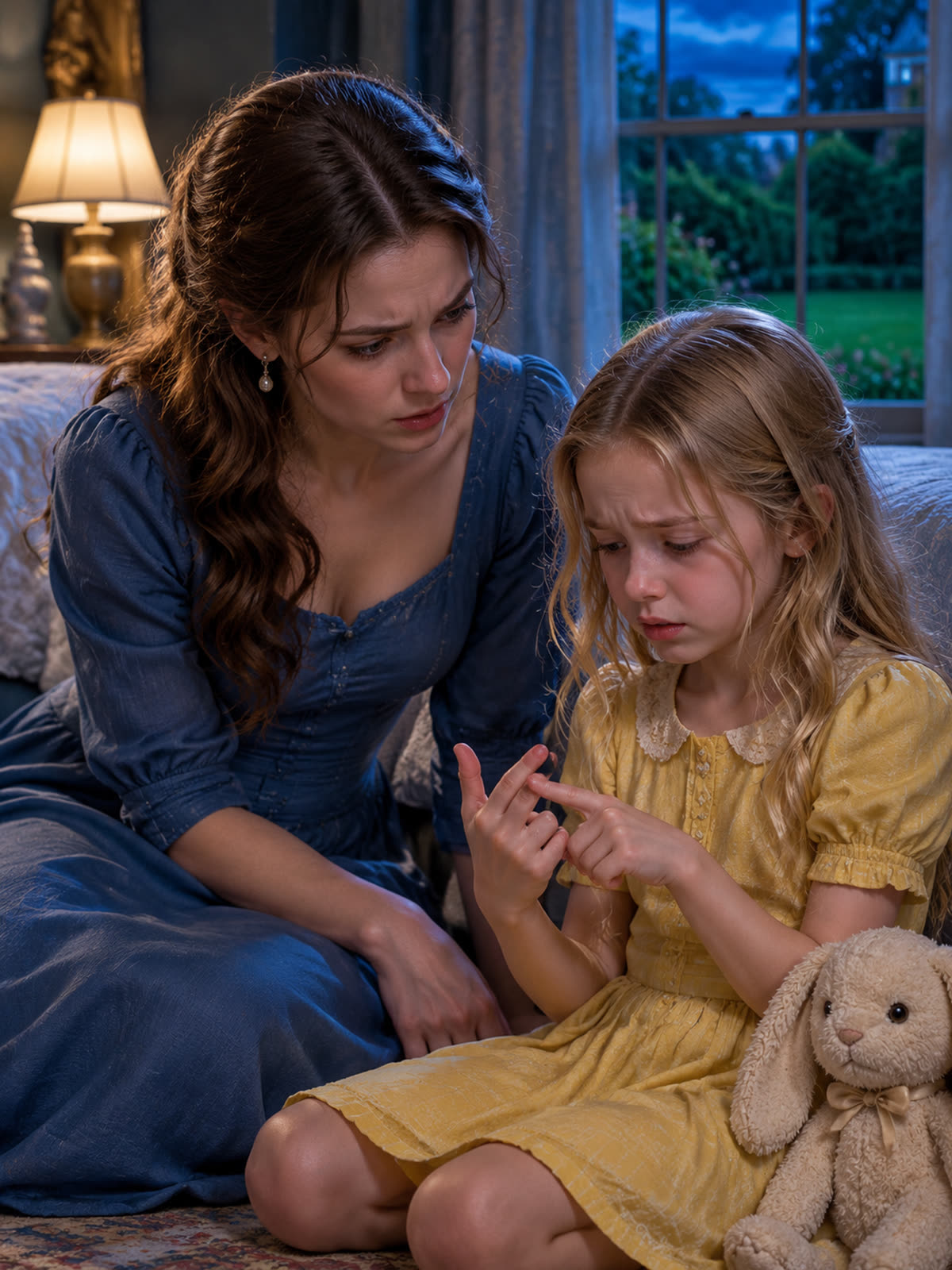
At four years old, she had decided that silence was the safest place available to her. I held her until she slept. Then I went into the hallway and sat with a hand over my mouth, shaking. I knew what she had entrusted to me, but knowing it and proving it were two different things.
I did not take the accusation straight to Desmond. My father had taught me how easily a deaf man could be dismissed when he accused someone powerful without evidence. I was a nanny whose shoes were held together with glue. Vivian was the woman who ran the household. I needed someone who would listen and know what to do.
On the hall table, I had noticed a security consultant’s card. I called the number for Gideon Pike. For an hour, he listened. Afterward, he contacted Bridget Colton. Two days later, a forensic team quietly began examining the estate’s records. While they worked, Pearl kept talking to me in the language she had been afraid to use.
I never explained how much her trust meant. Instead, I listened as she signed a little more each day. By the end of the first month, she no longer glanced up at the camera. At the end of the second, alone in the dark, she whispered her first word aloud. “Addie.” I sat on the edge of her bed and cried until the sheets were wet.
My mother’s treatment payment had fallen due on my seventh day in the house. I had told Desmond nothing about it. Gideon, however, noticed almost everything. He learned what was happening and quietly told his employer. The next morning, an envelope lay beside my breakfast tray. Inside was a check covering the entire amount.
I took it to Desmond’s study and placed it on his desk. “I can’t take this.” He answered, “It isn’t charity,” and continued, “It’s an advance. You’re the only person who’s gotten my daughter to say a word in a year.” I began, “Mr. Ashcroft…” But he interrupted with my name. “Adelaide.”
His voice was tired and low, without anything false in it. “My wife died, and I buried myself in work, and my daughter went somewhere I couldn’t reach. You went where I couldn’t. Let me do something for you.” I looked down at the check and pictured my mother in her hospital bed, counting the days.
“I’ll pay it back,” I said. “If you insist.” One corner of his mouth rose. “Over thirty years, with no interest.” For the first time in weeks, I laughed. My mother, Maureen, received her transplant evaluation that month. In October, a donor match became available—a gift from someone we did not know.
Desmond stayed beside me in the hospital corridor for eleven hours. He never left. When the surgeon finally emerged with a smile, I turned toward him and wrapped my arms around him without thinking. For an instant, he went perfectly still. Then he held me carefully, as though I were something rare that might be damaged.
“Thank you,” I said against his shoulder. “You did that,” he replied quietly. “Not me.” Looking back, I think that was when our relationship stopped being only that of a nanny and her employer. Something had shifted between us, although neither of us needed to give it a name at that moment.
I did not marry Desmond Ashcroft for his fortune. I want that understood. Before the wedding, I had already learned that I was an heiress myself, though even saying it seemed strange. Gideon’s investigation uncovered the Rowan Maritime Trust in January. Bridget needed two months to establish that it was real, and another to explain what it meant.
My father, she told me gently, had been the last of a family of shipping owners. All the time I had known him, all the ordinary years of our life together, he had carried that history without sharing it. I listened as Bridget explained the trust and the inheritance that had been hidden from both of us.
“Your family built this empire,” she told me. “Your grandfather left it to Walter in a trust. Walter walked away and lived a quiet life. Vivian found the paperwork when she married into the Ashcroft family and saw an opportunity.”
I thought of my father, who had given me a language and never mentioned an empire. “He never said a word,” I whispered.
PART 3 — The Word She Chose
“He told you something else, though, didn’t he?” Bridget said. “That silence doesn’t mean someone has nothing to say.” I cried for an hour after that. When I could finally speak again, I asked her to begin the paperwork. Whatever my father had walked away from, the truth about it could no longer remain hidden.
Desmond proposed on the second of June in Pearl’s bedroom. She sat on the floor in yellow pajamas, guarding the little velvet box she had insisted on carrying herself. “Say it,” she whispered to him, loudly enough for the whole house to hear. He knelt before me, looking partly amused and completely terrified.
“Adelaide Rowan,” he said. “I don’t want to marry you because you saved my daughter. I want to marry you because I can’t imagine a morning without your voice or your hands in it. Will you?” Pearl supplied a translation with her hands, just in case: Say yes, Addie. “Yes,” I said, signing the answer as well.
We married that August in the garden. My mother sat in the front row in a wheelchair, glowing with happiness and furious that she was not permitted to dance. Only afterward, during the weeks leading up to the Assembly, did Gideon and Bridget explain what the completed audit had uncovered.
For Pearl, giving evidence was never going to be simple. She was six years old, carrying memories no child should have. The prosecutors worked with a child psychologist, Dr. Okonkwo, and arranged for her to give her account in a small, quiet room. Only a few people would be present, and I could sit beside her.
If she wanted, I would interpret. She wanted me to. For the first twenty minutes, Pearl signed with small, measured movements, her worn rabbit resting in her lap. I spoke her words aloud and kept my voice steady. Then, midway through a sentence, her hands stopped moving.
Pearl looked at me. After that, she turned toward the judge, a silver-haired woman whose face remained patient. The room waited. Pearl opened her mouth, and instead of another movement of her fingers, a small, hoarse voice emerged—clear enough for everyone there to understand.
“Aunt Vivian said the tea was medicine,” she said. “But Mommy got more sick every time. I saw the powder. I told Mommy, and Mommy said not to worry. Then she went away.”
The judge remained still. Dr. Okonkwo wiped her eyes. “Thank you, Pearl,” the judge said gently. “That was very brave.” Pearl nodded, accepting the words. Then she turned back toward me, lifted one small hand, and rested it against my cheek.
“Addie, I did it. I talked.” My voice broke when I answered. “You did,” I said. “You did it, sweetheart.” Her father was waiting outside. Pearl ran into his arms and spoke her second sentence aloud for the first time in two years. “Daddy, I’m not scared anymore.”
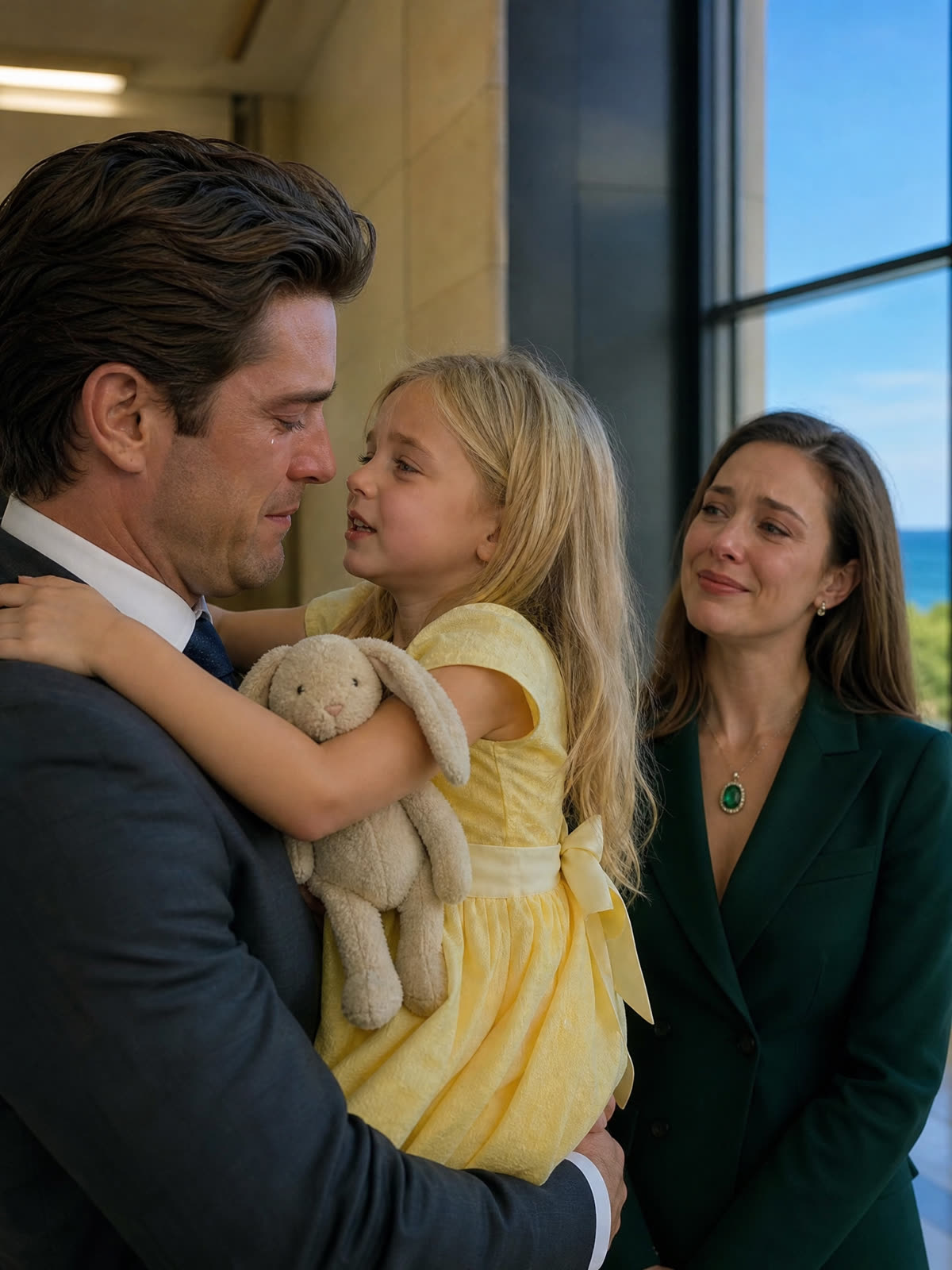
Desmond lifted her and held her without speaking. Tears ran openly down his face as he stood in the hallway of that Chicago courthouse with his daughter in his arms. People passed them, but nobody looked away. After everything she had been afraid to say, he could finally hear her telling him she was no longer frightened.
The trial continued for five months. Vivian Ashcroft was found guilty of murder, conspiracy, and fraud and sentenced to life without parole. Lawson Crane received thirty-four years. Nearly all of the one hundred and fifty million dollars was recovered and restored to the Rowan Maritime Trust, where it should have remained.
I did not celebrate the verdicts. A victory in court had never been what I wanted most. I wanted Pearl to sleep without the hallway light burning. I wanted my mother to walk again. And I wanted a life in which getting on a bus did not mean counting every coin first. Eventually, I received all three.
My mother’s recovery continued steadily. Desmond and I bought a house in Evanston, smaller than the mansion, with a porch swing and a maple tree. In the backyard, Maureen learned to garden. She gave every tomato plant the name of one of her doctors, turning her gratitude into something she could tend with her own hands.
Pearl renamed all the plants according to a system of her own. Every Saturday, she and my mother argued over which names were correct. The two of them had found something ordinary to disagree about, and neither seemed willing to surrender. After so much illness and silence, those arguments became part of our life together.
I put some of the recovered trust money toward creating the Walter Rowan Fund. It offered interpreters, sign language classes, and speech therapy without charge to families with deaf and nonspeaking children. Its first office occupied a converted brownstone on the north side. My father’s name belonged there, attached to the work his teaching had made possible.
Over the entrance, a small brass plaque carried a sentence in raised lettering and in sign: Silence doesn’t mean someone has nothing to say. Those were the words I had brought with me long before I knew there was an inheritance. They belonged to the father who had taught me to understand hands before I could read a page.
On a bright October morning, Pearl stood ready to cut the ribbon herself. The scissors were oversized in her hands. “Is that right, Addie?” she asked, raising them for me to see. “That’s exactly right.” She closed the blades, the ribbon parted, and the people gathered around us applauded.
Pearl turned toward the crowd and signed a small, solemn thank-you, just as she had learned to do. Several people answered her in the same language. She had once been afraid to let anyone know what her hands could say. Now she stood before an audience, offering a message and watching it come back to her.
Later, after the crowd had grown thinner, Desmond found me at the back of the room looking at the plaque. “He’d be proud of you,” he said. I kept studying my father’s words. “He wouldn’t have wanted a plaque.” Desmond answered, “He’d have wanted this.”
He nodded toward Pearl. She was teaching a roomful of children how to sign “banana.” Then he added, “He’d have wanted you to carry it on.” I took his hand. Beyond us was the work itself: children learning, hands moving, people being given a way to understand one another.
I remembered the woman I had been at the bus stop: the patched blue dress, the shoes kept together with glue, the two boiled eggs, and the folder repaired with yellow tape. I had walked toward that mansion convinced there was nothing about me that anyone inside could possibly need.
I had been wrong. What mattered most was the small, quiet gift my father had given me before I learned to read. It was the one thing I had carried into that house without knowing its value, and it had been the very thing someone there was waiting for.
“Mommy!” Pearl called, running toward us, breathless. She stopped in front of us and raised her enormous eyes to mine. Mommy. It was the first time she had called me that. I had been waiting to hear it, even while trying so hard not to let myself wait.
I knelt before her. Slowly, in my father’s language, her hands formed the words I would remember for the rest of my life: Mommy. Mine. I gathered her into my arms. Desmond wrapped his arms around us both, and from across that bright, noisy, beautiful room came my mother’s laughter.
My father had been right. Silence had never meant there was nothing to say. It had meant that someone was waiting for the right person to listen. Laughing and crying at once, I drew back enough for Pearl to see my hands. “Say it again,” I signed. She grinned—and lifted both hands.
Disclaimer: This story is a work of fiction inspired by real-life themes. Names, characters, places and events are fictionalized, and any resemblance to real persons is purely coincidental. Images are for illustration purposes only.
