


PART 1 — The Papers on the Birthday Table
Patricia closed her car door, settled the leather briefcase against her side, and looked toward the house.
“Good morning, Margaret.”
“Good morning, Patricia.”
Ashley folded her arms across her chest.
“I don’t understand why we’re having a legal meeting at a birthday party.”
Patricia’s gaze traveled from Ashley to David.
“Perhaps because your mother has spent six months trying to clarify certain financial arrangements involving this family.”
David stopped with his coffee cup suspended near his mouth.
“Financial arrangements?”
I indicated the dining room.
“Let’s sit down.”
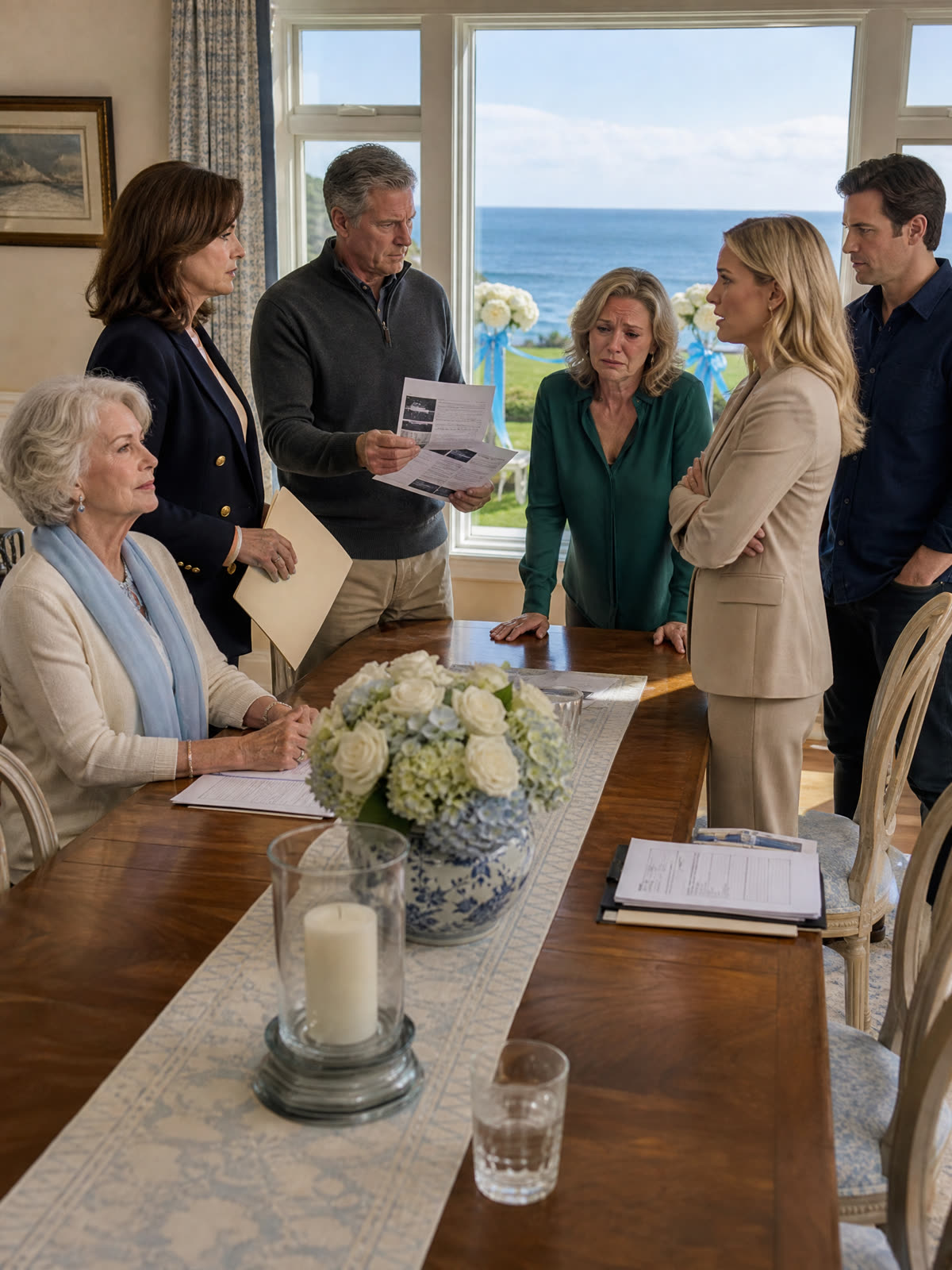
For several seconds, everyone stayed where they were. Beyond the windows, wind from the Atlantic swept past the house while workers positioned white chairs on the lawn. White roses, pale blue ribbons, and a long table facing the water were transforming the grounds for my birthday. It should have been a morning of celebration. Instead, the five people who followed me indoors looked as though they were walking into a courtroom.
Patricia placed her briefcase on the dining table. I remained on my feet.
“Before we begin, I want something understood. I didn’t invite Patricia to embarrass anyone.
She’s here because I’m no longer willing to pretend everything is fine.”
Ashley gave a dismissive laugh.
“Oh, Margaret. This is ridiculous.”
Patricia opened the case.
“Mrs. Hartwell, perhaps you should hear the information before reaching that conclusion.”
Ashley’s posture tightened.
“Excuse me?”
“Please sit down.”
Richard took a chair first, and Linda sat beside him. David lingered until I drew out the chair across from mine.
“David.”
He looked directly at me, then sat. Ashley finally took the remaining place. Patricia brought out a substantial folder. Its label read: FINANCIAL RECORDS — JANUARY THROUGH JUNE. Ashley inspected it with suspicion.
“What does that have to do with us?”
“More than you realize,” I replied.
Six months before that morning, I had noticed repeated transfers leaving my bank account for a company I did not recognize. At first, I blamed a banking mistake. Then I found three checks I had no memory of signing: one for $8,500, one for $12,000, and another for $6,200. All three had gone into an account belonging to Hartwell Lifestyle Consulting. Ashley had spoken about starting a consulting business, but I had never consented to finance it. When I asked David, he called the transfers temporary loans and assured me the money would be returned. Ashley told a different story. According to her, the funds had been a birthday gift. There were two explanations, neither matching the other, and only one account being depleted: mine. I had wanted to believe there was an innocent reason. Wanting that, however, did not make the discrepancies disappear.
Patricia turned the first page so everyone could see it.
“Between January of last year and last month, Margaret transferred $73,460 to David and Ashley.
Some payments were recorded as loans, others as emergency assistance, while several checks entered a business account.”
Richard bent toward the document.
“Seventy-three thousand?”
Linda looked at her daughter.
“Ashley?”
Ashley released an exaggerated sigh.
“Oh, for heaven’s sake. Margaret offered to help.”
“I did,” I acknowledged. “But that didn’t mean you could use my accounts without specific permission.”
Patricia laid another sheet in front of them.
“These records concern transactions involving financial information Margaret shared for a particular purpose.”
David’s forehead creased.
“What exactly does that mean?”
“Your mother approved payments to certain household contractors. She did not approve the additional transfers.”
Ashley shoved her chair backward.
“This is unbelievable. I don’t know what she’s talking about.”
Patricia’s manner did not change.
“Then explaining these transactions should help clarify matters.”
She slid a second folder toward Ashley, who made no attempt to open it. I watched her face. For the first time since I had known her, she seemed unable to decide what answer would serve her best.
“We also identified documents requesting changes to Margaret’s account access that appear to contain copied versions of her signature.”
David turned sharply.
“What?”
Ashley shook her head.
“That’s being taken out of context.”
“By whom?” Richard asked.
She looked toward her father.
“Dad, please.”
“No. Answer the question.”
Patricia set copies of the two documents side by side.
“The signatures remain under review. The bank has suspended the disputed access request.
Margaret has also withdrawn all unnecessary authorizations connected to her personal accounts.”
David turned to me.
“Mom, why didn’t you tell me?”
I almost laughed, though there was nothing remotely funny about the question. I had told him. Back in March, when the first questionable transaction came to light, I had called. He promised to speak with Ashley. The following day, he reassured me that it had all been a misunderstanding. I accepted his explanation—or perhaps I had simply needed to accept it.
“I did tell you,” I answered softly.
He dropped his gaze. Patricia moved to the next page.
“There’s another issue.”
Ashley rose suddenly.
“I won’t sit here while everyone treats me like I’ve done something terrible.”
Richard held her gaze.
“Then sit down and explain what happened.”
She stared at him. He had never spoken to her with that degree of firmness. The silence stretched until she lowered herself into her chair again.
Patricia continued without raising her voice.
“Margaret’s review also uncovered messages between Ashley and a financial adviser.
Those discussions concerned Margaret’s age, her circumstances after losing her husband, her assets, and possible arrangements for managing her property.”
David went completely still.
“What messages?”
Patricia spread several printed pages across the table. I knew the first one immediately. Ashley had sent it five months earlier: She doesn’t understand how much she has anymore. David says she just wants company. If we handle things carefully, she’ll let us manage everything. The next passage had been harder for me to absorb: Once the house is transferred, we won’t have to keep asking for money. David read it, then read it again. The expression on his face altered as he turned toward his wife.
“What house?”
Ashley parted her lips, but no answer came.
“Margaret’s house.”
My house. The white Cape Cod home where Harold and I had brought up David. The doorframes still held pencil lines marking the years of his childhood. Harold had died peacefully in our bedroom after forty-eight years of marriage. That was the home Ashley had once called inconveniently large for someone my age. David kept staring at her.
“You were trying to get Mom’s house?”
Ashley shook her head.
“No. That’s not what it means.”
“Then explain it.”
“She might eventually need assistance. We were considering possibilities.”
“Possibilities?” I repeated.
To my surprise, my voice stayed level.
“Did those possibilities include asking me to sign paperwork without fully explaining it?”
Ashley turned toward me.
“You’re making everything sound intentional.”
I reached into my handbag and took out a small envelope. Inside was a letter Harold had written shortly before he died. I had not intended to read it aloud. Yet looking at Ashley, I remembered how often I had let other people determine what I ought to endure.
“Harold knew I worried constantly about David,” I explained.
David lifted his head.
“Dad?”
I nodded.
“Your father worried that someday I’d mistake helping you for shielding you from your own decisions.”
I unfolded the letter. Near the end of his life, Harold’s handwriting had become a little less steady, but every line was unmistakably his. He wrote: Maggie, never let love become a reason to surrender your independence. David will always be our boy, but he is a grown man. Let him stand on his own feet. You have given him enough to build a good life. Don’t let anyone convince you that your kindness means you owe them the rest of yours. I stopped there. My hands were shaking. For a brief moment, I could almost hear him asking whether I had remembered his favorite coffee. Linda laid her fingers gently against my wrist, and I nodded my thanks.
Ashley shifted in her chair.
“That’s a touching letter, Margaret, but it doesn’t establish anything.”
“No,” I agreed. “It doesn’t. The financial records do.”
Patricia brought the folder together.
“The bank has referred the disputed paperwork for further review. All relevant records and communications have been preserved.”
Ashley stood again.
“This concerns our family. You can’t ru!n everything over a few misunderstandings.”
Richard rose slowly, holding the printed messages.
“A few misunderstandings?”
He looked from the pages to his daughter.
“You told us Margaret wanted everyone together for her birthday.
You claimed she preferred sleeping on the sofa and that you were arranging the entire weekend.”
Ashley faced him.
“I was trying to make things easier.”
“For whom?” Linda asked.
“Mom, don’t start.”
Linda’s eyes shone with tears.
“For years, I convinced myself you were ambitious, overwhelmed, and determined to succeed.
Whenever you needed help, you described Margaret as difficult, forgetful, or unable to handle her finances.”
She placed both palms on the table.
“Were you trying to convince us she couldn’t manage her own affairs?”
Ashley did not answer. In that silence, we were all left facing the same disturbing possibility. David pushed away from the table and went to the window. Outside, workers were placing little vases of white roses at the birthday settings. He watched them for a while before turning back.
“Mom, did you know all this before inviting us?”
“I knew enough to investigate. I didn’t know everything.”
“Why didn’t you tell me?”
I looked carefully at him.
“Because I hoped you’d choose to tell me the truth yourself.”
His shoulders sank. He understood what I meant. Perhaps only then did he recognize how much of the trust between us had already been lost. Ashley moved toward him.
“David, don’t let her turn you against me.”
He stepped back.
“Don’t.”
She stopped where she stood.
“I didn’t do anything without your knowledge,” she said hurriedly.
David stared at her.
“What are you saying?”
Her eyes moved between him and the papers.
“You knew your mother was supporting us financially.”
“Accepting help isn’t the same as using money without permission.”
“You told me she wouldn’t notice.”
The sentence was out before she could take it back. Nobody spoke. David’s face hardened.
“What?”
Ashley pressed her hand over her mouth. Richard closed his eyes, and Linda slowly withdrew her hand from the table. David moved a step nearer his wife.
“You told me she wouldn’t notice?”
Ashley shook her head.
“I meant the transfers and household expenses. You said she had plenty.”
“I never told you to take anything!”
“You knew we were struggling!”
“That doesn’t justify it!”
His voice rang through the dining room. Even when he was a teenager, I had never heard that much frustration in it.
He turned toward me with tears gathering in his eyes.
“Mom, I didn’t know about the documents.”
On that point, I believed him. But believing him could not undo the decisions he had made.
“You knew I was giving you money,” I said.
“You knew I continued helping even after telling you I was concerned about my savings.”
He nodded.
“You also knew I feared becoming dependent on others after your father passed away.”
His expression collapsed.
“I know.”
“And you allowed your wife to decide what I could afford.”
He looked down.
“I thought I was helping us through a difficult period.”
“David, I was struggling too.”
His eyes closed. That seemed to reach him more deeply than any page Patricia had laid before us. For so long, my difficulties had remained outside the conversation, while every problem in his household became another reason I should give.
“I had just lost your father.
I was learning to sleep alone in a home filled with his voice for almost fifty years.
Some mornings, I couldn’t even prepare breakfast because part of me still expected him to come downstairs.”
My voice shook.
“Instead of asking how I was coping, you called to ask whether I could pay another bill.”
David started crying. I did not go to him. It was not because I had stopped loving my son. It was because love could no longer require me to spare him every painful recognition. Patricia gathered the documents quietly.
“Margaret, we need to finalize two decisions.”
I nodded.
“Go ahead.”
“The first involves the disputed funds. We can seek recovery through the appropriate legal channels.
The second concerns the financial support arrangements you previously created for David and Ashley.”
Ashley looked up immediately.
“What arrangements?”
Patricia opened a different folder.
“Margaret established a discretionary family assistance account to help David with emergencies, medical expenses, and essential needs.
She has now instructed me to close that arrangement.”
Ashley laughed in disbelief.
“You can’t do that.”
Patricia met her stare.
“She can. The account belongs entirely to Margaret.”
David swallowed.
“Mom, please don’t.”
I faced him.
“I haven’t decided whether I’ll ever help you financially again.
But I have decided that any future assistance must come with clear responsibility.”
He gave a slow nod.
“The disputed transactions will be addressed separately. Margaret won’t provide further payments while the review continues.”
Ashley seized her handbag.
“This is unbelievable. I’m leaving.”
Richard moved out of her way.
“Then leave.”
She looked at him as though she could not understand his response.
“You’re my father.”
“And I’m deeply disappointed that my daughter considers it acceptable to embarrass a woman who has generously supported this family.”
Ashley turned to Linda.
“Are you seriously taking her side?”
Linda wiped a tear from her cheek.
“I’m standing with the truth.”
Ashley surveyed the room, clearly waiting for David to come with her. He did not move. She picked up her bag and walked toward the stairs, stopping in the doorway.
“David?”
He did not turn around.
“I’m not going anywhere until you come upstairs and talk to me.”
He stared at the floor before answering with words I had never expected to hear.
“You’ve been talking for years. I think it’s time I listened to somebody else.”
Ashley went upstairs. A bedroom door slammed, the noise carrying through the house. We all remained silent. Outside, the ocean kept moving toward shore, untouched by anything that had happened around our table.
Patricia rested her hand over mine.
“Are you all right?”
I looked at the preparations for my celebration: the white roses, the blue ribbons, the seventy little candles waiting for nightfall.
“No,” I admitted.
“But I believe I’m finally making the right decisions.”
Patricia nodded.
“That’s enough for today.”
She left soon afterward, promising to speak with the bank and provide updates through the proper channels. Richard and Linda remained in the house. David stayed by the window. A heavy exhaustion came over me then. It was not the ordinary tiredness of a demanding morning. It was the deeper weariness of admitting that people I loved had hurt me, and that loving them had not prevented it. Nothing about that recognition felt victorious. Necessary did not mean painless.
I climbed the stairs and walked to the master bedroom. My bedroom. Ashley’s suitcase stood open across the bed. Designer clothing covered the white comforter, and her cosmetics crowded the bathroom counter. I stopped in the doorway, looking at everything she had settled there. Then I lifted the framed photograph from the bedside table. Harold and I were celebrating our fortieth anniversary in it. He was laughing, and I was leaning into his shoulder. I carried the picture downstairs. Linda noticed it at once.
“Are you going to take the master bedroom?”
I met her eyes.
“Yes.”
She gave me a sad little smile.
“Good.”
I had finally said where I belonged. But Ashley’s belongings were still spread across the bed upstairs.
PART 2 — What They Had Not Told Me
That afternoon, David knocked on my bedroom door. I was sitting by the window, watching the tide move in.
“Come in.”
He stood in the doorway with red eyes, looking older than he had that morning.
“Can I sit?”
I nodded. He pulled a chair toward mine but left a little space between us. For a while, neither of us said anything.
“I don’t know where to start.”
“Start with the truth.”
He rubbed his palms together.
“When Dad died, I thought I had to handle everything.
The house, the bills, you.
But I didn’t know how.”
I watched his face.
“You never asked what I needed.”
“I know.”
“You made the decisions yourself.”
He nodded. The distance between our chairs felt small compared with the distance those decisions had created.
“Ashley kept saying you were lonely and that helping us financially gave you a sense of purpose.”
I turned my face away.
“Did you believe that?”
“Initially, yes.
Later, I realized you were helping because you loved us.
But I didn’t want to acknowledge how much we’d come to depend on you.”
He swallowed.
“I was ashamed.”
“So you continued accepting my money.”
“Yes.”
“And when Ashley lied about the bedroom?”
He lowered his eyes.
“I heard her. I knew you’d never agreed to sleep on the sofa.”
I shut my eyes. That admission cut more deeply than anything else he had said.
“You knew?”
He nodded.
“I thought correcting her would cause an argument. I didn’t want to spoil the weekend.”
I faced him again.
“So you thought it was acceptable to spoil my birthday instead?”
His mouth trembled.
“I was selfish.”
I let the silence stay between us. David began to cry quietly.
“I miss Dad,” he whispered.
The confession surprised me, not because I questioned his sorrow, but because he had not spoken those words in the three years since Harold died.
“I miss him too,” I replied.
David looked down at his hands.
“Sometimes I call your number just to hear your voice because I can’t call his anymore.”
I reached toward him and rested my fingers against his.
“Then call me, David.
But call because I’m your mother, not because you need another payment.”
He nodded.
“I understand.”
I wanted to tell him that everything would be all right, that forgiveness had already repaired the damage, that the next morning would bring something different. But I could not give assurances I did not yet know how to keep.
“Rebuilding trust takes time,” I said.
“I know.”
“And I need you to understand that things cannot return to how they were.”
His hand closed gently around mine.
“I don’t expect them to.”
He stayed another twenty minutes. We spoke about Harold: the summer David fell off his bicycle and his father carried him home with a scraped knee, and the Christmas tree that toppled after David loaded one branch with too many decorations. A little laughter found its way into the room. It was brief and unexpected, but it belonged to us. At last, David rose.
“Happy birthday, Mom.”
He kissed my forehead.
“I’m sorry I made you feel alone.”
I watched him go. For the first time in years, he seemed to have spoken to his mother rather than to the person who could pay away his difficulties. Yet there was still another conversation waiting for me.
At four o’clock, Linda appeared upstairs.
“Can I come in?”
“Of course.”
She sat beside me on the bed and spent several moments studying the framed photograph of Harold. Then she turned toward me.
“I need to tell you something about Ashley.”
“What is it?”
Linda clasped her hands tightly together.
“Three months ago, she asked Richard and me to help prepare paperwork concerning your house.”
My stomach contracted.
“What paperwork?”
“She claimed you’d eventually agreed to transfer ownership.
She wanted us present to witness a conversation with you.”
A cold feeling moved through me.
“Did you agree?”
“No. Richard refused.”
“Why?”
Linda glanced toward the window before answering. I waited, already afraid of what explanation could have accompanied such a request.
“Because Ashley claimed you were becoming forgetful.
She suggested settling everything early, before managing decisions became more difficult for you.”
I stared at Linda.
“And you believed her?”
Tears filled her eyes.
“I wanted to believe she was helping you.
But something about the situation didn’t feel right.”
She opened her purse and removed a folded envelope.
“I kept this.”
Inside was a photocopy of a proposed agreement transferring property. My name was printed at the top, and David was identified as the intended recipient. Another provision, however, held my attention. It would have given Ashley authority over the management of the property and related financial decisions. I read those lines once, then again, then a third time. All morning, I had been trying to absorb how far things had gone. Now another page showed me there was still more I had not known.
“Did David know?”
Linda shook her head.
“I don’t believe so. But I can’t be certain.”
I folded the document carefully.
“Patricia needs to review this.”
“I know.”
Linda touched my arm.
“Margaret, I’m sorry.”
“For what?”
“For letting Ashley speak on your behalf.
For accepting her explanations without questioning them.
For not coming directly to you.”
I searched her face. What I saw was not merely the embarrassment of having been caught on the wrong side of a disagreement. Her regret was real.
“Thank you for keeping the document,” I said.
She nodded. Then she put her arms around me. It was not the quick, courteous hug we exchanged at family occasions. It was an honest embrace, long enough for both of us to stop pretending that any of this was all right.
My birthday celebration went ahead that evening. I had thought about canceling it. Then I looked at the flowers, the carefully prepared table, and the ocean beyond the windows. For years, I had let other people’s feelings decide whether I was permitted to enjoy my own life. I would not do that again. Guests started arriving shortly before sunset: old neighbors, former colleagues, and friends who had known Harold before David was born. The caterer brought out lobster, roasted vegetables, warm bread, and the lemon cake I had ordered weeks before. David came downstairs in a clean shirt. Ashley remained upstairs. Richard and Linda joined everyone, though neither could completely hide how troubled they were. Nothing had been neatly resolved. Even so, the evening was mine, and I intended to be present for it.
At seven, David came over to my chair.
“Mom, can I say something before the cake?”
“Of course.”
He stood beside me and lifted his glass. Conversation faded around the table.
“I want to thank my mother for bringing everyone together tonight.”
He paused, looking directly at me.
“She planned this weekend. She paid for it.
And she deserves to enjoy every moment.”
His voice faltered.
“I also owe her an apology.
I haven’t shown her the respect she deserves.
I allowed someone else’s description of her to matter more than the woman who raised me.”
Nobody interrupted him. He lowered the glass.
“Mom, I’m sorry.”
My eyes filled, and I reached for his hand.
“Thank you, sweetheart.”
He sat beside me while the guests offered gentle applause. What he had said could not restore everything. But he had said it plainly, without asking me to make it easier for him.
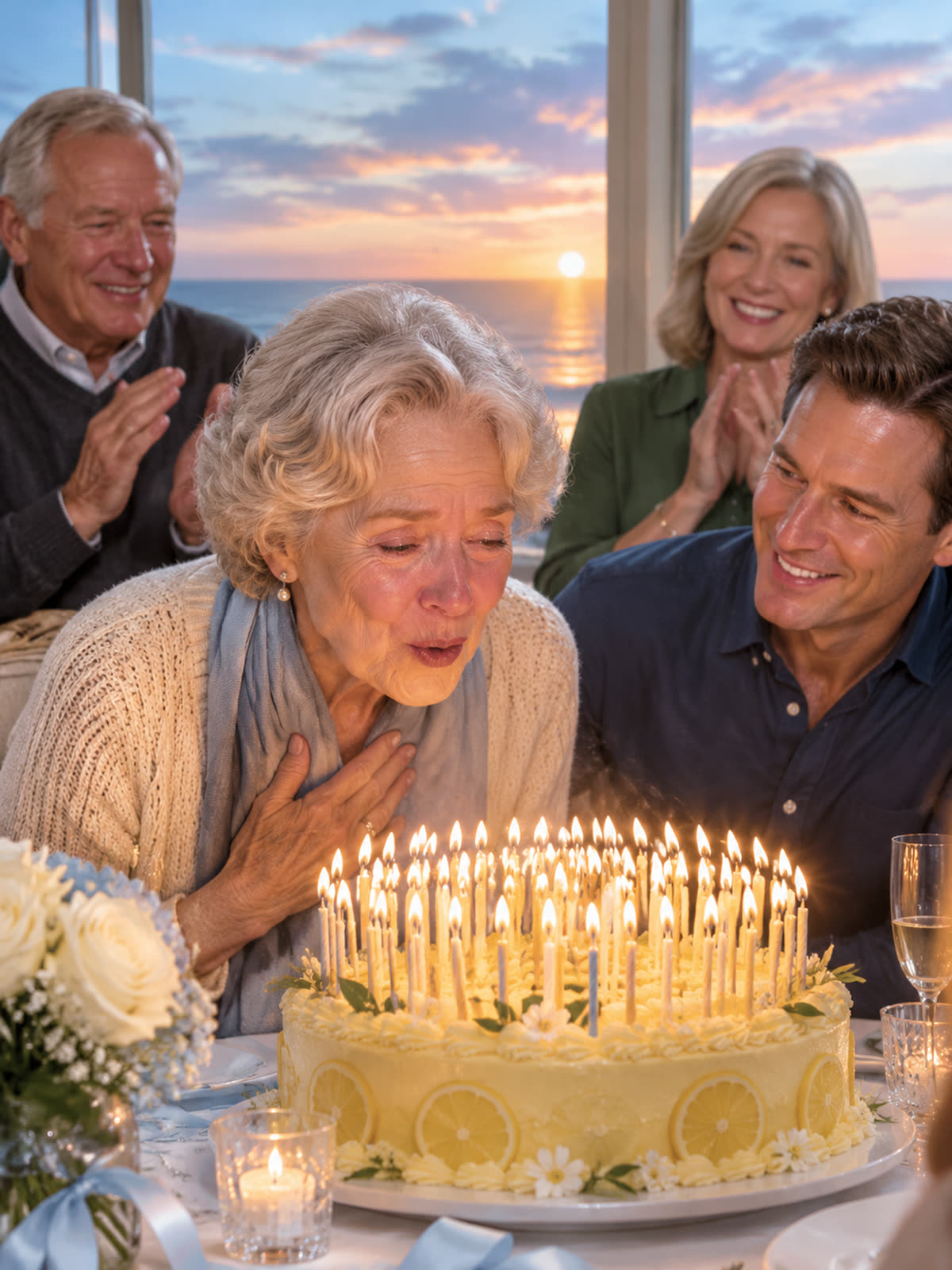
Someone began singing Happy Birthday. I laughed while tears ran down my face. Seventy candles trembled in the evening light. I shut my eyes, and for an instant I pictured Harold across the table, smiling behind his coffee cup. I made my wish. Not for money, and not for revenge. I wished for courage. Then I blew out the candles, and applause rose around me. For the first time in three years, I did not feel like a widow waiting for life to resume. I felt like a woman who still had life ahead. The flowers, the guests, and the light over the ocean had not erased the morning. They simply reminded me that pain did not have to claim every remaining hour of the day.
By the following morning, Ashley was gone. Her suitcase had disappeared from the master bedroom, and the expensive skincare products no longer occupied my bathroom counter. She had left a note on the kitchen island: David, we need to talk privately. I cannot believe you allowed your mother to hum!liate me. There was no apology in it, no mention of the financial records, and no acknowledgment of the money. There was only blame. David read it beside the coffee machine, folded it, and dropped it into the trash.
“I’m going to stay at a hotel for a few nights,” he told me.
I nodded.
“Take whatever time you need.”
He hesitated.
“Mom, I don’t know what happens next.”
“Neither do I.”
He looked out toward the water.
“But I know I can’t continue living this way.”
I put my hand on his shoulder.
“Then begin making choices you can respect.”
He embraced me before he left.
The birthday weekend ended, but the legal issues did not end with it. Patricia remained in contact with the bank. The disputed documents went through formal examination, and the banking records established that the contested request for account access had never been approved. Every transfer was considered on its own. Some payments were legitimate loans, which David acknowledged. Others had been made without my informed permission. Ashley eventually hired an attorney. For several weeks, our representatives handled the communication. I did not answer angry messages or argue over accusations. I stopped trying to defend myself to people who would not consider what had happened from my perspective. I kept the paperwork. Just as importantly, I kept the boundaries I had finally established. Neither was useful if I abandoned it the moment someone objected.
The investigation ultimately found that Ashley had knowingly supplied inaccurate financial information and had tried to obtain authority over property she had no right to manage. The disputed paperwork was withdrawn. The bank permanently canceled the unauthorized access requests. The outstanding financial claims were resolved formally, with Ashley agreeing to repay money transferred without proper authorization. Her business account closed. Her professional standing suffered when the findings became part of the proceedings. The proposed transfer of my property never happened. There was no dramatic arrest in front of my house, no shouting match in a courthouse corridor. The consequences arrived quietly, but they were lasting. Ashley did not gain the control she had pursued. She had damaged the trust of the people who once defended her, and my generosity could no longer be treated as permission to interfere with my independence.
Richard and Linda found it difficult to come to terms with everything. One afternoon, Richard called.
“Margaret, I owe you an apology.”
“You aren’t responsible for Ashley’s decisions.”
“I know. But I should have questioned her sooner.”
He paused.
“I keep thinking about that bedroom.”
I looked toward the ocean.
“So do I.”
“I should have insisted you take it.”
“You eventually did.”
“Not soon enough.”
I valued his understanding of that distinction. There was a difference between eventually objecting and refusing to accept something in the first place. He was not trying to erase it with a quick apology. He was acknowledging the moment when he could have acted differently, and that mattered to me more than an easy explanation would have.
Later that week, Linda asked me to lunch. We met at a small restaurant facing the harbor. She was early and had already ordered tea. At first, we talked about ordinary things: the weather, grocery prices, and a neighbor’s newly adopted golden retriever. Then she reached across the table.
“I hope you understand that you never have to invite us anywhere again.”
I smiled.
“Linda, I invited you because I wanted your company.
Not because I needed anyone’s approval.”
She nodded.
“Would you still invite us next year?”
I looked into her eyes.
“If we’re both willing to be truthful, absolutely.”
She laughed through her tears. Our friendship survived that way—not because we pretended the weekend had never happened, but because we were willing to speak honestly about it. I did not need the past denied. I needed it understood.
David changed more slowly. He rented a modest apartment close to work. During the first month, he called each Sunday, and our conversations were awkward at first. He would ask whether I had eaten. I would ask whether his electricity bill was paid. We were trying to find a way of speaking that did not place money in the middle of everything. Neither of us knew immediately how to do that. The habit of his needing and my providing had shaped too many conversations for too long. Still, the calls continued, and that gave us room to practice something different. Trust was not returning in one grand gesture. Whatever might be rebuilt would have to be made from ordinary choices, repeated without a demand attached.
One Sunday, he called while I was pruning my roses.
“Mom?”
“Yes?”
“Can I come over?”
“Of course.”
“Not because I need anything.”
I smiled.
“I didn’t assume you did.”
He arrived carrying a paper bag. Inside were two pieces of apple pie from a bakery near his apartment.
“I remembered Dad liked this kind.”
I looked down at them. Harold had loved apple pie, particularly when it was warm. David and I took the slices out to the back porch and ate slowly. He told me about his apartment, his neighbors, the refrigerator that made too much noise, and his first attempt at cooking chicken, which he had burned. I laughed so hard that I had to put down my fork.
Then his face became thoughtful.
“I used to believe adulthood meant having everything figured out.”
I looked at him.
“Most of us are still learning.”
“I think I forgot you were learning too.”
I touched his hand gently.
“We all are.”
He turned toward the garden.
“Do you think Dad would be disappointed in me?”
I took a moment before answering.
“Your father would have been upset about what happened.
But he would have wanted you to accept responsibility and grow from it.”
David nodded.
“I want to do that.”
“Then do it. One choice at a time.”
He stayed until sunset and washed our plates before leaving, without being asked. It was a small thing. Yet sometimes small things show whether a person has truly begun to change.
Over the following months, I changed the locks, revised my estate paperwork, and opened a separate savings account. I named Patricia as an independent contact for important financial matters. Fear was not guiding those decisions. I was learning that protecting my independence did not require anyone else’s permission. I also began doing things I had postponed. I joined a gardening club, signed up for painting classes at the community center, and walked on the beach three mornings a week. My arthritis still bothered me, particularly in cold weather, but I stopped treating every ache as a reason to stay inside. Then, one afternoon while sorting Harold’s old desk, I found a small wooden box. I recognized it immediately. He had kept it locked for years. I had never been especially curious about what was inside. This time, I opened it.
PART 3 — The Key Harold Left Behind
Inside the box were photographs, several old receipts, a small silver key, and an envelope with my name on it. Across the front, Harold had written: Maggie — Open when you are ready. My hands started trembling. I sat down before opening it. The letter inside was dated eight months before his death. There was his handwriting again, waiting among the ordinary things he had saved. After everything that had happened with David and Ashley, I had spent so much time examining documents for what they might have taken from me. Now I was holding something Harold had left for me. I unfolded the pages carefully and began to read.
The letter began: My Maggie, If you are reading this, I hope you have found a little more peace than you had when I wrote it. I know how much you worry about David. I know you will always want to make his life easier. That is one of the reasons I love you. But I want you to remember something. We did not raise our son so that he could spend the rest of his life being carried. We raised him so that one day he could stand beside us. There may come a time when people mistake your kindness for weakness. Don’t argue with them. Just remember who you are. I have also left something in the box that belongs to you. It is not money. It is something I hope you will use when you are ready to begin again.
I picked up the little silver key and examined it. Then I used it to open a hidden compartment in the wooden box. Inside was a photograph of a lovely cottage near the water, surrounded by wildflowers and a white picket fence. I turned it over. Harold had written on the back: The place we always said we would visit when we finally had time. I stared at the picture. I remembered that cottage. Twenty years earlier, while traveling along the Massachusetts coast, Harold and I had passed it. I had admired the garden. He had joked that we should buy the place and spend our retirement watching the sea. We had laughed together, carrying the thought with us for a little while before ordinary life crowded it aside.
There had always been something requiring our attention. Work, bills, David’s education, repairs to the house, and family obligations filled the years. We kept assuming that later would leave room for everything we had postponed. Apparently, Harold had never let go of that little house. Beneath the photograph, I found a reservation confirmation. He had paid for a week at the cottage during the autumn following his death. The reservation was no longer valid, but the address was still there. Underneath it, he had added one last handwritten sentence: You don’t have to wait for anyone to give you permission to enjoy the life we built. I held the letter to my chest and began to cry.
It was not the same overwhelming grief that had followed Harold’s death. This crying felt different, as though feelings I had carried for years were finally finding their way out. The next morning, I called the cottage’s owner. The property was still there: the little white house, the garden, the wooden fence, and the sea. I booked a week. The old reservation could not be used, but the place itself had not disappeared. For so long, later had seemed like a promise that life would always honor. Holding Harold’s letter, I understood that waiting did not make a dream safer. Sometimes it merely kept the dream beyond reach.
When I told David about my plans, he smiled.
“That’s wonderful, Mom.”
“Would you like to visit for a day?”
He thought about it before answering.
“Only if you really want me there.”
I laughed.
“I wouldn’t have invited you otherwise.”
It was a small exchange, yet I noticed the difference. He was not assuming that every invitation carried an obligation, or that my plans belonged to everyone before they belonged to me. I had asked because I wanted to spend that time with him. He had paused long enough to make certain it was what I wanted. There was no request for money beneath the conversation, no expectation that I should turn my week into something arranged around his needs.
David came to the cottage one afternoon. We walked beside the ocean, ate sandwiches on the porch, and watched the sun go down. At one point, he stopped near the fence.
“Dad would have loved this.”
“He did love it.”
David turned to me.
“I’m glad you’re doing this.”
I squeezed his arm.
“Me too.”
We did not devote the afternoon to talking about Ashley. There was no reason to. What had happened deserved to be acknowledged, but it did not deserve to occupy every conversation afterward. The beach, the porch, and our time together were not an argument with the past. They were simply parts of the life still available to us.
Before he left, David gave me a small envelope. A check was inside: his first payment toward the legitimate loans he had accepted responsibility for. It was not a large sum, but he had earned it himself. I studied the check.
“David, you don’t have to repay everything immediately.”
“I know. But I want to begin.”
I folded it and put it in my purse.
“Thank you.”
He embraced me. This time, I hugged him back without wondering whether a financial request would follow. The amount was not what made the moment important. He had chosen to begin making things right, without waiting for me to ask or explain why it mattered. For once, the envelope in my hand represented responsibility rather than another demand.
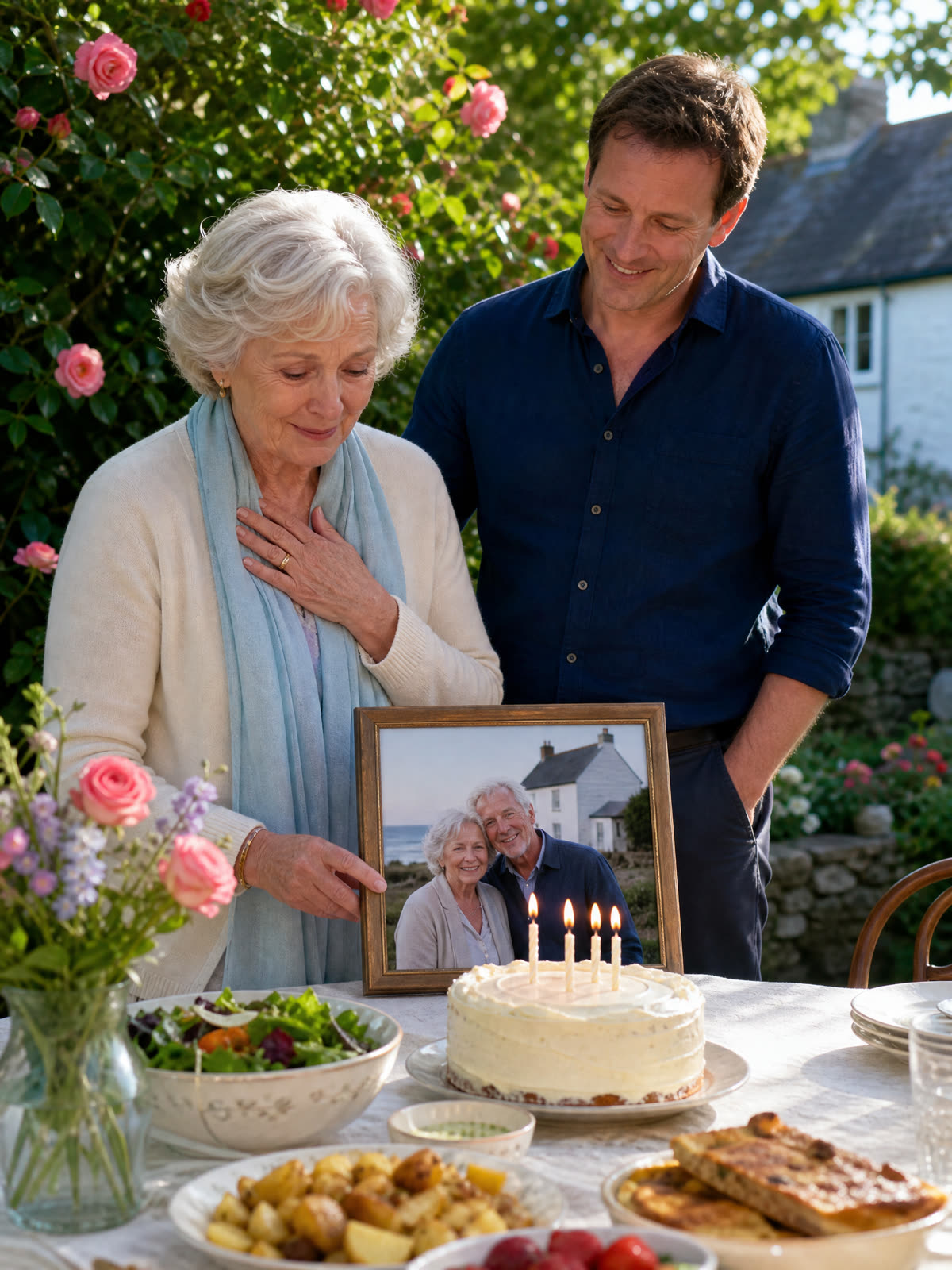
The following spring, I celebrated my seventy-first birthday at home. There was no expensive rental, no elaborate catering, and no attempt to make the occasion grander than it needed to be. We had a small garden table, fresh flowers, homemade food, and people who genuinely wanted to celebrate with me. Richard and Linda came. Two old friends brought dessert. David arrived early to help put out the chairs. He also brought a framed photograph. It showed Harold and me outside the little cottage. Until that moment, I had not known David had a copy. I looked at the picture, then at my son.
“When did you get this?”
“Dad gave me a copy years ago. He told me to keep it safe.”
I examined the photograph. Harold’s arm was around my shoulders, and I was laughing. Behind us, the ocean stretched into the distance. David smiled.
“I thought you should have it.”
I placed the frame beside my birthday cake. There we were, in a moment I could still recognize, beside a place that had waited through all the years we believed we would eventually have time. The picture was not a replacement for Harold. Nothing could be. But it belonged among the flowers and the food and the people gathered in my garden. His memory did not have to remain shut away from the life I was still living.
Later, when everyone had settled around the table, Richard raised his glass.
“To Margaret.”
Linda smiled.
“To her courage.”
David lifted his glass last.
“To my mother, who taught me that loving someone means respecting them, even when they don’t give you what you want.”
I looked at him. His eyes were clear. There was still regret in them, but there was something else now, something I had missed for years: understanding. We ate, laughed, and retold familiar family stories. Nobody needed to make an announcement about how different the afternoon felt. The difference was already there in the way we spoke to one another, in who had helped arrange the chairs, and in the absence of any expectation that I should earn my own celebration.
As the sun lowered behind the trees, I stepped onto the porch alone. The garden had grown quiet. A light breeze moved through the roses, and I looked at Harold’s photograph. For three years, I had believed that losing him meant losing the person who made me feel safe. Now I understood it differently. He had left things that outlasted his presence: our home, our family, the memories we had made, and the confidence to continue even when people I loved disappointed me. Missing him had not become less real. It simply no longer meant that every part of me had to remain where grief first found me.
My phone vibrated. David had sent a message: Thank you for today, Mom. I love you. I smiled. Then another message appeared, this one from Linda: You looked beautiful today. Happy birthday again. I set the phone on the table. For a moment, I thought about the Cape Cod weekend again—the master bedroom, the sofa, and the remarks I had overheard. Your mother is just a lonely old widow. She can sleep on the floor. Those words no longer determined the way I saw myself. They had become a reminder of the moment I finally understood that living alone did not mean being powerless over my own choices.
For years, I had believed that holding a family together meant quietly absorbing every disappointment. I had treated endurance as though it were the same thing as love. But a healthy family should not require one person to give up her dignity so everyone else can remain comfortable. I could love David without continuing to finance his mistakes. I could forgive him without denying what he had done. I could hope Ashley found happiness without allowing her back into my private affairs. And I could miss Harold every day without assuming that my own story had ended when his did. Those truths did not cancel one another. I no longer needed to choose between caring for other people and respecting myself.
That evening, I went inside and returned Harold’s letter to the wooden box. I placed our cottage photograph beside it, then closed the lid gently. I was not trying to put the past out of sight. I had learned that memories could be treasured without being allowed to prevent the next part of life from beginning. The box would still be there. So would the words he had written. I did not need to carry them in my hands every hour for them to remain with me. What mattered was that I had finally begun to live as though I believed them.
A week later, a small package arrived from David. Inside was a delicate silver necklace and a note written by hand: For the woman who deserves to feel celebrated every day, not just once a year. I love you. David. I put the necklace around my neck. It was not especially expensive, and the price made no difference to me. What mattered was that he had chosen something for his mother without attaching a request to it. I stood before the mirror and looked at myself: seventy-one, silver-haired, with a few more wrinkles and a body that sometimes complained when the weather changed.
But my eyes met their reflection with a confidence I had not felt in years. I smiled, picked up my keys, and prepared to meet a friend for lunch. The Cape Cod rental had cost three thousand dollars. The birthday weekend had asked far more of me than money. Still, what I had gained could not have been bought. I had learned that setting boundaries did not require me to close my heart. Protecting my independence did not demand bitterness. Sometimes the most loving thing a mother could do was stop carrying an adult son through the consequences of his own choices. That lesson had hurt. It had also made room for a relationship that did not depend on my continuing to surrender more of myself.
As I walked toward the car, warm sunshine touched my face. My phone rang. It was David.
“Hi, Mom.”
“Hello, sweetheart.”
“I was wondering if you’d like to have dinner with me this weekend. Just us.”
I smiled.
“Where?”
“Your favorite little Italian restaurant. I’ll make the reservation.”
“Are you paying?”
For a moment, he was quiet. Then he laughed.
“Yes, Mom. I’m paying.”
I laughed too.
“Then I’d love to come.”
We said goodbye. I put the phone in my purse and looked up at the clear blue sky. There was nothing elaborate about the invitation. That was part of what made it matter. My son had called because he wanted my company, and he was taking responsibility for the evening himself.
For the first time in years, I was not waiting for someone else to tell me what I was worth. I knew. That was enough. I had my home, my memories, and people who cared for me without requiring me to disappear inside their needs. More than anything, I still had myself. That was the greatest birthday gift Harold had left me: not a new life untouched by sorrow, but the courage to keep living the one that remained mine. I had spent seventy years building a meaningful life. Whatever came next, I would not spend the years ahead accepting a place on someone else’s floor.
Disclaimer: This story is a work of fiction inspired by real-life themes. Names, characters, places and events are fictionalized, and any resemblance to real persons is purely coincidental. Images are for illustration purposes only.
