

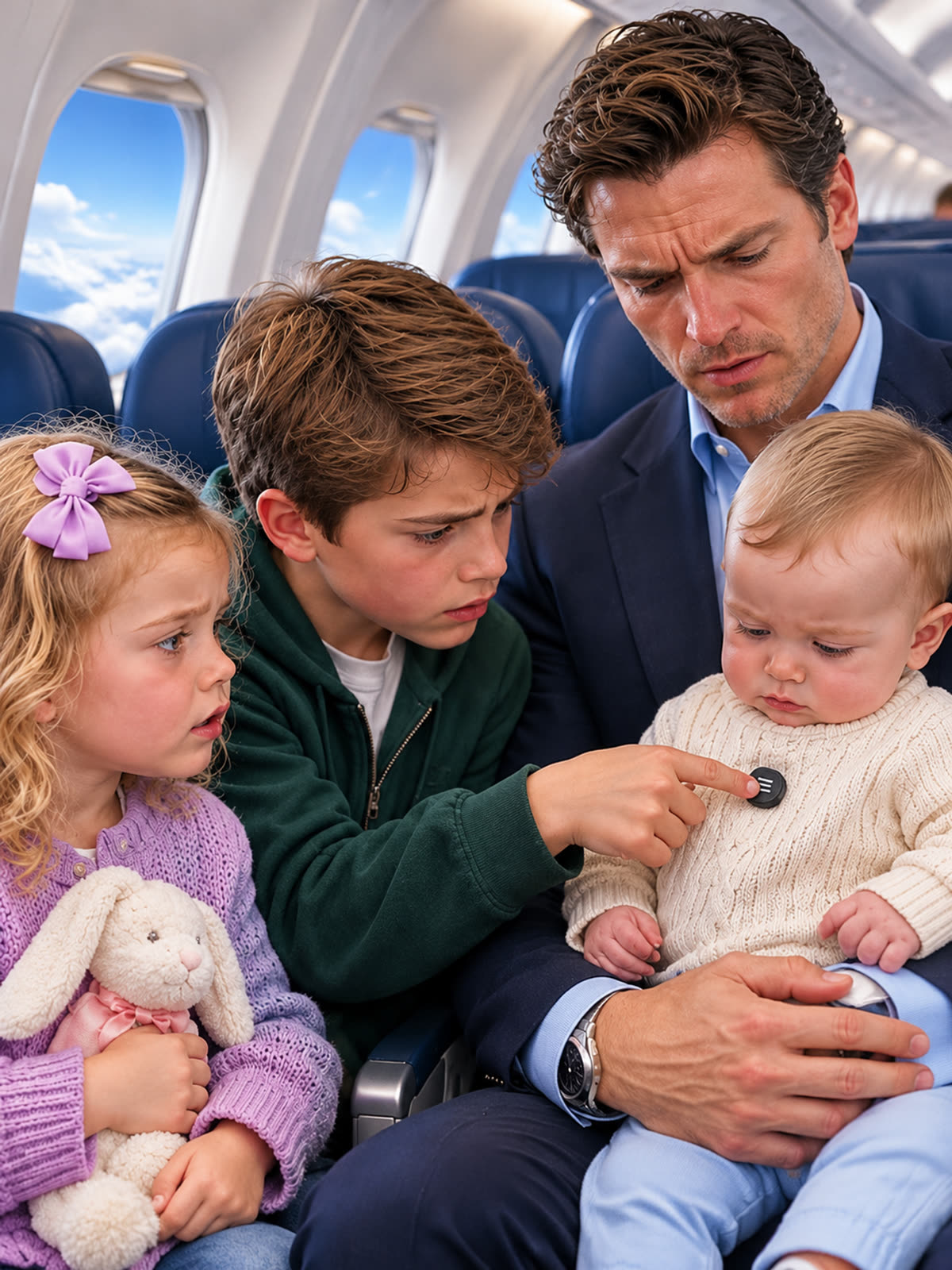
PART 1 — The Baby, the Beacon, and the Missing Mother
“Sir, I think your baby is trying to tell you something.” The wealthy businessman stared at me as if I had no right to interrupt him. His six-month-old son had been crying for almost an hour on our flight to Rome. Two flight attendants, a private nurse, and even his security guard had already attempted everything they could think of. Then I noticed something strange beneath the baby’s shirt. His distress might have nothing to do with hunger. What I discovered would link this stranger’s family to the night my mother vanished. I was only ten.
My name is Wesley Hartwell. Just four days before that flight, I had been an ordinary fifth grader in a peaceful neighborhood outside Philadelphia. Now I was crossing the Atlantic with my three-year-old sister, Poppy, going over every instruction our mother had given me. Rebecca Hartwell was the sort of mother who checked our schoolbags twice and tucked encouraging notes into our lunches. She never let us forget that family came first. Until those four terrible nights, I had never imagined facing something like this without her.
That evening, I overheard Mom arguing on the telephone downstairs. When I went to see what was happening, she was beside the kitchen table, studying a small black object in her hand. Something about her expression seemed unfamiliar. “Wesley, take Poppy upstairs and get your blue backpack.” I asked, “What’s wrong, Mom?” Her answer frightened me more than the argument had. “I need you to listen carefully. If I tell you to leave, use the garden gate and go straight to the place we discussed.”
She pulled me into a hug so tight I could hardly breathe. “Whatever happens, stay with your sister.” A few minutes afterward, somebody knocked at the front door. I heard quick footsteps, a raised voice, and the sound of something falling in the kitchen. By the time I came downstairs again, Mom had disappeared. Her phone was on the floor beside an overturned chair, and the back door was open. I waited for her to come home. She never did.
Eventually, I remembered the emergency envelope she had concealed in my bedroom. It held money, two plane tickets, and an address in Rome for a woman called Rosalie Whitcomb. Mom had once explained that Rosalie was a relative we could always turn to for help. I gathered Poppy, her favorite stuffed rabbit, and our little suitcase, then followed the plan Mom had left for us. I had no way of knowing whether I was choosing correctly. I knew only that my little sister could not be left alone.
We were halfway over the Atlantic when a crying baby drew my attention toward business class. I had walked forward to ask an attendant for warm water for Poppy and found several adults gathered around one seat. A tall man in an expensive charcoal suit stood holding the baby, looking utterly exhausted. I later learned his name was Everett Blackwood. He ran a successful technology company and traveled with a security adviser named Russell. None of his money seemed capable of giving his son any comfort.
“He’s been fed, changed, and examined,” one of the flight attendants explained. “We can’t figure out what’s bothering him.” The baby twisted away when someone brought a bottle toward him. Watching him, I remembered the way Poppy sometimes behaved when she was smaller. “Maybe he doesn’t want another bottle,” I said quietly. Everett turned to look at me. “Excuse me?” I suddenly felt very young standing among all those adults, but the baby’s restless movements still reminded me of my sister.
“Maybe he just wants you to hold him close enough to hear your heartbeat.” Everett seemed taken aback. “And how would you know that?” I answered as honestly as I could. “My sister used to cry like that. Mom said sometimes little kids need to know someone is there.” Everyone fell quiet for a moment. Then Everett shifted the baby higher against his chest. Little by little, the crying began to ease, and the tense gathering around his seat grew still.
“His name is Oliver,” Everett told me. “He’s cute,” I said. “I think he likes you.” A weary smile crossed his face. For a moment, it seemed that the problem had been nothing more complicated than a baby wanting his father nearby. Then Oliver moved against Everett’s shoulder. Beneath the collar of his cotton shirt, I caught sight of a small dark shape. It did not look like part of his clothing, and I could not stop looking at it.
“Sir, what’s that under his clothes?” Everett glanced down, and Russell moved closer to inspect the fabric. Fastened inside Oliver’s clothing was a flat black object scarcely bigger than a matchbox. Three thin silver lines sat within a circle on its surface. My stomach tightened the instant I saw that emblem. There was no mistaking it. I had seen precisely the same mark on the object in our kitchen the night Mom disappeared.
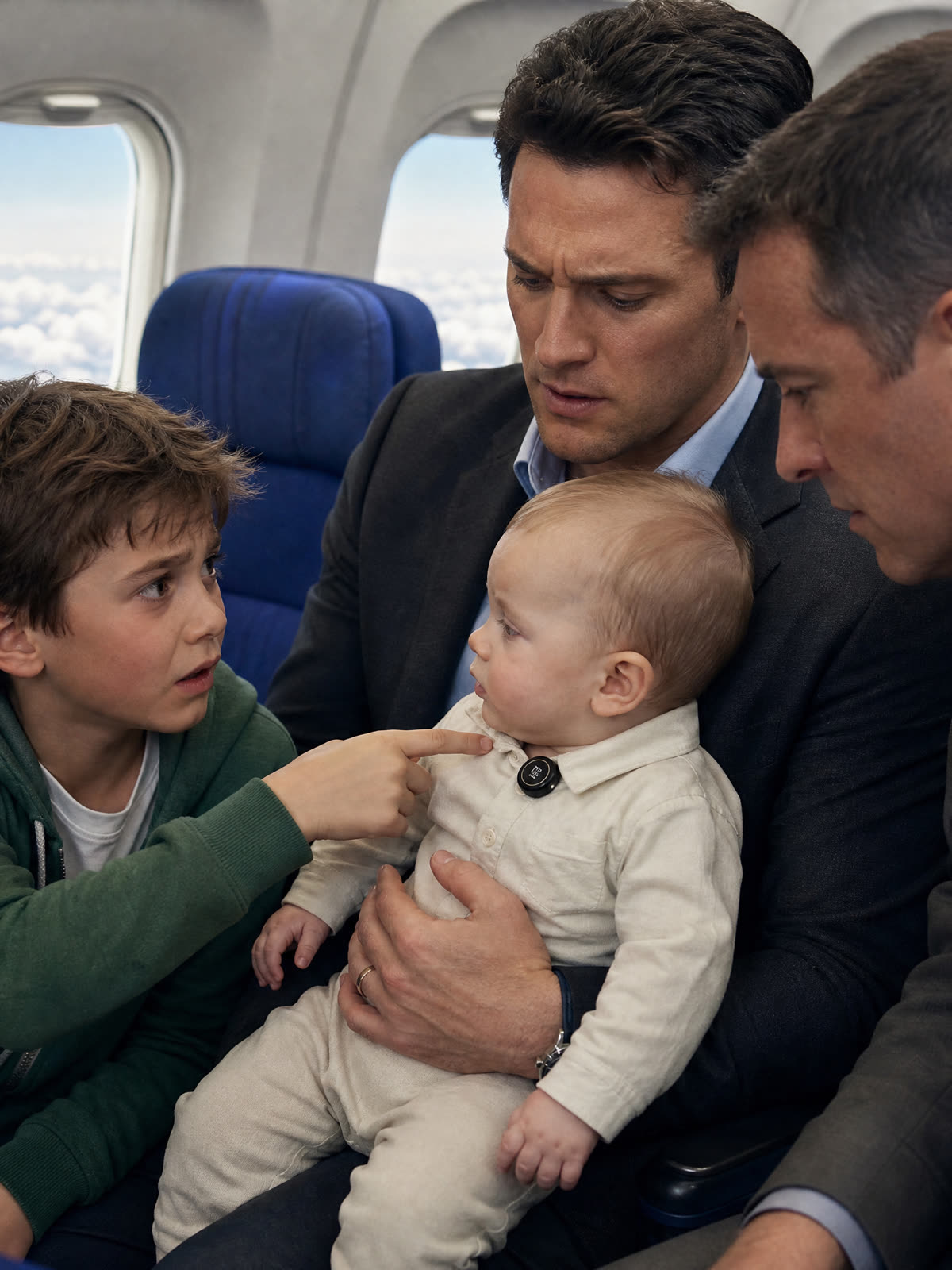
“Where did you get that?” I asked. Russell’s attention moved straight to me. “Why?” I looked from him to Everett before answering. “Because there was one just like it in our kitchen the night my mother disappeared.” Everett’s expression changed immediately. He asked me to sit and tell him what had happened. Until then, I had been a child offering advice about a crying baby. Now both men were listening as though every word mattered.
I described Mom’s unusual behavior, the overturned chair, her damaged phone, and the emergency instructions that had brought Poppy and me aboard the airplane. When I finished, Everett inspected the object again. “My company manufactured equipment like this several years ago,” he admitted. Russell identified it as an older location beacon, a model that was supposed to have been discontinued. “Only a small number of people had access to this version,” he said.
“Then why was it hidden in your baby’s shirt?” I asked. Everett gave no answer. Instead, he removed it carefully from Oliver’s clothes. Beneath it was a small irritated mark where the damaged casing had been pressing into the baby’s skin. Once the object was gone, Oliver settled comfortably against him. I had been right that something was bothering the baby, but recognizing it had brought back every frightened question I had been trying to hold inside.
Without warning, the black device started flashing. Russell immediately slipped it into a protective pouch. “It’s attempting to connect to an old tracking network,” he explained. Everett stared at the pouch, looking genuinely uncertain for the first time. “Wesley, I think we need to find your mother.” I wanted desperately to believe him. But his company had made the very same device Mom had seemed so afraid of. Wanting his help did not make it easy to trust him.
As the airplane began descending toward Rome, Poppy woke from her nap. She climbed onto the seat beside me and looked at Oliver, now asleep in Everett’s arms. “Baby sad?” she asked. “Not anymore,” I told her. She reached into her small backpack and brought out Biscuit, the stuffed rabbit she carried everywhere. Holding him toward Everett, she said, “Biscuit makes people happy.” Everett smiled and took the toy from her.
When he gave Biscuit a gentle squeeze, something clicked inside. Russell heard it as well. He examined the rabbit and found a short stretch of stitching along its back where the thread was darker than the surrounding seams. I remembered watching Mom repair that very spot a few weeks before. At the time, it had seemed like an ordinary kindness for Poppy’s favorite toy. Now the sound from inside made the memory feel entirely different.
“Mom fixed Biscuit,” I explained. “She said he needed something special to help us find our way home.” Russell exchanged a look with Everett. After getting Poppy’s permission, he carefully opened the repaired seam. Another small black device was tucked inside, marked with the same silver emblem. My mother had put it there herself. Whatever she had feared that night, she had made sure we would carry this object with us.
Russell studied it and found that someone had replaced the internal transmitter with a tiny memory chip. “This isn’t being used to track anyone,” he said. “Someone modified it to carry information.” I stared at the opened rabbit. Mom had concealed something important inside the one toy Poppy would never willingly leave behind. The emergency envelope had not been the only preparation she had made for us.
“She knew,” I whispered. Everett leaned toward me. “Knew what?” I looked at Biscuit before answering. “That something might happen. That’s why she wanted us to keep Biscuit.” Everett assured me that nobody would examine the chip without taking proper security precautions. I wanted those precautions to mean we were finally safe. Then we landed, and Russell received a telephone call that changed everything.
Rosalie Whitcomb was waiting at the airport. She also had a message from my mother: “Tell Wesley not to trust anyone who says the black devices belong to Everett Blackwood.” I turned toward the man who had promised to help me find Mom. He looked every bit as surprised as I felt.
PART 2 — The Truth Behind My Mother’s Disappearance
We found Rosalie near the arrivals area after reaching the terminal. She was silver-haired and wearing a navy coat. The moment she recognized us, she hurried forward. “Wesley! Poppy! Thank goodness you’re here.” She folded both of us into her arms. I had so many things I wanted to ask that I could hardly separate them, but only one question mattered enough to say aloud.
“Where’s Mom?” Rosalie’s eyes filled with emotion. “She’s safe, sweetheart. She’s been trying to reach you.” My knees nearly gave way beneath me. For four days, I had not known whether Mom could come back, whether she was hurt, or whether following her instructions had taken us farther from her. Hearing that she was safe loosened something inside me, even though I still did not understand why she had disappeared.
Rosalie explained that Mom was staying somewhere secure while talking with investigators about an old technology project. Her telephone had stopped working, and a series of misunderstandings had kept her from reaching us sooner. The explanation did not erase the overturned chair or the open back door from my memory. Still, it meant there was an explanation. For the first time, those memories did not have to mean the worst.
Everett remained several steps away while Rosalie spoke to us. “Rebecca told you not to trust me?” he asked. Rosalie turned toward him. “She was afraid someone might be using your company’s name without your knowledge.” The message that had frightened me on the airplane suddenly sounded different. Mom had been warning us about something she did not fully understand, not necessarily accusing the man standing in front of us.
Russell showed Rosalie the protective pouch holding the first beacon. She examined it closely. “Then you should all hear what Rebecca has to say.” I still had questions about the devices, Everett’s company, and the information hidden inside Biscuit. But for the first time since we had left home, I allowed myself to believe that everything might yet turn out all right. Mom was alive, and we were going to see her.
The reunion came the following afternoon. Rosalie brought us into a quiet office where Mom sat beside a window. Poppy recognized her immediately and ran across the room. “Mommy!” Mom dropped to her knees and caught her in her arms. Watching them together was everything I had wanted during those four days. Even so, I could not make myself move away from the doorway.
I had spent those days making sure Poppy had food, that she was comfortable, and that she stayed safe. I had followed instructions without knowing whether they were enough. Now Mom was right in front of me, and I could not decide whether I wanted to hug her or ask why she had left us. She seemed to understand the conflict before I found any words.
“Wesley, I’m so sorry.” I finally told her the fear I had carried across the ocean. “I thought you weren’t coming back.” Her face crumpled. “I know, sweetheart. I should never have let you carry that fear.” Then she began explaining what had happened, not just on the night she disappeared but in the days that had led her to the black object in our kitchen.
Years earlier, Mom had worked independently as a technology consultant. More recently, an anonymous envelope had arrived containing an old serial number associated with Blackwood Technologies. She worried that an outdated tracking system might still be active. To find out, she obtained one of the discontinued beacons and tested it. She had wanted to understand the equipment, but the test had given her a result she had not expected.
The beacon connected. Mom panicked, afraid that someone might be monitoring our house. The argument I had overheard was a telephone disagreement about the equipment, and the knock at the door had come from a worried neighbor. Mom had hurried outside to investigate another possible signal, accidentally leaving her damaged phone behind. After that, one misunderstanding followed another. What had looked to me like a sudden disappearance had begun with a frightened decision and a broken line of communication.

“I believed I was protecting you by keeping everything quiet,” she said. “But I made you feel completely alone.” I lowered my eyes to my shoes. Her explanation answered questions, but it could not change how those nights had felt. I had tried to behave as though I knew what I was doing because Poppy needed me to. Most of the time, I had been afraid that the next choice would be the wrong one.
“I didn’t know what else to do.” Mom reached for my hands. “You did more than anyone should ever expect from a ten-year-old. But you should never have been put in that position.” Hearing her say that mattered more than being told I had been brave. I had not wanted to be the person responsible for everything. I had simply been the only one there.
At last, I stepped into her arms. For the first time in days, I could stop pretending I was brave. Poppy no longer had to look to me for every answer, and I no longer had to act as if I had them. Mom was there to hold us both. Nothing about the explanation made those four days disappear, but I did not have to carry them by myself anymore.
Everett and Russell joined us later that afternoon. Mom immediately recognized the beacon they had removed from Oliver’s clothes. It had belonged to a former colleague named Meredith, who had helped her examine the old network. Meredith had died several months earlier, leaving behind an infant son. As Mom explained the connection, the two families’ separate worries began fitting into the same story.
Meredith had been Everett’s wife. He listened without interrupting while Mom explained that the device had been returned to Meredith before her death. Apparently, somebody in the household had mistaken the obsolete beacon for a modern child-safety accessory and attached it inside Oliver’s clothing. The broken casing had rubbed against his skin, causing the discomfort none of the adults aboard the airplane had understood.
There was no evidence that anyone had deliberately targeted Oliver. Everett closed his eyes. The object that had frightened us so badly had reached his baby through a mistake, and the crying that had brought us together had been caused by its damaged casing. Understanding that did not erase Everett’s exhaustion or his grief. It did, however, give him an answer about what his son had needed.
“I’ve spent months thinking that if I hired enough people, Oliver would have everything he needed.” Mom glanced toward the sleeping baby. “He needs people who love him. Especially you.” Everett looked at me. “A ten-year-old boy had to remind me of that.” I shrugged. “Poppy taught me most of what I know about babies.” Everyone laughed softly. It was the first time I had heard Everett laugh.
The investigation answered questions about the old equipment, but it also brought something else into the open—something Mom had avoided discussing with me for years. After hearing the truth about her disappearance, I had thought the largest unanswered question in my life had finally been settled. Instead, another part of our family’s past was about to become far less simple than I had believed.
My father was Patrick Hartwell. Mom and he had separated after years of disagreements and difficult decisions. Poppy’s father, Simon, had come into Mom’s life later and had died before Poppy was born. I had grown up believing my own father simply did not want to be part of my life. Now Mom admitted that the truth was more complicated than the version I had been left to understand.
My father was alive. He was living in Germany.
PART 3 — The Family We Could Still Become
“I thought keeping the past away from you would make things easier,” Mom said. I had already learned how frightening it could be when adults kept important things quiet. “But you never asked me what I wanted to know,” I replied. She nodded. “You’re right.” This time, she did not try to explain away the question. She admitted that I should have been allowed to ask it.
A few days later, Dad and I spoke over a video call. He looked older than he did in the photographs Mom kept in a drawer. For a while, neither of us seemed able to begin. Finally, he said, “Wesley, I should have been there for you.” I answered, “Yes, you should have.” He did not argue. He apologized and asked whether we could talk again. I agreed, not because everything had suddenly been forgiven, but because I wanted a chance to know him.
We remained in Rome for twelve days while Mom and Everett helped investigators review the company’s remaining records. The chip concealed inside Biscuit held archived technical information that clarified how the old tracking network had been used. What Mom had hidden in Poppy’s rabbit was finally serving the purpose she had intended: helping the adults understand what had happened.
Everett supplied documents concerning decisions made by his late father, who had founded the company. He understood that some of those records could harm his family’s reputation, but he considered the truth more important. “Loving someone doesn’t mean pretending they never made mistakes,” he told me. After everything Mom had explained, and after the conversation with Dad, I understood why that mattered.
Over those days, I watched Everett begin doing things differently. Instead of immediately summoning a caregiver, he carried Oliver along the hotel corridors himself. He learned the songs that soothed his son and started recognizing the signs that meant he was tired. The man who had stood helplessly on the airplane was learning to notice the small things his baby could not explain.
One evening, Oliver drifted to sleep against his chest while Everett was still dressed in his business suit. “You were right, Wesley,” he said. “He wanted his dad.” I reminded him, “I told you that on the airplane.” Everett smiled. “You certainly did.” There was no crowd of anxious adults around them that evening. There was simply a father holding his sleeping son.
I was learning something during those days as well. Taking responsibility did not mean that every problem belonged to me. I could care about Poppy without becoming the person who had to solve everything for her. Sometimes asking an adult for help was the bravest choice available. After trying so hard not to let anyone see my fear, it felt strange to understand that I was allowed to need reassurance too.
Three weeks later, we returned to Pennsylvania. Mom replaced her telephone and repaired the kitchen chair. She helped Poppy choose a fresh ribbon for Biscuit, and together we painted our old garden gate a bright blue. Dad began visiting whenever his schedule permitted. At first, conversation between us was awkward. Gradually, though, we discovered things we could talk about. Knowing each other became something we were doing, rather than something we had already missed.
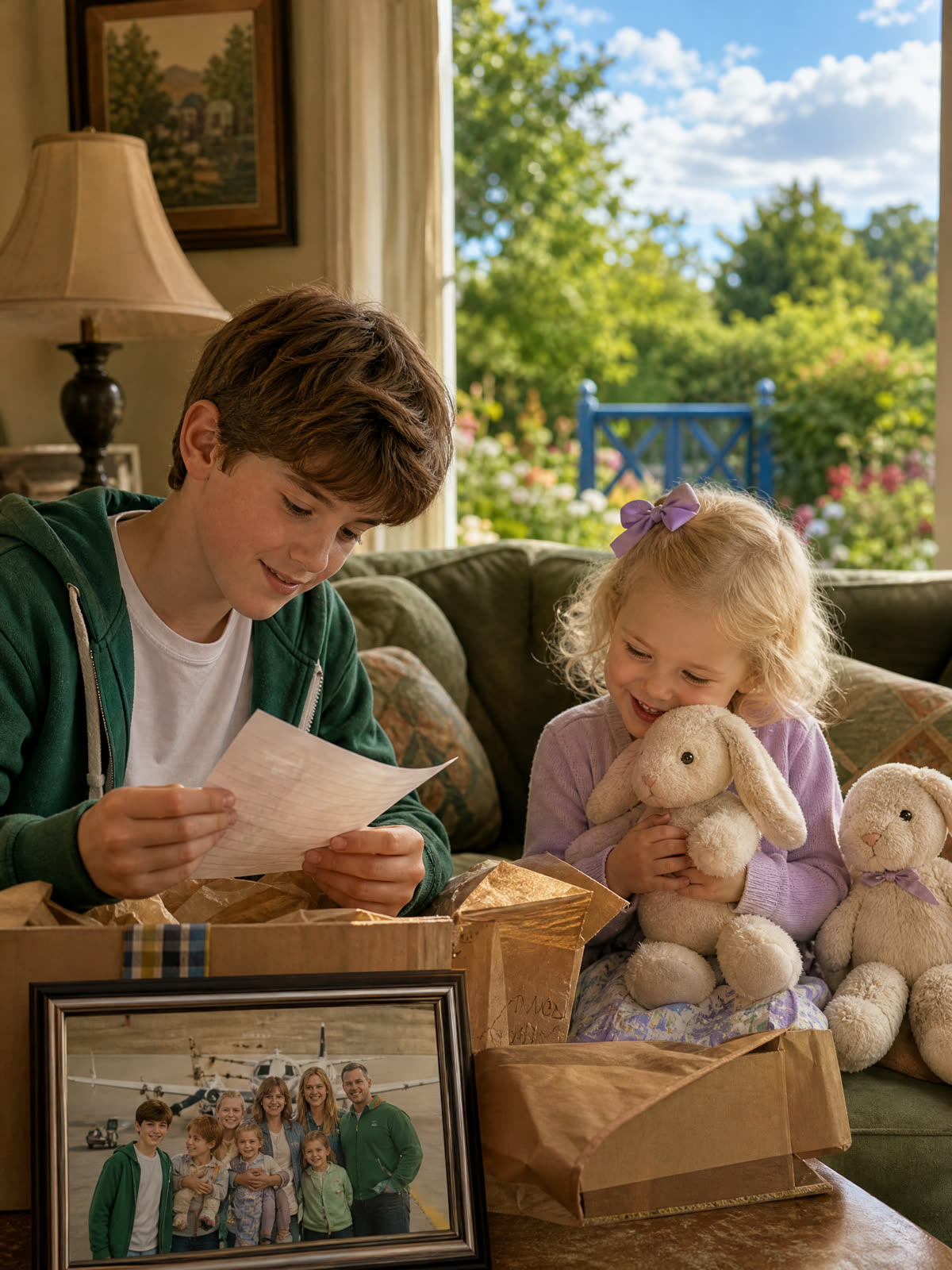
Everett occasionally sent photographs of Oliver. In one, the baby was sleeping against his father’s chest during a business meeting. On my eleventh birthday, a package arrived from Rome. Inside were a new stuffed rabbit for Poppy and a framed photograph of our little group at the airport. Russell had tucked in a handwritten note: “Both rabbits have been thoroughly inspected.”
Everett had added a message of his own: “Thank you for noticing what the rest of us overlooked.” The picture, the rabbits, and the notes brought back the flight that had changed so much for all of us. We had begun as strangers caught in separate worries. Now Oliver’s father sent us photographs, Poppy had another rabbit, and the people in that airport picture were part of a story none of us had expected to share.
What happened taught me that courage can come from very small people, but that does not mean children should be given burdens that belong to adults. A child who seems unusually grown-up may simply have learned to keep fear hidden behind responsibility. What that child often needs most is not admiration for managing alone, but the reassurance that someone else is finally there to help.
Love cannot be measured by costly presents, impressive houses, or the number of people hired to care for a family. It shows itself in the moments when we choose to be present. A parent can provide every material comfort and still miss the emotional connection a child has been asking for. Oliver had needed relief from the damaged device, but he had needed his father’s closeness too.
Keeping secrets can feel like a way to protect the people we love. Honesty and careful communication, however, can provide the security that silence fails to give. Forgiveness does not require pretending painful things never happened. It leaves room to acknowledge them while deciding whether trust can be rebuilt. I could speak to Dad again without pretending his absence had not hurt, just as I could love Mom while telling her how frightened I had been.
Even strong families face misunderstandings, disappointments, and conversations nobody finds easy. Choosing to face those moments together can become the beginning of something healthier. Adults should not dismiss what a child notices, either. Sometimes children recognize emotional needs or small details that busy grown-ups have stopped seeing. Growing older does not mean anyone stops needing comfort or reassurance. Everyone deserves to admit when life feels overwhelming without fearing that they must face it alone.
Almost a year after our flight, Mom received confirmation that the old tracking network had been permanently shut down. I wanted to ask whether the investigators were completely certain about everything. But that evening, watching Poppy play in the yard while Dad repaired the latch on our blue garden gate, I understood that I did not need every question answered immediately.
Then something caught my attention. Near the bottom of the gate, a tiny metallic glimmer appeared. It might have been a loose screw or a piece of old hardware. For a moment, I thought about going outside to inspect it. After everything that had begun with one small black object, I could not help noticing something that seemed out of place.
Before I moved, Mom called from the kitchen. “Wesley, dinner’s ready!” I looked toward the gate one more time. Whatever that little object might be, I knew something I had not known a year earlier. Every mystery did not have to become mine to face alone. If I needed help, I could ask for it.
“Coming, Mom!” I went inside. Poppy was laughing, Dad had burned the garlic bread, and Mom was acting as though she had not noticed. For the first time in a long while, home felt like somewhere I could simply be a child. That mattered more than any secret I might ever uncover.
Perhaps the most valuable gift we can offer someone we love is the certainty that they will not have to face tomorrow’s fears, mistakes, or unanswered questions entirely alone. I finally understood what that certainty felt like. It did not mean every loose end had been tied up. It meant there were people beside me when I was ready to look.
Investigators believed the missing device had probably been discarded long ago. But one device remained unaccounted for.
Disclaimer: This story is a work of fiction inspired by real-life themes. Names, characters, places and events are fictionalized, and any resemblance to real persons is purely coincidental. Images are for illustration purposes only.
