


PART 1: THE LIGHT SHE DIDN’T LEAVE ON
Nothing prepared me to come home and discover that my wife and our three-month-old daughter had disappeared from the life we shared. I was carrying a diamond bracelet, two expensive shopping bags, and black lace lingerie bought for Samantha. That was who I had allowed myself to become. I wasn’t a misunderstood husband, an unwanted man, or someone stranded in a loveless marriage. Before I even turned into the driveway, I was arranging my purchases into lies. The bracelet could stay inside my briefcase until morning. The lingerie could remain in the trunk. The larger bags would require an explanation, but I could say they contained materials for a client presentation if Claire asked. Then I noticed the porch light. It was off. Claire always turned it on when she expected me home. Always.
She had done it on the nights I blamed meetings for keeping me late. She had done it during the final weeks of pregnancy, when the stairs aggravated her aching back and swollen ankles. After Hope was born, when Claire’s sleep came in scraps of ninety minutes, she still remembered. Darkness bothered me, and she had never treated that as too small a thing to care about. That evening, every downstairs window was black. I sat with the engine running until my phone vibrated. Samantha. Wear the cologne I like tomorrow, baby. Looking back, what disgusts me is how automatically I slipped the phone away, gathered the gifts, and walked toward the door. The stillness felt wrong before I crossed the threshold. “Claire?” The narrow walnut console beneath the mirror was missing. Her ceramic bowl for our keys was gone. So was the wedding photograph that had stood there for four years.
In that picture, Claire was laughing under her veil, and I was looking at her as though the rest of the world had fallen away. I stared at the empty space where it belonged. “Claire?” My voice traveled through the house strangely. I set down one shopping bag, then the other. The living-room couch was gone. The rug, nursing chair, baby swing, and bassinet by the window had vanished with it. There was no basket of burp cloths beside the chair, no stack of the blankets Claire folded so carefully, no breast pump she hated cleaning, no cushion she used to support her back while feeding Hope. But my television remained. My speakers, oversized leather recliner, bar cart, and costly whiskey were exactly where I had left them. Someone had removed Claire and Hope from the room while leaving every piece of me undisturbed. Panic spread through my chest. “Claire!”
I reached the stairs almost without remembering the distance between them and the living room. I took them two at a time. The nursery door stood open. The crib was still there because we had assembled and bolted it together inside the room, but everything surrounding it was gone. Diapers. Bottles. Wipes. Pacifiers. The stuffed rabbit. The little white sound machine that used to glow on the dresser. I opened the first drawer. Nothing. The second was empty too. So was the third. Even the flowered hat Claire’s sister Natalie had mailed from Atlanta before the birth had disappeared. I stood there breathing hard. Three nights earlier, Hope had cried in that room while Claire waited beside the crib, her hair twisted into a loose knot, wearing an old college shirt of mine. She had looked so tired that guilt almost reached me. Almost.
She’d asked, “Can you take her for twenty minutes? I haven’t showered today.” Instead of reaching for my daughter, I looked at my phone. Samantha was waiting. I told Claire that a client emergency meant I had to get online. Hope kept crying. Claire looked at me without anger, and somehow that had been easier to ignore. She seemed emptied out. “Okay,” she’d whispered. Then I left. Now that small answer followed me through the vacant nursery. Okay. I went to our bedroom. Her side of the closet was bare. Her shoes, makeup, nursing bras, medications, postpartum supplies, hairbrush, charger, and books were gone. The nursing pillow was missing from the bed. Her robe no longer hung behind the bathroom door, and her shampoo was absent from the shower. My suits, shoes, watches, and chargers remained untouched. Even the shirt I had thrown down that morning lay where I had dropped it.
The care she had taken frightened me more than smashed glass would have. Had she broken my watches or dumped my clothes outside, I could have called her hysterical. Broken plates would have given me something to point at. If she had screamed, I might have pretended that her anger explained my behavior. But she had damaged nothing. She had taken what was hers and left what was mine. I called again and again. Each attempt went to voicemail. I sent Where are you? Then Where is Hope? Then Claire, call me NOW. There was no answer. I began calling Natalie. By the fourth attempt, fear was hardening into anger, the emotion I knew how to use. How could Claire leave with our child and refuse to tell me where they were? Didn’t I have a right to know? I wish shame had stopped those thoughts immediately. It didn’t.
I was still demanding explanations after spending months teaching my wife that mine were worthless. Back downstairs, I finally noticed a thick manila envelope beneath the kitchen island’s pendant light. My name was written across the front. Daniel. My hands trembled as I opened it. Divorce papers. Financial disclosures. Bank statements and credit-card records. Hotel bills, restaurant receipts, boutique purchases, and the jewelry-store charge. Yellow highlighting marked the amounts: $486.72. $731.18. $1,094.00. $2,180.00. At first, I saw only the numbers. Then I noticed the dates Claire had added beside them. Hope fever — 101.8. The note sat beside a hotel charge. I remembered that night at once. Claire had called three times while I was with Samantha. When I finally answered, fear strained her voice. “Daniel, she’s hot. I checked twice. It’s over a hundred and one. Should we go to the hospital?”
I had stepped into the hotel bathroom, keeping my voice low so Samantha wouldn’t hear Hope crying through the phone. “Babies get fevers, Claire. Call the pediatrician.” “Can you come home?” “I can’t. I’m with the Anderson account.” There had been a silence before Claire said, “I’m scared.” My answer was, “You’ll be fine.” You. Not Hope. I had spoken as though my wife asking for help with our sick infant were simply failing some test of independence. Another highlighted entry was for dinner with Samantha. Claire had written Stitches hurting. Asked you to come home. I remembered that too. Childbirth had left her with severe tearing and weeks of pain. She had messaged me asking me to come home because she was hurting and Hope wouldn’t settle. I had answered that a client dinner couldn’t be canceled. Instead, I watched a server shave truffles onto our pasta while Samantha complained that I seemed distracted.
A different hotel bill carried another note: Photo of Hope smiling. You replied 4 hrs later: “Sorry. Crazy meeting.” I lowered myself into a kitchen chair. Claire hadn’t merely discovered an affair. She had rebuilt the calendar of my betrayal. She had placed my excuses beside the evenings they concealed and shown herself what every absence really meant. Photographs slid from the envelope onto the counter. In one, Samantha and I held hands outside a restaurant. Another showed my arm around her waist in a parking garage. A third caught us kissing. The photographer had been across the street. The last image was from that very afternoon. I stood at a jewelry counter while a salesperson packed the diamond bracelet. That bracelet was now less than thirty feet away. I had brought my own evidence into a house Claire had already emptied after collecting hers.
A small white note was attached to the divorce filing. Even the spaces between the sentences felt like her. You chose her. Now you can have her. Don’t look for us. My attorney will contact yours. That was all. I read it again before sliding down onto the kitchen floor among the papers and photographs. Claire had occupied the part of my life I called home. Samantha had belonged to restaurants, hotel rooms, and the passenger seat of my car. Hope mostly appeared in pictures I showed people at work. I had kept each part separate so that I never had to examine the whole. Claire had torn down every dividing wall. There was no private version of me to hide behind. Husband. Father. The same person, accountable for every choice. My phone lit up again. Samantha. Miss you already. I looked from her message to Claire’s note. You chose her. Now you can have her. The words felt like a sentence being passed.

Three months earlier, I had cried when Hope was born. That memory tormented me because those tears had not been an act. Claire had labored for thirty hours. By the end, exhaustion had drained the color from her face, her hair was stuck to her forehead, and her nails had pressed marks into my hand. When the nurse placed Hope against her chest, our daughter gave one furious cry and then grew unexpectedly quiet. I stared at her tiny features. Through her own tears, Claire looked at me. “She’s here.” I kissed our daughter’s forehead, then my wife’s. “I’ll take care of you both,” I said. The man standing in that hospital room believed himself. I couldn’t pretend that I had never loved them. I had loved them. I still did. What I had also believed was that wanting something entitled me to take it, no matter what that wanting cost anyone else.
Samantha had entered my life during Claire’s pregnancy. Her consulting firm worked alongside my company on a major account. First there were lunches that stretched beyond anything work required, then messages unrelated to the project, then drinks. The first kiss happened in a parking garage. I remembered drawing back long enough to say, “I’m married.” Samantha looked at my ring. “I know.” I could have walked away at that moment. Instead, I kissed her again. At home, Claire was seven months pregnant, sleeping badly and struggling with swollen ankles. Sex had become less frequent, and sometimes she winced because her body hurt. Once she cried over a favorite dress she could no longer wear. Another evening she was terrified because several hours had passed without her feeling the baby move. I responded to the realities of pregnancy by wishing they would stop demanding anything of me.
Our house filled with appointments, hospital-bag plans, car-seat decisions, pediatrician discussions, and a breast pump waiting in its box. We talked about cord blood and whether Claire’s mother should stay after the birth. Samantha existed outside all of it. She was rested, funny, fragrant, and ready for an evening out. She didn’t ask whether I had assembled the changing table. She asked what cocktail I wanted. She didn’t mention aching hips. I confused a relationship without responsibility for a deeper kind of connection. Worse, I began to resent Claire for making home feel demanding. After Hope arrived, that comparison became even crueler. Claire was exhausted, hurting, and leaking milk through her shirts. She cried without warning. Some mornings, she was still wearing the clothes I had seen on her the night before. Samantha seemed bright because I never asked her to carry anything heavy.
Samantha received expensive dinners and hotel rooms. Claire received dirty bottles and a husband looking at his phone while she tried to explain that something might be wrong with her stitches. I called my escape chemistry. It was cowardice. That first night after Claire left, I didn’t sleep. Around two in the morning, I sat on the nursery floor beneath the empty crib. Without Hope’s blankets, it seemed far too large. I opened my phone and scrolled through hundreds of pictures, most of them sent by Claire. Hope asleep against her chest. Hope curled around my finger. Hope after her first bath. Hope in a onesie reading DADDY’S GIRL. I stopped at a hospital photograph Claire had taken. I was asleep in a chair with my daughter tucked against me. The picture looked like proof of fatherhood. That night, it felt more like evidence of how little a photograph could tell.
At six, an email arrived with a law firm’s name in the subject line. Claire’s attorney said that she and Hope were safe, that divorce-related communication should go through counsel, and that temporary arrangements for Hope would be proposed soon. Safe. I couldn’t stop returning to that word. I called the office. “I need to speak to my wife.” The receptionist answered, “Mr. Mercer, I’m not able to facilitate personal communication.” “Is my daughter with her?” “I can confirm only what was stated in the correspondence.” “Where are they?” “I cannot provide that information.” “She can’t keep my daughter from me.” “You should have your attorney contact us.” Her steady voice enraged me. “I’m her father.” “Yes, sir.” “Then tell me where she is.” “I cannot do that.” When I raised my voice further, the call ended. I stood gripping the phone before looking down at the divorce papers again.
By noon, I was in a twenty-third-floor office across from Peter Lang, an attorney in his fifties whose quiet manner and expensive suit did nothing to soften his lack of interest in my excuses. He reviewed Claire’s filing. “She has documentation,” he said. “So?” He looked over his glasses. “So nothing. Adultery is one issue. Parenting is another. But the financial records may become relevant depending on how marital funds were used.” “I want to see my daughter.” “Then we pursue an appropriate temporary parenting arrangement.” “I want Claire to come home.” “That isn’t something the court can order.” “She took half the furniture.” Peter consulted the inventory. “According to this, she took property identified as hers, property purchased by her before marriage, items used primarily by the child, and several mutually owned household items her attorney expects will be addressed during division.” I hated hearing my outrage translated into something so reasonable.
“She planned this.” “Yes.” “How long?” “I don’t know.” Later, I learned it had been two weeks. For two weeks I had arrived home late, kissed her cheek, complained about work, and climbed into bed beside a woman who knew where I had really been. During those same days, she was quietly learning how to leave me. Peter tapped the filing. “You need to assume that every text you send from this point forward may be read by attorneys.” I remembered my demands from the night before and felt heat climb into my face. “What am I supposed to do?” “Stop contacting her directly until we understand what she’s asking for.” “What she’s asking for is a divorce.” “Yes.” “No. Claire doesn’t do this.” Peter held my gaze. “She already did.” I walked out angry, still unwilling to understand the simplest thing he had told me.
In the parking garage, I called Samantha. “Hey, baby.” The familiar greeting made me recoil. “Claire knows.” A pause. “Knows what?” I nearly laughed. “Everything.” Another silence followed. “Daniel…” “She left.” “What do you mean, left?” “She took Hope. She filed for divorce.” “Oh my God.” I leaned against my car. I had imagined this conversation before. In those fantasies, discovery led to a dramatic ending for my marriage, and then Samantha and I could stop hiding. I had never imagined the nursery without blankets. I had skipped the financial statements, the missing wedding photograph, and the daughter whose whereabouts I didn’t know. Samantha spoke softly. “Come over.” I closed my eyes. “What?” “You shouldn’t be alone tonight.” I had wanted that invitation from her countless times. Now it sounded like an answer to a question I could no longer bear to ask.
“I can’t.” “Why?” Beyond the openings in the concrete, the city carried on. “Because my daughter is gone.” Uncertainty entered Samantha’s voice. “She’s with Claire, right? She’s okay.” I remembered the fever. Claire asking me to come home. The white card beside the divorce papers. “I have to go.” “Daniel.” I ended the call. For the first time since the affair began, Samantha wanting me didn’t feel like power. It showed me how little our relationship had ever required. She didn’t know Hope’s formula or the lullaby that settled her. She didn’t know Claire still hurt when she climbed the stairs. She didn’t know Hope made a tiny squeaking noise just before crying. There was no reason she would. I had built a place with her where none of those things had to matter.
When I returned to the house, the designer bags still waited on the foyer floor. The bracelet was inside one of them. I carried everything into my office and pushed it into a closet. I couldn’t make myself throw the purchases away, return them, or deliver them to Samantha. They remained there like exhibits I had tried to hide from myself. Three days later, Peter called. “Claire has proposed temporary visitation.” I went completely still. “When?” “Saturday.” “Where?” “A neutral location. Her sister will be present for the exchange.” “Natalie’s here?” “Apparently.” “Will Claire be there?” “Yes.” After that, his words barely registered. I was going to see Hope. I was going to see Claire. For three nights I rehearsed what I would say, always beginning with the same plea: come home. I had not yet understood that the woman I was preparing to address was no longer the woman who had kept asking me to stay.
PART 2: THE WOMAN WHO NO LONGER ASKED
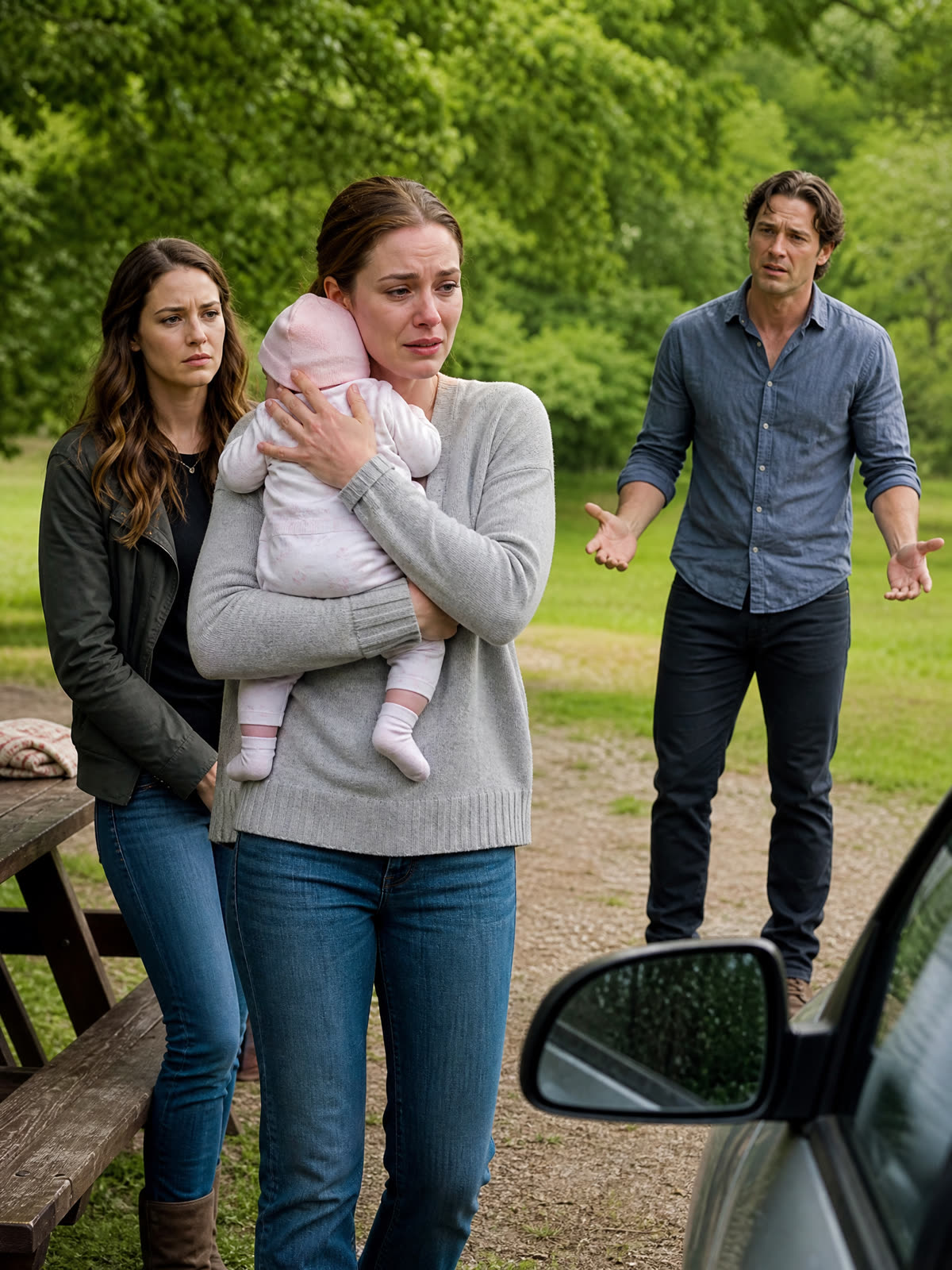
Claire stood beside Natalie’s rental car when I arrived. For months, I had become accustomed to the signs of her exhaustion: red eyes, milk-stained shirts, a hand always busy with a blanket, a bottle, or the diaper bag. That morning, her hair was neatly pulled back, and she wore jeans and a gray sweater. Something in her face had changed as well. Hope rested against her chest in a carrier, wearing a pale pink hat. Not the flowered one Natalie had sent. A different one. Her eyes were open. I stepped toward them, and Claire’s body tightened. I cannot adequately describe what that did to me. My wife had once reached for me without thinking when I entered a room. Now my approach made her brace herself. Natalie stood beside her, watching me with something colder and more settled than anger.
“Claire.” She waited before answering. “Hi, Daniel.” I looked at our daughter. “Can I hold her?” Claire’s mouth tightened, and for one awful moment I expected her to refuse. Instead, she carefully released the carrier. Hope stirred. Claire kissed her forehead before placing her in my arms. “Support her head.” “I know.” My reply came out too sharply. Claire looked at me, and I swallowed. “Sorry.” Hope stared up at me. For a moment there was a smile. Then her lower lip began to tremble. “No, no, sweetheart.” Claire moved forward automatically before stopping herself. That movement told me more than any accusation could have. For months, she had been the person who answered every cry, got up at every waking, and understood every need. I had taught both of them that I was an optional presence.
I walked slowly with Hope. “Hey. It’s Daddy.” She cried harder. Natalie turned her face away. Claire’s expression stayed controlled, but her hands curled into fists. “What usually settles her?” I asked quietly. Claire blinked. “You don’t know?” There was no accusation in her voice, which somehow made the question worse. “I…” I looked down at my daughter. “No.” Claire swallowed. “Walk with her. Don’t bounce too hard. Put her against your chest. She likes pressure.” I followed her instructions. Gradually, Hope’s crying weakened and then stopped. Her cheek settled against my shirt. I closed my eyes. For a few minutes, I wasn’t a husband facing divorce or a man whose affair had been exposed. I was simply holding my child, and the ordinary weight of her seemed to fill everything I had left empty.
Then Hope made the little squeak that came before her cry. Claire was already beside me with a bottle. “She needs to eat.” I accepted it. “Can I feed her?” “Yes.” We sat at a picnic table while Natalie remained several yards away. Claire took the seat across from me. Hope drank eagerly, her little jaw working. “How much?” “Four ounces usually. Sometimes five.” “When did that change?” Claire stared. “What?” “She used to take three.” “Three weeks ago.” Three weeks. I had missed a change so ordinary that Claire had probably adjusted to it without thinking. I looked at her. “Where are you staying?” Her face closed. “No.” “Claire.” “My attorney told you.” “I need to know where my daughter lives.” “You know she’s safe.” “That isn’t enough.” “It was enough when you left us alone while she had a fever.”
Hope kept drinking while I struggled to find an answer. “I know.” “Do you?” “Yes.” Claire’s eyes filled, but she blinked the tears back. I lowered my voice. “I found everything.” “You mean the evidence?” “Yes.” “You already knew what you did, Daniel.” “I know.” “No. You knew the pieces. That’s different.” I looked up. Anger finally crossed her face. “I spent two weeks matching your lies to dates. Do you understand what that was like?” She continued before I could answer. “The night Hope had a fever, you were at a hotel.” “I know.” “The night I called you because I thought my stitches had opened, you were having dinner with her.” “I know.” “The night I sent you that picture because Hope smiled for the first time—” “I know.” “You were with her.” Hope startled, and Claire immediately softened her voice.
I looked down at my daughter. “I don’t know what to say.” Claire gave one brief laugh without any humor in it. “That’s the first honest thing you’ve said to me in months.” I flinched. “Claire, I’m sorry.” She looked away. “I know that isn’t enough.” “No.” “I’ll end it.” Her gaze returned to me. “With Samantha.” “Don’t.” I stared at her. “What?” “Don’t tell me what you’ll give up for me now.” “I’m trying to tell you that I choose you.” “No.” She shook her head. “No, Daniel. You don’t get to rewrite the order.” My mouth dried. She leaned toward me. “You already chose.” “Claire—” “Every time I called and you didn’t come home, you chose. Every hotel room. Every dinner. Every message you hid. Every time you looked me in the face and lied.”
Tears ran down her face, and she let them. “You chose her while I was bleeding.” My breath caught. “You chose her while I was nursing your daughter at two in the morning. You chose her when I couldn’t stand up straight without pain. You chose her when Hope was sick.” “I know.” “No, Daniel. I need you to stop saying that.” Her voice broke. “Because I don’t think you do.” Hope finished the bottle. I lifted her to my shoulder, and Claire watched me burp her. Then she said something that changed the shape of everything I had been telling myself. “I didn’t leave because you fell in love with someone else.” She swallowed. “I left because when I needed you most, you decided I was the least interesting thing in your life.” I closed my eyes. There was nothing left to blame on temptation, confusion, or the bracelet.
Claire had been struggling within reach of me, and I had treated her need as an interruption. When the visit ended, I placed Hope back in her arms. The emptiness in mine felt almost physical. Before Claire could turn away, I asked, “How did you find out?” She glanced at Natalie, whose expression tightened. “The credit card.” “The jewelry charge?” “That was the first one.” Claire adjusted Hope against her shoulder. “You told me we needed to be careful with money because I was on maternity leave. Remember?” I remembered. I had criticized the cost of the organic diapers she ordered. Two days later, I had spent more than two thousand dollars on a bracelet for another woman. “I was awake at three in the morning. Hope had just fallen asleep on me. I checked our account because I was worried about the hospital bills.” She looked straight at me. “And there it was.”
I pictured Claire on the bathroom floor, keeping the phone’s light away from Hope as our daughter slept against her. “I thought it was a mistake,” she said. “Then I found the hotels.” I looked at the ground. “Then restaurants.” She drew a slow breath. “Then I started checking dates.” Natalie turned away. “I called Natalie.” “What did you tell her?” “That I needed somewhere to stay.” Claire paused. “Then she asked what you’d done.” Her eyes dropped to Hope. “I couldn’t even say it at first.” I imagined the effort of whispering the truth without waking our child. “You never confronted me.” “No.” “Why?” Her look was tired. “Because I already knew you would lie.” That was when I understood that, for Claire, the opposite of love had not become hatred. It had become certainty. She no longer considered asking me for the truth a useful thing to do.
“I hired someone to document it,” she said. “The photographs.” “Yes.” “The picture at the jewelry store was taken the day you left.” “Yes.” My stomach sank. “So you knew I was buying it.” Her face went still. “I knew.” “And then you left before I got home.” “Yes.” While I stood under bright store lights selecting diamonds for Samantha, Claire had been finishing the removal of her life from our house. Baby clothes. Blankets. Our wedding photograph. “Why leave the crib?” The question seemed to hurt her. “Because it wouldn’t fit through the door.” Reality was crueler than any symbolism I had imagined. Natalie approached. “We should go.” I looked at Claire. “Please don’t do this.” The plea escaped before I could stop it. She closed her eyes. When she opened them, she looked exhausted again. “I already did.” I watched her carry Hope to the car. This time, I stayed where I was.
Samantha called that afternoon. I watched her name until the ringing stopped. On the third call, I answered. “What’s happening?” she asked. “I saw Claire.” “Oh.” “And Hope.” A pause. “How did it go?” I laughed bitterly. “How do you think?” “Daniel, I don’t know what you want me to say.” For months, she had been where I went whenever home required something difficult of me. “Are you coming over tonight?” “No.” “Why not?” Claire’s words came back: You chose her while I was bleeding. “I can’t do this anymore.” Samantha’s voice hardened. “So I’m just the mistake now?” “No.” “You told me you were miserable.” “I was selfish.” “You said the marriage was basically over.” “I lied.” “To me?” “To everyone.” The pause after that was long. “You bought me a bracelet yesterday.” “I know.” “You told me you loved me.”
I pressed my fingers against my forehead. “I said whatever made the next hour easier.” The silence changed. I had finally hurt Samantha with the truth I had refused to give Claire. When she answered, her voice was low. “You’re a coward.” “Yes.” She never received the bracelet. The affair didn’t end with a grand declaration that one woman mattered more than another. It ended because the fantasy holding it together could no longer survive what I had done. Samantha had wanted the version of me who could vanish from responsibility. Claire had needed the version who remained when things became difficult. The divorce moved forward over the following months. Nothing about it happened in one clean, dramatic collapse. Instead, our life came apart through signatures, parenting schedules, divided accounts, weekend bags, and photographs removed from walls. Each practical arrangement carried another small admission that what had once been ours would never be ours in the same way again.
When Hope first spent the night with me, I barely slept. Claire supplied a written routine: formula amounts, diaper cream, the temperature that counted as a fever, the pediatrician’s number, and every detail she thought I might need. I read it three times. Then I resented it. A part of me heard an accusation in every instruction, as though she were announcing that I didn’t know my own child. At 1:17 in the morning, Hope began to cry, and I finally understood. The list wasn’t an insult. Claire was shielding our daughter from everything I hadn’t bothered to learn. I walked the hallway with Hope against my chest. I checked her diaper, offered a bottle, and checked the room temperature. By 1:40, sweat ran down my back. At 1:52, I nearly called Claire. My thumb rested over her name while Hope screamed against my shoulder.
Claire had done this alone for months while I sat in hotel bars with Samantha. If Hope was safe, I could learn to care for her. I put the phone away. I held her the way Claire had shown me, close and secure, and walked slowly. I hummed the lullaby written in the instructions. Hope seemed unimpressed. Eventually, the screaming became quieter cries, then little hiccups, then silence. At 2:13, she fell asleep against me. I stood in the dark hallway and cried because I finally understood how ordinary the thing Claire had asked of me had been. Stay awake. Be there. Care for our child. What I had once treated as a burden now felt like a privilege I had almost lost before understanding it. I began changing diapers, washing bottles, and learning the differences between a hungry cry and an exhausted one.
I learned that Hope rubbed her left ear when she was tired, that she hated the chill after a bath, and that a ceiling fan could hold her attention for an astonishing amount of time. I learned to leave spare onesies everywhere. None of those discoveries brought Claire back. That became another difficult lesson. For a while, I thought improvement ought to earn restoration. If I became a better father, attended therapy, stopped drinking, and came home on time, surely she would notice. If I admitted the affair without excuses, returned the gifts, and stopped blaming loneliness, stress, or fatherhood, perhaps I could accumulate enough good behavior to outweigh what I had done. My therapist ended that line of thinking with one sentence. “You’re treating accountability like a transaction.” I hated hearing it. Then I began to recognize how completely he was right.
Money had always offered an easy route to comfort. Even the affair had been transactional in ways I preferred not to acknowledge. Samantha gave me an escape. I supplied attention, dinners, hotel rooms, gifts, and promises. Claire had needed something I couldn’t purchase for her. I had withheld it. Several months into the separation, we attended a required mediation session. Hope was nearly eight months old by then. She could sit up, had two teeth, and laughed when I pretended to sneeze. Claire looked healthier than she had during our final months together. Seeing that hurt, because it meant life without me had become healthier for her than life beside me. With our attorneys between us, we discussed the house, retirement funds, bank accounts, furniture, parenting time, and expenses. Listening to our marriage broken into categories made everything feel both painfully practical and impossible to believe.
When Claire’s attorney raised the nursery furniture, I looked at her. “You can have the crib.” Peter lightly touched my arm. Claire answered, “Daniel, we can handle property through the agreement.” “I don’t want it.” Her expression shifted. I made myself finish. “It should be where Hope lives most of the time.” Saying that nearly undid me. Claire looked down at the table, then nodded. “Okay.” Nothing between us had come that close to tenderness in months. Afterward, I found her waiting for the elevator. Our lawyers had already left. For once, there was no one else between us. I remained several feet away. “Claire.” She looked over. “I need to tell you something.” Her face tightened. “I don’t want to hear about Samantha.” “It’s not about her.” I watched the elevator numbers change and swallowed, trying not to turn another apology into a demand.
“I’m sorry I kept trying to make my apology sound like a request.” Claire stayed still. “Every time I said I was sorry, I followed it with come home, give me another chance, don’t do this. I wasn’t apologizing. I was bargaining.” The elevator stopped on another floor. Neither of us spoke for a moment. “I don’t expect you to forgive me.” Her eyes filled slightly. I looked down. “I just need you to know that I understand now why you left.” “Do you?” “I think so.” I forced myself to be specific. “You couldn’t depend on me.” Her face tightened. “When things became difficult, I made you carry them alone. Then I lied so I could keep escaping.” She stared at me. “You were recovering from giving birth, and instead of helping you, I acted like your pain was ruining my life.”
A tear slipped down her cheek, and she quickly wiped it away. “I made you feel unwanted at the exact moment you needed to feel protected.” The elevator opened. Neither of us moved. “I’m sorry.” I left the words alone. Claire looked at me for a long time before whispering, “I believe you.” My heart moved before I could stop it. Then she added, “That doesn’t mean I can come back.” I nodded. “I know.” This time, I did. As the doors began closing, she stepped inside. “Hope loves when you sing to her.” She gave the smallest smile. “Your voice is terrible.” I laughed and cried together. It wasn’t a promise of reconciliation. It was the first indication that she could see me as Hope’s father without seeing only the man who had abandoned them. I held that distinction carefully instead of turning it into another way to ask for her return.
Weeks later, I opened the office closet where the shopping bags remained. The lingerie and bracelet were still inside. I took the bracelet to the store, but the return period had expired. The clerk offered credit. “What am I supposed to do with that?” He looked uncomfortable. “I can ask my manager.” Under the lights, the diamonds looked exactly as they had when I bought them. Two thousand one hundred eighty dollars. I remembered criticizing the diapers. “Forget it,” I said. I left with the bracelet and eventually recovered less than I had paid. The money went into the account for Hope’s expenses. I didn’t tell Claire. There was nothing generous about returning money that should never have been spent that way. Around the same time, I found another copy of our wedding photograph among the remaining household things, not the framed one Claire had taken.
I sat on the floor holding that photograph for almost an hour. In it, I was looking at Claire. I wanted desperately to rewrite the marriage around the ending—to say we had been unhappy for years, that she had grown distant, that Samantha had arrived during a vulnerable season. There were fragments of truth available if I arranged them dishonestly enough. But the person who had become vulnerable was my wife. I had renamed my selfishness loneliness. If I kept that excuse, I could repeat everything with different people and still call myself misunderstood. I placed the photograph in a drawer, not to erase Claire but because remembering her did not make her mine. The changes I was making had not repaired what I had broken. They had only brought me close enough to see it clearly. I still had to face the ending without asking her to turn it into another beginning.
PART 3: THE LIFE THAT CONTINUED WITHOUT ME
The divorce became final eleven months after I walked into the house carrying Samantha’s bracelet. There was no courtroom eruption, no judge delivering a lesson, no confession that changed the outcome. Claire didn’t return because I had finally understood what I should have understood before she left. Real life offered none of the neat rewards people imagine redemption should bring. We agreed on parenting arrangements, and the house was sold. My mother asked why I hadn’t kept it. I couldn’t find a way to explain that living there had become unbearable, not because Claire had emptied it, but because the emptiness finally showed me how little I had contributed long before she packed anything. On my last night, I walked through the rooms. I went to the nursery first. The crib had been moved to Claire’s months earlier. Small marks still showed where screws had held furniture against the wall.
I remembered assembling the crib while Claire sat cross-legged nearby, reading the instructions. “You put that piece backward,” she’d told me. “I did not.” “You definitely did.” “I know what I’m doing.” She had laughed. “You have three extra screws.” “They’re optional.” “They are absolutely not optional.” The memory hurt because the happiness in it had been real. I couldn’t honestly claim I had stepped outside a marriage that was already dead. Downstairs, the kitchen island was bare, but I could still picture the manila envelope beneath the light and Claire’s white note resting among the papers. You chose her. Now you can have her. At first, I had treated losing Claire as punishment. Now I understood that the loss had begun much earlier, in all the small decisions I had refused to count.
I had chosen Samantha through deleted messages, invented meetings, ignored calls, booked hotel rooms, and evenings when Claire held our daughter alone while I resented being needed. People often imagine the kiss as the instant betrayal begins. It is only the visible point in a longer chain of permissions. I permitted myself to resent Claire’s exhaustion. I permitted myself to enjoy another woman’s attention, conceal messages, and lie about my time. I permitted myself one more hour away, then another. I allowed myself to act as though Claire were unreasonable for asking me to come home. Long before I crossed the physical boundary, I had built a road that led straight to it. By the time I was carrying expensive gifts through our front door, I had already abandoned the life I would later accuse her of taking from me.
The affair was over long before the divorce. After that final phone call, Samantha and I never spoke again. Months later, I saw her at an industry event. She stood across the room with two colleagues. Our eyes met, and for a moment neither of us moved. Then she looked away. There was no hatred in it. Briefly, after Claire left, I had tried blaming Samantha. She had known I was married. She had known about the pregnancy and Hope’s birth. All of that was true, but it didn’t change whose promises had been broken. Samantha hadn’t made vows to Claire. I had. She hadn’t stood beside a hospital bed and promised to care for our daughter. I had. She hadn’t answered my wife’s frightened calls with lies about where she was. Whatever Samantha owed to her own conscience belonged to her. What I had done belonged to me.
Hope’s first birthday came two months after the divorce was finalized. Claire invited me to a small gathering with Natalie, her parents, a few friends, and children too young to understand the importance adults assigned to cake. For once, I arrived early. Claire opened the door. “Hi.” “Hi.” From inside, Hope heard my voice. Then came the quick slap of her hands against the floor. She crawled around the corner, saw me, and smiled. Using the wall, she pulled herself upright. “Da!” Everything inside me seemed to stop. Claire looked from our daughter to me. Hope bounced where she stood. “Da! Da!” Then she threw herself toward me with the reckless confidence of a child certain that someone would catch her. I caught her. She pressed both hands to my face while I laughed into her hair. Behind her, Claire was crying.
I looked at Claire, and neither of us said anything. That moment belonged to Hope, not to the marriage we had lost or the conversation we might once have tried to build around it. Later, while everyone ate cake, Natalie came over. For almost a year, we had exchanged only what practical circumstances required. “You’re doing better.” I looked at her. “I’m trying.” She nodded. “I know.” Across the room, Claire was cleaning frosting from Hope’s fingers. “Did you help her move that night?” Natalie followed my gaze. “Yes.” “How long did it take?” “The whole day.” I swallowed. “Did she cry?” Natalie’s jaw tightened. “Not while we packed.” I waited. “She cried when she took the wedding picture.” Then she added, “She stood in the foyer holding it for maybe five minutes.”
I lowered my eyes. “I thought she hated me by then.” Natalie looked almost angry. “That would have made it easier.” I looked back up. “She loved you, Daniel.” No insult she had ever given me had hurt as much as that sentence. “She left because she loved herself and Hope enough not to keep living like that.” I nodded. “I understand.” “Good.” She walked away. For the rest of the gathering, I kept imagining Claire in the foyer, holding our wedding photograph. Not screaming. Not smashing anything. Simply standing there with a life she had loved in her hands, preparing to leave it behind. I had misunderstood her departure from the beginning. She hadn’t acted on an impulse. She hadn’t stopped loving me overnight. She had reached the point where loving me was no longer a sufficient reason to stay.
When the gathering ended, I helped collect paper plates and toys. Claire carried Hope upstairs because she was exhausted. Before going, she paused. “You can stay a few minutes if you want. I’ll bring her back down after I change her.” “Sure.” Alone in the living room, I noticed the photographs. Hope. Claire. Natalie. Claire’s parents. In one, Claire held Hope beside a lake. In another, our daughter was smeared with mashed banana. There were no pictures of Claire and me together. There shouldn’t have been. Knowing that didn’t stop it from hurting. I was learning that pain did not automatically mean someone had wronged me. Sometimes it was simply the feeling of being outside a life I had once assumed would always leave room for me, regardless of what I did inside it.
Claire returned carrying a sleepy Hope. “She wants you.” My daughter immediately laid her head on my shoulder. I rubbed her back. “She’ll be asleep in two minutes.” “Probably.” For a while, we stood quietly. Then I asked, “Are you happy?” Claire looked surprised, and I regretted asking before she could answer. “You don’t have to answer.” She considered it. “I’m getting there.” I nodded. “Good.” I meant it without needing her happiness to contain a place for me. That was how I recognized something had genuinely changed. A year earlier, I had cared about Claire being happy only if I could remain at the center of it. Now she stood in the home she was rebuilding, holding the life she had reclaimed, and I could want that life to be good without asking her to hand it back.
She studied me. “What about you?” I looked at Hope. “I don’t know.” Claire waited. I gave a small smile. “But I’m trying to become someone she can be proud of.” Her expression softened. “She already loves you.” “I know.” Hope shifted against my shoulder, and I kissed her hair. “I want to deserve the trust.” Claire nodded slowly. “That part takes longer.” “Yes.” She wasn’t speaking only about our daughter. I didn’t ask whether she would ever trust me again as a man. That was no longer something I was entitled to request. Some damaged things can be repaired. Others can only be treated carefully in the form the damage has left them. I gave Hope back to her mother. I had learned how to hold my daughter. Learning how to let Claire have the life she wanted required something different.
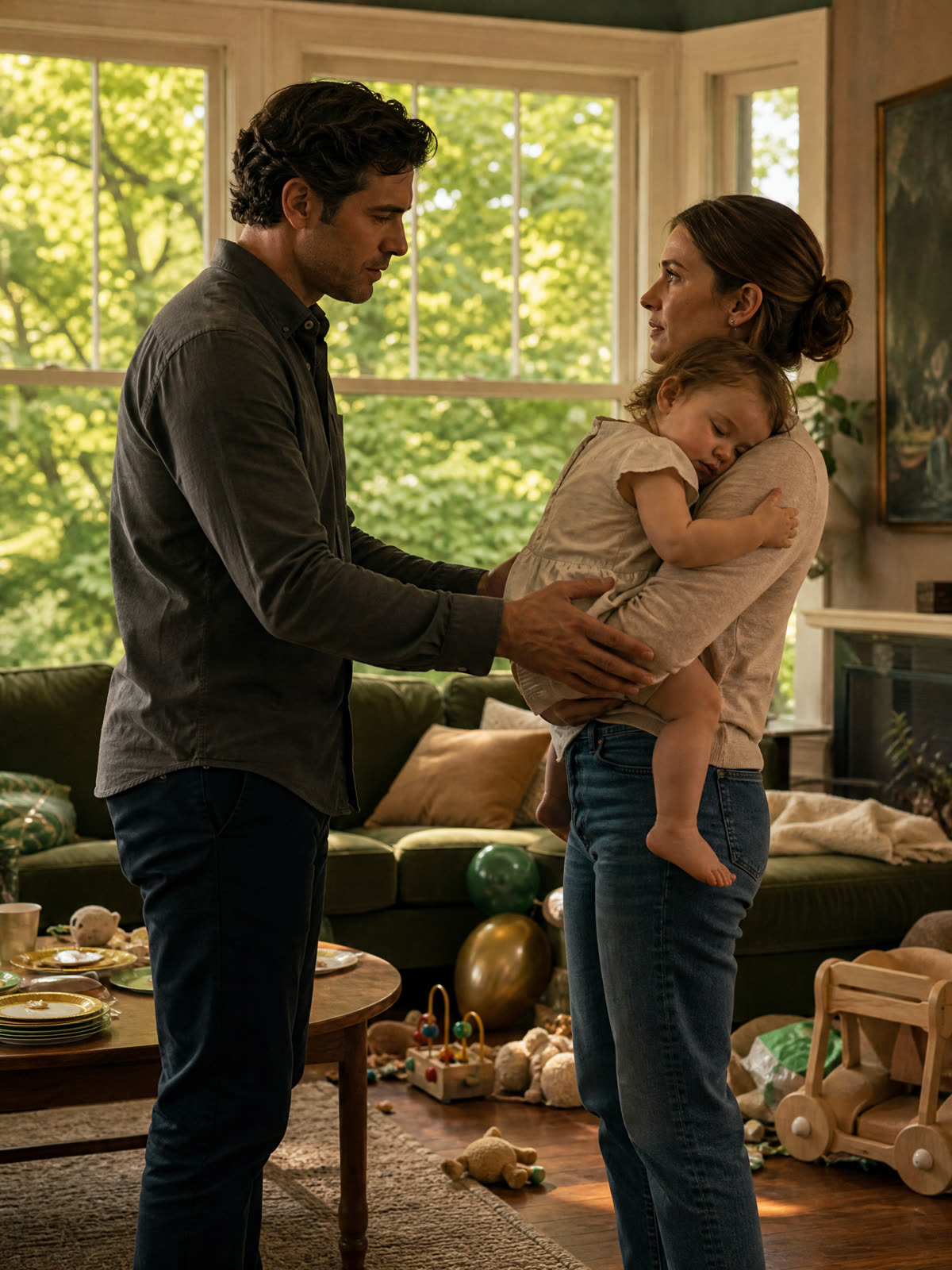
At the door, Claire said, “Drive safe.” For years, I had heard those words each morning without really hearing them. They had faded into the ordinary sounds of marriage, along with the small acts of care I accepted as if they happened on their own. That night, I understood what had always been there. Concern. Nothing more complicated, and nothing small. “Good night, Claire.” “Good night, Daniel.” I drove home alone. My apartment was smaller than the house we had shared. Toys waited in the living room for Hope’s weekends. Bottles dried beside the sink. A high chair stood near the table, diapers filled the hallway closet, and a framed photograph of Hope sat beside my keys. The place wasn’t glamorous. It didn’t offer escape. It was a real home with responsibilities inside it, and for once I didn’t want those responsibilities somewhere else.
Before bed, I checked my phone. Claire had sent a photograph of Hope asleep in her crib. There was no accompanying message. I looked at it for a long time before typing Thank you. I nearly added more. I wished things were different. There were other words I could have used to make her simple kindness carry the weight of my regret. I erased them. Claire responded with a small thumbs-up, and I put the phone down. Not every opening was an invitation to ask for another chance. Not every act of generosity needed to become proof of something I wanted. She had shared a picture of our daughter sleeping. I could accept that gift for what it was instead of reaching through it for a life she had already told me she could not return to.
I still think about the night I found the porch light off. What stays with me is how offended I felt by the darkness, as though Claire had violated an agreement by no longer making my return comfortable. Now I understand that she had spent years lighting the way for me in ways much larger than a bulb beside the door. She waited. She made excuses. She gave me chances to notice what was happening within reach of my hands. On that final night, she stopped helping me find my way back to a home I had already deserted while still using its address. The light was not a trick or a punishment. It was simply one more thing she no longer had the strength, or the obligation, to do for a man who kept choosing not to come home.
She took her clothes, Hope’s blankets, the nursing chair, and the photographs she wanted. She carried away the hurt she could manage and left me the portion that was mine. For months, I had called that abandonment. It was consequence. There is one detail from the morning after she left that I have never told anyone. Before I contacted a lawyer, before anger completely covered the fear, I found one of Hope’s socks beneath the nursery radiator. It had pink stitching around the ankle. Claire must have overlooked it while packing. I sat on the floor with that tiny sock in my palm. At the time, I took it as a promise. People leave things behind by mistake. Surely something forgotten meant they would have to return. I wanted the smallest scrap of fabric to contradict everything Claire had deliberately told me.
I kept the sock. Not because I still believe it means she will come back, but because it holds a lesson I once refused to learn. A life can be destroyed without anyone waking up and deciding to destroy it. Enough small betrayals will do it. Enough evenings spent choosing comfort. Enough times hearing someone who loves you ask you to come home and assuming the chance to answer differently will always remain. It won’t. Sometimes you walk through your front door carrying jewelry for another woman and discover that the people you expected to keep waiting have learned how to live without you. Claire never returned as my wife. However often I wished for a different conclusion, wishing did not change what had happened or restore what she had needed to protect.
What remained was smaller than the ending I once imagined and harder to earn honestly. A daughter who eventually reached for me. A former wife who could share a room with me without flinching. A parenting schedule I stopped treating as negotiable. The opportunity to become dependable without expecting admiration for performing the responsibilities I had always had. And the truth. During most of our marriage, I had confused love with the belief that someone who knew my best qualities would keep forgiving my worst behavior. Claire’s departure taught me otherwise. Loving someone does not require them to survive every choice you make. Being sorry does not give you a claim on the life you discarded. I could regret what happened for the rest of my life and still have no right to ask her to carry that regret beside me.
The last time I brought Hope back after a weekend, she fell asleep before we reached the end of my street. When I carried her toward Claire’s door, the porch light was on. Claire opened it before I knocked. We quietly passed the diaper bag between us while Hope stirred against my chest. Claire smiled. “Good weekend?” “The best.” “She eat?” “Everything except peas.” Claire laughed softly. “She hates peas.” “I know.” Two words I had used so carelessly at the picnic table, as though repeating them could prove I understood what I had done. This time, they meant something ordinary and solid. I knew what my daughter would eat because I had sat beside her while she ate. I knew what she disliked because I had been there to notice.
I knew how she slept. I knew which song made her clap and which stuffed animal she needed at bedtime. I knew when she had a fever. None of that knowledge made me exceptional. It made me present. I kissed her forehead and carefully placed her in Claire’s arms. Our hands brushed for half a second. There was no spark of the old romance, no secret promise that everything might still be reversed. There was pain, and beside it something gentler than forgiveness. Claire whispered, “Good night.” I stepped back. “Good night.” The porch light stayed on as I walked to my car. This time, I didn’t mistake it for an invitation to belong inside. It was kindness. I could receive it without pretending it meant she was reconsidering the boundary she had fought so hard to make.
I drove away knowing exactly where my daughter would sleep. Knowing she was safe. Knowing Claire had rebuilt a life that I had once made unbearable. There had been a time when I thought the worst thing that ever happened to me was opening the door of that empty house. It wasn’t. The worst thing was understanding that Claire hadn’t stolen my family or carried away a life I had been faithfully protecting. I had been giving it away myself, one decision at a time. She was the first person brave enough to stop letting me do it to them. The empty rooms had only made visible what my choices had already hollowed out. No shopping bag, apology, or later improvement could change the order in which those things happened.
And still, I had to keep living after understanding it. I had to show up for the next weekend without treating it as evidence that I deserved my marriage back. I had to answer the next need without congratulating myself for answering. I had to remember the sock without making it a sign, the photograph without making it a claim, and the porch light without making it a promise. The chance left to me was not the chance to undo the past. It was the chance to stop repeating it in smaller ways that I might otherwise excuse. Hope trusted the arms that caught her. Claire had learned what it cost to trust promises instead of presence. I finally understood the difference. But understanding was not the end of the test. The next choice would still be mine—and there would not always be another chance.
Disclaimer: This story is a work of fiction inspired by real-life themes. Names, characters, places and events are fictionalized, and any resemblance to real persons is purely coincidental. Images are for illustration purposes only.
