

PART 1 — The Dinner He Wanted Us to Eat
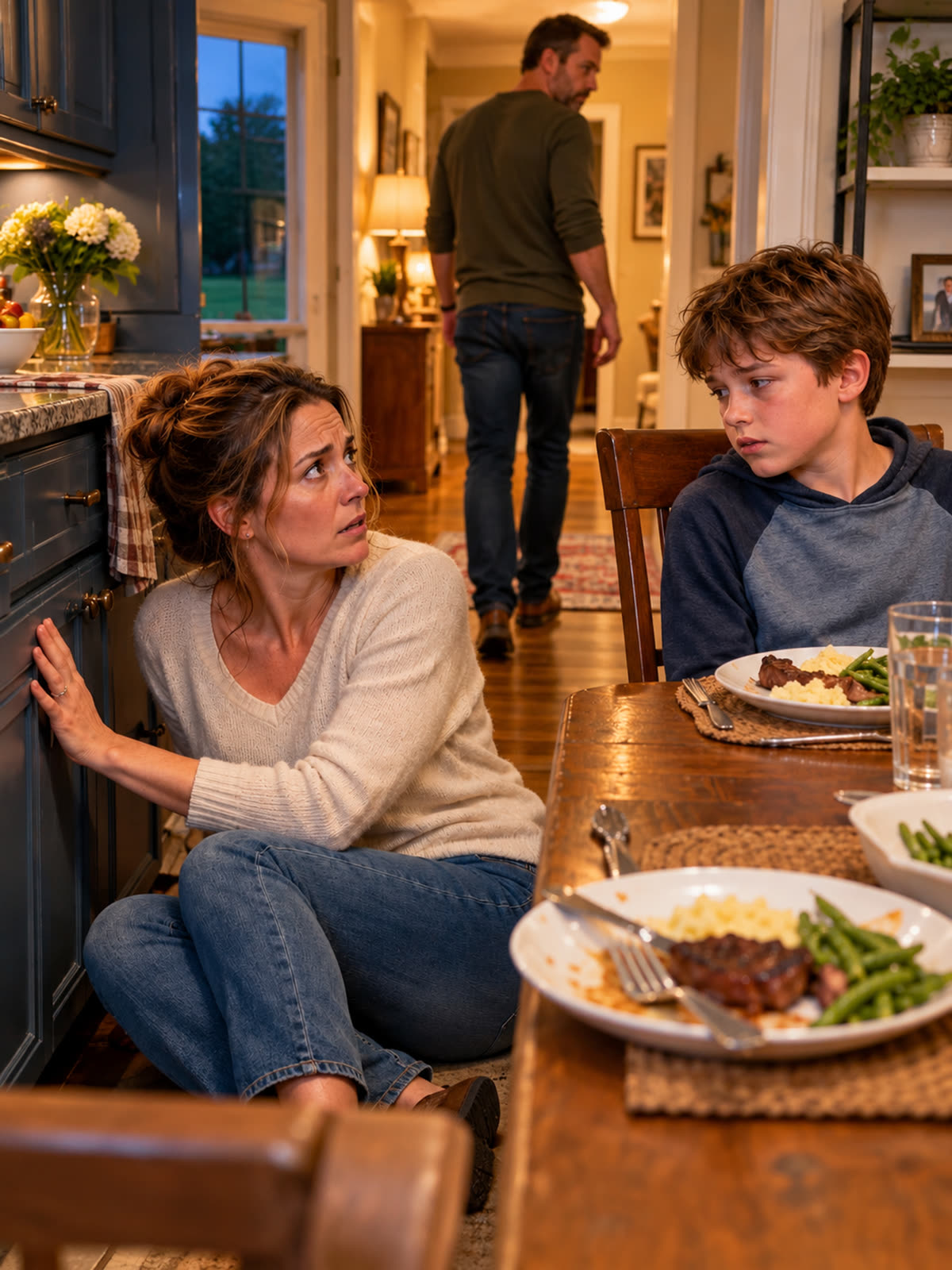
My husband prepared dinner. After we ate, my son and I collapsed. While pretending to be unconscious, I heard him whisper, “It’s done. They’ll both be gone soon.” Once he left the room, I whispered, “Don’t move yet.” Even now, remembering those moments feels like stepping back into a nightmare. The meal, the kitchen, the man I had married—all of it should have belonged to an ordinary evening. Instead, it became the night my son and I nearly disappeared.
I couldn’t make my body respond. My limbs felt impossibly heavy, as though the floor had swallowed every bit of strength I possessed. My thoughts remained clear enough to understand that something terrible was happening, but understanding did nothing to restore control. Eli lay beside me, motionless. His face blurred whenever I tried to focus on it. Only the faint sound of his breathing kept panic from taking over completely. As long as I could hear him, I had something to hold on to.
Jared stood only a few feet away when I heard those words. They were spoken so quietly, with such chilling certainty, that for a moment they seemed more unreal than the weakness spreading through me. I was not meant to hear them. I was not meant to remain aware of anything. Every instinct urged me to reach for Eli, get up, run, fight. Instead, I listened to my husband’s footsteps retreat and forced myself to stay still.
I still cannot explain how I managed that stillness. Perhaps the years I had spent nursing had taught me to think through fear. Perhaps it was simply the instinct of a mother who understood that the smallest mistake could cost her child everything. Something inside me said, “Stay still. Don’t panic. Wait.” To explain how we reached that kitchen floor, though, I have to return to the hours before dinner, when our lives still looked almost normal.
My name is Naomi. I am thirty-eight, a mother, and, until recently, a wife. When Eli was born, I left nursing to raise him full-time. That choice had always felt like one of the few things in my life I had gotten completely right. He was curious, bright, and forever noticing details other people missed. Since he was little, he had followed me around, copying the way I folded clothes or stirred coffee, sometimes even humming the way I did.
Jared and I had been married for twelve years. In the beginning, he was funny without trying, charming without seeming to work at it. He could make a whole room feel lighter, and he had made me feel chosen. For years, I believed our family rested on something dependable. Then, over the last two years, small changes began accumulating. His laughter became less frequent. His answers shortened. The man who had once felt so familiar slowly became difficult to reach.
There were late nights explained with vague excuses, a phone he suddenly kept locked, and conversations conducted in whispers behind closed doors. When I questioned him, he called me paranoid or controlling. Eventually, I stopped asking. I concentrated on keeping things steady for Eli, preserving the appearance of a peaceful home even while I felt that peace slipping away. I wanted my son to feel secure. I also wanted to believe there was still something secure for him to feel.
So when Jared announced that he wanted to cook dinner, I felt suspicion tangled with a hope I was almost embarrassed to admit. He never volunteered to make a meal. Perhaps this meant he wanted to reconnect. Perhaps he was finally trying. He said he had a special recipe: steak, mashed potatoes, and green beans. Eli was delighted. Even a small effort from his father could make him glow, and I wanted desperately to let that happiness mean something.
Soft music played while I put our good plates on the table. Jared hummed over the potatoes, handling the cooking with a confidence I had never associated with him. For a little while, the scene resembled our earlier years—or at least the way I remembered them. Still, beneath that fragile comfort, my instincts whispered, “Something is off.” I pushed the thought aside. Stress, I told myself, had taught me to see trouble everywhere. I did not want to spoil the evening before it began.
The steak was slightly overdone, and the beans carried too much garlic, but the potatoes troubled me. They were unusually smooth and glossy, with a texture that seemed to coat my tongue. Beneath the butter was a faint bitterness. Jared watched Eli and me too closely, smiling in a way that felt strained rather than affectionate. Trying to sound casual, I said, “These potatoes taste a little funny.” He laughed as though I had delivered a line he had been expecting. Then the room began to tilt.
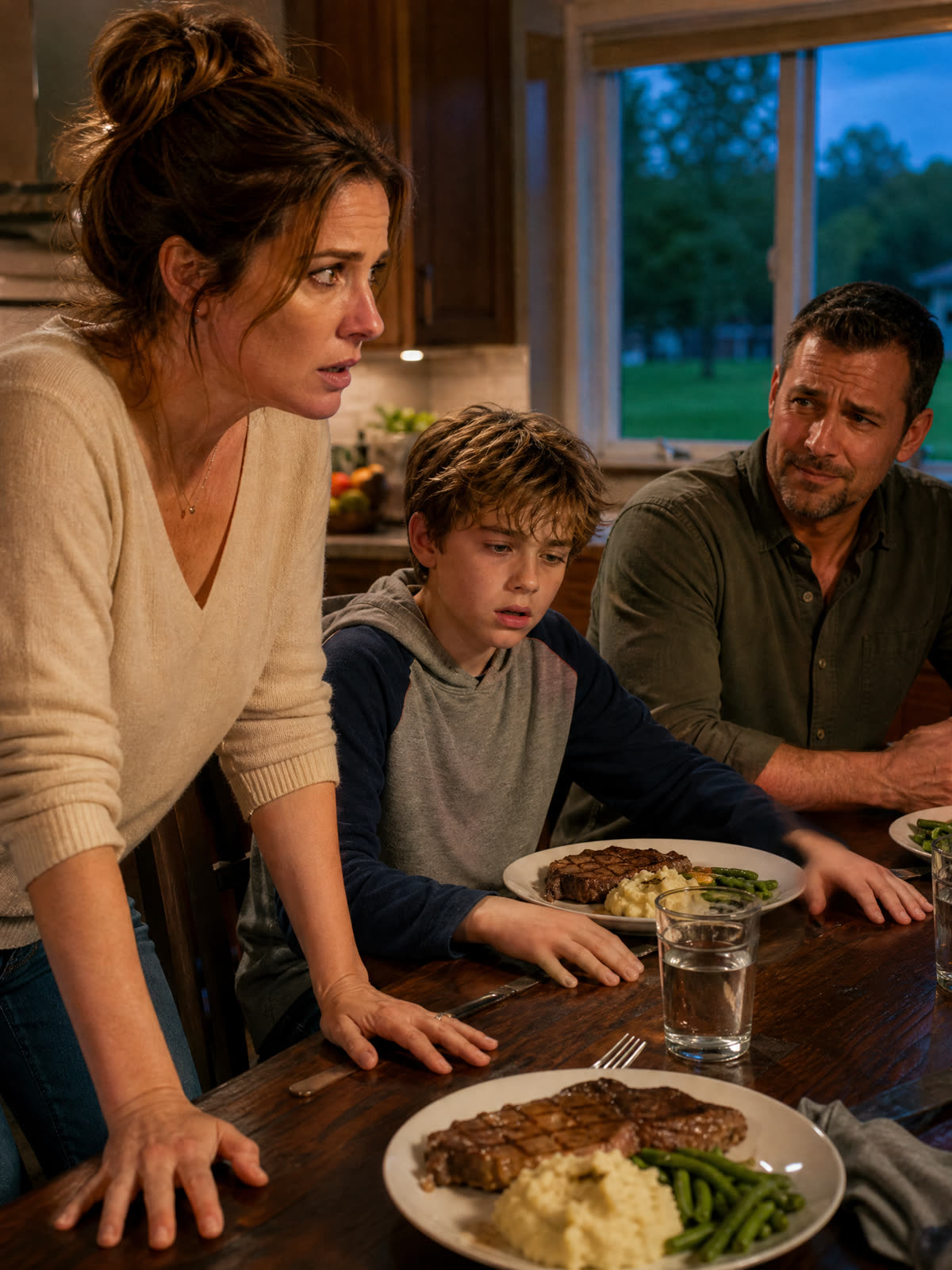
First came dizziness, followed by a dry throat and numbness in my fingers. Eli whispered that his stomach hurt. His face had gone pale. My nursing instincts surged through the confusion: this was not an ordinary upset stomach, not some harmless mistake in the kitchen. I tried to move, but my body was already failing me. Across the room, Jared stood at the sink washing his hands with an awful composure, as though nothing unusual was happening.
That was when I knew. As my strength gave way, I eased Eli down beside me and let myself appear to lose consciousness. It was the only thing I could think to do. A moment later, Jared came back, and I heard him say, “It’s done.” He believed we were dying. We nearly were. I kept my body slack, fighting the urge to reach for my son while my husband moved away with the unhurried confidence of someone finishing a task.
His footsteps receded. At last, the front door clicked shut. I opened my eyes only far enough to check the kitchen. Empty. I pressed my fingers against Eli’s back. He stiffened slightly but did not lift his head. He understood what I needed from him. Even through the fear and weakness, my brave boy understood. In the smallest whisper I could manage, I told him, “Bathroom. Spit out everything. Try to throw it up.”
Eli was only eleven, but in that moment he understood more than any child should have to. He gave a slight nod and began crawling toward the hallway, his limbs trembling. I followed, dragging legs that felt almost detached from the rest of me. We reached the guest bathroom, where I turned on the faucet to conceal the sounds we might make. Every movement took effort. Every second seemed to matter more than the one before it.
We were both sick in that bathroom, coughing and heaving while fear overwhelmed everything else. Tears streamed down Eli’s face. Watching him struggle was almost unbearable, but he kept fighting, and so did I. Eventually, we sank onto the cold tiles, shaking and exhausted. My breathing began to settle, and my thoughts became less clouded. I knew we were not safe simply because we felt a little steadier. We were still inside the house where Jared had tried to kill us.
Eli found my hand and squeezed it. “Mom, why would Dad do that?” There was no answer I could give him—not one I understood, and certainly not one that could make this less terrible. I could not explain how a father could look at his child and do what Jared had done. But explanations had to wait. Whatever strength remained in us needed to be used for one thing: getting out before he came back.
I reached for my phone. The screen stayed black. I tried again, but there was no response. I had charged it that morning. Then I stumbled to the wall phone and found no dial tone. The meaning settled over me with a fresh wave of dread. This had not been an impulsive act. Jared had prepared for it. He had considered how we might call for help and taken those possibilities away. “We have to go now,” I whispered.
I took the emergency flashlight from beneath the sink and wrapped Eli in my hoodie because he could not stop trembling. We moved through the house as quietly as we could. Every floorboard seemed louder than it had ever been. Every patch of shadow looked like somewhere Jared might be waiting. I kept us moving, even though my legs were unsteady and my mind kept returning to the door, wondering whether it might open before we reached safety.
The garage air felt cold and metallic. I reached toward the automatic door control, then stopped. The motor would announce what we were doing. Instead, I caught the handle and lifted the door by hand. It groaned loudly enough to send my heart racing, but I could not stop halfway. Once it was raised, I looked outside. Jared’s car was gone. The street held no headlights, no approaching figure—only the stillness of early evening.
“Go,” I whispered to Eli. “Straight to Miss Levers. Don’t stop.” He ran barefoot across the lawn, and I followed as quickly as my weakened legs allowed. He reached her door first and pounded on it. When she opened it, confusion gave way to alarm at the sight of us, pale and shaking with cold sweat. “What happened?” she gasped. I forced the words past my dry throat: “Call 911. He poisoned us. My husband… he tried to kill us.”
PART 2 — The Life He Planned Without Us
Miss Levers did not waste time questioning whether I could possibly mean what I had said. Her expression became fierce. She pulled us inside, locked the door, and reached for her phone. I watched her make the call with a steadiness I could no longer find in myself. The simple fact that someone else was taking action nearly brought me to tears. Until then, it had felt as though every breath Eli and I took depended entirely on what I did next.
Within minutes, sirens sounded along the street. Red emergency lights swept across her living-room walls. Paramedics came in and began checking us, asking questions while their hands moved quickly through the work of helping. Someone lifted Eli into their arms. Someone else guided me toward the door. For the first time since I had tasted the bitterness in those potatoes, I let myself take a full breath. We had escaped the house. Now other people were fighting for us, too.
At the hospital, everything happened quickly: blood samples, intravenous fluids, toxicology tests, neurological checks. The nurses moved with a speed and purpose I recognized from my own years in scrubs. Being on the other side of that care felt strange. I understood enough to recognize their concentration, but I was no longer the nurse helping a frightened family. I was the mother waiting to learn what had been done to her child and whether we had reached help in time.
Less than an hour later, a doctor explained the results. A large quantity of a sedative, probably a benzodiazepine derivative, had been crushed into our food. The dose, he said, could have produced something that looked like an accidental overdose. Beneath that clinical explanation lay what Jared had intended: a way for us to die that might leave him an explanation. The doctor believed we might not have awakened if we had not been sick when we were.
Hearing it described so plainly made me feel ill again. The dinner had not simply gone wrong. The faint bitterness, Jared’s watchful smile, the calm way he washed his hands—each piece now belonged to the same deliberate act. When police officers came to take my statement, I told them everything I could remember. I described the meal, the dizziness, Eli’s collapse, Jared’s words, the useless phones, and the escape across the lawn. Saying it aloud did not make it feel more possible.
When I finished, I asked the question that had been pressing against every other thought. “Did you find him?” The officer’s jaw tightened before he answered. “He’s not at the house. His car is gone. A statewide alert is out.” My stomach knotted. Surviving was supposed to mean the danger had ended, yet Jared was still somewhere beyond those hospital walls. I could not stop imagining him slipping into another life while Eli and I learned to live looking over our shoulders.
Less than forty-eight hours later, the police found him at an airport. He was trying to board a flight using a false name. He had forged documents and a second phone. The details made one thing unmistakable: the dinner was only part of a much larger plan. He had prepared an escape for himself with the same care he had put into making certain we would have none. While we were struggling to stay alive, he had been moving toward the life he expected to begin.
I had known by then that Jared intended to leave us behind. What I had not yet understood was why he had decided leaving required our deaths. That final piece came when my sister Alina arrived at the hospital. She looked shaken in a way that went beyond fear for us. It was the expression of someone carrying information that had become impossible to keep. I could see that whatever she needed to tell me had been weighing on her long before she entered the room.
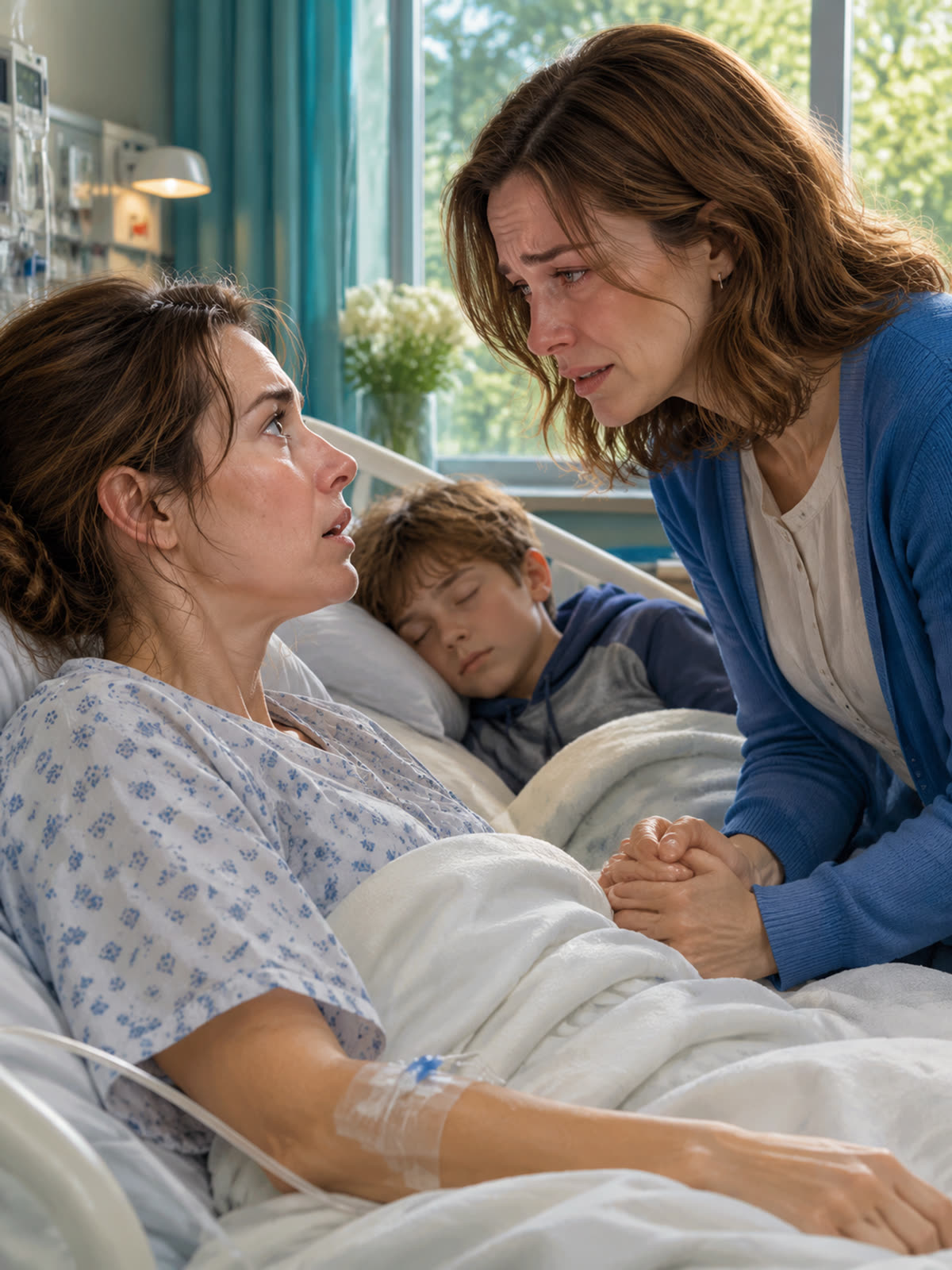
Eli slept beside me beneath a thin blanket. His breathing was even now, mercifully free of the frightening uncertainty that had filled the hours before. Alina sat close to my bed and leaned forward, her hands clasped tightly together. I watched her struggle to begin. There was guilt in her face, and her eyes shone with tears she had not yet let fall. I felt myself bracing before she said anything, as though my heart recognized another blow was coming.
Her voice was barely a whisper. “Naomi, there’s something I need to tell you.” I stayed still and waited. She looked at me with an anguish that made the silence between us feel heavier. Then she continued, “I didn’t want to say anything until I knew for sure,” and added, “But for the last two months, I knew Jared was cheating.” The words struck with the force of something cold. After everything that had happened, there was still another truth I had not known.
She had seen him in a Midtown restaurant with a young woman, perhaps twenty-five. The woman had looked polished and completely at ease beside him. Alina watched Jared kiss her. Then she saw them leave together and enter a condominium building. There had been nothing ambiguous about what she witnessed, yet she had struggled with what to do afterward. She had not known how to tell me, or whether stepping into our marriage would make things worse.
For weeks, she had debated speaking up. She wondered whether it might be a temporary lapse, some confusion he would come to regret, something that could still be repaired. But hearing that Jared had tried to kill his wife and child destroyed every ordinary explanation she had tried to give his behavior. Whatever she had seen at that restaurant was no longer merely an affair. It belonged to something far darker than she could have imagined when she first recognized him.
I did not become angry with her. I could see how badly she was hurting, and I knew how long I had spent explaining away the signs myself. She had hesitated for two months. I had lived beside his growing distance for much longer. Neither of us had understood where it led. It would have been easy to turn toward the smallest, nearest hurt, but her silence was not what had placed Eli and me on that kitchen floor. Jared had done that.
Alina went on. The woman Jared had been seeing came from a wealthy family. A recent inheritance had conditions attached to it, including a requirement that she marry someone without the financial and legal complications of an existing family. No debts. No dependents. No tangled obligations. As my sister explained it, I began to see the shape of the future Jared wanted and the way he had decided we stood between him and it.
He wanted to become a man with a clean slate. Not a husband arranging a divorce. Not a father accepting responsibility for his child. He wanted the version of himself that could step into someone else’s wealth without carrying the life he had already built. Apparently, he had decided the way to accomplish that was to remove us altogether. Hearing the motive set out so plainly felt unreal. Money, appearances, freedom from obligations—those were the things he had weighed against our lives.
I kept thinking of twelve years reduced to something he wanted erased. Our home. The nights we had stayed awake with a crying baby. Holidays and private jokes and all the ordinary moments I had believed meant we belonged to one another. I had known his habits, his laughter, the sound of his voice when he was tired. None of that had stopped him from imagining a future in which Eli and I were simply gone.
The airport arrest made even more sense now, though understanding the plan did nothing to make it easier to bear. The false name, forged documents, and second phone were not desperate choices made after an accident. They were preparations for an entirely different existence. Jared had expected to leave behind an explanation for our deaths and step into a future shaped around someone else. The husband I had been trying to reach had been planning how not to be that man anymore.
Meanwhile, the police assembled the evidence. They had the toxicology results and food samples from our kitchen. They examined the disabled phone lines, the false passport, and the plane ticket. The second phone and financial records added more pieces, showing transfers and arrangements connected to his planned identity. One item might have invited an excuse. Together, they formed something far more solid. His preparations had left a trail, and investigators were following it.
Each detail took me back to something I had experienced without understanding it at the time. My dead phone. The silent line on the wall. His car missing from the garage. The casual certainty in his footsteps as he moved away from us. What had felt like separate shocks that night now fit into a single design. He had not simply hoped something terrible would happen. He had arranged the evening around it and prepared to leave before anyone could ask questions.
The truth was no longer hidden behind a locked screen or a closed door. It was in the food, the documents, the flight reservation, and the life he had been preparing to claim. I knew what he had wanted. The police knew how he had tried to get it. Yet the man who had left us on the kitchen floor still had a story of his own to tell—and he began by insisting that none of it meant what it so clearly did.
PART 3 — What Surviving Could Not Erase
At first, Jared denied everything. He told the police there had been a misunderstanding, that perhaps Eli and I had become sick and panicked. He claimed he had been hurrying to the airport for work. He said the false passport was not his. After hearing the care with which he had prepared to leave, those explanations sounded almost impossible. But he offered them anyway, as though enough words might separate him from the evidence or turn that dinner back into an ordinary meal.
They could not. The case against him was too strong. The toxicology findings, the food recovered from our kitchen, the disabled telephone lines, the false documents, and the arrangements for another identity all supported one another. The prosecutors later told me the case was airtight. Eventually, with his denials leading nowhere, Jared pleaded guilty. Attempted murder. Child endangerment. Using controlled substances with the intention of causing harm. The man I had trusted with our lives was sentenced to life without parole.
People assumed that sentence would bring relief. Perhaps part of me understood that it should. He would not be coming back to our house. We would not spend our lives wondering whether he might appear at the door. But what I felt was quieter and heavier than relief, like standing after a storm and seeing everything it had nearly destroyed. It was justice. It mattered. Yet justice could not return us to the people we had been before dinner that night.
Prison did not stop me from waking with my breath caught in my throat. It did not silence the memory of his voice whispering, “They’ll be gone soon,” inside my head. It did not change the way Eli held on to me, as though letting go might make me disappear. Jared’s punishment answered what would happen to him. It did not answer what would happen inside us, or how long it would take before ordinary moments stopped carrying the possibility of danger.
After the hospital discharged us, we moved into Alina’s home. Her house became a refuge. A locked door could mean protection again instead of confinement. Morning sunlight in the kitchen could be something simple, something that did not ask anything from us beyond being there to see it. My sister kept telling us we were no burden. I believed she meant it, though from time to time I still caught the guilt in her eyes.
I never blamed her for failing to imagine what Jared would do. Knowing about an affair was not the same as knowing that a man might try to kill his family. She had not been responsible for predicting something so monstrous. The truth was that I had not predicted it either. I had shared a home and a child with him. I had spent twelve years learning his expressions, his routines, his moods. Even then, I had never imagined he could look at us and see obstacles.
Our bodies recovered, though the doctors’ words stayed with me. They told us how fortunate we were, how another ten minutes—or even five—might have changed everything. The narrowness of that escape followed me like a cold shadow. We had survived, but survival did not feel like a single event that ended when we left the hospital. It felt like something we had to learn, morning after morning, while our minds caught up with the fact that we were still here.
Eli had nightmares. Some nights he woke and came into my bed without speaking, curling against me the way he had when he was smaller. At other times, I noticed him watching a doorway or listening closely to footsteps. I did not make him explain what he was feeling. He had been forced to understand too much already. I let him come close when he needed to and move at his own pace when he wanted quiet.
Every day, I reminded him, “We’re safe now.” I meant it, even on days when fear found its way back into my own thoughts. Three months had passed since we collapsed on the kitchen floor, and sometimes the whole experience still seemed to belong to someone else. Then I would see him asleep, breathing steadily, and remember how I had listened for that same sound through the blur of the poison. We had survived something we were never supposed to survive.
Eli began drawing again. At first, his pictures held dark clouds, shadows, and houses without windows. Lately, there were trees and dogs, small scenes he noticed around him, the neighbor’s cat resting on a porch, sunlight falling across the kitchen table. I did not ask him to explain the change. I simply noticed it. Healing did not always announce itself in words. Sometimes it appeared in the space where a dark shape had been, replaced by something ordinary enough to feel hopeful.
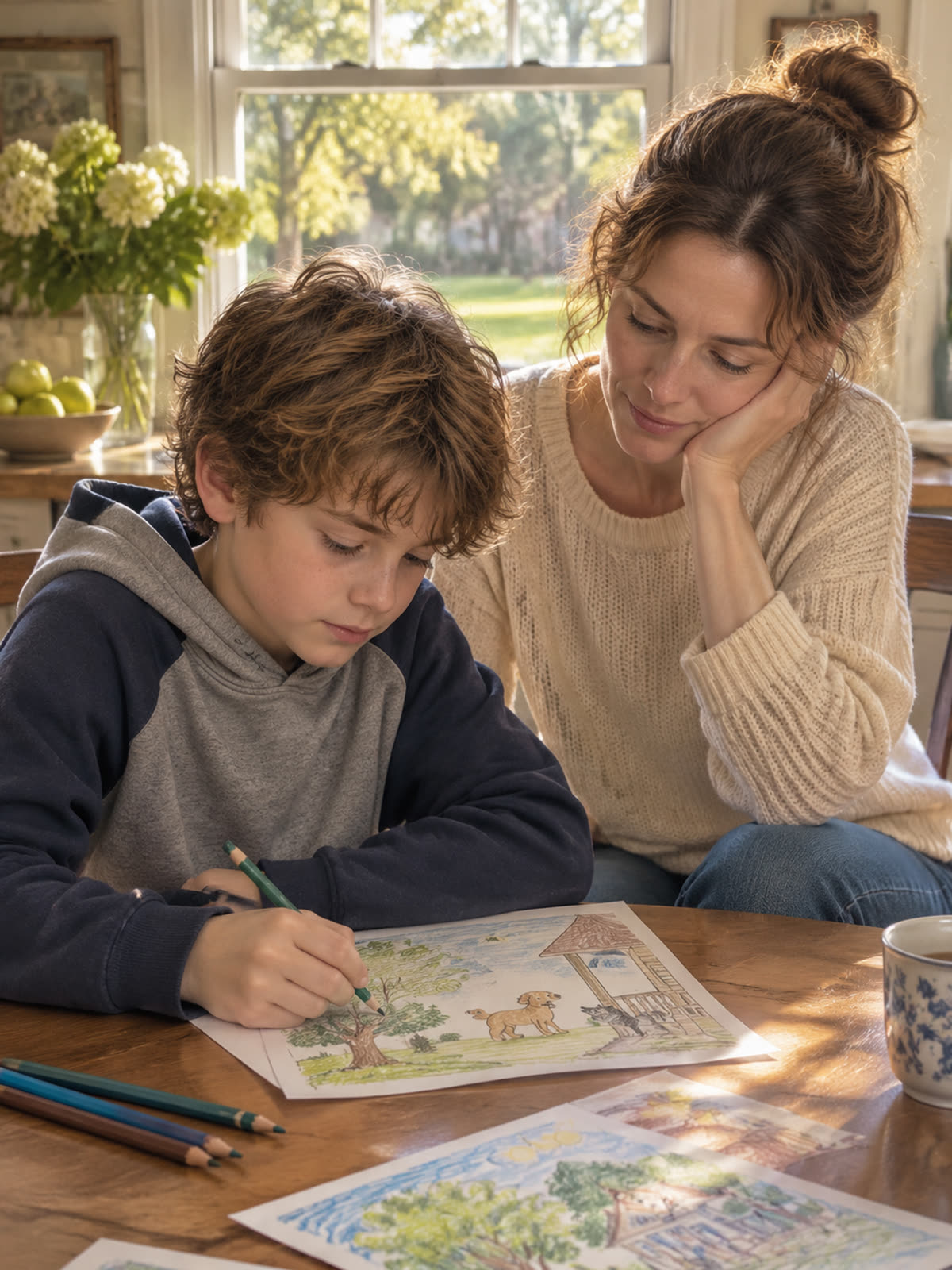
He still did not mention Jared often. Sometimes he stared out a window with a seriousness that seemed far too heavy for an eleven-year-old. Sometimes he sought comfort without saying why. I held him when he needed holding and let silence remain silence. He would speak when he was ready. For now, I wanted him to know that he did not have to translate every frightening thought into language before I would understand that he needed me near.
I had begun to understand that emotional recovery followed no clean timetable. Physically, the emergency had ended. Inside, the fear loosened more slowly, in layers too small to measure. There were mornings when I felt almost like myself, and others when a memory could pull the kitchen floor back beneath me. I stopped expecting healing to look dramatic. Sometimes it looked like drinking something warm while the house remained quiet. Sometimes it sounded like Eli laughing down the hall.
Those small things became important in a way I had never fully understood before. Sunlight through the kitchen window. The low sound of the kettle. My son’s laughter. They were not grand promises that everything would be easy now. They were evidence of the life we still had. Before the nightmare, I might have passed through those moments without noticing them. Afterward, I found myself holding on to their plainness, grateful that an ordinary morning could exist at all.
I also kept returning to the way love can change what we allow ourselves to see. Perhaps it makes us overlook the edges of another person. Perhaps we become attached to the version we first loved and keep searching for it long after the person in front of us has changed. I had wanted Jared to be stressed, distracted, temporarily distant—anything but dangerous. I had mistaken my ability to explain his behavior for a reason not to question it.
People began asking what I had learned and what I would tell someone who suspected something was wrong. Later, the question often came in fuller form: “What would you tell someone who suspects something is wrong in their relationship? What advice would you give?” I thought about it carefully, because I remembered how often I had quieted myself. I had said, “He’s stressed,” or, “It’s just a phase,” or, “Maybe I’m overthinking.” Those explanations had been easier than facing what I did not want to know.
What I tell people now is that instincts deserve attention even when they are quiet. A feeling does not have to arrive with a complete explanation before you are allowed to notice it. When something in your home changes, when words no longer match actions, when your body tightens and you cannot yet say why, you do not have to dismiss yourself. Doubt is not automatically disloyalty. Sometimes it is the first sign that you are finally paying attention.
I cannot go back and answer every warning differently. I cannot change the times I accepted an excuse because I wanted it to be true. What I can do is stop treating my own awareness as something shameful. That night, survival did not look like a confrontation. My strength was not in overpowering Jared or demanding a confession. It was in remaining still, listening, and waiting long enough to give Eli and me a chance to get away.
Those choices were small when measured against what was happening: a body kept limp, a hand pressed gently against my son’s back, a whisper, the decision to wait until the front door closed. Yet they opened the way out. Now, as we rebuild, I try to choose truth instead of comforting appearances, safety instead of denial, awareness instead of the urge to silence myself. Love should not require danger. It should not depend on abandoning your own voice.
If someone hears our story while doubting themselves, I hope they recognize that their unease matters. They are not alone simply because they cannot yet explain what they feel. I used to believe that preserving peace meant swallowing questions. Now I know that silence can hide something very different from peace. Eli and I are living, recovering, finding our way through ordinary days again. But I have not forgotten how quietly our chance to survive first arrived.
When I return to that night in my mind, I do not begin with the airport arrest or the courtroom sentence. I begin beside my son on the kitchen floor, listening to Jared walk away. My body is failing, Eli is still breathing, and every frightened part of me wants to move before it is safe. Then I hear the thought that held me there: “Don’t move. Not yet.” In that memory, the footsteps are fading—and I am still waiting for the moment we can escape.
Disclaimer: This story is a work of fiction inspired by real-life themes. Names, characters, places and events are fictionalized, and any resemblance to real persons is purely coincidental. Images are for illustration purposes only.
