

Part 1: The Toast
I almost didn’t go. For two years I had found reasons to skip Thanksgiving at my parents’ house: a deadline, a client emergency, a cold I invented the night before. This time I stood in my kitchen on Thursday morning, holding my car keys, and realized I was tired of hiding. Not tired of the work, or of the quiet life I had built. Tired of letting a story about me go uncorrected for so long that everyone I loved had memorized it.
The drive took a little over an hour, and the countryside was putting on its final show of the season. Maples burned orange and crimson along the ridgelines, and golden fields rolled out under a sky so clear it looked rinsed. Pumpkins were stacked at roadside farm stands, and woodsmoke curled from chimneys. On any other day I would have pulled over to take it in. Instead I gripped the wheel and rehearsed nothing, because I had learned long ago that rehearsed speeches never survive my family.
My parents’ house sat at the end of a long gravel drive lined with old maples, a white colonial with black shutters and a porch swing nobody ever used. Cars were already parked along the grass. Cara’s white SUV took the best spot, right by the front steps, gleaming as though it had been washed that morning. I parked at the far end, beside Aunt Carol’s dented sedan, and sat for a moment with the engine ticking as it cooled.
Mom opened the door before I could knock. She wore her cream cardigan and the pearls Dad gave her on their thirtieth anniversary, and she pulled me into a hug that was warm but brief, the way a person hugs someone she isn’t quite sure how to hold. “You look tired,” she said, studying my face. “Are you eating enough?” It was the closest thing to a real question I would get all day, and she had already moved on before I could answer it.
The house smelled of roasting turkey, sage, and cinnamon. Voices drifted from the dining room, and I recognized Cara’s laugh at once: bright, practiced, the laugh of someone who has always been the center of every room. She stood by the window in a lavender silk blouse, pearl earrings catching the light, showing her phone to two of our cousins. I caught a glimpse of the screen as I passed: wide windows, a kitchen island, a backyard with a stone patio. Her new house.
“Stella!” Cara said, crossing the room to kiss the air beside my cheek. “You made it. We were starting to think you’d bail again.” Her tone was light and teasing, and as always it landed somewhere beneath my ribs. Trevor lifted a hand from the sofa, offering a polite, slightly distracted smile. He looked like a man listening to a conversation in another room. I smiled back, took a glass of cider from Mom’s tray, and found a corner to stand in.
Aunt Carol arrived from the kitchen with a basket of rolls, her reading glasses swinging on their chain. She squeezed my arm and told me I was too thin, then drifted off to inspect the cranberry sauce. Uncle Pete was talking football with Dad. The cousins were arguing over which pie to cut first. It was a perfectly ordinary Thanksgiving, and I felt it closing around me like a coat that no longer fit.
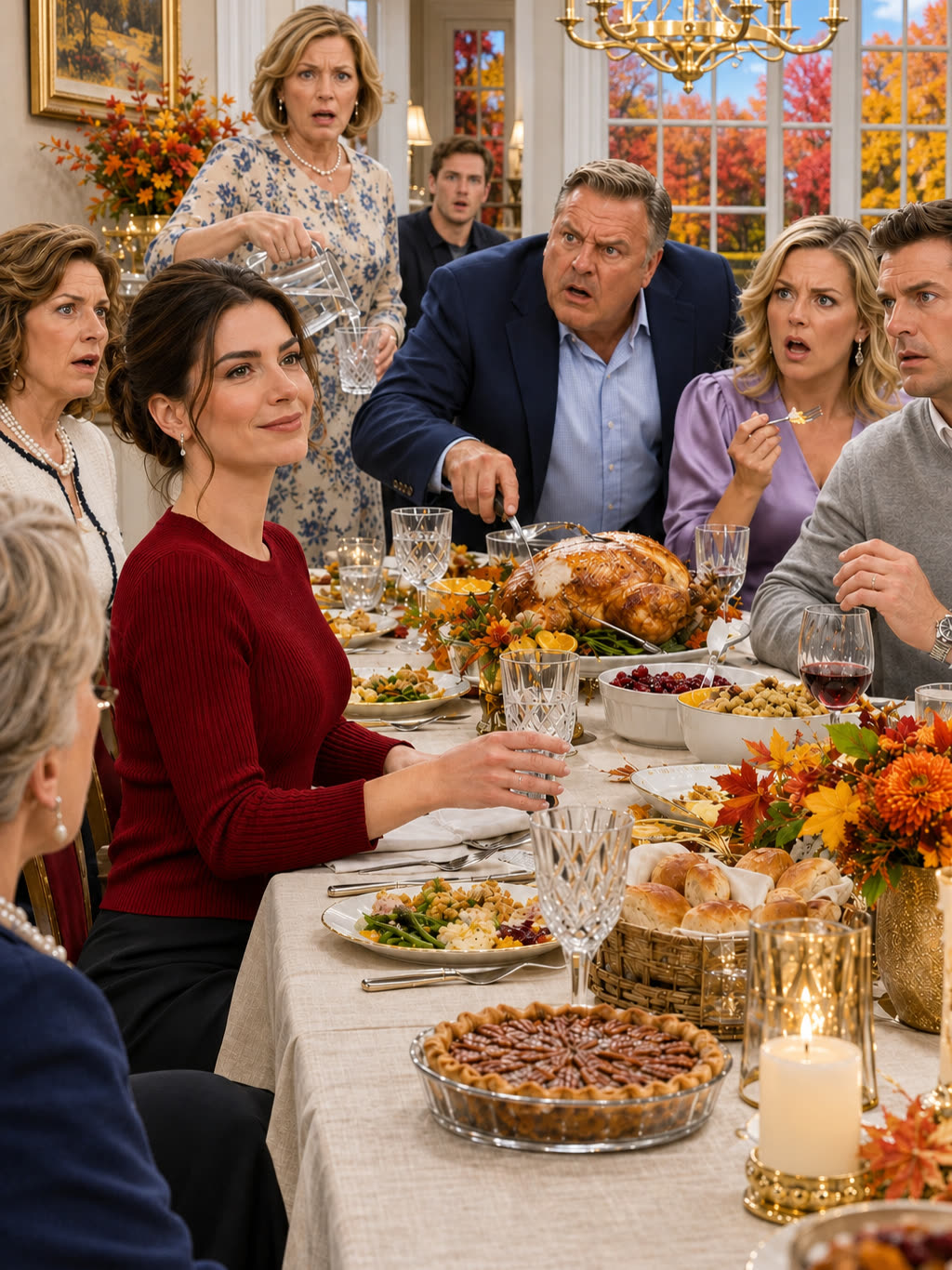
Dinner was called at four. The table stretched nearly the length of the dining room, laid with Mom’s good china, brass candlesticks, and a centerpiece of orange chrysanthemums and red maple leaves. Everyone drifted to their usual places. Cara sat at Dad’s right hand, Trevor beside her. I was steered, as I have been every year, to the far end near the kitchen door, where the draft from the swinging door reached my ankles. Dad carved the turkey with the ceremony of a man conducting an orchestra.
Plates were passed. Stuffing, green beans, mashed potatoes, a bowl of cranberries that glittered like rubies. Dad asked Cara about the closing on her house for the third time that week, and she answered as though it were the first, glowing with every detail. When he turned to me he asked, “Still freelancing, Stella?” in the tone people use for a child’s hobby. “Still freelancing,” I said, and he nodded the way he always did, as though I had confirmed something sad.
Then Dad tapped his fork against his wine glass, and the table quieted. He rose with the glow of a man about to enjoy himself. “I want to say a few words,” he began. “This family has a lot to be thankful for. And especially this year.” He turned to Cara, beaming. “To Cara and Trevor, and their beautiful new home. Honey, we’re so proud.” Glasses lifted, and then he looked down the table at me and grinned, as though sharing a joke. “Stella, your sister just bought a gorgeous home! When will you catch up?”
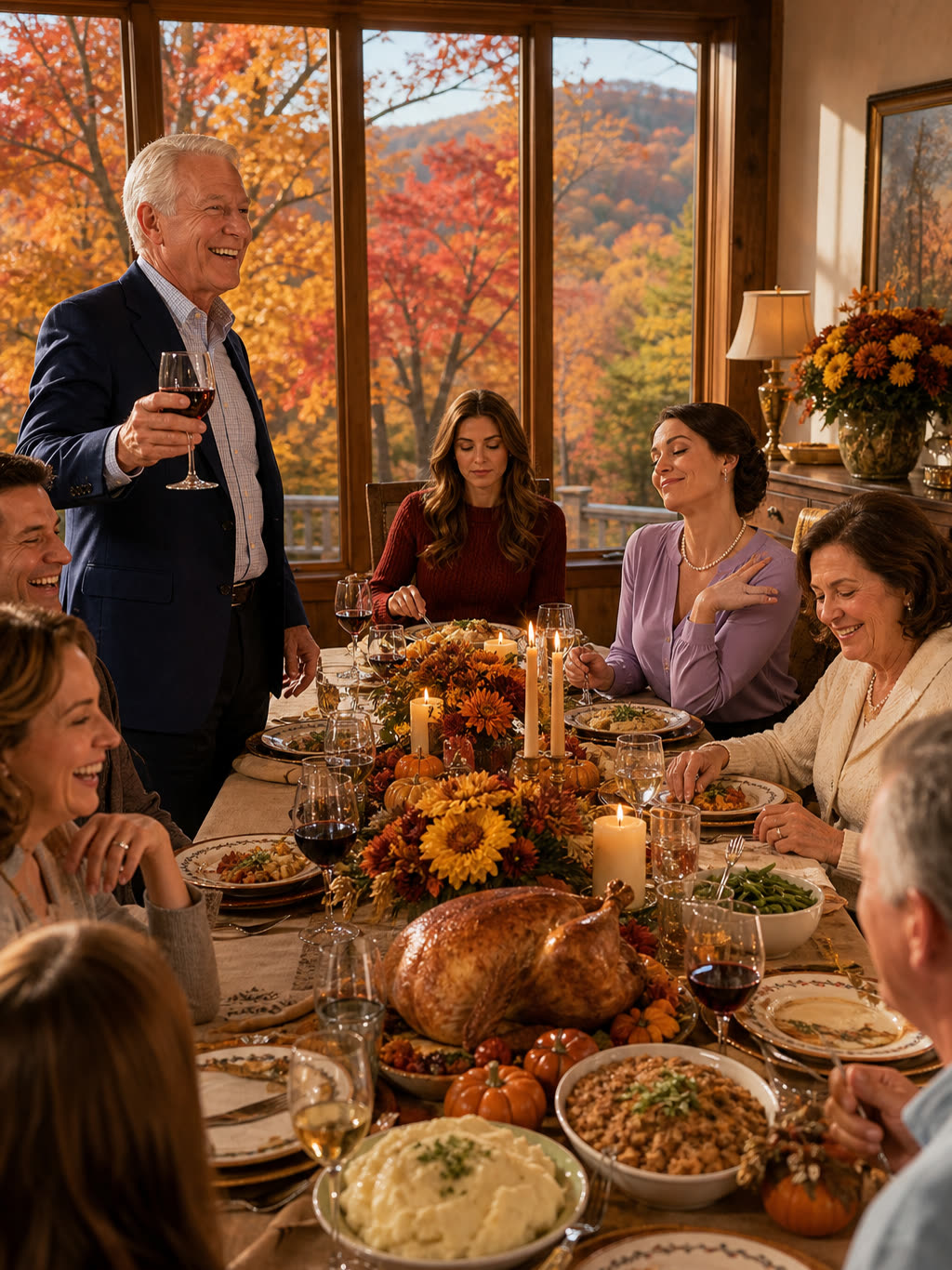
Laughter rippled around the table. It wasn’t cruel, which was the worst part. It was affectionate, easy, the kind of laughter that has no idea it is a wound. Uncle Pete chuckled into his wine. One of the cousins said, “Ooh, burn,” and Aunt Carol patted the air in mock apology. Cara gave a modest little shrug, basking in it. Mom smiled at her plate. Every face turned toward me, waiting for the familiar response: the small laugh, the shrug, the promise to try harder.
I set down my fork. I felt strangely, almost eerily calm, the way the air feels in the instant before a storm breaks. How many times had I heard some version of that question? At holidays, at birthdays, at graduations, at weddings. Every one of them had taught me to make myself smaller, to apologize for the room I took up and the pace I kept. I looked at my father’s hopeful, expectant face and understood that he truly believed he was being funny.
“Actually, Dad,” I said, “I bought a house too.” I said it gently, without any particular emphasis. For a moment the sentence just hung there, as though the room hadn’t decided what to do with it. A cousin stopped chewing. Somewhere in the kitchen, a timer began to beep and nobody went to silence it.
Dad laughed first, a short, bright bark of disbelief. “You what?” he said. “Come on, Stella. If this is a joke, it’s a good one.” He glanced around for someone to share his amusement, but the faces around the table were suspended between a smile and a question. Cara’s fork paused halfway to her mouth.
“It’s not a joke,” I said. “I closed on it in the spring.” I reached for the butter dish with a steady hand. My heart was beating hard enough that I could feel it in my fingertips, but my voice came out level, and that surprised me more than anything. For years I had imagined this moment going very differently, with me trembling, defensive, desperate to be believed.
Mom set down her water glass. “Spring?” she repeated quietly. “Stella, why wouldn’t you have told us?” I only shrugged, because the honest answer was too large for a dinner table. Trevor shifted in his chair. Aunt Carol’s eyes darted from my face to Dad’s, as if she were at a tennis match and had lost track of the ball.
Dad recovered the way he always did, by reaching for his authority. He cleared his throat, straightened his navy blazer, and set the carving knife down with a deliberate clink. “Well,” he said, with a smile that didn’t quite reach his eyes, “that’s something. A condo, I suppose? One of those starter places downtown?” He glanced at Cara for approval, as though the conversation were a ball he was passing back to her.
“It’s a house,” I said. “With a yard.” I broke a roll in half and spread butter on it, because the motion gave my hands something to do. I could feel the table leaning toward me now, the way plants lean toward a window, and I was in no hurry. For the first time in my life I wasn’t racing to fill the silence.
“Where is it?” he asked, striving for an offhand tone.
“About twenty minutes from here,” I replied, spreading butter on a roll as casually as possible.
Dad laughed again, less naturally this time. Cara set her fork down. Trevor reached for his water. Across the table, one of my cousins was already typing something under the tablecloth, and I could almost hear the news racing through half the county.
“So what’s the square footage on this mystery house of yours?”
I met his gaze without flinching.
“Just over four thousand.”
Everyone seemed to inhale together. Aunt Carol murmured “Oh”, Cara blinked, and Trevor looked torn between admiration and unease. A log shifted in the fireplace in the next room and the sound seemed to ring through the house. Dad opened his mouth, closed it, and opened it again, and for the first time in my entire life I watched my father search for words he didn’t have. I took a bite of my roll and waited, because I knew the evening was only beginning.
Part 2: The Deed
Dad settled farther into his chair. “That’s a lot of space for someone on their own.” His voice had lost its jovial edge. Now he sounded like a man checking a fence he had always assumed was sturdy, pressing on it to see whether it would hold.
I gave a small shrug. “Maybe. But I paid in full, so it’s not exactly a burden.” I said it the way a person mentions the weather. I had no wish to gloat. If I’m honest, I wasn’t even sure I wanted them to be impressed. I only wanted, for once, to say a true thing aloud and let it stay said.
The room seemed to be hearing a different account of my life, although none of the facts were new to me. I had lived long workdays and quiet sacrifices. Their surprise was theirs. The quiet afterward felt less like embarrassment than a room reconsidering its assumptions. I let them work through it rather than rushing to make everyone comfortable, which was a habit I had practiced so long that sitting still inside the silence felt almost physical, like holding my breath underwater.
Dad studied me with a puzzled expression, uncertain whether to dismiss the news as a joke or ask more questions. His fingers drummed once against the tablecloth. Outside the tall windows, the last of the afternoon light turned the maples copper and gold, and the long shadows of the trees stretched across the lawn toward the house. Everything looked exactly as it always had. Only the people inside had begun to tilt.
Cara remained motionless, her pie untouched and her expression guarded. She had always been the one who knew precisely what to do with her face, and I watched her search for the right one now. The sugary smile she reached for kept slipping, and beneath it I saw something I couldn’t name. It looked almost like fear, although I told myself I must be imagining it.
“You paid in full?” Dad finally asked, doubtful.
I nodded.
“Every cent. No mortgage.”
Trevor unexpectedly breathed, “Wow.” Cara immediately glanced his way, and the look she gave him was so sharp that he dropped his eyes to his plate. I noticed it, and so did Mom. Something in the air at that end of the table had changed, a hairline crack in a surface that had always looked smooth.
“I’ve been building this for years,” I continued. “Just not publicly.”
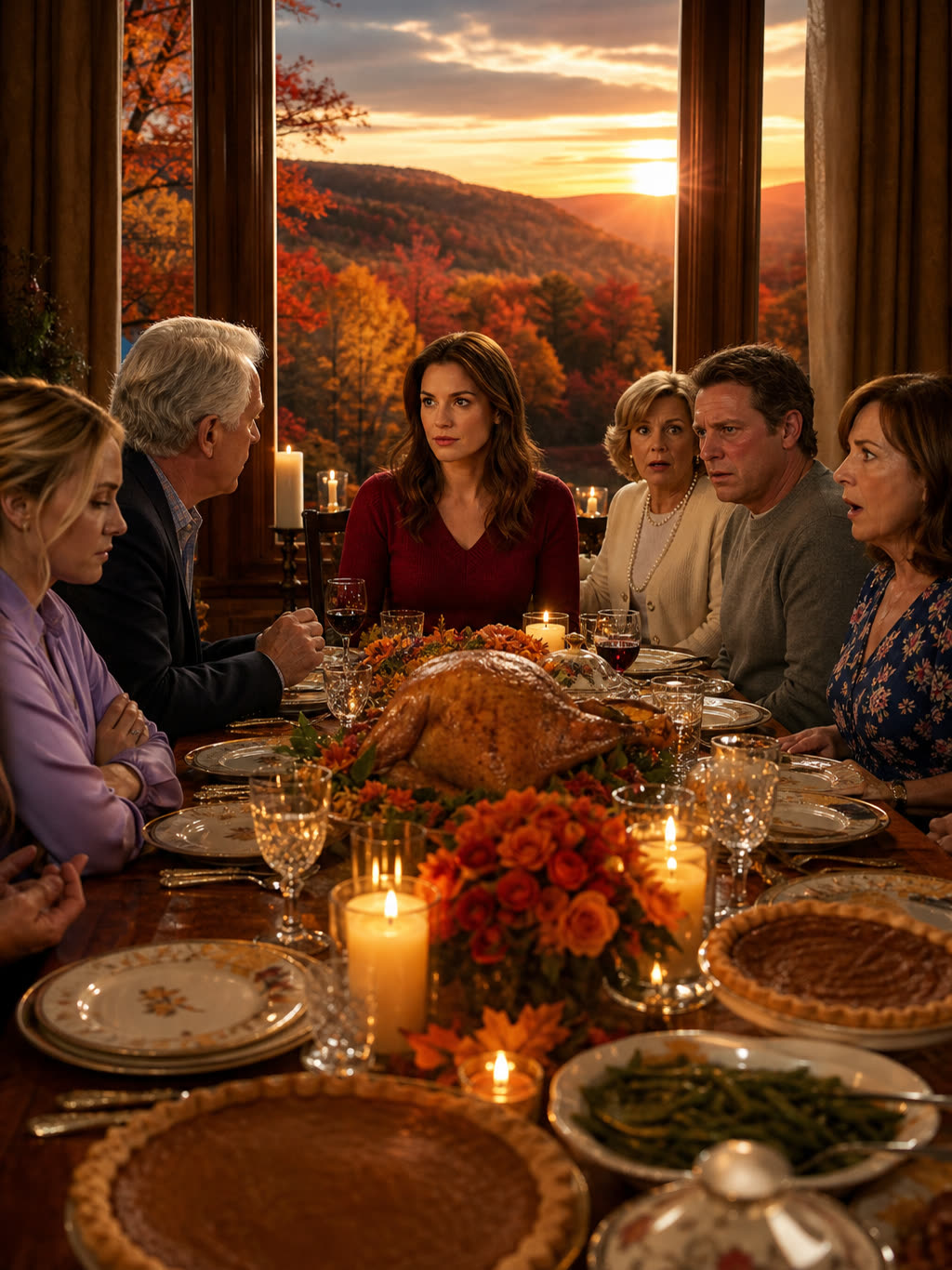
Uneasiness spread around the table, settling over the conversation. Cara attempted to regain control, her sweetness forced, as though a cheerful tone could restore the familiar hierarchy. She laid her hand over Trevor’s and leaned forward with her brightest expression, the one she wore for photographs. “That’s great, Stella,” she said, her tone sugary sweet. “But buying a house is a big deal. You didn’t want to share that with your family?”
I faced her evenly.
“You mean the family that only ever asks how close I am to being like you?”
Her smile wavered. A cousin coughed into a napkin. Aunt Carol suddenly became fascinated by the salt shaker. I hadn’t raised my voice, and I hadn’t meant it as a weapon, yet the sentence landed in the middle of the table like a dropped plate, and nobody seemed to know whether to pick it up.
“I didn’t hide it out of spite,” I added. “I just didn’t feel the need to explain myself anymore.”
I wasn’t speaking harshly. I simply meant every word.
Dad tried another subject. He picked up his wine, set it down, and scrambled toward familiar ground. “So what kind of work are you doing now? I thought you were freelancing.”
“I was. Now I run my own consultancy. I have six clients under retainer.”
Mom finally spoke.
“Six?” she asked.
She sounded less skeptical than startled by an understanding that had arrived, and for the first time all afternoon she seemed to be truly listening. Her gray eyes held mine across the candles, and I saw her doing arithmetic she had never bothered to do. Years of phone calls cut short and vague answers accepted. Years of me saying “things are fine” while she asked nothing more.
“I’ve been financially independent for a while now.”
Dad shifted, determined to restore his usual comparison. I almost admired the stubbornness of it, the way a man will keep rowing against a current because he has never learned to do anything else. “Well, Cara’s house is in a fantastic neighborhood. Great schools, great investment.”
Trevor nodded automatically; Cara straightened with renewed confidence. She smoothed her blouse and lifted her chin, grateful to be handed back the spotlight. I looked at the pearl earrings, the manicured hands, the practiced posture, and felt no envy. Only a tired, steady sort of tenderness, mixed with something harder that I was done pretending not to feel.
“Oh, totally,” I said lightly. “Although technically, it’s not her name on the deed.”
Silence fell instantly. Cara’s composure fractured. The candle flames seemed to stand perfectly still, and in the next room the grandfather clock ticked so loudly that I could count the seconds. Dad’s head turned slowly toward his favorite daughter.
“Excuse me?”
“It’s just what the records show,” I said. “Trevor signed the mortgage. It’s public information, you know. Registry of deeds.”
Trevor flushed.
“We’re married,” he said quickly. “It’s our house.”
“Of course,” I said, my voice neutral. “But we both know how banks work.”
Cara tightened her jaw.
“Why would you even look that up?”
“I didn’t,” I said. “Someone sent it to me months ago. Said it was funny how I was always the one being compared when I was the only one not owing a bank anything.”
Dad raised a hand.
“Okay, okay. This is getting out of hand.”
“No,” I said, still calm, still centered. “It’s not. It’s finally honest.”
For an instant I noticed doubt cross Dad’s face, replacing the certainty with which he had always treated Cara as our family’s success story. He seemed to be reconsidering who had earned that title, and I could almost watch the old framed picture in his mind tilt on its nail. Cara folded her arms defensively.
“I never asked to be compared.”
I agreed.
“Neither did I. But it happened anyway. Every holiday, every birthday, every backhanded compliment.”
The refrigerator’s faint buzz seemed unusually loud from the kitchen. I wasn’t trying to wound anybody. I had simply stopped disguising reality to protect everyone else. The cousins stared at their plates. Uncle Pete discovered an urgent interest in his napkin. Nobody reached for the rolls.
“I built something real,” I said. “I just didn’t need an audience to clap for me along the way.”
Nobody responded. Dad appeared desperate to retake charge, while Cara held her fists beneath the table. I could see the whiteness of her knuckles where the tablecloth rode up, and the sight pricked at me. I had spent so many years being the one who was hurt that I had never considered what it might cost her to stand on a pedestal she hadn’t built.
“You know,” she said, “for someone who didn’t want attention, you sure timed this pretty perfectly.”
I inclined my head.
“I didn’t time anything. You asked when I’d catch up. I simply answered.”
Trevor shifted beside her.
“Let’s not make this a competition.”
“It’s always been a competition,” I said gently. “Just one I wasn’t told I was in.”
Nobody laughed. Nobody breathed. In the long pause I looked at my sister, really looked, and noticed what I had missed in the doorway hours before: the faint shadows beneath her eyes, concealed with expert makeup, and the way her smile appeared a half second too late, like a light switched on by hand. Something was wrong with Cara, and it had nothing to do with me.
Then Cara leaned across the table, close enough that only I and the people beside me could hear. The sugar had drained from her voice, leaving something low and brittle. “You think you know everything about my house,” she whispered. “You have no idea what you just walked into.” Her eyes were bright, and for one terrible second I couldn’t tell whether it was anger or tears. Trevor reached for her arm, but she pulled away, and the whole table went silent as the front doorbell rang.
Part 3: Nobody Followed
The doorbell rang again, and Mom half rose from her chair. “That’ll be the neighbors dropping off the pie,” she said, to no one in particular. Nobody moved. Aunt Carol patted her arm and said she would get it, and she slipped away gratefully. Through the doorway I heard a cheerful voice, a brief exchange, the thud of a closing door. When she returned with a covered dish, the table had not shifted an inch.
Cara’s whisper still hung between us, and I couldn’t let it go. “What did you mean?” I asked, quietly enough that the others had to lean in. She stared down at her untouched pie, and her composure finally gave way. Her lips pressed together, her shoulders folded inward. Trevor stared at the ceiling, his jaw working.
“The house,” she said at last, in a voice I barely recognized. “We stretched. Trevor’s hours were cut in the summer, and the mortgage is more than we can comfortably carry. We’ve been drowning, Stella. Every month.” She let out a short, cracked laugh. “And every time Dad called me the success story, I smiled, because what else could I do?”
“Cara,” Mom breathed.
“Don’t,” Cara said. “Please don’t.” She dabbed at her eyes with a napkin, and her mascara smudged in a thin gray line. For the first time all day she looked like my little sister, the girl who used to climb into my bed during thunderstorms. “I didn’t want anyone to know,” she said. “I couldn’t stand being the one who needed help.”
I let the silence stretch. I could have said many things. I could have pointed out that she hadn’t exactly hesitated to accept the praise. I could have said that the pedestal she stood on was built with the same lumber as the box they had nailed around me. But I saw in her face the same exhaustion I had worn for years, and I understood that comparison is a trap with two sides, and that both of us had been caught in it.
“I’m sorry you’ve been carrying that,” I said, and meant it. “I really am. But I need you to hear this too.” I turned to include the whole table, and my voice held steady, though my hands had begun to tremble in my lap. “I worked twelve-hour days for nearly three years. I didn’t go on vacations. I didn’t go into debt. I built my business client by client, staying up until two in the morning, designing proposals and doing my own taxes.”
I surveyed their faces.
“No one asked. Not once.”
Aunt Carol suddenly remembered.
“You skipped two Thanksgivings in a row, didn’t you?”
I nodded.
“And no one called. No one checked in. You just assumed I was drifting. That I was still the one behind.”
Cara gave a dismissive snort, though it came out wet and unconvincing.
“So what? You wanted applause? A parade for doing your job?”
“No,” I said. “I wanted a family that didn’t measure my worth by how closely I mirrored your life.”
Her cheeks reddened. The firelight from the next room flickered across her face, and for a moment she looked very young. A gust of wind pressed against the windows, and the last gold leaves swirled past the glass like sparks.
“I never claimed to be better,” I added. “But you all made it very clear I was somehow less. And I believed it until I realized your standards had nothing to do with me.”
I looked from one relative to another.
“You praised milestones you could measure. Square footage, curated lives on social media. But not resilience. Not risk. Not growth in silence.”
Dad finally asked, quietly,
“Why didn’t you just tell us?”
I held his gaze.
“Because it wouldn’t have mattered. You already decided who I was a long time ago. You put me in a box labeled ‘still trying’ and never looked inside.”
He drew a sharp breath.
“That’s not fair.”
“It’s not about fairness,” I said. “It’s about a pattern.”
I turned toward my sister.
“You’re not the villain, you know. But you’ve never once used your voice to shift the spotlight. You stood there and soaked in all the praise without asking why it was always so one-sided.”
Cara stared, caught between defensiveness and possible guilt.
“I didn’t know,” she said quietly.
“You didn’t ask,” I replied. “And you never wondered why I stopped showing up.”
Mom’s eyes filled.
“Stella, I didn’t realize.”
“I know,” I said gently. “That’s the problem.”
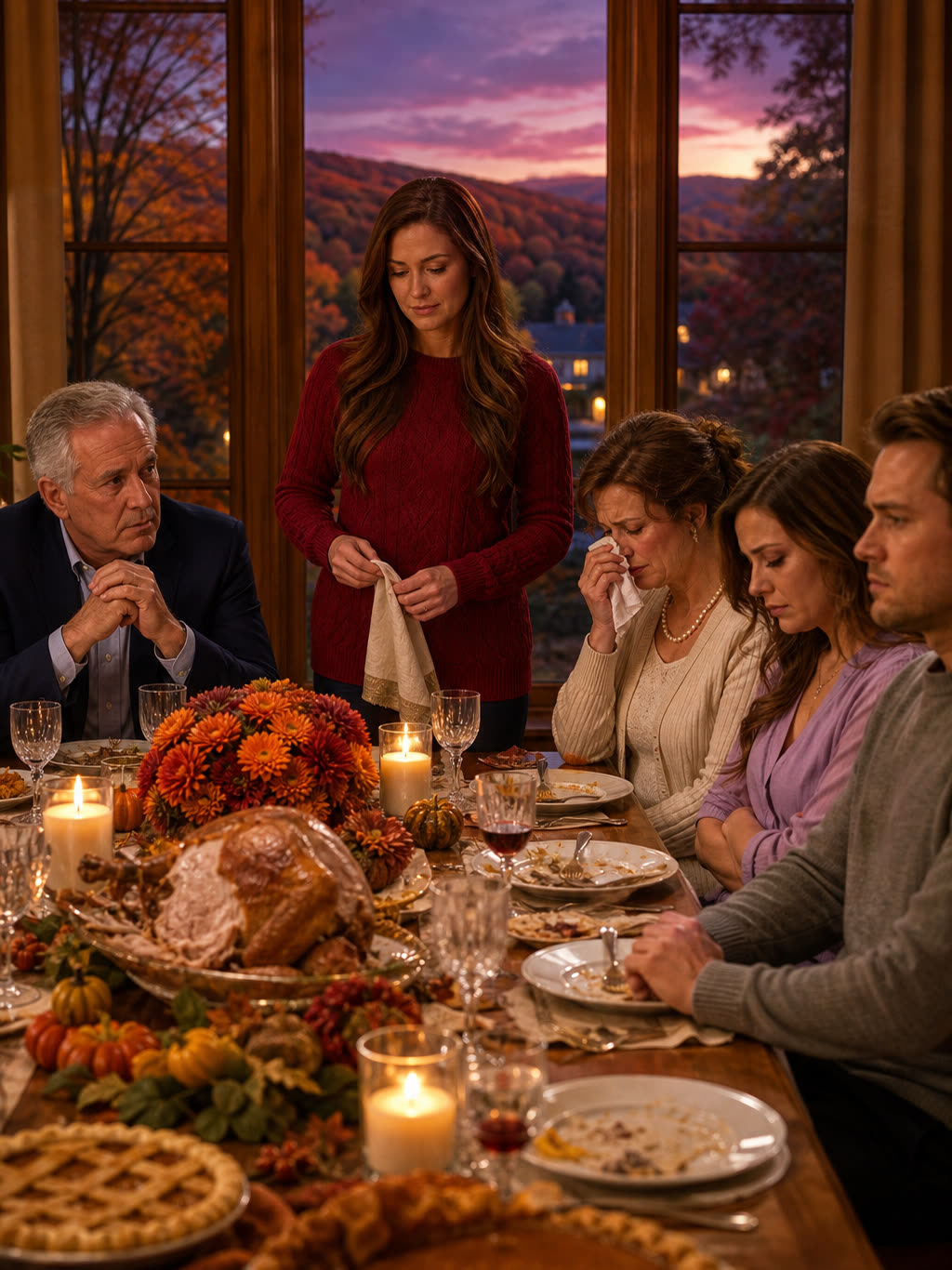
The years seemed to settle over us at once, heavy as snow on a roof. No one could restore the old arrangement. Cara studied her plate, her hands flat on the cloth. Trevor sat rigidly, jaw tight, eyes fixed on nothing. Mom wiped her eyes, struggling to remain composed. Dad looked suddenly older, just uncertain where to stand now that his familiar assumptions had shifted. The candles had burned lower, and the cold turkey sat forgotten in the center of the table like a monument to a holiday no one could finish.
For years I had softened my achievements to avoid making Cara uncomfortable. At that table, I understood the effort that habit had required and how nobody had noticed it. At last, I could speak plainly without permission or apology. I folded my napkin carefully. Anger had passed; I didn’t need a victory or another explanation.
“I think I’ll head out,” I said quietly, standing up.
“Stella…” Mom began, then stopped.
I looked at her without bitterness.
“You always asked me to come back, but never asked how I was doing,” I said gently. “You wanted updates you could brag about, not the truth of who I was becoming.”
She opened her mouth but found nothing to say. I faced Cara.
“We don’t have to be close. But it would have meant something if, just once, you had pulled me aside and asked me how I was really doing. No filters. No audience.”
She remained quiet, although her eyes now showed recognition. I saved Dad until last.
“You wanted me to catch up,” I said. “But I was never behind. You just never looked.”
His shoulders lowered.
“You’re right,” he said almost inaudibly.
That small acknowledgment was enough; I had no desire to demand a longer apology in front of everyone. I walked toward the entrance and slipped on my coat. My fingers found the buttons without trouble, though my pulse still hammered. Nobody followed or called after me. Oddly, their silence offered closure. Perhaps they finally understood that the version of me they had constructed had never belonged to them.
Outside, the evening air was sharp and cold, yet welcome. The sky had deepened to violet above the black outlines of the maples, and one pale star showed over the ridge. Woodsmoke drifted across the lawn. Away from that table, I wasn’t a perpetual disappointment, a quiet girl waiting to measure up, or someone chasing her sister’s achievements. I was Stella, already living the life I had built. For the first time in years, I could leave without needing anyone to follow.
I drove home with the windows cracked, the cold air stinging my face. Twenty minutes later my headlights swept across the front of my house: the wide porch, the tall windows, the old oak in the yard still holding a few stubborn leaves. I turned off the engine and sat in the quiet, listening to it tick. No one had clapped, and I found that I didn’t need them to.
Inside, I hung my coat, put the kettle on, and stood at the kitchen window watching the last light drain from the field behind the house. My phone buzzed on the counter. Cara’s name lit the screen above a short message: “Can we get coffee this week? Just us. No audience.” I read it twice. I didn’t answer right away. But I set the phone down gently, and I felt something in my chest that had been clenched for years finally begin to loosen.
Disclaimer: This story is a work of fiction inspired by real-life themes. Names, characters, places and events are fictionalized, and any resemblance to real persons is purely coincidental. Images are for illustration purposes only.
