

Part 1: The Suitcases in the Hallway
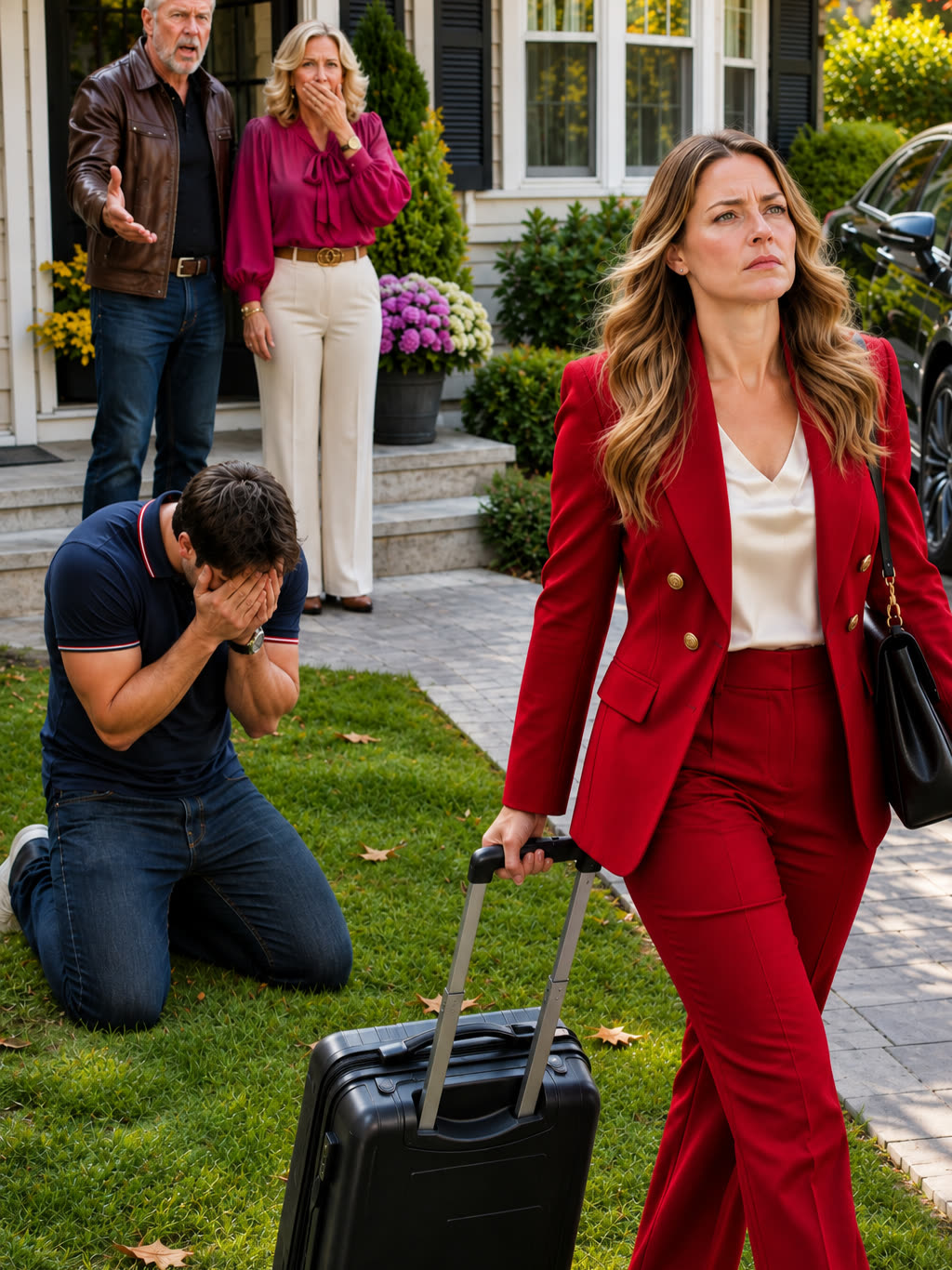
My unemployed brother flung my suitcases into the hallway because I hadn’t made dinner after a twelve-hour workday.
“Get out, Naomi! You’re thirty-four years old and still living in your mother’s house. You’re nothing but a useless leech!”
I stared at him, wondering whether he had forgotten that I was the one who paid the mortgage, the utilities, and most of the groceries. The words hung in the air of the narrow hallway, and for a moment I honestly couldn’t tell whether I was more angry or more astonished.
Then my mother came out of the kitchen.
Instead of defending me, she said, “Your brother is the man of this house now. Maybe you should leave until he calms down.”
That was the moment I stopped trying to buy my family’s love. It didn’t arrive as a dramatic revelation. It settled over me quietly, like a door clicking shut somewhere deep inside my chest, and I understood that I had been paying for something that was never actually for sale.
My name is Naomi Carter. I’m thirty-four, and until that Sunday evening I had spent three years supporting my mother and my twenty-nine-year-old brother, Brent, in our childhood home outside Chicago. I had never described it to myself as supporting them. In my head it was simply what a loving daughter did when her family was in trouble.
My father had died three years earlier and left behind a house with a substantial mortgage. Mom’s Social Security income couldn’t cover the payments, and Brent hadn’t held a steady job in years. The numbers simply did not work, and everyone in the family knew it, though nobody wanted to say it aloud.
At the time, I was living in a comfortable apartment in downtown Chicago and working as a senior cybersecurity consultant. I liked my life there. I liked the view from my window, the quiet mornings, and the feeling of having built something entirely on my own. Then Mom called me in tears, afraid she was about to lose the house, and I broke my lease and moved home. I promised to help until she could find a more manageable financial arrangement.
Every first of the month, I transferred $3,000 into her household account. Over three years, those transfers added up to $108,000. On top of that, I covered the electricity, water, internet, and the occasional property expense that came up. The mortgage stayed in my mother’s name, but I was the person making sure the payments actually got made, month after month, without being thanked and without being asked.
Brent contributed nothing. He slept until noon, played video games late into the night, and grumbled whenever I asked him to help with even the smallest chore. Mom always came to his defense.
“He’s having trouble finding his direction,” she would say.
Apparently, finding his direction required expensive gaming equipment and uninterrupted high-speed internet, which I was also paying for. I noticed the irony every time I paid the bill, and every time I swallowed it.
I rarely argued. I was too busy working sixty-hour weeks, traveling for client meetings, and making certain nothing in that house went unpaid. Arguing felt like a luxury for people with spare energy, and I had none. I told myself that keeping the peace was part of the price, and that the price was worth it.
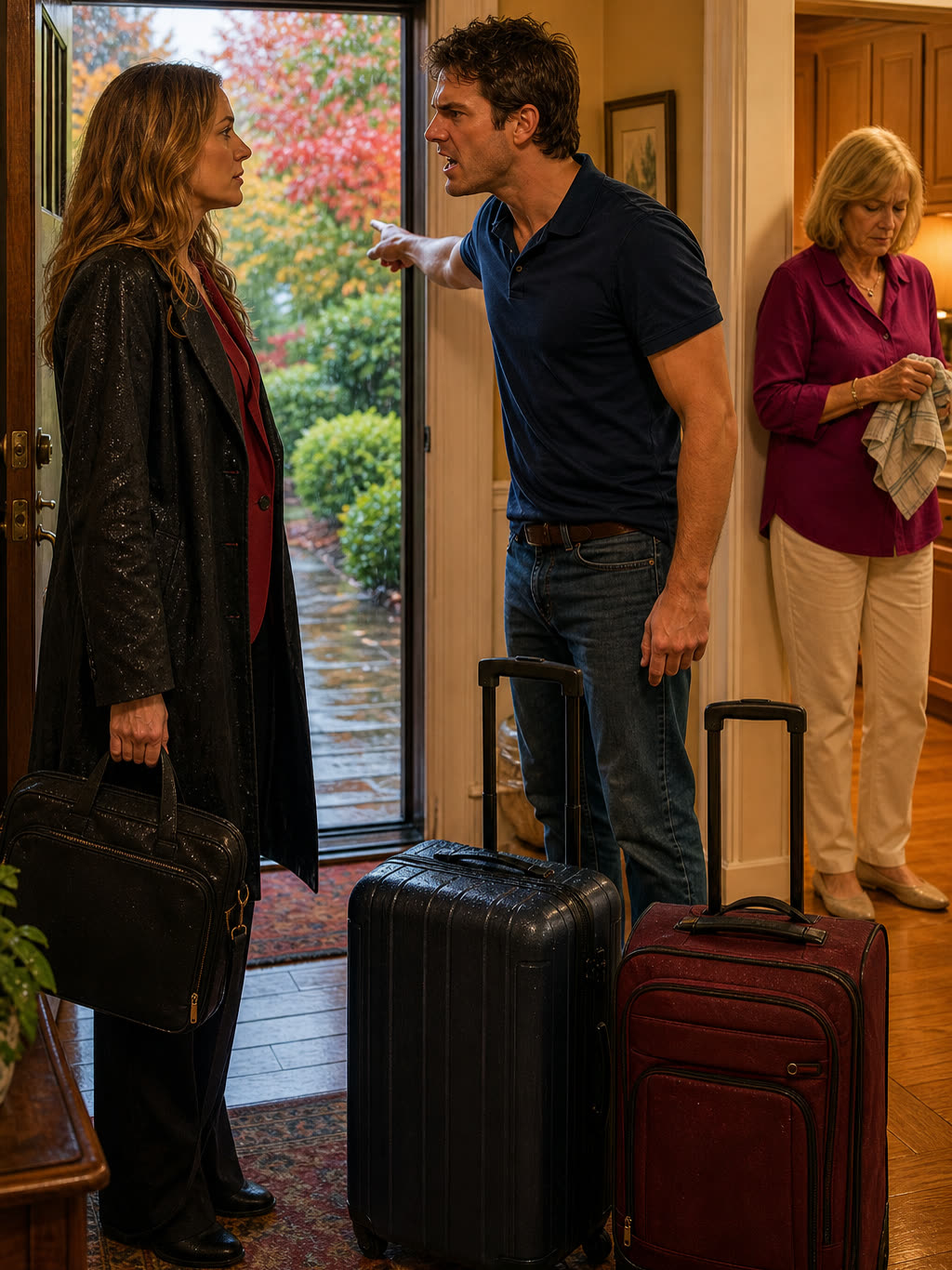
That Sunday, I came back from a business trip completely drained. It had rained all afternoon, my coat was damp, and I was carrying my laptop bag when I pushed open the front door. All I wanted was a hot shower and a quiet evening.
Instead, my two suitcases were waiting in the hallway. They had already been packed.
I stood there with water dripping from my sleeves, trying to make sense of what I was seeing. Someone had gone through my closet. Someone had folded my clothes, or at least stuffed them in, and zipped everything shut. It had clearly been planned, and it had clearly been done while I was away working.
Brent came out of the living room with his arms crossed, wearing the smug expression of a man who has rehearsed a speech.
“You can’t stay here anymore.”
I looked at the luggage.
“Why are my things packed?”
“Because I’m tired of you acting like you own the place. You didn’t even bother making dinner.”
“I’ve been out of town working.”
“That’s always your excuse.”
I glanced toward the kitchen, where Mom stood holding a dish towel, twisting it between her fingers as though it might rescue her.
“Mom, are you hearing this?”
She avoided my eyes.
“Naomi, your brother has been under a lot of stress.”
“Stress from what? He doesn’t work.”
Brent stepped closer, and I could smell the stale air of the room he rarely left.
“See? That’s exactly why I want you gone. You think paying a few bills gives you the right to disrespect me.”
“A few bills?” I repeated.
He pointed toward the door.
“I’m the man of this house. You can leave.”
I turned to my mother. Part of me still believed she would step in, that she would remember the thousands of dollars and the three years and the broken lease.
“Do you want me to go?”
She hesitated. The silence stretched out long enough for me to hear the rain against the window.
Then she whispered, “Maybe a hotel would be best for now.”
I waited for her to change her mind. I gave her every second I could. She didn’t.
I slid my house keys off the ring and set them on the entryway table, where they landed with a small, final sound.
“Okay.”
Brent looked surprised, almost disappointed that there was no fight.
“That’s it?”
I picked up my suitcases.
“You wanted me out. I’m leaving.”
That night, I checked into a hotel near the airport. The room was plain and smelled faintly of carpet cleaner, but nobody there expected anything from me. I sat on the edge of the bed with my coat still on and opened my banking app. I scrolled through the recurring transfers I had made for thirty-six months, one after another, each representing an evening I hadn’t spent on myself.
Then I canceled the next $3,000 payment and removed my cards from the household’s automatic utility payments.
I wasn’t going to interfere with accounts that legally belonged to my mother. I simply stopped volunteering my income to support people who had just thrown me out into the rain.
The following morning, I contacted my employer about an international assignment we had discussed months earlier. I half expected it to be gone. Instead, a position in Lisbon, Portugal, was still open, and my manager sounded almost relieved to hear from me.
By the end of the week, I had accepted it.
Before leaving Chicago, I saved copies of every transfer receipt, every utility payment, and every message concerning my financial support. Some part of me understood that I might need them someday, though I couldn’t have said why. Then I boarded a flight to Portugal with the same two suitcases Brent had packed.
As the plane lifted over the gray edge of Lake Michigan, I waited to feel guilty. What I felt instead was a strange, unfamiliar lightness.
My mother didn’t call to ask whether I had arrived safely. Days passed, and then weeks, and my phone stayed silent. I told myself I wasn’t checking it. I checked it constantly.
Her first message came three weeks later.
Naomi, the mortgage payment is coming due. You forgot to send the money.
I read it twice. There was no greeting and no question about how I was doing. There wasn’t even a pretense of caring where I had landed.
For three years, she had treated my financial support as something she could depend on without ever having to question it. Now she was about to discover what happens when that support ends.
And my brother, who had so proudly declared himself the man of the house, was about to learn exactly how much it costs to keep one.
Part 2: The Notice of Default
Three weeks after my brother threw me out of the house I’d been paying for, my mother wrote to remind me about the mortgage.
Naomi, the mortgage payment is due. You forgot to transfer the money.
It wasn’t How are you? It wasn’t Did you get to Portugal safely? It was only a reminder that the $3,000 she had received every month for three years hadn’t shown up in her account.
I was sitting in my new apartment in Lisbon when I read it. Sunlight was spilling across the tiled floor, and from the street below came the faint rattle of a tram. For the first time in years, I wasn’t bracing for another exhausting commute or wondering whether Brent had left dirty dishes piled in the kitchen.
My company had moved me into its European cybersecurity division, and I had rented a modest apartment near the city center. It had enough room to work, a small balcony, and something I had almost forgotten existed.
Peace.
I answered Mom’s message.
I didn’t forget. I stopped the payments when you told me to leave.
Her reply arrived almost immediately.
Naomi, don’t be ridiculous. Your brother was upset. You know how he gets.

I looked at those words for a long while. For three years, I had heard the same excuse whenever Brent insulted me, refused to work, or complained about the household rules. He was tired. He was frustrated. He was going through a difficult time.
Apparently, I was the only person in our family who wasn’t allowed to have one.
You agreed that I should leave, I wrote. I’m no longer living there, and I won’t continue paying your household expenses.
Mom phoned six times that evening. I let every call ring out. Instead, I opened the folder where I kept my financial records and went through it slowly, line by line. Thirty-six monthly transfers of $3,000. Electricity bills, internet payments, water charges, and receipts for repairs I had arranged over the years.
I had spent more than $108,000 helping to preserve a home in which my brother believed I had no right to live. I refused to pretend that hadn’t happened.
During the second month, the messages came more often.
The electric company says your card isn’t working.
Brent needs the internet for job applications.
We can’t cover everything with my Social Security check.
I wondered whether Brent had submitted a single application. Then Mom sent another message.
He says you’re punishing us because you couldn’t control the household anymore.
I almost laughed out loud on my balcony. The man who had packed my belongings and ordered me out was accusing me of being controlling because I wouldn’t pay his bills. I didn’t respond.
But I did contact Sarah Mitchell, the Chicago attorney who had helped our family with my father’s estate. I wanted to know whether I had unknowingly taken on any legal responsibility for the mortgage.
Sarah examined the documents. The property was in my mother’s name, and the mortgage had remained her legal obligation after my father’s death. My monthly transfers had helped her make the payments, but I hadn’t signed the loan or guaranteed the debt.
“You aren’t required to keep making voluntary contributions,” Sarah explained. “But your mother needs to contact the lender immediately. Ignoring missed payments could put the house at risk.”
I asked Sarah to put that advice in writing, and then I forwarded it to Mom. She never thanked me. Instead, Brent wrote from her phone.
You think you can just walk away after making everyone dependent on you? A lawyer told me we can sue you for abandoning your responsibilities.
I sent the message straight to Sarah. She confirmed that Brent’s accusation didn’t create any legal obligation on my part. I filed the exchange with the rest of my records.
By the third month, the tone of Mom’s messages had shifted.
Naomi, the bank sent another notice.
They’re charging late fees.
Please call me. I’m scared.
I felt the old ache in my chest. I loved my mother. I didn’t want her to lose the home where she had raised us. But I also remembered standing in that hallway, worn out from work, while she watched Brent order me into the rain. She had chosen to protect his feelings rather than acknowledge everything I had given.
And even now, neither of them had apologized.
I sent one last message.
Mom, please speak with the lender about repayment options or selling the house before the situation gets worse. I can help you understand the paperwork, but I won’t resume the payments.
She never answered.
Two weeks later, an email arrived from our former next-door neighbor, Mrs. Higgins. She had lived beside my parents for thirty years and had always been kind to me. Her message began by asking whether I was doing well overseas, and then she explained why she had written.
The lawn was overgrown. Trash had piled up beside the driveway. Brent had argued with a municipal inspector who came to look into a complaint.
But it was the final paragraph that troubled me most.
Naomi, your mother was crying on the porch yesterday. She told me the bank might take the house. I asked whether Brent was looking for work, and she said he refuses to discuss it.
I sat with that email open for a long time while the light faded over the rooftops. My mother was facing the consequences of losing my financial support. My brother was still refusing to take any responsibility. And the house I had spent three years helping them keep was now in danger of being lost.
That evening, another message came from Brent. This time he wasn’t demanding money. He wanted me to sign a document from the bank, and he attached a photograph of the first page.
At the top, in bold letters, were the words: NOTICE OF DEFAULT.
This is your fault, Naomi, Brent wrote. You need to fix it before we lose the house.
I was sitting at my kitchen table in Lisbon, nearly four thousand miles from Chicago. For three years, I had helped my mother keep our childhood home by paying the mortgage and covering the household costs. But when Brent decided I no longer belonged there, Mom had told me to leave.
Now they expected me to rescue them again.
I sent the notice to Sarah, who confirmed once more that the mortgage was in my mother’s name and that my voluntary payments hadn’t made me responsible for the loan.
“Your mother needs to contact the lender immediately,” Sarah said. “There may still be options, but waiting will make everything harder.”
I asked her to lay those options out in a letter Mom could easily follow. Sarah described possible repayment arrangements, loss-mitigation assistance, and the option of selling the property before foreclosure. I forwarded the letter without comment.
Mom answered the next morning.
Brent says selling would be a terrible mistake. He thinks you’ll eventually come home.
I stared at the screen. Even after everything, my brother believed he could make decisions about a house he couldn’t afford.
I’m not coming back, Mom, I wrote. Please make a decision based on what you can actually pay.
She didn’t respond.
Over the following months, things steadily got worse. The high-speed internet was cut off once the account I had funded was closed, and Brent refused to arrange an affordable replacement. Mom began cutting back on heating and groceries. The landscaping service I had paid for stopped coming, and the yard grew wild. Then Mrs. Higgins sent photographs of municipal maintenance notices taped to the front door. Brent had apparently argued with the inspector rather than fixing the violations.
I felt terrible for Mom. But I couldn’t ignore that Brent was still living there without contributing a cent.
I called her.
“Has Brent found work?”
“He’s looking.”
“Has he had any interviews?”
She hesitated.
“He says employers don’t appreciate his experience.”
“Mom, he hasn’t worked in years.”
“He’s trying, Naomi.”
I closed my eyes. She was still shielding him from reality.
By the tenth month, the lender had started formal foreclosure proceedings. Sarah obtained the public filings and explained that the property could eventually be sold if the default wasn’t resolved. The overdue payments, fees, and other charges had grown substantially.
Mom called me, sobbing.
“Your father loved this house.”
“I know.”
“He built the back patio himself.”
“I remember.”
“Then how can you let us lose it?”
I looked around my apartment. I had spent three years sacrificing my savings and my personal life to preserve that home. But my mother was asking me to keep doing it indefinitely while Brent went on treating me like an unwelcome guest.
“Mom, I offered to help you understand your options. I even sent you information about selling before things got this far.”
“Brent said we should wait.”
“Then Brent needs to explain how he plans to pay the mortgage.”
She cried harder. I hated hearing her that way. But I didn’t send another check.
A few weeks later, Brent finally began applying for jobs. Mrs. Higgins told me he had been turned down for several positions and had argued with a hiring manager about starting at an entry-level wage. He had spent years telling me my career meant nothing because I worked from a laptop. Now he was learning that employers expected qualifications, experience, and a willingness to learn.
Then Mom contacted our aunt Clara in Ohio. She told her that I had abandoned the family, vanished overseas, and deliberately let our childhood home fall into foreclosure.
Aunt Clara called me that same evening.
“Naomi, your mother says you left her without warning. Is that true?”
I felt the old pressure return. For years, I had been expected to defend myself whenever Brent complained about me. This time, I had something stronger than an argument.
“I’ll send you the records,” I said.
I opened the folder I had kept since leaving Chicago. Inside were thirty-six bank transfers totaling $108,000, utility receipts, messages about my financial support, and the conversation in which Mom had told me to leave. I sent everything to Aunt Clara and waited.
Twenty minutes later, she phoned back. Her voice was completely different.
“Naomi,” she said quietly, “your mother told me you never helped with the house.”
Part 3: What the Records Showed
My mother told our relatives I had abandoned her and left her to lose our childhood home. She conveniently forgot to mention the $108,000 I had sent her over three years, or that she had stood by while my unemployed brother threw me out.
But when Aunt Clara opened the bank statements I had emailed her, my mother’s version of events started to fall apart.
“Naomi, these transfers are all from your account?” she asked.
“Every single one.”
“And you paid the utilities too?”
“Yes. I sent those receipts as well.”
Aunt Clara said nothing for several seconds. Then she asked about the night I left. I described how Brent had packed my suitcases because I hadn’t cooked dinner after coming home from a business trip. I had saved the messages Mom and I exchanged afterward, including her admission that she had told me to stay elsewhere until Brent calmed down.
Aunt Clara read them carefully.
“So your brother ordered you out of a house you were helping pay for, and your mother defended him?”
“That’s what happened.”

“And now they’re blaming you because the payments stopped?”
I didn’t need to answer. Aunt Clara sighed.
“I’ll speak to your mother.”
Two days later, my phone began filling with messages from relatives who had previously believed I’d simply walked away from my responsibilities. My uncle Marcus called to apologize.
“Your mother made it sound like you disappeared without warning. We had no idea how much you’d been paying.”
I thanked him. I hadn’t sent the records to embarrass anyone. I wanted the family to understand why I couldn’t keep supporting the household.
Aunt Clara, however, was furious. She told Mom that Brent was twenty-nine years old and perfectly capable of finding work. She also reminded her that I had offered practical information about selling the house before the mortgage problems became severe.
Mom called me that evening.
“Did you have to tell everyone our private business?”
“You told them I abandoned you.”
“I was upset.”
“So was I when Brent threw me out.”
She began to cry.
“Naomi, we’re going to lose your father’s house.”
I felt that familiar ache in my chest, but I didn’t offer another payment.
“Mom, I’m sorry you’re facing this. Sarah can explain the remaining options, but I can’t keep financing the house.”
She hung up.
Several weeks later, the foreclosure sale went forward after the lender completed the required legal process. The property was sold to an investment company.
I learned about it from Sarah, who had been monitoring the public filings at my request. Even though I wasn’t responsible for the mortgage, hearing that our childhood home had been sold hurt more than I had expected. I remembered Dad teaching me to ride a bicycle in the driveway and building the back patio one summer. Those memories were real.
But so was the night my mother told me to leave.
After the sale, the new owner began the lawful process of taking possession. Mom and Brent received notices explaining their deadline to move out and the consequences of staying without permission. Brent refused to take them seriously. He insisted that nobody could force him out because he had lived there his whole life.
Eventually, the company obtained a court order authorizing the eviction. Mrs. Higgins emailed me after sheriff’s deputies arrived to enforce it. She said Brent had argued with the officers while movers carried his belongings out of the house. Mom sat on the neighboring porch, clutching her purse, watching the place she had lived in for decades being emptied.
I read the email twice, then closed my laptop. I didn’t feel victorious. I felt sad that everything had come to this when there had been so many chances to prevent it.
A few weeks later, Aunt Clara called with an update. Mom and Brent had moved into a small one-bedroom apartment on the outskirts of Chicago. The rent was far lower, but the space was cramped. Brent slept on a secondhand couch in the living room. For the first time in years, he couldn’t count on unlimited internet, food deliveries, or someone else paying every bill.
Mom’s Social Security income barely covered her own necessities. Aunt Clara had helped her find information about senior assistance programs, but she refused to fund Brent’s lifestyle.
Then she told me something unexpected.
“Your brother finally got a job.”
I set down my coffee.
“Really?”
“He’s working nights at a storage warehouse.”
For years, Brent had insisted that entry-level jobs were beneath him. Now he was working long shifts because he needed money for his own expenses. I hoped the experience would teach him something, but I had no interest in supervising his progress.
My life in Lisbon had become full in ways I hadn’t anticipated. My work was going well, I had made friends, and I was starting to enjoy having time that belonged entirely to me.
Then, almost a year after I left Chicago, an email arrived from Mom. There was no demand for money. There was no complaint about the mortgage. There was only a short message.
Naomi, I finally understand what you were doing for us. I should never have let Brent throw you out. I’m sorry.
I sat on my balcony and stared at the screen while the morning sun spread across the rooftops. For months, I had imagined how it would feel to hear my mother admit she’d been wrong. I had expected relief. Instead, I felt sadness for everything that had happened before she finally said it.
It was the first apology she had offered without asking me to pay for something.
I waited until the following evening to answer.
Thank you for apologizing, Mom. I appreciate it. I hope you’re taking care of yourself.
Her reply arrived within minutes.
I miss you, sweetheart.
I believed her. But missing someone wasn’t the same as respecting them. For three years, I had worked exhausting hours to help preserve our childhood home. I had sent $108,000 in monthly support, paid household expenses, and put my own plans on hold. When Brent decided I no longer belonged there, Mom had allowed him to pack my things and order me out.
Her apology mattered. It just couldn’t erase that night.
Over the following months, we began trading occasional messages. Mom told me about her smaller apartment, the neighbors she had met, and the community center Aunt Clara had encouraged her to visit. She was learning to manage her expenses on her Social Security income. It wasn’t the life she had expected, but she was finding ways to make it work.
Brent, meanwhile, kept his night-shift job at the storage warehouse. According to Aunt Clara, he complained constantly about the hours and the pay, but he kept showing up. For the first time in years, he had to budget for his own food, phone bill, and transportation.
Mom told me they had argued about household expenses several times.
“He thinks I should pay for everything because I’m his mother,” she admitted during one phone call.
I stayed quiet. Then she said something I had never heard from her before.
“I understand now how unfair we were to you.”
I looked out my apartment window.
“Mom, I never expected Brent to become wealthy. I just wanted him to contribute something.”
“I know.”
“And I wanted you to recognize that I was helping because I loved you, not because I owed you everything.”
Her voice trembled.
“I know that too.”
It was the closest we had come to discussing the truth without an argument.
I didn’t resume sending money. Instead, I encouraged her to keep working with the local assistance programs Aunt Clara had helped her find. I also made one boundary clear: I would keep a relationship with her only if it wasn’t built around financial demands.
She agreed.
Brent never apologized. Once, he sent me a message claiming that I had destroyed the family by refusing to help. I didn’t argue. I saved the message and went on with my day. By then, I had learned that not every accusation deserved a reply.
Two years after leaving Chicago, my life looked completely different. My work in cybersecurity had grown into several international projects, and I had received a promotion that brought more responsibility and a better salary. I had made close friends in Lisbon. I spent weekends exploring nearby towns, visiting galleries, and learning Portuguese.
Six months earlier, I had met Marco, an Italian marine architect, at an art exhibition. He was thoughtful, funny, and genuinely interested in my work. When I mentioned that I had spent years supporting my family, he didn’t ask why I had stopped.
He asked whether I was happier now.
It was such a simple question. And yet nobody in my family had ever thought to ask it.
One Saturday, Marco invited me sailing along the southern Portuguese coast. The weather was beautiful, with clear skies and a gentle breeze moving across the water. We stood together on the deck as the shoreline slowly shrank behind us.
“You’re quiet today,” he said.
“Just thinking.”
“About what?”
“My old home.”
He glanced at me.
“Do you miss it?”
I considered the question. I missed my father. I missed the family dinners we’d shared before his death and the afternoons we’d spent working in the backyard. But I didn’t miss being responsible for everyone else’s comfort. I didn’t miss walking on eggshells around Brent. And I certainly didn’t miss feeling that my value depended on how much money I could provide.
“I miss some memories,” I said. “But I don’t miss the life I was living.”
Marco smiled and slipped his hand into mine. We stayed on the deck for a while, watching the boats drift past.
Later that evening, I received a photograph from Mom. She was standing outside her apartment beside Aunt Clara, smiling at a small collection of flowers she had planted in containers. Underneath, she had written:
I’m learning to take care of things myself. Your father would have loved these.
I smiled and sent her a heart. For the first time, our conversation had nothing to do with money, guilt, or a crisis I was expected to solve.
I didn’t know whether our relationship would ever become what it had been before. Perhaps it wouldn’t. But I was willing to let it grow into something healthier, one conversation at a time.
As the boat turned back toward the harbor, I thought about the night Brent had set my suitcases in the hallway. He had believed he was taking away my home. My mother had believed I would eventually return and resume paying their bills. Neither of them had imagined that leaving would give me the chance to build the life I had postponed for years.
I had lost a house, but I hadn’t lost my future. And after spending so long trying to earn a place in my own family, I had finally learned that I deserved a home where I was welcome without having to pay for the privilege.
Still, as the harbor lights came into view, my phone buzzed once more, and I couldn’t help wondering whether Brent would ever find the words that Mom had.
Disclaimer: This story is a work of fiction inspired by real-life themes. Names, characters, places and events are fictionalized, and any resemblance to real persons is purely coincidental. Images are for illustration purposes only.
