

Part 1: The Invisible Routing Number
It was three forty-five on a Saturday afternoon at a vineyard in Napa Valley, and I stood in front of a seating chart edged in gold leaf. Across the top, in graceful calligraphy, it announced: Table One: Simon and Brittney, Parents of the Bride. My eyes drifted down the board, past the wedding party, past the relatives on my ex-husband’s side, until they landed in the bottom right corner. Table Eighteen: Naomi and Guest. It had been placed directly beside the swinging doors of the kitchen. I said nothing to the coordinator hovering a few feet away. I folded my copy of the timeline, smoothed the front of my dress, and crossed the lawn toward the resort’s management office.
Seated across the desk from the venue manager, Thomas, I opened my purse and drew out the cashier’s check for seventy-two thousand five hundred dollars. Then I slid it back into my wallet. After that, I asked him to take my American Express card off the open bar authorization.
Nine months before I found myself in front of that chart, I was sitting at the kitchen island of my home in Walnut Creek, California. It was a Tuesday morning, crisp and bright, the kind that makes you feel you have everything under control. A half-finished mug of lukewarm coffee sat beside my laptop, and I was buried in quarterly tax estimates for three different clients. My firm is small, just me and two junior accountants, but we serve enough high-net-worth individuals to keep the pressure constant. I like numbers. They follow rules. They balance. They don’t manipulate you.
Then Harper walked in. She had texted twenty minutes earlier to ask if she could stop by, which was unusual for a Tuesday. She let herself in, dropped her oversized tote on the counter, and gave me a tight, nervous smile. She was twenty-six, vibrant, ambitious in spurts, and newly engaged to a decent young man named Liam. “Hey, Mom,” she said, leaning against the edge of the marble island.
I closed the spreadsheet. “Hey, sweetheart. What’s going on? You look like you’re about to ask for an extension on tax season.” She gave a small, breathless laugh. “Not quite. But it is about money.” She perched on one of the barstools, tracing the rim of my coffee mug with a fingertip. “It’s the wedding, Mom. Liam and I… we started looking at venues. We really want the Silverado Resort up in Napa. It’s perfect. It has the vineyards, the outdoor pavilion, everything.”
“Okay,” I said, leaning back. “Napa is beautiful. Have you priced it out?” “Yes,” she said quickly. Then she stopped and looked down at her hands. “The thing is, Dad said he was going to handle the venue and the catering. He promised me when Liam proposed. But… he called me last night.”
I already knew where this was heading. I had been married to Simon for twenty-seven years before I finally grew tired of underwriting his lifestyle. He worked in commercial real estate sales. When the market was hot, he was a genius, buying rounds for the whole bar and upgrading his leased Mercedes. When it cooled, he became the victim of macroeconomic forces beyond his control, and the mortgage on our house turned into my problem alone. “Let me guess,” I said, keeping my voice even. “He’s having a bad quarter.” Relief flickered across Harper’s face because I had said it first. “The commercial market in San Francisco is completely dead right now. He’s closing almost nothing. He said his cash flow is tied up in a couple of investments Brittney talked him into, and he just doesn’t have the liquid capital right now. He promised he’d pay me back later, but the venue needs the deposit by Friday, or we lose the date.”
I studied my daughter. I could see the anxiety tugging at the corners of her mouth, the desperate longing for her father to be the man he had always pretended to be, and the quiet dread that her dream wedding was about to collapse. “How much is the total estimate?” I asked. She swallowed. “For the venue, catering, and the open bar… it’s a hundred and eighty thousand.”
It was an absurd sum for a single day. But I had it. My firm was profitable, I lived beneath my means, and I had invested carefully for two decades. More than that, I knew that if I stayed out of it, Simon would string her along with empty promises until the last possible moment, leaving her humiliated and scrambling. “I’ll cover it,” I said. Her face lit up. “Mom, really? Are you sure? Dad said he’s going to contribute as soon as his next big deal closes.”
“Harper,” I said gently, “don’t count on your father’s next big deal. Just plan your wedding. I’ll handle the venue contract.” That was my first mistake. I believed I was protecting her. Instead, I was buying a front-row seat to my own erasure.

The contract with the Silverado Resort was simple. I signed as the Primary Financial Guarantor and wired the initial fifty-thousand-dollar deposit that same week. Over the following six months, I authorized scheduled payments totaling another fifty-seven thousand five hundred dollars. I never bragged. I never demanded control of the guest list or the menu. I simply paid the invoices so Harper could concentrate on the details.
The details, it turned out, were being closely supervised by Brittney. She was thirty-five, a former staging consultant who had met Simon while he was trying to lease an empty office park. She lived her life like a running Instagram campaign: curated, filtered, branded. The wedding, evidently, was her newest project.
The first real warning arrived in my mailbox about two months before the wedding. It was the formal invitation, heavy cardstock with letterpress printing and blind-embossed edges. It was gorgeous. I opened it and read the opening line. Simon Bennett and Brittney Vance request the honor of your presence at the marriage of their daughter, Harper Olivia Bennett… I read it twice. My name wasn’t on it. Not at the top, not at the bottom, nowhere.
I didn’t phone Simon. I phoned Harper. I didn’t scream or accuse her of anything. I simply asked, plainly, why the mother who was funding the event had been left off the invitation. “Mom,” she said, her tone immediately sliding into the exasperated, faintly condescending cadence Simon always used to deflect. “It’s just a traditional printing convention. It doesn’t mean anything.”
“Traditional conventions usually include the mother of the bride,” I pointed out. “Dad’s paying for a lot of the smaller things,” she insisted, defensive now. “And he said it’s really important for his image with his business associates who are coming. You know how he is about saving face right now. He needs to look successful. He said you wouldn’t mind because you hate being the center of attention anyway.” “Harper, Brittney is thirty-five. She is not your mother. And your father isn’t paying for the wedding.” “Mom, please don’t be so sensitive about this,” she pleaded. “Brittney helped me design the invitations. She’s been doing so much of the legwork. Please don’t make this a whole dramatic thing. It’s just a piece of paper.”
Don’t be so sensitive. There it was: the gaslighting, the exact phrase Simon used whenever I caught him in a lie or a selfish choice. It was a tidy little trick that made my valid objection feel like a neurotic overreaction. I let it go. I told myself it was ink on cardstock. I told myself I was being the bigger person.
But the pattern was set. Over the next few weeks, I became a ghost in the planning process. Whenever I asked about the cake tasting, Harper mentioned in passing that she and Brittney had already gone. “Brittney had a connection at the bakery,” she’d say. When the floral arrangements were being finalized, Brittney went with her to the florist. I only learned of it because Brittney posted a story on Instagram: Wedding prep with my girl! So excited for the big day! A string of champagne emojis followed.
Simon, meanwhile, played the grand patriarch in public. At a family barbecue a month before the wedding, he stood on the deck with a craft beer, telling anyone within earshot how stressed he was about “managing the logistics of a Napa wedding.” He griped, loudly and cheerfully, about the cost of premium linens and imported ranunculus. “You give these girls a budget,” he joked to my brother-in-law, “and they just blow right past it. But what can you do? It’s her special day.”
I was standing ten feet away, holding a plate of potato salad, watching him perform. He never glanced at me once. He was soaking up all the credit and all the social currency of providing for his daughter without spending a dime of his own money. Brittney stood right beside him, nodding sympathetically, playing the worn-out, devoted stepmother.
I was nothing but a silent routing number, the invisible infrastructure holding up their perfect performance. I resented Simon, of course. But the deeper, sharper pain was watching my own daughter willingly join the illusion. Harper knew exactly who paid the bills, yet she chose the story that kept her father happy and her stepmother engaged.
I thought I could swallow the humiliation. I thought I could sit in the background and keep writing checks. I didn’t realize the invitations and cake tastings were only the beginning. The real betrayal hadn’t even started.
The bridal boutique on Maiden Lane had the kind of aggressive ambient lighting designed to make everything look expensive. I sat on a velvet sofa with a glass of complimentary sparkling water, waiting for the attendant to draw back the heavy linen curtains.
Harper stepped out of the dressing room in a silk crepe gown with a structured bodice and a sweeping, minimalist train. The dress cost twelve thousand dollars. I knew the exact figure because my credit card had cleared the final balance three days before we ever walked through the boutique doors. She looked beautiful. I set my glass on the side table and began to rise. I wanted to walk over, adjust the train, and tell her she looked perfect. But Brittney beat me to it.
Brittney practically launched herself from the opposite sofa. She pressed both hands over her mouth, her manicured acrylics catching the lighting. “Oh, Harper,” she gasped, her voice trembling with manufactured awe. “It is absolutely stunning.” She stepped onto the fitting pedestal and wrapped her arms around my daughter. Harper hugged her back, her shoulders relaxing. Brittney dabbed carefully at the corners of her eyes, taking care not to smudge her eyeliner.
The boutique employed a promotional photographer to capture moments for their social media, and Brittney had eagerly signed the release form in the lobby. The young man with the camera circled the pedestal, adjusting his lens. “Let’s get the mothers in here,” he said, gesturing vaguely toward me.
I walked over and stood on Harper’s left. Brittney stayed on her right, one arm hooked tightly around Harper’s waist. The photographer stepped back, squinting through his viewfinder, and waved a hand in my direction. “Could you take half a step to the left?” he asked, pointing toward a large decorative urn filled with dried pampas grass. “You’re casting a shadow on the beadwork. We really want to focus on the dress detail.”
I took half a step to the left. That put me behind the tall arrangement of grass. In the floor-to-ceiling mirror, I watched myself slide out of the focal point, reduced to a shoulder and a sliver of beige fabric at the very edge of the frame.
Later that evening, I saw Brittney’s post on Instagram. It was a mirror selfie she had taken while the photographer fussed with his lighting. It showed Harper in the white dress, with Brittney resting her head affectionately against Harper’s shoulder. The caption read, My little girl.
There is a very particular, quiet indignity in watching another woman claim the emotional real estate you spent twenty-six years building. It isn’t about the twelve thousand dollars. It’s about the invisible labor: two decades of packing school lunches, checking for fevers at three in the morning, paying for braces, driving to soccer tournaments in the rain. I built the foundation. I was now funding the celebration. And somehow I had been demoted to administrative assistant in my own daughter’s life, while a woman who had known her for three years took the bow.
I didn’t comment on the photo. I didn’t send Harper a passive-aggressive text. I kept my mouth shut because I wanted my daughter to enjoy a peaceful engagement. That peace lasted until the floral invoices arrived.
I managed the wedding expenses through the resort’s online payment portal. One Thursday afternoon, an automated email told me the floral estimate had been updated. I logged in and checked the line items. The total had jumped by nine thousand dollars. I scrolled the itemized list: custom hanging wisteria installations for the pavilion ceiling, imported white orchids, silk velvet ribbon tied around every menu card. None of it had been part of the design Harper and I had discussed.
I called my daughter. She answered from her car, the Bluetooth connection making her sound slightly hollow. “Harper, I’m looking at the florist bill,” I said, keeping my tone neutral. “It went up significantly. There are ceiling installations listed now.” She immediately sounded tense. “Brittney and I went to the florist yesterday. Brittney said the pavilion ceiling was going to look too bare in photographs. She thought the hanging florals would bring the whole theme together.” “I understand that, but adding nine thousand dollars to the budget without asking me isn’t how this works.” “Dad said it was fine,” she said quickly. “Your father isn’t the one receiving the invoices,” I replied.
She didn’t answer. The silence stretched, thick and uncomfortable. Finally she muttered that she was pulling into her office parking lot and had to go.
Two hours later, my phone rang. It was Simon, and he skipped the greeting. “What are you doing to Harper?” I was standing in my kitchen sorting the mail. I dropped a stack of envelopes onto the counter. “I am reviewing a floral invoice that was altered without my permission.” “She was crying when she called me,” Simon said. His voice carried that familiar, heavy disappointment he used to make me feel I had failed a test I never knew I was taking.
“Are you really going to ruin your daughter’s mood right before her big day over a few pennies?” I stared at the marble countertop. “Nine thousand dollars is not a few pennies, Simon. Especially since you aren’t paying for any of them.” He didn’t miss a beat. “This is exactly why she didn’t want to tell you about the flowers. You reduce everything to a spreadsheet. She is stressed enough as it is. Brittney is just trying to help her achieve her vision, and you’re making her feel guilty for it. Just let her have the day she wants, Naomi.” He hung up before I could answer.
I stood alone in the quiet of my kitchen. I could have called him back. I could have canceled the floral order outright; I had the legal right and the financial leverage to do both. But I kept picturing Harper crying in her car. Simon knew exactly how to play me. He knew my greatest weakness was my daughter’s anxiety. If I fought him, Harper would be caught in the middle, Simon would play the generous, supportive father, and I would be the rigid, controlling mother who cared more about a budget than her daughter’s happiness.
As long as she is happy, I told myself. I walked to the kitchen island, opened my laptop, and logged back into the resort’s payment portal. I reviewed the balance, typed in my routing number, and authorized payment for the imported orchids and the silk velvet ribbon. I closed the screen, completely invisible and entirely compliant.
It happened exactly one week before the wedding. I was in my home office on a Thursday evening, reviewing a client’s quarterly portfolio. The house was silent except for the low hum of the air conditioning and the rhythmic clicking of my mouse. My desk was in order: three neat stacks of manila folders, a fresh legal pad, and a glass of sparkling water leaving a small ring of condensation on a stone coaster.
My phone vibrated at the edge of the desk. A text from Harper lit the screen. Mom, can you look at this link? We’re finalizing the cocktail hour music, and Liam thinks it’s too heavy on jazz. Just want your opinion before I send it to the string quartet. A blue hyperlink followed. I picked up the phone, tapped it, and waited for Spotify to open. It didn’t. Safari launched instead and redirected me to a shared Google Document.
Harper had copied the wrong link from her clipboard. The title loaded at the top in bold black letters: Harper and Liam — Master Run of Show — Final. I should have closed it. I was a practical woman who respected boundaries, and I knew this was a document meant for the vendors. But I was also the person funding the entire event, and natural curiosity moved my thumb down the page.
It was a meticulously detailed timeline: vendor arrivals, floral setup, microphone checks. Harper had always been highly organized, a trait she certainly inherited from me and not Simon. I read through the afternoon schedule, noting the precision of the time blocks. Then I reached the section labeled Ceremony Processional. My eyes ran down the bullet points. Officiant. Groomsmen. Bridesmaids. Ring Bearer. Then the next line. Parents of the Bride — Simon Bennett and Brittney Bennett.
I stopped breathing. The air in my office suddenly felt thin and cold. Brittney’s last name was Vance; she had deliberately kept her maiden name for her staging business. But on this official document, distributed to the wedding planner, the coordinator, and the venue staff, she was Brittney Bennett. The Mother of the Bride. My name was nowhere in the processional.
I swallowed hard, a dry, metallic taste settling at the back of my throat. My thumb moved again, scrolling down to the Reception Timeline. 7:15 — Grand Entrance of the Wedding Party. 7:30 — Welcome Toast. Speaker — Brittney Bennett (Mother of the Bride). I set the phone on the desk. The sparkling water sat inches away, but I didn’t reach for it. My hands lay perfectly still on the smooth wood.
I looked at the glowing screen. I wanted to believe it was a mistake, a typo by an overworked planner, a misunderstanding. But I am an auditor. I look at evidence, and I follow the data. I picked up the phone and tapped the comment icon in the upper right corner. The sidebar slid open to a thread of notes between Harper and the Master of Ceremonies.
The MC had left a highlighted comment on the Welcome Toast section. Harper, just confirming we are only introducing Simon and Brittney? Do we need to announce Naomi at any point during dinner? Harper’s reply was time-stamped two days earlier. Hi Mark. Please do not mention Naomi in the speeches or announcements. My mother prefers not to draw attention, and we want to maintain a cohesive, formal tone for Liam’s family. Just focus the introductions on my dad and Brittney.
Maintain a cohesive, formal tone. Those words did not merely sting. They severed something fundamental inside me. For months I had told myself a very specific story: that Harper was a stressed, anxious bride caught in the gravitational pull of Simon’s relentless manipulation. I had excused her silence. I had rationalized her complicity. I had believed she was a victim of her father’s narcissism, simply trying to survive the planning without a confrontation.
Reading that comment, the illusion shattered entirely. Harper was not a victim. She was an architect. She had not been bullied into excluding me; she had actively orchestrated my erasure. She had authored the script, directed the vendors, and carefully managed the optics so that Simon and Brittney would look like the affluent, generous benefactors of her luxury wedding. And she had done it because Liam’s family was wealthy, established, and strictly traditional.
Harper wanted to present them with a flawless, photogenic family unit. I, the divorced mother who actually worked for a living, who paid the bills, who didn’t fit the curated aesthetic of a Napa Valley vineyard, was a disruption to that narrative. So she had reduced me to a silent vendor. A hidden checking account.
I sat in my office chair for a long time. The house remained utterly silent. No tears came. There was no urge to scream, no impulse to call Simon and demand an explanation, no desire to text Harper and ask how she could be so cruel. The pain was there, immense and heavy, a crushing ache in my chest. I had spent twenty-six years pouring my life into that girl. I had absorbed the late-night fevers, the teenage heartbreaks, the college tuition, and now the hundred-and-eighty-thousand-dollar wedding.
But as the minutes ticked by, the sorrow began to harden into something else. Something sharp. Something administrative. Harper had decided to treat her wedding not as a family celebration but as a corporate production. She had drafted a script, assigned roles, and managed the PR. She was treating our relationship as a transaction, trading my financial backing for Simon’s social capital.
I looked at the blue light of the screen one last time, reading the words Primary Financial Guarantor in my mind, remembering the exact phrasing of the contract I had signed with the resort. If my daughter wanted to treat this wedding like a business transaction, that was fine. But in business, the person who funds the project dictates the terms. And if the terms are breached, the funding stops.
I closed Safari. I locked the phone. I picked up my pen, pulled the fresh legal pad toward me, and began to write a list.
Part 2: The Final Billing Meeting
The morning after I found the timeline, I woke at six. I didn’t call my sister to vent. I didn’t text my daughter demanding an explanation. I didn’t confront my ex-husband. I walked into the kitchen, brewed a pot of dark roast, and carried a mug back to my home office. When you audit businesses for a living, you learn to separate emotion from procedure. A betrayal is a feeling. A contract is a fact. I opened my laptop, searched my email for the Silverado Resort events team, and found a thirty-two-page PDF titled Master Service Agreement. I printed it, grabbed a yellow highlighter, skipped the floral guidelines, noise ordinances, and liability waivers, and went straight to Section Four, Subsection B: Payment Terms and Financial Guarantor.
It was all there in standard corporate legalese. The contract was issued exclusively in my name. I was listed as the Primary Financial Guarantor. Simon’s name did not exist on the document. Neither did Brittney’s. Harper appeared only in a subclause identifying her as the Event Beneficiary. That meant she received the services but held zero legal authority to alter billing, approve overages, or authorize the release of services. I held the purse strings, legally and exclusively.
I turned to the final page with the itemized ledger. The total estimated cost was one hundred eighty thousand dollars. I had already paid one hundred seven thousand five hundred. That non-refundable amount covered the venue reservation, ceremony chairs, sound equipment, the florist, and the non-refundable catering deposit. Harper would get her ceremony overlooking the vineyards, entirely paid for. But a luxury wedding is built in phases, and hospitality is a strict business. It does not run on goodwill, and it certainly does not run on the promises of men like Simon.
I highlighted a paragraph under Clause Six. The remaining balance, seventy-two thousand five hundred dollars for the multi-course reception dinner, the waitstaff, the linens, and the venue overtime fees, had to be collected in person by four o’clock on the day of the event, right after the ceremony and just before dinner service. The venue also required an active, verified credit card to authorize a twenty-five-thousand-dollar hold for the premium open bar and late-night incidentals. My American Express was holding that authorization. I read the termination clause. If the Primary Financial Guarantor failed to provide the final payment, or if the card authorization was revoked before four o’clock, the venue reserved the right to suspend all food and beverage services immediately. The kitchen would not plate the meals. The bartenders would not pour the wine.
I set the highlighter down. The math was perfect. The legal structure was flawless. Harper had designed a beautiful stage play, but I owned the theater. At ten o’clock that morning, I put on a gray wool coat, picked up my purse, and drove to my Chase branch on Main Street. I didn’t turn on the radio. The silence in the car felt clean and necessary. I sat in the glass-walled office of a branch manager I had known for five years and asked him to draft a cashier’s check for seventy-two thousand five hundred dollars, payable to the Silverado Resort. He typed, printed the check on thick, secure paper, stamped it, and handed it across the desk. I folded it carefully and slid it into the zippered compartment of my wallet.
That piece of paper was my leverage. If I handed it to the venue manager at four o’clock Saturday, the reception would proceed. The guests would eat prime rib. The champagne would flow. Simon would stand at the head table and bask in his colleagues’ applause, taking credit for a lavish evening he hadn’t financed. But if the check stayed in my wallet, and I logged into my American Express app and clicked a button to revoke the vendor authorization, the entire production would stop.
I thanked the manager, walked back to my car, and drove home. Upstairs, I pulled my overnight bag from the top of the closet and packed my toiletries, a comfortable pair of shoes, and the navy-blue silk dress I had bought for the wedding. I had no intention of skipping the event. A bitter, absent mother was exactly the narrative Harper and Simon had prepared. If I stayed home in Walnut Creek, they would spin my absence as proof of my difficult nature, and Simon would play the brave, long-suffering father who had stepped up to give his daughter a perfect day despite her mother’s erratic behavior. I was not going to give them that satisfaction.
I would drive to Napa. I would put on my navy-blue dress. I would sit exactly where they told me to sit, and I would watch the ceremony. I zipped the bag shut. The profound sadness of the night before hadn’t vanished, but it was now boxed away, replaced by the cold, steady rhythm of procedure. Harper wanted to run her family like a corporate event. I was simply preparing to attend the final billing meeting.
The rehearsal dinner took place Friday evening at a boutique winery ten miles down the Silverado Trail from the main resort. The setting was undeniably beautiful. String lights stretched across a stone terrace, casting a warm amber glow over fifty guests, and long farm tables were lined with eucalyptus runners and white pillar candles. Most of the guests were Liam’s extended family, people who owned summer homes in Tahoe and spoke with the quiet, unhurried cadence of generational wealth. I was seated near the edge of the terrace, just close enough to the outdoor heat lamps to feel a draft on my left shoulder.
As the first course was being cleared, the sharp chime of silverware against crystal silenced the ambient chatter. Simon stood at the head of the center table. He adjusted his jacket and let the attention of fifty affluent guests settle onto his shoulders. He wore a custom charcoal wool suit; I knew his tailor in the financial district and knew the suit cost at least two thousand dollars. In his right hand he held a glass of the estate’s reserve Cabernet, a vintage that ran one hundred fifty dollars a bottle. He looked the part. He always knew how to look the part. “If I could have everyone’s attention,” Simon began, his voice projecting with the effortless boom of a career salesman. “First of all, Brittney and I want to thank you all for traveling to be here with us tonight. Looking around this terrace, seeing two families come together… it is deeply humbling.”

I picked up my fork and pressed the tines into my entrée, a grilled chicken breast, a dish catering kitchens notoriously struggle to execute for large crowds. As I sliced a piece off the edge, I noted the dry, fibrous texture. I chewed slowly, keeping my eyes on the man at the head of the table. “They say a father’s job is to protect his little girl,” Simon continued, offering Harper a warm, nostalgic smile. “But as she grows up, you realize your real job is to build a foundation for her. To give her the world, or at least a beautiful corner of it.” He paused, letting the evening breeze rustle the grapevines behind him. It was incredibly theatrical.
“I won’t lie to you,” Simon said, lowering his voice to a tone of manufactured humility. “It takes a lot of late nights. It takes grinding out those tough deals in the city. It takes sacrifice. But when I look at Harper today, and I look at the incredible weekend we’ve put together for her and Liam… every single hour of hard work was worth it.” A soft murmur of appreciation rippled through the guests. Liam’s father, a senior partner at a corporate law firm, nodded approvingly and raised his glass toward Simon.
Beside Simon sat Brittney with immaculate posture in a champagne-colored silk slip dress. She rested a manicured hand tenderly on his forearm and looked up at him with wide, shining eyes, radiating the exact frequency of a proud, supportive wife who had watched her husband toil in the commercial real estate trenches to provide this luxury for his family. Harper sat across from them, dabbing the corner of her eye with a linen napkin. “Thank you, Dad,” she mouthed silently.
I swallowed the dry chicken. I sipped my iced water. I did not stand. I did not throw my napkin on the table. I did not tap my glass and announce to fifty people that the man delivering this touching monologue had contributed absolutely nothing to the weekend’s ledger. He was using my money to purchase the respect of Liam’s family, taking the grueling hours I spent auditing tax returns and wearing them like a two-thousand-dollar suit.
He raised his glass to toast the bride and groom. The crowd applauded. Glasses clinked. Servers moved through the tables pouring more of the expensive Cabernet. I sat quietly near my heat lamp, methodically cutting another piece of dinner, watching the performance unfold with quiet, unyielding focus. As Simon sat back down, basking in the applause, he glanced across the terrace. His eyes met mine for a fraction of a second. He gave a brief, tight nod, a gesture masquerading as polite acknowledgment but carrying the smug weight of a man who believed he had won. I didn’t look away. I held his gaze, put the dry chicken in my mouth, and waited.
The catering contract required the final balance by four o’clock the next afternoon. Simon had twenty hours left to enjoy his performance.
Saturday morning arrived with the pale, unfiltered sunlight that makes Napa Valley famous. I woke at seven in a standard king room in the resort’s overflow wing. The view from my single window offered a gravel service path and the side of a maintenance shed. A quarter mile away, in the main building, Harper, Brittney, and Simon occupied the Vineyard Presidential Suite, with its vaulted ceilings, private wraparound terrace over the estate, and two marble bathrooms. I knew the floor plan intimately; I had reviewed it on the itemized lodging invoice. The suite ran thirty-five hundred dollars a night. My room was four hundred and fifty. I had paid for both.
I spent the morning getting ready in complete solitude. No makeup artist knocked at my door. No champagne cart rolled in, and no photographer documented my transition into the mother of the bride. I plugged in my own curling iron and applied my own foundation. At ten o’clock, I stepped into my navy-blue silk dress and reached awkwardly behind my back to pull up the zipper myself.
When I finally walked out onto the resort grounds, the machinery of a luxury wedding was in full motion. I strolled along the paved paths with my leather purse over my shoulder. Delivery vans idled near the loading docks. A crew of six stood on ladders inside the outdoor pavilion, meticulously hanging the custom white wisteria Brittney had insisted on. I paused to watch. A sprawling canopy of imported silk and fresh greenery floated overhead. It looked exactly as it was meant to look. Expensive.
I continued toward the main building to find a quiet place to sit before the early afternoon photos. The corridors near the luxury suites were lined with thick patterned carpet that swallowed the sound of my heels. As I rounded the corner near the Presidential Suite, the heavy mahogany door swung open. Simon stepped out holding a garment bag and a cup of coffee. He wore a crisp white undershirt and tailored trousers, suspenders hanging loose at his sides.
He was mid-sentence, calling back into the suite about steaming a lapel, when he turned and saw me. He stopped. The door clicked shut behind him, cutting off Brittney’s high-pitched laughter and the frantic, joyful energy spilling from the room. We stood ten feet apart in the empty hallway. He looked me up and down. He offered no compliment and didn’t ask how I had slept. Instead his posture stiffened, and he closed the distance, lowering his voice to the pitch of a manager addressing a problem employee.
“Naomi,” he said, glancing over his shoulder to make sure the hallway was empty. “I’m glad I caught you.” “Good morning, Simon.” He stepped closer, invading my space just enough to assert authority. He smelled of expensive shaving cream and nervous sweat. “Listen to me carefully,” he said, his tone clipped and hard. “Today is about Harper. It is not about whatever issues you are currently working through, and it is certainly not about you dragging your feet.”
I looked at the knot of his tie, draped casually around his neck, and said nothing. “I saw your face at the dinner last night,” he continued, taking my silence as an invitation to press harder. “You sat in the corner looking like you were attending a funeral. I am not going to let you bring that dark cloud into my daughter’s wedding day. Liam’s parents are hosting a very specific kind of event, and we need to present a united, supportive front.” He shifted the garment bag to his other hand and pointed a finger at me. “So, you need to pull it together. Put a smile on your face. Mingle with the guests. And if you can’t manage that, if you are going to sit there and radiate misery, then just stay out of the way. Sit quietly in your corner and let the rest of us celebrate.”
I looked at the finger pointed at my chest, then up into his eyes. Simon believed compliance was the same as surrender. I didn’t argue. I didn’t defend my mood at the rehearsal dinner. I didn’t remind him that Liam’s parents were attending an event fully financed by the woman he was currently reprimanding. I glanced down at the bodice of my navy dress, reached up, and calmly smoothed a tiny, invisible wrinkle near my collarbone. Then I met his gaze and offered a polite, serene smile.
“You’re right, Simon,” I said, my voice perfectly level. “Today is entirely about Harper. You don’t have to worry about me making a scene. I will sit exactly where I am supposed to sit.” His shoulders dropped a fraction of an inch. The tension left his jaw. He let out a short, patronizing breath, satisfied that he had managed a logistical hurdle. “Good,” he said, giving me that tight, authoritative nod. “See that you do.” He turned, swiped his keycard, and pushed back through the mahogany door. Pop music and clinking glasses spilled into the corridor for two seconds before the door sealed shut and left me alone.
I adjusted the strap of my purse and checked the watch on my left wrist. It was eleven-thirty. The ceremony was set for three o’clock. The venue’s financial deadline was exactly four hours and thirty minutes away. I walked slowly down the corridor, feeling nothing but the steady, measured rhythm of my own footsteps.
The ceremony ended at exactly three thirty. I had followed Simon’s instructions to the letter. I sat quietly in the third row on the groom’s side in my navy silk dress, hands folded in my lap. I made no scene. I watched my daughter exchange vows, listened to the string quartet, and blended seamlessly into the background.
When the guests drifted toward the terrace for cocktail hour, I did not follow the crowd toward the champagne flutes and passed hors d’oeuvres. I walked to the reception pavilion to find the seating chart. It stood on an ornate wrought-iron easel, thick parchment bordered in gold leaf, with sweeping calligraphy. At the top, perfectly centered, it read, Table One: Simon and Brittney Bennett, Parents of the Bride.
I let my eyes travel down the columns of affluent names. Past Liam’s parents at Table Two. Past Simon’s business associates at Tables Four and Five. I followed the elegant ink to the bottom right corner. Table Eighteen: Naomi and Guest. I glanced past the easel into the dining pavilion and found Table One, directly in front of the dance floor, dressed in towering floral centerpieces and velvet-backed chairs. Then I looked for Table Eighteen.
It was tucked into the far back corner, perilously close to the swinging wooden doors of the catering kitchen, where clattering dishes and shouting line cooks would bleed through the walls all evening. It was the table meant for distant cousins, overlooked plus-ones, and obligations. I stood in front of the gold-leaf board, listening to muffled laughter drifting from the terrace. My chest did not tighten. My eyes did not sting. The crushing sorrow that had paralyzed me in my home office two nights earlier was gone, replaced by a profound, hollow clarity.
The seating chart was not an oversight. It was a physical manifestation of my usefulness to them. I was expected to sit by the kitchen doors, eat my catered meal, and silently underwrite the performance at Table One. I smoothed the front of my skirt, adjusted the strap of my purse, turned my back on the pavilion, and walked straight across the manicured lawn toward the main building. In my wallet, a piece of paper worth seventy-two thousand five hundred dollars waited. And the clock on the resort tower was creeping toward four.
Part 3: Table Eighteen
I bypassed the bustling lobby and followed the carpeted hallway into the resort’s administrative wing. I stopped before a frosted glass door marked Event Management, knocked twice, and pushed the handle down. The office smelled of printer toner and stale coffee. Thomas, the venue manager, stood behind a wide desk speaking into a two-way radio clipped to his lapel. He held up an index finger, finished his transmission about the ice supply, and turned to me with a polished, professional smile. “Good afternoon,” he said smoothly. “Can I help you find something? The cocktail hour is just out through the courtyard.”
“Good afternoon, Thomas,” I said, stepping forward and unzipping my purse. “I do not need directions. I need to discuss the final billing for the Bennett-Sterling reception.” His customer-service smile faltered for a fraction of a second, replaced by the alert look of a manager sensing a logistical complication. “Of course. Mrs. Bennett?” “Just Naomi,” I corrected gently. I took my California driver’s license from my wallet and set it face-up on his desk. Beside it, I laid the printed copy of the Master Service Agreement.
“I am the Primary Financial Guarantor on this account,” I said, keeping my voice perfectly level. “The contract states that the final balance for the dinner service and the venue overtime is due by four o’clock today.” Thomas glanced at his monitor, fingers moving quickly over the keys. “Yes, ma’am. We have the final balance calculated at seventy-two thousand five hundred dollars. I was actually planning to discreetly locate you after the cocktail hour to run the payment.”
“You will not need to run it,” I said. “I am formally declining to pay the outstanding balance. Furthermore, I am withdrawing my financial guarantee for the remainder of the evening. I require you to immediately revoke the authorization on the American Express card currently holding the twenty-five-thousand-dollar incidentals deposit for the open bar.” Thomas stopped typing. The hum of the computer tower beneath his desk suddenly sounded very loud. He looked at my license, then the contract, and finally at me.
He was a professional in luxury hospitality. He did not ask whether I was angry with the bride. He did not ask whether there was a family dispute. He operated strictly on procedure and liability. “Naomi,” he said, his tone shifting into a grave, administrative cadence. “You are the sole authorized signer on this ledger. If you revoke the credit card on file, and if we do not process a certified payment of seventy-two thousand five hundred dollars by four o’clock, company policy is absolute. We will suspend all remaining services.” “Please clarify what that entails, Thomas, just so we are in complete agreement.” He folded his hands over his keyboard. “It means the kitchen will halt production. We will not plate the dinner service. The waitstaff will be pulled from the floor. And the bartenders will immediately close the open bar. The event will effectively end at the conclusion of the cocktail hour.”
“I understand the policy perfectly,” I replied. “Please process the cancellation of my card.” He held my gaze, searching for hesitation or bluff, and found only the quiet resolve of an auditor. He turned to his screen, mouse clicking rapidly through the billing software. A small receipt printer hummed to life. Thomas tore off the slip and slid it across the desk with a heavy black pen. “I need your signature to officially terminate the payment authorization,” he said. I picked up the pen. My hand was entirely steady. I signed across the bottom line with firm, even pressure and slid the paper back.
Then I reached into my purse and felt the crisp edges of the cashier’s check nestled in my wallet, a small piece of paper worth seventy-two thousand five hundred dollars. I snapped the purse shut, retrieved my license, and gave Thomas a polite nod. “Thank you for your time, Thomas,” I said. “You have a beautiful property.” “Thank you, Naomi,” he said quietly, picking up his radio.
I walked out of the administrative office. I didn’t return to the terrace or the pavilion. I walked straight out the front doors of the resort and handed my ticket to the valet. In the driveway, as I waited for my car, the late afternoon sun was warm against my face, and the air smelled faintly of dry earth and crushed grapes. The drive was paved with crushed white gravel that crunched under arriving tires. A young valet in a tailored vest jogged off toward the lower lot to retrieve my Lexus.
I stood in the shade of a massive oak tree, listening to the faint bass of the cocktail band drifting over the manicured hedgerows. It was a beautiful afternoon, low seventies, and everything was proceeding exactly on schedule. Then the heavy glass doors of the main lobby burst outward hard enough to bounce against their brass hinges. Simon emerged. He was moving faster than I had seen him move in a decade. The confident stride from the rehearsal dinner was gone. His face was flushed a deep, mottled red, and a sheen of sweat coated his forehead.
He scanned the circular drive, chest heaving, until his eyes locked onto me under the oak. He marched across the gravel, his bespoke charcoal suit suddenly looking restrictive around his tight shoulders. “Naomi!” he barked, closing the last ten feet. He didn’t care who heard. A family climbing out of a luxury SUV turned to look; he ignored them. “What did you just do?” I kept my hands resting easily at my sides. “I closed out my tab, Simon. It seemed like the responsible time to leave.”
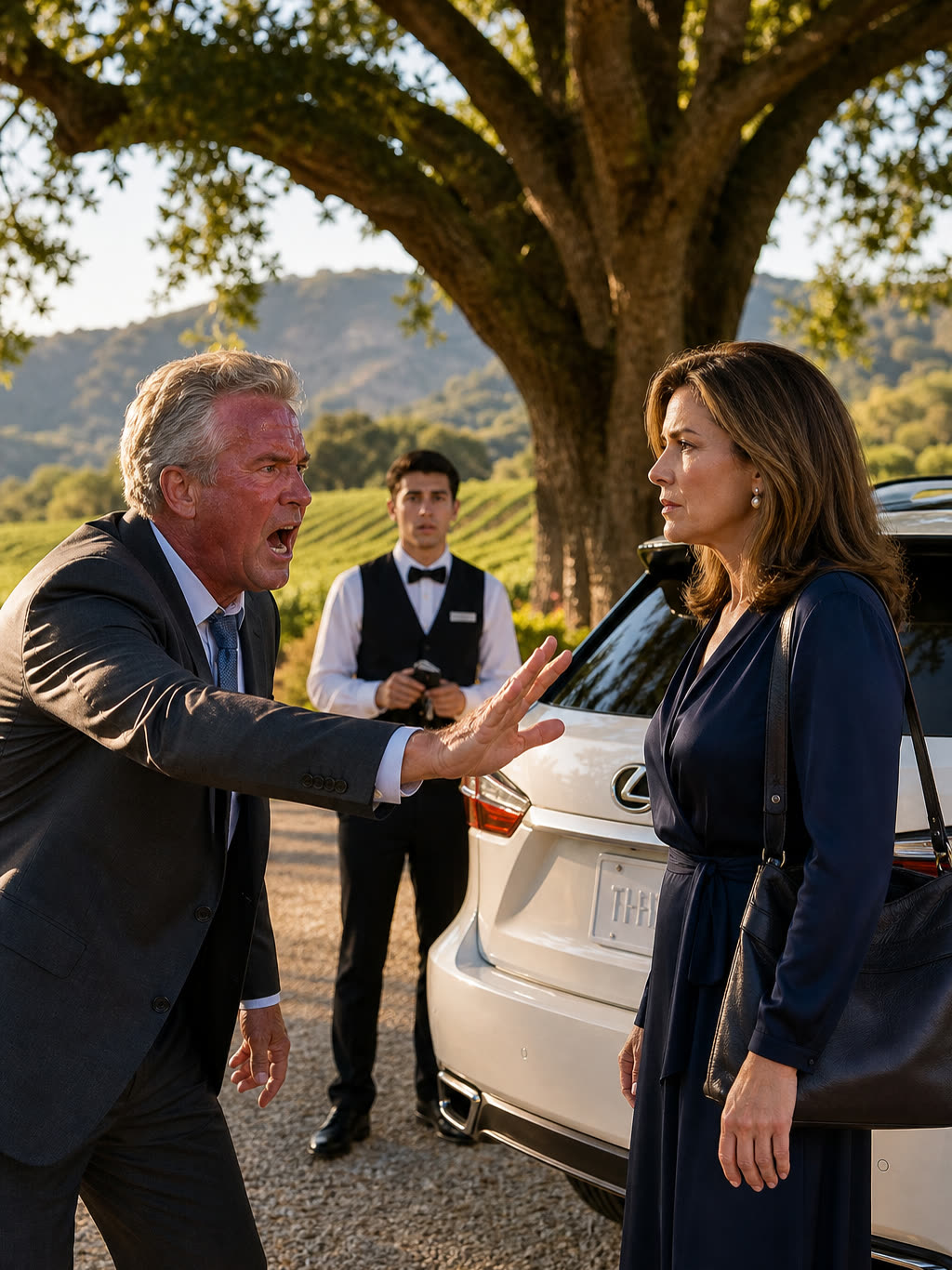
“Do not play administrative games with me,” he hissed, stepping so close I could smell the sharp tang of panic cutting through his cologne. “Thomas just pulled me out of the cocktail reception. He said you canceled the credit card authorization. He said the kitchen is refusing to plate the dinner service.” “Thomas is very good at his job,” I replied evenly. “He is adhering to Clause Six of the Master Service Agreement.” Simon’s hands clenched into fists. He was vibrating with rage and terror. For forty-eight hours he had shaken hands, accepted praise, and soaked in the social currency of funding a luxury event for Liam’s family. Now the bill had arrived at his table.
“You are insane,” he spat, his voice dropping to a frantic, guttural whisper. “You are having a complete psychological break. We have two hundred VIP guests in there. Liam’s senior partners are drinking scotch on the terrace. The caterers are threatening to pack up the prime rib. You are going to ruin your own daughter’s wedding over a petty mood swing.” He thrust an open palm toward me. “Give me the cashier’s check, Naomi. Thomas said you had it in your purse. Hand it over, right now, and I will go inside and fix this before Harper finds out.”
I looked at his outstretched hand, then at the beads of sweat gathering along his hairline, threatening to drip onto his starched white collar. “I am not giving you a check for seventy-two thousand five hundred dollars,” I said. “You agreed to pay for this!” he shouted, dropping all volume control. The valet, who had just pulled my white SUV to the curb, stepped out and froze, holding my keys, unsure whether to approach.
“I agreed to be the Primary Financial Guarantor,” I corrected, my tone strictly conversational. “And for the past six months, I fulfilled that role while you and Brittney played the generous hosts. But I took a walk through the reception pavilion today, Simon. I checked the seating chart.” His jaw locked. He tried to calculate where the conversation was going, but rising panic muddied his logic. “This is about a table. You are stopping a dinner service for two hundred people because you didn’t like your seat?”
“I am seated at Table Eighteen,” I said, articulating each word with crystalline precision. “Right next to the kitchen’s swinging doors. I am positioned precisely where one puts a distant relative or an unavoidable obligation. You and Brittney, however, are seated at Table One. Right in the center of the room. Underneath the nine-thousand-dollar floral installation Brittney ordered.” Simon opened his mouth, but nothing came out. I stepped toward the driver’s side door and looked back at him over the roof.
“I am just a guest sitting at Table Eighteen, Simon. And guests sitting by the kitchen doors do not pay seventy-two thousand five hundred dollars for dinner. The seating chart is very clear. The ‘Parents of the Bride’ are seated at Table One. And historically, the parents of the bride are the ones obligated to settle the final invoice.” The trap clamped shut. I saw the exact moment the mechanics of the situation crushed the air out of his lungs. He had wanted the title. He had wanted the credit. He had spent months ensuring everyone in Liam’s wealthy orbit believed he was the architect and financier of this weekend. He had demanded that I stay silent and invisible so his performance could run uninterrupted. Now I was giving him exactly what he asked for. The stage was entirely his.
“I don’t have it,” he choked out, the words scraping his throat. The bluster vanished, replaced by the raw, naked fear of a man whose bluff had been called on a massive scale. “Naomi, you know my cash flow is tied up. I cannot cover a seventy-two-thousand-dollar balance today. I don’t have twenty-five thousand in credit for the bar tab. They will shut the doors.” “Then you should probably call your investors,” I said. “Or perhaps Brittney can put it on her staging company’s corporate card.”
“You cannot do this to Harper,” he pleaded, grabbing the edge of my open car door to keep me from closing it. “She is in her wedding dress. She is taking photographs. If the venue cuts the food, she will be humiliated in front of her new in-laws.” I looked down at his hand gripping my door, knuckles white with strain. I did not feel a shred of pity. “I already paid one hundred seven thousand five hundred dollars to ensure Harper had her beautiful ceremony overlooking the vineyards,” I said. “Her marriage is fully funded. The party, however, is your responsibility. You told everyone at the rehearsal dinner how hard you worked to provide this for her. Now is your opportunity to prove it.”
I reached out and firmly pried his fingers off the edge of my car door. “Thomas is waiting in the management office, Simon,” I said, slipping into the driver’s seat. “I would not delay. He is very strict about his four o’clock deadline.” I pulled the door shut. The heavy seal of the Lexus cabin muted the world. Through the tinted glass, I watched Simon stare at me, arms limp at his sides, paralyzed by the realization that he was about to walk into a room of two hundred affluent guests with absolutely nothing in his wallet. I put the car in drive, signaled, and rolled down the long driveway.
I had reached the end of the resort’s tree-lined drive, foot on the brake, waiting for a gap in the heavy Saturday traffic along the Silverado Trail, when a flash of bright white caught the sun in my rearview mirror. I checked the driver’s side mirror. It was Harper. She was running, her gown of structured silk crepe and imported lace dragging violently across the crushed white gravel. She held the heavy train up with one hand, sprinting awkwardly in satin heels, kicking up small clouds of pale dust that settled into the delicate hemline.
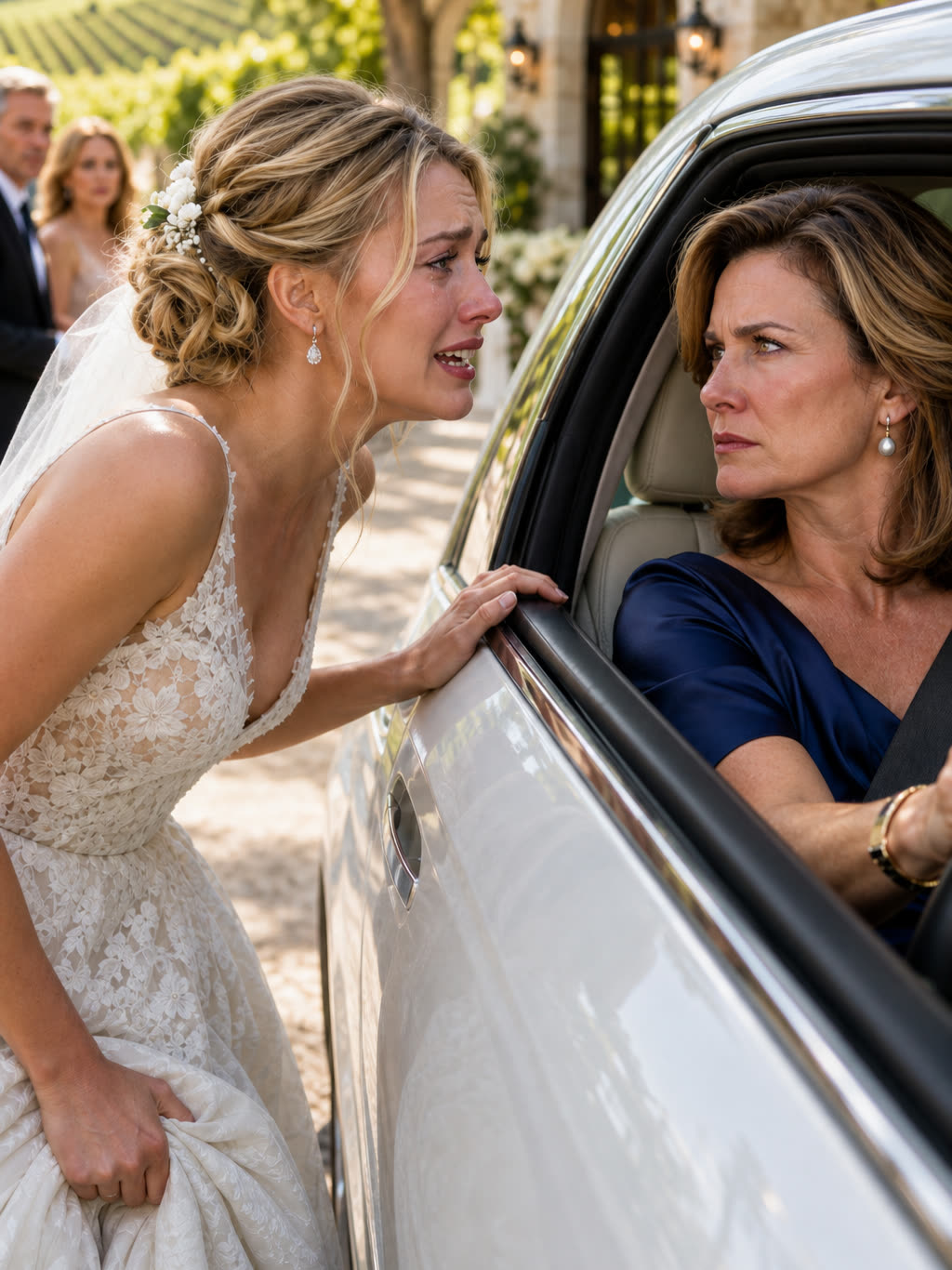
She reached the passenger side of my SUV and slapped her palm flat against the tinted glass. I shifted into park. I did not unlock the doors. I pressed the console button and lowered the passenger window exactly four inches. “Mom! Mom, wait!” Harper gasped for air, her chest heaving against the tight bodice. A streak of foundation had rubbed off on her collarbone. Her eyeliner, the waterproof formula the makeup artist had charged two hundred dollars to apply, was smudging at the outer corners, mixing with a fresh track of tears.
“Dad just came into the bridal suite,” she choked out, fingers gripping the top edge of the glass. “He said you canceled the venue payment. He said Thomas is locking the doors to the dining pavilion.” “That is accurate,” I said, both hands loosely draped over the leather steering wheel. “You can’t do this!” she cried, her voice cracking with panic. “Liam’s parents are standing on the terrace. The guests are asking why the waitstaff isn’t bringing out the first course. You have to come back inside and sign the check.”
I watched her face and noted exactly what was missing from her panic. There was no apology for the seating chart. There was no recognition of the cruelty of her choices. Her singular focus was the disruption of her catering schedule and the embarrassment it would bring in front of Liam’s family. “The outstanding bill is seventy-two thousand five hundred dollars, Harper,” I said evenly. “I suggest you ask your father to clear it.” “He doesn’t have it!” she screamed, the polished bride aesthetic dissolving into the tantrum of a cornered child. “You know he doesn’t have it! His money is tied up. He told you that!” “Then he shouldn’t have hosted a party he couldn’t afford.”
Harper’s face contorted. The tears spilled over in earnest, cutting tracks through her blush. She leaned closer to the gap, deploying the survival tactic she had watched her father use for two decades: shift the blame, play the victim. “It wasn’t my fault,” she sobbed, her voice trembling. “The seating chart… it was Brittney’s idea. She said Table One was traditionally for the hosts, and Dad said since he was giving the welcome speech, it just made logistical sense. I didn’t want to fight with them, Mom. They pressured me.”
I looked at my daughter and at the familiar, frantic shifting of accountability. “Brittney did not write the master timeline, Harper,” I said quietly. The truth hung between us, heavy and absolute in the warm Napa air. “Brittney did not leave a comment for the MC instructing him to erase my name from the announcements because my presence would ruin the formal tone for your new in-laws. You typed those words. I read them.”
Harper froze. Her breath hitched. The realization that I had seen the digital ledger of my own exclusion hit her like a physical blow. Her eyes widened, darting back and forth as her mind scrambled for a new defense. “I can fix it,” she stammered, fresh tears welling. She was bargaining now. “I’ll go tell Thomas to move your seat. We can put you at Table Two with Liam’s aunts. I’ll tell the MC to announce you right before the dinner service. Just please, Mom. Please. You’re ruining my wedding.”
She genuinely believed my dignity could be negotiated. She thought a better chair and a manufactured announcement would balance the invoice. She still saw me not as a mother but as a vendor withholding services over a contract dispute. I turned my head and looked directly into her eyes. I felt no impulse to comfort her. The maternal instinct that had driven me to fix her messes, pay her debts, and cushion her falls for twenty-six years had cleanly and finally expired.
“You are a married woman now, Harper,” I said. My voice held no anger, only the cold, unyielding weight of a finalized transaction. “You structured this event exactly the way you wanted it. You already chose your mother for today.” “Mom, no—” “Now,” I continued, cutting through her plea, “go back inside. Find the woman sitting at Table One and tell her husband to swipe his credit card.”
Harper’s mouth fell open. A raw, ugly sob tore from her throat. She reached her hand through the gap, trying to grab my forearm. I pressed the window switch. The motor hummed. The glass rose smoothly, forcing her to snatch her fingers back before they were caught. The window sealed into the rubber molding with a soft, definitive thud. The acoustic dampening of the Lexus severed the sound of her crying. I could see her mouth moving, her face crumpled in desperation as she slapped the tinted glass with an open palm, but the noise was entirely blocked out. She was just a silent performance in my peripheral vision. I checked my side mirror, lifted my foot from the brake, and merged onto the Silverado Trail. I did not look back.
Highway Twenty-Nine South was moving smoothly, weekend traffic thinning by late afternoon. I merged into the center lane, set the cruise control to sixty-five, and aimed the air vents at my face. The dashboard clock read four-fifteen. I scrolled through my downloaded playlists until I found the Dave Brubeck Quartet. The clean, mathematical precision of “Take Five” filled the cabin. The piano chords were orderly. The saxophone was deliberate. It was exactly the structure I needed to anchor me back in reality.
As the manicured, rolling vineyards of Napa gave way to the flat concrete spans of Interstate Eighty, I let my mind map the logistics of what was unfolding behind me. There would be no cinematic explosion. No one was going to flip a table or hurl champagne into the resort pool. The fallout would be entirely administrative, which in my professional experience is far more devastating. By now Thomas would have walked into the catering kitchen and spoken to the executive chef. The commercial ovens would be off. The waitstaff in their pressed black vests would be told to stop polishing silverware and break down the prep stations. The prime rib would be wheeled back into the walk-in refrigerators. The bar would be shuttered, the premium scotch locked behind steel grates. Out on the terrace, two hundred guests in tuxedos and floor-length gowns would be finishing their first cocktail, checking their Rolexes, and wondering why no one had invited them into the pavilion.
And somewhere in the administrative wing, Simon would be staring at his phone, discovering the hard limits of banking hours. It was late Saturday afternoon. Wire transfers do not process on weekends. You cannot call a customer service representative and casually request a seventy-two-thousand-five-hundred-dollar limit increase on a standard credit card. Simon could not smooth-talk an automated banking system. He would be frantically scrolling his contacts, calculating which golf buddies or business associates had that kind of liquid cash and the willingness to lend it, getting voicemails from men at soccer games and backyard barbecues. Eventually, the math would box him into a corner. He would have to walk onto that terrace, pull Liam’s father aside, and ask the senior law partner to front the cash. His entire curated identity, the successful, generous patriarch providing a luxury wedding, would evaporate the moment he asked his new in-laws to pay for their own dinner. The thought didn’t make me smile. It simply settled into my mind as a balanced equation. The bill had found its rightful owner.
By the time I crossed the Carquinez Bridge into Vallejo, the adrenaline that had carried me through the afternoon began to recede, leaving a hollow, scraping sensation in my stomach. I realized I had eaten nothing all day but a dry piece of toast at seven in the morning. A tall yellow arrow appeared in the distance against the fading blue sky. I signaled, exited the interstate, and pulled into the drive-thru lane of an In-N-Out Burger. I sat in a line of four cars, listening to idling engines, smelling the comforting scent of fried potatoes and grilled onions drifting through the open window.
A teenager in a red apron and paper hat walked up to my window holding a digital tablet. He didn’t care that I was wearing a navy-blue silk dress. He didn’t care about my social standing or the timeline of a Napa wedding. “Hi, how are you doing today?” he asked. “I am doing very well, thank you,” I said. “I would like a Double-Double with onions, an order of regular fries, and a Diet Coke.” He tapped the screen. “That’s nine dollars and forty-five cents. You can pay at the first window.” I pulled forward, handed a crisp ten-dollar bill to the cashier, and dropped the fifty-five cents in change into my cup holder. At the second window I received a heavy paper bag with translucent grease stains already blooming near the bottom, and a cold, sweating paper cup.
I didn’t merge back onto the highway right away. I pulled into a space facing a brick wall at the edge of the lot, put the car in park, and turned off the engine, leaving the windows cracked for the early evening breeze. I unwrapped the burger in my lap. It was messy. The cheese had melted into the edges of the toasted bun, and the lettuce crunched loudly as I took the first bite. I ate a hot, heavily salted french fry and took a long sip of Diet Coke. It was the most magnificent meal I had eaten in months. It tasted infinitely better than the dry catered chicken I had forced down at the rehearsal dinner. It tasted better than the imported caviar and the hundred-and-fifty-dollar Cabernet I was supposed to be consuming at Table Eighteen.
I sat alone in the quiet cabin, watching the brake lights of interstate traffic streak by in the distance. My phone lay dark in the center console. I had set it to Do Not Disturb before leaving the resort. No calls came through. No frantic texts demanded that I return and fix a crisis I hadn’t created. For twenty-six years I had believed that love required me to serve as the invisible shock absorber for my family. I had believed that being a good mother and a good wife meant quietly paying invoices, smoothing over deficits, and shrinking myself so Simon and Harper could take up more space. As I finished the last fry and wiped my hands on a thin paper napkin, I felt the profound weightlessness of my new reality. I was no longer responsible for funding their illusions. I crumpled the bag, tossed it on the passenger floorboard, and started the engine. I merged back onto Interstate Eighty, heading south toward Walnut Creek, driving the speed limit all the way home.
Six months later, the dust from the Napa wedding had settled, though the financial shrapnel was still tearing through Simon’s life. I sat in my Walnut Creek office on a Tuesday morning, reviewing the final quarter projections for my firm. Sun warmed the hardwood floor. My coffee was hot. My schedule was entirely my own. I never actively sought news about Simon, but in an affluent, interconnected suburb, financial gossip travels with the efficiency of a wire transfer.
Simon had managed to save the reception. During the cocktail hour he had pulled Liam’s father aside and begged for a short-term loan. Liam’s father, who valued his family’s reputation above all else, had quietly written a check to the venue so his guests would be fed. But a loan from a senior law partner is not a gift. It is an obligation, and it comes due. To repay him and cover the balance on the twenty-five-thousand-dollar bar tab, Simon had been forced to liquidate the remaining equity in his leased Porsche and trade it for a heavily used, sensible sedan. When that wasn’t enough, he opened three new credit cards with punishing double-digit interest. He was drowning in minimum payments. The San Francisco commercial real estate market had not miraculously rebounded to rescue him. The lavish, effortless lifestyle he had projected at Table One was being dismantled piece by piece by compound interest.
Brittney, I heard, was not handling the austerity well. The custom floral arrangements and designer dresses had vanished from her Instagram feed, replaced by vague, passive-aggressive quotes about “weathering difficult seasons” and “finding out who your real friends are.” The illusion of the wealthy, generous patriarch had shattered, leaving her married to a fifty-four-year-old man driving a Honda Accord and dodging calls from creditors. I felt no triumph. I felt no pity. I simply recognized the absolute symmetry of the mathematics.
My phone buzzed on the corner of my desk. A text from Harper. We had spoken sparingly since the wedding. There had been no screaming matches, no tearful apologies, just the polite, distant communication of two adults recalibrating a damaged relationship. Hi Mom, the message read. Liam and I are looking at a townhouse in Dublin. We found one we love, but we’re a little short on the down payment. Could we meet for coffee this week to talk about it? I looked at the screen. I noted the familiar cadence, the casual approach, the quiet expectation that the Primary Financial Guarantor was still on standby, ready to underwrite the next phase of her curated life.
I picked up the phone and typed my reply. I would love to see you for coffee, Harper. Thursday at ten works for me. But I want to be clear before we meet—I am not contributing to a down payment. If you still want to get coffee, let me know. I pressed send, set the phone down, and turned back to my spreadsheets. I loved my daughter. I would always love my daughter. If she was hungry, I would feed her. If she was sick, I would care for her. But the bank of Naomi was permanently closed.
For twenty-seven years I had let my family treat my boundaries as suggestions. I had believed love was synonymous with endless accommodation. I had let Simon and Harper draft the scripts and quietly paid the invoices to keep the production running. But sitting in my sunlit office, I finally understood the fundamental rule of emotional and financial commerce. You cannot let people walk all over you and then apologize for the mud on their shoes. You certainly cannot let them trample you and then hand them a check to buy a new pair of boots.
My phone buzzed again. Okay, Harper wrote. Thursday at ten is fine. See you then. I smiled, a small, genuine smile. I closed the text thread, picked up my pen, and returned to my audits. The numbers balanced perfectly. The ledger was clean. And for the first time in my adult life, I owed absolutely nothing to anyone.
Disclaimer: This story is a work of fiction inspired by real-life themes. Names, characters, places and events are fictionalized, and any resemblance to real persons is purely coincidental. Images are for illustration purposes only.
