

The Shape of an Absence
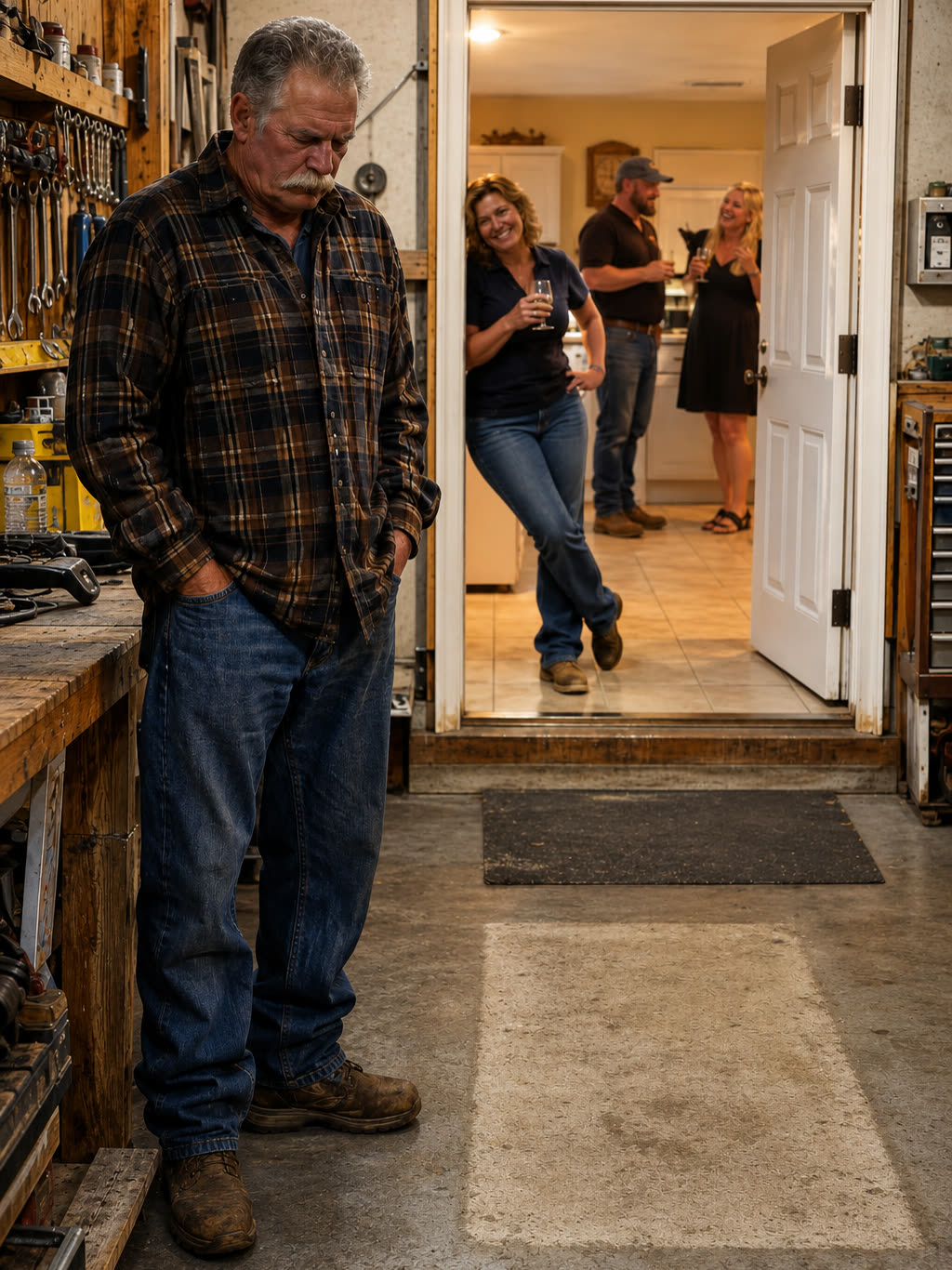
I stood in the doorway of my workshop and stared at the spot where my father’s 1952 Vincent Black Shadow had sat for forty-three years. For a long moment my mind simply refused to believe what my eyes were reporting.
The concrete floor still remembered her. A pale rectangle marked where her tires had shielded the slab from the weather. A faint outline showed where the center stand had pressed down through four decades of winters. Near the back wall was a small dark circle where the gearbox had let go of a single drop of oil on most cold mornings, one deliberate bead every November through March, as dependable as any calendar I ever owned. I knew that stain the way some men know the bends of a familiar road.
The bike was gone.
Behind me stood my wife of thirty-six years, arms folded, wearing the look of a woman who had finally cracked a problem she had been chewing on for years.
“I sold it this morning,” Margaret said. Her voice carried the brightness she used when she expected to be thanked. “Fifty-five thousand dollars, Harold. Cash. Can you believe that? Fifty-five thousand for that old rusty thing.”
I did not turn around. I kept my eyes on the bare concrete, on the ghost of something that had mattered more to me than I had apparently managed to make clear in thirty-six years of marriage.
“Who did you sell it to?”
“A dealer from Asheville. Came down with a trailer while you were at your cardiology appointment. He was absolutely thrilled. Said it would clean up beautifully.”
Clean up beautifully.
Those words drifted through the workshop air and vanished.
“Now we can finally take that Alaska cruise Beverly has been talking about,” she said. “And I was thinking we could redo the kitchen. I told you that motorcycle was just sitting there gathering dust. I told you for years and you never listened.”
I pulled the workshop door shut. The brass knob felt cold in my palm even though it was a warm October afternoon, the kind we get in western North Carolina when the maples along the driveway turn orange and the mountain air smells of change. I had always loved afternoons like that one. I had spent plenty of them in that workshop with the radio playing and my hands busy, the world asking nothing of me.
That morning the world had walked into my workshop and taken something it had no right to touch.
In the kitchen, Beverly and her husband Trevor were already waiting, pouring champagne into my mother’s crystal glasses. Those glasses had survived three moves, two hurricanes, and the Thanksgiving my nephew knocked over half the buffet table. They had gone unused for years. Beverly was already rehearsing a toast when I stepped in.
“The man of the hour,” she said. “Don’t look so grim, Harold. Margaret finally cleared out that eyesore.”
Trevor slapped my shoulder hard enough to sting. He wore a golf shirt with his real estate company’s logo stitched across the chest, which I had always thought suited him. Trevor looked at every square foot of the world as a possible income stream, so he had never once walked through my life without spotting something he could turn into something else.
“Fifty-five grand for old metal,” he said. “Should’ve done it years ago. That workshop could be a rental by now. Mountain properties are pulling in eight hundred a weekend.”
I sat down.
I let them talk. I let Beverly describe the cruise cabin she had already looked up. I let Trevor explain that men my age needed to learn to let go of their hobbies. I accepted a glass of champagne I had no intention of drinking, held it in both hands, and waited.
Because here was what none of them knew.
Here was what Margaret had never once bothered to ask in thirty-six years.
The Vincent Black Shadow she had just sold for fifty-five thousand dollars was one of thirty-one factory-modified Series C racing bikes built after the 1952 Isle of Man season, its engine hand-tuned by Phil Irving himself. My father bought it in 1953 from a returning serviceman who had shipped it in through the port of Savannah, and he rode it home to North Carolina wearing the grin of a man who knows he has just come into something rare.
He handed it to me on my twenty-first birthday.
I remember the exact texture of that day. My mother’s chocolate sheet cake in the dented pan she always used. The way my father waited until the last guest had left before he walked me out to the garage and lifted the canvas tarp. The keys lying in his open palm as he held them out. He said just one thing: Take care of her, son. She will outlive both of us if you do.
Along with the bike came a steamer trunk of paperwork that my father had kept with the solemn care of a man who knew history demanded proof. Receipts. Photographs. A copy of the original Isle of Man entry papers. A handwritten note from the factory confirming the engine specifications. Service records in my father’s blocky lettering, every oil change and replaced cable and adjustment, every mile worth recording.
I had spent fifty-seven years following his example.
Three months before the sale, an appraiser from Charlotte had valued the bike between four hundred twenty and four hundred seventy thousand dollars. The American Vincent Owners Club kept a standing offer of four hundred thousand, sight unseen, on the condition that the machine stay in the United States and one day be displayed alongside the original documentation.
I had never accepted. The Vincent was never a financial instrument to me. It was my father’s hand on my shoulder at twenty-one. It was every Sunday morning with motor oil and a radio and the quiet peace of a man working on something real. It was the one place where time had not taken everything.
At twenty-three minutes past four, the phone rang.
Margaret answered because she stood closest. She picked up in her pleased, expectant voice.
Then I watched the expression drain from her face.
First the corners of the smile. Then the eyes. Then the color.
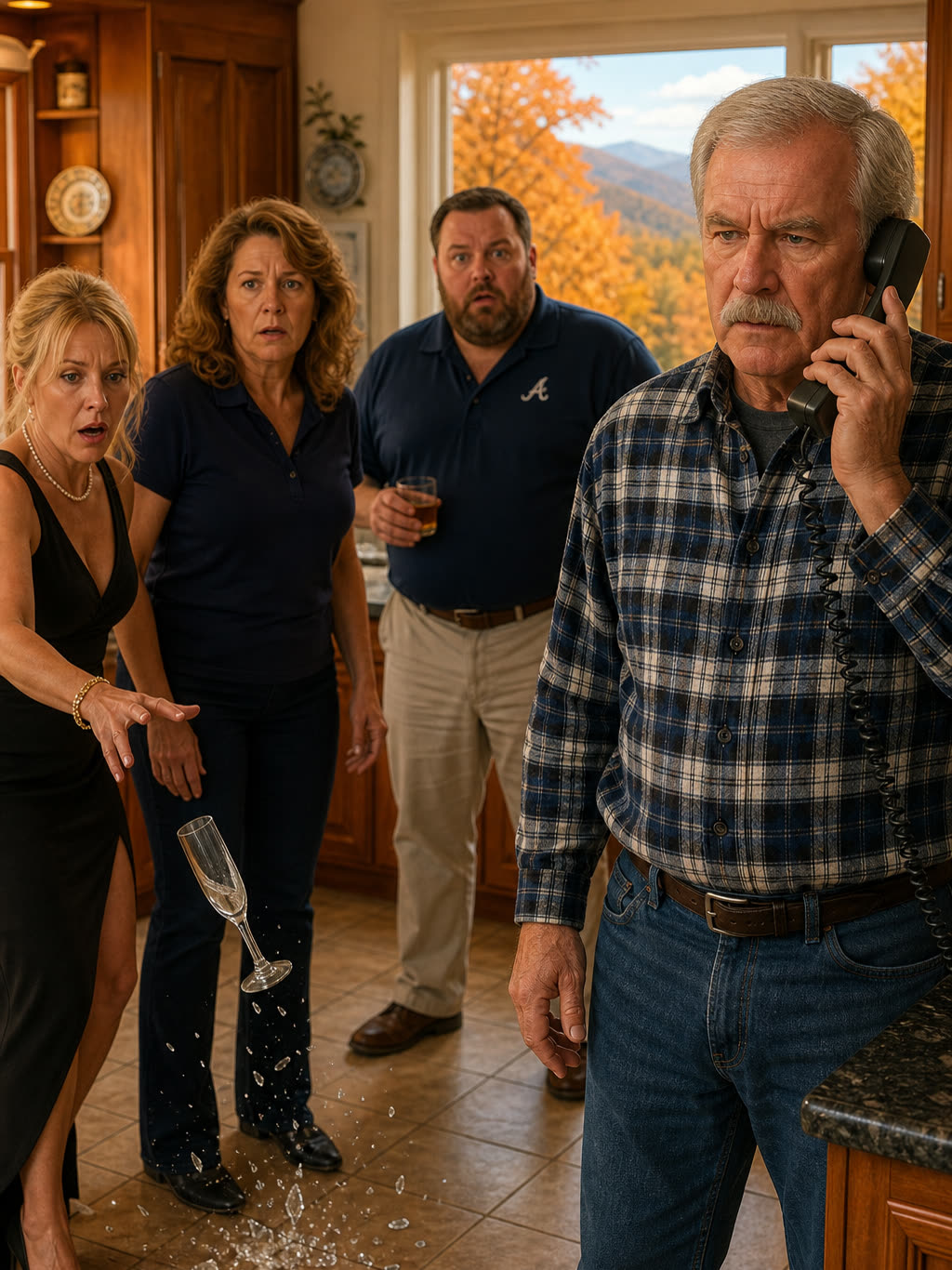
“What do you mean, the police?” she said.
Trevor went still. Beverly’s hand froze above the champagne bottle.
Margaret’s eyes found mine across the table. For the first time all afternoon she was looking straight at me. “Harold,” she said. “Harold, why are the police at the dealership?”
I stood.
I crossed the kitchen and held out my hand. She gave me the phone without a word of argument, which was unusual enough that I noticed it.
“This is Harold Whitfield,” I said. “I am the registered owner of that motorcycle. I did not authorize its sale. I will be at your location in Asheville within the hour. Please ask the officers to wait.”
The dealer, a man named Marcus Kettering, said yes sir and I’m sorry sir and please hurry, and I hung up.
I looked at Margaret. Then at Beverly, who had become very interested in the countertop. Then at Trevor, whose face had faded to the color of old putty.
“That motorcycle,” I said, in the same quiet register I had used in the workshop, “is worth between four hundred twenty and four hundred seventy thousand dollars. The American Vincent Owners Club has had it under observation for years. The title to that motorcycle has been in my name since March 1968. It has not changed hands once. Which means the documents Marcus Kettering received this morning required a signature he should never have been able to obtain.”
Beverly’s champagne glass slipped from her fingers and burst across the kitchen tile.
“I have not signed anything,” I said. “I will be very interested to learn how someone convinced a licensed dealer otherwise.”
Margaret began to cry. It was not the soft, measured crying of someone apologizing. It was the harder crying of a person who has just measured the distance between where she is standing and where she meant to be, and found it impassable.
I took my truck keys from the hook and left.
The drive to Asheville follows I-26 through the mountains, past church signs and gas stations and old barns turning silver in the October light. In forty years of living in Hendersonville I had made that drive a thousand times. It had never felt strange before. That day it felt like a road leading into a different version of my own life, and I could not tell whether the crossing was a loss or a relief.
Marcus Kettering’s shop filled an old brick building near a row of warehouses, the kind of place with polished windows and motorcycles displayed under warm lights. When I turned into the gravel lot, a sheriff’s SUV and a state police cruiser were parked beside the side door.
I sat in the truck for a few seconds with my hands on the wheel. Somewhere inside that building was the only thing my father ever gave me, and I had no idea what I was about to learn about the woman who had put it there.
A Signature That Was Not Mine
Marcus met me just inside the door. He was a broad man in his fifties with gray threaded through his beard and the look of someone who had aged five years since breakfast. He led me back to his office, where two deputies and a detective from the county sheriff’s office were already waiting, along with a small older man in a tweed jacket who rose to his feet the moment he saw me.
Jeffrey Pendleton had driven from Knoxville the instant he received the alert from the owners club. He was nearly seventy, thin and precise, and his eyes filled when he looked at me.
“Harold,” he said. “Is she intact?”
“She was intact when she left my workshop this morning.”
Marcus told me he had secured the bike the minute the club phoned and had let no one near it since. Detective Sergeant Nora Faulkner had a calm face and the particular patience of someone who has watched people do many things to each other inside families and no longer needs an explanation for how such things happen. She asked me to describe everything from the beginning.
So I told her about my father and 1953 and the steamer trunk and the title that had been in my name since March 4, 1968. I told her about the paperwork and the appraisal and the club’s standing offer. Then I told her about Margaret.
She slid two documents across the desk. A bill of sale and a title transfer, both carrying my name.
“Did you sign these?”
I studied them. “No.”
“You’re certain?”
“I have signed my name Harold Whitfield since I was fourteen years old, with the H joined to the W. I have done it that way for fifty-four years without variation.” I pointed at the signature on the pages. “Whoever wrote this treated them as two separate words. That is not my hand.”
Jeffrey looked for three seconds and confirmed the same. He had fifty years of club paperwork carrying my true signature.
Detective Faulkner wrote in her notebook. Then she asked the hard question, the one I had known was coming.
“Mr. Whitfield, do you wish to pursue charges?”
I thought about my father.
Not dramatically. I did not hear his voice or see his face with any special clarity. I simply remembered him, a man who wore out one set of work clothes every two years and never bought himself anything he did not need, standing in the garage on my twenty-first birthday with his hands at his sides, trying to look unmoved. He had handed me a motorcycle worth more than everything else he owned put together, and the gift he meant was not financial. It was trust. He was telling me he trusted me to understand that some things matter beyond their price.
I thought about thirty-six years of Sunday mornings.
I thought about the word practiced, and everything that word implied.
“Yes,” I said. “Forgery, fraud, theft. Whatever applies.”
Detective Faulkner did not look surprised.
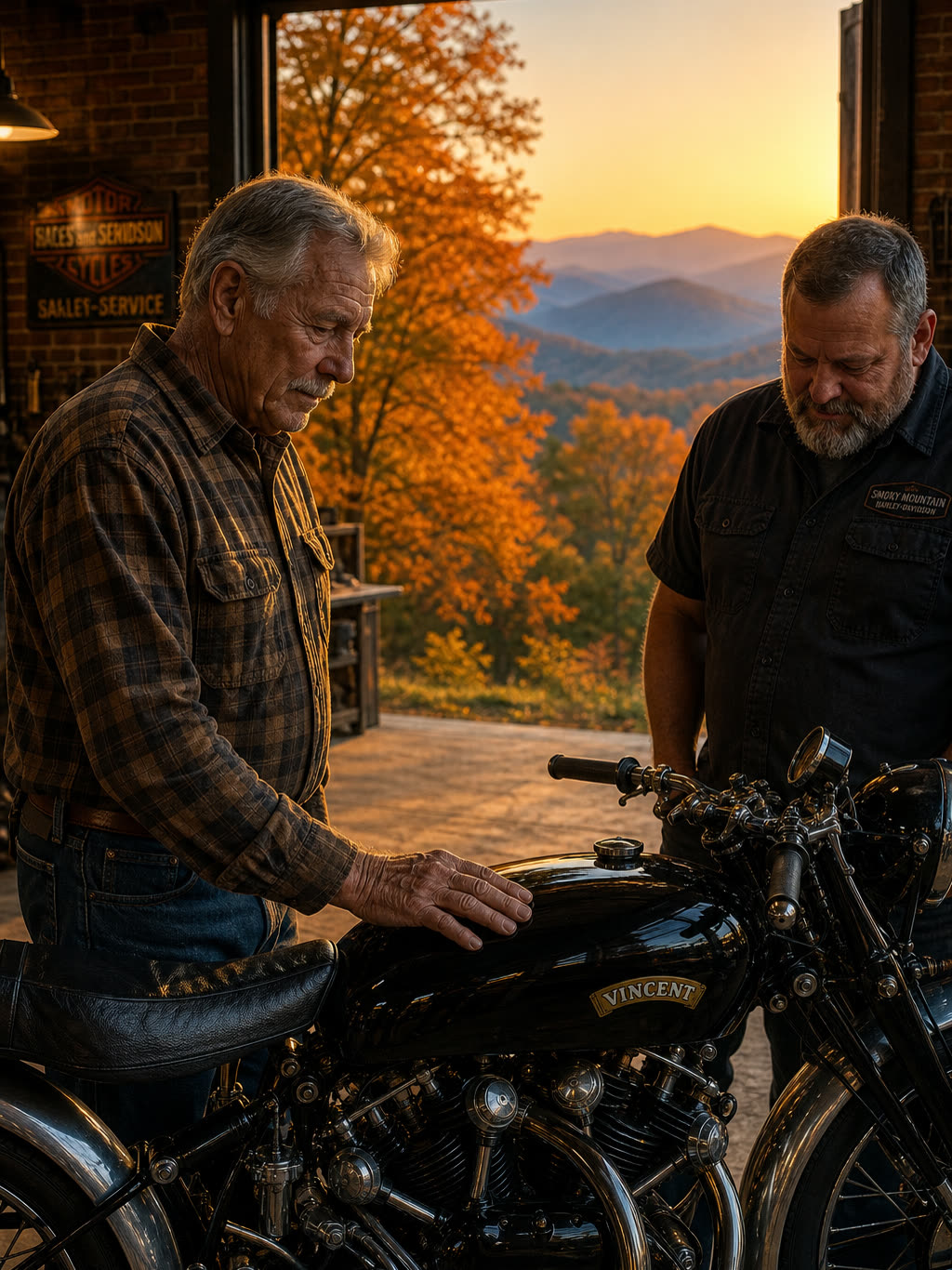
Marcus led me to the back workshop. The Vincent stood near the far wall under the fluorescent lights, her black paint glowing, her chrome catching thin strips of brightness. I walked toward her slowly. I laid my hand on the tank and felt cold metal. Real. Still mine.
“I’m sorry,” Marcus said.
“You didn’t know.”
“I should have checked harder.”
“Yes,” I said. “You should have.”
He took that without argument. I respected him for it.
I drove home close to midnight. The house was dark except for the kitchen light. Margaret sat at the same table where Beverly and Trevor had been celebrating six hours earlier. The champagne was gone. The broken glass had been swept away. The good crystal was put back in its cabinet.
She looked smaller.
I hung my jacket over a chair and sat across from her.
She said she had not known the bike was worth that much. I told her she had not asked. She said she thought she was helping. I told her she had forged my name. She covered her face with both hands.
I asked how she had done it.
She told me she had traced my handwriting from a letter I wrote to my cousin in 2019 and practiced for several weeks until she was satisfied. She had copied my driver’s license on the printer while I was mowing the back field. She had told Marcus I was too ill to come in person.
A few weeks, she had said.
Not the impulse of one morning. Not the product of one bad afternoon. Several weeks of practice, of planning, of deciding that the thing I had kept faith with for fifty-seven years was hers to dispose of because she had never thought to ask why it mattered.
I told her I had pressed charges.
Her head came up. Her face changed.
I told her Beverly would likely be named as well, since she had forty years of legal aid experience and had sat in my house celebrating what she surely recognized as a fraudulent sale. I told her Trevor had advised on real estate transactions his whole career and understood title transfers and property documentation.
“Where will I go?” Margaret asked.
“I don’t know,” I said. “That is no longer my concern. I will be filing for divorce on Monday.”
I slept in the spare room. Or rather I lay there in the dark, listening to branches drag across the ceiling, waiting for the feeling I expected, the devastation, the grief of thirty-six years coming apart. Somewhere around three in the morning I recognized what had actually arrived in its place.
Something lighter.
Not happiness. Something more structural than happiness. The particular feeling of a man who has stopped carrying a weight he had been calling necessary.
The investigation moved with the efficiency that overwhelming evidence brings. Margaret was charged with forgery, fraud, theft, and uttering a forged instrument. Weeks of text messages between her and Beverly showed that they had discussed how to make the sale look legitimate, which produced conspiracy and accessory charges for Beverly. Trevor had advised Margaret in writing on how to describe the Vincent as marital property and how to pressure a dealer into moving fast. His real estate license was suspended for a year.
Marcus drove the Vincent back two days after the charges were filed. He refused any payment for the transport. I watched him roll her down the ramp in the early morning light, and when her tires touched my concrete floor again, I had to turn away for a moment. Marcus pretended not to notice. That was when I knew we would eventually become friends.
The divorce went forward through Priya Sanderson, my attorney, who was sharp enough to establish quickly that the Vincent had been gifted to me before the marriage and kept under separate documentation, which excluded it from the marital estate. Margaret’s criminal charges drained the court’s sympathy for her claims on everything else. She received her car, her clothes, and a settlement large enough for legal fees. I kept the house, the workshop, the motorcycle, and most of my savings.
Margaret was sentenced to two years, with eligibility for release after eight months. Beverly and Trevor received suspended sentences.
I did not attend the sentencing. I was in Maggie Valley.
Jeffrey Pendleton had phoned to ask me to bring the Black Shadow to the American Vincent Owners Club annual rally. I assumed he meant a quiet dinner and a mention in the newsletter. I rode out the long way through the mountains, two days over roads that curved through gaps in the Blue Ridge, past white clapboard churches and old gas stations with rocking chairs and barns that had been turning silver since before I was born. I slept at a roadside inn near Boone where the clerk came outside to look at the Vincent in the parking lot and stayed ten minutes talking about her grandfather’s Indian Scout. In the morning I drank black coffee and wiped the dew from the seat and rode south as fog lifted out of the valleys.
When I rolled into the rally grounds on Saturday morning, hundreds of motorcycles were parked in rows across the grass. Old men in waxed jackets, younger collectors with cameras, women in denim vests, tool rolls spread open on blankets, the whole beautiful disorder of people gathered around a shared understanding.
I rolled into the main paddock, and the noise fell away.
Custodian of the Year
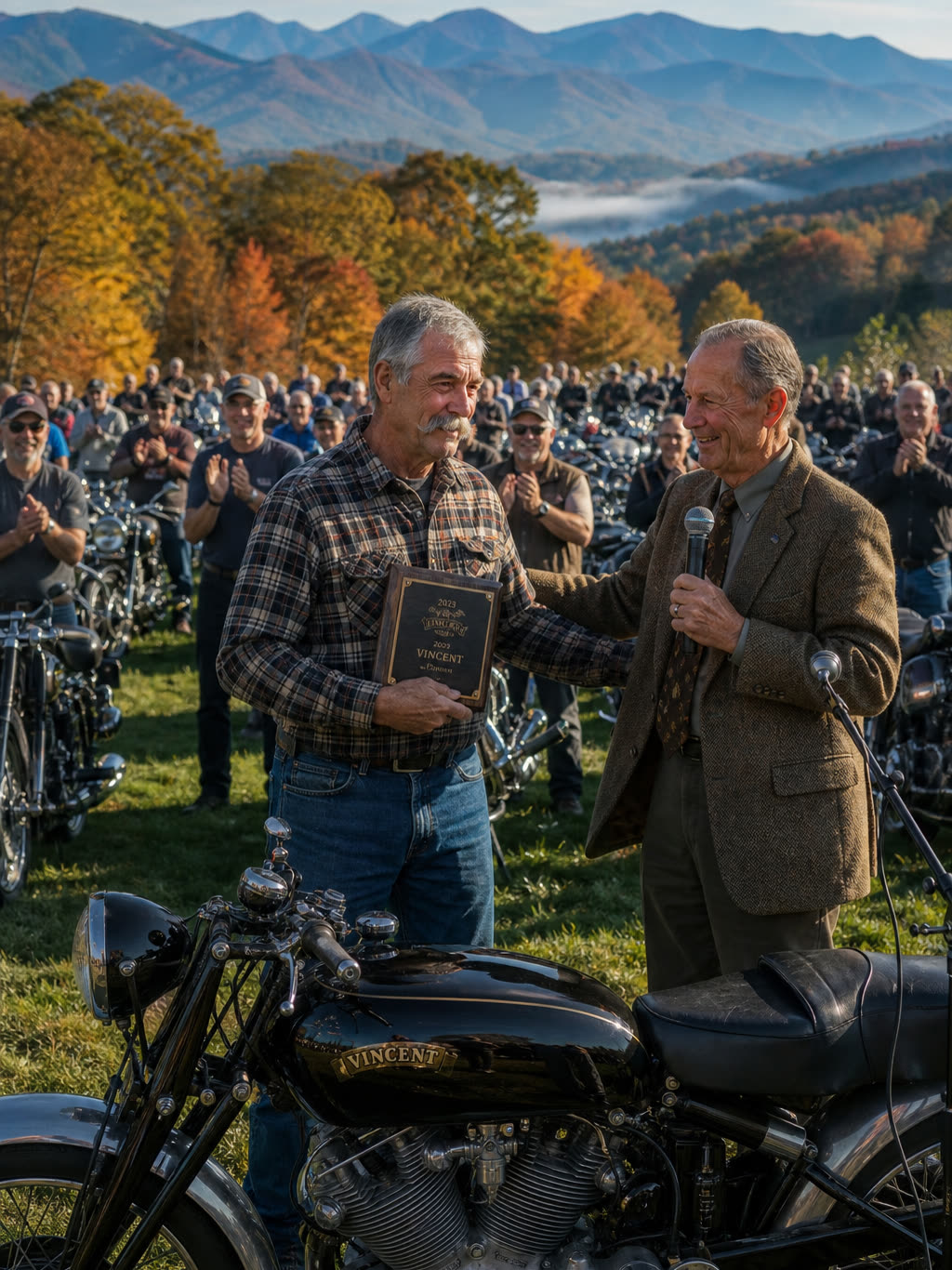
One by one, heads turned. Conversations broke off. Engines cut out. The clapping began at the registration tent and spread outward until the entire field was on its feet. Men my age and older, some taking off their caps. A man I had never met walked over after I parked and took my hand in both of his and shook it for a full minute without saying a word.
Jeffrey stepped forward with a microphone and described the motorcycle, its history, its configuration, its significance. He described the events of the previous months. He described fifty-seven years of stewardship.
Then the club presented me with the Custodian of the Year award. A bronze plaque, small enough to hold in one hand and heavier than it looked. My name engraved beneath the emblem.
I held it and thought about my father. Not with any particular drama. Just with the steady recognition of a man who has finally understood that keeping a promise matters even when no one is watching, especially when no one is watching, and that a promise’s value is not changed by the price someone assigns to the object it protects.
That afternoon I talked with strangers who understood more about my father in the first hour than my own household had managed in thirty-six years. A woman in her eighties told me she had danced with him at a club function in 1962 and had never forgotten his laugh. A retired machinist from Ohio knew the name of the man who had rebuilt the magneto in 1974. A young man from Georgia asked if he could photograph the engine stamp for a preservation archive and handled the request with more reverence than Margaret had shown the entire motorcycle in her life.
That night I sat around a fire pit with Jeffrey and half a dozen old riders while the mountains went dark around us and sparks drifted up into the cold air. Someone passed me a plate of barbecue. Someone else handed me coffee strong enough to clean a carburetor. The talk wandered through machines and fathers and roads and the particular dignity of keeping old things properly alive.
Beside that fire I understood something I had not fully grasped before. These strangers had honored my father and my stewardship in a single afternoon more completely than my own home had managed in three and a half decades. Not because they were better people. Because they had asked. They were curious about what the motorcycle meant, and they had asked, and then they had listened, which is the whole of what I had wanted from my marriage without ever quite naming it so clearly.
Margaret had never asked a single question about my father in thirty-six years.
Not one.
She had never asked what he said when he handed me the keys. She had never asked why I kept every oil change receipt. She had never asked why I polished the chrome every Sunday. She had not asked because she had not wanted to know, because knowing would have made it harder to dismiss, and dismissing it had become part of how she understood me.
I went home from Maggie Valley and changed my will. The Vincent, the documentation trunk, the tools, and a substantial portion of my estate went to the American Vincent Owners Club, with a requirement that the motorcycle be ridden at least once a year by a club preservation member and eventually displayed with the full archive of original documentation. The remainder went to two charities my father had supported, a rural medical transport foundation and a program offering mechanical training scholarships to young people from working-class families.
Margaret’s nieces and nephews, who had eaten at my table and borrowed money and walked past my workshop for years without once asking about anything in it, received nothing. They had always laughed at Margaret’s jokes about my hobby. They had been content with her version of me because it was easier and more convenient than their own. I was not obligated to reward that.
I am sixty-eight now.
My workshop currently houses three motorcycles. The Vincent, a 1965 Norton Atlas I acquired as a winter project, and a 1978 Ducati 900 SS that belonged to a friend who left it to me when he died because he knew I would not let it become a decoration. I ride one of them every Sunday that weather allows.
On the second Saturday of each month, I open the workshop to young people interested in classic motorcycles. They come from Hendersonville and Asheville and small towns tucked back into the hills. Some arrive with their fathers. A few know considerably more than they first let on. I teach them carburetor cleaning, valve clearance settings, service manual reading, and the particular skill of listening to an engine describe its own problem before you reach for a tool.
Mostly I teach patience. Machines punish impatience immediately and without mercy. Life takes longer to deliver the same lesson, but it delivers it.
Jeffrey Pendleton drives over from Knoxville now and then to help. Marcus Kettering comes too. We became friends the way men do after surviving the same event from opposite sides, slowly and without ceremony, over coffee and tools and the subjects that actually matter to both of us. He still apologizes from time to time. I still tell him to stop.
There is someone in my life named Eleanor. She is sixty-five, a retired nurse who rode a Triumph Tiger Cub in her twenties. She came to one of my workshop mornings last spring asking whether I could help get her late husband’s BSA Bantam running. It had sat under a tarp in her shed for fourteen years with Christmas decorations stacked on top.
We got it running.
The first time it fired, Eleanor covered her mouth with both hands and cried. Not for the motorcycle exactly, I think, but because something she had believed was permanently lost had spoken again. I understood that feeling without needing it explained.
She rides the Bantam now. On clear Sunday afternoons she rides behind me on the Vincent along the Blue Ridge Parkway when the road is quiet and the air comes clean off the mountain ridges. She brings tea into the kitchen when I stay out too late in the workshop. She laughs at my bad jokes without any charity in it, which means she finds them genuinely funny rather than being polite, and that distinction matters more than I expected.
The first time she asked about my father, I had to stand still for a moment.
We were beside the Vincent, and she said, “What was he like?”
Four words.
No one in my household had asked me that in decades.
So I told her. About his hands, always nicked around the knuckles. How he whistled while he worked and went silent when he was troubled. How he never hugged easily but always checked tire pressure before anyone drove away. How he gave me the most valuable thing he owned without a speech because he knew I would hear the speech in the work itself, every Sunday for the rest of my life, in the weight of the chrome cloth and the smell of the oil and the particular satisfaction of a properly maintained machine.
Eleanor listened.
That was all she did.
It was entirely enough.
I want to say one thing before I finish.
If you are living with someone who has spent years dismissing the things you love, who rolls their eyes at the work that matters to you, who calls your father’s gift a rusty pile of junk, who has never once asked why you do what you do on Sunday mornings, pay careful attention.
They are not always teasing.
When someone tells you for three decades that the thing you care about is worthless, they may mean it. When they practice your signature for several weeks, they definitely do.
The signs are almost always there long before the action. Most of us prefer not to see them because seeing them requires changing a life we have spent years building.
But I also want to say this: there are people who will see you. There are strangers who will honor your father’s motorcycle and the fifty-seven years you spent keeping his promise more completely in a single afternoon than some marriages manage in a lifetime.
Go find them.
Do not wait for an empty workshop and a concrete floor and the precise shape of an absence to teach you this.
Take care of the things that matter.
Take care of the people who understand why they matter.
The Vincent is in the workshop tonight. I can see the soft glow of the work light through the kitchen window. Eleanor is making tea in the kitchen, and the house smells of lemon and old wood and the rain coming in over the mountains. Tomorrow morning I will polish the chrome the way I have done every Sunday for fifty-seven years. The morning after that, I will start her up and ride her down toward Asheville with the mountains on both sides and the engine saying everything my father meant.
He trusted me to understand.
I understood.
Disclaimer: This story is a work of fiction inspired by real-life themes. Names, characters, places and events are fictionalized, and any resemblance to real persons is purely coincidental. Images are for illustration purposes only.
