

Part 1: The Yellow Truck
Eleven days after I closed on my new house, my phone buzzed with an alert from my security system while I was four hours away.
Person detected in driveway.
The clock read 10:14 on a Saturday morning. I was standing barefoot in my sister Rachel’s kitchen in Louisville, a mug of coffee in my hands, laughing at something her husband had said about his golf game.
I nearly ignored it. A delivery driver, I figured. I’d ordered a new shower curtain and a set of towels, the first towels I had ever chosen in my adult life without anyone else weighing in.
I opened the live camera feed anyway. And then I stopped breathing.
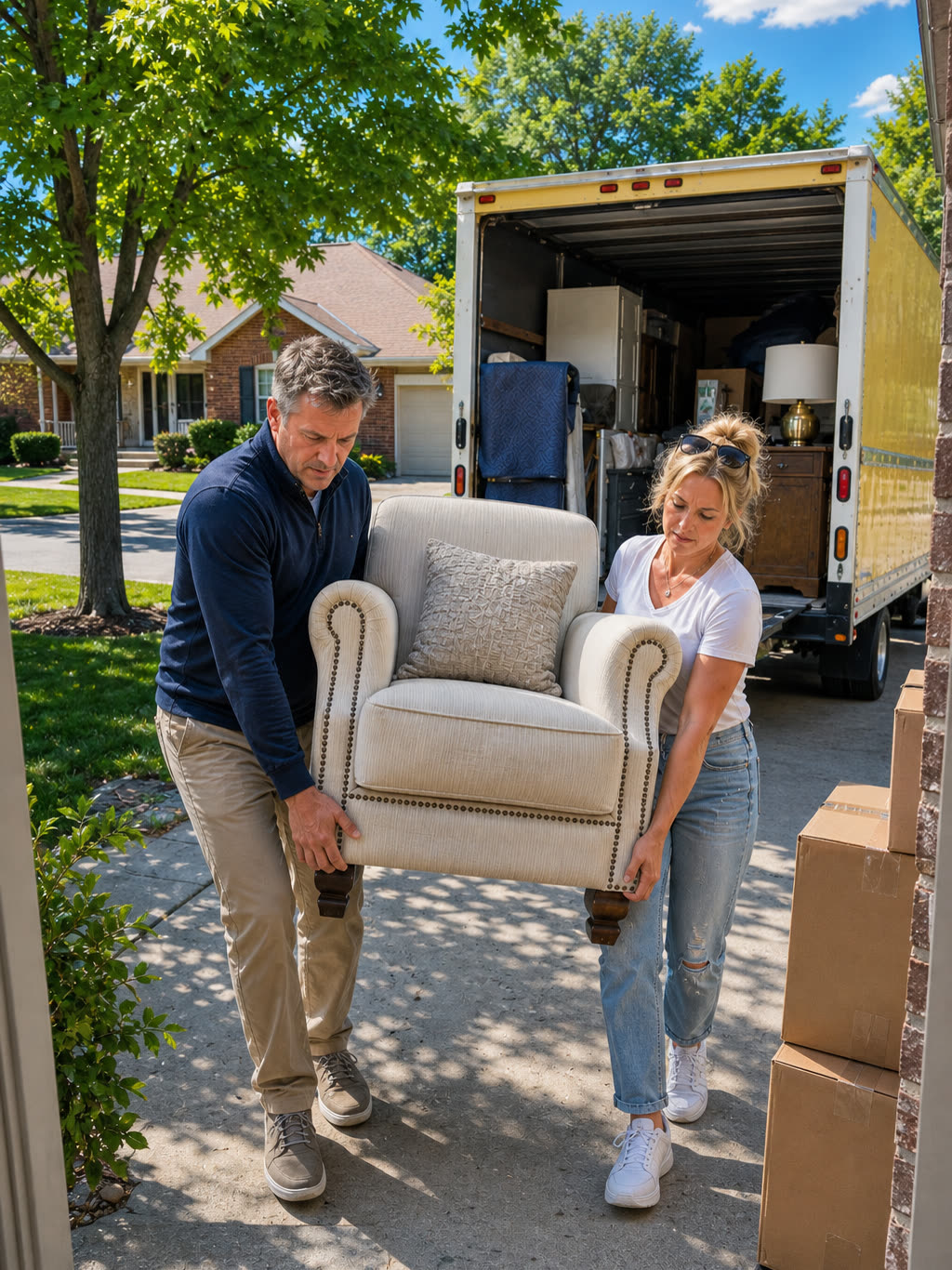
A yellow moving truck was backing into my driveway. The driver’s door swung open.
A man climbed out. He was tall and gray at the temples, wearing a navy quarter-zip pullover I had bought him for Christmas three years earlier. It was Mark. My ex-husband.
The passenger door opened, and a woman stepped down. She was blond and in her forties, with white sneakers on her feet and big sunglasses pushed up into her hair. Vanessa. His new wife.
For a moment the two of them stood in my driveway, gazing up at my house. Mark said something. Vanessa laughed. Then they walked to the back of the truck, and Mark hauled the rolling door up.
Side by side, they started carrying furniture into my house. I didn’t call either of them. I called the police. But that came a few minutes later. First I just stood in my sister’s kitchen, my coffee going cold, watching my ex-husband carry a television up my front walk as if he lived there.

My name is Diane Whitaker. I’m fifty-three years old.
Mark and I were married for twenty-seven years. We met at Ohio State, at a party in somebody’s basement. He was a junior studying finance. I was a sophomore studying elementary education. He was confident and funny and certain about everything, and I was shy and unsure about nearly all of it. I think that’s what drew me. He made the decisions, so I never had to.
We married the summer after I graduated and bought a split-level house in Westerville, outside Columbus. We had one daughter, Emily, who is twenty-five now and lives in Chicago. I taught third grade for twenty-four years. Mark climbed to vice president at a regional bank, then left to start his own financial consulting firm.
For twenty-seven years, Mark chose where we lived. Mark chose what car we drove. He chose our vacations, the restaurant for our anniversary dinner, and which of my friends were “a bad influence.” He did the taxes. He managed the money. When I asked questions, he explained things slowly and patiently, the way I explained long division to eight-year-olds.
I didn’t realize how small I’d become until I was nearly fifty.
The divorce was finalized in January. I won’t go through all of it. There was no single terrible event, only a long, slow pile of small things, until one morning I understood that I couldn’t remember the last decision I’d made that Mark hadn’t approved first.
I filed in the spring of the year before. He was shocked. Then he was angry. Then he was very, very calm, which was worse.
Five months after the divorce became final, he married Vanessa. I learned it from Facebook. Emily called me in tears.
“Mom, did you know? Did he tell you?”
“No, sweetheart. He didn’t tell me.”
“They’ve only been together, like, a year. Right?”
I didn’t answer that one. I’d done the math myself, and I didn’t love the result.
The house I bought was a small brick ranch in Granville, a little college town about forty minutes east of Columbus. It had three bedrooms, a big backyard with two old maple trees, and a front porch with a swing that came with the place.
I paid $327,500. Only my name was on the deed.
The down payment came from my share of the divorce settlement plus money my mother left when she died six years ago. Mom had been a nurse for forty years and had saved quietly all her life. She left me a little over a hundred and forty thousand dollars. I’d kept that money separate. Mark wanted it in our joint investment account, and I said no. It was one of the very few times in twenty-seven years I told him no about money. He sulked for a week.
That house was more than a purchase. For the first time in nearly three decades, I had made a major decision entirely alone. I picked the town. I picked the street. I picked the house. I sat across from the seller’s agent and negotiated eleven thousand dollars off the price by myself. My hands trembled under the table the whole time, but I did it.
I posted nothing online. I told no one in Mark’s orbit. Even Emily only knew I’d been “looking at houses.” I planned to surprise her: fly her in for the Fourth of July, pick her up at the airport, drive her to Granville, and put a key in her palm. I’d been daydreaming about her face.
Only a handful of people knew the address. My sister, Rachel. My divorce attorney, Patricia Haddad. My real estate agent. And my best friend, Lynn Sorensen.
Lynn and I had been friends for thirty years, ever since our daughters landed in the same kindergarten class. She was the first person I called when I decided to leave Mark. She drove me to my first meeting with Patricia and sat in the car with me afterward while I cried. When I bought the house, Lynn helped me move in. She hauled boxes in the June heat and put my bed frame together with a butter knife because we couldn’t find the screwdriver.
When I told her I was going to Louisville for a week to see Rachel, she offered to drive out on Wednesday and water my plants. So I had given her the code to my side-door keypad.
Now I stood in Rachel’s kitchen and watched Mark open the back of the yellow truck.
A television came out first, a big one, still in its box. Then cardboard boxes. Dozens of them. Vanessa carried a tall brass floor lamp toward my front porch, holding it like a torch.
One box was marked KITCHEN. Another said BOOKS. Then I saw the one that turned my stomach: MASTER BEDROOM.
Rachel leaned over my shoulder to see my phone. She’s two years younger than I am, shorter, louder, and far less patient, and she was still in her pajamas.
“Diane,” she said. “Are they actually moving in?”
I couldn’t answer, because it certainly looked that way.
Then Mark walked around the side of the house toward the side door. I had installed a smart keypad there the day after closing. It was the first thing I did. I didn’t even own curtains yet. I just wanted a lock nobody else had a key to.
Mark didn’t search for a hidden key. He didn’t check under the mat or the flowerpot. He didn’t hesitate at all. He simply reached out and tapped in four numbers.
Beep.
Beep.
Beep.
Beep.
The light turned green. The door unlocked.
Rachel stared at me.
“He has your code.”
“No,” I said.
“What do you mean, no? He just used it!”
“I never gave it to him.”
Part 2: The Paper in the Truck
On my screen, Mark held the side door open with one hand while Vanessa carried the brass lamp inside. Then he returned to the truck, lifted the boxed television, and followed her in.
The door swung shut behind them.
For twenty-seven years, whenever Mark crossed a line, I called him first.
When I found a charge on our credit card for a hotel in Cincinnati on a weekend he said he was in Cleveland, I called him first. When he sold my grandmother’s piano without asking because it “took up too much space,” I called him first. When he told Emily she was “too emotional” to be a nurse like her grandmother, I called him first.
He always had an explanation. He talked calmly and confidently and kept talking until I began to doubt myself, until I started thinking maybe I’d misunderstood, maybe I was overreacting, maybe I was the problem.
You’re getting worked up over nothing, Di.
You always do this.
Let me explain it to you again.
My thumb drifted toward his name in my contacts, out of habit. Twenty-seven years of habit. Then I stopped. I wasn’t going to ask him for an explanation. Not this time. Not ever again.
I set my coffee on Rachel’s counter and opened the folder on my phone where I’d saved my closing documents. I scrolled to the deed. There it was. Grantee: Diane Marie Whitaker, a single woman. My name. Nobody else’s.
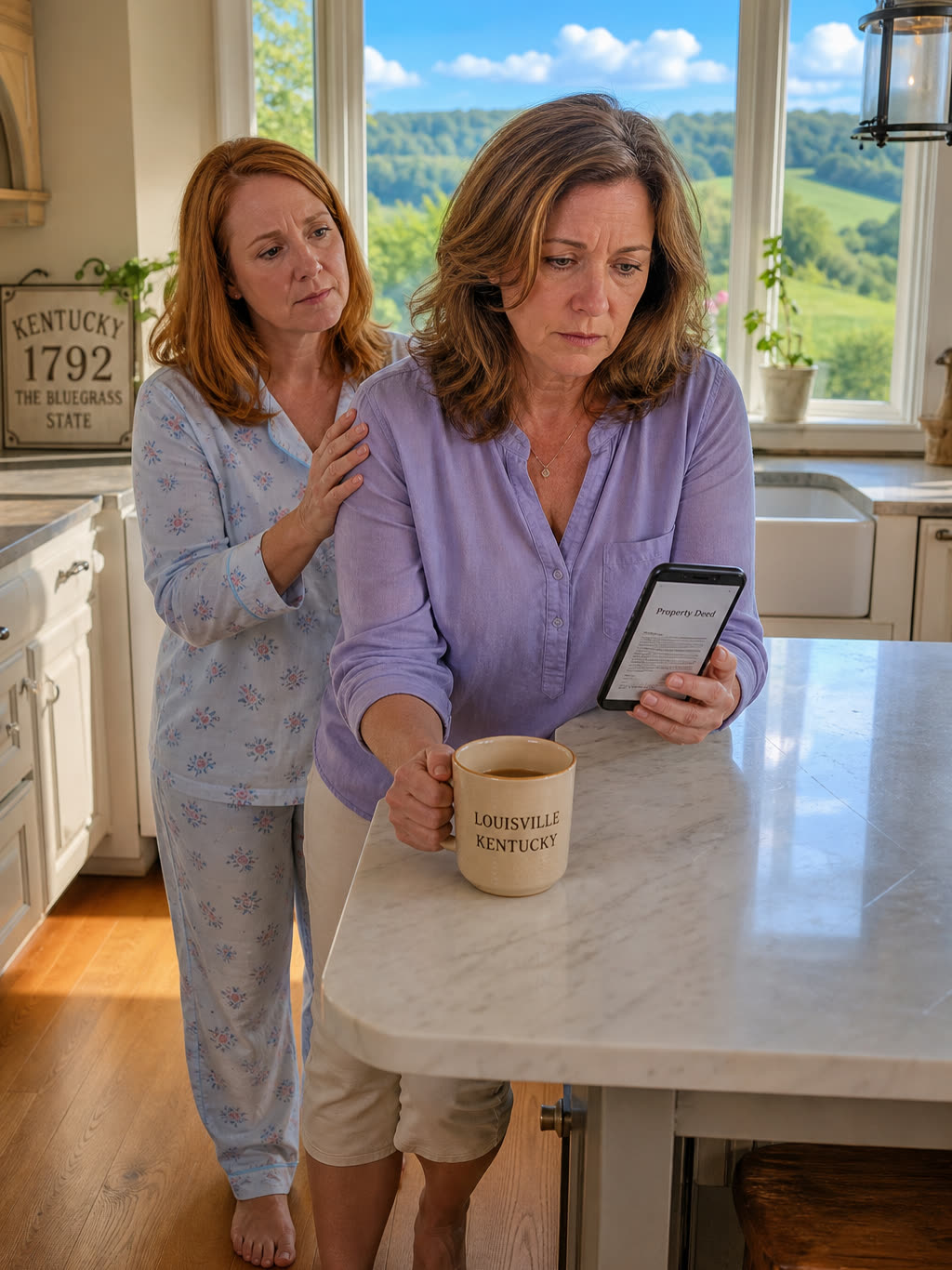
I stared at it. A single woman. It was the first legal document of my adult life with my name on it alone.
Then I called the Granville Police Department.
“My ex-husband and his wife are moving furniture into a house that belongs solely to me,” I told the dispatcher. My voice shook, and I tried to steady it. “I’m four hours away in Kentucky. Neither of them has permission to be there. I’m watching them on my security camera right now.”
The dispatcher had a calm, flat voice. She asked for the address and my name, and then she asked a string of questions.
“Does your ex-husband live at this address?”
“No.”
“Has he ever lived at this address?”
“No. I just bought it. Eleven days ago.”
“Are you the sole legal owner?”
“Yes. I have the deed. My name’s the only one on it.”
“Have you given either of them permission to enter the property?”
“Absolutely not.”
“Is there any court order in place? Custody arrangement? Anything that gives him a right to be there?”
“No. We have no children under eighteen. The divorce is final. He has no rights to anything I own.”
I could hear her keys clicking. Then she asked the question that changed everything.
“Ma’am, do you know how your ex-husband got inside?”
I looked at my screen. I’d paused the feed by accident, and it was frozen on Mark’s finger hovering over my keypad.
“No,” I said.
And suddenly I saw a second problem. Mark shouldn’t have known the code. But he shouldn’t have known the address either. I had kept the purchase private on purpose. I hadn’t posted it anywhere. I hadn’t told Mark or most of my friends. My mail was still forwarded to a P.O. box. I’d even asked my agent not to put a SOLD sign in the yard. Almost nobody knew.
Almost.
While the dispatcher kept me on the line, another notification popped up. Vanessa was carrying a box through my side door. This one was marked BATHROOM. Mark stood in the driveway with his hands on his hips, looking toward the street.
Then a dark SUV rolled slowly past the house. A black Chevy Tahoe, I thought, or maybe a Suburban. It didn’t stop, but it moved slowly enough that Mark raised one hand toward it. Not a big wave. Just a small lift of the hand, as if to say Got it, thanks. The SUV drifted off the edge of my screen.
Rachel saw it too.
“Who was that?” she said.
“I don’t know.”
But something about that SUV tugged at me. I had seen it before and couldn’t place where.
Suddenly the whole picture looked different. The moving truck wasn’t the whole story. Somebody had handed Mark an address I’d deliberately kept private. Somebody had handed him a code that worked on my door. And whoever it was knew enough about my plans to choose a Saturday morning when I’d be four hours away.
“Ma’am,” the dispatcher said, “I’ve got an officer on the way. Should be there in about four minutes. Please stay on the line.”
“Okay.”
“And don’t contact your ex-husband. Let the officer handle it.”
“I wasn’t going to,” I said. And for the first time in twenty-seven years, I meant it.
Four minutes is a very long time when you’re watching someone carry boxes into your house. I watched Mark carry in a box marked OFFICE. I watched Vanessa carry in two lamps, a rolled-up rug, and a laundry basket full of throw pillows. I watched Mark carry in a box that said MARK — WINTER CLOTHES.
Winter clothes. It was June. He wasn’t here for a weekend.
Rachel stood behind me with her hand on my shoulder. Her husband, Tom, had come in from the back porch and stood in the doorway in his golf shirt, looking confused.
“What’s going on?” Tom said.
“Mark’s moving into Diane’s house,” Rachel said.
Tom stared at her.
“He’s what?”
“Shh,” Rachel said. “Watch.”
Then a police cruiser appeared at the edge of the camera view. It pulled in behind the moving truck and parked, no lights flashing. The officer who got out was young and stocky, with a shaved head and sunglasses.
Mark saw him. For the first time that morning, the confidence drained from his face. He stood very still in my driveway, holding a box marked GARAGE, and then he set it down slowly on my lawn. Vanessa came out of the side door, stopped short at the sight of the police car, and covered her mouth with her hand.
The officer walked up the driveway and said something to Mark. Mark answered. I couldn’t hear them. My camera’s audio is poor, just a muffled sound like people talking underwater. Mark was smiling now. He was doing the thing he does, talking calmly, palms turned up, being reasonable.
I knew exactly what he was saying. I didn’t need audio.
Officer, this is just a misunderstanding. My ex-wife is very emotional. She’s been having a hard time since the divorce. Let me explain.
Then Mark pulled his phone from his pocket. I expected him to call me. I actually braced for it, glancing down at my own phone, waiting for his name to light up. He didn’t call me. He called someone else. I watched him press the phone to his ear and turn away from the officer, talking fast, one hand over his other ear, nodding. Then he hung up.
Less than a minute later, my own phone began to ring. Rachel read the screen before I did, and her face changed.
I looked down. The name belonged to one of the very few people who knew about my new house. Someone I had trusted for thirty years. Someone who knew exactly where I was supposed to be that weekend. Someone who had my code.
Lynn.
I answered.
“Hello?”
For several seconds there was only silence on the other end. I could hear breathing. I could hear a TV somewhere in the background.
Then Lynn spoke.
“Diane,” she said. “You need to listen to me before you do anything.”
My heart pounded so hard I could feel it in my throat.
“What did you do?”
Another pause.
“I didn’t tell Mark where you lived,” Lynn said quickly. “I swear to God, Diane. I didn’t tell him.”
On the feed, Mark now stood beside the officer. Vanessa paced by the moving truck with her phone pressed to her ear.
“Then how does he have my address?”
Lynn’s voice dropped.
“Because Mark already knew about the house.”
I felt cold, even though Rachel’s kitchen was warm and full of sunshine.
“That isn’t possible.”
“It is.”
“How?”
“He found the purchase records,” Lynn said. “Online. On the county auditor’s website. He searched your name. Property sales are public, Diane. It’s all public. Your name, the address, the price. Everything.”
I stared at Rachel, and she shook her head slowly. I hadn’t thought of that. I had been so careful about everything else: Facebook, the SOLD sign, the P.O. box. I hadn’t once thought of the county records. Mark had. Of course he had. He was a financial consultant, and he spent half his life reading public records.
“When?” I said.
“A few weeks ago,” Lynn said. “Right after you closed. Maybe right before.”
“And you knew.”
Silence.
“Lynn. You knew he’d found it. And you didn’t tell me.”
“I didn’t know what he was going to do,” Lynn said. Her voice cracked. “I thought he was just… being nosy. Checking up on you. I didn’t want to upset you. You were so happy about the house, Diane. You were finally happy.”
“But the code,” I said. “The code, Lynn. Mark just walked up to my door and typed in the code. The only people who have that code are me and you.”
The silence went on for a long time. It told me more than words could have.
“You gave him the code,” I said.
“No.”
“Then who did?”
Another long pause.
“I didn’t give it to him directly,” Lynn said at last.
My grip on the phone tightened until my fingers ached.
“What does that mean?”
“It means someone else did,” Lynn whispered.
On the feed, the officer had walked to the back of the moving truck and climbed up into the cargo bay. I could see what was inside: dozens of boxes, a couch wrapped in plastic, a dresser, a mattress leaning against the wall, a coffee maker, a microwave, a rolled-up rug, racks of clothes on hangers. It made one thing painfully clear. Mark hadn’t come to visit. He’d come prepared to stay.
“Diane,” Lynn said. “There’s something else. Something you don’t know about your divorce.”
My divorce. Twenty-seven years of marriage. Fourteen months of lawyers. Bank statements, property appraisals, retirement account valuations. Arguments over who got the dining room table and who got the good knives. I’d thought it was over, signed and sealed and done. Apparently, it wasn’t.
“What don’t I know?” I said.
The answer came in a whisper.
“Your house wasn’t supposed to be yours alone.”
I couldn’t speak. Rachel grabbed my free hand and squeezed it.
“What does that mean?” she said loudly, leaning toward the phone. “Lynn, what does that mean?”
I put the call on speaker and set the phone on the counter. Lynn’s voice came out tinny and small.
“Before you bought the house,” she said, “Mark found out something about the money you used. To buy it.”
I looked at the closing documents still open on my phone. Every payment was documented. Every transfer had been reviewed by my lawyer, the bank, and the title company. Everything had been approved. Or so I had thought.
“Mark believes,” Lynn said, “that part of that money belongs to him.”
I looked back at the camera. Mark was leaning against my porch railing now, arms folded, as if he owned the place. But something worse was happening. The officer had climbed down from the truck holding several stapled pages with a blue backing sheet. He unfolded them and read. He turned to the second page and read that too. Then he looked straight at Mark.
Mark’s face changed. It didn’t turn angry or calm. It went blank. The officer took one step back from him, then pressed his hand to his radio and said something into it.
I knew then that this was no longer a story about an angry ex-husband walking into his former wife’s house. There was something in that truck. Something connected to my divorce. Something Mark believed gave him the right to be inside my home.
The officer called me himself about ten minutes later. His name was Officer Brandon Yates, and his voice was younger than I expected.
“Mrs. Whitaker?”
“It’s Ms. Whitaker now,” I said, and then felt silly for saying it. “Sorry. Yes. This is Diane.”
“Ms. Whitaker, I’m at your property. I’ve got your ex-husband and his wife here. I’ve confirmed through the county records that you’re the sole owner. They’ve been asked to stop unloading, and they’re cooperating.” He paused. “But I need to ask you about a document.”
“What kind of document?”
“Your ex-husband provided me with something he says gives him the right to occupy the property. I need to read part of it to you.”
My stomach dropped.
“Okay.”
I heard paper rustling.
“It’s titled ‘Agreement Regarding Equitable Interest and Occupancy,’” Officer Yates said. “It says that you, Diane M. Whitaker, acknowledge that a portion of the funds used to purchase the property at this address are marital funds belonging to Mark R. Whitaker. It says that in exchange for not pursuing legal action to recover those funds, you grant him and his spouse the right to occupy the property for a period of up to twenty-four months while ‘the matter is resolved.’”
I couldn’t breathe.
“And it’s signed,” Officer Yates said. “By you. And notarized.”
Part 3: The Code Only I Knew
“I never signed anything like that,” I said. My voice came out high and strange. “I’ve never seen that document in my life. Never.”
“The notary stamp,” Officer Yates said slowly, “is from a Vanessa L. Whitaker. Licensed in Franklin County.”
Rachel made a sound like she’d been punched. Vanessa. Mark’s wife was a notary.
“What’s the date on it?” I asked.
“The signature’s dated May 28th.”
I closed my eyes. On May 28th, I had spent nine hours in a hospital waiting room in Chicago. Emily had had her appendix out. I’d flown up the night before. I had the boarding pass, the hospital parking receipt, and the photo Emily’s boyfriend took of me asleep in a plastic chair at two in the morning. I hadn’t been anywhere near Ohio. I hadn’t been anywhere near Vanessa.
I told Officer Yates all of it. He was quiet for a long time.
“Ms. Whitaker,” he said finally, “I’m going to need you to come in and give a statement. As soon as you can. And I’m going to need copies of everything you just told me about.”
“I’m leaving now,” I said.
“Ma’am, you don’t have to drive four hours today. Monday is…”

“I’m leaving now,” I said again.
Rachel drove. She wouldn’t let me; she said my hands were shaking too badly, and she was right. Tom stayed behind with the dogs. Rachel tossed a toothbrush and a change of clothes into a bag and was in the car within four minutes.
We crossed the Ohio River at 11:20. I watched the water slide by beneath the bridge, brown and slow, and I felt nothing at all.
Somewhere past Cincinnati, my phone rang again. Lynn. I let it go to voicemail. She called back, and I let it go again. She texted. Please, Diane. Please let me explain. I’m so sorry.
Rachel glanced at me from the driver’s seat.
“Are you going to call her back?”
“Not yet.”
“You want me to?”
“No,” I said. “I want you to drive.”
Around Dayton, I finally played Lynn’s voicemail. Her voice was thick, as if she’d been crying.
Diane. It was Greg. It was Greg. I wrote your code on the whiteboard on our fridge so I wouldn’t forget it when I went to water your plants. I didn’t think anything of it. Greg and Mark still golf every Thursday. I didn’t know. I swear to God I didn’t know until Mark called me this morning screaming that the cops were there and that I needed to get you to call them off. That’s when I figured it out. I asked Greg. He admitted it. He sent Mark a picture of the whiteboard. Two weeks ago. Mark told him you’d agreed to let them stay for a while. That you’d worked it all out. Greg believed him. That was him in the SUV. He was driving by to make sure everything was going okay. Diane, I’m so sorry. I’m so, so sorry. Please call me.
The dark SUV. Greg Sorensen’s black Tahoe. I had ridden in it a hundred times: to Lynn’s daughter’s wedding, to a Bengals game, to the airport. I set the phone in my lap.
“Greg,” I said out loud.
Rachel’s hands tightened on the wheel.
“Lynn’s husband?”
“He took a picture of my code off their fridge. And sent it to Mark.”
Rachel said nothing for a long while.
“Did Lynn know?” she asked at last.
“She says she didn’t.”
“Do you believe her?”
I looked out at the cornfields sliding past, green and flat and endless.
“I believe she didn’t know about the code,” I said slowly. “But she knew Mark had found the house. Weeks ago. And she didn’t tell me.”
“Why not?”
“Because she didn’t want to upset me,” I said. “Because I was happy.”
Rachel was quiet.
“That’s a terrible reason,” she said.
“I know,” I said. “It’s also exactly what I would’ve done. For twenty-seven years, I did exactly that. For Mark. I never told anybody anything that might upset them.”
We reached Granville at 2:40 that afternoon. The moving truck was gone, and so was the police car. Mark and Vanessa were gone too. But the boxes remained. They’d been allowed to take the truck and their personal items, but the officer had made them leave whatever they’d already carried inside, so they couldn’t go back in.
I stood in my own living room and looked around. The brass floor lamp stood in the corner by my front window. The big boxed television leaned against my wall. A rolled-up rug lay in the middle of the floor, and a laundry basket of throw pillows sat on my couch.
A box marked KITCHEN rested on my counter, already opened. A coffee maker stood beside mine, a fancy silver one with a built-in grinder. Mark’s coffee maker. He’d had it six years. I’d given it to him for his fiftieth birthday.
In my bedroom, a box marked MASTER BEDROOM sat open on my bed. On top lay a framed photograph of Mark and Vanessa on a beach somewhere, both sunburned and smiling. Vanessa had meant it for my nightstand. I looked at it for a long time, then laid it face-down on the dresser and sat on the edge of my bed.
Rachel found me there twenty minutes later. She sat beside me and said nothing, just put her arm around me.
“He was going to sleep here,” I said. “In my bed. With her.”
“I know.”
“I bought this bed. Myself. I went to the store and lay down on forty different mattresses until I found the one I liked. Nobody told me which one to get.” My voice cracked. “It’s the first bed I’ve ever picked out myself, Rachel. The first one.”
Rachel tightened her arm around me.
“And he still doesn’t get to sleep in it,” she said. “Not ever.”
The first thing I did was change the code on the keypad. The second was call a locksmith. On a Saturday afternoon it cost two hundred and eighty dollars to have every lock in the house replaced. I didn’t care. I’d have paid two thousand. The third was call Patricia Haddad, my divorce attorney. She picked up on the second ring, even though it was Saturday.
“Diane? What’s wrong?”
I told her everything. There was a long silence on the line.
“I’m going to need you to read me that document,” Patricia said. “Word for word. Did the officer give you a copy?”
“He took a picture with his phone and sent it to me.”
“Read it to me.”
I read all three pages aloud. Agreement Regarding Equitable Interest and Occupancy. Diane M. Whitaker acknowledges. Marital funds. Twenty-four months. My signature at the bottom. It wasn’t my signature. It was close, close enough that I needed a second look. But the D was wrong. I put a loop at the top of my D, and this one had none.
Patricia waited until I finished.
“That’s not a legal document, Diane,” she said. “I want you to understand that. Even if you had signed it, a private agreement like that wouldn’t override a divorce decree. But you didn’t sign it. And somebody notarized your signature on a day you can prove you were in Chicago.” She paused. “That’s not a civil matter anymore. That’s forgery. And notary fraud. Those are felonies in Ohio.”
“Mark knows that,” I said. “He’s not stupid. Why would he do something like this?”
“I don’t know,” Patricia said. “But I have a guess. It’s about your mother’s money. Isn’t it?”
My mother’s money. The hundred and forty thousand dollars she left me. Forty years of night shifts at Riverside Methodist, cheap shoes, clipped coupons, and never a vacation longer than a long weekend. I’d kept it separate, always, except once.
In the spring of 2019, Mark and I refinanced our Westerville house, and the bank needed to see a certain level of cash reserves. Mark asked me to move my mother’s money into our joint savings account, just for a few weeks, until the refinance closed. I said no. He explained it again, slowly and patiently. I said no again. He explained a third time. It was only temporary, he said, just a number on a screen, the bank wouldn’t touch it. Didn’t I trust him? The fourth time, I said yes.
The money sat in the joint account for nineteen days. When the refinance closed, I moved every penny back into my own account. I kept the statements. I kept everything. Some part of me knew I would need them.
During the divorce, Mark’s lawyer raised it. “The inheritance was commingled,” he said. “It entered a joint account. Therefore it became marital property. Mr. Whitaker is entitled to half.” Patricia dismantled that argument in about fifteen minutes. She had the bank statements, the transfer records, and the original letter from my mother’s estate. Every dollar that went in came back out. Nothing was spent on joint expenses. The judge agreed. The inheritance was mine, in writing, on page eleven of the final decree. Mark signed that decree in January, in front of me. I thought it was over.
“He never let it go,” I said quietly to Patricia. “Did he?”
“I don’t think Mark lets anything go,” Patricia said. “I think he decided the judge was wrong. And when he saw you’d put that money into a house, he decided half the house was his.”
“So he just… moved in?”
“I think he thought you’d do what you always did,” Patricia said gently. “I think he thought you’d come home, see him there, and he’d explain it to you. With a piece of paper and a notary stamp. And you’d decide it wasn’t worth the fight.”
I said nothing, because that was exactly what I would have done a year ago, or two, or at any point in twenty-seven years.
On Monday morning I went to the Granville police station. Officer Yates met me in the lobby. He looked even younger in person, maybe twenty-six, with a round face and big hands. He led me into a small room with a table, two chairs, and a box of tissues in the corner. I brought everything: my deed, my closing documents, the divorce decree with page eleven flagged by a yellow sticky note, Emily’s hospital records, my boarding pass, the parking receipt, and the photo of me asleep in the plastic chair. He went through it page by page, took notes, and made copies.
“Ms. Whitaker,” he said when we finished. “I want to tell you something. Off the record.”
“Okay.”
“When I first pulled up to your house on Saturday,” he said, “your ex-husband was very convincing. He was calm. He was polite. He had paperwork. He told me you’d had some kind of breakdown since the divorce. That you’d agreed to this arrangement and then panicked and changed your mind. He said you did that a lot.”
I closed my eyes.
“And I almost believed him,” Officer Yates said. “I’m being honest with you. I was about to tell you it was a civil matter. That you’d need to go to court.”
“What changed?”
“The notary stamp,” he said. “I asked his wife if she was the notary. She said yes. I asked her if she’d watched you sign it. She hesitated.” He looked at me. “She hesitated for a long time. Then she said Mark brought it to her already signed. He told her you’d signed it at his lawyer’s office and they just needed it stamped.”
“So she notarized it without seeing me sign it.”
“That’s what she said. Right there in your driveway.” He shook his head. “That’s when I stepped back and called my sergeant.”
I thought of Vanessa standing in my driveway in her white sneakers, holding a brass lamp. I had hated her for a long time: her photo on Facebook, her blond hair, her big sunglasses, the way she’d shown up in my husband’s life before I had even left it. But sitting in that little room, I suddenly wondered how many times Mark had explained things to her, slowly and patiently. How many times she’d started questioning herself. How many times he’d said, Don’t you trust me?
The investigation took four months. The county prosecutor’s office examined the document, Mark’s emails, and his text messages with Greg Sorensen. They found a draft of the agreement on Mark’s laptop, with notes in the margins. They learned that Mark’s consulting firm had lost its two biggest clients the previous fall and that the lease on Vanessa’s condo had ended on May 31st. They’d had nowhere else to go. Mark had stood in my driveway telling a police officer I was having a breakdown, when he was the one who had run out of options.
Vanessa cooperated fully. She told the prosecutor that Mark brought her the document already signed on June 2nd and asked her to backdate the notary stamp to May 28th, saying I’d signed weeks earlier and the date needed to match. “I’m his wife,” she told the investigator, in a report Patricia showed me later. “Why would I think he was lying to me?” The state revoked her notary commission, but she wasn’t charged. The prosecutor decided she’d been deceived too. Three months later, she filed for divorce.
I heard it from Emily. “Mom,” she said on the phone, “Vanessa left Dad.” “I heard.” “She moved back to Dayton. To her sister’s.” A pause. “Dad’s living in an extended-stay hotel near the airport.” I said nothing. “Are you happy?” Emily asked. She didn’t say it angrily. She just asked. “No,” I said. “I’m not happy. I’m not sad either. I just don’t feel much of anything about it.” “That’s kind of how I feel too,” Emily said quietly.
Mark pleaded guilty in November. His lawyer worked out a deal: guilty to forgery, a fifth-degree felony, and to criminal trespass, with the other charges dropped. He received two years of probation, a fine, and a protective order barring him from coming within five hundred feet of me or my house. I went to the sentencing with Patricia beside me, Rachel driving up from Louisville, and Emily flying in from Chicago. Mark sat at the defense table in a gray suit. He looked older and thinner, his hair grayer than I remembered. When the judge asked if he had anything to say, he stood and looked at me. For a second I thought he was finally going to apologize, that after twenty-seven years he would say I’m sorry, Di. I was wrong. “I still believe,” Mark said, “that I was entitled to a share of that money.” The judge studied him over her glasses. “Mr. Whitaker,” she said, “a judge in Franklin County already decided what you were entitled to. You signed that decision. If you disagreed with it, you had the right to appeal. You didn’t. Instead, you forged your ex-wife’s signature and moved into her house while she was out of state.” She took off her glasses. “That’s not a misunderstanding about money. That’s a choice.” Mark sat down. He didn’t look at me again.
Emily held my hand all the way out of the courthouse.
“He’s never going to say sorry,” she said. “Is he?”
“No,” I said. “I don’t think he is.”
“Does that bother you?”
“It used to,” I said. “For a long time, I thought I needed him to say it. I thought it wouldn’t be real until he admitted it.” I squeezed her hand. “But I don’t need him to say it anymore. I know what happened. The judge knows what happened. You know. That’s enough.”
Emily looked at me sideways.
“You’re different, Mom.”
“Different how?”
“I don’t know,” she said. “You used to always look at Dad before you answered a question. Like you were checking. You don’t do that anymore.”
Emily had been hurt that I hadn’t told her about the house. She said so that night in the car. After a long silence she asked, “Why didn’t you tell me? About the house? Before?”
“I wanted to surprise you.”
“Mom. I had to find out from the police report.”
I winced. “I know. I’m sorry. I was going to fly you in for the Fourth. I had it all planned. I was going to hand you a key.”
Emily was quiet for a while.
“Were you afraid I’d tell Dad?” she asked.
I didn’t answer right away, because the honest answer wasn’t that I didn’t trust her. It was that I had spent so long being careful about everything that I didn’t know how to stop.
“A little,” I admitted. “Not because of you. Because of me. I was afraid of everybody. I was afraid of anybody knowing anything.”
Emily looked out the window.
“I wouldn’t have told him,” she said quietly.
“I know, sweetheart.”
“I’m on your side, Mom. I’ve always been on your side. Even when you weren’t on your own side.”
I had to pull the car over. I couldn’t see the road.
I didn’t speak to Lynn for six weeks. She called. She texted. She sent a card showing two old women on a porch swing. She left a bag of my favorite lemon cookies from the Westerville bakery on my front porch, with a note that said I’m so sorry. Whenever you’re ready. If you’re ever ready. I wasn’t ready.
The code wasn’t what hurt most; Greg had given it away, not Lynn. What hurt was the other thing. She had known for weeks that Mark had found my house, and she had said nothing. She’d watched me hang curtains and plant tomatoes and talk about my fresh start, all the while knowing Mark had already been studying my address on the county website. She had kept it from me to protect me. Mark had kept things from me for twenty-seven years, and he, too, had always said it was to protect me.
In August, I finally called her. We met at a coffee shop in Granville, halfway between her house and mine. She was already there when I walked in, at a corner table, looking as if she’d lost ten pounds, her eyes red. I sat down across from her. For a long time neither of us spoke.
“I left Greg,” Lynn said finally.
I stared at her. “Lynn. No. That’s not… I didn’t want…”
“It wasn’t because of you,” she said. “Not just because of you.” She wrapped both hands around her cup. “When I asked him why he sent Mark the picture, he said Mark told him you’d agreed. That it was all worked out. And I said, Greg, did you ask Diane? Did you call her and check?” She shook her head. “He looked at me like I was crazy. He said, ‘Why would I check with Diane? Mark’s the one who handles that stuff.’”
I closed my eyes. Mark’s the one who handles that stuff.
“Thirty-one years,” Lynn said quietly. “I’ve been married to Greg for thirty-one years. And I suddenly realized he’s never once asked me what I thought about anything. Not once. He just asks whoever he thinks is in charge.” She dabbed her eyes with a napkin. “I watched you leave Mark, Diane. I watched how scared you were. And I sat there thinking, Thank God my marriage isn’t like that.” She laughed, but it wasn’t really a laugh. “Turns out I just never asked.”
“Why didn’t you tell me?” I asked. “That Mark had found the house?”
Lynn looked down at her coffee.
“Because I was a coward,” she said. “Because you were so happy. You were happier than I’d seen you in twenty years. And I didn’t want to be the one to take that away. I told myself he was just being nosy. That he’d look and then forget about it. That it didn’t matter.” She looked up. “But it did matter. And you should’ve had the chance to decide that for yourself. Not me. You.”
I said nothing.
“I’m not asking you to forgive me,” Lynn said. “I just wanted you to know I understand what I did.”
I sat looking at her across the table. My best friend. Thirty years. Kindergarten pickups and birthday parties and that awful winter when my mother died.
“Next time,” I said slowly, “if you know something about my life, you tell me. Even if it’s going to upset me. Even if I’m happy. Especially then.”
“I will,” Lynn said. “I promise.”
“I mean it, Lynn.”
“I know you do.”
I reached across the table and took her hand. We’re not quite where we were, and I don’t know if we ever will be. But she comes to Granville every other Sunday now. She sits on my porch swing drinking iced tea and tells me about the tiny apartment she rented in Worthington and the pottery class she’s taking. She’s terrible at pottery. She brought me a bowl shaped like a lopsided potato. I use it for my keys.
I gave away Mark’s things. Patricia sent his lawyer a letter giving him thirty days to arrange a pickup through a third party. He never did, and after thirty days the items were legally considered abandoned. The brass lamp, the rug, and the throw pillows went to the women’s shelter in Newark. The boxed television went to the senior center. The winter clothes went to the Salvation Army.
The silver coffee maker with the built-in grinder I kept for a while, though I couldn’t say why. It sat on my counter beside my own cheap one for weeks, and every morning I looked at it. Then one September morning I packed it into a box and drove it to Goodwill. The woman at the donation drop-off looked it over and said, “Oh, wow. This is a really nice one. Are you sure?” “I’m sure,” I said. “I never liked the coffee it made.” It was true. It was too strong and too bitter. Mark liked it that way, and for six years I had drunk it every morning without saying a word.
The beach photograph of Mark and Vanessa I wrapped in bubble wrap and mailed, without a note, to her sister’s address in Dayton. Two weeks later a card arrived in my P.O. box with no return address. Inside, in round, careful handwriting, was a single line: Thank you. I’m sorry. — V. I put it in my nightstand drawer. I think I wanted to remember that she had been fooled too.
Emily finally saw the house in October. I picked her up at the Columbus airport, and we drove to Granville with the windows down. The leaves on the maples were just beginning to turn, gold and red and orange, and the air smelled of woodsmoke and apples. I pulled into the driveway and shut off the engine. Emily sat for a moment, looking at the brick, the porch, the swing, and the two maples in the backyard, half-gold.
“Mom,” she said. “It’s perfect.”
“It’s small.”
“It’s perfect,” she said again. “It looks like you.”
I walked her up the side path to the side door and stopped in front of the keypad. For four months, I had been the only person in the world who knew that code. I hadn’t told Lynn. I hadn’t told Rachel. I hadn’t written it down anywhere. I had chosen four numbers that meant something only to me and never said them aloud. Emily waited behind me. I turned and looked at her.
“I’m going to tell you the code,” I said.
“Okay.”
“It’s the date Grandma Ruth was born,” I said. “Month and day. Zero-three-one-four.”
Emily’s eyes filled with tears.
“Grandma’s birthday?”
“It was her money that bought this house,” I said. “Her night shifts. Her cheap shoes. Every dollar. I wanted her to be the one who let me in.” I took a breath. “And now I want her to let you in too.”
Emily stepped forward, reached past me, and pressed the buttons herself, slowly.
Beep.
Beep.
Beep.
Beep.
The light turned green.
“Don’t write it down,” I said.
“I won’t,” Emily said. “I promise.”
She opened my door and walked into my house. I followed her in and closed the door behind us.
Disclaimer: This story is a work of fiction inspired by real-life themes. Names, characters, places and events are fictionalized, and any resemblance to real persons is purely coincidental. Images are for illustration purposes only.
