

The Keys by Her Plate
My name is Mark Lindgren. I’m thirty-eight years old, and since I was nineteen I’ve been working the same six hundred acres in O’Brien County, Iowa. Mostly corn and beans, with a little oats now and then for a cover crop. The soil is black and so rich that it looks like coffee grounds when you turn it over in the spring. It’s the kind of ground that people’s great-grandparents broke open with horses and a walking plow. My great-grandfather was one of those people.
The home place sits four miles south of Primghar, out on a gravel road. There’s a white farmhouse with green trim, and a red barn that Dad repainted every seven years whether it needed it or not. There’s a machine shed, two grain bins, and a windbreak of cottonwoods that my grandmother planted in 1952. From the kitchen window you can see the entire north quarter. In October the corn stands up like a wall of gold, and the beans turn the color of a lion’s back. I grew up looking out that window.
My mother died when I was eight. Breast cancer. She was thirty-four. After that it was only Dad and me. Dale Lindgren was six-foot-two and quiet, with hands like fence posts and a laugh that surfaced about twice a year. He could go days without speaking more than a dozen words, but he spoke those words to me.
He put me on a tractor when I was ten. He taught me how to read a field by walking it. He taught me to grease the combine every morning before breakfast, every bearing and every zerk, because the one you skip is the one that fails. “Machinery’s honest, Mark,” he used to say. “It tells you exactly what you didn’t do.”
When I was nineteen, I came home from my first year at Iowa State. I’d gone because Dad wanted me to, to study agricultural business. My grades were good, and I hated every minute. I sat in lecture halls in Ames staring out the windows and thinking about the north quarter. That summer I told him I wasn’t going back.
He was quiet for a long time. We were sitting on the tailgate of his pickup at the end of a bean row, drinking warm Pepsi. “You sure?” he finally said. “I’m sure,” I said. He nodded once. “Then we’ll farm it together,” he said.
And we did, side by side, for nineteen years. He paid me a wage, not a big one. It was fourteen dollars an hour at first and eventually twenty. He covered my health insurance. He let me live in the little house on the east eighty, the one my grandparents had retired to.
We never wrote anything down. There was never a scrap of paper about the land, because Dad didn’t believe in paper between family. “It’ll all be yours someday,” he’d say whenever the subject came up, which wasn’t often. “Don’t worry about that.” So I didn’t.
Dad married Elaine when I was twenty-four. She was a widow from Sheldon, twenty miles to the east. Her first husband, a pharmacist, had died of a heart attack at fifty-one. She had two sons, Brad and Kyle, who were in their late teens when she married Dad, and who both moved to Phoenix after high school and never came back. Elaine was fifty when she married him. She was small and neat, with short silver hair and reading glasses she wore on a beaded chain. She’d taught home economics at Sheldon High School for twenty-six years. She was not a farm woman and had never lived on a farm in her life. I want to be fair to her, and I’ve thought about this a great deal. She tried. She learned to drive the grain truck that first fall, though she ground the gears so badly that Ron, our grain hauler, started calling it “Elaine’s coffee grinder.” She learned to cook harvest meals for a crew of six and have them in the field by noon. She planted a garden, canned tomatoes, and kept the farmhouse spotless. Most of all, she made Dad happy. I hadn’t seen him happy since my mother died, but with Elaine he laughed more. He went to church potlucks. He took her to the Okoboji lakes every June for their anniversary. For that alone I was grateful to her.
But she and I never got close. I don’t know whose fault that was, and probably it was both of ours. I was a grown man when she arrived, set in my ways and used to it being just Dad and me. She was a grown woman who’d already raised her own boys and didn’t need another one. We were polite and respectful. She set a plate for me at supper and I thanked her for it. I fixed her leaky faucets and shoveled her walk. But I always had the feeling that I was a guest at her table, and I suspect she always felt like a guest on my farm.
Dad died two years ago this past August. He was sixty-eight. He’d been tired for a few weeks and short of breath, but he wouldn’t see a doctor in the middle of summer because there was too much to do. One afternoon he was spraying the north quarter, and he didn’t come in for supper. I found the sprayer stopped at the end of a row with the engine still idling, and him slumped over the steering wheel. It was a heart attack. The doctor said it was massive and that he probably hadn’t felt much. I hope that’s true.
Brad and Kyle flew in from Phoenix for the funeral. They stayed two nights at the Super 8 in Primghar, wore sunglasses inside the church, and checked their phones during the graveside service. At the luncheon in the church basement, Brad asked me what the land was worth per acre. I told him I didn’t know. That wasn’t true, because I knew exactly, but it didn’t seem like the right question to answer over ham sandwiches. They flew back to Phoenix the next morning, and they haven’t been back since.
Dad’s will was simple, just one page. He’d signed it at the lawyer’s office in Primghar right after he married Elaine, fourteen years earlier. Everything went to his wife. There was no mention of me, no mention of the land, and no mention of nineteen years. The lawyer, an old man named Harold Bauer, read it to us in his office. When he finished, he took off his glasses and looked at me. “Mark,” he said. “I asked your dad about this. When he signed it. I asked if he wanted to make provisions for you.” “What did he say?” Harold sighed. “He said Elaine would do right by you,” he said. “He said she’d know what he wanted.”
I didn’t fight it. Dad’s will was Dad’s will. The land belonged to Elaine now, every acre and every bin and every piece of machinery, including the combine I’d run for nineteen harvests. I kept farming on a handshake. Elaine kept paying me twenty dollars an hour, and I kept living in the little house on the east eighty. We never talked about the future. I told myself there was time. I told myself she’d do right by me, like Dad said.
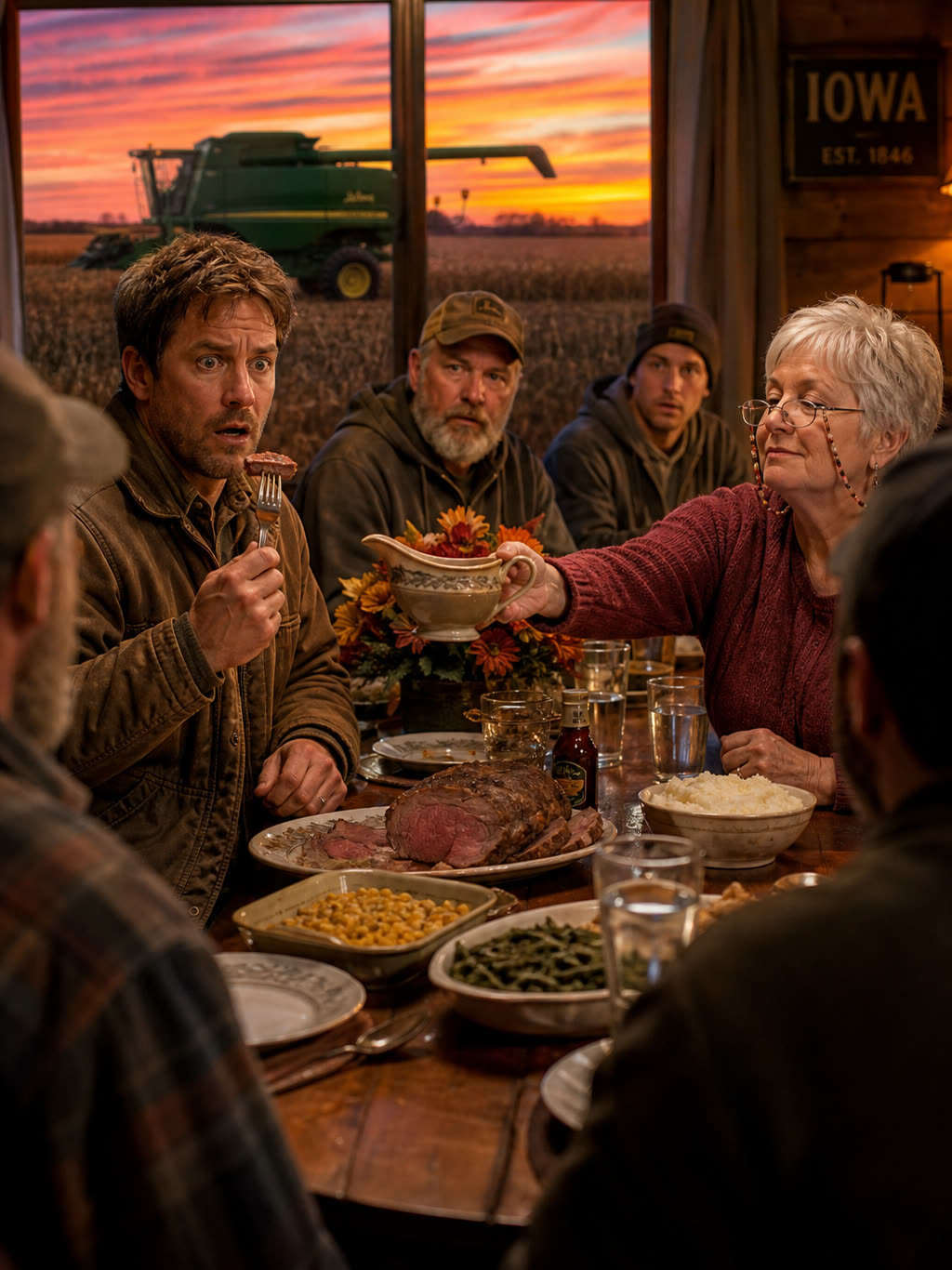
It was a Tuesday in October, at dusk. We’d been running beans for nine days under perfect weather, dry and sunny with a little wind. Four hundred and forty acres were in the bin, and a hundred and sixty were left on the west side. Elaine made harvest supper the way she did every fall: roast beef and mashed potatoes, green beans with bacon, dinner rolls from scratch, and apple crisp with ice cream. She set the long table in the farmhouse dining room with seven places. Our crew was there. Ron Hessler had hauled our grain for eleven years. He was fifty-nine, with a gray beard and a Pioneer seed cap he never took off. His wife, Patty, drove the second grain truck. Deb Kruse ran the grain cart, a tough little woman in her forties who could back a semi into a bin faster than any man in the county. Tom and Linda Visser, a retired couple from Paullina, helped us every harvest because, Tom said, sitting at home made him want to shoot the television. The combine sat right outside the dining room window, a green John Deere S670 that Dad had bought used in 2017 and that I’d run every harvest since. It was parked in the yard with dust still on the cab and the header unhooked on its cart, ready for the morning. Through the glass I could see the last pink light on the cab windows. We were halfway through supper, everybody tired and happy. Ron was telling a story about a raccoon that got into his grain truck in 1998, and Deb was laughing so hard she had to put down her fork. Elaine passed the gravy. She said it like she was talking about the weather. “I signed a new will in Primghar today,” she said.
Ron stopped mid-sentence. Elaine handed the gravy boat to Linda and picked up her own fork. “The land goes to Brad and Kyle,” she said.
Nobody chewed. Nobody moved. Out in the yard a barn cat yowled at something, and the kitchen clock ticked. I sat there with a forkful of roast beef halfway to my mouth.
Brad and Kyle, in Phoenix. They hadn’t set foot on the place since Dad’s funeral. They’d worn sunglasses in church and asked what the land was worth per acre over ham sandwiches. Every acre that Dad and I had farmed side by side for nineteen years was going to them.
I set my fork down and looked at Elaine. She was cutting her roast beef into small, neat pieces, and she didn’t look up. My heart was pounding so hard I could hear it in my ears.
Here’s what I knew. Dad’s will was Dad’s will, and the land was legally hers. She had every right in the world to leave it to anyone she wanted: her sons, the church, the Humane Society. There was nothing to fight. No paper had my name on it, and there was no handshake a court would recognize. The only thing left to fight was her mind, and nobody changes a mind over roast beef.
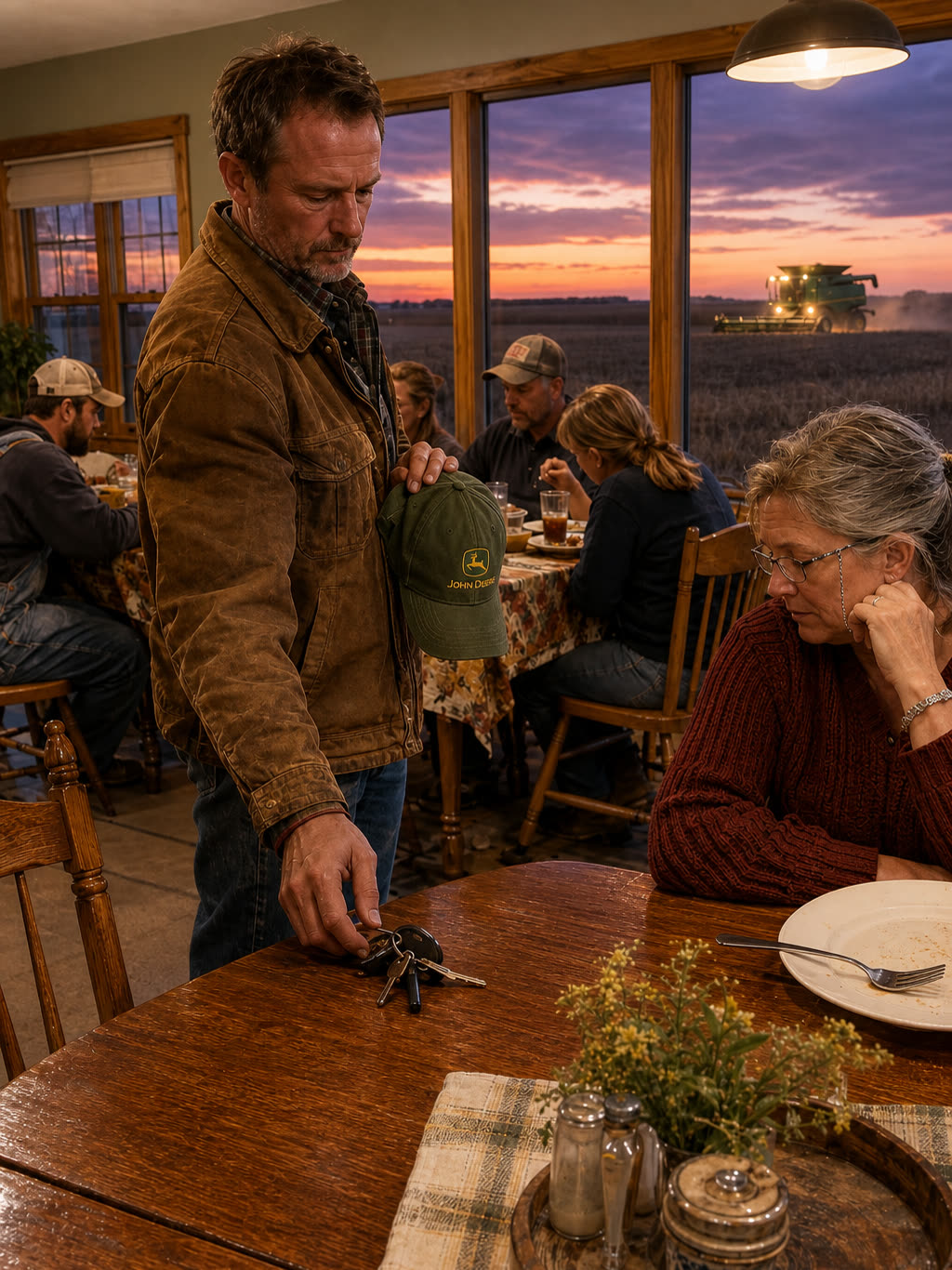
So I didn’t argue. I didn’t raise my voice, since I’ve never been much for that, and Dad wasn’t either. I stood up and pushed my chair back slowly. I took my work hat off the back of the chair, where I’d hung it when I sat down, a faded green cap with a John Deere logo and a sweat stain around the band. I held it in one hand. Then I reached into the pocket of my canvas work coat.
The keys were there, where they always were. There was the combine key on a ring with a little brass tag, the key to the machine shed, the key to the fuel tank, and the key to the grain truck. I took them out and walked around the end of the table. I set them down beside Elaine’s plate, right next to her roast beef. “Those are yours, Elaine,” I said.
My voice came out calm, and I don’t know how. “So is the combine,” I said.
She looked at the keys like they might bite her. Then she looked up at me, and her face had gone pale under her reading glasses. “Mark,” she said. “Sit down and finish your supper.”
“There’s a hundred and sixty acres of beans left on the west side,” I said. “They’re ready. They need to come out this week.” I put my hat on. “I’ll write the custom man’s number by the phone,” I said. “Gene Hartwig. Out of Sutherland. He’s good.”
Then I walked to the kitchen. I found a pen in the junk drawer and a sticky note on the refrigerator, and I wrote Gene Hartwig, custom harvest and his phone number. I stuck it on the wall above the kitchen phone, the old yellow one Dad never would replace. When I came back through the dining room, nobody had moved.
Ron Hessler set his fork down on his plate, very carefully. He looked at Elaine, and then he looked at me. “Dale would not have liked this,” he said quietly. He didn’t say it to either of us. He said it to the table. I never knew which one of us he meant.
I walked out the front door and across the yard, past the combine with the last of the sunset still on its windows. I didn’t look at it. I got in my pickup and drove to the little house on the east eighty, and I sat in the driveway for a long time with the engine off. I didn’t cry, and I want to be honest about that. I wanted to. But I’d spent nineteen years learning from a man who didn’t cry, and I had no idea how to start.
I figured that was the end of it. I was wrong. The next morning I drove one mile east, and that short drive set everything else in motion.
The Chair by the Window
Arlen Stuckey farms the eight hundred acres next to ours, and he has his whole life. His family and mine have shared a fence line since 1911. He’s sixty-eight now, with knees that are shot. He had one replaced in March and is waiting on the other, and he walks like a man crossing a creek on slippery rocks. He and his wife, Marcy, never had children, so Arlen has farmed alone for forty years, with hired men whenever he could find them.
He’d asked me twice that year whether I knew anybody looking for work. The first time was in April at the co-op, and the second was in September at the Sanborn sale barn. “Somebody who can run a combine,” he’d said. “And won’t get it stuck in the first wet spot.”
When I pulled in, he was already out in his machine shed at six-thirty in the morning, with coffee in a thermos cup. He was staring at his combine, an older Case IH, like it had personally insulted him. He saw my truck and watched me get out. For a minute he didn’t say anything. He’d heard, of course. In O’Brien County, news travels faster than a prairie fire. “Mark,” he said.
“Arlen.” I took a breath. “You still looking for somebody?” I asked.
He studied me for a long moment. “Twenty-four an hour,” he said. “Same as I’d pay anybody. Health insurance through the co-op plan. You start now if you want.”
“I want,” I said. He nodded once and handed me his coffee cup. “Header’s loose on the left side,” he said. “Been rattling since Monday. You want to take a look at it before we go?”
I fixed the header. It was two loose bolts and a worn bushing, and it took twenty minutes. Arlen watched the whole time from a five-gallon bucket he’d turned upside down to sit on. When I finished, he climbed slowly to his feet. “Dale always said you were the best mechanic in the county,” he said. “Better than him.” I didn’t know Dad had said that. He never said it to me.
We ran corn that whole day. It was good corn, two-twenty an acre on the yield monitor. I ran the combine, and Arlen ran the grain cart slowly and carefully, with his bad knee propped on a pillow he’d duct-taped to the floor of the tractor cab. We didn’t talk much, and we didn’t need to. Farming with somebody is like dancing with somebody. You learn their rhythm, and after that, words only get in the way.
That first night, Marcy set a plate for me at their harvest table. Their kitchen was small and warm, with yellow curtains and a cuckoo clock that didn’t cuckoo anymore. The table was round, with four chairs, and Marcy set three places. There were pork chops fried in a cast-iron skillet, sweet corn she’d cut off the cob and frozen in August, mashed potatoes with real butter, and a pan of scotcheroos, the peanut butter and chocolate bars that every church lady in Iowa knows how to make. She didn’t ask me a single question. She didn’t ask about Elaine or the will or Brad and Kyle in Phoenix. She just pointed to one of the chairs. “You’ll want the chair by the window,” she said.
I sat down and looked out. From that chair you could see across Arlen’s stubble field, past the fence line and the shelterbelt, all the way to Dad’s beans a mile west. A hundred and sixty acres, golden brown in the last light, ready and waiting. I looked at them for a long time. Marcy put a pork chop on my plate. “Eat,” she said. I ate.
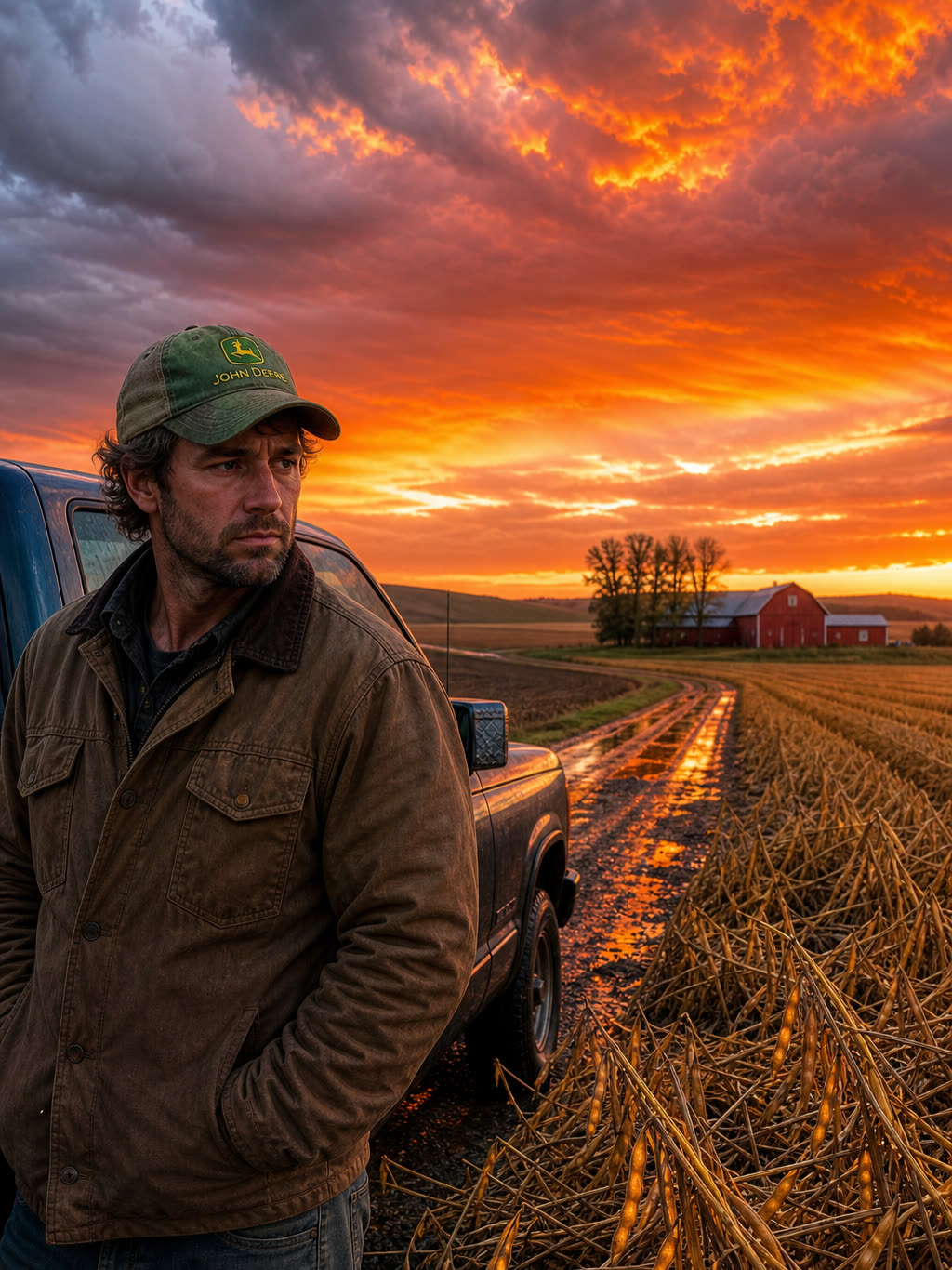
Then it rained. It started Thursday afternoon, a cold, gray rain blowing in from the northwest. The weatherman on KTIV said it would clear by Friday. It didn’t clear by Friday. It rained all day Friday and all day Saturday, and by Sunday morning the rain gauge on Arlen’s porch post read almost two inches. Here’s what you need to understand about soybeans. When beans are ready, the pods are dry and brittle, and the beans inside rattle when you shake the plant. That’s when you harvest them, when they’re at their best. But if dry beans get wet, the pods soften, then dry again, then get wet again, and every time the pods get weaker. Eventually they split open on their own and the beans fall on the ground. Farmers call it shatter. Once a bean hits the dirt, it’s gone. You can’t pick it up and you can’t get it back. Every morning I drove past Dad’s beans on my way to Arlen’s. I slowed down at the edge of the field and looked out the window. I could see the plants going down, lodged over from the wind and the wet, the pods starting to gape. Every one of those beans had my hands in them. I’d planted them in May and sprayed them in June. I’d walked those rows in July looking for aphids and scouted them for white mold in August. I’d watched them turn gold in September, like I had every year since I was nineteen.
Deb Kruse called me on Monday night. “Mark,” she said. “I thought you should know.”
“Know what?”
“Elaine called Phoenix,” Deb said. “Tuesday after you left. She called Brad first.”
“And?”
“Brad said he couldn’t get off work,” Deb said. “He said she should hire somebody. He said that’s what money’s for.”
“And Kyle?” I asked.
“Kyle never called back,” Deb said. “She left three messages.” I didn’t say anything. “She called Gene Hartwig too,” Deb said. “The custom guy. He’s booked solid until the second week of November. Some big operation over by Spencer.”
“November,” I said.
“November,” Deb said. “Those beans won’t last until November, Mark. You know that.”
“What about the crew?” I asked. “Ron? Tom?” Deb was quiet for a second.
“Ron came over Saturday,” she said. “He sat in the combine for twenty minutes. He couldn’t figure out the monitor. He’s never run it. None of us have. You always ran it. Dale always ran it before you.” She sighed. “Elaine tried too,” she said. “Sunday afternoon. I saw her climb up in the cab. She was up there almost an hour. She never started it.”
I’ll be honest with you. I wanted to go back every single morning. Every time I drove past those beans, my hands wanted to turn the wheel and my foot wanted to hit the brake. I wanted to pull into that yard, climb up in that cab, and run until those hundred and sixty acres were in the bin. It would have taken me two days, maybe three with the wet. But I didn’t, because going back would have told her something. It would have told her that nineteen years could be given away at supper, over roast beef and gravy, to two men who’d never once driven a grain truck, and that I’d still come running the minute the beans were in trouble. It would have told her that I was just the hired man, that I’d always be the hired man, and that she could take everything and I’d still show up to save it for somebody else.
So I ran Arlen’s corn. I kept my mouth shut. I fixed his grain cart when the hydraulic line blew, and I helped him move his cattle from the summer pasture to the stalk field. Every night I sat in the chair by the window and ate whatever Marcy put in front of me. She kept setting my plate by the window. On the eighth night I couldn’t eat. I sat there with a plate of meatloaf in front of me, looking out at Dad’s beans. The sun had come out that afternoon, and the field looked dark and soggy and flattened. You could see where whole sections had gone down. Marcy sat across from me. Arlen had already gone to bed, because his knee was bad that night.
“You want to talk about it?” she asked. It was the first question she’d asked me in eight days.
“I don’t know what I’m doing, Marcy,” I said. She nodded slowly. “Dale’s beans,” she said. “Going down.”
“Every one of them,” I said. “And I’m sitting here eating your meatloaf.” Marcy was quiet for a long time. “Can I tell you something?” she said.
“Of course.”
“Dale came over here one night,” she said. “About ten years ago. He sat in that same chair. He and Arlen drank a couple of beers on the porch. I was in the kitchen.” She looked out the window. “He said something I’ve never forgotten,” she said. “He said, Mark’s the best thing I ever grew. Better than any crop. I just don’t know how to tell him.”
I couldn’t speak. “He was a quiet man,” Marcy said. “Quiet men don’t say things. They assume you know.” She reached across the table and patted my hand. “Sometimes the people who love us most,” she said, “are the worst at making sure we know it.”
On the tenth day I was running corn on Arlen’s south forty. It was a cold, clear afternoon under that hard October blue, and the yield monitor was reading two-thirty. Arlen was in the grain cart, running alongside me. The radio crackled. “Mark,” Arlen’s voice said. “Your stepmother is standing at the end of the row.”
I looked up. At the end of the row, about two hundred yards ahead, where Arlen’s corn met the fence line, a small figure stood in the stubble. She had silver hair and wore a barn coat that was too big for her. It was Dad’s barn coat, the brown Carhartt with the torn left pocket. I shut the combine down and sat for a moment in the sudden silence. Then I opened the cab door and climbed down the ladder.
I walked toward her through the corn stubble. She stood alone. I couldn’t see a car, so she must have walked, a mile from the home place across the fields and along the fence line, in October, at sixty-four years old. Her shoes were caked with mud, and her face was red from the cold wind. She was holding something that had been Dad’s. It was a small, spiral-bound notebook with a green cover faded almost to gray, the kind you buy at the farm supply store for a dollar. It was water-stained at the corners, with a pencil stuck through the spiral. I knew it immediately. It was Dad’s field book.
He carried one every year and kept it in the toolbox in the combine cab. He wrote everything in it: planting dates, seed varieties, rainfall, yields by field, fertilizer rates, what broke, what he fixed, and what it cost. Every January he bought a new one at the co-op in Primghar, and he kept the old ones in a shoebox on a shelf in the machine shed. I had never once read one.
I stopped about ten feet from her. Neither of us spoke for a long time while the wind rattled the dry husks in the stubble. “Elaine,” I said finally.
“Mark,” she said. Her voice was shaking. “I tried to run it,” she said. “The combine. Sunday. I sat up in the cab for an hour. I couldn’t even figure out how to turn on the monitor.” She laughed, and it wasn’t a happy laugh. “I’ve been married to a farmer for fourteen years,” she said. “And I can’t run a single piece of machinery on that place.”
“I found this,” she said. “In the toolbox. Behind the seat. I was looking for the manual.” She held out the notebook. “There are nineteen more,” she said. “In the machine shed. In a shoebox. I found those too.” She looked down at it in her hands. “I read them, Mark,” she said. “All of them. I’ve been reading them since Sunday.”
She opened the green notebook and turned to a page near the back. Then she held it out to me, and she was watching my face as I reached for it.
What Dad Never Said Out Loud
I took it. My hands were cold, and the paper was soft from being handled. It was Dad’s handwriting, blocky capital letters pressed hard into the page with a carpenter’s pencil.
AUG 3 — SPRAYED NORTH 1/4. 2 PT GLYPHOSATE. WIND 6 MPH SW.
AUG 3 — MARK FIXED THE SPRAYER BOOM. BETTER THAN I COULD.
I turned the page.
AUG 9 — RAIN .4 IN.
AUG 9 — TALKED TO HAROLD BAUER ABOUT THE WILL. NEED TO FIX IT. GOING TO GIVE MARK THE LAND. LIFE ESTATE FOR ELAINE. SHE NEEDS THE INCOME. MARK NEEDS THE GROUND. APPT AUG 22.
I read it three times. August ninth, two years ago. August twenty-second would have been the appointment, and Dad died on August nineteenth. I couldn’t breathe. I looked up at Elaine, who was crying now, not loudly, just tears running down her red, wind-chapped cheeks. “He was going to change it,” she said. “Three days. He was three days away.”
“Keep reading,” she said. I turned back, further and further, years further. Every notebook was there. She’d brought them all in a canvas bag over her shoulder, and she pulled them out one by one and handed them to me.
2007 — MAY 14 — MARK PLANTED THE EAST 80 BY HIMSELF. FIRST TIME. STRAIGHTEST ROWS I’VE EVER SEEN.
2009 — OCT 2 — MARK FIXED THE COMBINE FEEDERHOUSE. SAVED $2,000.
2012 — JULY 19 — DROUGHT. MARK SAID PLANT THE COVER CROP ANYWAY. HE WAS RIGHT.
2015 — MARCH 3 — MARK TURNED DOWN THE JOB AT THE ELEVATOR. MORE MONEY. SAID HE’D RATHER STAY. DON’T KNOW WHAT I DID TO DESERVE HIM.
2019 — NOV 11 — LAST BEANS IN. MARK RAN 18 HRS STRAIGHT. TOLD HIM TO GO HOME. HE WOULDN’T.
And on the inside cover of every single notebook, every year, was the same line in the same blocky handwriting. SOMEDAY THIS IS ALL MARK’S. HE EARNED IT.
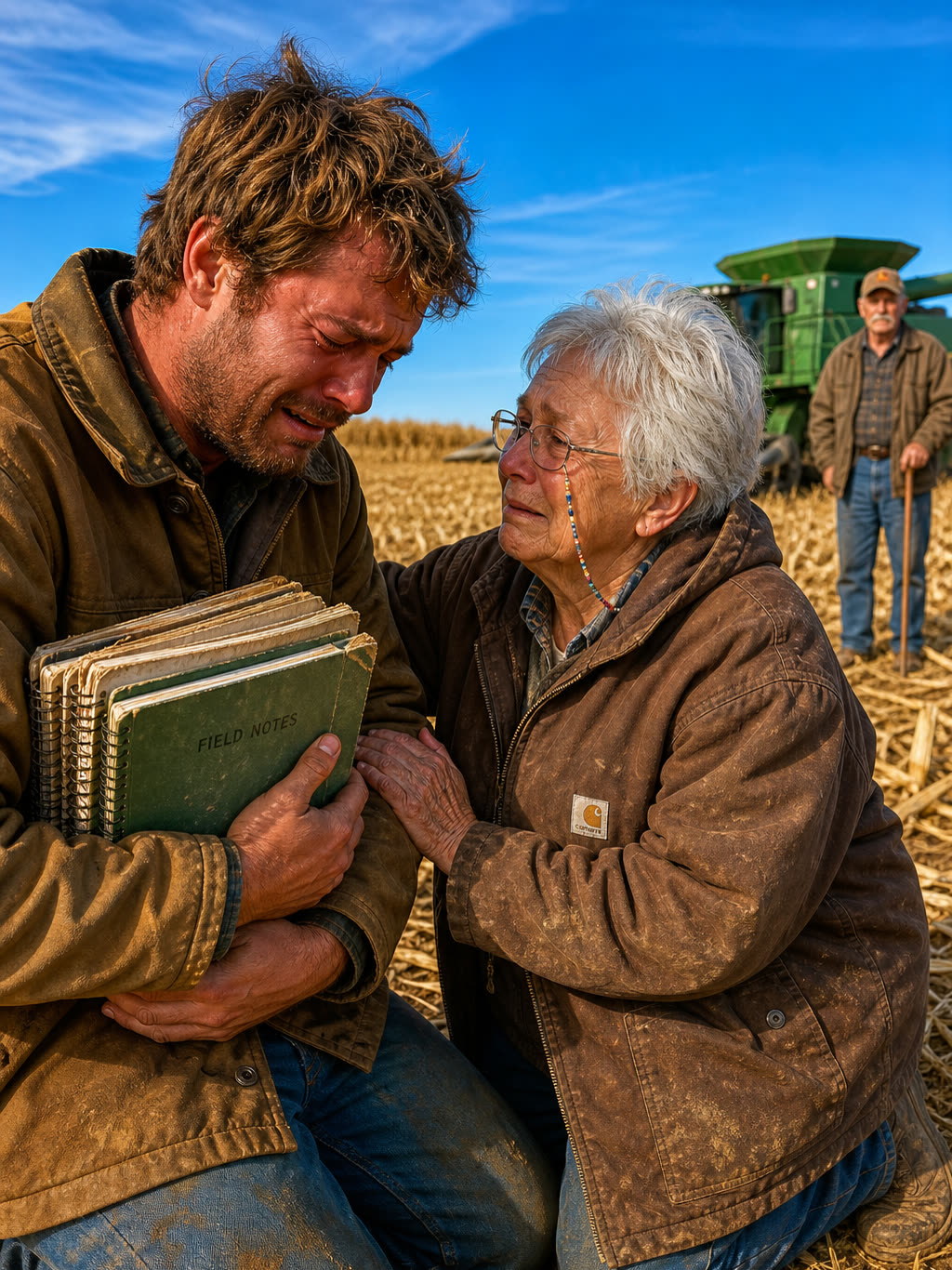
I stood in the corn stubble at the end of Arlen’s row, holding nineteen of my father’s field books, and for the first time since I was eight years old, I cried. Really cried, the kind that comes up from somewhere you didn’t know was there. Elaine didn’t say anything. She stood there for a while, and then she stepped forward and put her hand on my arm. “I didn’t know,” she said. “Mark, I swear to you. I didn’t know any of this.”
I wiped my face with my sleeve. “Why’d you do it?” I asked. “Why’d you give it to them?” She was quiet for a long time. “Because I was afraid,” she said finally.
“Of what?” She looked out at the fields, at Arlen’s corn and at Dad’s beans a mile west. “Of being alone,” she said. “After Dale died,” she said, “I’d sit in that kitchen every night by myself. You’d go back to your little house on the east eighty. The crew would go home. And I’d sit there with nothing but the clock ticking.” She swallowed. “My boys never call,” she said. “They never visit. Brad calls on my birthday. Kyle sends a card at Christmas. That’s it.”
“Brad called in September,” she said. “He said if I left him and Kyle the land, they’d come home more. They’d visit. They’d bring the grandkids for Thanksgiving.” She shook her head. “He said the land would give them a reason to come back,” she said. “And I believed him. Because I wanted to believe him. Because I wanted my boys back.”
“And you,” she said. “I never knew what you thought of me. Fourteen years, Mark. You were always polite. Always thanked me for supper. Always fixed my faucets.” She looked at me. “But I always felt like you were waiting,” she said. “For me to be gone. So you could have your dad’s farm back the way it was before I came.”
I stared at her. “Elaine,” I said. “I never once wanted you gone.”
“How was I supposed to know that?” she said. “You never said anything. Neither did Dale. You two would sit at that table and talk about seed corn and yield maps, and I’d sit there like a stranger.” She wiped her eyes. “You Lindgren men,” she said. “You don’t say anything. You just assume everybody knows.”
That was what Marcy had said, almost word for word. Quiet men don’t say things. They assume you know. “I’m sorry,” I said. “I should have told you. I should have told you I was glad Dad married you. That you made him happy. That I’d never seen him laugh like that since my mom died.”
Elaine put her hand over her mouth. “You never said that,” she whispered.
“I know,” I said. “I’m saying it now.”
“The beans,” Elaine said. “Mark, I know I don’t have the right to ask.”
“Then don’t ask,” I said. She flinched. I held up Dad’s field book. “Don’t ask for the beans,” I said. “Not for the beans. If I go back, it’s not because of the beans.”
She looked at me. “Then why would you go back?” she asked. I looked at the notebook in my hands, at the line on the inside cover. Someday this is all Mark’s. He earned it. “Because Dad wrote it down,” I said. “Nineteen times. And because you walked a mile across a cornfield in his coat to show me.”
I turned toward Arlen’s combine. Arlen had climbed down from the grain cart and was standing beside it, leaning on his cane. He’d been watching the whole thing. “Arlen,” I called. “I need a couple of days.” Arlen was quiet for a moment. “Take the Case,” he said. I stared at him. “Your combine?”
“Two combines go faster than one,” Arlen said. “I’ll run Dale’s. You run mine. Ron can haul. Deb can run the cart. Marcy can drive the second truck. She’s done it before.” He limped toward us through the stubble. “My corn’ll keep,” he said. “Corn’s patient. Beans aren’t.”
“Arlen,” I said. “Your knees.”
“My knees have been bad for twenty years,” Arlen said. “They’ll be bad tomorrow too.” He stopped in front of Elaine and took off his seed cap. “Mrs. Lindgren,” he said politely. “Dale was my neighbor for forty years. I’d have done this for him. I’ll do it for you.”
Elaine started crying again. “Arlen,” she said. “I can’t pay you.”
“Didn’t ask you to,” Arlen said. He put his cap back on. “Out here,” he said, “we don’t keep score.”
We ran beans for two days straight. Arlen ran Dad’s combine. He’d never run a Deere before, only Case, but he figured out the monitor in about ten minutes. He said Dad had shown him once, back in 2018, during a coffee break at the co-op. I ran Arlen’s Case, which was older and louder, with a cab that smelled like forty years of coffee and diesel. But it ran.
Word got around. By noon on the first day, three more neighbors had shown up. Jim Vandermeer brought his grain cart from three miles south, and the Hoogeveen brothers brought a semi from Sanborn. Pastor Dale from the Methodist church, who shared my father’s name and had been his friend since grade school, arrived at two o’clock with a cooler of sandwiches. Ron hauled grain from dawn to midnight. Deb ran the cart so fast I swear she was flying, and Marcy drove the second truck, singing hymns over the CB radio.
Elaine fed everyone. She set up the long table in the machine shed and made roast beef and potatoes, green beans with bacon, sandwiches and coffee, and three pans of brownies. She drove meals out to the field in the back of Dad’s pickup, which she’d finally learned to drive without grinding the gears.
We lost some, and I won’t pretend we didn’t. Ten days of rain is a long time for beans. On the west end, where the field sat lowest, we lost almost a third. The yield monitor read thirty-eight bushels an acre in the worst spots, when it should have been sixty. But on the high ground, where the field drained better, the beans held. We got fifty-five, then fifty-seven, and sixty-one on the best stretch near the shelterbelt.
At eleven-forty on the second night, I made the last pass on the west side. The header pulled in the last row of beans, the yield monitor ticked down, and the grain tank was almost full. I shut it down and sat in the dark cab while the engine ticked as it cooled. Out the window I could see Dad’s combine at the other end of the field with its lights on. Arlen was climbing down the ladder slowly, one rung at a time. I got out and walked across the stubble.
Elaine was standing at the edge of the field by Dad’s pickup, holding a thermos of coffee. She poured me a cup. “Is that all of it?” she asked. “That’s all of it,” I said. “How much did we lose?” “About eleven hundred bushels,” I said. “Maybe twelve.” She was quiet for a moment. “That’s my fault,” she said. “That’s the rain’s fault,” I said. “And a little bit ours. Both of us.” She handed me the coffee.
The next Monday, Elaine called Harold Bauer. She asked him to tear up the will she’d signed that Tuesday, and to pull Dad’s notes from his file, the ones about the appointment on August twenty-second. Harold had them. He’d kept them for two years. He told me later he’d thought about calling Elaine a dozen times, but he hadn’t felt it was his place. “I should have,” he said. “I should have called.”
She didn’t just give me the land, and I want to be clear about that. When I tell this story, people always assume she handed me everything. She didn’t, and I didn’t want her to. We sat in Harold’s office on a gray Thursday afternoon, Elaine, me, and Harold, with Dad’s nineteen field books stacked on the corner of his desk. “Here’s what I’d like to do,” Elaine said. She’d written it down on a legal pad in her neat, home-economics-teacher handwriting.
“Mark gets three hundred acres now,” she said. “Today. Deeded to him. The north quarter and the east eighty and the forty by the creek. For the nineteen years. For everything Dale wrote down.” I started to say something, and she held up her hand. “The other three hundred,” she said, “Mark buys from me. On contract. At a fair price. Over twenty years. I live on the payments.” She looked at me. “And when I die,” she said, “whatever’s left on the contract goes to Brad and Kyle. Along with the house in Sheldon I still own. And my teacher’s pension. And my life insurance.”
“That’s not fair to you,” I said. “Giving me three hundred acres.”
“It’s not a gift,” Elaine said. “It’s back pay. Dale wrote it down. Every page.” She tapped the stack of field books. “I’m not giving you anything you didn’t earn,” she said. “I’m just finally paying you what he owed you.”
“And the other three hundred?” Harold asked. “Why not give him that too?” Elaine looked at me. “Because Mark wouldn’t want it,” she said. “Would you, Mark?” I thought about it. “No,” I said. “I want to buy it. I want to earn it. The way Dad did.” Elaine smiled, a real smile, the first one I’d seen from her in months. “That’s what I thought,” she said. “You’re just like him.”
Brad called three days later, and he was angry. Elaine put him on speaker in the farmhouse kitchen so I could hear. “Mom, what are you doing?” he said. “That land is worth four million dollars. You’re giving half of it away to some hired hand?”
“He’s not a hired hand,” Elaine said. “He’s Dale’s son.”
“He’s not your son,” Brad said. Elaine was quiet for a moment. “Brad,” she said. “When was the last time you came home?” He didn’t answer.
“I called you,” she said. “When the beans were going down. I called you and asked for help. You said you couldn’t get off work. You said I should hire somebody. You said that’s what money’s for.”
“Mom—”
“Mark didn’t say that,” Elaine said. “Mark walked away from that farm because I gave it to you over roast beef. And then he came back. With his neighbor. And three more neighbors. And the pastor. And they saved what they could.” She took a breath. “You’ll still get something,” she said. “The house in Sheldon. My pension. My insurance. And whatever’s left on Mark’s contract when I’m gone.” She took off her reading glasses. “But you’re not getting land you’ve never walked,” she said. “Land you’ve never planted. Land you’d sell to the first investor from Des Moines who made you an offer.”
“How do you know I’d sell it?” Brad said.
“Because you asked what it was worth per acre at Dale’s funeral,” Elaine said. “Over ham sandwiches.” Brad hung up. Elaine sat at the kitchen table for a long time afterward, looking at the phone. “I’m sorry, Elaine,” I said. She shook her head. “Don’t be,” she said. “I should have known. I just didn’t want to.”
Kyle called a week later. He didn’t yell, and he was quiet. Elaine told me about it afterward. “He said he was sorry,” she told me. “For not calling back. He said he didn’t know what to say. He said he’d been ashamed for a long time about not coming home.” She smiled a little. “He asked if he could come in the spring,” she said. “For planting. He said he wanted to learn.”
It’s October again now, one year later. We’re running beans on the west side in perfect weather, dry and sunny with a little wind. The yield monitor is reading fifty-eight on the high ground. Kyle came in April for planting and stayed two weeks. He’s thirty-two, an accountant in Phoenix, pale and soft-handed and terrified of the tractor. By the end of the first week he could run the planter, and by the end of the second he’d stopped wearing sunglasses in the field. He came back for harvest, and he’s in the grain cart right now, running alongside me. Deb is teaching him. She says he’s slow, but he listens.
Arlen got his other knee replaced in March, and he walks better now. He still can’t run a combine for more than a few hours at a time, so we have an arrangement. I run his corn every fall, and he pays me twenty-four an hour. Next year, when he turns seventy, I’ll start renting his ground, all eight hundred acres. He says he’d rather see it farmed by somebody who knows the fence line than sold to some outfit from Sioux Falls. “Besides,” he said, “Marcy won’t let me leave you out of the will now.” I thought he was joking. I’m still not sure.
Last night was harvest supper. Elaine made it the way she always does, with roast beef and mashed potatoes, green beans with bacon, dinner rolls from scratch, and apple crisp with ice cream. She set the long table in the farmhouse dining room, with ten places this year: Ron and Patty, Deb, Tom and Linda Visser, Kyle, Arlen and Marcy, who’d never once eaten at our table in forty years of sharing a fence line, and me. Elaine had set my plate at the end of the table, by the window. I looked out, and the combine sat right outside with the last pink light on the cab glass. From that chair I could see the north quarter. My north quarter. The beans were coming out, gold and dry and rattling in the pods.
We were halfway through supper when Elaine stood up. She didn’t make a speech, because she’s not that kind of woman. She just reached into the pocket of her apron and took out a set of keys. There was the combine key on a ring with a little brass tag, the key to the machine shed, the key to the fuel tank, and the key to the grain truck. She walked around the end of the table and set them down beside my plate, right next to my roast beef. “Those are yours, Mark,” she said.
Her voice was shaking just a little. “So is the combine,” she said. “Your dad would have wanted you to have it.” I looked at the keys. Then I looked at her, this small, neat woman with silver hair and reading glasses on a beaded chain, who’d walked a mile across a cornfield in my father’s coat, and who’d read nineteen years of his handwriting and finally understood what he’d never said out loud. “Elaine,” I said. “Sit down. Finish your supper.”
She laughed, and everybody laughed. Ron laughed so hard he had to take off his seed cap and wipe his eyes. She sat down.
After supper, after the dishes, after the crew had gone home, I found Elaine in the machine shed. She was standing in front of the shelf where Dad kept his old field books. The shoebox was there, with all nineteen notebooks, and she’d put them back in order. Beside it was a new notebook with a green cover, the kind you buy at the farm supply store for a dollar. She’d bought it for me in January. “You should start your own,” she said. “Write things down. Like he did.”
I picked it up and opened the cover. On the inside, in her neat home-economics handwriting, she’d already written something. For Mark. Write down what you grow. And this time, say it out loud too. — Elaine
I didn’t know what to say, so I did the thing my father never did. I hugged her. She froze for a second, and then she hugged me back, hard, like she’d been waiting fourteen years. “Thank you,” I said. “For what?” she asked. I thought about it. I thought about the keys by her plate, about ten days of rain, about Marcy’s chair by the window, and about a mile of stubble and a coat that was too big for her. “For walking out to the end of the row,” I said.
Tonight, before bed, I sat at my kitchen table in the little house on the east eighty. I opened my new green notebook, took out a carpenter’s pencil, and pressed hard into the page, the way Dad used to.
OCT 14 — BEANS ON WEST SIDE. 58 BU HIGH GROUND.
OCT 14 — HARVEST SUPPER. ELAINE MADE ROAST BEEF.
OCT 14 — TOLD ELAINE THANK YOU. OUT LOUD.
Then I closed the notebook and turned off the light. Out the window, a mile to the west, I could see the farmhouse porch light still on. She leaves it on for me now, every night during harvest. I don’t think she knows I can see it from here. Someday, I’ll tell her. Out loud.
Disclaimer: This story is a work of fiction inspired by real-life themes. Names, characters, places and events are fictionalized, and any resemblance to real persons is purely coincidental. Images are for illustration purposes only.
