

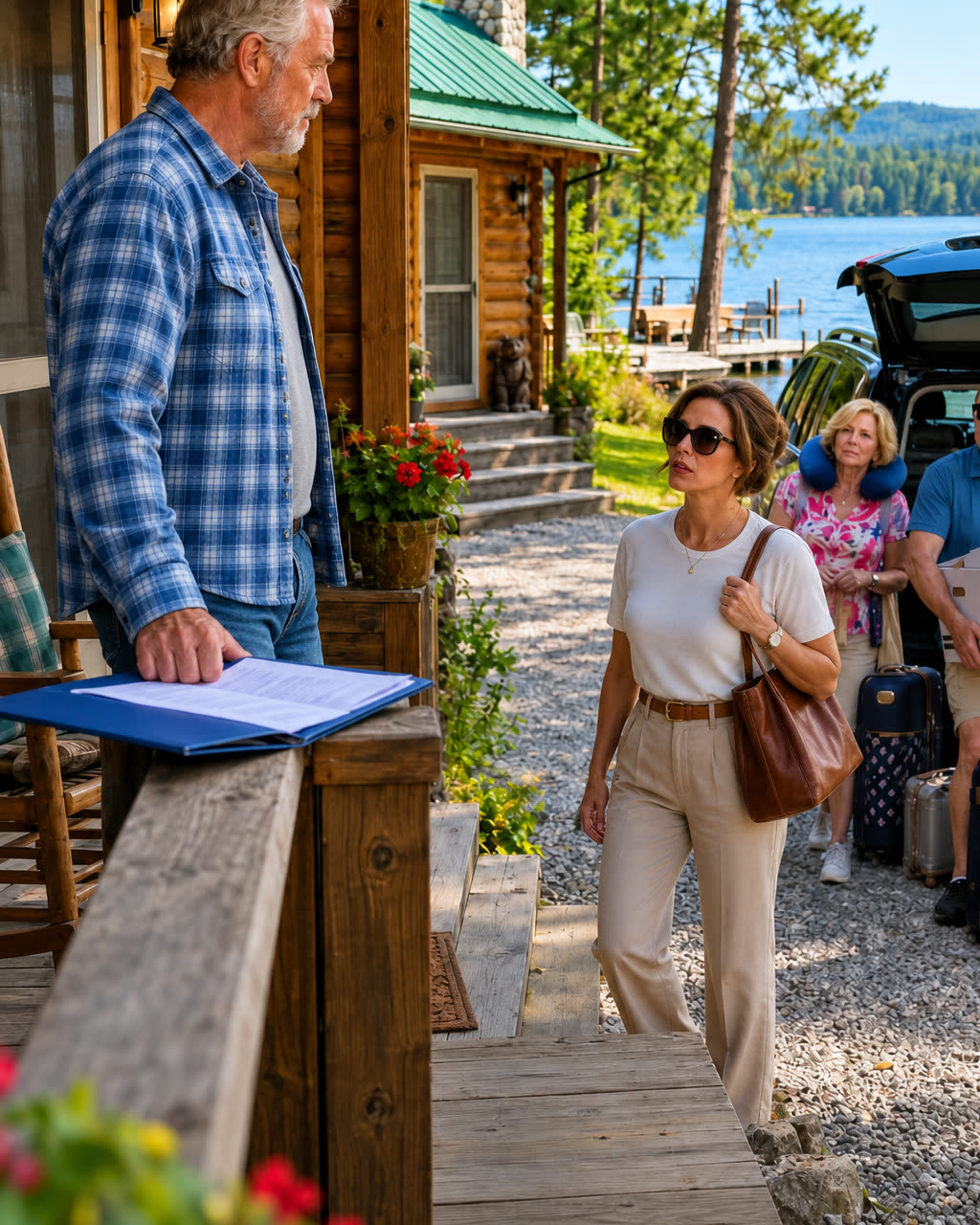
Part 1: The Order on the Dock
I had been retired for barely two days when my daughter-in-law decided that my new cabin by the lake would make the perfect summer home for her parents. She didn’t ask me. She told me to get the bedrooms ready, and then, almost as an afterthought, she added that if the arrangement bothered me, I could always sell the property. She said it the way someone suggests returning a sweater that doesn’t fit. To her, the cabin was a small inconvenience I had picked up on a whim, not the thing I had spent the better part of my working life saving toward.
According to her, forty-one years of savings counted for nothing. The quiet mornings beside the water counted for nothing. The fact that mine was the only name on the deed counted for nothing. All of it vanished the moment she found a use for my home. I didn’t argue. I didn’t remind her who owned the place. I didn’t even raise my voice. Over the years I’ve learned that the loudest man in the room is rarely the one who settles the matter. He’s only the one people remember shouting.
Instead, I made one quiet phone call, put together a thin folder, and waited outside. I stayed on the porch until their SUV came rolling up my driveway as though they already held the keys.
I was sixty-four when I retired and bought that cabin, and I bought it for exactly one reason: I wanted to hear myself breathe again. That was the whole of it. I had never pictured a glamorous retirement. I never dreamed of a sprawling mansion or some showpiece retreat built to announce money to every boat drifting past. I didn’t want extravagance, and I didn’t want a millionaire’s hideaway. I wanted solid wood under my boots and a lake breeze moving through the screen door. I wanted a cup of coffee going slowly cold in my hand. Most of all, I wanted mornings quiet enough to finally settle the ringing that forty-one years in a steel mill had left in my ears.
Noise had filled nearly every hour of my adult life. Furnaces roared. Forklifts beeped as they backed up. Steel screeched against steel. Men bellowed over the machinery, because on a mill floor a gentle voice couldn’t get anything poured, cut, hoisted, or repaired. Even after my last shift, I woke up twice in my city apartment certain the factory whistle had just blown. Both times there was nothing there. There was only the hum of the refrigerator and my upstairs neighbor dragging something heavy across his floor at 12:38 in the morning. Lying there in the dark, I realized the mill hadn’t let go of me just because I’d handed in my badge.
So when I found a three-bedroom log cabin with a green metal roof, a stone chimney, and a weathered dock that badly needed sanding, the decision made itself. The place smelled of cedar shavings, old lake water, and honest work. The siding was overdue for fresh stain, the boathouse door stuck in its frame, and the porch steps groaned under my weight. I welcomed every one of those flaws. There was comfort in knowing exactly what needed my attention. A house that needs fixing doesn’t pretend to be anything other than what it is. After a lifetime of hearing promises shouted over the factory racket, I had come to prize that kind of honesty.
My son, Elliot, knew how much the place meant to me. His mother walked out when he was thirteen, and I raised him by myself without ever asking him to pick a side. I packed his lunches before sunrise. I stood at his games in freezing weather, still in my work boots. I showed him how to change the oil in an old pickup, and I sat through parent-teacher conferences still carrying the faint smell of the mill. Between the extra shifts and being both parents at once, there wasn’t much room left for pride. What mattered were the ordinary duties. I made sure he ate, I showed up at the school whenever somebody needed me, and I came home every night, even when the workday had taken nearly everything I had.
When Elliot married Sienna seven years earlier, I made a real effort to build something decent with her. I let a lot slide. She called my apartment industrial vintage without the deliberate styling, and she said my restored maple table looked very rustic. She called my job charming, in that particular tone that means useful but unimpressive. And how did I respond? With silence. Unfortunately, people who never pay for what they take can easily mistake silence for consent.
Thirty-six hours after I moved in, I was sitting out on the dock at 6:17 on a Thursday evening when my phone rang. It was Sienna. The sun was sliding low over the far shoreline, and the boards beneath me were still warm from the day. I almost let it go to voicemail. I wish I could say I had a premonition, but I didn’t. I simply answered, the way a father answers when someone in his son’s family calls.
"Your son and I have decided my parents will stay at your cabin for the summer," she announced. Then, before I could take in the first sentence, she delivered the second: "If you don’t like that, you can sell the place and move back somewhere you can actually be useful."

Water lapped softly against the rocks along the shore. Somewhere past the reeds, a loon called out across the lake, long and lonesome. My coffee had gone cold in my hand, and for a moment I simply looked at it. Everything around me was exactly as peaceful as it had been a minute earlier. Somehow that made her words land harder.
I asked her only one thing.
"Has Elliot agreed to this?"
"My husband understands that family sometimes requires sacrifices," she replied. Then, after the briefest pause, she added, "Unlike certain people."
After that came the instructions. Her parents would arrive on Friday. I could pick them up if that turned out to be necessary. Because of Beverly’s back problems, she was entitled to the main bedroom, and Gordon needed space for his paperwork. I was to empty the closets and not make trouble. She rattled it all off the way a dispatcher reads out a delivery schedule.
None of it was a request. Every word was an order. When you ask someone for something, you acknowledge that the choice belongs to them. When you give them orders, you treat them as part of the furniture. Sitting there on the dock, I understood which one she had done, and I understood it had probably been that way for years without my noticing.
I didn’t fight her. With reasonable people, a plain refusal is enough. With entitled people, a refusal is just the opening bell of an argument. So I didn’t refuse. I decided instead to lay out the facts so clearly that nobody could pretend to misunderstand them.
At 7:04 p.m., I called the county clerk’s office and confirmed the recorded deed. At 7:41, I printed the closing documents, the property-tax receipt, and the ownership paperwork that named exactly one proprietor: me. At 8:12, Sienna sent a text, and I printed that too.
"Don’t embarrass everybody over a few empty bedrooms."
Then I pulled a legal pad toward me and wrote across the top in black ink:
"My home is not available for reassignment."
By Friday afternoon, not one guest bed had been made up. The closets were untouched, and the door to the primary bedroom stayed shut. On the kitchen table sat a thin blue folder. Inside were the deed, the tax bill, the insurance papers, copies of her texts, and an unsigned rental agreement. I had written that agreement at market rate, with terms I was certain they would never accept.
My hands were surprisingly steady. For a moment, though, I wanted to shout. I wanted to roar about every hour I had spent beside those furnaces, every weekend I had given away, every exhausted supper I had eaten standing over the kitchen sink. I wanted her to understand that I hadn’t spent four decades on concrete floors so her parents could treat my peace as spare storage space.
But rage is an expensive way to spend the tranquility you’ve worked so hard to earn. I could shout until my throat burned, and afterward I would still have the same ownership papers and the same unwanted guests on their way. I would rather let the papers say what my anger could never improve upon.
So I pulled on my old denim jacket, picked up the folder, and stepped out onto the porch.
The gravel driveway still held the heat of the afternoon. The little American flag beside the mailbox snapped in the breeze, and the screen door squealed against its spring as it swung shut behind me. I stood at the railing and watched the road through the pines.
At exactly 4:26 p.m., an SUV turned off the road and started up my drive. Sienna sat in the front seat behind her sunglasses, already smiling before the vehicle had even stopped. Beverly rode in the back with a travel pillow wrapped around her neck. Gordon sat clutching a banker’s box against his chest, clearly confident that somebody had already cleared space for whatever was inside it.
The rear hatch rose, revealing two suitcases waiting to be carried in.
Sienna stepped out, looked straight past me at the cabin as though she were inspecting a hotel lobby, and said:
"Good. You’re ready."
I didn’t answer her. I laid my blue folder open across the porch rail. And for the first time in seven years, I watched her confident smile begin to slip before I had said a single word.
Part 2: Thirty-Two Minutes
I turned the pages to the deed and held it so Sienna, Beverly, and Gordon could all see it. There was my name, the only one recorded. There was the county seal, pressed into the paper, and beneath it the legal description of the property, every boundary line set down in plain, unarguable language.
Nobody spoke. Down below the lawn, the water brushed against the stones, and behind me the screen door creaked faintly on its hinges. A breeze moved through the pines and stirred the corner of the page under my hand. I kept my palm flat and waited.
At last, Sienna declared that the whole thing was absurd, because family shouldn’t need documents. She said it with a little laugh, the kind people use when they want everyone else to see how unreasonable you are being.
I didn’t answer. I simply laid out the next page, the property-tax receipt. Then I set down the insurance page beside it. Then I placed the printout of her own message on top:
"Don’t embarrass everyone over empty rooms."
Beverly studied it for a moment, and her expression changed before her daughter’s did. She had come prepared with a travel pillow and luggage. She had not come expecting to see her own arrival laid out on a porch rail like evidence in a hearing. I watched her read the line once, then again, and I watched the color shift in her cheeks.
Gordon set his banker’s box down on the gravel with a dull thud. He didn’t look at me. He turned his head toward his daughter.
That one gesture told me a great deal. Somewhere on the drive up, Sienna must have explained this arrangement in very different terms. Maybe she had told them I offered. Maybe she had told them Elliot had taken care of everything. Maybe she had said I was being a little stubborn but would come around in the end.
Whatever version she had given them, it hadn’t included legal ownership records. And it certainly hadn’t included her own words printed out in black and white.
I set the unsigned rental agreement on top of the stack. Its terms were simple: market rent, a security deposit, specific dates, and no automatic claim to any bedroom or closet. Nothing in it turned my home into a family vacation resort just because someone found that convenient.
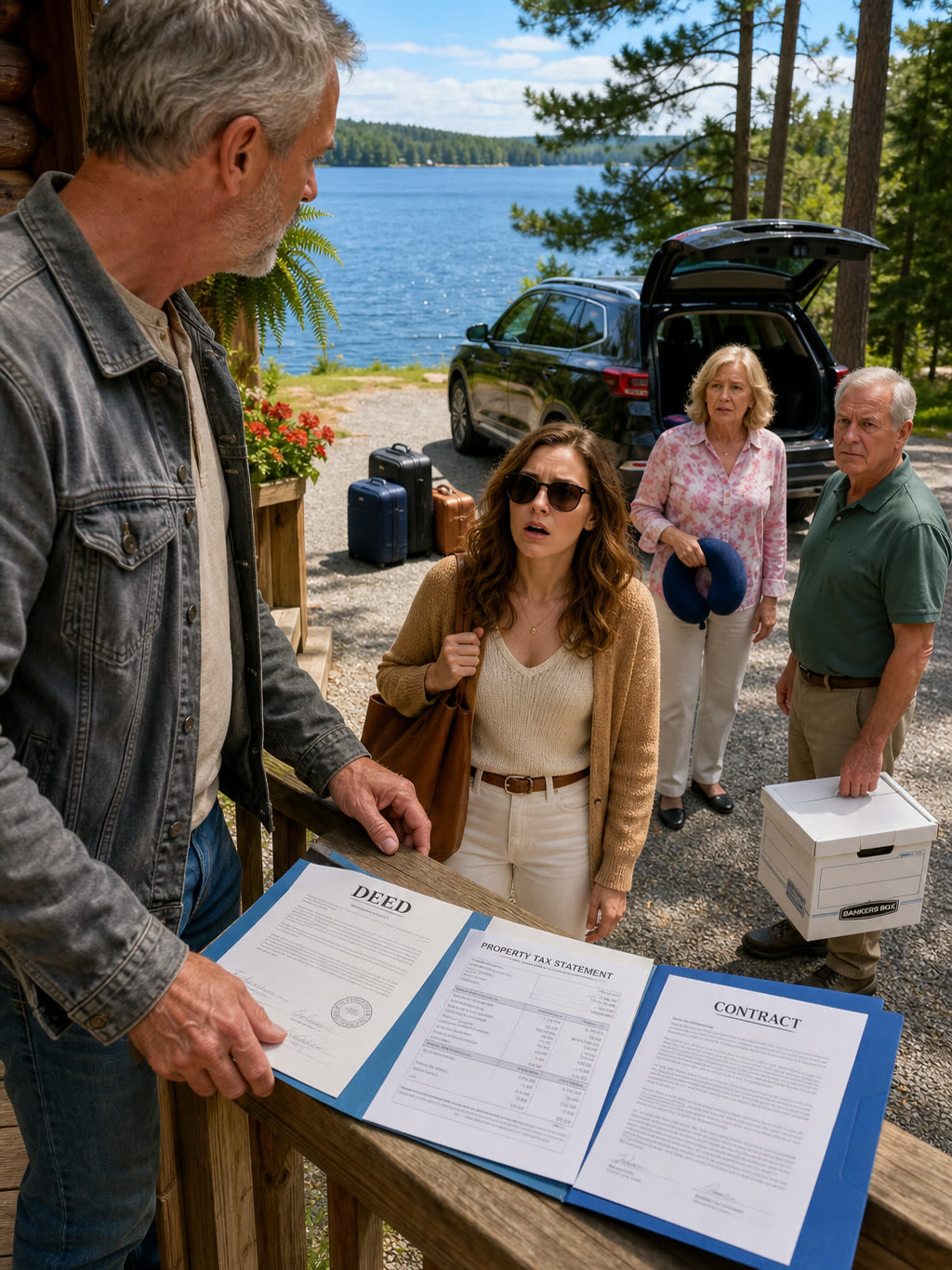
Sienna looked as though I had slapped her with the papers. Her mouth opened slightly behind the sunglasses, and her hand tightened on the strap of her tote bag. For a long second she seemed to have forgotten what she meant to say next.
I hadn’t touched her, of course, and that distinction mattered. I hadn’t done anything vindictive. I hadn’t insulted her or raised my voice or tried to shame her. I had simply put the facts where everyone could see them.
She recovered enough to accuse me of embarrassing her parents. I told her I hadn’t invited them into an embarrassing situation. That was the sharpest I allowed myself to sound all afternoon, and even then I kept my voice level.
Beverly turned to her daughter and quietly asked what, exactly, Elliot had agreed to. Sienna hesitated. It was only a second or two, but that hesitation did more work than any speech I could have given.
Then her phone buzzed. Elliot’s name lit up on the screen, glowing in the space between us.
Sienna tried to step away with it, but the porch was small, and the truth was already standing out in the open where none of us could walk around it.
I asked her to put the call on speaker. She didn’t move. So I held out my hand. Maybe it was because everyone was watching, but after a moment she handed me the phone.
I answered with my son’s name. Elliot sounded confused. He wanted to know why Sienna had been calling him over and over while he was driving home from work.
I asked him the same question I had asked her the night before. Had he agreed to Beverly and Gordon living in my cabin for the summer?
There was a pause on the line. It wasn’t the silence of a man caught in a lie. It was the silence of a man piecing together what he had thought his wife told him, and realizing it didn’t match what he was hearing now.
Then he said no.
One word, and the whole scene shifted beneath our feet.
Sienna went pale. Beverly closed her eyes. Gordon bent down, lifted his box off the gravel, and held it against his chest. He was no longer moving toward my front door.
Elliot asked what was going on. I didn’t dramatize any of it. I read him Sienna’s text. I read him the first line of my rental agreement. Then I told him that her parents’ luggage was already sitting in my driveway.
For a while, there was nothing but quiet. On his end I could hear traffic rushing past. On mine I could hear my own breathing and the slow, steady lap of the lake.
For years I had done everything in my power to keep Elliot from having to choose between the adults in his life. His mother’s leaving had taught me how unfairly grown-ups can load their decisions onto a child’s shoulders, and I had sworn I would never do that to him.
But Elliot wasn’t thirteen anymore. He was a husband and he was a son, and his wife had tried to arrange this whole situation without letting him see the full truth of it.
He asked to speak to Sienna. I handed the phone back, and she stepped down off the porch onto the gravel. None of us needed to hear what was said. Her posture told us enough.
At first she stood stiff and straight, chin lifted, one hand planted firmly on her hip, as though pure confidence could still settle everything in her favor. Then her arm fell to her side. She turned her back to her parents and said Elliot’s name in a voice smaller than any I had ever heard come out of her.
Beverly sank onto the edge of the SUV’s back seat and rubbed the bridge of her nose with two fingers.
Gordon finally turned to face me. He explained that he had been told I wanted the company, and that the arrangement for the cabin was already settled.
I believed him. Not because he had earned unlimited trust, but because his embarrassment looked real. A liar usually works hard to keep his face lively and convincing. Gordon’s face was perfectly still, the face of a man who had just discovered he’d been carried somewhere under false pretenses.
I told them both I was sorry for the way they had been dragged into this, but I made it clear that the cabin wasn’t available. I could see the discomfort of two people who had arrived believing something untrue, and I could feel for them, without taking responsibility for planting that belief myself. Both things could be true at once. Kindness doesn’t have to mean giving in.
It had taken me sixty-four years to learn that.
Sienna came back up the gravel holding her phone. No apology followed. Some people can’t admit they were wrong while the consequences are still fresh. To do so would mean admitting they had gambled with someone else’s life and lost.
She told her parents they ought to go. She didn’t say a word to me.
Beverly rose slowly from the seat. Gordon loaded his box back into the SUV, then lifted the two suitcases in after it. The rear hatch came down with a soft, final thump.
Before she climbed into the passenger seat, Sienna glanced one last time at the blue folder on the rail. I kept my palm resting on it. It wasn’t meant as a threat. It was simply a reminder that the papers inside would stay just as true no matter how she felt about them.
Their SUV backed down my driveway at 4:58 p.m. I remember the time exactly. Only thirty-two minutes had gone by since they had pulled in. In less than an hour, an entitled plan had run headlong into one thin folder and come apart.
The dust settled slowly over the gravel. The flag by the mailbox kept snapping in the breeze, and the lake went on brushing the stones as if nothing at all had happened. I stood there with the phone still pressed to my ear.
Elliot was still on the line. And then he said my name, the same way he used to say it as a boy, back when he suddenly realized he had missed something that mattered.
Part 3: Smoother Planks
I told him I wasn’t asking him to punish his wife on my behalf. I didn’t want sides drawn or doors slammed. I only wanted him to see me as a person with a life of my own, not as a convenient spare room attached to the family. That difference was important, and I needed him to hear it.
He said he understood. I believed him, though rebuilding trust after a family wound isn’t as simple as flipping a switch. It’s more like replacing damaged boards on a dock. You pry up one rotten plank, set a sound one in its place, and then move on to the next, one at a time, until the whole thing can bear weight again.
That evening I latched the screen door, sat down at the kitchen table, and left the folder lying open in front of me. The light through the windows turned gold and then gray. I didn’t turn on the radio. I just sat with the quiet.
To my surprise, the cabin didn’t feel spoiled. I had expected Sienna’s demands to keep echoing through the rooms and sour my first week of retirement. I thought I might walk past the closed bedroom doors and feel her instructions hanging in the air. Instead, my home felt more secure than it had the day I signed for it.
Maybe defending a place without being cruel makes it feel more truly yours. I hadn’t torn anyone down to keep it. I had only stood still and let the truth hold.
I slid the deed back into the folder and tucked it into the drawer beside the stove. Then I brewed a pot of coffee, late as it was. Retirement hadn’t erased my old habits, and I wasn’t in any hurry to lose that one.
Outside, the water deepened to a dark blue. A truck rumbled past on the road and kept going. Nobody came up my driveway. Nobody told me to empty a closet. Nobody called my quiet life a collection of empty rooms.
In the days that followed, Elliot came out by himself. He showed up carrying a toolbox in one hand and a paper sack of sandwiches from a roadside diner in the other.
We couldn’t sort everything out at once. The men in my family had never been much good at spreading their feelings out on a table for inspection.
So we talked while we sanded the dock and tightened the loose screws on the porch, working through the hard parts a few pieces at a time. Whenever the conversation stalled, the work gave our hands something useful to do. Neither of us felt the need to fill every silence with an explanation.

He told me Sienna had painted me as lonely and eager to share the cabin. She had also suggested that turning the plan down would hurt Beverly’s health and embarrass everyone involved.
I listened to all of it. Then I told him that being married didn’t mean he had to let his wife erase his father.
He didn’t argue with me. He just nodded and went back to sanding. For our first day, that was enough.
Sienna stayed away for two weeks. When she finally came, she stood outside the cabin without her sunglasses. She looked younger somehow. Not necessarily softer, but less shielded by her usual armor.
Her apology wasn’t perfect. Real apologies seldom are.
She talked about the pressure of trying to solve several problems at once. Her parents had worries of their own, she said. And then she admitted that she never should have spoken to me the way she had.
I accepted that last part. The explanations I took as context, not as excuses, and that difference mattered too.
People who have taken too much sometimes try to hand it back wrapped in reasons. Explanations can help us understand a wrong. They don’t undo it.
I told her she was welcome to visit when invited. I said Beverly and Gordon could come for dinner sometime, as long as everybody understood they would be guests. But nobody would be moving into my cabin for the summer.
She nodded, without any rehearsed comeback. It was the closest thing to a fresh start we could manage just then. Whether something better grew from it would depend on time, and on whether she could learn the difference between family and unlimited access.
By the end of my first month, we had sanded the dock smooth. Elliot helped me stain the outside of the siding, and the old logs drank in the color like they had been waiting for it.
Beverly sent a short, embarrassed letter apologizing for showing up without speaking to me herself first. Gordon mailed back the unsigned rental agreement with a dry note saying the market rent had raised his respect for me more than he had expected.
I laughed out loud at that. It was the first genuinely funny moment in the whole affair.
I kept the blue folder. Not because I expected another invasion, but because it reminded me of something I had nearly forgotten.
A peaceful man still needs a backbone. A quiet house still needs a door he can lock. And a lifetime of work doesn’t become shared property just because somebody says the word family persuasively enough.
Most mornings now, I sit out on the dock with my coffee. The planks feel smoother under my boots than they used to, and the porch steps still creak, though not quite as loudly as before.
Sometimes Elliot comes by, and now and then he brings lunch. Other times we hardly say a word and let the lake fill the silence for us. That suits me fine.
I didn’t work forty-one years so I could retire and win family arguments. I retired to hear myself breathe.
And after that Friday, nobody in my family ever called my home empty rooms again.
Disclaimer: This story is a work of fiction inspired by real-life themes. Names, characters, places and events are fictionalized, and any resemblance to real persons is purely coincidental. Images are for illustration purposes only.
