

Part 1: The Paper in Kurt’s Vest
Kurt stared down at the frost for a long time. Then he took a single, slow step in Dale’s direction.
I’d known Kurt Ostrowski for eleven years. He’d stood up at my wedding with a carnation pinned crooked to his lapel. He’d eaten my chili through a dozen Packers games. And every November since Brad first drove him out in a borrowed truck, he’d hunted my grandfather’s ridge.
Not once had I seen him look the way he did that morning, planted at the edge of Grandpa’s cornfield in the gray dawn with frost on his boots.
Behind him stood Mike Pruett and Russ Lindahl, rifles slung, breath smoking in the cold. Their eyes kept flicking from me to the three blaze-orange hats in the trees and back again.
Dale stayed exactly where he was. He stood beside me at the base of the old wooden ladder stand, hands empty at his sides, the gray beard on his chin frosted white. He was fifty-eight and about six-foot-two, and he had the stillness of a man who had stood in rooms far worse than a cornfield.
Kurt halted maybe three feet from him. He searched Dale’s face, then the faded patch stitched to the left shoulder of Dale’s canvas hunting coat: a black horse head on a yellow shield, cut by a diagonal stripe.
“First Cav,” Kurt said quietly.
Dale’s eyebrows lifted just a fraction. “That’s right.”
“Desert Storm?”
“Desert Storm. Then Iraq twice.”
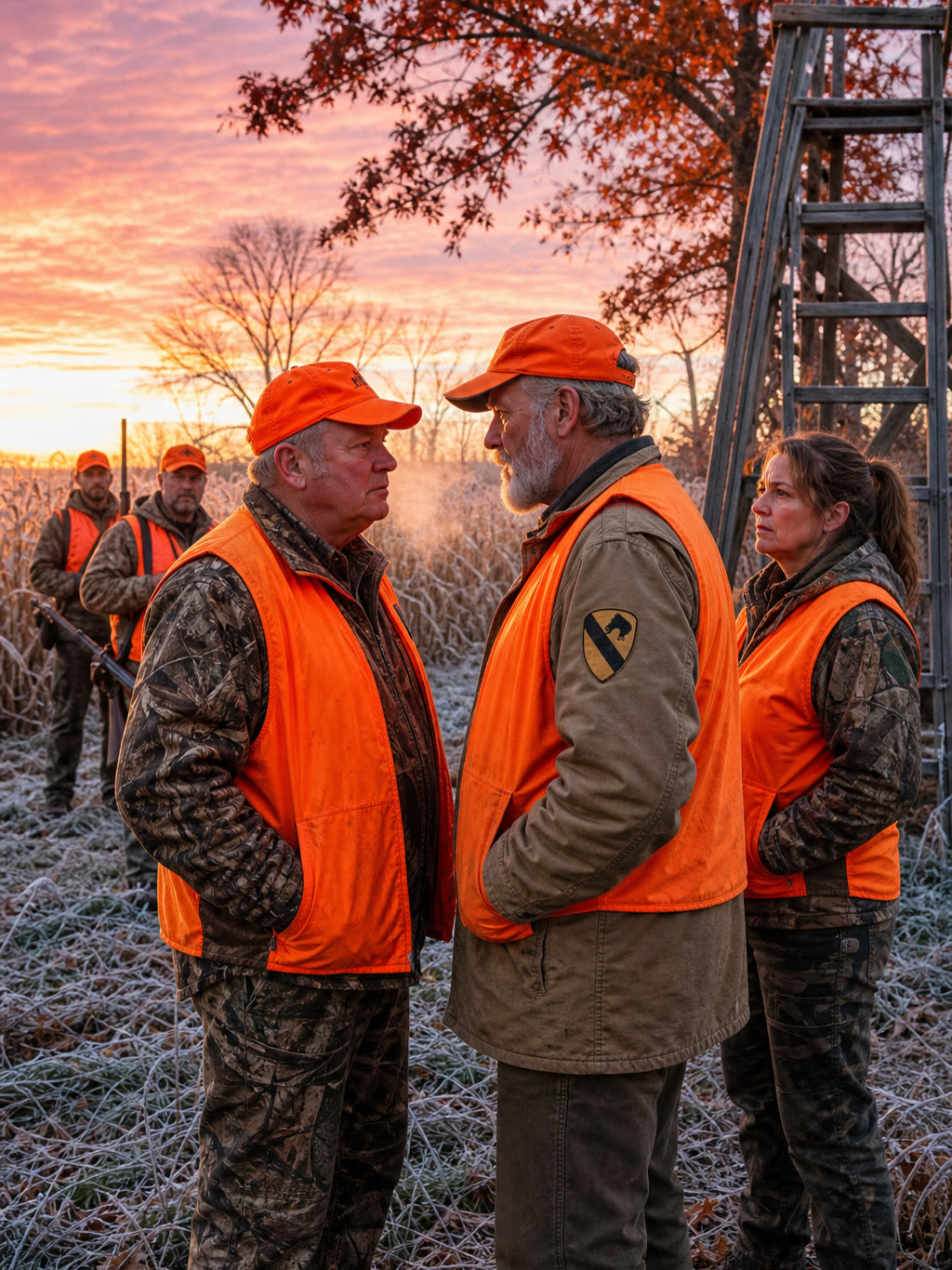
Kurt stood there a long while, breathing white clouds into the cold. Then he worked his right glove off one finger at a time and held out his bare hand.
“Twenty-fourth Infantry,” he said. “Ninety-one. I was nineteen.”
Dale looked at the hand. Then he pulled off his own glove and shook it.
No one spoke. A mile away, a second shot cracked across the hills, and then a third.
Kurt let go of Dale’s hand and turned to me. His face had gone red, and the cold had nothing to do with it.
“Amy,” he said. “What do you mean you didn’t cool off? Brad told us you were fine with it. He said you agreed to it.”
“Agreed to what?”
Kurt reached inside his blaze-orange vest, drew out a folded sheet of paper, and passed it to me. It had gone soft along the creases, the way paper does when it’s been in and out of a pocket many times.
I opened it in the gray light. Across the top, in bold letters someone had typed on a computer, it read HUNTING LEASE AGREEMENT.
Beneath that was the legal description of my eighty acres, lifted word for word from the deed: the Southwest Quarter of the Northeast Quarter and the Northwest Quarter of the Southeast Quarter of Section 14, Township 27 North, Range 4 West. Then: Lessor, Amy L. Halvorsen. Lessee, Kurt Ostrowski, on behalf of hunting party. Term, November 2026 gun season. Consideration, $4,000, paid in cash.
Two signatures sat at the bottom.
One belonged to Kurt.
The other read “Amy L. Halvorsen,” in a loopy, slanting hand that looked nothing like my own.
I’ve signed my name the same way since I was twelve, when Grandpa Arvid taught me to write it on the back of a savings bond. I hadn’t signed that paper. I’d never laid eyes on it.
“Brad gave us that in August,” Kurt said. “He said you signed it at his place when you came to pick up the rest of your boxes. He said you were glad for the money, with property taxes and all.”
My hands shook so badly the paper rattled.
“I didn’t sign this, Kurt,” I said. “I haven’t been to Brad’s place since the divorce. I haven’t spoken to him except on the phone in August, when he told me I don’t even hunt and hung up on me.”
Kurt stared at me. Behind him, Mike swore under his breath.
“Then where’d our four grand go?” Russ asked.
Nobody needed to answer that.
To understand how I came to be standing on that ridge at dawn with three Army veterans and a forged lease, you have to know about my grandfather.
Arvid Halvorsen was born in 1932 in the farmhouse that still sits at the foot of that land, a mile and a half outside Elk Mound, Wisconsin. He served in Korea with the Second Infantry Division and came home in 1953 with a Purple Heart and a limp in his left leg that never left him. He married my grandmother, Ingrid, in 1955 and worked that land for fifty years. They grew corn and soybeans, kept a handful of beef cattle, and raised three children on whatever the eighty acres would give.
But the thing he loved most was the ridge.
The north forty is mostly hardwoods: big white oaks, some red ones, and a creek bottom crowded with cedar. Every autumn the deer drifted down off that ridge to feed in the picked corn. Grandpa called it the best deer ground in Dunn County, and nobody ever argued, mostly because nobody else had a ridge like it.
He never charged a single person a dime to hunt there.
Every opening morning, from 1961 until the year before he died, he walked his hunters in himself. Most of them were veterans: Korea, Vietnam, the Gulf, and later the younger men from Iraq and Afghanistan. He kept a small green ledger in the kitchen drawer with every name in it, the year each man hunted, and whether he got a deer. Now and then he added a line or two more. “Jim Haugen, Vietnam, 1969. First hunt since he came home. Didn’t shoot. Sat all day. Said it was the first time he slept since Khe Sanh.”
When I was small, he let me follow behind him on those mornings. I carried his steel thermos, which was nearly as big as I was, and he told me to step where he stepped so the leaves wouldn’t crunch.
“Why don’t you charge them, Grandpa?” I asked him once. I was maybe nine. “The Larsons charge people to hunt their land. Uncle Gary says they make a lot of money.”
He stopped at the edge of the field in the dark and looked down at me.
“Some things you don’t sell, Amy,” he said. “These men already paid.”
Grandpa died three years ago in March, at eighty-nine. His will had been drawn up by an old Menomonie lawyer named Harold Brekke, who had handled the Halvorsen family’s business since the sixties. It left the farmhouse and the eighty acres to me, his only granddaughter, in my name alone.
At the time, I was married to Brad Kessler.
We’d been married nine years. Brad was a sales manager at the John Deere dealership in Menomonie. He was charming and easygoing, the sort of man who could sell a combine to a dairy farmer who had no use for one. Everyone liked Brad. For a long time, so did I.
When Grandpa’s will went through probate in Dunn County, Brad sat next to me in Harold Brekke’s office while Harold read it aloud. When Harold reached the part about the land, Brad squeezed my knee.
Afterward, out in the parking lot, he said, “That’s our land now, babe.”
“It’s my land,” I said, half joking. “Grandpa left it to me.”
He laughed. “Same thing, right? We’re married.”
It was not the same thing. I learned that a year later, when the marriage fell apart.
I won’t tell you all of it. There’s no point. There was no affair, no screaming, nothing you’d put in a country song. We simply woke up one day and understood that we’d been living like roommates for three years. Brad wanted to move to Madison and sell the farmhouse. I wanted to stay. Brad wanted to cash out the land. I couldn’t even imagine it.
“It’s just dirt, Amy,” he said once. “It’s eighty acres of dirt and some old trees.”
“It’s Grandpa’s,” I said.
“Your grandpa’s dead.”
That was the night I knew we were finished.
We filed in the spring. Brad hired an Eau Claire lawyer named Darren Fiske, who wore cowboy boots with his suits and billed $325 an hour. At our first mediation session, Fiske argued that the land should count as marital property, or at the very least that Brad deserved a share of its increase in value.
“My client contributed substantially to the improvement of that property,” Fiske said. “He built four deer stands on it. He maintained the trails. He paid half the property taxes in 2024.”
My lawyer was a calm, gray-haired woman named Patricia Haugen. I learned later that she was the granddaughter of Jim Haugen, the Vietnam vet in Grandpa’s ledger. She didn’t even glance up from her file.
“Mr. Fiske,” she said, “in Wisconsin, property acquired by inheritance is individual property. It stays individual property unless it’s mixed with marital assets in a way that makes it impossible to trace. Mrs. Halvorsen inherited this land by will. The deed is in her name alone. It was never retitled, and it was never refinanced. The tax bill came in her name. Your client wrote one check for half of one year’s property taxes. That’s $930. We’ll be happy to reimburse it.”
Fiske kept at it for two more sessions. He claimed the stands Brad built had added value. Patricia brought in a local appraiser named Gordon Lund, who testified that four homemade wooden deer stands added, in his professional opinion, “approximately nothing” to the value of eighty acres of farmland.
The divorce became final in October, two years ago. Under the judgment, the farmhouse and the eighty acres stayed mine as individual property. Brad kept his truck, his bass boat, his half of our joint savings, roughly $23,000, and his own 401(k). I paid back his $930 in property taxes with a check drawn on my account at Royal Credit Union, and in the memo line I wrote: “Paid in full.”
Brad moved into an apartment in Menomonie. I stayed on in Grandpa’s farmhouse.
I believed that was the end of it.
I didn’t know he’d held on to something. Not a key. Something worse than a key.
He’d held on to the idea that the ridge belonged to him.
Part 2: Posted
Kurt told me in August, as casually as if he were telling me the weather.
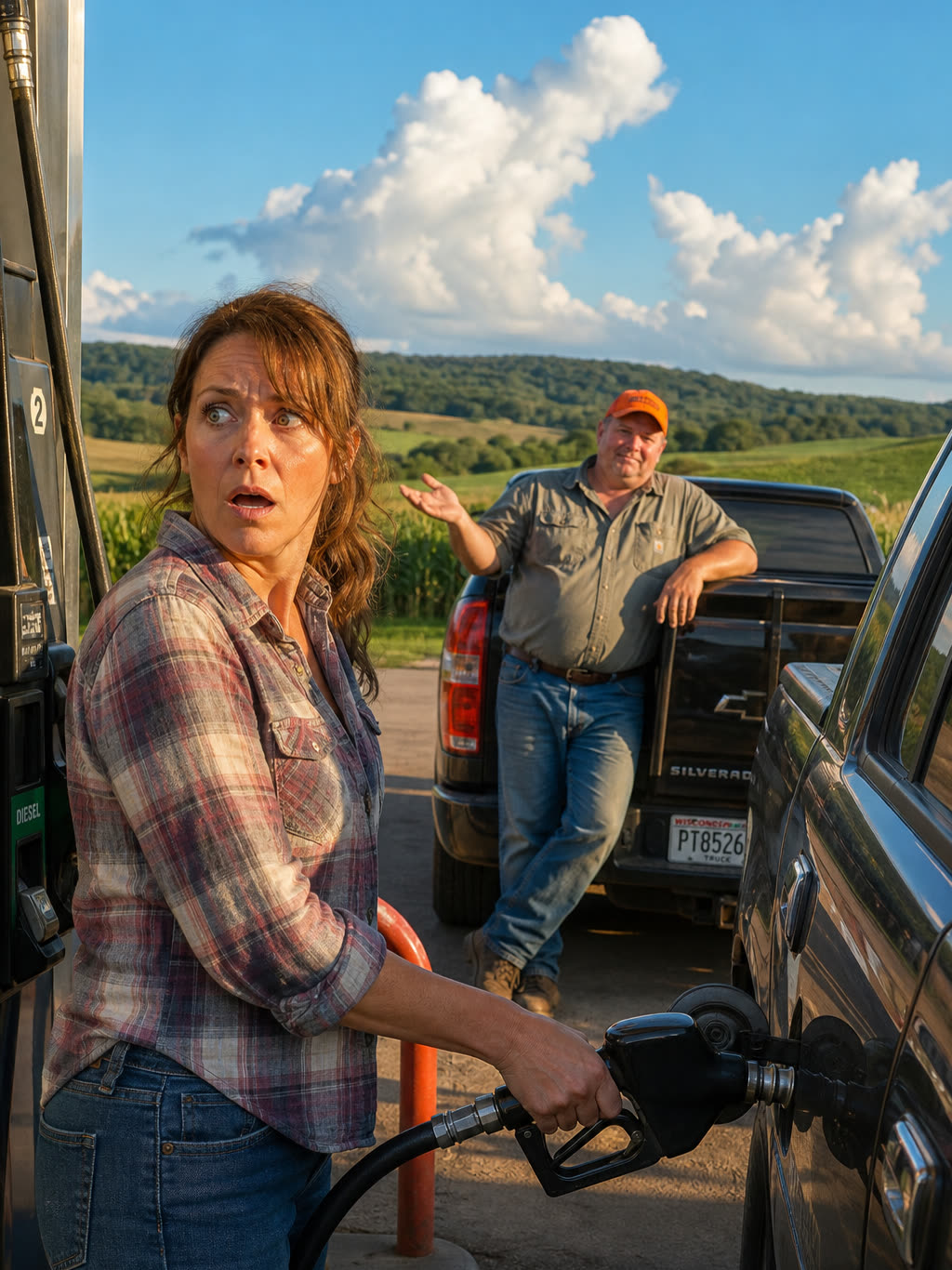
I was filling my truck at the Cenex in Elk Mound when Kurt pulled up to the next pump in his black Silverado and waved.
“Amy! How you doing?”
“Good, Kurt. You?”
“Good, good.” He lifted the nozzle out and leaned back against his truck bed. “Hey, just so you know, we’re paid up with Brad through this season. Four grand, cash. Me, Mike, and Russ. Same as last year.”
“Same as last year?” I said.
“Yeah. Brad said you were okay with it, with him still running the hunting out there. He said you didn’t care about it since you don’t hunt.” Kurt shrugged. “Figured you knew.”
I didn’t know.
I’d had no idea that for the past two seasons, after the divorce, after the judgment, after I wrote “Paid in full” on a check, Brad had been collecting four thousand dollars a year in cash from his friends to hunt land that wasn’t his.
And all that time I’d been home in the farmhouse every November weekend, hearing shots up on the ridge and assuming they came from the neighbors.
I called Brad that night.
He picked up on the fourth ring. I could hear a TV in the background and a woman laughing.
“Amy. What’s up?”
“Kurt told me you’ve been leasing the hunting on my land. Four thousand dollars a season. For two years.”
There was a pause. Then he chuckled, that easy, warm chuckle that used to make me forgive him anything.
“Come on, Amy. You don’t even hunt. It’s wasted on you. Those guys love it out there. They’ve been hunting that ridge for years.”
“With my grandfather’s permission,” I said. “And then with mine, when we were married. Not with yours, Brad. You don’t own anything out there.”
“I built those stands.”
“You built four plywood boxes on my land.”
“Amy.” His voice stayed even, almost amused. “Don’t make this into a thing. It’s a few weeks in November. Nobody’s hurting anybody.”
Then he hung up.
He never raised his voice. He never needed to. That was Brad’s gift: making you feel like the unreasonable one simply by staying calm while you came apart.
I sat at Grandpa’s kitchen table a long time with the phone in my hand. The green ledger was in the drawer right in front of me. I took it out and paged through it: all those names, all those years. Fifty-nine years of men climbing that ridge beside my grandfather because he’d told them they had already paid.
And Brad was selling it for cash.
The next morning I drove to Menomonie and sat across a desk from Patricia Haugen.
“I don’t want to sue anybody,” I told her. “I just want it to stop.”
“Then we stop it,” she said. “You don’t need a sheriff or a judge to keep people off your own land, Amy. The deed has one name on it. That’s yours.”
She laid it out plainly. Wisconsin law allows a landowner to post her land against trespass. If I put up signs at the proper intervals along the boundaries and at the gates, anyone who came on without my permission would be trespassing, no matter who had told them it was fine. And if I sent Brad a certified letter revoking whatever permission he imagined he had, he couldn’t claim afterward that he hadn’t known.
“There’s one more thing you need to know,” Patricia said. She folded her hands on the desk. “Something about liability.”
“Wisconsin has a recreational use law,” Patricia said. “Most states do. It protects landowners who let people hunt, fish, hike, or whatever on their land for free. If somebody gets hurt hunting on your property, falls out of a tree stand, say, the law mostly protects you from being sued. It encourages people to open their land.”
“Grandpa always said nobody could ever sue him for letting somebody hunt.”
“Your grandfather was right, because he never charged.” Patricia leaned forward. “But Amy, a lot of that protection can go away if the landowner gets paid. Brad has been collecting four thousand dollars a season to let people hunt your land. If one of those men falls out of one of Brad’s homemade stands and breaks his back, his lawyer is going to argue that this was a paid hunting arrangement on your property. Then you’re the one in the courtroom, not Brad.”
A chill went all the way through me.
“He’s not just taking money for something that isn’t his,” I said slowly. “He’s putting the farm at risk.”
“Call your insurance agent,” Patricia said. “Today.”
That afternoon I called Lyle Swenson at the Farm Bureau office. Lyle had written Grandpa’s farm policy for thirty years. When I told him about the cash lease, the line went quiet for a long time.
“Amy, your farm liability policy covers incidental recreational use. Neighbors, family, friends hunting for free. It does not cover commercial hunting leases. If somebody’s paying to hunt that ground, I’d need to know about it and write a separate rider. And I’d want a written lease, proof the lessee has their own insurance, and stand inspections.” He sighed. “Without any of that, if there’s an accident, you could be in a real mess. We’re talking about the farm.”
The farm. Eighty acres worth about $640,000 at Dunn County’s going rate, plus the farmhouse. Everything Grandpa had built.
That night I drove to the Fleet Farm in Menomonie and bought eighty orange PRIVATE PROPERTY – NO TRESPASSING – NO HUNTING signs, a box of aluminum nails, and a staple gun. I spent two weekends walking every fence line on those eighty acres, putting up signs exactly as Patricia had told me: at the corners, along the boundaries, and on both sides of the field gate.
My neighbor Earl Nygaard has farmed the ground to the south for forty years and cash-rents my sixty tillable acres for corn at $185 an acre. He spotted me posting signs along the line fence and pulled his tractor over.
“Brad’s crew?” he asked.
“Brad’s crew,” I said.
Earl nodded slowly. “I wondered about that last November. Saw his buddies’ trucks parked at your gate every Saturday, and you weren’t with ’em. Didn’t seem right.” He climbed down off the tractor. “Want help with the north line? That fence is a mess along the creek.”
We posted the north line together. Earl didn’t say much. He didn’t have to.
Then I sat at Grandpa’s kitchen table and wrote a single letter. Patricia read it over before I mailed it.
“Mr. Kessler: This letter is formal notice that any permission you may believe you have to enter, use, hunt, or grant hunting rights on my property in Section 14, Town of Elk Mound, Dunn County, Wisconsin, is revoked, effective immediately. This revocation applies to you and to any person to whom you have granted, sold, or represented any right to enter or hunt this property. The property is posted. Any entry without my express written permission will be treated as trespass. — Amy L. Halvorsen, Owner.”
I sent it from the Elk Mound post office, certified, return receipt requested. It cost $8.85.
Four days later the green card turned up in my mailbox, signed in Brad’s loopy handwriting.
No one called me, and no one argued.
I assumed he’d gotten the message. I assumed he’d tell his buddies.
I was wrong about the second part.
But I didn’t know that yet. What I knew, in September, was that the ridge was quiet for the first time in sixty years, and that the quiet felt wrong.
I kept taking the green ledger out of the drawer at night. I’d read the names the way some people read scripture. One entry came up again and again, year after year, starting in 1992: “Dale Brennan, Desert Storm, 1st Cavalry. Came back thin. Got a six-point.” Then 1993, and 1994, and on through the decades, with a phone number in Grandpa’s shaky pencil written beside his name in 2015. The last entry was the November before Grandpa died. “Dale Brennan. Walked me in this time. Bad leg.”
I didn’t remember Dale. I’d been away at school for a lot of those years, then married, then busy. But Grandpa had written that a man walked him in. Grandpa never let anybody walk him in.
I called the number on a Sunday afternoon, half expecting it to be disconnected.
A deep, unhurried voice answered. When I told him who I was, there was a long silence, and then he said, “Arvid’s granddaughter. The little one with the thermos.”
He lived in Chippewa Falls now. He told me he hadn’t hunted since Grandpa died. He said it didn’t feel right going anywhere else, and nobody had asked him back to the ridge.
“I’m asking,” I said. “You and anybody you think should be there. For free. Like he did it.”
Dale was quiet so long I thought the line had dropped.
“There’s two men at the VFW post I’d bring,” he said finally. “Young enough to be my sons. They could use a morning like that.”
That was how I met Josh Lindqvist and Ray Kowalczyk. Josh was thirty-four, tall, with a thick dark beard, and had done two tours in Afghanistan. He spoke maybe a dozen words the first afternoon they came out to scout. Ray was about forty-five, an Iraq vet, with a square jaw and a laugh that came out of nowhere. Dale walked the ridge ahead of both of them with a limp of his own I hadn’t expected, pointing out the old scrapes along the white oaks the way Grandpa used to.
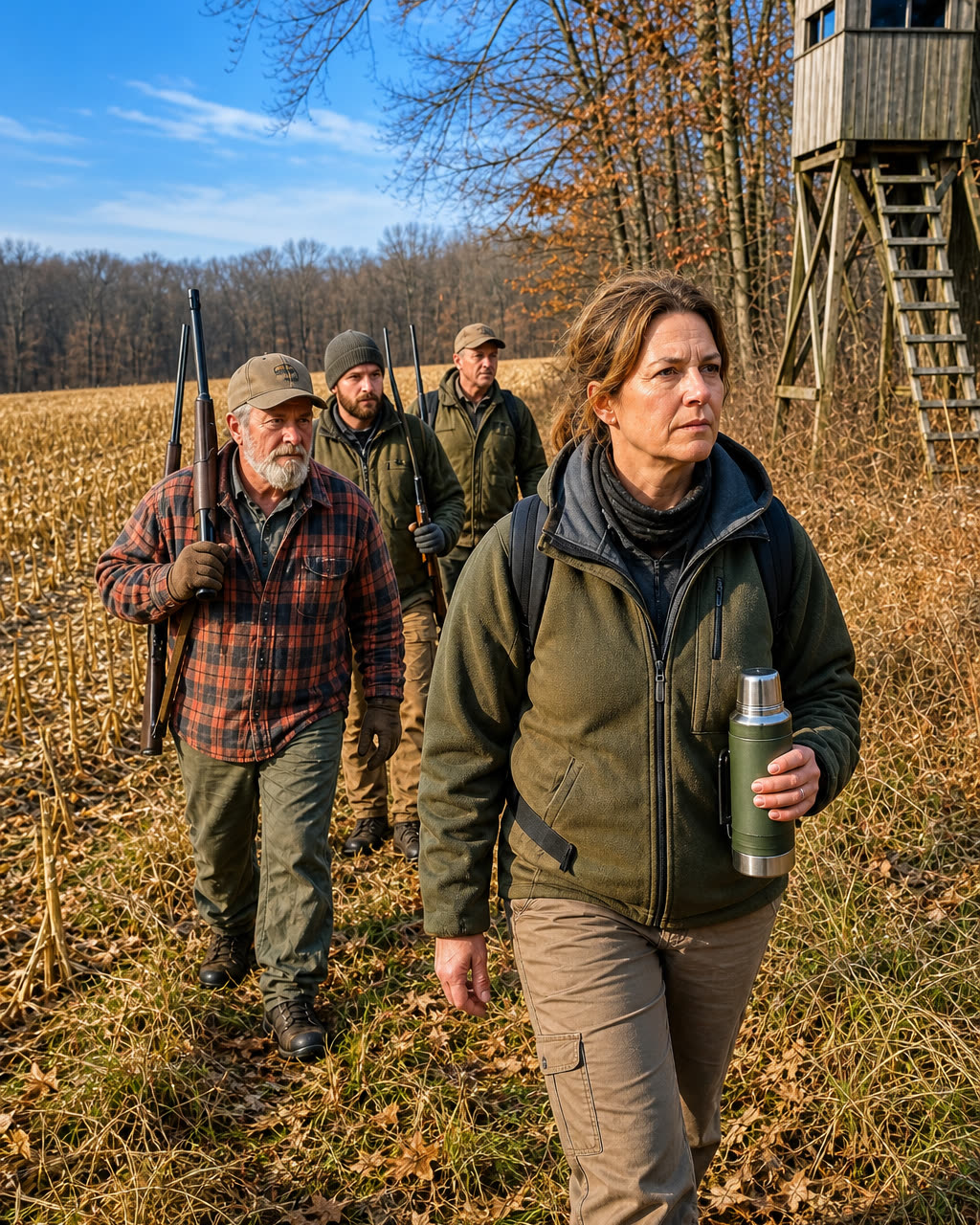
We didn’t use Brad’s plywood boxes. Lyle had made me nervous about them, and Dale took one look at the rusted screws and shook his head. Instead we used Grandpa’s old wooden ladder stand at the edge of the cornfield, which Earl and I had checked board by board, and the men brought their own climbing stands for the oaks.
I wrote each of them a simple letter of permission, signed in my own hand, no money involved. Patricia said that was the way to do it.
On opening morning I was up at four. I made coffee and poured it into Grandpa’s dented green steel thermos, the same one I used to drag along behind him. At five-thirty, three sets of headlights came up the drive.
I walked them in myself. I went first, the thermos in my hand, the frost crunching under my boots, and they followed in a line: Dale, then Josh, then Ray, rifles on their shoulders, orange vests bright against the dark. I told them to step where I stepped. Dale smiled at that.
Josh and Ray climbed into the oaks. Dale stayed with me at the foot of the ladder stand while the sky went from black to gray, because, he said, Arvid always waited with the first man until shooting light.
The first shot of the season sounded a mile off, somewhere over toward the Larson place.
Then I heard truck doors slamming down by my gate.
Three figures in blaze orange came walking up the field edge through the cut corn, rifles slung, moving like men who’d walked that path a hundred times. They walked right past my orange signs.
Kurt was in front. He stopped when he saw me, and for a second he looked almost relieved.
“Amy? Brad said you’d cooled off about all this.”
“I didn’t cool off, Kurt,” I said. My voice was steadier than I felt. “I posted every fence line.”
Kurt’s eyes went past me to the trees, to the two orange hats up in the oaks, and then to the gray-bearded man standing quietly at my side.
He looked down at the frost for a long moment. Then he took one slow step toward Dale.
Part 3: What the Ledger Says
For a while after Russ’s question, nobody moved. Up in the oaks, Josh and Ray had come down from their stands. They walked toward us along the field edge, rifles unloaded and pointed at the ground, exactly the way Dale had told them to if anything ever looked wrong.
Kurt took off his orange cap and ran a hand over his graying hair. Then he pulled out his phone, thumbed a number, and put it on speaker.
It rang five times before Brad picked up, his voice thick with sleep. “Kurt. You guys get one already?”
“We’re standing on the ridge,” Kurt said. “With Amy.”
There was nothing on the line but breathing. The wind moved through the oaks over our heads.
“Okay,” Brad said. “Okay, look. Put her on. There’s been some kind of mix-up.”
“There’s a lease in my hand with her name on it,” Kurt said. “Did she sign it, Brad?”
Another pause. Then came the chuckle, warm and easy, the one I’d heard a thousand times. “Kurt, come on. She would have, if I’d asked. She doesn’t care about that land. It just sits there.”
Kurt looked at me for a long second. Then he ended the call without another word.
He turned to Mike and Russ. “Unload,” he said. They did it right there in the frost, working the bolts, brass cartridges dropping into their gloved palms. Kurt folded the lease along its soft creases and held it out to me. “You keep that,” he said. “You’re going to need it.”
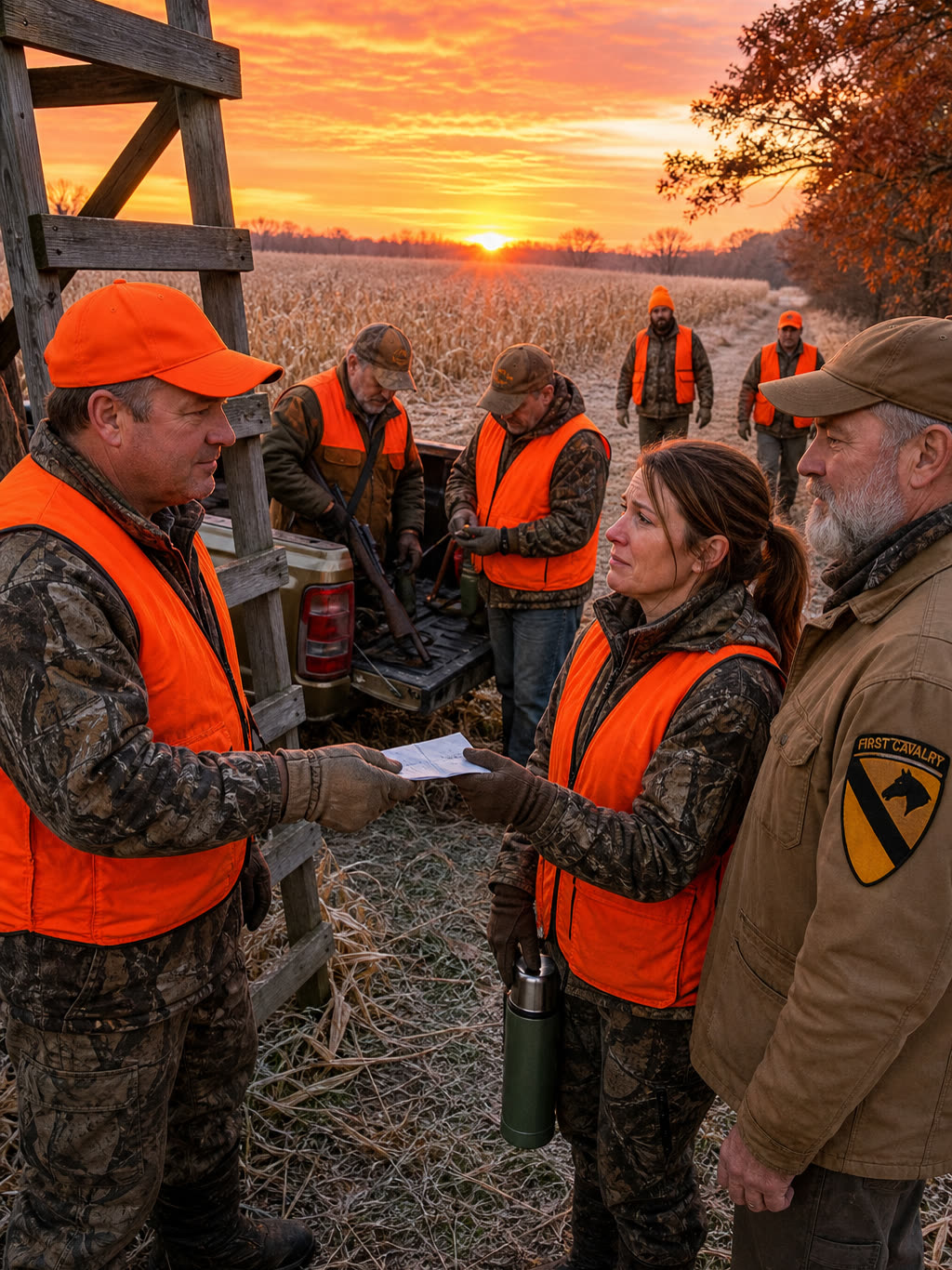
I took it. My hands had finally stopped shaking.
“We’re trespassing,” Kurt said. “We’ve been trespassing two years and didn’t know it. I’m sorry, Amy. I should’ve called you. I should’ve known Brad well enough to call you.”
“You didn’t know,” I said.
“I knew he talked big about this place like it was his.” Kurt shook his head. “I just figured that was Brad.”
Mike, who hadn’t said a word except the one I won’t repeat, cleared his throat. “Four grand a year,” he said. “I took that out of my Christmas money. Both years.”
Russ just stared at the ground.
Dale had been quiet through all of it. Now he looked at Kurt and said, “Arvid ever walk you in?”
Kurt was silent a while. When he spoke, his voice was rough.
“First year. He asked me at the gate if I’d served. I told him no.” He looked off at the ridge. “I didn’t talk about it back then. Didn’t talk about it to anybody. And Brad was standing right there, and I didn’t want to be one of those guys in that green book. I didn’t want anybody asking.”
“He would’ve walked you in anyway,” I said. “He wouldn’t have asked you anything else.”
“I know that now.” Kurt’s jaw worked. “He did it anyhow, you know. Walked me to the south stands that first morning, step for step. Told me where the deer would cross. He was right.”
I unscrewed the green thermos. Steam rose into the cold. I poured coffee into the cup lid and handed it to Kurt, and after a second he took it. Then Dale, then Mike and Russ and Josh and Ray, passing the lid around in a circle at the foot of the ladder stand while the sun came up red over the cornfield.
Nobody hunted for the next half hour. We just stood there.
Before they left, Kurt asked me what I wanted them to do.
“Go home today,” I said. “Tomorrow, call Patricia Haugen in Menomonie. She’ll want to talk to all three of you.”
Kurt nodded. Then he did something I didn’t expect. He walked over to Dale and Josh and Ray, shook each of their hands, and told them good luck. “Big eight comes through that cedar bottom around nine,” he said to Josh. “Every year. Right where the creek bends.”
Josh got him at nine-fifteen.
Patricia didn’t waste time. On Monday morning she had all three of Kurt’s crew in her office, one at a time, writing out statements. She had my old checks, my driver’s license, the savings bond I’d signed at twelve that I’d kept in Grandpa’s lockbox, and the green return receipt with Brad’s signature, side by side with the lease. Even I could see it. The loops in the forged “Halvorsen” matched the loops in “Kessler.”
“Forging a signature on a document like this isn’t a civil matter, Amy,” Patricia said quietly. “Taking eight thousand dollars from three men by telling them you agreed isn’t either. This is for the district attorney.”
“I said I didn’t want to sue anybody.”
“You’re not suing anybody.” She slid the papers into a folder. “You’re reporting a crime.”
A Dunn County deputy came out to the farmhouse that Wednesday. She sat at Grandpa’s kitchen table, took photographs of the lease and the receipt, and wrote down everything I said in slow, careful printing. When she left, she paused at the door and looked at the orange signs on the gate.
“You posted it right,” she said. “That helps.”
Brad showed up on Friday evening.
I heard his truck before I saw it. He parked crooked in the drive and came up onto the porch the way he used to when he lived there, as if he still had the right. I opened the door but didn’t step aside.
“Amy.” He smiled. It was the smile that sold combines. “Can we talk like adults for a minute? A deputy called me at work. At work, Amy. In front of my manager.”
“You signed my name.”
“It’s a piece of paper.” He spread his hands. “It’s a few weeks in November. Those guys got to hunt. Nobody got hurt. You didn’t even know until Kurt opened his mouth.”
“You signed my name,” I said again. “And you took their money. And if one of them had fallen out of one of your plywood boxes, I would have lost Grandpa’s farm.”
“Oh, come on.” He laughed. “Nobody was going to fall.”
“Patricia says you’d better get a lawyer.”
And then, for the first time in all the years I’d known him, Brad’s calm cracked. His face went blotchy. His voice climbed.
“That land should have been half mine! I put nine years into that place! I built those stands with my own two hands, and you sat in that house and let it rot, and you want to put me in front of a judge over some old man’s hunting club?”
Behind him, out on the road, Earl Nygaard’s tractor slowed to a crawl and then stopped, its engine idling. Earl didn’t get down. He just sat there in the cab, looking up at the porch.
Brad saw him. He stopped talking.
“Goodbye, Brad,” I said, and closed the door.
It took until spring. The district attorney charged Brad with forgery and theft by fraud. Fiske tried to argue that it had all been a misunderstanding between friends, that Brad had honestly believed I’d approve. The handwriting, the certified receipt, and three written statements from men who had stood at his wedding made that a hard case to argue. In the end Brad took a plea. He paid back every dollar to Kurt, Mike, and Russ: eight thousand in all, with interest. He got probation. The dealership let him go in January, though I heard about that from Earl and never asked anybody for details.
He moved to Madison that summer, which was what he’d always wanted.
In December, after the season closed, Earl, Dale, Kurt, and I took down Brad’s four plywood stands. It took one afternoon and a pry bar. Kurt pulled the last screw out of the last board and held it up, rusted almost through.
“I sat in that thing two years,” he said, and shook his head.
Lyle came out in the spring and looked over Grandpa’s old ladder stand with me, and then the climbing stands Dale’s men used. He went home and wrote a letter for my file confirming that everyone who hunted my land did so by written permission, free of charge. He told me Grandpa would’ve liked that I had it in writing.
“Arvid never wrote anything down but those names,” he said. “And they turned out to be the most important part.”
The next November I walked six men in on opening morning.
Dale went first behind me, then Josh, then Ray. Then Kurt, Mike, and Russ, because I’d called Kurt in October and told him the ridge was open, and when he started talking about money, I told him what Grandpa had told me in the dark on the field edge when I was nine.
He didn’t argue. He just said, “Thank you,” and his voice went rough again.
I carried the green thermos. I told them all to step where I stepped. The frost crunched anyway, because six grown men in boots are not quiet no matter what you tell them, and somewhere in the line Ray laughed under his breath and Dale shushed him like a father.
That night, after the trucks were gone, I took the ledger out of the kitchen drawer and opened it to the first blank page. For three years it had been closed. Grandpa’s last entry was there in faded pencil: Dale’s name, the bad leg, the walk in.
I wrote underneath it in my own hand, the same way I’ve signed my name since I was twelve.
“Dale Brennan, Desert Storm, Iraq twice, 1st Cavalry. 2026. Came back to the ridge.”
“Josh Lindqvist, Afghanistan. 2026. Eight-point in the cedar bottom, where the creek bends.”
“Ray Kowalczyk, Iraq. 2026. Laughed too loud. Grandpa would’ve liked him.”
I sat a long time with the pen over the page before I wrote the next one.
“Kurt Ostrowski, 24th Infantry, Desert Storm, 1991. Nineteen years old. Hunted this ridge eleven years. 2026 is the first year he said it out loud.”
Then I closed the ledger, put it back in the drawer, and rinsed out Grandpa’s thermos for the morning.
Some things you don’t sell. These men had already paid.
Disclaimer: This story is a work of fiction inspired by real-life themes. Names, characters, places and events are fictionalized, and any resemblance to real persons is purely coincidental. Images are for illustration purposes only.
