

Part 1
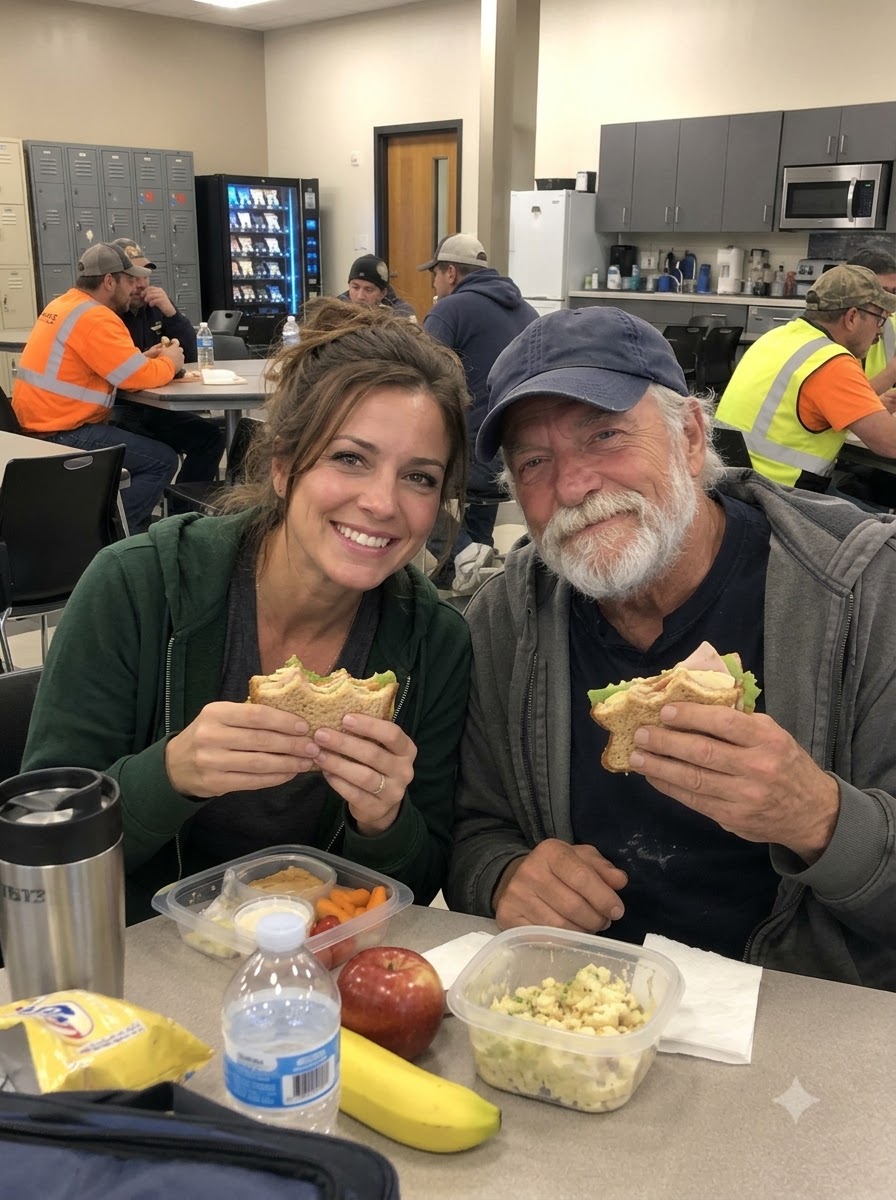
On my first day at Halvorsen & Pike, I carried a turkey sandwich that I was far too anxious to eat.
I arrived forty minutes before my shift began. I parked in the farthest corner of the parking lot because I didn’t want to accidentally take a space that belonged to someone else. Then I sat behind the steering wheel, rehearsing my introduction.
“Hi, I’m Charlotte. Charlotte Reyes. I’m the new claims analyst.”
I repeated it several times, as though I might somehow forget my own name.
My desk was on the fourth floor, inside a gray cubicle with a half-dead spider plant abandoned by whoever had occupied it before me.
My manager, Diane, was a brisk woman who shook my hand once and immediately informed me, “We move fast here.”
I spent the rest of the morning meeting people whose names I could barely remember. By the thirtieth introduction, my cheeks actually hurt from smiling.
When noon finally arrived, my stomach was so tightly knotted that I could feel the tension in my throat.
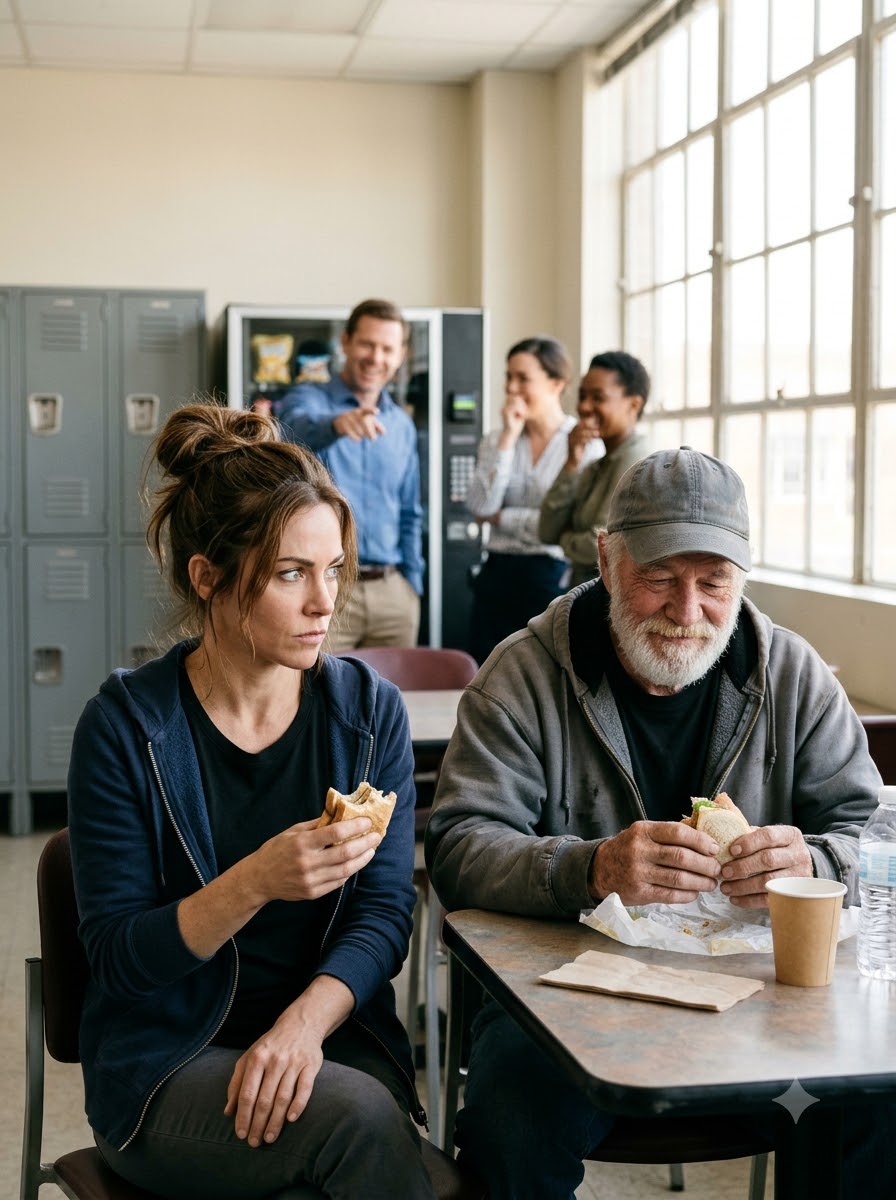
I went down to the third-floor break room, pushed open the doors, and stepped into a wall of noise.
Every table seemed to have its own established group.
People were laughing at jokes I didn’t understand, leaning toward coworkers they had apparently known for years, and discussing everything from weekend plans to football.
Someone was heating fish in the microwave.
Another person was loudly complaining about the Bengals.
I stood near the entrance with my brown paper lunch bag clutched in both hands.
I was twenty-eight years old, newly arrived in Columbus, Ohio, from a small Kentucky town where almost everyone knew me.
My apartment was barely furnished. My job was unfamiliar. I wasn’t even certain I was qualified to do it.
And there I stood, feeling like a frightened middle school student who couldn’t find anywhere to sit.
Every table was occupied.
Every conversation already had its own rhythm.
There seemed to be no place for me.
Then a man sitting near the window looked up.
He wore a gray work uniform with a name patch sewn above the pocket. He was thin, with short white hair and a quiet expression. I guessed he was in his sixties.
He sat alone at a small table with two chairs.
“You can sit here, if you’d like,” he said.
I nearly burst into tears.
It was the first genuinely kind invitation I’d received all morning, offered without any expectation attached.
“Thank you,” I replied.
I sat down so quickly that I almost knocked over his coffee.
“I’m Charlotte.”
“Charles,” he said.
Then he returned to eating his sandwich.
That was our entire introduction.
He didn’t ask about my department, where I came from, or why I looked so nervous.
He simply gave me a place to sit.
I sat with Charles that first afternoon because I had nowhere else to go.
But the following day, I returned because I wanted to.
Without ever discussing it, we developed a routine.
Noon.
The same table beside the window.
The same two chairs overlooking the parking lot and a narrow strip of grass where one miserable little maple tree never seemed to grow.
Charles brought almost exactly the same lunch every day.
Bologna and cheese on white bread with yellow mustard, carefully wrapped in wax paper. An apple. A thermos filled with black coffee.
The corners of the wax paper were folded so precisely that I suspected he’d been wrapping sandwiches that way for decades.
My lunches were far less predictable.
Leftover pasta, yogurt, or whatever I could grab before rushing out the door.
Sometimes I brought nothing more than crackers and a cheese stick.
We discussed ordinary things.
The weather.
The Western novels Charles enjoyed, especially those written by Louis L’Amour.
The broken elevator on the east side of the building, which he had reported nine times.
“They tell me it’s on the list,” he said one afternoon.
“What list?”
“The list of things they’re going to fix after they fix everything else.”
I laughed so hard that orange juice came out of my nose.
Our conversations rarely involved anything important.
Yet those lunches slowly became the most comforting part of my day.
Charles’s name patch read C. WILSON.
He had already worked at Halvorsen & Pike for twenty-two years when I arrived.
He knew the entire building better than anyone.
He knew which printers jammed constantly, which conference rooms became freezing in the afternoon, and which vending machine would release two bags of chips if you pressed B4 twice.
He also knew everyone’s name.
Every single person who worked there.
Most of them barely knew his.
Charles carried a small black notebook in his shirt pocket, secured with a rubber band.
Every afternoon, just before returning to his cleaning cart, he would take it out, remove the band, and write a sentence or two.
Then he’d close it and tuck it away.
I assumed he was recording maintenance issues or making grocery lists.
I never asked.
Looking back, that is one of the things I regret most.
During eleven years of lunches, I never once asked what he was writing.
The teasing began after we’d been eating together for about two months.
One afternoon, a man from underwriting named Derek walked beside me in the hallway.
“Lunch with your boyfriend again?” he asked, grinning.
I laughed because I was still new and didn’t want to create trouble.
“Charles is better company than you,” I replied.
Then I continued walking.
Unfortunately, the joke spread.
People began smirking when they saw me heading toward Charles’s table.
Women from my own department whispered to each other as I passed.
One Monday, someone taped a sign to Charles’s chair.
It had been printed in an elaborate font.
RESERVED FOR CHARLOTTE’S DATE.
Charles arrived at noon, noticed it, and quietly peeled it off.
He folded the paper into four neat squares and placed it inside his pocket.
Then he sat down and unwrapped his sandwich.
He never mentioned it.
I wanted the floor to swallow me.
At the company Christmas party, Megan from accounting approached me with an expression of exaggerated concern.
She touched my arm.
“Are you worried about your career trajectory?”
I frowned.
“What do you mean?”
“Sitting with the janitor every day,” she explained. “I mean, people notice that kind of thing, Charlotte. Perception matters.”
She spoke as though simply sharing a table with Charles might damage my professional reputation.
I laughed off the comment.
Just as I laughed off all the others.
But pretending not to care and genuinely not caring are very different things.
Many evenings, while driving home on Route 315, I replayed those remarks in my head.
I wondered whether I had become the office joke.
Sometimes I considered eating lunch at my desk instead.
But I never did.
Charles seemed completely unaffected by the whispers and laughter.
Or perhaps he was simply better at hiding his feelings.
One afternoon, Derek and his friends were particularly loud about what they called “the lunch lovebirds.”
I finally couldn’t ignore it.
“Doesn’t it bother you?” I asked Charles. “What they say?”
He slowly sipped his black coffee from the lid of his thermos.
Then he looked at me.
“People are loudest,” he said, “when they don’t understand what quiet is worth.”
At the time, I didn’t fully understand him.
Years passed, as they tend to do when we’re busy living them.
During my third year, I received a promotion to senior claims analyst.
The promotion came with a larger workspace and a raise substantial enough for me to finally buy a couch.
I didn’t mention it to Charles.
The following afternoon, however, he placed something in front of me.
A chocolate cupcake covered in rainbow sprinkles.
It was still inside a plastic container from the Speedway gas station on Morse Road.
The price sticker remained attached.
$2.49.
“How did you know?” I asked.
“It was on the bulletin board by the elevator,” he replied. “The one that works.”
“You don’t have to do that, Charles.”
“I know,” he said. “I wanted to.”
I ate the cupcake in four bites.
It was the best thing I’d tasted in years.
In my fifth year at the company, I married Kevin, a kind high school history teacher.
I invited Charles to our wedding, but he didn’t attend.
Instead, he sent a card containing a twenty-dollar bill and a short message written in his careful, old-fashioned handwriting.
“Wishing you every happiness. C. Wilson.”
Three years later, Kevin and I divorced.
There had been no dramatic betrayal.
No affair.
No screaming argument.
We had simply reached a point where we realized we’d been living more like roommates than husband and wife.
He wanted children, while I remained uncertain.
I dreamed of returning to Kentucky someday, and he wasn’t sure he wanted to leave Ohio.
We disagreed about too many important things, and neither of us knew how to resolve them.
Kevin moved out on a Saturday.
I returned to work Monday morning without telling anyone.
At noon, I sat across from Charles and opened a container of leftover lo mein.
I stared at the food without eating.
For the rest of that week, I barely spoke.
Charles never asked what was wrong.
He didn’t pressure me to explain.
Instead, he talked about ordinary things.
The new carpet on the fifth floor.
A raccoon he’d discovered near the dumpster and named Gerald.
The Louis L’Amour novel he was reading for the fourth time.
He gave me something to listen to besides my own miserable thoughts.
And he allowed our silences to feel comfortable.
On Friday, I finally spoke.
“Kevin moved out.”
Charles nodded and took a sip of coffee.
“I figured it was something like that.”
“How?”
“You stopped wearing your ring on Tuesday,” he said. “And you’ve been eating lunch like it’s medicine.”
That was all.
Somehow, it was enough.
The following year, my mother died.
She was sixty-four.
A stroke took her on a Sunday morning in her kitchen in Bowling Green, Kentucky, while she was preparing biscuits for church.
My Aunt Dot found her.
I drove four hours to Kentucky that afternoon, although I remember almost nothing about the journey.
Three days after the funeral, I returned to work because I couldn’t bear the silence of my apartment.
Every time I sat still, I imagined hearing my mother’s voice.
“Charlotte Ann, are you eating?”
On my first day back, I forgot to pack lunch.
I didn’t realize it until I sat across from Charles and reached into my empty bag.
I stared at the table.
Charles said nothing.
He picked up his bologna sandwich, tore it into two pieces, and pushed half toward me on a square of wax paper.
“Eat something,” he said. “You’ll feel worse if you don’t.”
I ate it.
And for the first time since my mother’s funeral, I began crying in front of someone who wasn’t family.
I cried right there in the break room, with Derek, Megan, and the entire accounting department nearby.
Charles didn’t try to stop me.
He didn’t offer empty reassurance or look around to see who was watching.
He simply ate his half of the sandwich and let me cry.
The next day, a second sandwich waited on the table.
Wrapped in wax paper.
Corners folded neatly.
“In case you forget again,” he explained.
For the next two weeks, he brought me lunch every day.
I thought I understood what kindness looked like.
But I had no idea how much of my life Charles was quietly carrying with him.
Part 2
Over the years, Charles did countless little things that I barely understood the importance of at the time.
One winter evening, my car battery died in the parking garage during a snowstorm.
It was nearly seven o’clock.
Charles appeared with jumper cables and a flashlight, even though his shift should have ended two hours earlier.
“I was finishing up the third floor,” he explained.
I later learned that the third floor was always finished by four.
Another time, my grandmother’s opal ring slipped off my finger and disappeared down the drain in the fourth-floor women’s restroom.
I called facilities in a panic.
Charles arrived with a wrench and a bucket.
He took the plumbing apart beneath the sink, retrieved the ring, wiped it clean with his handkerchief, and handed it back without making a fuss.
When I worked through a terrible cold, a box of tissues and a can of chicken noodle soup mysteriously appeared on my desk.
There was no note.
I knew who had left them.
And every birthday, Charles bought me a chocolate cupcake with rainbow sprinkles from the gas station.
For eleven years, he never forgot.
Yet I knew remarkably little about him.
He lived alone in a small Clintonville house he’d owned since the 1970s.
His wife, Ruth, had died in 1999.
He grew tomatoes and green beans during the summer and occasionally brought me a paper bag filled with fresh produce.
That was almost everything I knew.
Once, around our seventh year of lunches, I asked whether he had children.
He became very quiet.
His eyes moved toward the little maple tree outside the window.
“I did,” he said.
Then he changed the subject to the broken elevator.
I didn’t ask again.
I thought I was respecting his privacy.
I didn’t understand that sometimes a person is silently hoping you’ll ask twice.
One Monday in March, Charles didn’t appear at work.
I noticed immediately.
After eleven years of meeting at noon, his absence was impossible to overlook.
At 12:01, I sat at our table with my sandwich.
At 12:15, his chair remained empty.
I told myself he was probably sick.
He was seventy-two, after all.
Perhaps he had caught a cold or hurt his back.
Surely he’d return the following day.
But Tuesday passed without him.
Then Wednesday.
That afternoon, I approached Tony, a young facilities employee who’d recently joined the company.
“Have you seen Charles Wilson? The custodian on days?”
Tony shrugged.
“Older guy? Don’t know. They sent me to cover his floors this week.”
Thursday morning, Diane stopped beside my cubicle carrying a stack of files.
She mentioned it casually, almost as an afterthought.
“Oh, hey. Did you hear about the janitor? Charles, I think his name was? Passed away over the weekend. Heart attack, I guess. HR sent an email.”
I stared at her.
“Charles?” I whispered. “Our Charles?”
“I guess so,” Diane replied.
She was already turning away.
“Can you have the Henderson file done by three?”
I stood up and walked calmly toward the fourth-floor restroom.
The same restroom where Charles had once dismantled the plumbing to retrieve my grandmother’s ring.
I entered the last stall, locked the door, and sat on the closed toilet lid.
For ten minutes, I held both hands over my mouth, struggling to breathe normally.
Finally, I opened my email.
There it was.
A message from HR, sent Tuesday morning.
I’d skimmed past it, assuming it concerned parking passes.
“We are saddened to share that Charles Wilson, a member of our facilities team for 33 years, passed away on Saturday, March 8. Funeral arrangements will be shared as they become available.”
Thirty-three years.
Four sentences.
That was all the company had offered.
At noon, I went to the break room.
I didn’t know why.
Perhaps habit was stronger than grief.
Everything looked exactly the same.
The room was noisy.
Derek was telling another story.
Someone was microwaving fish.
And Charles’s chair was empty.
I sat in my usual place and stared across the table.
Someone had pushed his chair in neatly.
It looked as though he might return at any moment.
The funeral took place the following Saturday at Schoedinger Funeral Home on North High Street in Clintonville.
The chapel was a small brick building with white trim.
The funeral details had appeared at the bottom of an HR email, beneath a reminder about new expense-reporting software.
On Friday, I quietly asked several coworkers whether they planned to attend.
Most offered excuses.
“Oh, I’d love to, but I have my kid’s soccer thing.”
“Saturday’s tough for me.”
“I didn’t really know him, you know?”
Megan from accounting tilted her head sympathetically.
“That’s so sweet of you to go, Charlotte.”
She spoke as though I were participating in a charity event.
Not one person from my office came.
I attended alone.
There were perhaps twelve mourners inside the chapel.
Several elderly men from Charles’s church wore suits that no longer fit properly.
A neighbor had brought a casserole for the reception.
Another elderly woman sat with a walker beside her chair.
A man wearing a dark suit sat alone in the front row.
I thought about the thirty-three years Charles had spent working at Halvorsen & Pike.
He had repaired printers, retrieved lost belongings, helped stranded employees, and quietly kept the building functioning.
He knew hundreds of names.
Yet barely a dozen people had come to say goodbye.
I sat near the back.
The service was brief and dignified.
A pastor from Overbrook Presbyterian read the Twenty-Third Psalm.
Someone sang “How Great Thou Art,” slightly off-key.
Beside the casket stood a photograph of Charles as a younger man.
He appeared to be around forty, wearing a suit and tie, with dark hair and a broad smile.
I had never seen him smile quite like that.
When the service ended, the mourners gradually moved toward the reception room.
I remained seated.
I wasn’t ready to leave.
I kept looking at the photograph, wondering how many parts of Charles’s life I had never known.
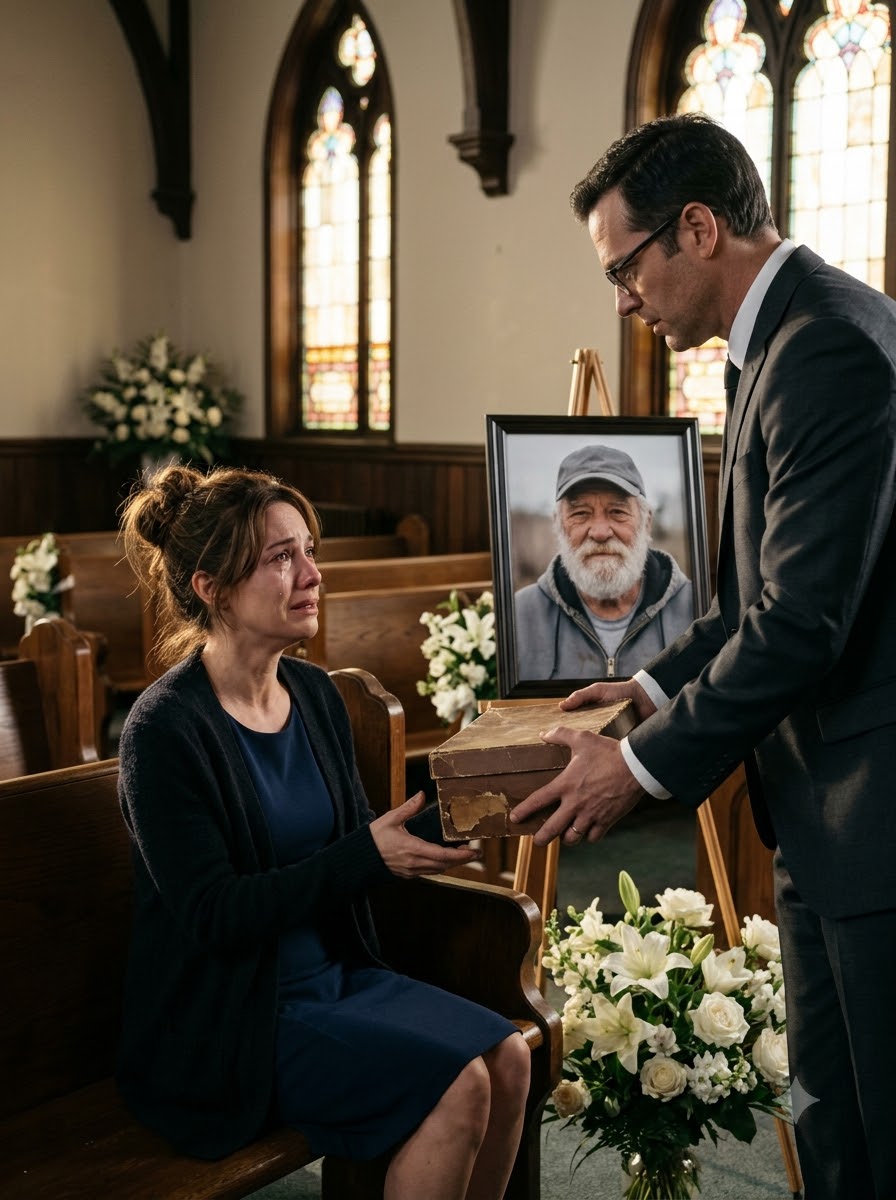
Then the man in the dark suit from the front row approached me.
He was younger than I’d first thought, perhaps forty-five, with glasses and a kind expression.
“Excuse me,” he said. “Are you Charlotte?”
I nodded.
“Yes. Charlotte Reyes.”
“My name is Liam Brennan. I was Mr. Wilson’s attorney.”
He offered his hand.
I shook it, still surprised that Charles had an attorney.
Charles, who ate bologna sandwiches and bought $2.49 cupcakes.
“He left something for you,” Liam continued. “He was very specific. I was told to give it to you personally. Only if you came today.”
“Only if I came?”
“He said, ‘If she comes, give it to her. If she doesn’t, burn it.’”
Liam smiled faintly.
“He said you’d come. He was certain of it.”
Then he bent down and lifted an old shoebox from beside the pew.
It was a Florsheim box, its cardboard softened with age.
The edges had faded brown, and one corner was held together by yellowing Scotch tape.
He placed it in my hands.
“Mr. Wilson left this for you.”
He set a business card beside me.
“If you have any questions. Any at all. Please call.”
Then he walked away.
I remained alone in the chapel, holding the box on my knees.
For a long time, I couldn’t bring myself to open it.
Finally, I lifted the lid.
Photographs filled the top of the box.
Dozens of them.
Perhaps a hundred.
Some were printed on glossy CVS photo paper.
I picked up the first photograph.
And my breath caught.
It was me.
Eleven years earlier.
My first day at Halvorsen & Pike.
I was sitting across from Charles at the little table by the window, clutching my brown paper lunch bag.
My face wore the nervous, grateful smile of someone who had just been offered a lifeline.
I had no memory of anyone taking that photograph.
Then I remembered Charles’s old silver flip phone.
He used to leave it beside his thermos, and I often teased him about how outdated it was.
He must have taken pictures when I wasn’t paying attention.
I picked up another.
My promotion day.
There I was, holding the gas station cupcake and grinning.
Another showed one of my birthdays.
Then another.
Eight birthday photographs, each featuring a cupcake with rainbow sprinkles.
There was a photograph from the week I became engaged, holding up my hand to show Charles my ring.
Another showed me after my divorce.
I looked exhausted and hollow, staring through the window with untouched lo mein in front of me.
He had kept that moment too.
Then came the day after my mother’s funeral.
Half a bologna sandwich lay on wax paper between us.
My hands were wrapped around a Styrofoam coffee cup.
There was a photograph of me holding my grandmother’s recovered opal ring toward the light.
Another showed me asleep in my chair, my head resting against the window.
I didn’t even remember that day.
Then I found a picture of the cruel sign someone had taped to Charles’s chair.
RESERVED FOR CHARLOTTE’S DATE.
He had unfolded it and photographed it.
My chest tightened.
Charles had preserved eleven years of my life.
Ordinary moments.
Painful moments.
Tiny victories.
Things nobody else had considered worth remembering.
Things I hadn’t even remembered myself.
Beneath the photographs lay the black notebook.
The one Charles carried in his uniform pocket.
The one he wrote in after lunch every day.
Except there wasn’t just one.
There were four.
Three were completely filled, and the fourth was about halfway finished.
I removed the rubber band from the first notebook.
My hands trembled as I opened it.
The entries were brief, carefully dated.
“Sept 14. New girl from Kentucky. Charlotte. Too scared to eat. Gave her a chair.”
“Sept 15. She came back. Turkey sandwich. Ate half.”
“Sept 22. She laughed today. Snorted juice. First real laugh.”
“Oct 30. Derek made a joke about us. She laughed it off. Her hands were shaking after.”
I turned another page.
Then another.
Charles had noticed everything.
Part 3
I continued reading through the notebooks, my hands growing less steady with every page.
“Feb 9. Promotion. She pretended it wasn’t a big deal. It was.”
“Feb 10. Cupcake from the Speedway. Chocolate. She ate it in four bites.”
“June 3. Getting married in August. A teacher. Hope he’s good to her.”
“Nov 18. Not wearing her ring. Eating like it’s medicine. Don’t ask. Just talk.”
“Nov 22. She told me. Kevin’s gone. Told her I’d figured.”
I swallowed hard.
Then I reached the entries about my mother.
“Apr 7. Her mother is gone. Stroke. Forgot her lunch. Gave her half.”
“Apr 8. Ask tomorrow if she slept.”
“Apr 8. She didn’t sleep. Brought two sandwiches.”
There were entries about the snowstorm and my car battery.
“Dec 12. Battery dead in the garage. Told her I was finishing the third floor. I wasn’t.”
And about my grandmother’s ring.
“Jan 3. Lost her grandma’s ring down the drain. Found it. She cried. Good tears.”
Page after page, year after year.
Charles had recorded the things I thought nobody noticed.
The handwriting became shakier with time, but his observations remained just as thoughtful.
The final entry was dated Friday, March 7, the day before he died.
“She asked about the elevator again. Still broken. She laughed. Eleven years. Still the best part of my day.”
I lowered the notebook onto the pew.
I couldn’t hold it anymore.
Tucked inside the back cover was a folded letter.
Two sheets of lined paper.
My name appeared on the front in Charles’s careful handwriting.
Charlotte.
I carried the shoebox outside and found a wooden bench beneath a dogwood tree beginning to bloom.
There, I unfolded the letter.
Dear Charlotte,
If Mr. Brennan has given you this, then you came. I knew you would. You’re the only person who ever came back to my table twice.
I want you to know that I knew what people said about us. All of it. The jokes. The sign on my chair. The way some of them looked at you with pity for sitting with the janitor every day. I heard every word. A man who cleans a building hears everything in it.
I never minded. Not once. Because none of them understood what they were looking at.
They thought they were looking at a lonely old man and a nice young woman who felt sorry for him.
That isn’t what they were looking at.
I read the first page twice.
Then I turned to the second.
Something slipped from between the sheets and landed in my lap.
An old photograph.
Its colors had faded into soft orange tones, and a crease ran down the middle.
A younger Charles stood beside a young woman wearing a graduation cap and gown.
He had his arm around her shoulders.
She held a rolled diploma close to her chest.
Her smile was broad and slightly crooked.
For one impossible second, I thought I was looking at myself.
She had dark, wavy hair.
A round face.
The same uneven smile that lifted a little higher on the left.
Even the way she held her diploma reminded me of how I had clutched my lunch bag on my first day.
I turned the photograph over.
Two words appeared in faded blue ink.
My daughter.
Beneath them, in smaller writing:
Grace. Ohio State, Class of 1983.
I unfolded the remaining page.
I had a daughter, Charlotte. Her name was Grace. Our only child. She was smart and stubborn, and she laughed so hard at her own jokes she snorted. She wanted to be a social worker.
She graduated from Ohio State in June of 1983. That’s the picture. Ruth took it. It’s the last picture we have of the two of us together.
Three weeks later, a drunk driver crossed the center line on Route 23 north of Delaware. Grace was twenty-two.
After that, Ruth and I were never the same. We stayed married. We loved each other. But most days after that felt like background noise I was just waiting out. Then Ruth got sick and passed in 1999, and after that, there wasn’t even anybody to wait it out with.
I took the job at Halvorsen & Pike because it was quiet. Because nobody looks at the man with the mop. For twenty-two years, I came in, I cleaned, I ate my sandwich by the window, and I went home. That was enough. I didn’t need more than that.
Then, on September 14th, eleven years ago, a girl from Kentucky walked into the break room holding a lunch bag in both hands. Exactly the way Grace used to hold things. And she looked around that room like she was about to cry.
And I couldn’t stand it.
You reminded me of her the moment I saw you. I want you to know that wasn’t a sad thing. It never once made me sad. It made the world feel a little less empty again. Like a light got turned back on in a room I’d stopped going into.
I never told you. I’m sorry for that. I didn’t want you to feel like you owed me something. Or like you were standing in for a girl you never met. You weren’t. You were always you. Charlotte, from Bowling Green, Kentucky, who snorts orange juice and eats cupcakes in four bites and can’t keep a ring out of a drain.
But I want you to know the truth now. Because I won’t be around to be embarrassed about it.
Everybody in that building thinks I gave you a seat at my table.
The truth is, you gave me one.
Thank you for eleven years of lunches, Charlotte. They were the best part of every single day.
Eat something. You’ll feel worse if you don’t.
Charles
I sat beneath the dogwood tree and cried until the words blurred.
I cried for Charles.
For Grace.
For Ruth.
For the decades Charles had spent sitting alone by that window before I arrived.
And for all the years I had spent across from him without knowing the depth of his grief.
I thought about the day I had asked whether he had children.
“I did,” he’d answered.
And I had allowed the conversation to end.
I had believed I was being respectful.
Now I wished I had asked again.
After a while, Liam Brennan emerged from the chapel and sat at the opposite end of the bench.
For several minutes, he said nothing.
Then he spoke softly.
“He talked about you. When we did his will last fall. After his first heart scare. He talked about you for an hour.”
I wiped my face.
“What did he say?”
“He said you were the bravest person he knew. He said you came back to work three days after burying your mother and sat at his table like nothing happened. He said you never once let those people run you off.”
Liam smiled.
“He also said you can’t park.”
A broken laugh escaped me.
“I really can’t.”
Liam explained that Charles had left his house to the Overbrook Presbyterian food pantry.
His savings would fund a scholarship at Ohio State for students studying social work, established in Grace’s name.
“He wanted you to have the box,” Liam said. “That’s all. He said the box was the important part.”
He stood, then paused.
“He said one more thing. He said, ‘Tell her to go back to the table. Tell her not to let them have it.’”
I drove home with the shoebox on the passenger seat.
I even fastened the seat belt around it.
That night, I couldn’t sleep.
I sat on the couch I’d purchased with my first promotion raise and examined every photograph, every notebook, and every page.
Around two in the morning, I found an entry from my fourth year.
“Mar 14. Derek asked her if she was ‘slumming it.’ She told him I was better company than the whole fourth floor. Loud. In front of everybody. Nobody’s said that about me since Grace.”
I had completely forgotten that afternoon.
Charles hadn’t.
On Monday, I entered the break room at noon with the shoebox tucked beneath my arm.
The room was as noisy as ever.
Derek sat at his usual table, entertaining his coworkers.
Megan stood near the coffee machine with several women from accounting.
A few people glanced toward me.
Megan offered a sympathetic half-smile.
“Hey, Charlotte. You doing okay? Heard you went to the janitor’s funeral.”
The janitor.
Not Charles.
Not Charles Wilson.
Just the janitor.
For eleven years, I would have smiled politely and let the comment pass.
Not this time.
I walked to our table beside the window.
Charles’s chair remained pushed in neatly.
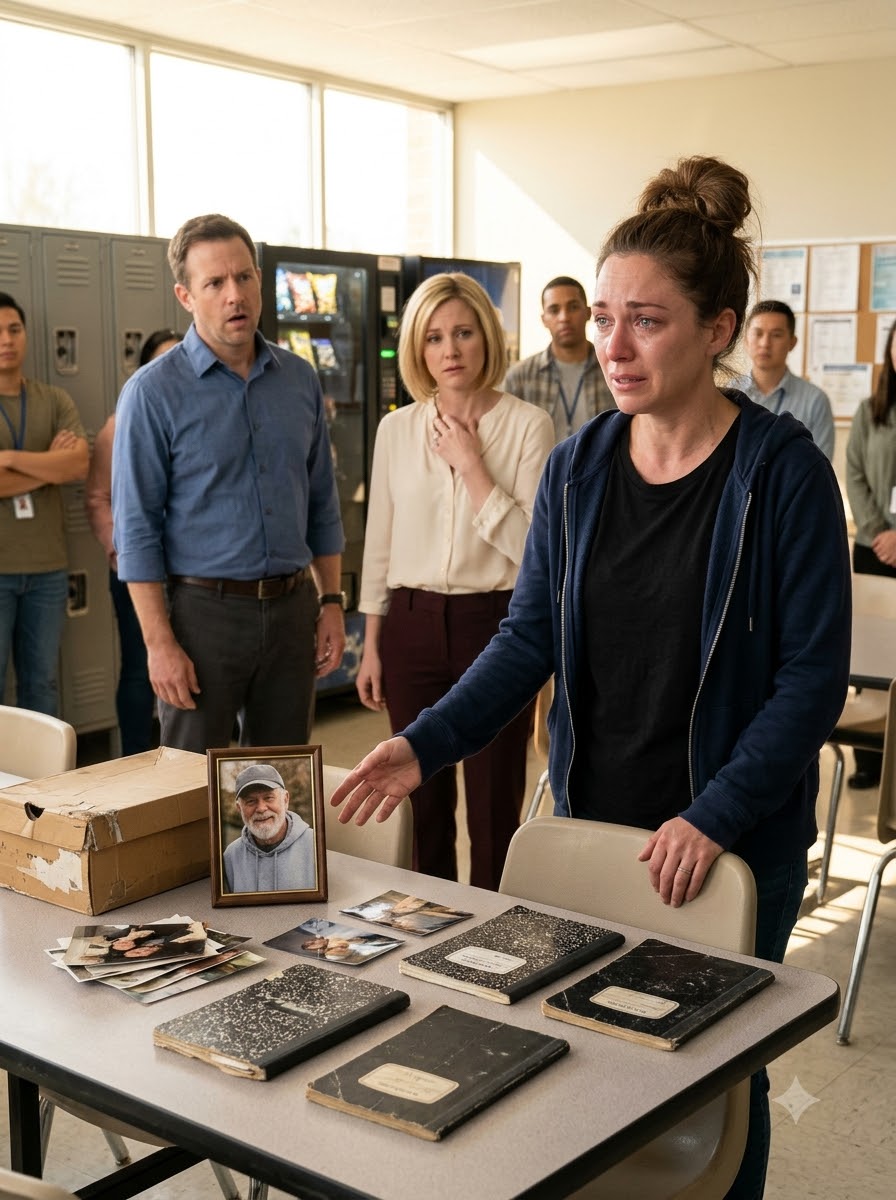
I placed the shoebox on the table and removed the lid.
Then I turned toward the room.
“His name was Charles,” I said.
My voice carried far enough that Derek stopped speaking.
“Charles Wilson. He worked in this building for thirty-three years. Longer than any of you. He fixed your printers. He found your keys. He jumped your cars in the parking garage. He knew every single one of your names.”
The conversations began to fade.
“And for eleven years,” I continued, “every single one of you thought I was doing him a favor by sitting with him.”
I removed the first photograph.
My first day, holding my lunch bag.
Then the promotion cupcake.
Then the photograph taken after my mother’s funeral, with half a bologna sandwich resting on wax paper between us.
I placed the photograph of the cruel sign beside them.
RESERVED FOR CHARLOTTE’S DATE.
Someone at Derek’s table drew a sharp breath.
Next, I set down the four black notebooks.
I opened them to the dated entries.
Finally, I placed Grace’s graduation photograph in the center of the table, directly in front of Charles’s empty chair.
The room became silent.
I’d spent the entire night thinking about what I might say.
But standing there, I realized I didn’t need a speech.
I stepped back.
And let them look.
One by one, coworkers began approaching our table.
Not everyone came.
But many did.
They studied the photographs.
They read the dates and the careful handwriting.
A young employee from IT picked up a notebook, read a page, and gently put it down.
Some people looked ashamed.
Others quietly walked away.
Derek remained seated at his table, staring at his lunch.
He said nothing.
Megan approached last.
She picked up the photograph of my promotion cupcake.
She studied the plastic container and its $2.49 price sticker.
Then she examined Grace’s photograph.
She looked at the young woman’s face, then at mine.
“She looks just like you,” Megan whispered.
“I know.”
She carefully returned both photographs to the table.
She didn’t apologize.
She didn’t say anything else.
She simply returned to her seat.
For the rest of lunch, she didn’t laugh once.
I didn’t need an apology.
I only wanted them to know Charles’s name.
I sat down in my usual chair.
That morning, for the first time in eleven years, I had prepared a bologna and cheese sandwich on white bread with yellow mustard.
I’d wrapped it in wax paper, carefully folding the corners.
It took three attempts to make the folds look right.
Across from me, Charles’s chair stood empty.
It would remain empty.
But somehow, the emptiness no longer felt like something that had been taken away.
It felt like evidence of something precious that had existed.
For eleven years, someone had noticed me.
Every day.
And for eleven years, I had chosen to sit across from him.
I ate half my sandwich.
Then I wrapped the remaining half in wax paper and placed it in front of his chair.
That spring, several things changed at Halvorsen & Pike.
Someone from the fifth floor installed a small brass plaque above our table.
I never discovered who arranged it.
The inscription read:
CHARLES WILSON. 1953–2026. THIRTY-THREE YEARS. HE NOTICED.
The east elevator was finally repaired the week after Charles’s funeral.
After years of complaints and nine reports.
Tony from facilities told me he’d found Charles’s final maintenance request in the system, dated March 6.
“East elevator still broken. Charlotte keeps asking.”
When I heard that, I laughed so hard inside the repaired elevator that I had to grab the railing.
In June, a new employee joined our floor.
His name was Mateo.
He was twenty-three, fresh out of Ohio State, and had recently moved to Columbus from a small town in New Mexico.
On his first day, I saw him standing just inside the break room doors.
He held a lunch bag in both hands.
His eyes moved from one crowded table to another.
Every group already seemed complete.
Every conversation had begun without him.
He looked like he might cry over a sandwich.
I looked at him.
Then I looked at the empty chair across from mine.
The chair beneath Charles’s plaque.
For three months, I had protected that chair.
I hadn’t imagined allowing anyone else to sit there.
Then I remembered Charles’s voice.
“People are loudest when they don’t understand what quiet is worth.”
I stood.
“Hey,” I called. “You can sit here, if you’d like.”
Mateo looked so relieved that his eyes almost filled with tears.
“Thank you,” he said.
He hurried over and sat down so quickly that he nearly knocked over my coffee.
“I’m Mateo.”
“Charlotte,” I replied.
Then I returned to my sandwich.
He came back the following day.
And the next.
Mateo talks much more than Charles ever did.
He tells me about his little sister in New Mexico, his grandmother’s green chile, and video games I don’t understand.
Most of the time, I simply listen.
One afternoon, Derek made another joke in the elevator.
“Got yourself a new lunch buddy, huh?”
I looked at him.
“He’s better company than you.”
Then I walked away.
Every afternoon after lunch, before returning to my desk, I reach into my bag and remove a small black notebook.
I slip off the rubber band.
I write a sentence or two.
Then I close it and put it away.
One day, Mateo noticed.
“What are you writing?” he asked.
“Grocery list,” I told him.
He nodded and didn’t ask again.
That’s all right.
Someday, I’ll make sure he asks twice.
