

PART 1
For five years, my father made me pay $250 in rent every single month, even when I was barely earning enough to survive.
I grew to resent him for it.
I believed he was taking money I desperately needed to build a future of my own.
But after his funeral, his closest friend arrived at our house carrying a sealed cardboard box.
What I discovered inside would change everything I thought I understood about my father.
Before my mother died, our house was always filled with music.
Dad used to sit on the living room couch most evenings, strumming his guitar while Mom sang along from the kitchen.
“Come on, buddy.”
Sometimes Mom would grab a wooden spoon and pretend it was a microphone, singing so dramatically that I’d laugh until I couldn’t remember the words.
“Come on, buddy,” Dad would say, patting the seat beside him. “Your turn.”
I’d scramble onto the couch with my little toy guitar, pretending I was performing for an enormous audience.
Back then, our house felt warm.
It felt alive.
And I thought those evenings would last forever.
Then Mom died when I was nine.
And the music disappeared with her.
Dad put his guitar away.
He began accepting extra shifts at work, often returning home so exhausted that he barely spoke.
There was always food in the refrigerator.
He signed my school forms when necessary.
He made sure the bills were paid whenever he could.
But he rarely asked how my day had gone.
It was as though the man who once laughed and played guitar beside me had disappeared, leaving behind someone whose only purpose was to work.
One afternoon, I approached him about my worn-out shoes.
“Can I get new shoes? These let water in,” I once asked.
“Put on another pair of socks,” he replied without looking up from dinner.
That was Dad.
Practical.
Distant.
Always ready with an answer, but rarely with the one I needed.
I had a father living in the same house.
Yet most days, it didn’t feel as though I had one.
When I was twelve, I discovered some old photographs tucked inside a drawer.
In one picture, Dad stood onstage with a guitar strapped across his chest.
His hair reached his shoulders.
Bright lights shone above him, and a crowd of people cheered in front of the stage.
I stared at the photograph in amazement.
“Dad, you were in a band?”
“Long time ago.”
“What was it called? Did you make an album?”
He snatched the pictures away.
“That’s enough questions.”
I stepped back, confused by his reaction.
But the photographs stayed in my mind.
I couldn’t stop wondering about the young man who’d once stood beneath stage lights, smiling as though there was nowhere else in the world he’d rather be.
One evening, I finally asked whether he’d ever dreamed of becoming famous.
Dad stared into his coffee.
“It was a dream once. But my time’s gone. Maybe you will inherit it.”
I didn’t understand what he meant.
He never explained.
By the time I turned sixteen, I’d taught myself to play guitar.
I spent hours practicing chords, studying songs, and trying to understand how melodies fit together.
Eventually, I began writing music of my own.
I dreamed of studying music production.
I wanted to learn how to record songs professionally and, someday, create an album.
For the first time in years, I felt connected to something that made me genuinely happy.
It was also the first time I felt I might have something in common with my father.
I found a music production program I desperately wanted to attend.
I printed the information and brought the brochure to Dad.
He barely glanced at it.
“Music doesn’t pay the bills. Get a real job.”
“But you played music!”
“And look where it got me.”
Then he walked away.
I stood there holding the brochure, feeling as though he’d dismissed not just my plans, but everything I loved.
That night, I passed the living room and noticed Dad standing near his old guitar.
For a moment, I thought he might finally pick it up.
Maybe he’d play something.
Maybe we’d talk about music the way we had when Mom was alive.
Instead, he turned off the light and went to bed.
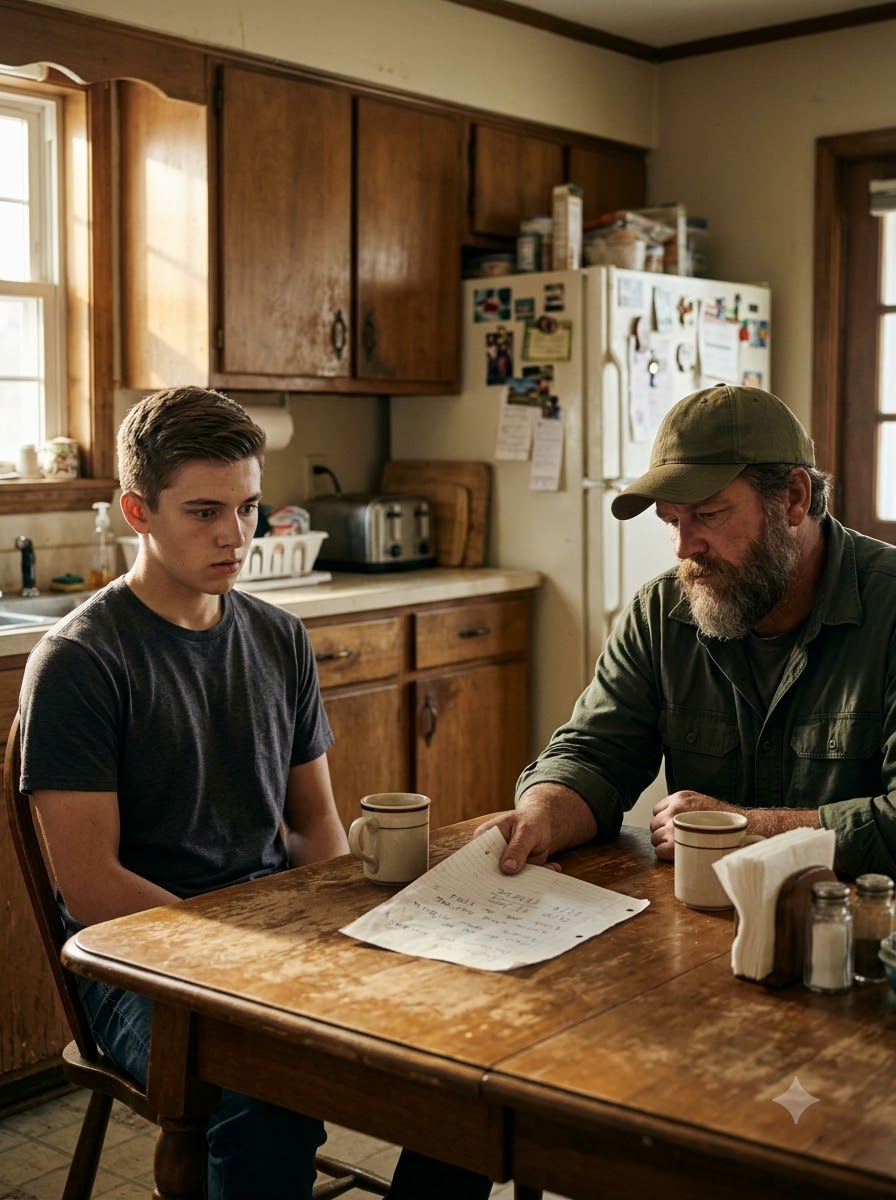
Two years later, on my eighteenth birthday, Dad placed a small scrap of paper on the breakfast table.
“Pay me $250 for your room. On the first of every month.”
I stared at him, certain I’d misunderstood.
“You’re an adult now.”
“You’re charging your own son rent?”
“It’s my birthday, Dad.”
“Then consider this your first lesson in responsibility.”
I waited for him to laugh.
I thought perhaps this was some strange birthday joke.
But Dad simply picked up his coffee and continued drinking.
He was completely serious.
I already had a part-time job.
Now I had to take additional shifts stocking shelves at the grocery store.
After paying rent, buying food, filling my gas tank, and covering other expenses, I had almost nothing left.
Whenever I managed to save a little, something went wrong.
My car needed repairs.
My hours at work were reduced.
My shoes wore out.
Every unexpected expense seemed to push my future farther away.
Meanwhile, Dad occasionally came home with beer or new fishing equipment.
One day, after seeing another purchase, I muttered under my breath.
“Must be nice having money for hobbies.”
He heard me.
“Work hard enough, and you will too.”
I wanted to tell him I was already working as hard as I could.
I wanted to ask why he couldn’t see that.
But I knew how the conversation would end.
So I said nothing.
At nineteen, I finally saved enough to purchase a used microphone and an audio interface.
They weren’t expensive professional equipment, but they were mine.
I turned my bedroom into a makeshift recording space.
I hung blankets along the walls to reduce echoes.
I experimented with recording software and spent my evenings creating songs.
For a little while, music made the house feel less empty.
Then one night, Dad appeared in my doorway.
“Turn that racket down. I’ve got work tomorrow.”
“I’m almost finished.”
“I said turn it down.”
I removed my headphones and turned toward him.
Years of frustration suddenly came pouring out.
“You couldn’t stand seeing me do something I actually love, could you?”
“I can’t stand watching you waste your life like I did.”
I stared at him.
He looked exhausted.
Angry.
And completely unwilling to understand me.
The argument ended when I slammed my bedroom door so hard that a picture fell from the wall.
After that, I recorded less frequently.
My guitar spent most days inside its case.
I still played whenever Dad was away, but I no longer wanted him to hear me.
His oldest friend, Frank, visited occasionally.
Sometimes the two men left together carrying tools or pieces of old equipment.
I assumed they were repairing something in Frank’s garage.
I never bothered asking.
By twenty-three, Dad and I barely spoke.
We passed each other in the hallway like strangers sharing a house.
On the first day of every month, I left $250 on the kitchen table.
Sometimes, I’d catch him looking at me.
His expression would change, almost as though he wanted to say something.
But he never did.
And I had stopped trying.
Five years after he first demanded rent, my father died of cancer.
I’d spent years imagining how relieved I’d feel when I finally had the house to myself.
But after his funeral, I stood in the hallway staring at his old work boots beside the front door.
I couldn’t bring myself to move them.
During his final week, we’d barely spoken.
Our last conversation had been about a leaking kitchen faucet.
Nothing important.
Nothing meaningful.
No apology.
No chance to say the things we’d spent years keeping inside.
And now there would never be another conversation.
That evening, someone knocked at the door.
It was Frank.
Dad’s oldest friend stood on the porch holding a cardboard box sealed with tape.
“Your dad left this with me.”
He carried it inside and placed it on the kitchen table.
“He wanted you to open this only after he was gone.”
I gave a bitter laugh.
“What, did he save every dollar of rent I paid him?”
Frank didn’t smile.
“I wouldn’t make any guesses until you see what’s inside.”
I tore away the tape and lifted the lid.
At first, I thought Frank must have brought the wrong box.
Inside was an old leather vest decorated with band patches.
There were backstage passes, guitar picks, and photographs of Dad performing onstage.
Then I uncovered a picture of Mom.
She stood beside Dad, smiling at him while he played his guitar.
He looked happier than I’d seen him in fourteen years.
Suddenly, I remembered those evenings from my childhood.
Mom singing in the kitchen.
Dad playing on the couch.
Me pretending to perform with my toy guitar.
The memories hit so hard that I sank into Dad’s chair and began sobbing.
Frank sat beside me and supported me until I could breathe normally again.
He stayed until I’d calmed down.
Then he quietly left.
Later, as I returned the photographs to the box, something metallic caught my eye beneath the leather vest.
I moved the vest aside.
There was a key.
A small tag was attached to it.
On the tag was an address I didn’t recognize.
I turned it over, searching for an explanation.
There was nothing else.
No note.
No instructions.
Just an unfamiliar address and a key.
I grabbed my jacket and car keys.
The address led to the outskirts of town, beyond a stretch of warehouses and an abandoned gas station.
I’d lived in the area my entire life, yet I couldn’t remember ever visiting that particular street.
I checked the address again.
It matched.
“What were you doing out here, Dad?” I whispered.
I walked around the building, looking for some indication of what it was.
There was no sign.
No parked cars.
Nothing visible through the windows.
The place appeared abandoned.
Except for one detail.
A clean welcome mat lay outside the entrance.
I slipped the key into the lock.
It turned easily.
For several seconds, I stood motionless.
Part of me was frightened of what I might discover.
What if Dad had been hiding something terrible?
What if the man I’d spent years resenting had an entire secret life I knew nothing about?
Finally, I pushed the door open.
I found the light switch.
And the moment the lights came on, I froze.
Because standing before me was something I never could have imagined my father owned.
PART 2
The room was a professional recording studio.
Dark acoustic panels covered the walls.
A large mixing desk occupied one corner, surrounded by speakers and computer monitors.
Several microphones stood near guitar amplifiers.
Behind a glass partition sat a complete drum kit.
I stepped farther inside, trying to make sense of what I was seeing.
Everything looked expensive.
Professional.
Carefully arranged.
And impossibly clean.
I ran my fingertips along the mixing desk.
There wasn’t a trace of dust.
Someone had been maintaining this place.
Recently.
“Dad?” I whispered, almost expecting him to answer.
Of course, nobody did.
I walked slowly through the room, examining the equipment.
There were electric guitars.
A keyboard.
Microphones and audio equipment that I’d only ever dreamed of owning.
I recognized one audio interface immediately.
I’d researched that exact model years earlier.
It cost more than three months of my wages.
How could my father have afforded all of this?
And why had he kept it hidden?
Then I noticed a wall covered in photographs, concert posters, and old newspaper clippings.
One picture showed Dad as a young man, holding his guitar high above his head beneath bright stage lights.
Another showed a crowd reaching toward the stage.
I moved closer to a framed newspaper clipping.
The headline read:
“Local Rock Band Packs Riverside Theater for Third Consecutive Weekend.”
I read it twice.
Then a third time.
My father hadn’t simply played guitar with a few friends in somebody’s garage.
He’d performed in front of packed audiences.
People had bought tickets to watch him play.
He’d once been part of something extraordinary.
Yet he’d never told me any of it.
“Why did you hide all this?” I murmured.
I continued exploring the studio.
Everywhere I looked, there was another piece of professional equipment.
It was the kind of place I’d imagined working in when I was sixteen, sitting in my bedroom with blankets hanging from the walls.
Then I noticed something beside the keyboard.
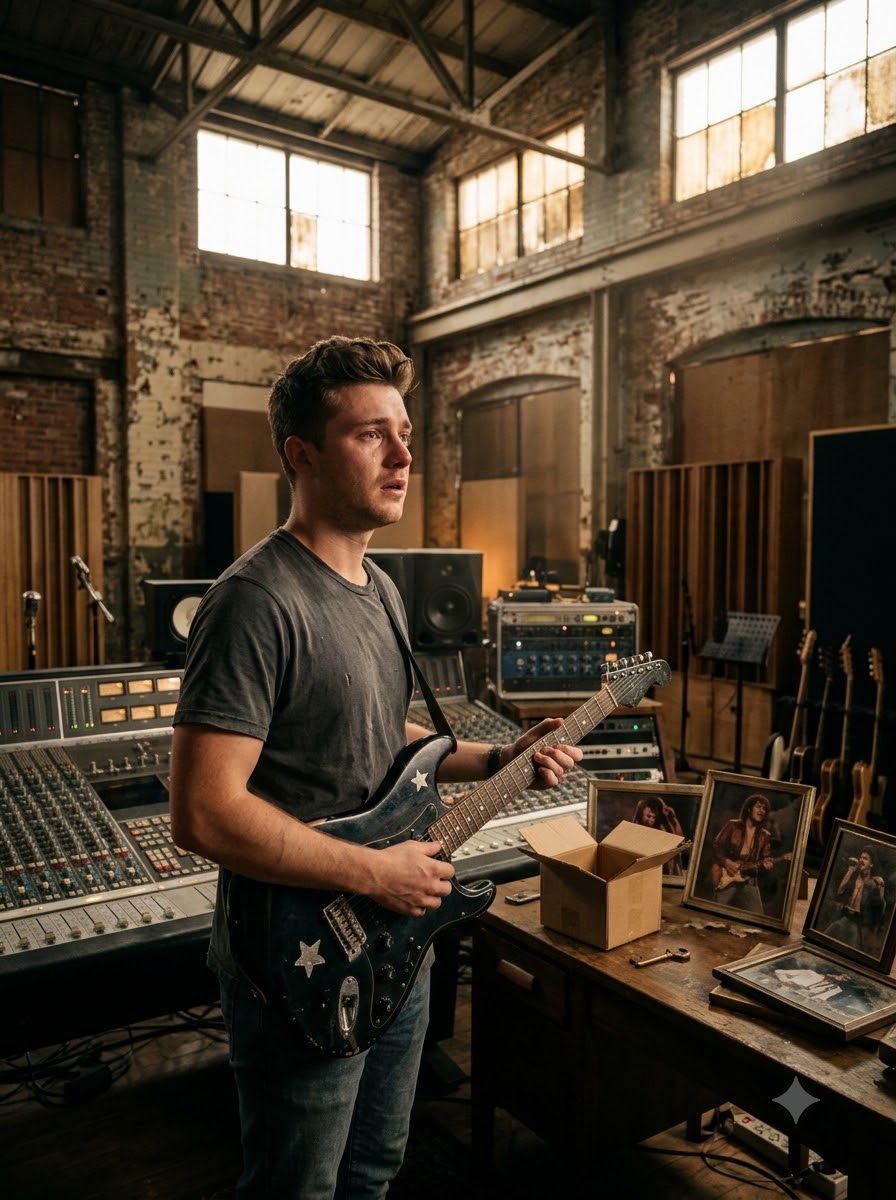
A battered black guitar stood on a rack.
Near its neck was a tiny silver star sticker.
I stopped breathing for a moment.
It was my guitar.
The one I’d purchased secondhand when I was sixteen.
I’d played it almost every day until my arguments with Dad became unbearable.
Later, while clearing out my bedroom, the guitar had disappeared.
I’d assumed I’d accidentally thrown it away.
But here it was.
I lifted it carefully from the stand.
The strings were new.
The body had been cleaned.
Even the small crack near the bridge had been repaired.
Someone had taken the time to restore it.
I ran my thumb over the familiar silver star.
For years, I’d believed Dad hated hearing me play.
He’d complained whenever I recorded music.
He’d dismissed my ambitions.
He’d told me I was wasting my life.
Yet he’d kept my guitar.
He’d repaired it.
And he’d placed it inside a recording studio filled with equipment I could never have afforded.
A thought began forming.
Had Dad built this place for someone other than himself?
Could he possibly have built it for me?
But that made no sense.
Why would a man who’d spent years discouraging my dreams secretly create the very place where I could pursue them?
I carefully returned the guitar to its stand.
Then I noticed a small flash drive beside the mixing desk.
A piece of tape was attached to it.
Two words had been written in Dad’s handwriting.
“Our Band.”
I picked it up.
A computer sat nearby, already connected to the studio equipment.
I plugged in the flash drive.
There was only one video file.
I clicked “Play.”
The screen flickered.
Grainy footage appeared.
Four young men were rehearsing in a cramped garage.
One of them was my father.
His hair fell past his shoulders.
He held an electric guitar.
A cigarette was tucked behind his ear.
He looked completely different from the tired, silent man I’d grown up with.
“Come on, Frank!” he shouted at the drummer. “My grandma can keep a better beat than that!”
“Then invite her to join the band!”
Everyone burst into laughter.
I smiled despite myself.
Frank.
Dad’s closest friend.
The same man who’d brought me the mysterious box.
I’d known him for years, but I’d never imagined him sitting behind a drum kit, laughing with my father in a crowded garage.
The video continued.
There were recordings of concerts.
Clips from backstage.
Rehearsals filled with jokes and ridiculous mistakes.
In one scene, Dad attempted to jump from a speaker.
He landed flat on his backside.
In another, the bassist accidentally knocked over an entire tray of drinks.
Everyone shouted and laughed.
I found myself laughing too.
Actual tears gathered in my eyes.
Not because I was sad.
Because the young man on the screen was funny.
Energetic.
Confident.
He joked with his friends.
He smiled without hesitation.
He seemed to love every moment of his life.
I’d never known that version of my father.
The man who’d raised me rarely laughed.
He barely spoke at breakfast.
He came home from work exhausted, ate dinner in silence, and went to bed.
I’d spent years believing that was simply who he was.
Now I realized there had been another version of him.
A version who’d once been happy.
A version who’d loved music as much as I did.
Then the footage stopped abruptly.
The screen went black.
I leaned forward, thinking the video had ended.
Several seconds passed.
Then another image appeared.
Dad was sitting inside the same studio where I stood.
But this wasn’t the young musician with shoulder-length hair.
This was the man we’d buried that morning.
His face was thin and hollow.
Cancer had taken most of his hair.
He looked exhausted.
And he was staring directly into the camera.
“Hey, son.”
My breath caught.
For a moment, I couldn’t move.
It felt impossible to hear his voice again.
Dad lowered his eyes toward his hands.
“I’ve never been good at this stuff. Talking about feelings. You know that better than anybody.”
He attempted a small smile.
“First thing I want to say is… I’m sorry.”
I gripped the edge of the mixing desk.
“I spent so much time worrying about making sure you had a decent life that I forgot something pretty important. Life’s supposed to make you happy, too. Not just pay the bills.”
He shook his head slowly.
“When your mom died, I got scared. I thought if I worked hard enough, kept a roof over our heads, and made sure you learned to stand on your own two feet, I’d be doing my job.”
He paused.
“Somewhere along the way, I forgot how to be your dad.”
My eyes filled with tears.
I’d spent fourteen years waiting for him to acknowledge what had happened between us.
Now he was finally saying the words.
And he wasn’t alive for me to answer.
Dad swallowed.
“A while back, I started watching these old recordings. Just feeling nostalgic, I guess. And I remembered how much I loved playing music. How happy it made me. Then I remembered how you used to look when you played.”
“And I realized I’d spent years trying to protect you from the very thing that once made my own life worth living.”
He wiped his eyes.
I could see how difficult it was for him to continue.
“By then, we’d barely spoken in years. I wanted to tell you everything, but I knew how it would look. Like I was trying to buy your forgiveness with some expensive gift.”
He gestured toward the studio around him.
“So I made a decision. I asked Frank to give you that box only after I was gone. Because I don’t want you to feel like you owe me anything. Not forgiveness. Not gratitude. Not even a phone call.”
I stared at the screen.
For years, I’d believed my father simply didn’t care about my future.
Now I was standing inside a studio he’d kept secret from me, listening to him explain why.
Dad drew a shaky breath.
“When you get this place, it’ll be yours. You can make music, sell the equipment, turn it into something else. Whatever makes you happy. And I won’t be around to tell you you’re doing it wrong.”
He stared into the camera for several seconds.
Then someone entered the frame.
It was Frank.
He rested a hand on Dad’s shoulder.
“We’ve got his back, buddy.”
Two more men joined them.
I recognized both from the photographs on the studio walls.
One was the bassist.
The other was the drummer.
The bassist grinned.
“Besides, once you’re gone, we’re going to need a new guitarist.”
“And a singer,” the drummer added. “Preferably one who can actually hit the high notes.”
Dad laughed and wiped his face.
“You hear that, son? Apparently, they’re already planning to replace me.”
He looked toward his former bandmates.
Then he faced the camera again.
“Seriously, though. These idiots have been my friends for most of my life. They’ll help you if you want to give music a shot. And if you don’t, they’ll respect that too.”
The men stepped away.
Dad remained alone.
He looked tired.
But there was something peaceful in his expression that I hadn’t seen in years.
“One last thing. Open the drawer under the mixing desk. There’s something in there to help you get started.”
I glanced instinctively toward the drawer beneath my hands.
Dad’s voice began trembling.
“I wish I’d been a better father. I wish we’d had more time. But most of all, I wish I’d told you how proud I am of you.”
A tear rolled down his cheek.
“I love you, son. I always have.”
He reached toward the camera.
“Goodbye, buddy.”
The screen went black.
I remained motionless.
Then I folded forward over the mixing desk and began sobbing.
I cried harder than I had at his funeral.
For years, I’d wanted my father to tell me he was proud of me.
I’d wanted him to understand that music wasn’t simply a foolish dream.
I’d wanted him to see me.
And now, when he finally had, I couldn’t tell him how much those words meant.
Eventually, I lifted my head.
I wiped my face.
Then I remembered his final instruction.
The drawer beneath the mixing desk.
I reached down and slowly pulled it open.
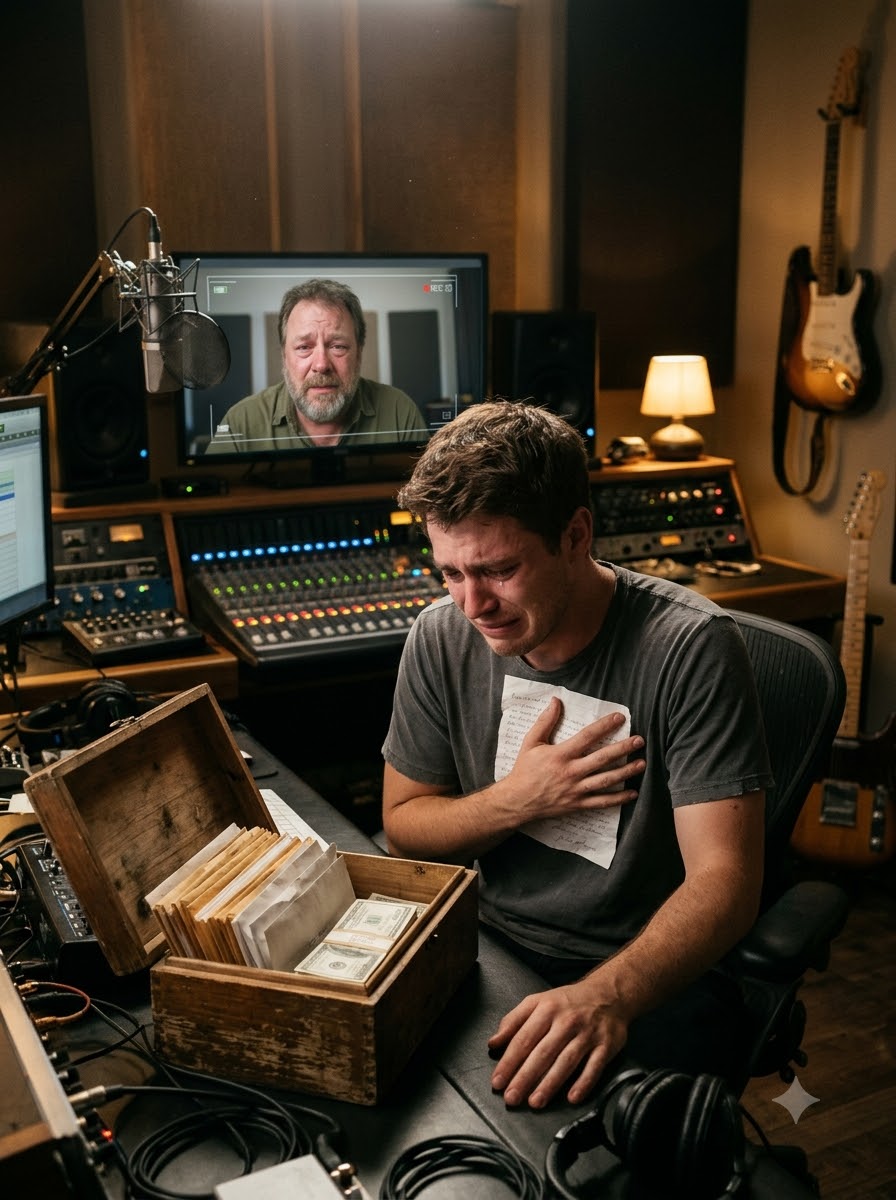
Inside sat a wooden box.
It was filled with envelopes arranged in neat rows.
Every envelope had a month and year written across the front.
I picked up the first one.
Opened it.
And found two hundred-dollar bills and a fifty.
I stared at the money.
Then I opened the next envelope.
Exactly the same amount.
I counted the envelopes.
There were sixty.
And suddenly, I understood what my father had been hiding for the past five years.
PART 3
I sat in front of the mixing desk, staring at the wooden box.
Sixty envelopes.
Each carefully labeled with a month and year.
Each containing exactly $250.
I began counting the money, although part of me already knew what the total would be.
Five years.
Twelve months each year.
Two hundred and fifty dollars every month.
Fifteen thousand dollars.
Every single rent payment I’d made since turning eighteen was sitting in that drawer.
My hands started shaking.
I remembered the morning of my eighteenth birthday.
Dad pushing a scrap of paper across the breakfast table.
“Pay me $250 for your room. On the first of every month.”
I’d stared at him, waiting for a smile.
I’d thought he was joking.
Instead, he’d told me that adulthood came with responsibility.
And for the next five years, I’d believed he was taking money I needed for my own future.
Every month, I left the cash on the kitchen table.
Sometimes I had to work extra shifts to earn it.
Sometimes I had to postpone buying something important.
Sometimes I looked at my bank account and wondered whether I’d ever save enough to leave that house.
All the while, Dad had been keeping the money.
Not spending it.
Not using it for beer or fishing equipment.
Not taking it for himself.
He’d been saving it.
For me.
I opened another envelope.
Then another.
Every one contained the same amount.
There was no missing month.
No unexplained deduction.
Every payment had been preserved.
On top of the envelopes lay a handwritten note.
I recognized Dad’s handwriting immediately.
“You earned every dollar of this. Don’t waste it the way I wasted my chance.”
I read the note again.
Then I pressed it against my chest.
For years, I’d believed my father was slowly taking away my chance to build a future.
Two hundred and fifty dollars at a time.
But he’d been setting that money aside while quietly preparing something I never imagined.
A professional recording studio.
A place filled with instruments, microphones, and equipment.
A place where I could create the music I’d dreamed of making since I was sixteen.
And a box containing every dollar I’d paid him.
I looked around the room again.
The dark acoustic panels.
The speakers.
The mixing desk.
The computer monitors.
The microphones standing beside the amplifiers.
The drum kit behind the glass.
Everything had been carefully arranged.
Everything had been maintained.
Nothing looked abandoned.
This wasn’t some forgotten room filled with old equipment.
It was a studio ready to be used.
My eyes moved toward the guitar beside the keyboard.
My old black guitar.
The tiny silver star sticker was still there.
So was the repaired crack near the bridge.
I remembered how devastated I’d been when the instrument disappeared.
I’d assumed it had been lost while I was clearing my bedroom.
I never suspected Dad had taken it.
I certainly never imagined he’d have it repaired and restrung.
For years, he’d told me to stop wasting my time on music.
Yet he’d preserved the very instrument I’d used to pursue it.
I couldn’t understand why he’d never found a way to tell me.
Then I remembered his recorded message.
He’d been afraid the gift would seem like an attempt to buy my forgiveness.
He hadn’t wanted me to feel indebted to him.
Not for the studio.
Not for the money.
Not for anything.
He wanted me to be free to decide what happened next.
I looked toward the computer.
The screen was dark.
Dad’s final words echoed in my mind.
“I love you, son. I always have.”
Those were words I’d needed to hear for so many years.
As a child, after Mom died, I’d waited for him to sit beside me and talk about her.
I’d wanted him to pick up his guitar again.
I’d wanted him to ask about my day.
Instead, he’d worked longer hours and grown quieter.
When I asked for new shoes, he’d told me to wear another pair of socks.
When I showed him the music production program, he’d told me to find a real job.
When I played guitar in my bedroom, he’d complained about the noise.
I had interpreted every one of those moments as proof that he didn’t care about what made me happy.
Now I understood that he’d been frightened.
Mom’s death had changed him.
He’d convinced himself that providing food, shelter, and financial discipline was enough.
He’d believed he could protect me from disappointment by discouraging the dream he’d once pursued himself.
But somewhere along the way, he’d stopped being the father who invited me onto the couch with my toy guitar.
He’d forgotten how to share his life with me.
And I had grown up believing his silence meant he didn’t love me.
The recording had shown me something different.
It hadn’t erased the difficult years.
It hadn’t made our arguments disappear.
It hadn’t changed the fact that we’d barely spoken during his final week.
Our last conversation would always be about that leaking kitchen faucet.
Nothing could change that now.
But the studio showed me that Dad had eventually recognized what he’d done.
He’d understood that he’d spent years pushing me away from something that once made him happy.
And he’d tried to make things right.
Not with an apology spoken across our kitchen table.
Not with a conversation while we were both still alive.
But with a place where I could finally pursue the future I’d imagined.
I thought about the old band footage.
Dad laughing with Frank.
Joking with the drummer.
Playing guitar beneath bright stage lights.
Trying to jump from a speaker and landing on his backside.
The bassist knocking over drinks.
The four of them laughing as though nothing in the world could possibly go wrong.
That young man had seemed so different from the father I’d known.
But he was still Dad.
The same man who’d once filled our living room with music.
The same man who’d invited me to play beside him.
The same man who’d lost his wife and never truly recovered from the grief.
For fourteen years, I’d remembered him mostly as the silent man sitting across from me at breakfast.
Now I had seen the person he’d been before our family changed.
I looked at the photographs hanging on the studio wall.
There were crowds.
Concert posters.
Newspaper clippings.
Proof that my father’s musical dreams had once been real.
He hadn’t merely imagined performing before audiences.
He’d done it.
He’d stood onstage and played while people cheered.
And when his life took a different direction, he’d buried that part of himself so deeply that his own son barely knew it existed.
I wondered how many times he’d come to this studio while I was working at the grocery store.
How many evenings he’d spent arranging equipment.
How many hours he’d worked alongside Frank and the others.
I remembered seeing them leave our house carrying tools and old equipment.
I’d assumed they were repairing things in Frank’s garage.
Now I understood why they’d been spending time together.
They’d been preparing this place.
I thought about Frank bringing the box to our house after the funeral.
He’d watched me make that bitter joke.
“What, did he save every dollar of rent I paid him?”
And he’d simply told me not to guess until I opened it.
He’d known.
He’d known about the studio.
He’d known about the envelopes.
He’d known Dad’s final message was waiting for me.
Yet he’d respected my father’s request and allowed me to discover everything myself.
I looked toward the flash drive still connected to the computer.
“Our Band.”
Two words in Dad’s handwriting.
A lifetime of memories stored on something small enough to fit in my pocket.
I realized I now had the chance to know my father in a way I never had while he was alive.
Through his music.
Through the recordings he’d saved.
Through the friends who’d known him before grief changed him.
And through the studio he’d left behind.
The bandmates in the video had promised to help if I wanted to pursue music.
They’d also promised to respect my decision if I chose something else.
For the first time, I understood that the choice was truly mine.
I could make music.
I could sell the equipment.
I could turn the studio into something different.
Dad had said he wouldn’t be around to tell me I was doing it wrong.
Those words hurt.
Because for so long, I’d resented him for telling me what to do.
Now I wished he were sitting beside me, even if only for one more conversation.
I wished I could ask him about the Riverside Theater.
About the band.
About the songs he’d written.
About Mom singing in our kitchen.
I wished I could tell him that I still remembered sitting beside him with my toy guitar, pretending we were performing before thousands of people.
I wished I could tell him that those memories had never stopped mattering.
And I wished I could ask why he’d waited until it was too late to say the things we both needed to hear.
But there would be no answer.
Only the video.
The studio.
The guitar.
And the wooden box filled with sixty envelopes.
I carefully placed the money back inside.
Then I folded Dad’s note and held it between my fingers.
“You earned every dollar of this. Don’t waste it the way I wasted my chance.”
He’d wanted me to have a future that wasn’t limited by his mistakes.
He’d wanted me to find happiness, not merely earn enough money to survive.
He’d wanted me to understand that responsibility mattered, but so did having something worth living for.
I still wished he’d found a kinder way to teach me those lessons.
I wished he’d told me the truth while we could still talk.
I wished we hadn’t spent five years passing each other in the hallway like strangers.
But I could no longer believe he’d taken my money because he didn’t care.
He’d saved every dollar.
And he’d left me something far more valuable than I’d expected.
A chance to begin again.
I stood up and walked toward my old guitar.
I lifted it from the stand.
The instrument felt familiar in my hands.
The strings were new, but the weight was the same.
The little silver star still shone near the neck.
I remembered the boy I’d been at sixteen, practicing alone in his bedroom.
The teenager who dreamed of studying music production.
The young man who recorded songs with blankets hanging on the walls because he couldn’t afford proper acoustic panels.
Now I stood inside a real recording studio.
A studio my father had prepared for me.
I looked at the dark computer screen.
For a moment, I imagined Dad sitting on the living room couch, patting the seat beside him.
“Come on, buddy,” Dad would say, patting the seat beside him. “Your turn.”
I remembered Mom singing in the kitchen.
The wooden spoon microphone.
The laughter.
The warmth.
The music that had disappeared when I was nine.
I held the guitar a little tighter.
Then I looked around the studio one final time.
There were so many things I wanted to say.
So many questions I’d never be able to ask.
But one thought rose above all the others.
For five years, I’d believed Dad was taking away my future, $250 at a time.
All along, in his stubborn and deeply misguided way, he’d been trying to give it back.
I looked toward the silent computer.
“Thanks, Dad,” I whispered. “I just wish you’d told me while you were here.”
