

PART 1
For twenty years, my mother prepared an extra meal every day for the homeless man living behind our house.
I grew up watching her carry food through the back door, regardless of how little we had for ourselves.
The morning after her funeral, that same man took both my hands, glanced toward our kitchen window, and whispered, “Before she died, your mother BEGGED ME TO STAY SILENT.”
Then he reached into his coat and produced something I hadn’t seen since I was eight years old.
But to understand why that moment changed everything I believed about my family, I have to explain what life with my mother had been like.
For most of my childhood, I believed she cared more about a stranger than she cared about her own comfort.
There were times when I even wondered whether she cared more about him than she did about me.
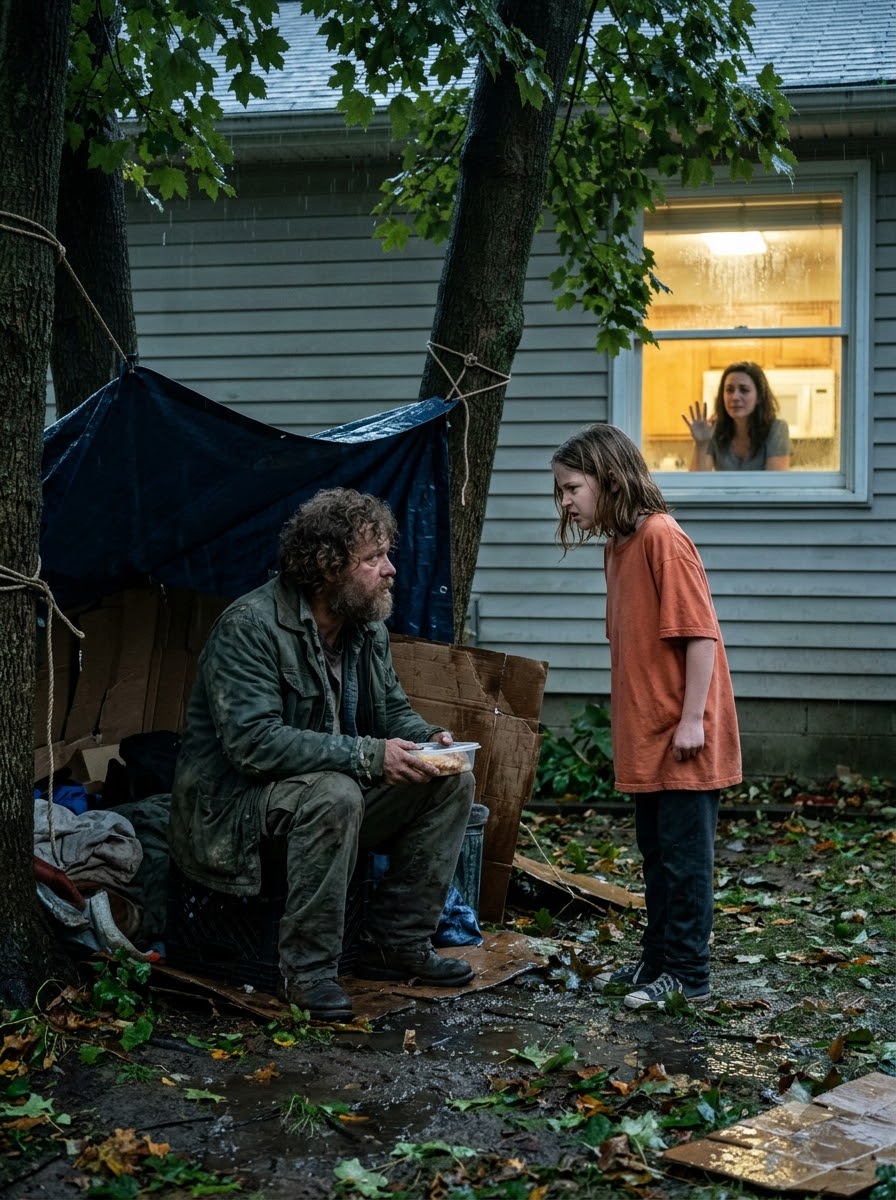
His name was Elias.
He lived behind our modest rental home, beneath two aging maple trees, in a makeshift shelter constructed from ripped tarps, discarded boards, and sheets of metal scavenged from nearby construction sites.
Nobody seemed to know when he’d first settled there.
As far back as my memories reached, Elias had been part of the landscape behind our fence.
He wore a faded brown coat and often sat beside a coffee can filled with burning twigs, holding his hands above the small flames to keep warm.
Every afternoon, my mother, Evelyn, prepared three meals.
One for herself.
One for me.
And one for Elias.
She saved plastic containers from grocery-store purchases, washed them carefully, and used them to carry his food.
Some evenings, she packed soup.
Other nights, it was chicken and rice.
On Sundays, when she cooked meatloaf, Elias always received the thickest piece.
I noticed every time.
Children have a remarkable ability to recognize what feels unfair, especially when they believe they’re the ones receiving less.
And our family had very little.
Every spring, rainwater leaked through our kitchen ceiling.
Our heater failed whenever the weather turned bitterly cold.
During some winters, I wore my coat inside because the house was too cold to sit comfortably without it.
When I was eleven, the front of my sneakers split apart.
Mom covered the opening with gray tape and promised she’d replace them after her next paycheck.
That evening, I watched her put two pieces of chicken into Elias’s container.
Only one piece remained on the plate between us.
I’d been carrying resentment for years.
That night, I finally let it out.
“He eats better than I do.”
Mom was standing beside the stove, stirring gravy.
Her hand stopped.
“Claire, please don’t start.”
“I’m not starting anything. I’m telling the truth.”
She resumed stirring, although I could see the tension gathering in her shoulders.
“Elias hasn’t eaten all day.”
“How do you know?”
“I just know.”
I glanced down at the gray tape covering my shoes.
“The electricity was shut off twice this winter, but you never forget his dinner.”
Mom set down the spoon.
“We have a home.”
“So does he. He built one behind ours.”
“Claire.”
“What?”
Her voice carried a warning.
But I was too angry and hurt to listen.
“You give him the best food. You save blankets for him. You worry when he disappears. Why?”
“He needs help.”
“So do we.”
Mom turned away and picked up another plastic container.
I followed her.
“He’s just some strange man who decided to live behind our house.”
The container slipped from her fingers and struck the counter.
“He is not just some strange man.”
Her voice was so fierce that I instinctively stepped backward.
For several seconds, we stood motionless.
The kitchen smelled of onions and gravy.
Rain tapped against the glass above the sink.
Beyond the window, a faint light glowed beneath Elias’s shelter.
“Then who is he?” I asked.
Mom parted her lips.
For a moment, something crossed her expression that I couldn’t understand.
Fear.
Perhaps shame.
I thought she was finally about to explain.
Instead, she filled the container, pressed the lid into place, and handed it to me.
“Take this to him before it gets cold.”
“Mom—”
“Please, Claire.”
I held the food against my chest.
“Maybe if you stopped feeding strangers, we wouldn’t live like this.”
Her palm struck the countertop so hard that the silverware jumped.
“Do not ever say that again.”
I stared at her.
My mother almost never raised her voice.
“You have no idea what that man gave up,” she said.
“Gave up for whom?”
The color drained from her face.
“For you?”
Mom turned toward the darkened window.
“Take him his dinner.”
She refused to say anything more.
Outside, Elias sat beside the fence while rainwater dripped from the edge of his tarp into a metal bowl near his boots.
He looked up as I approached.
“Your mom make chicken tonight?”
“Yes.”
A faint smile appeared.
“She always puts too much pepper in the gravy.”
I frowned.
“How would you know?”
His smile vanished.
I pushed the container toward him.
“You don’t know her.”
Elias accepted the meal without opening it.
“No,” he said quietly. “I suppose you’re right.”
I turned and hurried back inside.
Through the kitchen window, I saw Mom watching us.
One hand rested against the glass.
Years passed, but the third meal remained a daily ritual.
Elias lived behind our fence through blazing summers and winters so severe that the water pipes froze.
Sometimes he disappeared for several days.
Whenever that happened, Mom barely slept.
She left sandwiches wrapped in foil beneath the maple tree.
She visited the bus station and asked whether anyone had seen him.
When he finally returned, looking thinner and more exhausted than before, she never demanded an explanation.
She simply heated soup.
Eventually, I stopped asking questions.
Every conversation ended with the same answers.
Elias needs help.
You don’t understand.
Let the past stay where it is.
Yet unusual things kept happening around our home.
After a powerful windstorm damaged the roof, someone repaired it before Mom could contact the landlord.
When the wooden porch step cracked, a new one appeared overnight.
Every winter, neatly stacked firewood appeared beside our back door.
Mom always insisted she hadn’t ordered any.
During my first year of high school, the soles of my boots split.
I didn’t tell her.
She was already working two jobs and sleeping fewer than five hours most nights.
The following morning, I discovered a pair of gently used leather boots beside my backpack.
“Where did these come from?” I asked.
“Someone from church donated them.”
She answered much too quickly.
I glanced through the window.
Elias was sweeping snow from our porch.
When he realized I was watching, he lowered his head and returned to the fence.
I wore those boots for three winters.
At eighteen, I left home to attend college in another city.
Distance made my relationship with Mom easier.
We spoke every Sunday.
I returned for holidays.
But I stopped questioning her about Elias.
Whenever I visited, he was still there.
Older.
Thinner.
His beard increasingly gray.
And every evening, the third meal still waited beside the stove.
I eventually found a job at a library, rented a small apartment, and built a life away from that house.
I visited Mom whenever I could.
Then she became sick.
At first, she blamed exhaustion.
She claimed the pain beneath her ribs came from lifting boxes at work.
By the time she finally visited a doctor, the cancer had already spread.
I’d always believed my mother was indestructible.
Evelyn could carry two grocery bags in each hand, open the door with her elbow, and still remember to ask whether I’d eaten.
Within months, she’d grown so thin that her wedding ring slipped from her finger.
I moved back home.
My days became a cycle of medical appointments, medications, and pretending not to notice how little food she could manage.
Elias remained behind the fence.
Mom could no longer cook, so I prepared simple meals.
Two for us.
And, because she insisted, another for him.
Even then, I resented it.
One evening, while Mom slept on the couch, I carried a bowl of stew outside.
Elias sat beside a pile of chopped wood.
“You should leave,” I told him.
He slowly raised his head.
“What?”
“My mother is dying. She worries about you when she should be thinking about herself.”
His expression tightened.
“I know she’s sick.”
“Then stop making her responsible for you.”
Elias stared at the ground.
After a long silence, he spoke.
“I tried to leave many times.”
“Then why did you come back?”
He looked toward the kitchen window.
“Because she asked me to stay close.”
“Why?”
He shook his head.
“That isn’t mine to tell.”
I was so furious that I almost threw the bowl at him.
Instead, I placed it on the ground and walked away.
Two weeks before Mom died, I sat beside her hospital bed as rain ran down the window.
Her breathing had become shallow.
Speaking seemed to require all the strength she had left.
“Claire.”
“I’m here.”
She reached for my wrist.
“You have to promise me something.”
“Anything.”
“Elias.”
My stomach tightened.
“Mom, please.”
“Listen to me.”
“You need to rest.”
“No.”
Her fingers gripped my wrist with unexpected strength.
“Promise me you’ll keep taking him food.”
I stared at her.
Even now, when she had so little time left, she was still worrying about the man behind our house.
“Why is it always him?” I whispered.
Tears filled her eyes.
“I never put him before you.”
“It felt like you did.”
“I know.”
Her voice broke.
“And I am so sorry.”
“Then tell me the truth.”
Mom glanced toward the hospital door.
“If Grant comes to the house after I’m gone, do not let him take the blue box.”
I frowned.
“Uncle Grant?”
Grant was Mom’s younger brother.
He lived forty minutes away with his wife, Monica, but we usually saw him only during holidays.
He wore expensive watches, drove a black sedan, and spoke about our poverty as though it were an illness he’d narrowly avoided catching.
“What does Grant have to do with Elias?”
Fear filled Mom’s eyes.
“He’ll erase him completely.”
“Erase Elias?”
She tightened her grip.
“The blue box is behind the loose panel in my closet. Your name is written on it.”
“Mom, what is inside?”
“Promise me Grant won’t touch it.”
“I promise.”
A tear rolled toward her temple.
“He was my safe place,” she whispered.
“Who was?”
Mom closed her eyes.
She never answered.
Four days later, my mother died.
And the warning she’d given me became the only thing I could think about.
PART 2
After Mom’s funeral, relatives filled our little house with flowers, sympathy cards, and trays of sandwiches.
Everyone spoke in hushed voices, as though Mom might still be sleeping in the next room.
But before most of the visitors had even left, Uncle Grant was already searching through her belongings.
I found him in the hallway opening cardboard boxes.
He pulled a stack of old photographs from a drawer.
“What are you doing?”
He turned with the patient smile he always wore when he wanted someone else to feel unreasonable.
“Helping.”
“I didn’t ask you to go through her things.”
“You’re grieving, Claire. This isn’t the time to make emotional decisions.”
He dropped the photographs into a trash bag.
I immediately pulled them out.
“I’ll decide what stays.”
His smile tightened.
“Evelyn kept too much. Broken dishes. Old clothing. Papers that only reminded her of difficult years.”
I glanced toward the kitchen window.
Beyond the fence, Elias’s shelter stood partly concealed by weeds and bare branches.
“Mom warned me about you.”
Grant stopped moving.
“What did she say?”
“That you weren’t allowed to touch the blue box.”
For an instant, his expression betrayed him.
His eyes widened.
Then he forced a laugh.
“Your mother was heavily medicated.”
“She knew exactly what she was saying.”
“Did she?”
“She was afraid you would erase someone.”
Grant glanced toward the living room, where Monica and several cousins were talking.
Then he lowered his voice.
“Some things were buried for a reason, Claire.”
“What things?”
He reached for his coat.
“Do yourself a favor. Leave old pain where it belongs.”
The next morning, I cooked beef stew.
It was the only meal I could make without repeatedly checking the recipe.
I poured it into one of Mom’s saved containers and drove back to the house.
The backyard felt unusually empty.
Elias’s shelter remained beneath the maple trees, but his blankets were neatly folded.
His coffee cans were gone.
The firewood had been stacked carefully beside the fence.
“Elias?”
Nobody answered.
I walked around the side of the house.
A black SUV stood near the curb.
Beside it was a man wearing a clean gray coat.
At first, I didn’t recognize him.
His long beard had been shaved away.
His hair was neatly trimmed.
Without his layers of dirty clothing, he appeared older and thinner than I’d ever realized.
Then he turned.
“Claire.”
I nearly dropped the food.
“Elias?”
Mrs. Porter, our longtime neighbor, climbed out of the driver’s seat.
“The vehicle belongs to my son,” she explained. “Elias wanted to visit your mother’s grave before Grant came around.”
I looked at his coat.
“Borrowed,” he said softly.
His eyes were red.
I raised the container.
“I brought your dinner.”
He didn’t reach for it.
Instead, he took both my hands.
His palms felt rough and cold.
“Before she died, your mother begged me to stay silent.”
A chill traveled through me.
“Silent about what?”
Elias turned toward the kitchen window.
It was the same window where I’d so often seen Mom watching him.
“About who I am.”
My heart began racing.
“Who are you?”
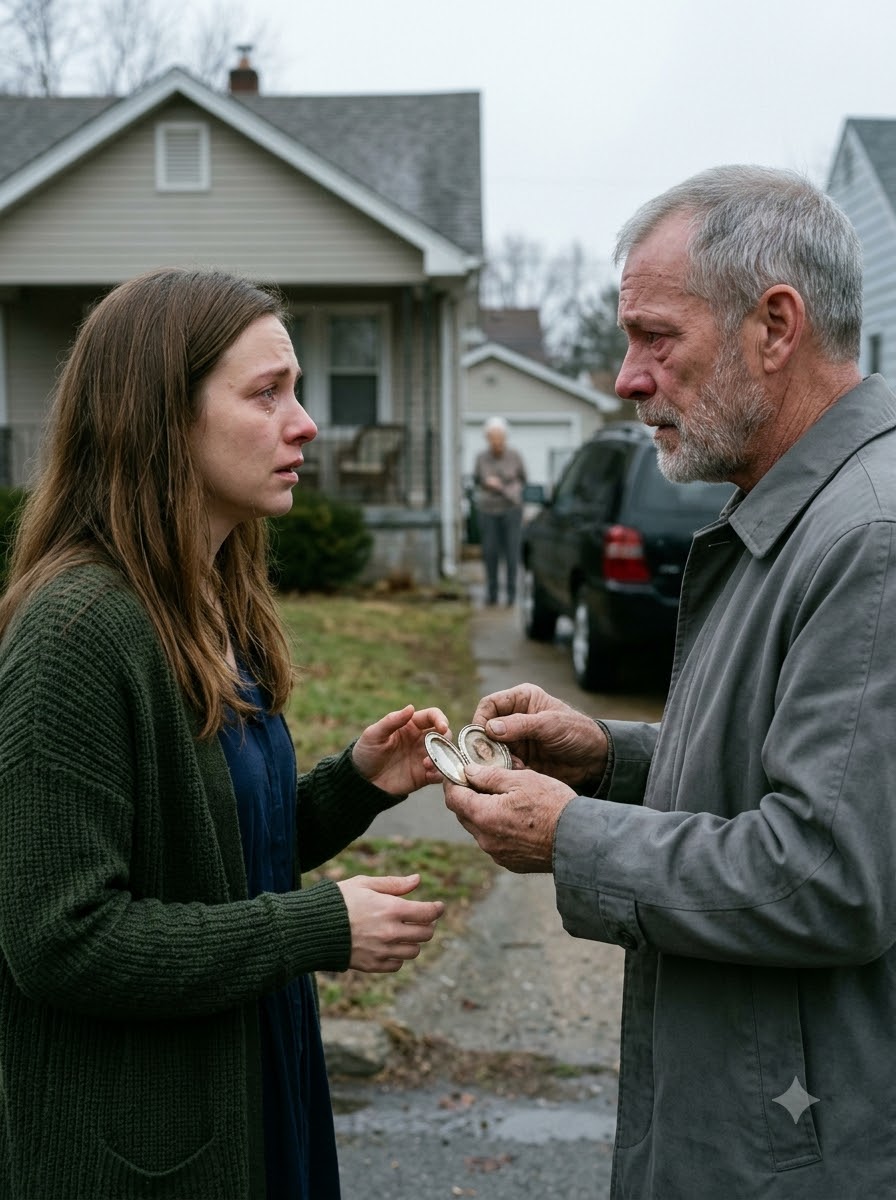
Slowly, he reached inside his coat.
He pulled out a silver chain.
Hanging from it was a small, dented locket.
I recognized it instantly.
I’d seen photographs of Mom wearing that necklace when I was little.
When I was eight, I’d asked to borrow it for a school play.
Mom told me she’d lost it.
“Where did you get that?”
Elias closed his hand around the locket.
“Evelyn gave it to me.”
“She told me it was lost.”
“She couldn’t tell you the truth.”
“Why would my mother give you her necklace?”
“Because it was mine first.”
I stared at him.
Elias opened the locket.
Inside was a faded photograph of two children sitting on wooden porch steps.
The little girl had dark braids and scraped knees.
I recognized my mother immediately.
Beside her sat an older boy with one arm wrapped protectively around her shoulders.
On the other side of the locket, three words were scratched into the silver.
MY SAFE PLACE.
My mouth went dry.
“Who is the boy?”
Elias watched me for a long moment.
Then he answered.
“Find the blue box.”
Before I could stop him, he released my hands and stepped away.
“You said you would tell me who you are.”
“I promised Evelyn that the truth would come from her.”
“She’s gone.”
“No,” he said, looking toward the house. “She left it for you.”
I hurried inside.
Mom’s bedroom still carried the faint scent of lavender lotion and the medications she’d taken during her final weeks.
I opened her closet.
I pulled out blankets, shoes, and an old suitcase.
Near the bottom of the wall, I found a narrow wooden panel.
When I pressed one edge, it shifted.
Behind it was a blue metal box.
My name had been written across the lid in Mom’s handwriting.
I carried it into the light and opened it.
Inside were old photographs, hospital documents, school records, and dozens of letters tied together with a faded ribbon.
The first photograph showed Mom as a little girl standing beside the boy from the locket.
On the back, she’d written:
Elias walked me home again.
Another picture showed them asleep beneath a single blanket on an old sofa.
The blanket barely covered the boy’s feet because most of it had been tucked around Mom.
Beneath the photographs lay an envelope.
For Claire.
My hands trembled as I opened it.
My darling Claire,
If you are reading this, then fear followed me all the way to the end.
Elias was my brother before he became the man behind our fence.
He packed my lunches, walked me to school, and stood between me and our father whenever the drinking made him cruel.
One winter, our pipes froze, and there was only one thin blanket in the house. Elias stole our mother’s bracelet and tried to sell it.
He was not buying alcohol or drugs.
He was trying to buy blankets because I was sick and could not stop shaking.
Our parents called him a thief.
Grant never let anyone forget it.
As Elias grew older, he began struggling with an illness no one in our family wanted to understand. There were hospitals, periods when he became confused, and years when he could not keep a job or a home.
Grant used every bad day as proof that Elias had always been dangerous.
When you were born, I allowed Elias to visit.
He never held you without washing his hands twice. He repaired your crib and sat beside it when you had a fever.
Then Grant found out.
He told me he would report me to social services. He said a poor single mother allowing an unstable homeless man near her child would look unfit.
I was terrified he could take you away.
So I made the cruelest bargain of my life.
I kept Elias close enough to survive, but far enough away that you believed he was a stranger.
Please understand this: the food I gave him was never taken from you.
Most of the time, he had already found a way to help us first.
The boots you wore in high school came from Elias.
He repaired the roof, replaced the porch step, chopped the firewood, and quietly gave me the money that paid the deposit for your first year at college.
He never wanted you to know.
He believed you would hate me if you understood that I had allowed my own brother to sleep outside.
I am sorry, Claire.
I was trying to protect you, but fear made me hurt both of you.
Do not let Grant erase him after I am gone.
Elias has spent his whole life believing he belongs outside.
Please show him he was wrong.
Love always,
Mom.
I read the letter once.
Then again.
Finally, I lowered myself onto the closet floor.
All around me lay the photographs and documents she’d hidden.
And memories I’d carried for years began rearranging themselves.
The boots beside my backpack.
The firewood after winter storms.
The roof that had somehow been repaired before the landlord arrived.
The new porch step.
The way Elias watched me return from school without ever crossing the fence.
The third meal hadn’t simply been charity.
It had been Mom’s apology.
And Elias hadn’t been taking from our family.
He’d been quietly giving us everything he could while allowing me to believe he was a stranger.
I remembered the night I’d accused him of eating better than we did.
I remembered pushing the food into his hands.
“You don’t know her.”
And I remembered his answer.
“No,” he said quietly. “I suppose you’re right.”
He had let me say those words.
He had accepted them without defending himself.
I pressed Mom’s letter against my chest.
For twenty years, I’d thought Elias was the reason our family had so little.
Now I knew he’d helped keep us afloat.
Then the front door opened.
Footsteps sounded in the hallway.
I looked up.
Uncle Grant appeared in Mom’s bedroom doorway.
His gaze went directly to the blue box.
“You found it.”
And the expression on his face told me he already knew exactly what was inside.
PART 3
I rose slowly, still holding Mom’s letter.
“You knew.”
Grant sighed as though I were making a simple situation unnecessarily complicated.
“Claire, put the papers down.”
“You told everyone Elias was dead.”
“That was easier.”
“For whom?”
He stepped farther into the bedroom.
“You don’t understand what he was like.”
“I understand that he stole a bracelet to buy Mom blankets.”
His face hardened.
“That is the story Evelyn chose to believe.”
“It is the truth she wrote down.”
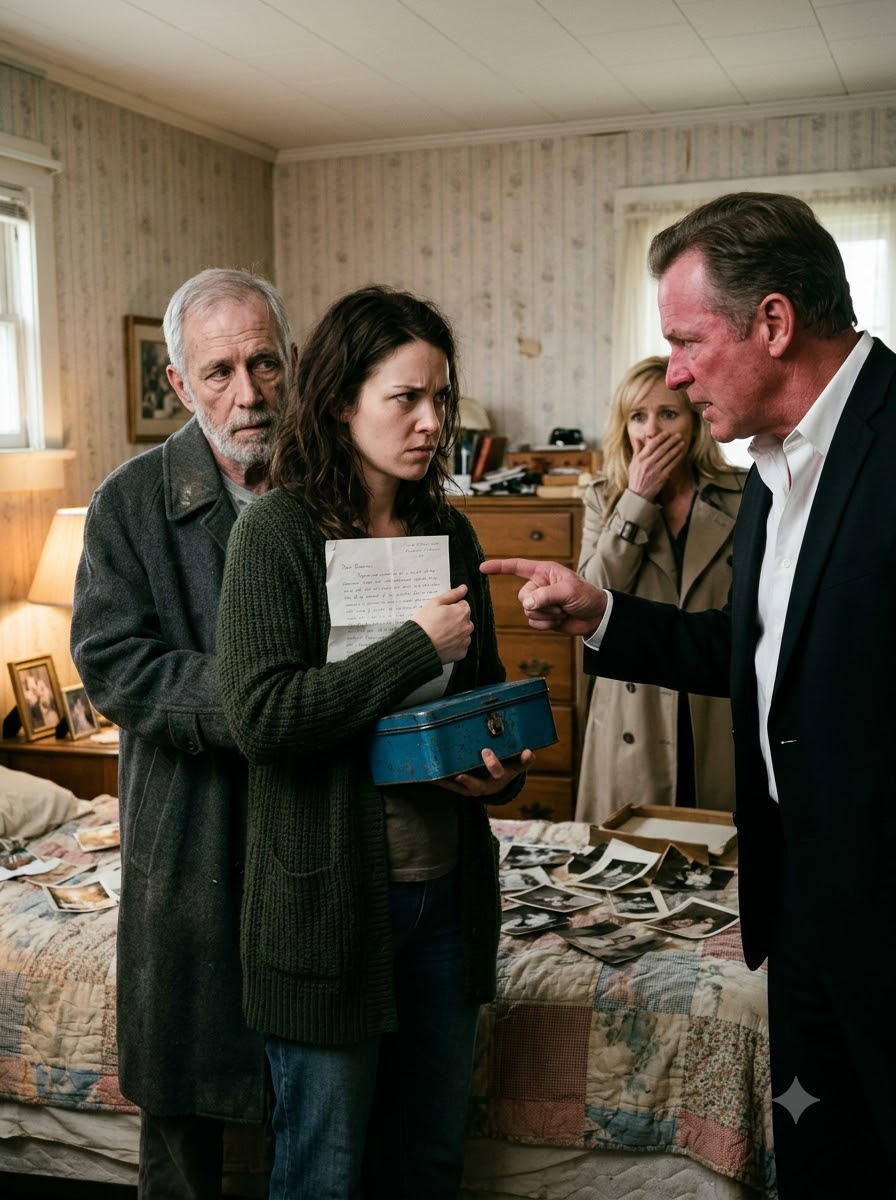
“She spent her entire life making excuses for him.”
“And you spent yours making sure everyone was ashamed of him.”
Grant reached toward the box.
I immediately moved it out of his reach.
“Mom told me not to let you touch this.”
“She was dying. She was confused.”
“No. She was afraid of you.”
Voices came from the hallway.
Monica appeared first.
Mrs. Porter followed, along with two of my cousins.
And behind them stood Elias.
The moment Grant saw him, his carefully controlled expression vanished.
“Get him out of this house.”
I stepped directly in front of Elias.
“No.”
“Claire, you have no idea what you’re inviting into your life.”
“I know exactly who I’m inviting in.”
Monica looked from Grant to Elias.
“What is happening?”
I lifted the photograph from the locket.
“Elias is Mom’s older brother.”
Monica stared at her husband.
“You said her brother died when they were teenagers.”
Grant clenched his jaw.
“It was simpler.”
“Simpler?” she repeated.
“He caused chaos everywhere he went.”
Elias remained silent.
He stood just inside the doorway, his hands hanging at his sides.
He looked like a man who had spent so many years being told he didn’t belong that he’d learned to expect rejection before anyone spoke.
I faced Grant.
“You threatened Mom with social services.”
“I protected you.”
“You frightened a poor single mother into hiding her own brother.”
“He was unstable.”
“He was ill.”
“He was dangerous.”
For the first time, Elias raised his head.
“I never hurt Claire.”
Grant gave a bitter laugh.
“You stole from our mother.”
“For Evelyn,” Elias said. “She was freezing.”
Monica turned sharply toward her husband.
“You never told me that.”
“It changes nothing.”
“It changes everything,” I said.
Grant looked around the bedroom, searching for someone who would agree with him.
Nobody spoke in his defense.
He pointed toward Elias.
“He will drain you. Evelyn spent her entire life rescuing him, and look where it got her.”
I held Mom’s letter tightly against my chest.
“No. She spent her life being afraid of what you might do.”
Grant snatched his coat from the chair.
“You will regret this.”
“I already regret believing your version of him.”
He reached for the blue box once more.
Monica moved between him and the bed.
“Leave it.”
“Monica.”
“You told me he was dead.”
Grant stared at her.
Then he looked around at the rest of us.
For the first time, he seemed to understand that nobody was going to help him take the box.
He turned and walked away.
A moment later, the front door slammed.
Silence settled over the bedroom.
Elias hadn’t moved.
His eyes remained fixed on the floor.
“I should go,” he said.
I looked at him.
“Where?”
He shrugged slightly.
“Somewhere Grant won’t cause trouble for you.”
Mom’s words returned to me.
Elias has spent his whole life believing he belongs outside.
Please show him he was wrong.
I walked toward him.
“Uncle Elias.”
His head lifted.
For a moment, he seemed unable to breathe.
I realized how long it must have been since anyone in our family had called him that.
Not a stranger.
Not a problem.
Not the homeless man behind the fence.
My uncle.
I picked up the container of stew I’d left on the dresser.
“Come into the kitchen.”
He hesitated.
“I can eat near the fence.”
“No.”
“I’m used to it.”
“That’s the problem.”
I led him down the hallway.
The kitchen looked exactly as it had throughout my childhood.
The old table stood beneath the window.
Mom’s plastic containers were still stacked beside the sink.
The stove was clean.
Outside, the two maple trees stretched over the fence where Elias had spent so many years living.
I pulled out a chair.
Elias stopped beside it.
“Sit down.”
“Claire, I don’t want to take anyone’s place.”
“You’re not taking a place.”
I poured the stew into two bowls and set one before him.
“You’re finally sitting in yours.”
He slowly lowered himself into the chair.
Then he placed the silver locket on the table.
He opened it.
The faded photograph of himself and Mom lay between us.
Two children on wooden porch steps.
A little girl with scraped knees.
An older brother with his arm around her shoulders.
I studied their faces.
For most of my life, I’d known Mom only as the woman who worked too hard, worried too much, and somehow always found enough food for one more person.
I’d never truly understood the little girl she’d once been.
The frightened child whose older brother had protected her from their father’s cruelty.
The girl who’d been cold and sick while Elias tried to find money for blankets.
The sister who grew into a mother and spent decades trying to repay a kindness she could never forget.
Mom hadn’t been perfect.
She’d made decisions out of fear.
She’d hidden the truth from me.
She’d allowed Elias to live outside our home because she was terrified that Grant’s threats might cost her custody of her daughter.
Her choices had hurt us both.
But now I understood that her silence hadn’t come from indifference.
It had come from a desperate attempt to protect the people she loved, even when she couldn’t find a way to protect them all.
I thought about the arguments we’d had.
The accusations I’d thrown at her.
The way I’d insisted that Elias was taking food we couldn’t afford to spare.
All those years, I’d been measuring love by what appeared on our dinner plates.
I hadn’t known what Elias had contributed before those plates were filled.
He’d repaired our roof.
He’d fixed our porch.
He’d brought us firewood.
He’d found boots when mine were falling apart.
He’d helped pay the deposit that allowed me to begin college.
And he’d done those things without asking for thanks.
Without demanding recognition.
Without even allowing me to know who he was.
I looked across the table.
Elias was holding his spoon but hadn’t begun eating.
For a moment, I wondered whether he was waiting for permission.
The thought broke my heart.
“It’s getting cold,” I said softly.
He looked at the bowl.
Then at me.
And finally, he began to eat.
I sat across from him with my own bowl.
For twenty years, Mom had prepared a third meal and carried it through the back door.
She’d sent it beyond the kitchen window, past the porch, and across the yard to the man everyone believed was a stranger.
That evening, the food remained inside.
There was no fence between us.
No tarp.
No coffee can filled with burning twigs.
Just two bowls of warm stew and a silver locket resting on my mother’s chipped kitchen table.
I knew the days ahead wouldn’t be simple.
Elias would need a doctor.
He would need a safe place to live.
He would need support that went beyond a meal and a warm room.
And we would have to discover how to build a relationship after spending so many years separated by secrets.
I couldn’t erase what had happened.
I couldn’t give him back the years he’d spent behind our fence.
I couldn’t ask Mom the questions I should have asked while she was alive.
But I could make a different choice now.
I could stop treating Elias as someone who belonged outside.
I could learn about the uncle I’d never been allowed to know.
And I could honor Mom’s final request without repeating the fear that had shaped her life.
I looked at the locket again.
MY SAFE PLACE.
For so long, those words had belonged to Mom.
Elias had been the person who protected her when she was small and frightened.
The person who sacrificed what little he had so she could stay warm.
The person who continued helping her even after their family had turned his struggles into something shameful.
Now Mom was gone.
And I finally understood what she had been asking of me.
Not simply to keep feeding him.
Not merely to preserve the secret she’d carried for decades.
She wanted him to know that he still belonged somewhere.
That he hadn’t spent his whole life giving love without deserving any in return.
That he didn’t have to remain outside forever.
I watched Elias take another spoonful of stew.
Then I glanced toward the empty chair where Mom used to sit.
For the first time since her death, the kitchen didn’t feel quite so empty.
Tomorrow, there would be difficult conversations.
There would be practical decisions, medical appointments, and the slow work of beginning again.
But that night, there was warm food, my mother’s old table, and an uncle who had finally been invited inside.
For twenty years, I’d believed Mom was feeding a stranger.
Now I understood.
She had been trying to keep her brother alive.
And with the truth finally uncovered, I could begin giving him something she’d been too afraid to offer openly.
A place in our family.
A place at our table.
Exactly where he had belonged all along.
