


PART 1
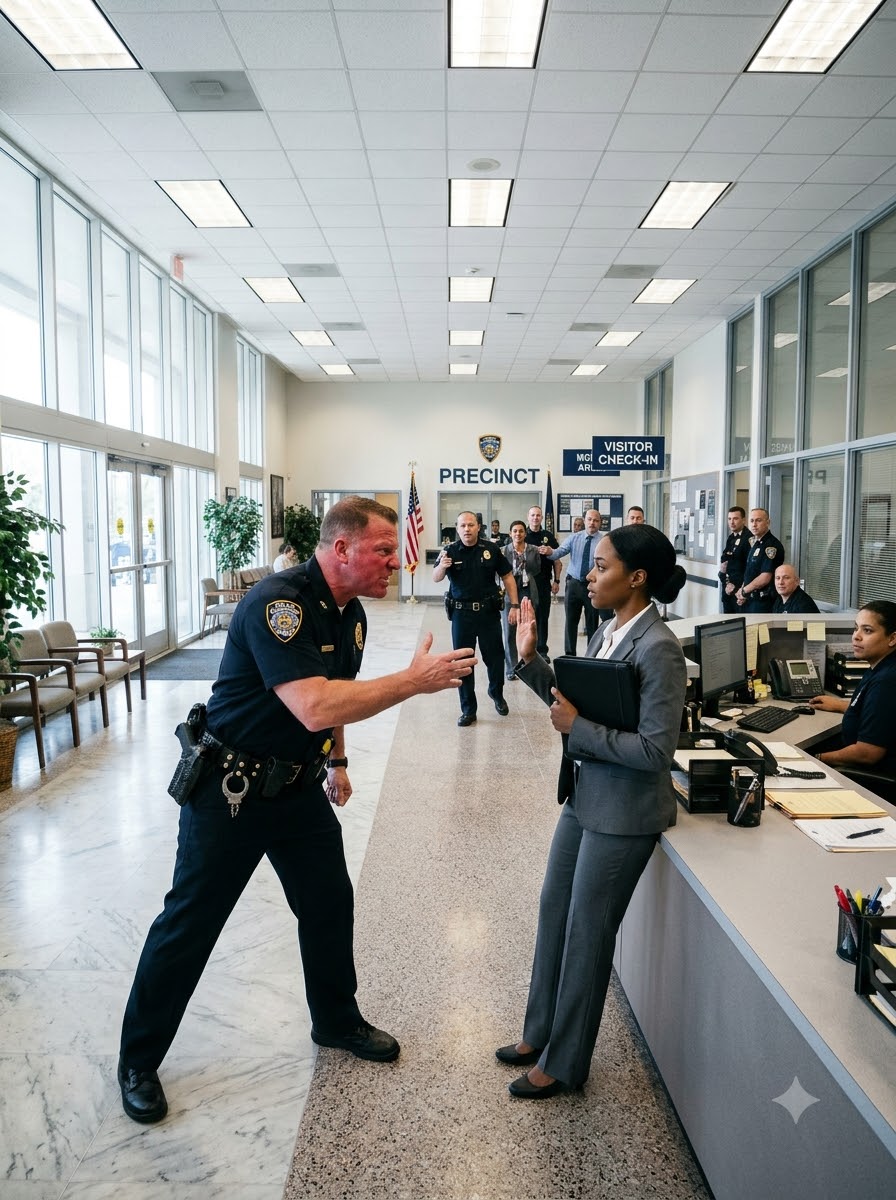
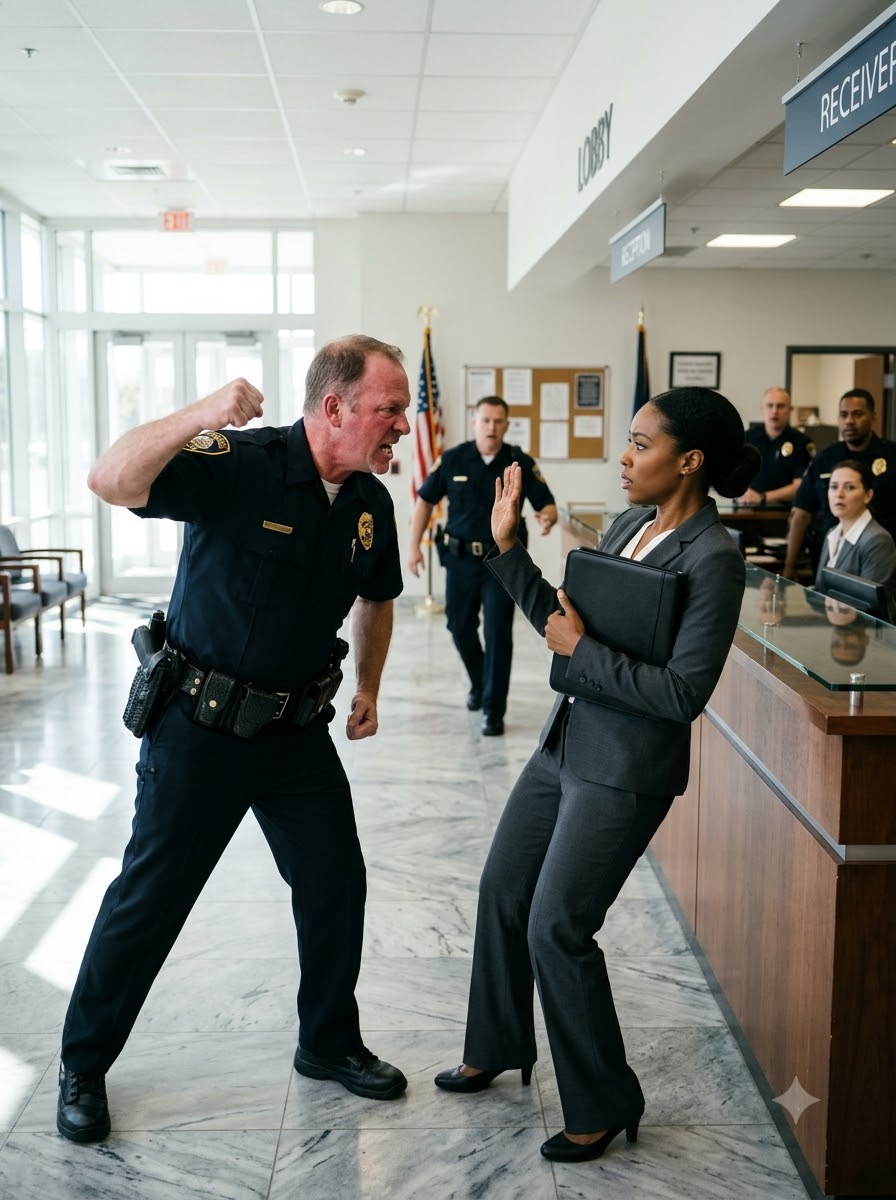
The instant Officer Dale Pruitt’s fist struck the jaw of the Black woman wearing a charcoal-gray suit, three events unfolded almost simultaneously.
A tooth bounced across the polished tile floor.
A concealed microphone beneath her silk collar transmitted a single encrypted command to a federal operations center twelve blocks away.
And every exit in the Harwick County Sheriff’s Department slammed shut with a deafening metallic crash.
The noise sounded like a cannon firing inside the building.
Within seconds, the entire facility had been sealed.
Nobody inside was going anywhere.
And for several of the officers trapped behind those doors, freedom would remain out of reach for years.

But the chain of events that led to that moment had begun long before Dale Pruitt raised his fist.
It was a Wednesday morning in late August.
The Gulf Coast heat was oppressive, the kind that made the air feel thick enough to touch.
Meridian Falls, Louisiana, was a town of approximately forty thousand residents.
It had changed very little since the 1980s, except that its economy had weakened and its residents had become increasingly distrustful of strangers.
The Harwick County Sheriff’s Department occupied a low, two-story concrete building near the edge of town.
Inside, the lobby carried a mixture of unpleasant smells.
Industrial disinfectant.
Stale coffee.
And the nervous perspiration of people who had spent too many hours waiting for answers they feared receiving.
Along the eastern wall stood a row of rigid plastic chairs.
Only one was occupied.
Josephine Elaine Duvall sat alone.
She was forty-three years old.
Nothing about her appearance suggested that she belonged in the waiting room of a small-town sheriff’s department.
Her slate-gray pantsuit was expertly tailored.
A cream-colored blouse rested neatly beneath the jacket.
She wore no visible jewelry apart from a narrow gold watch on her left wrist.
Her polished shoes reflected the harsh fluorescent lights overhead.
Her back remained perfectly straight.
Her hands rested loosely on her thighs, palms relaxed and open.
Her eyes moved slowly around the room.
Not nervously.
Not impatiently.
But with the controlled attention of someone who had spent two decades learning to recognize danger before it announced itself.
Josephine had arrived at 9:45 a.m.
Her appointment with Sheriff Clovis Beaumont was scheduled for ten.
At the reception desk, she had signed the visitor register and presented identification describing her as a federal consultant.
The credentials were intentionally ordinary.
They revealed nothing about her actual authority.
After completing the registration process, she had taken a seat and waited.
By the time the next incident began, forty minutes had passed.
Josephine was not a federal consultant.
That was merely the identity she had chosen to present.
Her actual position carried considerably greater consequences.
Josephine Elaine Duvall was the Deputy Assistant Director of the Criminal Investigative Division of the Federal Bureau of Investigation, United States Department of Justice.
Her security clearance was so sensitive that revoking it would require a congressional subcommittee briefing.
Beside her chair rested a slim leather folio.
Inside was a sealed federal indictment spanning sixty-eight pages.
It named Sheriff Clovis Beaumont and eleven deputies in a far-reaching racketeering and civil rights conspiracy.
The alleged crimes had infected Harwick County’s institutions for nearly a decade.
Josephine had come to deliver the indictment and initiate the final phase of a federal operation.
Although she appeared to be alone, she had not entered the town without support.
Forty federal tactical personnel waited in three unmarked vehicles inside a parking garage two blocks east of the department.
They monitored an encrypted communications frequency.
Every member of the team understood the signal that would activate the operation.
Until then, they were to remain out of sight.
Inside the lobby, Josephine waited quietly.
She observed.
She listened.
And she gave no indication that anything unusual was about to happen.
At 10:28 a.m., the front entrance burst open.
The doors struck their stops with enough force to rattle the frosted glass panels.
Officer Dale Pruitt entered.
He moved with the confidence of a man convinced that every room belonged to him.
Pruitt was broad-shouldered and thick-necked.
His face carried the permanent redness of someone whose blood pressure had probably concerned doctors for years.
His uniform met department regulations, but he wore it carelessly.
His badge hung slightly crooked.
He was chewing something.
And his expression suggested that he regarded everyone around him as an inconvenience.
He scanned the lobby.
Then his eyes settled on Josephine.
He stopped looking elsewhere.
Pruitt had served twelve years in the Harwick County Sheriff’s Department.
His disciplinary history contained repeated warning signs.
Complaints of excessive force.
An allegation of racial harassment that the union had helped suppress.
Two civil lawsuits settled privately.
Both settlements included confidentiality agreements.
Both had been paid using public money.
The taxpayers financing those agreements had never been told exactly what they were paying for.
Yet Pruitt remained employed.
Sheriff Beaumont preferred deputies who followed orders without questioning them.
And the local district attorney owed the department more favors than he could comfortably explain.
Pruitt had learned that consequences were usually something other people experienced.
He crossed the lobby in eleven heavy steps.
His boots struck the tile deliberately.
“Hey.”
He stopped two feet from Josephine.
He looked down at her.
“You’ve been sitting here a while. What’s your business?”
Josephine raised her eyes.
Her expression remained neutral.
During her career, she had interviewed dangerous men in dark rooms on four continents.
Dale Pruitt was not particularly difficult to understand.
He was a volatile man accustomed to controlling people through intimidation.
“I have an appointment with Sheriff Beaumont,” she replied calmly.
“I checked in at the front desk. I’m waiting.”
“Who made the appointment?”
“The appointment was coordinated through the department’s administrative office. I can provide the confirmation number if that would be helpful.”
Pruitt’s jaw shifted.
Her composure irritated him.
He expected people sitting in his department’s lobby to behave in one of two ways.
They were supposed to be nervous.
Or deferential.
Josephine was neither.
She simply sat there, completely untroubled by his presence.
“I’m going to need to see your ID.”
“I’ve already provided my visiting credentials to the desk officer.”
“I’m not the desk officer.”
He stepped closer.
His shadow fell across her.
“I’m asking you now. You want to make this easy or you want to make it difficult?”
Josephine slowly placed her folio on the neighboring chair.
Then she began standing.
Her movements were controlled.
Her hands remained visible.
“I’m standing up,” she announced.
She continued in the same calm voice.
“I’m going to reach into my jacket for my credentials.”
She had been trained to announce potentially ambiguous movements.
She wanted Pruitt to understand exactly what she was doing.
She wanted to eliminate any reasonable possibility of misunderstanding.
And she was giving him every opportunity to step back.
Pruitt ignored all of it.
What followed lasted less than two seconds.
Yet over the next eighteen months, investigators, attorneys, journalists, and congressional committees would examine those seconds repeatedly.
The incident would be reconstructed using four separate camera feeds.
The footage would eventually be replayed approximately forty thousand times across federal court proceedings, news broadcasts, and congressional hearings.
Josephine moved her right hand toward the inside pocket of her jacket.
Slowly.
Deliberately.
In full view.
Pruitt lunged.
He did not reach for his handcuffs.
He did not draw his Taser.
He pulled back his right arm.
Then drove his closed fist into the left side of Josephine’s jaw.
The force of his 240-pound body traveled through the blow.
The impact made a sickening sound.
Josephine’s head snapped sideways.
She staggered backward into the row of plastic chairs.
The chairs scraped and crashed across the floor.
She caught herself against an armrest before falling completely.
For an instant, she remained suspended between standing and collapsing.
One hand braced against the chair.
Her face turned slightly away.
A dark bruise was already beginning to form beneath her left cheekbone.
Blood appeared at the corner of her mouth.
She tasted it.
At the reception desk, a young deputy named Sandra Tran stood frozen.
Both palms pressed against the desktop.
Her face had gone almost white.
Two officers across the bullpen stopped in the middle of walking.
Pruitt remained where he stood.
His fist was still raised.
He breathed heavily.
Adrenaline coursed through him.
“I told you to show ID first.”
He spoke as though explaining himself to the room.
Already, he was constructing a justification.
Josephine slowly straightened.
She did not rush toward him.
She did not shout.
She did not reach for the service weapon at her hip.
She was qualified to use three different firearms platforms.
Had she chosen to respond violently, the encounter might have ended permanently.
Instead, she remained disciplined.
She touched the corner of her mouth with her left hand.
Her fingertips came away stained with blood.
She looked at them.
Then she raised her right hand toward the underside of her collar.
Six days earlier, a federal technical specialist had sewn a transmitter no larger than a nickel into the lining of her jacket.
Josephine pressed two fingers against it.
“Lockdown authorization, Duvall.”
Her voice was perfectly steady.
“Execute.”
Pruitt laughed.
It was a short, incredulous sound.
“Execute what? Lady, you’re under arrest. You assaulted a—”
He never finished the accusation.
A tremendous mechanical crash interrupted him.
The sound came from every direction at once.
It reverberated through the floor.
Across the ceiling.
Inside the walls.
The heavy glass doors at the main entrance slammed shut under the force of pneumatic mechanisms.
A steel crossbar dropped across them.
The impact produced a deep metallic thud.
Before anyone could understand what was happening, the side exits in the eastern corridor activated.
Two reinforced fire doors swung closed.
Electronic deadbolts engaged.
They could not be released from inside.
Then the rear delivery entrance sealed.
The roof access stairwell.
The parking garage connector.
The holding cell corridor.
Every controlled exit.
Clank.
Clank.
Clank.
Clank.
The entire sequence took eight seconds.
Eight seconds.
And the Harwick County Sheriff’s Department had been transformed into a secured federal containment site.
Every electronic screen in the building flickered.
Dispatch monitors.
Desktop computers.
Security displays.
Administrative terminals.
Then each showed the same image.
The blue-and-gold seal of the Federal Bureau of Investigation.
Bright against a black background.
Beneath it appeared a warning in red lettering.
“Federal containment protocol active. Do not attempt to exit. Remain in place.”
A synthetic voice emerged from the overhead speakers.
Calm.
Mechanical.
Emotionless.
“Federal building override in effect. This facility is under the jurisdiction of the United States Department of Justice. All personnel remain stationary.”
The announcement continued.
“A breach team will enter in 90 seconds. Resistance will be treated as obstruction of federal law enforcement.”
For three seconds, the building fell completely silent.
Then panic erupted.
Two deputies ran toward the eastern corridor.
They struck the sealed doors at full speed.
Both bounced backward as though they had collided with concrete.
The dispatcher screamed into her headset.
No response came.
Her communications line had been disabled.
In a rear office, someone knocked over a filing cabinet while desperately trying to move its contents.
Deputy Wyatt Foss seized his radio.
He began requesting backup.
But the department’s channels had been disabled by the federal communications override.
His calls went nowhere.
Pruitt turned slowly.
He stared at the locked entrances.
The glowing monitors.
The officers running through the corridors.
His expression moved from confusion to alarm.
Then to unmistakable terror.
“What did you do?”
He turned toward Josephine.
“What the hell did you do?”
She stood upright in the middle of the lobby.
The bruise along her jaw was darkening.
A thin streak of blood remained on her lower lip.
In her right hand, she held an open black leather credential wallet.
Inside was a silver federal badge.
“My name,” she said clearly, “is Deputy Assistant Director Josephine Duvall, Federal Bureau of Investigation.”
Her voice carried across the room.
She looked toward the panicking deputies.
Then toward the sealed doors and the monitors displaying the federal seal.
“I am the lead officer on a federal racketeering investigation designated Operation Gulf Ledger, targeting the administrative and operational command structure of this department.”
She lowered her credentials.
Her gaze settled on Pruitt.
“You are not locked inside this building to prevent me from leaving.”
She paused.
“You are locked inside this building to prevent the destruction of the evidence secured in Sheriff Beaumont’s office and the records room on the second floor.”
Josephine checked her watch.
“In approximately 60 seconds, a 12-person federal evidence recovery team will breach through the roof access point.”
She continued.
“At that time, any officer who has not moved away from the filing cabinets and record storage will be charged with obstruction of justice in addition to whatever charges already apply.”
She looked around the room.
“60 seconds.”
The lobby became silent.
Sergeant Hal Grover stood near the bullpen.
He was a twenty-five-year veteran.
He had served under four sheriffs.
He had survived by understanding situations faster than people expected.
Now he examined Josephine’s badge.
The monitors.
The locked doors.
And Pruitt.
Grover calculated what the next twelve hours might look like.
Then he made his decision.
“Everyone step away from your desks.”
His voice was rough but controlled.
“Hands where they can see them. Do it now.”
“Hal,” Pruitt began.
“Shut your mouth, Dale.”
Grover’s voice cracked across the room.
“You just assaulted a Federal Deputy Assistant Director.”
He stepped toward Pruitt.
“Shut your mouth, get on your knees, and put your hands behind your head.”
Then he delivered the final warning.
“That is the only decision you have left to make that matters.”
Pruitt stared at him.
The confidence drained from his expression.
Slowly, he lowered himself onto the floor.
Forty-three seconds remained.
From the rear of the building came the violent scrape of a chair being shoved backward.
Then hurried footsteps.
A door flew open.
Sheriff Clovis Beaumont emerged from his corner office.
He was moving almost at a run.
A phone was pressed against his ear.
His face was dark red.
Beaumont was sixty-one years old.
He had once been a large, imposing man.
Age had redistributed much of that weight.
He wore his uniform with the familiarity of someone who had spent three decades relying on its authority.
But now his practiced confidence had disappeared.
“I need the governor’s direct line, Earl!”
He shouted into the phone.
“Not his office, his direct line, right now!”
He stopped.
The lobby looked nothing like it had an hour earlier.
Pruitt was kneeling.
Grover had raised his hands.
Federal warnings covered every screen.
The exits were sealed.
And Josephine Duvall stood in the center of the room.
Blood marked her lip.
Her badge remained in her hand.
She watched Beaumont without the slightest trace of panic.
The sheriff lowered his phone.
“Duvall.”
He spoke her name as though he had feared hearing it for years.
“Sheriff Beaumont.”
Josephine stepped toward him.
“I have a sealed federal indictment, 68 counts including racketeering, civil rights conspiracy, obstruction of justice, and distribution of narcotics seized from the evidence vault.”
She removed an envelope from her folio.
“I’d recommend you accept service now.”
Beaumont stared at the envelope.
Then at the screens.
The sealed doors.
And finally Pruitt.
For a fraction of a second, something changed in his expression.
Josephine noticed.
She would remember it precisely when she testified four months later.
Beaumont was not worried about his deputy.
He was deciding whether Pruitt still had any value to him.
The answer was obvious.
He did not.
“You can’t do this,” Beaumont said.
His voice sounded hollow.
He knew the words were meaningless even as he spoke them.
“I have political standing in this district. I know people in the state legislature.”
Josephine checked the time.
“I have 20 seconds.”
Then she looked directly at him.
“What you have, Sheriff Beaumont, is approximately 20 seconds before a federal tactical team enters this building and you lose your last opportunity to accept service without a physical confrontation.”
She extended the envelope.
“I would recommend accepting the envelope.”
Beaumont stared at her.
Thirty years of favors.
Political influence.
Carefully cultivated fear.
And control over an entire department.
All of it was coming apart.
Finally, he reached forward.
He accepted the envelope.
Seven seconds later, a controlled breach charge detonated at the roof access door above the holding cell corridor.
The explosion shook the building.
Dust fell from the ceiling tiles.
Gray smoke rolled into the eastern hallway.
Then twelve federal agents entered through the opening.
They moved in coordinated pairs.
Full tactical equipment.
Rifles held at low ready.
Their commands echoed through the corridor.
“Down, down now!”
“Hands, show hands!”
“Stay down!”
Within ninety seconds, the entire facility was secured.
Beaumont was escorted toward a federal transport vehicle.
His hands were restrained behind his back with plastic cuffs.
Investigators photographed every filing cabinet on the second floor.
They sealed the records.
Then began removing them under a federal evidence warrant.
Pruitt was placed in a separate vehicle.
He was transported directly to a federal processing center.
The operation had concluded before Meridian Falls entered its morning news cycle.
But six hours later, in a federal detention facility two parishes north, Josephine Duvall would discover something that made even the violent assault in the lobby look different.
Because Dale Pruitt had not simply lost control that morning.
Someone had deliberately arranged for him to be there.
And the person responsible had known exactly what he was likely to do.
PART 2
Six hours after the Harwick County Sheriff’s Department was secured, Josephine Duvall entered an interview room at a federal holding facility two parishes north.
She had changed clothes.
Her new suit was deep charcoal.
A white shirt rested beneath the jacket.
She wore no tie.
A butterfly closure covered the injury near her jaw.
Dark purple bruising had spread from her cheekbone toward the area beneath her eye.
The swelling was painful.
But her expression remained composed.
Across the steel table sat Dale Pruitt.
He wore an orange federal jumpsuit.
It was slightly too small.
The uniform belt he had worn that morning was gone.
So was his badge.
His firearm.
His authority.
Everything he had relied upon to make other people feel powerless had been removed.
He stared at the tabletop as though it had personally offended him.
Josephine placed a cup of black coffee in front of him.
Then opened a case file.
She said nothing.
One minute passed.
Then another.
Pruitt shifted in his chair.
Finally, he spoke.
“I want a lawyer.”
Josephine turned a page.
“Your union representative, Officer Thibodeaux, was arrested at his home at 6:14 this morning.”
She didn’t look up.
“He’s currently being indicted for facilitating the destruction of use-of-force records in three separate civil rights cases.”
She paused.
“He will not be available to you.”
Pruitt stared.
Josephine continued.
“You have the right to a court-appointed attorney, and one will be made available to you at arraignment.”
She closed the file slightly.
“That’s not what I’m here to discuss.”
Pruitt raised his eyes.
“Then what are you here for?”
Josephine placed the file on the table.
She folded her hands.
“I’m here because of a text message.”
She spoke deliberately.
“Sent at 8:47 this morning from a burner phone registered to an intermediary working for Sheriff Beaumont’s administration.”
She slid a sheet of paper across the table.
It contained a printed transcript.
“Read the second paragraph.”
Pruitt picked it up.
His hands trembled.
He began reading.
His expression changed.
First confusion.
Then disbelief.
Then something between anger and humiliation.
The message had been sent from an intermediary to Beaumont.
It read:
“Federal agent incoming, female DAD-level DOJ task force lead, black. She’ll be in the lobby by 10. Pruitt comes off shift around that time.”
The message continued.
“You know how he gets with suits. Stall her and he’ll create a scene. Buys you at least an hour to sanitize the second floor.”
Below it appeared Beaumont’s reply.
“Understood. Give Pruitt the lobby post. He won’t need instructions.”
Pruitt lowered the paper.
His breathing grew heavier.
“He knew you were coming.”
The realization seemed physically painful.
Josephine nodded.
“He knew I was coming.”
She let him absorb the answer.
“He knew who I was, and he knew what you would do if a black woman in an expensive suit sat in your lobby and didn’t behave the way you expected her to.”
Pruitt stared at the transcript.
Josephine continued.
“You weren’t protecting the department, Officer Pruitt.”
Her voice remained calm.
“You were a distraction, a disposable one.”
She allowed another moment to pass.
“Clovis Beaumont handed you a felony charge to buy himself 60 minutes.”
Then she delivered the final truth.
“He gave you up without a second thought.”
Silence settled over the interview room.
Pruitt continued looking at the message.
Everything he had believed about loyalty was collapsing.
He had spent years defending the department.
Defending the badge.
Defending the culture of unquestioning obedience that governed Harwick County law enforcement.
He had convinced himself that officers protected one another.
That loyalty would always be rewarded.
That the people above him valued his willingness to do whatever they required.
Now he understood.
Beaumont had known Josephine’s identity before she entered the building.
He had deliberately kept her waiting.
He had arranged for Pruitt to encounter her.
And he had counted on the deputy’s prejudice and temper to create a confrontation.
Pruitt was never supposed to be protected.
He was supposed to be sacrificed.
His violent behavior had become a tool for buying time.
An expendable distraction while the sheriff attempted to destroy incriminating evidence.
The realization stripped away the last remnants of Pruitt’s confidence.
He stared at the transcript for a long time.
Then he spoke.
“The second floor.”
His voice was rough.
Josephine waited.
“He keeps the real ledgers in the wall behind the gun rack.”
He swallowed.
“There’s a panel.”
He looked up.
“I saw him put something there the night the Henderson complaint came in.”
Josephine remained still.
Pruitt continued.
“I can show your people exactly where.”
For a moment, she simply studied him.
Not with sympathy.
Not with satisfaction.
But with the careful attention of an investigator recognizing that a suspect had finally begun telling the truth.
Then she picked up her pen.
She placed a cooperation agreement between them.
“Start from the beginning, Officer Pruitt.”
She opened a fresh page.
“Tell me everything.”
Pruitt began talking.
And what he revealed would become one of the most important breakthroughs in Operation Gulf Ledger.
Federal investigators returned to the department.
They located the gun rack on the second floor.
Behind it, concealed within the wall, was a removable panel.
Inside the hidden compartment sat a fireproof lockbox.
The lockbox contained a handwritten ledger.
It documented eleven years of corruption.
Every payoff.
Every complaint that had been suppressed.
Every investigation redirected away from people favored by the department.
Every case manipulated to punish those who had become its enemies.
The ledger contained approximately four hundred pages.
And the handwriting belonged to Sheriff Clovis Beaumont.
He had documented the operation himself.
Not merely in vague notes.
But in detailed entries linking payments, names, dates, and decisions.
A federal prosecutor later described the discovery to the jury as the most comprehensive piece of self-incrimination she had encountered during twenty-two years of federal practice.
In effect, Beaumont had written his own confession.
Four hundred pages of it.
Operation Gulf Ledger expanded rapidly.
The investigation had already uncovered evidence of racketeering and civil rights abuses.
Now prosecutors possessed a detailed internal record tying those offenses to specific officials.
The sheriff’s hidden ledger allowed investigators to connect financial transfers to individual decisions.
Complaints that had mysteriously disappeared.
Evidence that had been mishandled.
Narcotics removed from storage.
Cases redirected.
Political favors exchanged.
The same names appeared repeatedly.
And the pattern was far larger than the department itself.
Sheriff Clovis Beaumont was indicted on forty-one federal counts.
District Attorney Barry Sexton became another major target.
For nearly a decade, Sexton had helped provide the legal structure that allowed civil rights complaints to disappear.
He understood which documents needed to be delayed.
Which cases could be quietly closed.
Which settlements could be concealed behind confidentiality agreements.
And which officials needed protection.
Federal agents arrested him on a Thursday evening.
He was sitting at a seafood restaurant.
He had not yet finished his appetizer.
Unmarked federal SUVs blocked his vehicle from the front and rear.
By the time he reached the parking lot, agents were waiting.
Sexton’s arrest revealed that the conspiracy had extended into the legal system supposedly responsible for holding the sheriff’s department accountable.
The investigation continued.
Mayor Leonard Gaffney of Meridian Falls was subpoenaed.
Financial records showed direct wire transfers into his campaign accounts.
The money was connected to proceeds generated by the department’s extortion activities.
Gaffney initially attempted to defend the payments.
But the evidence was extensive.
He negotiated a plea agreement.
Within thirty days, he resigned.
The town was left confronting a reality that many residents had suspected but few had been able to prove.
Corruption had not been limited to one violent officer.
It had reached the sheriff.
The district attorney.
And the mayor’s office.
The institutions that were supposed to restrain one another had instead helped protect the same criminal network.
The consequences spread across Harwick County.
Federal investigators examined complaints that had been dismissed years earlier.
Families who had believed their cases were closed began receiving calls.
Former detainees were interviewed.
Financial records were reviewed.
Evidence vault inventories were compared against actual contents.
Investigators traced narcotics that had been seized during legitimate operations but later disappeared from secure storage.
They followed payments through intermediaries.
They reconstructed meetings.
They compared official reports with private messages and handwritten entries.
The deeper they examined the department, the clearer the conspiracy became.
It had survived because the people responsible controlled the mechanisms that might have exposed them.
Beaumont influenced disciplinary decisions.
Sexton helped neutralize legal consequences.
Union representatives assisted in suppressing damaging records.
Political allies benefited financially.
And deputies like Pruitt provided the intimidation that discouraged ordinary residents from challenging the system.
The department had created a structure in which misconduct was rewarded, complaints were buried, and loyalty mattered more than the law.
Yet the structure contained its own weakness.
Beaumont had kept records.
Detailed records.
He had apparently believed that documenting payments and obligations would help him maintain control over the people involved.
Instead, those same records now allowed federal prosecutors to prove how the conspiracy worked.
Pruitt’s cooperation became crucial.
He identified the hidden compartment.
Explained the circumstances surrounding the Henderson complaint.
And provided information about the department’s internal culture.
He described how officers learned which people could be intimidated.
How supervisors discouraged questions.
How complaints disappeared.
And how the promise of protection from above encouraged increasingly aggressive behavior.
But his cooperation did not make him innocent.
Josephine understood that distinction.
So did the prosecutors.
Pruitt had chosen to strike an unarmed woman.
He had done so without a legitimate justification.
His actions reflected prejudice, entitlement, and a willingness to use violence when challenged.
Beaumont had manipulated those traits.
But he had not created them in a single morning.
Pruitt had carried them into the lobby himself.
That reality would become central to his eventual sentence.
Six months after the arrests, the federal trial began.
The proceedings took place in the United States District Court for the Eastern District of Louisiana.
The courtroom was crowded.
Reporters filled the designated seating.
Federal prosecutors arranged thousands of pages of evidence.
Defense attorneys prepared to challenge the government’s account.
Beaumont entered wearing civilian clothing.
He appeared determined to maintain control over his expression.
The sheriff who had once commanded an entire department now sat beside his attorneys while federal officers guarded the courtroom.
The trial began with financial records.
Witness testimony.
Wiretap evidence.
And the internal communications investigators had recovered.
Prosecutors explained how the conspiracy operated.
How seized narcotics were diverted.
How complaints were suppressed.
How public authority had been converted into private profit.
They presented the ledger.
Four hundred handwritten pages.
The entries connected years of misconduct to the people responsible.
But the most damaging evidence had not yet been presented.
On the third day, Josephine Elaine Duvall entered the courtroom.
She wore a midnight-blue suit.
Her credentials hung from a lanyard around her neck.
The bruising had healed.
Only a faint scar remained beneath her left cheekbone.
It was the sole visible reminder of the blow she had received in the sheriff’s lobby.
She approached the witness stand.
Took the oath.
And sat down.
For four hours, she testified.
Her manner was calm.
Her answers were exact.
She walked the jury through the wiretap recordings.
The forensic accounting.
The handwritten ledger.
And the text message transcripts.
She explained how the investigation had developed over two years.
How evidence had been gathered.
How the different pieces connected.
And why federal authorities had chosen the morning of her visit to execute the operation.
Her testimony was methodical.
She did not exaggerate.
She did not dramatize the assault.
She treated every fact as another part of the case.
That precision made her testimony devastating.
Beaumont remained composed through much of the third day.
He had spent decades concealing his intentions behind an expression of confidence.
But that expression began to fail when prosecutors displayed the text message exchange on the courtroom monitors.
The prosecutor asked Josephine to read the messages aloud.
She looked at the screen.
Then began.
“Federal agent incoming, female DAD-level DOJ task force lead, black.”
Her voice was clear.
“She’ll be in the lobby by 10. Pruitt comes off shift around that time.”
She continued reading.
“You know how he gets with suits. Stall her and he’ll create a scene. Buys you at least an hour to sanitize the second floor.”
Then she read Beaumont’s reply.
“Understood. Give Pruitt the lobby post. He won’t need instructions.”
The courtroom remained silent.
Beaumont turned toward the jury.
He studied their faces.
Several jurors were looking directly at him.
Their expressions were not filled with visible hatred.
They were something colder.
They appeared to recognize exactly what kind of man had written those words.
A sheriff so convinced of his own immunity that he documented his crimes.
A supervisor so accustomed to manipulating subordinates that he was willing to sacrifice one of his own officers.
A public official who treated violence as a convenient distraction.
Beaumont’s composure began to fracture.
He had believed that control over his department meant control over the consequences.
Now the jury was hearing his own words.
And there was no explanation capable of making them harmless.
Four days later, Dale Pruitt entered the courtroom as a cooperating witness.
He was noticeably thinner.
His face had changed.
The aggressive confidence he once carried had disappeared.
He looked like a man who had finally stopped lying to himself and discovered that the truth was far heavier than he expected.
He testified under a federal witness protection agreement.
His answers were direct.
He avoided unnecessary embellishment.
He described the department’s practices.
The concealed records.
The manipulation.
The culture of intimidation.
And the morning he struck Josephine.
He admitted what he had done.
He explained what he later learned about Beaumont’s plan.
He described the moment he realized he had been used as a distraction.
During his testimony, Pruitt looked toward Beaumont once.
The former sheriff did not meet his eyes.
Their relationship had ended long before the trial.
But that refusal made the ending unmistakable.
The loyalty Pruitt had once valued had never been mutual.
When his usefulness ended, Beaumont had abandoned him.
And when the truth became unavoidable, Pruitt had finally chosen to cooperate.
After hearing the evidence, the jury began deliberations.
Less than five hours later, the jurors returned.
Their verdict was guilty on thirty-seven of the forty-one counts.
The courtroom remained silent as the findings were read.
Beaumont sat motionless.
His attorneys listened.
Federal prosecutors made notes.
Josephine watched without visible celebration.
The case had taken two years of investigative work.
It had involved extensive financial analysis, surveillance, witness interviews, and coordinated federal operations.
Now the jury had reached its conclusion.
The next stage would determine how long the former sheriff and his collaborators would remain in prison.
And the judge’s words would make clear that the deepest crime was not merely the money stolen or the records destroyed.
It was the decision to turn public authority into a weapon against the people it existed to protect.
PART 3
Judge Celestina Noe presided over Clovis Beaumont’s sentencing.
She sat behind the bench with her reading glasses in one hand.
Her expression was controlled.
Years of federal judicial service had exposed her to extensive corruption.
She was no longer easily surprised by the misconduct of powerful officials.
But that experience had not made her indifferent.
She looked directly at the former sheriff.
Then delivered her sentence.
Two hundred and sixteen months in federal prison.
Eighteen years.
Beaumont remained seated as the number was announced.
The judge continued.
“You treated this department as a personal revenue stream.”
Her voice was measured.
“You treated this community as a population to be managed through fear rather than served through law.”
She paused.
“And when the law finally came for you, you attempted to use the worst impulses of one of your own officers as a human shield.”
The courtroom remained silent.
Judge Noe studied Beaumont.
“You are not a victim of your circumstances, Sheriff Beaumont.”
Another pause.
“You are the cause of them.”
The words carried the full weight of the evidence.
Beaumont had spent decades presenting himself as the protector of Harwick County.
He had worn the uniform.
Commanded deputies.
Cultivated political relationships.
And demanded respect from the people who entered his department.
But the investigation revealed how he had actually used his position.
He treated seized property as an opportunity for profit.
He allowed complaints to disappear.
He redirected investigations.
He protected allies.
And when he learned that a federal official was coming to confront him, he deliberately placed a volatile deputy in her path.
He expected Dale Pruitt to create a disturbance.
He expected the resulting confusion to buy enough time to destroy records on the second floor.
What he failed to anticipate was that Josephine Duvall had already prepared for the possibility of obstruction.
And that her response would seal the building before anyone could escape or destroy the evidence.
The hidden ledger had ensured that Beaumont’s actions could be reconstructed in extraordinary detail.
His own handwriting connected the criminal network across eleven years.
The jury had examined that evidence.
Now the judge had imposed the consequences.
Beaumont was escorted from the courtroom.
He would no longer command the department.
He would no longer control disciplinary files.
He would no longer decide which complaints deserved attention.
And he would no longer use his office to protect the people who helped sustain the conspiracy.
Other sentences followed.
District Attorney Barry Sexton received one hundred and eighty months in federal prison under his plea agreement.
Fifteen years.
For nearly a decade, he had helped provide legal cover for the department’s misconduct.
The office responsible for pursuing justice had instead become part of the machinery used to prevent it.
Sexton’s sentence reflected the seriousness of that betrayal.
Mayor Leonard Gaffney received ninety-six months.
Eight years.
He was also ordered to make full financial restitution.
Investigators had traced money from the department’s extortion activities into his political campaign accounts.
The payments had helped support the influence that allowed the network to survive.
His resignation had already removed him from office.
The prison sentence now ended the remaining illusion that political standing could shield him from accountability.
Then came Dale Pruitt.
His case was different.
He had committed a violent felony assault against a federal officer.
The attack had been unprovoked.
It had occurred after Josephine clearly announced her movements.
He had been given an opportunity to avoid confrontation.
Instead, he chose physical violence.
Yet his cooperation had also helped investigators locate the hidden ledger.
His testimony contributed to the prosecution of Beaumont and others involved in the conspiracy.
The court considered both realities.
Pruitt received forty-eight months in a federal minimum-security facility.
Four years.
His cooperation reduced his sentence.
But it did not erase his responsibility.
During sentencing, Judge Arno addressed him directly.
The judge explained that assisting investigators did not cancel the violent assault he had committed.
Nor did it eliminate the attitudes that made the assault possible.
Bias.
Entitlement.
The belief that a uniform entitled him to obedience without question.
And the willingness to use physical force as a first response rather than a last resort.
Those failures were not incidental to Operation Gulf Ledger.
They were part of the culture the investigation had exposed.
Pruitt would have to confront them.
The judge made that clear.
Pruitt listened.
He said he understood.
And for the first time, he appeared to be beginning to understand what those words actually required.
The Harwick County Sheriff’s Department was placed under federal receivership.
The order would remain in effect while the institution underwent a complete structural overhaul.
The old administrative leadership was removed.
The command structure was rebuilt.
The building itself was extensively renovated.
Procedures for handling evidence were redesigned.
Complaint systems were reviewed.
The department’s internal oversight mechanisms were replaced with processes intended to prevent the same concentration of unchecked authority.
An independent oversight board was established.
It received federal monitoring authority for a period of no less than five years.
The purpose was not simply to replace the officials who had been convicted.
It was to change the conditions that had allowed their misconduct to continue.
For years, the department had relied on personal loyalty.
Supervisors protected deputies.
Union representatives helped suppress complaints.
The district attorney shielded the department from legal scrutiny.
Political officials benefited from the arrangement.
And ordinary residents had little meaningful opportunity to challenge the decisions made against them.
The federal overhaul was intended to dismantle that structure.
No single sheriff would be permitted to control every complaint against his own officers.
Evidence storage would be subject to outside review.
Financial records would be audited.
And serious allegations would no longer disappear simply because the accused officer had powerful allies.
The changes would take time.
A new policy could be written in a day.
Trust could not be restored so quickly.
Residents of Meridian Falls had lived for years under a system that taught them to be afraid of the people supposedly responsible for protecting them.
Some had lost money.
Others had suffered unlawful treatment.
Still others had watched complaints vanish without explanation.
Those experiences could not be erased by replacing a sheriff.
They would remain part of the town’s history.
The new leadership would have to earn public confidence through conduct.
Through transparency.
Through consistent enforcement of the law.
And through a willingness to hold officers accountable even when doing so was uncomfortable.
That was the larger challenge left behind by Operation Gulf Ledger.
The criminal prosecutions had exposed the conspiracy.
The convictions had punished those responsible.
But the community still needed institutions it could trust.
And trust required more than official announcements.
It required evidence that the rules applied to everyone.
Including the people wearing badges.
On the morning the federal receivership order officially took effect, Josephine Duvall drove through Meridian Falls one final time.
She was heading toward the airport.
A flight was waiting.
There was another city.
Another investigation.
Another sealed indictment inside a leather folio resting on the seat beside her.
The work continued.
It always did.
Josephine had spent two decades learning how corruption operated.
It rarely announced itself openly.
It did not usually begin with an official declaring an intention to abuse power.
More often, it grew quietly.
A complaint dismissed without sufficient investigation.
A supervisor choosing loyalty over accountability.
An evidence report altered.
A payment accepted.
A favor exchanged.
An officer protected because exposing his misconduct might embarrass the department.
Each individual decision could appear small.
But over time, those decisions accumulated.
They created a system in which wrongdoing became ordinary.
People stopped questioning it.
Those who benefited learned to depend on it.
And those harmed by it learned that speaking up might accomplish nothing.
That was how corruption spread.
Not always through dramatic conspiracies announced in secret meetings.
Sometimes through routine decisions made by people who believed nobody would ever examine them.
Harwick County had demonstrated the danger of that belief.
For nearly a decade, Beaumont and his allies had operated as though the law existed for other people.
They controlled complaints.
They controlled records.
They controlled internal discipline.
And they believed that control made them untouchable.
Even Dale Pruitt had absorbed the same assumption.
When he entered the lobby that Wednesday morning, he saw a Black woman in an expensive suit who did not appear frightened of him.
He did not know her actual title.
He did not know about the sealed indictment.
He did not know forty federal tactical personnel were waiting nearby.
And he did not know that a concealed transmitter beneath her collar could activate the operation.
But he knew she was sitting quietly.
He knew she had checked in.
He knew she had explained her appointment.
And he knew she had announced that she intended to retrieve her credentials.
None of that stopped him.
He chose to strike her.
That decision exposed more than his own temper.
It revealed the culture that had protected him for twelve years.
A culture in which force could be used without sufficient justification.
A culture in which complaints could be settled privately.
A culture in which the public paid for misconduct without being told why.
And a culture in which supervisors valued obedience more than integrity.
Beaumont understood that culture.
He understood Pruitt.
He knew exactly how the deputy was likely to react to Josephine.
And he attempted to exploit that predictable behavior.
The plan depended on Pruitt being the kind of officer who would intimidate a woman simply because she refused to behave submissively.
It depended on him escalating the encounter.
Creating confusion.
And distracting everyone while incriminating records were destroyed.
Beaumont had treated his own deputy as expendable.
But Pruitt’s willingness to commit violence made the plan possible.
Both men were responsible for their choices.
That was one of the central truths Josephine carried away from the case.
Manipulation did not erase individual responsibility.
Loyalty did not excuse misconduct.
And a badge did not transform an unlawful assault into legitimate police work.
As she drove past the sheriff’s department, Josephine glanced toward the building.
The concrete exterior remained familiar.
But the institution inside was changing.
The doors were open again.
Employees moved through the lobby.
The screens no longer displayed federal containment warnings.
The building was no longer sealed.
Yet the consequences of that Wednesday morning remained.
The old leadership was gone.
Federal oversight was in place.
The hidden ledger had been recovered.
The conspiracy had been exposed.
And the people who believed they could operate beyond the law had discovered otherwise.
Josephine continued toward the airport.
She did not regard the case as a personal victory.
The injury to her jaw had healed.
The bruising had faded.
Only a small scar remained.
But the investigation had never been about whether a powerful FBI official could secure justice after being assaulted.
It was about the people who had suffered under the same department without possessing her resources.
People who could not activate a federal response.
People who had no tactical team waiting two blocks away.
People whose complaints had been buried.
People whose property had been taken.
And people who had been taught that challenging the sheriff’s department would only make their lives worse.
They were the reason Operation Gulf Ledger mattered.
Josephine’s title had helped her confront the institution.
But her title was not what made the assault wrong.
It was wrong before she displayed her badge.
It was wrong before the doors locked.
It was wrong before the federal agents entered.
And it would have been wrong if she had been an ordinary resident with no official credentials at all.
The law was supposed to protect that person too.
That principle was simple.
Living up to it was the difficult part.
Josephine knew that the work ahead would be patient and exhausting.
Corruption did not disappear merely because one sheriff went to prison.
It could return wherever officials learned that silence was safer than accountability.
Where supervisors protected misconduct.
Where citizens were discouraged from filing complaints.
Where evidence could be altered without consequence.
And where authority became something people possessed for their own benefit rather than a responsibility owed to the public.
That was why investigations had to continue.
Why records had to be examined.
Why institutions needed independent oversight.
And why people entrusted with power had to understand that their actions were subject to the same law they enforced.
Josephine had another case waiting.
Another city.
Another set of records.
Another group of people who might have spent years believing nobody would listen.
She would approach that investigation the same way she had approached Harwick County.
Carefully.
Patiently.
Without unnecessary spectacle.
The work required discipline.
Attention.
And the willingness to keep looking when powerful people insisted there was nothing to find.
As Meridian Falls disappeared behind her, Josephine thought about the moment the department’s doors had sealed.
Every officer inside had believed, until that instant, that they were operating within a space beyond consequence.
The sheriff believed his political connections would protect him.
The district attorney believed his influence could bury complaints.
The union representative believed records could be destroyed without anyone noticing.
And Dale Pruitt believed that a badge gave him the authority to strike someone who questioned him.
Then the doors closed.
The monitors changed.
The federal agents entered.
And the entire system was forced to confront the evidence it had spent years trying to hide.
But the real proof had not been the sound of steel doors locking.
It had been the handwritten ledger concealed behind the gun rack.
Four hundred pages.
Eleven years.
Names.
Dates.
Payments.
Complaints.
Decisions.
A record of misconduct preserved by the very man who believed himself beyond accountability.
That ledger demonstrated what Josephine had known throughout her career.
Power can conceal wrongdoing for a time.
Fear can silence witnesses.
Influence can delay consequences.
But evidence has a way of surviving.
And when it is finally examined honestly, the truth can become impossible to ignore.
Every officer in that lobby had believed the building belonged to them.
They believed the rules were theirs to interpret.
The records were theirs to control.
And the consequences were theirs to avoid.
The moment those steel doors sealed, that illusion ended.
The law had entered the building.
And this time, it was not leaving without the truth.
The ledger behind the gun rack had always told the real story.
It was only a matter of time before someone opened the wall and read it.
