

PART 1
“You really think a badge means nothing?”
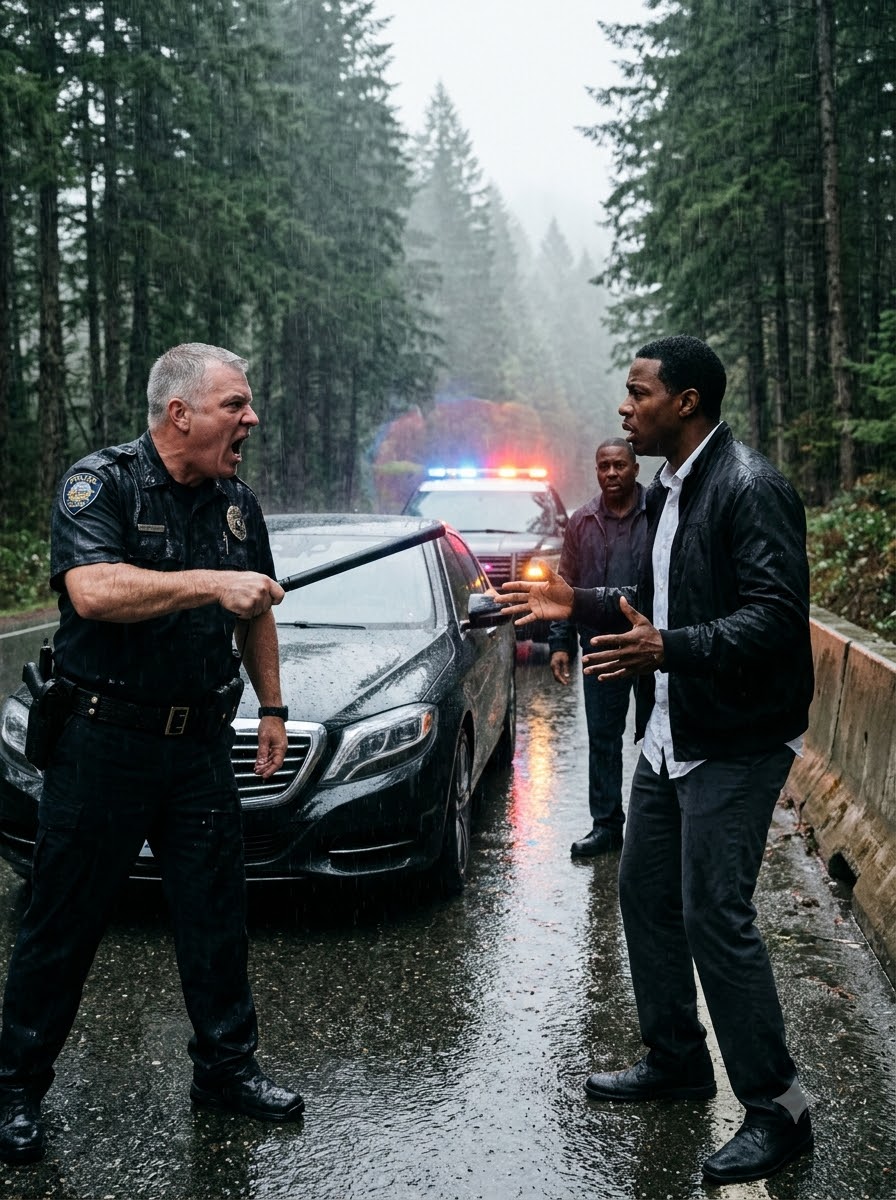
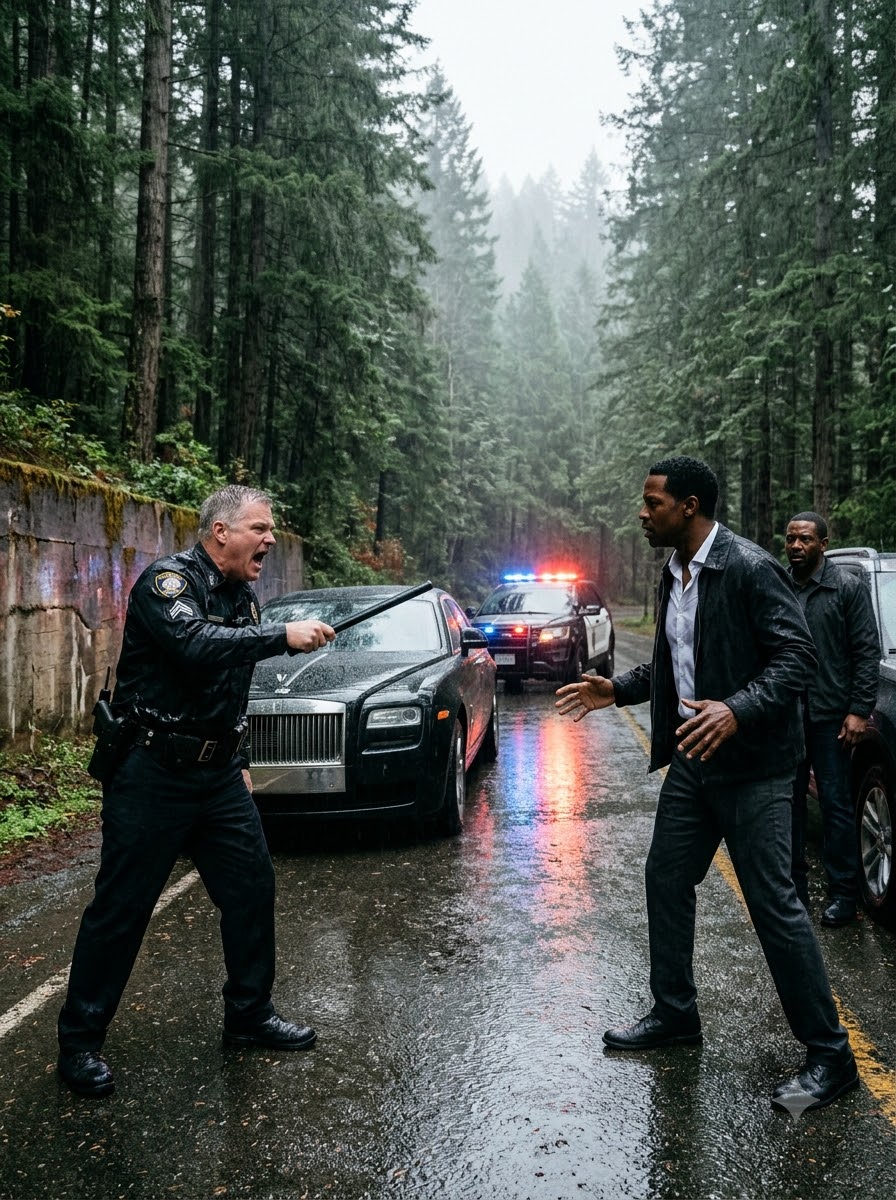
Captain Garrett Sterling slammed his fist against the hood of the Rolls-Royce.
The expensive metal shuddered beneath the blow.
He had already examined the registration.
It was valid.
He knew it.
And he had decided that it didn’t matter.
Damian Vance remained exactly where he stood.
He didn’t retreat.
He didn’t raise his voice.
Instead, he began mentally documenting everything around him, recording each detail with the precision of a man who had spent years directing federal investigations.
Beside him, his twin brother Kalin stood perfectly still.
Kalin’s hand moved three inches toward the holstered weapon at Sterling’s waist, not reaching for it, but close enough to respond if the captain made a dangerous decision.
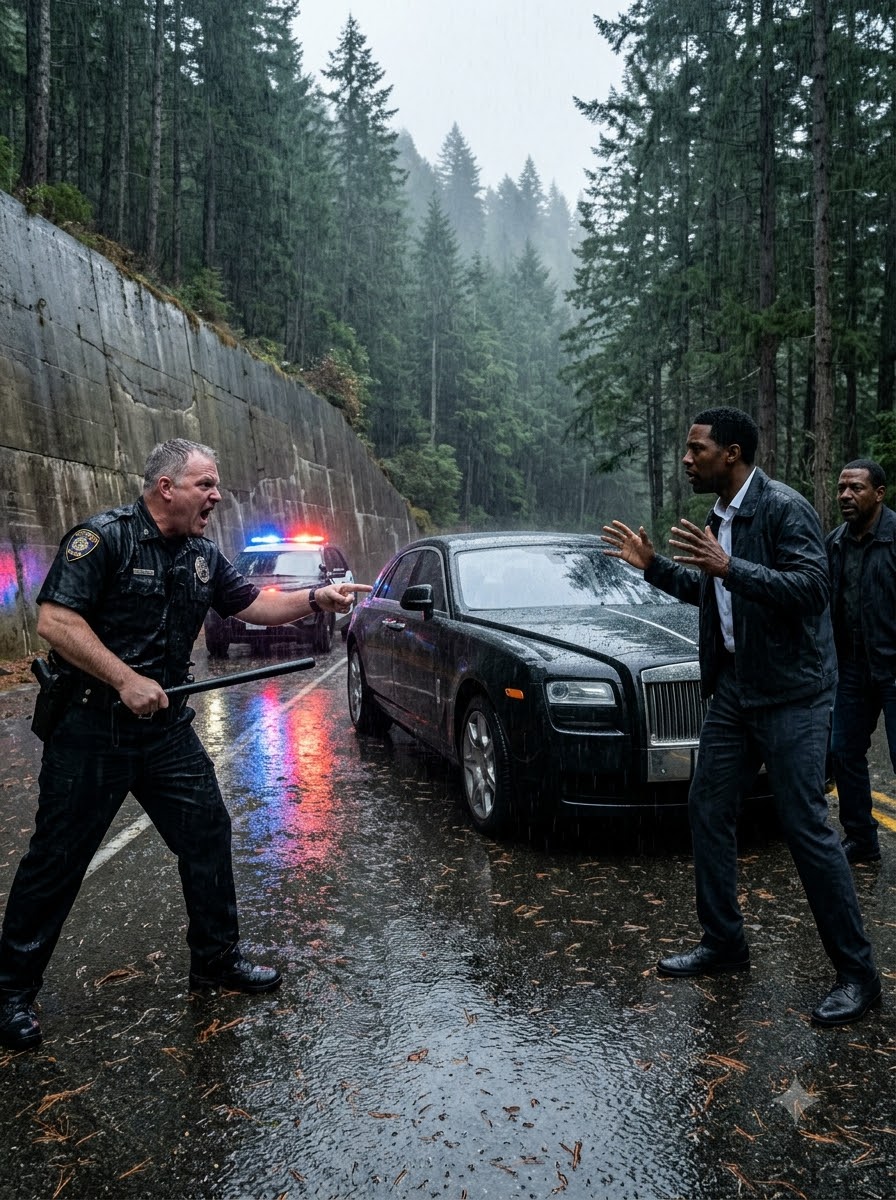
Suddenly, Sterling kicked the driver’s door shut.
The heavy door missed Damian’s wrist by less than an inch.
“Move again, and I’ll add resisting to the report.”
Kalin had already stepped away from the passenger side.
One hand was raised, palm open.
His other arm hung loosely beside him.
He appeared relaxed.
But there was nothing careless about his posture.
“You don’t want to do that.”
Something about Kalin’s voice unsettled Sterling.
For a moment, the captain’s eyes narrowed.
Then he dismissed the warning with a mocking laugh.
He spat onto the wet asphalt and snatched the registration from Damian’s hand before his brother had fully extended it.
The document slipped from Sterling’s fingers.
It landed in a puddle.
Sterling didn’t bother looking down.
“Two of you. One car worth more than my pension. You want me to believe this is legal?”
“It is legal,” Damian answered evenly. “You’re holding the proof.”
“I’m holding paper that could have come from anywhere.”
Kalin studied the crooked nameplate attached to the captain’s uniform.
Sterling.
Something changed briefly in his expression.
A flash of recognition.
Then it disappeared.
He said nothing.
He simply committed the name to memory.
Three hours earlier, there had been no police captain.
No patrol vehicles.
No flashing lights.
And no rain falling over a destroyed luxury car.
There had only been a quiet road outside Blackwood Ridge, Virginia, and two brothers returning from their father’s grave.
Pinerest Memorial Cemetery had been peaceful that morning.
A thin layer of mist hovered above the grass, just as it often did during August.
Arthur Vance had been buried there eleven years earlier.
Every year, during the same week, his sons returned.
No assistants.
No scheduled appearances.
No photographers.
No security detail drawing attention to them.
Just Kalin and Damian.
Arthur Vance had spent thirty-four years repairing municipal buses.
His hands were almost always marked with grease, even on Sundays.
He had possessed a quiet voice and an extraordinary amount of patience.
His sons couldn’t remember him raising his voice, not even when the transit union attempted to force him out after he reported a supervisor who had been stealing replacement parts.
When the twins were children, Arthur occasionally brought them to the bus depot on Saturdays.
Back then, they thought the inside of a diesel engine compartment was something magical.
They didn’t yet understand the exhaustion that came with repairing buses for a living.
Arthur let them hold the flashlight.
He taught them to identify wrenches by size before they could properly read the measurements.
And while he worked, he talked.
Not simply about engines.
He spoke about fairness.
Responsibility.
Integrity.
About what a person owed the people who trusted him.
Sometimes that trust meant maintaining a city bus carrying strangers across town.
Sometimes it meant wearing a badge that gave its owner the authority to deprive someone of freedom.
“Power doesn’t make a man important,” Arthur would say, wiping his hands on a rag that never seemed to become clean.
“It only shows you what kind of man he already was.”
Kalin remembered those words most clearly.
Damian remembered their father’s hands.
Neither brother had imagined growing up to hold the positions they eventually reached.
Arthur had raised them on a mechanic’s wages and the modest security of a transit worker’s pension.
Nothing had been handed to them.
They had learned to earn what they wanted.
Kalin entered the Federal Bureau of Investigation at twenty-three.
His advancement came slowly.
He accepted assignments in field offices that ambitious agents often avoided.
They weren’t glamorous postings.
But they taught him how investigations worked, how institutions failed, and how leadership was built through experience rather than publicity.
Damian chose a different path.
He specialized in federal financial crimes.
Instead of following suspects through streets, he followed money through bank accounts, shell companies, and falsified records.
Eventually, their careers intersected on a federal task force that neither had originally expected to lead.
Outside work, they rarely discussed their titles.
At the cemetery, during family holidays, or around their mother’s old kitchen table, they remained simply Kalin and Damian.
The same twins who had once repaired bicycle chains in Arthur’s garage while their father lectured them about mechanical torque and moral integrity in the same breath.
During the drive home, silence settled comfortably between them.
It was the kind of silence shared by people who had known each other long before professional titles complicated their lives.
“You were quiet back there,” Damian said, keeping his eyes on the road. “Thinking about him?”
“Same.”
Nothing more was necessary.
Eleven years of visiting the same grave had given them a private language.
It was a version of themselves that few colleagues ever witnessed.
For one hour each year, and during the drive afterward, they were simply two sons remembering their father.
After a while, Damian almost smiled.
“He’d hate this car.”
Kalin laughed.
“He’d ask why there’s an umbrella built into the door.”
For a brief moment, they were boys again.
The windshield wipers moved rhythmically across the glass.
Beyond the trees, a hawk flew low over an open field.
Damian followed its movement without thinking.
Then flashing lights appeared in the rearview mirror.
Red and blue reflections spread across the rain-covered glass.
His smile vanished.
A second patrol cruiser rounded the bend behind the first.
Kalin noticed immediately.
“That’s fast.”
He watched the second vehicle close the distance.
“Too fast for a routine stop. Too coordinated for one officer flagging a car and calling for backup out of caution.”
Damian remained silent.
He gradually released the accelerator.
Activated his turn signal well before reaching the shoulder.
And brought the Rolls-Royce to a controlled stop.
He returned both hands to the steering wheel, making sure they were visible.
Behind them, the patrol cars stopped at opposing angles.
Their doors opened almost simultaneously.
The captain approached with the confidence of a man who had spent years giving orders without being challenged.
His nameplate read Sterling.
“License.”
Damian handed it over.
Sterling examined the card.
Then Damian.
Then Kalin.
His gaze moved slowly over the leather interior, as though he were estimating the value of everything inside.
“Registration.”
Damian provided it.
Sterling studied the document.
His jaw tightened.
“Says this car is registered to you.”
“Because it is.”
Sterling laughed without humor.
“You expect me to believe that.”
“The registration is in your hand.”
The captain leaned through the window.
Damian could smell coffee on his breath.
“Where’d you get the money for something like this?”
From the passenger seat, Kalin spoke quietly.
“Is there a reason you’re asking about my brother’s finances, Captain?”
Sterling turned sharply toward him.
“Both of you out.”
“Why?” Damian asked.
It wasn’t an expression of confusion.
He wanted Sterling to provide a legitimate reason.
“Because I said so.”
“That isn’t a legal reason.”
Sterling’s jaw flexed.
Behind him, another officer had moved around the rear of the Rolls-Royce.
His hand rested near his equipment belt.
He examined the tinted rear windows as though expecting someone to emerge from the empty back seat.
Nothing moved.
“You get real comfortable real fast for a man who hasn’t answered a single question.”
“I’ve answered every question you’ve asked,” Damian replied.
“You haven’t asked one that requires us to exit the vehicle.”
A younger officer stepped closer.
Officer Elena Vasquez.
She kept her body camera facing the encounter.
Its recording light glowed red.
“Captain, dispatch can verify the registration in under a minute.”
Sterling didn’t turn toward her.
“Get back in your position, Vasquez.”
Damian opened the driver’s door carefully.
Every movement remained visible.
Kalin exited from the passenger side and followed half a step behind.
Close enough to intervene.
Far enough away to avoid escalating the situation.
A passing sedan slowed.
Then another.
Across the street, two customers outside a coffee shop stopped talking.
They began watching.
Sterling raised the registration.
“Two men in a car worth more than most houses in this town. And I’m supposed to just wave you through.”
“You’re supposed to verify the documents.”
Damian’s jaw tightened.
Maintaining his composure was becoming increasingly difficult.
Sterling released the registration.
It fell into the puddle.
One corner immediately darkened as water soaked into the paper.
Damian glanced down.
He didn’t move.
Vasquez looked at the document lying in the water.
Then at her captain.
For two years, she had worked under Garrett Sterling.
During that time, she had repeatedly told herself that the incidents she witnessed were the result of difficult police work rather than misconduct.
She had wanted to believe there was a reasonable explanation.
But watching a captain deliberately discard valid registration because he disliked what it proved made that explanation increasingly difficult to accept.
“Maybe the paperwork’s clean,” Sterling said, moving around the hood.
“Maybe it isn’t. Expensive cars move with clean paperwork all the time. Doesn’t mean much.”
Kalin answered without raising his voice.
“Then run the VIN.”
Sterling spun toward him.
“I know how to do my job.”
“Then do it.”
The calmness of the response seemed to ignite something inside Sterling.
He crossed the distance in two quick strides.
Only falling rain separated their faces.
“You think because you can afford a nice jacket, you get to tell me what to do?”
“No,” Kalin replied without blinking.
“I think the law tells you what to do.”
Sterling’s radio crackled.
Without taking his eyes off the twins, he pressed the transmission button.
“Possible stolen luxury vehicle. Two suspicious occupants.”
Vasquez turned sharply.
“Captain, we haven’t established that.”
Sterling covered the microphone.
“One more interruption, Vasquez, and you finish your shift behind a desk.”
She fell silent.
Her body camera continued recording.
Sterling reached for the driver’s door.
Damian moved between him and the vehicle.
The movement was controlled and economical.
“You don’t have permission to search this vehicle.”
“Excuse me?”
“You have my license. You have the registration. Verify them. That’s the extent of what you’re owed.”
Sterling smiled.
It was the smile of someone who had learned that intimidation usually worked.
He glanced toward the officers behind him.
“You believe this?”
One officer chuckled.
Vasquez remained silent.
Then she tried again.
“Captain, there’s no legal basis for a search without consent or probable cause.”
“I’ll decide what counts as cause.”
He didn’t even look at her.
Kalin observed the exchange.
His expression barely changed.
But he was memorizing every statement.
Every threat.
Every contradiction.
Sterling turned toward Damian.
He placed one palm against Damian’s chest.
Then shoved him.
Damian stumbled slightly before recovering his balance.
He didn’t retaliate.
He didn’t speak.
He simply stared at the captain.
For half a second, Sterling’s smile faltered.
Then he laughed again.
Kalin recognized the change in his brother’s silence.
It wasn’t fear.
It was concentration.
A passing driver slowed almost to a stop.
A phone rose above the dashboard.
Sterling didn’t notice.
Two years later, in a deposition room neither brother could yet imagine, those same ten seconds would be replayed at quarter speed.
Lawyers would examine the moment Sterling’s palm struck Damian’s chest.
Frame by frame.
The captain reached for the door again.
This time, he opened it.
“I did not consent to a search,” Damian said sharply.
“I don’t remember asking.”
Sterling leaned inside.
He opened the center console and began removing its contents.
A folder landed on the damp leather seat.
Other belongings followed.
Kalin remained beside the car.
He tracked the officers’ positions.
The cameras.
The time displayed on the dashboard.
And the moment Sterling’s movements obscured it.
Another young officer crouched beside the passenger footwell.
He reached beneath the dashboard.
His fingers found a small electronic module.
It had reinforced housing and several attached wires.
He began pulling it free.
Damian’s head turned immediately.
“Don’t touch that.”
The officer hesitated.
Sterling did not.
He crossed to the passenger side, seized the module, and ripped it from its mounting.
Wires tore loose.
He dropped the device onto the hood.
Then brought his boot down.
Crack.
Damian’s face remained composed.
But something in his eyes changed.
“You have no idea what you just destroyed.”
Sterling leaned closer.
“Then tell me who you think you are.”
Damian’s posture shifted almost imperceptibly.
His weight settled onto the balls of his feet.
His shoulders lowered slightly.
It was the instinctive preparation of a man whose body remembered years of training.
Sterling failed to recognize it.
He was too occupied grinding the broken module into the wet pavement.
He seemed to enjoy destroying something Damian had specifically asked him not to touch.
Kalin noticed his brother’s movement.
He always noticed Damian first.
Then he checked his watch.
At the far end of the road, headlights appeared.
One pair.
Then several more.
Soon a dozen sets of lights spread across the approaching roadway.
They moved with deliberate precision.
Damian looked directly at Sterling.
“You’re about to find out.”
Sterling straightened.
For the first time, uncertainty appeared in his expression.
He raised his radio.
“Dispatch, identify approaching vehicles.”
Static.
A long pause.
Then a strained voice answered.
“Captain, we’ve been ordered to clear this frequency.”
“Ordered by who?”
Silence.
Vasquez stopped moving.
Sterling tightened his grip on the radio.
Near the edge of the crowd, an elderly man wearing a faded green jacket leaned against a wooden cane.
He watched the approaching lights.
His expression suggested that he had been waiting years for something like this.
Sterling loosened his grip on the pry bar.
Only slightly.
“Nobody’s coming to save you.”
But the words sounded less like a threat now.
More like something he needed to believe himself.
Behind him, Sergeant Clayton Briggs had become unusually quiet.
He recognized the approaching formation.
Years earlier, he had witnessed federal vehicles arrive during a joint task force operation that ended two careers in his former precinct.
He knew what a convoy like this could mean.
Damian answered Sterling softly.
“This was never about saving us.”
Seven months of investigative work had brought the brothers toward this moment.
Not because they had planned to be stopped on this exact road.
Not because they had anticipated the rain.
And certainly not because they had expected Sterling to behave with such reckless cruelty.
The federal investigation had begun with three separate complaints.
They had been filed eighteen months apart.
Each was dismissed internally.
Each was labeled an isolated grievance.
Each disappeared without meaningful scrutiny.
Damian’s team had discovered a pattern beneath those closures.
Seized property was moving through channels that no legitimate process should have permitted.
Vehicles.
Cash.
Business equipment.
Property taken from people who had never been convicted of anything.
And much of it appeared to have been transferred through suspicious auctions.
Investigating a captain who controlled his department’s records was difficult.
Paperwork alone could be manipulated.
Complaints could be buried.
Witnesses could be intimidated.
The task force needed evidence that could survive those obstacles.
It needed to document the conduct described in the complaints.
In public.
In front of witnesses.
Vasquez had been the greatest uncertainty.
Damian’s team knew her name from personnel records.
They knew she had transferred into the department eighteen months earlier.
Her file was clean.
She had no disciplinary complaints.
But they didn’t know what she would do when forced to choose between obeying Sterling and following the law.
Some officers protected their supervisors.
Others protected their institutions.
Vasquez would ultimately choose something more important.
The equipment hidden inside the Rolls-Royce had been installed four days earlier.
A technician had completed the work in a garage two counties away.
There was no public record of the installation.
Only a sealed internal task force file under Damian’s authority.
The brothers’ cemetery visit was genuine.
Their grief was genuine.
Their drive home was genuine.
But the broader investigation had already been moving for months.
And the equipment was there to preserve evidence if an encounter occurred.
What Damian had not anticipated was how far Sterling would go.
The task force had considered numerous possible scenarios.
A prolonged traffic stop.
Repeated registration checks.
An unjustified vehicle search.
An officer attempting to intimidate two unidentified motorists.
Most scenarios assumed some minimal level of restraint.
None fully anticipated a captain openly destroying federal equipment while civilians recorded him.
Nor had the brothers expected Sterling to continue escalating after repeated warnings.
That was what stayed with Damian.
Not the convoy.
Not the eventual revelation of their identities.
But the moment Sterling raised the pry bar again, clearly aware that something was wrong, and decided to strike anyway.
The shattered module lay beneath the ruined dashboard.
Its damaged casing rested among broken plastic and rainwater.
But three hundred miles away, federal servers had already received its final transmitted data.
Sterling knew nothing about that.
He was about to learn.
Fifteen minutes earlier, before the captain reached the console, Vasquez had made a decision that would alter her career.
Sterling ordered her to switch off her body camera.
She raised her hand.
Pressed the control.
The red recording light disappeared.
Sterling believed she had obeyed.
What he didn’t notice was her other hand moving near her hip.
She carefully removed a thin microSD card from a concealed slot beneath the camera housing.
When Briggs pushed past her toward the trunk, she used the movement as cover.
The card slipped between her fingers.
It dropped silently into the shallow water beside the curb.
Donald Price stood only three feet away.
He saw it.
But he didn’t look down.
His expression remained unchanged.
He shifted his cane forward.
Placed its worn rubber tip beside the card.
And positioned himself so that the small object was hidden from view.
When Briggs turned away, Donald slowly bent down as though his knees were troubling him.
One hand rested on his leg.
His other hand moved briefly toward the water.
By the time he straightened, the card had disappeared into the seam of his boot.
Nobody noticed.
Donald caught Damian’s eye.
He gave a single nod.
Damian offered no visible response.
He simply registered what had happened.
Then turned his attention back toward Sterling.
The captain had discovered a black leather case secured beneath the rear seat.
Before Sterling could reach it, Kalin moved.
One quick lateral step.
Controlled.
Economical.
He placed himself between the captain and the vehicle.
He didn’t touch Sterling.
He didn’t raise his voice.
But the sudden movement startled a man already determined to interpret everything as a threat.
Sterling’s hand jerked toward his holster.
His thumb caught the retention strap.
The fastening snapped loose.
The atmosphere changed instantly.
Kalin stopped moving.
Both hands remained visible.
His feet were planted firmly.
He looked directly into Sterling’s eyes.
There was no fear in his expression.
Only warning.
“That holster is now unsecured in a public confrontation with an unarmed civilian standing three feet away.”
His voice was quiet.
“Draw that weapon and you’re not filing a report tomorrow. You’re being charged.”
He continued without blinking.
“First-degree use of deadly force against a civilian carries decades. Captain, think about what you’re doing before your hand finishes the thought it already started.”
Sterling’s fingers trembled against the leather.
For one long second, nobody moved.
Then he lowered his hand.
He fastened the retention strap again.
The movement almost resembled an apology to himself.
“On your knees,” he ordered instead.
His voice cracked slightly.
“Hands behind your back.”
Damian obeyed.
He offered no resistance.
Sterling forced his wrists together and closed the handcuffs.
The metal tightened painfully.
Kalin watched every second.
He memorized the moment Sterling had nearly made a decision that could have ended several lives.
Then the captain returned to the black leather case.
It was compact and heavily reinforced.
An electronic lock protected its contents.
The equipment alone cost more than many ordinary vehicles.
Sterling lifted it into the light.
“Well, well.”
Damian stepped forward instinctively.
The cuffs bit into his wrists.
“Leave that where it is.”
Sterling turned the case over.
“What’s inside?”
“Material unrelated to this stop.”
“Open it.”
“No.”
Sterling smiled.
“That kind of answer usually means I should be very interested.”
“It means you don’t have the authority to open it.”
The captain glanced at his officers.
“You hearing this?”
Nobody answered.
Across the street, more people raised their phones.
The growing crowd had stopped pretending not to watch.
Sterling’s patience finally broke.
He placed the case on the hood.
Removed a pry bar from his equipment.
And forced its edge against the electronic lock.
The first strike damaged the casing.
The second broke it open.
Inside were sealed folders and a compact storage drive.
No cash.
No weapons.
Nothing resembling the criminal evidence Sterling had expected to discover.
His triumphant expression faded.
Briggs lifted the top folder.
He opened it.
A federal marking appeared along the inner edge.
The sergeant’s face went pale.
He said nothing.
Damian watched the change.
He understood exactly what Briggs had seen.
Near the coffee shop, a woman moved closer while recording.
“They’re going through his things, his personal property on camera,” she said quietly into her phone.
An older bystander shook his head.
He muttered about the last time he had witnessed officers conduct a search this aggressively without explaining any actual charges.
Sterling snatched the folder from Briggs.
He scanned the page.
Confusion crossed his face.
Then anger.
Then something dangerously close to fear.
“What is this?”
Damian remained silent.
Sterling shoved the folder against his chest.
The impact forced him backward.
“You’re going to tell me what this is?”
“No.”
“You think you’re in a position to say no to me?”
“I think you’re in a position that’s about to get significantly worse.”
Sterling laughed.
The sound was thin and disbelieving.
“You’re cuffed in the rain and you’re threatening me.”
“I’m not threatening you,” Damian replied.
“I’m describing the next several hours of your life, and you’re the only person on this road who doesn’t understand that yet.”
Sterling’s composure fractured.
“You don’t get to talk to me like that!”
His voice rose.
“Not here. Not on my road.”
“It isn’t your road,” Damian answered.
The same words.
The same calm.
But now the entire street had witnessed how far Sterling was prepared to go to prove otherwise.
The captain turned toward the dashboard.
He pointed at the remaining equipment.
“Take it apart.”
The nearest officer hesitated.
“Captain—”
Sterling shoved past him.
He struck the housing with the pry bar.
Plastic fractured.
A cable snapped.
The last visible light on the damaged device flickered.
Then went dark.
Sterling lifted the broken equipment like a trophy.
“There. Whatever you were hiding, gone.”
Damian looked at the device.
His expression remained calm.
“Backup transmission completes in under thirty seconds of activation.”
Sterling’s smile vanished.
He stared at the shattered electronics.
Then at the two brothers.
Then toward the approaching headlights.
For the first time that evening, genuine fear appeared in his eyes.
“What transmission?”
Damian didn’t answer.
And at that exact moment, another patrol vehicle arrived.
A canine unit.
The dog that stepped onto the wet asphalt would expose the next part of the conspiracy before the federal convoy even reached them.
PART 2
The Belgian Malinois emerged from the patrol vehicle in a controlled trot.
Its handler followed closely.
The dog’s nose immediately began working through the damp evening air.
It approached the Rolls-Royce.
Circled the vehicle once.
Sniffed the open door.
But did not give an alert.
Then it turned away.
Its ears shifted backward.
A low growl developed in its throat.
The animal walked directly toward Sergeant Clayton Briggs.
It stopped in front of him.
Then sat.
Rigid.
Focused.
Its nose pointed toward the pocket of Briggs’s jacket.
The handler frowned.
“That’s not the vehicle.”
Briggs froze.
“Dog’s confused. Long night.”
The handler watched the animal carefully.
“He’s not confused.”
The dog remained completely still.
“In four years, I’ve seen him wrong exactly twice. And both times it turned out he wasn’t.”
Unease spread through the officers standing near the cruisers.
One deputy stepped away from Briggs.
Kalin spoke suddenly.
A single command.
Low.
Precise.
“Hig.”
The Malinois flicked its ears toward him.
It remained seated.
Alert.
Waiting.
The handler looked from the dog to Kalin.
Then back toward Briggs.
“Sergeant, empty your pocket.”
Briggs didn’t move.
“This is ridiculous.”
“Empty it.”
Sterling turned toward his sergeant.
For the first time, confusion and alarm appeared together on his face.
Briggs slowly reached into his jacket.
He removed a small folded plastic bag.
White powder was visible inside.
His hand trembled beneath the cruiser headlights.
“That’s not mine. I don’t know where that came from.”
The handler studied him.
“You were seen near the vehicle three minutes ago.”
He continued.
“Rear wheel well. I clocked it when we pulled up. Figured you were checking the tire.”
Briggs remained silent.
Any explanation now risked making matters worse.
Sterling opened his mouth.
Then closed it again.
He had no immediate response.
The handler moved forward.
He secured Briggs’s wrists.
There was no celebration in the movement.
No anger.
Only procedure.
“Sergeant Briggs, you’re being detained pending investigation into possession of a controlled substance and attempted evidence tampering.”
“This is a setup!”
Briggs’s voice climbed toward panic.
“Somebody planted that. I’ve been on this force eleven years.”
“Then eleven years is about to matter a great deal in the report I write tonight,” the handler replied.
He escorted Briggs toward the second cruiser.
Kalin watched the Malinois settle calmly near the handler’s feet.
The dog had completed its task.
Kalin said nothing.
Twelve feet away, Vasquez stood motionless.
Her expression held a mixture of dread and vindication.
The handler requested a supervisor from outside Sterling’s chain of command.
That request would later become an important part of the official record.
Two additional officers approached from the other cruiser.
They appeared uncertain whose instructions they should follow.
Sterling recovered his voice.
He turned his anger toward the twins.
“You set this up?”
“No,” Damian answered.
“You did every piece of it. We just made sure someone was watching when you did.”
Sterling reached toward Damian’s jacket.
He appeared ready to grab him.
To turn his frustration into another act of force.
Then his phone rang.
Loudly.
Insistently.
He pulled it from his back pocket.
The screen displayed an official designation.
State Police Command Center.
Sterling recognized it.
His face changed.
He answered sharply.
“Sterling.”
The voice on the other end was urgent and controlled.
“Federal task force elements inbound to his location. Immediate stand-down recommended. Do not obstruct. Do not detain. Repeat, do not detain.”
Sterling’s jaw tightened.
“This some kind of joke? Some lawyer trying to spook me off a legitimate stop?”
The warning was repeated.
More urgently.
Sterling gave a short, contemptuous laugh.
“In Blackwood Ridge, I am the law.”
He ended the call.
Then violently removed the phone’s rear panel.
He pulled out the battery.
And threw it into the darkness beyond the cruiser’s headlights.
Vasquez watched it disappear into the grass.
She understood how far the captain had gone beyond reason.
A direct stand-down instruction from state command was not something a responsible officer simply ignored.
Sterling had just demonstrated that he no longer cared about instructions from anyone.
She remembered the complaint she had nearly filed eight months earlier.
A senior officer had warned her that reporting a captain rarely ended well for the person making the complaint.
She had convinced herself to remain quiet.
Standing in the rain now, she wished she had filed it.
Damian observed Sterling’s behavior.
Something shifted in his posture.
Not relief.
Not yet.
It was the stillness of someone watching an opponent deliberately destroy his final opportunity to avoid catastrophe.
Kalin checked his watch.
A message had appeared.
Convoy four minutes.
He didn’t announce it.
Damian noticed the slight change in his brother’s expression.
He understood.
Four minutes.
Enough time for Sterling to make one more irreversible decision.
The captain turned back toward the damaged dashboard.
A fragment of the module remained attached to its mounting.
“Finish it,” he ordered.
The nearby officer hesitated.
Sterling pushed him aside.
He forced the pry bar into the housing.
Plastic split.
Wires tore free.
The final indicator light flickered once.
Then disappeared.
Sterling raised the destroyed device.
“There. Whatever you were hiding, gone.”
Damian studied it.
“Backup transmission completes in under thirty seconds of activation.”
He allowed the statement to settle.
The equipment had been active far longer than thirty seconds.
Sterling’s grin disappeared.
He stared at the ruined module.
At Damian.
At Kalin.
At Vasquez, whose body camera appeared dark but whose expression suggested she knew far more than she was saying.
Then toward Briggs.
The sergeant stood beside a cruiser, detained, while officers secured the suspicious bag.
Fear finally broke through Sterling’s anger.
“What transmission?”
Damian offered no explanation.
Behind him, the road was filling with headlights.
They swept across both lanes.
The engines approached in disciplined formation.
This was not emergency backup arriving in confusion.
It was an operation already underway.
A plan that had been moving long before Sterling decided to stop a black Rolls-Royce because he believed its occupants did not belong in his town.
Sterling’s hand drifted toward his holster.
Kalin moved immediately.
He placed himself between the captain and Damian.
One palm remained raised.
His voice was low enough that only Sterling could hear.
“Think very carefully about your next decision, Captain. Everything after this moment is permanent.”
Sterling’s hand froze.
Across the road, Donald Price watched from beside the curb.
He leaned heavily on his cane.
During the previous two years, he had returned to this same stretch of road twice.
The first time, he had watched his son’s work truck being towed away.
It never returned.
The second time, he had stood near the spot where the seizure occurred, trying to understand how a single police decision could destroy a small business without anyone offering an explanation.
He had spent years waiting for someone to believe his family.
Now he was watching something he had never expected to witness.
He didn’t yet know what it meant.
Vasquez had moved closer to him.
She spoke quietly.
“Sir, I’m sorry. For whatever that’s worth right now.”
Donald remained silent for a moment.
Then he answered.
“It’s worth something.”
He looked toward the approaching lights.
“Ask me again in an hour.”
The first SUV reached the shoulder.
It slowed beside Sterling’s cruiser.
More vehicles followed.
Their headlights spread across the wet road.
Rain struck the roofs.
Engines idled.
For a moment, nobody moved.
Then the doors opened.
Men and women wearing dark federal jackets stepped out.
Their movements were coordinated.
Two headed directly toward the damaged dashboard.
Two secured the area around the crowd.
Another agent knelt beside the broken black case and began photographing its lock.
Sterling raised one hand.
“Stop right there. This is an active investigation.”
Nobody obeyed.
The federal personnel continued moving.
A tall man in his fifties emerged from the lead vehicle.
Special Agent Zachary Cole.
He surveyed the scene in one practiced glance.
The shattered windshield.
The torn interior.
The scattered electronics.
Damian standing in handcuffs beneath the rain.
Cole’s jaw tightened.
He walked straight toward Damian.
He didn’t acknowledge Sterling.
“Sir.”
He reached for the handcuffs.
Damian turned his wrists.
The lock opened.
Click.
He rubbed the reddened skin beneath the metal.
He made no complaint.
Around the Rolls-Royce, agents worked methodically.
Evidence markers appeared beside pieces of the destroyed dashboard.
A photographer documented the broken case from several angles.
Fragments were left undisturbed until their positions had been recorded.
The careful procedures made Sterling’s earlier conduct appear even more reckless.
The captain found his voice.
“You can’t release my suspect.”
Cole didn’t turn.
“Your suspect?”
“He’s under investigation for obstruction. Possible financial crimes. We found concealed equipment in that vehicle.”
Damian spoke.
“Status.”
Cole answered immediately.
“Three locations secured. Seven subjects detained, financial servers recovered intact, warrants executed at all secondary sites.”
Sterling’s expression changed.
Damian continued.
“Primary accounts frozen twenty-three minutes ago.”
He looked toward Cole.
“Auction records recovered.”
The federal agent confirmed the information.
Around them, the roadside had transformed into an evidence-processing scene.
Agents approached witnesses.
They displayed credentials.
Asked for names.
Requested recordings.
Collected statements.
Someone erected a portable evidence table beside the damaged Rolls-Royce.
Sterling looked from the agents to the open handcuffs.
Then toward the brothers.
“What are you talking about?”
Nobody answered him immediately.
Damian walked toward the damaged dashboard.
He crouched and examined the fragments.
Cole followed.
“How bad?”
“Primary recorders destroyed,” Damian said.
He lifted a broken piece of the casing.
“Backup should have completed before impact.”
“It did.”
For the first time all evening, Damian released a quiet breath.
Some tension left his shoulders.
Sterling stepped closer.
He was still trying to recover the authority he had lost.
“What transmission?”
Damian stood.
“The one your officers repeatedly warned you not to interfere with.”
“That device was concealed in a vehicle I was investigating.”
“No, Captain.”
Damian faced him.
“The vehicle was involved in an investigation. Yours.”
Sterling stared.
“For seven months,” Damian continued, “we followed shell companies, altered seizure records, auctions that moved property no court ever authorized.”
He paused.
“Tonight, those threads finally closed.”
Sterling retreated half a step.
“Nothing.”
His voice sounded uncertain.
“Vehicles, cash… businesses.”
“And auctions,” Damian added.
“Including several connected to people inside Blackwood Ridge law enforcement.”
Sterling glanced toward Briggs.
A federal agent was securing evidence associated with the detained sergeant.
Briggs looked away.
“Seven months,” Damian repeated.
“Three complaints that went nowhere inside your own department because you controlled the paperwork that would have proven them.”
He let the accusation settle.
“We didn’t need you to confess tonight, Captain. We needed you to keep being exactly who you already were in front of enough people that no report could bury it afterward.”
Sterling’s hands trembled.
“You used us. You used this whole stop.”
“No,” Damian replied.
“You used a badge to decide two men in a car didn’t deserve the same rights as anyone else on this road.”
He gestured toward the ruined vehicle.
“Everything after that was yours.”
Sterling shook his head.
“You’re lying. You set us up.”
“No.”
Damian’s voice remained steady.
“You stopped us. We didn’t choose this encounter.”
He continued.
“You chose the stop. You chose to ignore valid registration. You chose the search, the cuffs, the destruction of federal equipment after repeated warning.”
His eyes moved toward the shattered windshield.
“And you chose that.”
Elena Vasquez approached through the federal agents.
She held her phone.
Sterling noticed her.
His old reflexes returned.
“You’re suspended. Get out of here.”
She ignored him.
She walked directly toward Cole.
“I have something you’ll want.”
She handed him the phone.
Sterling’s face drained.
“You wouldn’t.”
“My camera was ordered off,” Vasquez explained.
“I restarted it before Captain Sterling confiscated the unit. External copy uploaded before he ever touched it.”
Cole accepted the phone.
“How much did you capture?”
For the first time, Vasquez looked directly at Sterling.
“Enough.”
Two agents moved between her and the captain.
Sterling didn’t attempt to approach.
“The recording includes the search after registration cleared,” Vasquez continued.
“The destruction of the module, threats against a witness.”
She paused.
“And a conversation about changing the report.”
Briggs went pale.
Sterling turned sharply toward him.
“You said that where she could hear?”
“You said it,” Briggs snapped.
“I just stood there.”
Whatever loyalty had existed between them collapsed in that moment.
Their alliance had survived years of questionable conduct.
But it could not survive the prospect of federal prosecution.
Damian watched without satisfaction.
Only confirmation.
For years, the system had protected itself.
Quietly.
Efficiently.
Until the moment each participant became frightened enough to protect himself instead.
Cole listened to a brief message through his earpiece.
Then he looked toward Kalin.
“Final site secured.”
Kalin nodded.
“Preserve this entire scene.”
Sterling laughed desperately.
“You don’t have authority to give that order.”
Cole turned toward him.
“He does.”
Sterling’s gaze moved to Kalin.
At that moment, something slipped from the wallet clipped near Sterling’s belt.
A thin gold shield fell into the mud.
The captain instinctively moved his boot toward it.
As though he could grind away whatever it represented.
But the convoy’s floodlights swept across the road.
The shield caught the light.
An engraved eagle.
Gold lettering.
And words that nobody in Blackwood Ridge had expected to see.
Director.
Federal Bureau of Investigation.
A voice cut through the rain.
“FBI. Everyone stand down.”
Sterling’s pry bar slipped from his hand.
It struck the pavement with a metallic ring.
Two senior officials emerged from the third SUV.
They crossed the road quickly.
They didn’t approach Cole.
They didn’t approach Damian.
They went directly to Kalin.
One was a woman in her fifties wearing a federal windbreaker.
Two days earlier, she had personally briefed Kalin on the operation in a conference room three hundred miles away.
Neither had imagined that the final stage of the investigation would unfold with the bureau’s director standing on a rain-soaked roadside beside a wrecked Rolls-Royce.
She stopped in front of him.
Her posture became formal.
“Director Vance.”
Every nearby officer fell silent.
Sterling stared.
“Director?”
The word barely escaped his mouth.
The official continued.
“Director Kalin Vance, Federal Bureau of Investigation.”
Garrett Sterling had nothing left to say.
Briggs lowered his head.
Vasquez looked from one brother to the other.
The previous hour began rearranging itself in her mind.
The confidence.
The calm.
The unexplained equipment.
The approaching convoy.
The federal warnings.
The brothers had never been ordinary motorists.
But they had deserved ordinary legal protections from the beginning.
The crowd grew silent.
Phones remained raised.
Rain continued falling.
Federal engines idled along the shoulder.
Donald Price straightened against his cane.
He watched an agent retrieve the gold shield from the mud.
The agent cleaned it carefully and returned it to Kalin.
Donald said nothing.
For two years, he had been waiting for someone to take his family’s complaint seriously.
Now accountability was arriving in a form he never could have imagined.
Sterling stared at the damaged Rolls-Royce.
Then at Kalin.
Then back at the car.
“No.”
His voice was small.
“That’s not possible.”
Kalin adjusted his wet jacket.
“Why?”
Sterling opened his mouth.
No explanation came.
Damian stepped beside his brother.
Sterling looked at him.
“And him?”
Cole answered.
“Special Agent in Charge Damian Vance oversees the federal task force investigating the Blackwood Ridge asset seizure network.”
Briggs stumbled backward.
His foot nearly slipped on the wet pavement.
Sterling’s voice changed.
It became almost pleading.
“Director, if I had known.”
Kalin raised one hand.
Sterling stopped speaking.
“That sentence,” Kalin said quietly, “is the problem.”
“Sir, this was a misunderstanding.”
“No.”
Kalin glanced toward Donald Price.
“Was his son a misunderstanding?”
Sterling remained silent.
“Was threatening Officer Vasquez a misunderstanding?”
Still nothing.
Kalin looked at the shattered Rolls-Royce.
“Was that?”
Sterling’s breathing became uneven.
“You have to understand what this looked like.”
“What did it look like?”
Sterling hesitated.
Kalin stepped closer.
“Two men driving an expensive car.”
Nobody moved.
“You checked the registration. It was valid. You checked the VIN. It was clean. You found no warrant.”
He paused.
“And you continued anyway.”
Sterling lowered his gaze.
“The problem isn’t that you failed to recognize the FBI director standing in front of you.”
Kalin’s voice remained quiet.
“The problem is that you believed the man in front of you needed to be the FBI director before he deserved basic dignity.”
A murmur moved through the crowd.
Sterling’s shoulders sagged.
He looked toward the wrecked car.
The witnesses.
Vasquez.
The federal agents documenting everything.
He seemed to be replaying the entire evening, searching for the moment when he could have stopped.
But there had been many such moments.
Not one.
A dozen.
And at every one, he had chosen to continue.
Cole directed the evidence team.
Containers appeared along the shoulder.
Agents photographed the electronics.
Collected fragments of the broken case.
Cataloged pieces of the dashboard.
The objects Sterling had treated as worthless debris were now being preserved as federal evidence.
One agent photographed the spot where Briggs had first discovered the federal marking inside the folder.
Another collected pieces of the recording module.
Each item received a number.
Each location was documented.
Each piece of evidence became part of a chain Sterling could no longer control.
Vasquez watched from several feet away.
She folded her arms against the cold.
Her badge remained attached to her uniform.
Sterling had threatened to suspend her.
But he had never formally taken it away.
Damian turned toward Briggs.
“Sergeant Clayton Briggs, we have records connecting two asset auction companies to accounts controlled through members of your family.”
Briggs’s expression collapsed.
“I didn’t run those companies.”
“I didn’t say you did.”
Damian continued.
“But someone with your last name did, and every transfer roots back through an account you had signing authority on for four years.”
Briggs looked toward Sterling.
Sterling stared back.
The trust between them deteriorated further.
“We also recovered internal messages discussing which seizures should bypass review.”
Damian looked at the captain.
“That was you, Captain.”
Sterling spun toward him.
“That’s a lie.”
“You approved everything,” Briggs shouted.
Sterling lunged.
Two federal agents intercepted him.
They restrained him before he reached Briggs.
“Get off me. This is ridiculous.”
“He’s trying to save himself,” Damian observed.
“Yes,” Sterling snapped.
He was breathing hard.
“And that,” Damian answered, “is why we rely on evidence instead of anyone’s word, including yours.”
Cole returned with Vasquez.
The recording had been transferred and logged.
“It captured the conversation about changing the report and the destruction,” Cole confirmed.
Sterling turned toward her.
“You betrayed your department.”
Vasquez’s eyes filled with emotion.
But her voice remained firm.
“No.”
She stepped closer.
“I refused to betray the badge.”
Sterling looked away first.
Damian turned toward Donald Price.
“Mr. Price.”
Donald approached slowly.
He appeared uncertain until Damian’s expression reassured him.
“Your son’s case will be reviewed.”
Donald’s eyes glistened.
“His truck.”
“Everything.”
A woman near the back of the crowd raised her hand.
Her voice shook.
“They took money from my husband two years ago. No charges.”
Damian signaled to a nearby agent.
“Get her information.”
Another person spoke.
“My brother lost his van.”
Then another.
“They seized my daughter’s car.”
More voices followed.
Complaints began spreading through the crowd.
One after another.
People who had spent years believing nobody would listen were finally speaking in a place where Sterling could no longer silence them.
The captain listened.
His shoulders dropped lower with every account.
“This investigation started with three complaints,” Damian announced.
“Tonight we have dozens.”
Cole stepped forward.
His tone became formal.
“Garrett Sterling, you are being taken into custody pursuant to federal warrants connected to conspiracy, obstruction of justice, evidence tampering, and offenses arising from the Blackwood Ridge asset seizure investigation.”
Sterling looked toward Kalin.
“I served this city twenty-four years.”
Kalin showed no satisfaction.
“Then you had twenty-four years to understand what that badge required.”
“One mistake shouldn’t erase a career.”
Kalin glanced toward the ruined Rolls-Royce.
“This isn’t about one car.”
He looked toward Donald.
“One family.”
Then Vasquez.
“One officer.”
Finally, his eyes returned to Sterling.
“It’s about what you chose over and over whenever you believed the person in front of you had less power than you did.”
Sterling lowered his head.
Cole turned him around.
The handcuffs closed.
Click.
The same sound that had echoed around Damian’s wrists earlier that evening.
But this time, the arrest was supported by federal warrants, documented evidence, and criminal allegations that could withstand scrutiny.
Briggs was taken into custody minutes later.
He offered little resistance.
His expression suggested that he had known this outcome was possible long before tonight.
Several other officers were separated for questioning.
Some voluntarily surrendered their phones and records.
They chose cooperation before investigators demanded it.
Vasquez stood beside Damian.
She watched Sterling disappear into the rear of a federal vehicle.
“I thought nobody would believe me,” she said quietly.
“That’s what systems like his depend on.”
Her gaze dropped toward Damian’s wrists.
The skin was still red from the handcuffs.
“Why didn’t you tell him who you were?”
Damian looked toward his brother.
Kalin answered.
“Because the law shouldn’t change after someone learns your title.”
Sterling reached the federal SUV.
Before climbing inside, he looked back one final time.
Rain streamed down his jacket.
The Rolls-Royce sat behind the twins.
Its windshield was shattered.
Its interior had been torn apart.
An hour earlier, Sterling had treated the car as evidence that two Black men did not belong in Blackwood Ridge.
Now the wreckage demonstrated something entirely different.
It showed what could happen when a person entrusted with authority believed that prejudice entitled him to disregard the law.
Kalin looked at the destroyed vehicle.
Damian joined him.
“That’s going to be expensive,” Kalin said quietly.
Damian almost smiled.
“It can be replaced.”
Then he looked toward the people still giving statements in the rain.
“That can’t.”
Neither brother needed to explain what he meant.
The damage to public trust had begun long before their Rolls-Royce was destroyed.
And repairing it would require far more than replacing a luxury car.
PART 3
Four months later, Blackwood Ridge looked much as it always had.
The storefronts remained familiar.
The courthouse clock still marked the hours above downtown.
Quiet mornings gave way to ordinary traffic.
Residents continued opening businesses, walking to work, and greeting neighbors along the sidewalks.
But beneath that ordinary appearance, the town had changed.
The federal investigation had expanded rapidly after the arrests.
Investigators examined years of property-seizure records.
They found vehicles confiscated from people who had never faced criminal charges.
Cash taken during traffic stops without any resulting conviction.
Work trucks sold through auctions that should never have occurred.
Property transferred through businesses connected to public officials and their relatives.
The first review identified thirty-one suspicious cases.
That number increased to forty-seven.
Then sixty-three.
Families who had long since stopped expecting answers began receiving unexpected phone calls.
Their cases were being reopened.
Their complaints were finally being examined.
Forensic accountants followed the financial trail.
It took longer than the arrests.
Auction businesses had operated for years under names that attracted little attention.
Many turned out to be shell companies linked through accounts in three states.
Property moved from police impound lots into private ownership within days of seizure.
In many cases, no valid court order supported the transfer.
The financial arrangements had been deliberately complicated.
Accounts were layered through multiple businesses.
Ownership was concealed.
Transactions were structured to make the money difficult to trace.
Investigators spent months untangling those records.
Eventually, the same names appeared repeatedly.
Men who had worn badges.
Men who had believed that their authority allowed them to take what they wanted.
But the investigation also made an important distinction.
Not every officer was guilty.
Some were cleared.
Some had never known about the seizure network.
Others had witnessed questionable conduct without understanding the larger conspiracy.
Kalin insisted that those differences be recognized publicly.
He would not allow the investigation to become another exercise in collective accusation.
Accountability required evidence.
And evidence had to be evaluated fairly.
One young officer who had hesitated during Damian’s detention eventually testified for the prosecution.
He had questioned Sterling’s instructions.
He had received no meaningful explanation.
And he had watched a man remain composed while being handcuffed in the rain.
The officer testified voluntarily.
He kept his job.
Sterling did not.
When asked why he had risked contradicting his superior, the young officer gave a simple answer.
The man standing in handcuffs had looked at him as though his decision mattered.
He had been unable to forget that expression.
Among the families whose cases were reopened was the Price family.
Nathan Price had once operated a small landscaping business.
His truck had been seized during an encounter with Blackwood Ridge officers.
No criminal charges followed.
The vehicle disappeared into an auction system that Nathan and his father could not challenge effectively.
The truck was eventually sold.
Without it, Nathan’s business collapsed.
For two years, Donald Price had searched for answers.
He made calls.
Filed complaints.
Returned to the road where the seizure occurred.
And waited.
Nobody gave him a satisfactory explanation.
Then the federal investigation uncovered the records.
Officials eventually recovered money associated with the sale.
The original truck was gone.
But the compensation was sufficient for Nathan to purchase another vehicle and restart his business.
On the first morning he returned to work, Donald sat beside him in the passenger seat.
For a while, neither spoke.
The engine hummed.
The road stretched ahead.
Then Donald reached out and touched the dashboard.
“They finally believed us.”
Nathan shook his head.
His eyes remained on the road.
“No, Dad. They finally had to listen.”
Garrett Sterling no longer wore a badge.
Neither did Clayton Briggs.
The criminal proceedings against them moved forward.
The case rested on financial records, internal communications, witness statements, recovered property documents, and recorded evidence.
Not on Kalin’s position.
Not on Damian’s rank.
And not simply on the fact that the two men targeted that night happened to be powerful federal officials.
That distinction mattered deeply to Kalin.
When officials suggested presenting the case as a dramatic victory for the FBI director and his brother, he rejected the idea.
“This can’t become the story of two powerful men who got justice,” he told them.
“It has to become the story of everyone who deserved it before we ever showed up.”
Blackwood Ridge began restructuring its property-seizure procedures.
Major confiscations would now be reviewed through an independent process.
The department could no longer approve, transfer, and dispose of valuable property without meaningful outside scrutiny.
Old cases were reopened.
Records were corrected.
Some officers were cleared entirely.
Others faced disciplinary investigations that had previously been impossible.
Complaints against senior officers could finally be examined outside their own chain of command.
Elena Vasquez returned to duty.
An independent review determined that her suspension had been retaliatory.
Reporters began calling her a hero.
She rejected the description.
“I was scared,” she told one journalist.
Her voice was direct.
“I just finally decided that being scared wasn’t a good enough reason to stay quiet.”
She remained with the department for another year.
Then she transferred to a state oversight division.
Its responsibility was to examine complaints similar to those Donald Price had carried for years without receiving a meaningful response.
Officially, the transfer wasn’t a promotion.
Elena never regarded it as anything less than an opportunity to do more important work.
Clayton Briggs eventually accepted a plea agreement.
In exchange for a reduced sentence, he agreed to testify against Sterling and two auction operators.
Neither auction operator had been present on the rainy road.
But their names appeared throughout the financial records recovered by federal investigators.
Their businesses had helped move seized property into private hands.
Sterling refused every plea agreement offered to him.
He insisted on going to trial.
He lost.
Twelve jurors who had never met him examined the evidence.
They listened to witnesses.
Reviewed financial documents.
And watched the recordings from the night he destroyed the Rolls-Royce.
The same moments that had unfolded in the rain were played again inside a courtroom.
Second by second.
His decisions were no longer protected by a uniform or an internal report.
They were being judged against the evidence.
One Saturday afternoon, Kalin and Damian returned to Blackwood Ridge.
This time, they did not arrive in a Rolls-Royce.
Damian drove an ordinary rental sedan.
Plain.
Unremarkable.
The sort of car that rarely attracted attention.
Kalin glanced around the interior.
“No umbrella in the door.”
Damian nearly smiled.
“He’d approve.”
They were traveling to a community meeting at the public library.
There was no elaborate security arrangement.
No formal ceremony.
No press conference.
No barrier separating officials from residents.
Inside, folding chairs had been arranged in uneven rows.
Donald Price sat near the front.
Nathan occupied the chair beside him.
Elena Vasquez stood near the back wall.
Her arms were crossed.
She listened quietly.
For almost two hours, residents spoke about what had happened to them.
Some were angry.
Others cried openly.
Many simply wanted someone to acknowledge their experiences without dismissing them.
A man in his sixties described the day officers seized his fishing boat from its trailer.
No charges were filed.
Eleven weeks later, the boat was sold at auction for a fraction of its value.
A young woman described the year her mother spent trying to recover a vehicle taken during a supposedly routine traffic stop.
The car was never returned.
Other residents shared similar accounts.
Businesses disrupted.
Savings lost.
Property confiscated.
Complaints ignored.
Each story added another layer to a history the town had carried quietly for years.
One household at a time.
Without anyone connecting the pattern.
Until federal investigators finally began looking.
Kalin listened to every speaker.
He didn’t interrupt.
He didn’t offer empty reassurance.
He didn’t promise outcomes he couldn’t guarantee.
When someone finished, he nodded.
Made a note.
And allowed the next person to speak.
Near the end of the meeting, an older woman raised her hand.
“Director Vance.”
Kalin turned.
“I’ve wanted to ask you something.”
“Go ahead.”
She hesitated.
Then looked around the quiet room.
“Why didn’t you tell Captain Sterling who you were that first night?”
Nobody spoke.
Kalin glanced toward Damian.
Then answered.
“Because it shouldn’t have mattered.”
The woman frowned slightly.
She seemed unconvinced.
Kalin continued.
“If I’d shown him my position right away and he’d suddenly turned respectful, what would that have proven?”
No one answered.
“That he respected me.”
Kalin shook his head.
“No. It would only prove he respected power.”
He looked around the room.
“Every person stopped on a road deserves the same basic dignity.”
His voice remained steady.
“Whether they’re a federal director or a mechanic or a teacher or someone between jobs.”
Donald lowered his eyes.
Kalin continued.
“The most troubling part of that night wasn’t what happened after people learned who we were.”
He paused.
“It was everything that happened before.”
Silence filled the room.
Then Damian spoke.
“Our positions gave us resources most victims never get.”
He looked toward Nathan.
“He didn’t have a convoy coming.”
Then toward another family.
“They didn’t have investigators already watching.”
His gaze moved across the audience.
“That’s why this can’t end with Sterling. It has to change what comes after him.”
Elena nodded from the back.
“It has to.”
“Exactly,” Damian replied.
A younger man near the middle of the room raised his hand.
He looked uncertain.
“What happens to officers who want to do this right, who see something wrong and don’t know if reporting it will end their career instead of the person who deserves it?”
The room quieted again.
Damian answered.
“They need somewhere to report it that isn’t controlled by the person they’re reporting.”
He explained further.
“That’s what we’re building here. Not perfect, not instant, but real and outside the reach of whoever they’re afraid of.”
Elena spoke from the back.
“It’s also just doing the job the way you were trained to do it in the first place before anyone taught you it was safer not to.”
Several people nodded.
She offered no further explanation.
Nobody asked her to.
The meeting continued for another twenty minutes beyond its scheduled ending.
Few people seemed eager to leave.
Chairs scraped against the floor.
Neighbors began talking to one another.
Some had never openly discussed their experiences before.
Now they were comparing stories.
Sharing information.
And recognizing that what had happened to their families had not been isolated.
Weeks later, the twins returned to Pinerest Memorial Cemetery.
Autumn had begun transforming the trees.
Gold leaves.
Rust-colored branches.
Cooler air.
They walked toward Arthur Vance’s grave.
No cameras accompanied them.
No security personnel stood close enough to disturb the quiet.
The library meeting had been their final public appearance connected to Blackwood Ridge.
Afterward, both brothers declined every interview request.
Television producers wanted exclusive conversations.
Journalists wanted to revisit the night a corrupt captain unknowingly detained the FBI director.
Kalin gave the same response each time.
“This isn’t a story about us. Talk to the families instead.”
Eventually, most reporters did.
The gravel path from the cemetery entrance looked exactly as it always had.
Eleven years of visits had made it familiar.
The twins walked side by side.
Pinerest was quiet.
The sort of quiet that made conversation unnecessary until someone finally found something worth saying.
Damian placed fresh flowers beside the headstone.
They stood silently.
Then Kalin smiled faintly.
“He would have complained about that car every single day.”
Damian laughed.
“Every day.”
“Insurance finally settled it. Total loss.”
Kalin raised an eyebrow.
“A million and a half gone.”
“The car can be replaced.”
They stood together for another moment.
“Trust is harder,” Kalin said.
“Yes.”
A cool breeze moved through the trees.
Damian remembered Arthur working beneath an old city bus.
Grease on his hands.
His voice calm.
Trying to teach two teenage boys something they had not yet been old enough to fully understand.
He remembered the union meeting too.
The day Arthur stood before forty coworkers and reported what he had witnessed a supervisor doing.
Arthur knew the decision could make his final years at work miserable.
He spoke anyway.
In the end, he suffered no lasting professional consequences.
Not because the system had automatically protected him.
But because the truth had eventually been supported by enough witnesses.
Arthur had been right.
And eventually, people had been forced to acknowledge it.
Damian could still hear his father’s words.
“Power doesn’t make a man important. It only shows you what kind of man he already was.”
Sterling had possessed considerable power.
Vasquez had possessed very little.
Yet when the decisive moment arrived, she risked what she had to protect people who owed her nothing.
That was the difference.
Not rank.
Not money.
Not a title.
Character.
And whether it survived the opportunity to abuse authority.
Damian placed one hand against the headstone.
“We remembered, Dad.”
He looked at the simple lettering.
His mother had chosen it years earlier.
There were no grand titles.
No list of professional achievements.
Only Arthur’s name.
His dates.
And the words he had asked to be remembered by.
“He did the work and he did it honestly.”
The brothers turned and walked toward the car.
Blackwood Ridge would not transform overnight.
No community ever did.
But sixty-three families had finally been heard.
Property had been returned.
Records had been corrected.
Officials who abused their positions were facing consequences.
And officers who chose integrity over silence were beginning to understand that they did not have to stand alone.
The destroyed Rolls-Royce was eventually transferred into an evidence warehouse.
Its broken windshield and gutted interior no longer represented luxury.
The vehicle had become something else.
A warning.
Garrett Sterling had believed that dignity belonged only to people powerful enough to demand it.
He learned too late that dignity had never been his to grant or withhold.
Justice means very little when it protects only people whose titles are already recognized.
It means far more when it protects someone whose name carries no influence.
Someone nobody in the room considers important.
Until another person finally decides to listen.
Donald Price kept his old wooden cane even after his knees improved enough that he no longer needed it.
The wood had become smooth where his hand rested during two years of waiting.
Waiting beside roads.
Outside offices.
Near government buildings.
Hoping someone would eventually ask what had happened to his son.
Nathan’s landscaping business continued growing.
First one replacement truck.
Then three.
Then four.
A small fleet.
Each vehicle carried his father’s name in modest lettering along the door.
Most people never noticed it.
Donald and Nathan always did.
They rarely discussed the night on the road.
They didn’t need to.
Every morning those trucks left the driveway, the sight said enough.
Elena Vasquez spent time training new officers before transferring to the oversight division.
She sometimes showed them the footage from that rainy night.
Not as a dramatic story.
Not as proof that she had been courageous.
But as a lesson about the consequences of remaining silent.
She wanted new officers to understand what integrity could cost.
And what the absence of integrity could cost even more.
She never announced that she was the officer in the recording.
Most trainees eventually figured it out.
Usually around the moment the body-camera light went dark.
And then quietly returned.
Kalin and Damian resumed their lives.
As ordinary as the lives of two senior federal officials could ever be.
Blackwood Ridge gradually became a place they had visited rather than a case file they carried every day.
Neither brother spoke publicly about the encounter after the library meeting.
They saw no reason to.
The families whose property had been recovered continued telling the story themselves.
One conversation at a time.
Their names had been cleared.
Their calls were finally returned.
Their complaints had been acknowledged.
And their experiences had become part of a broader public understanding of what had happened.
That was how the story survived.
Not through the fame of the two brothers.
But through the people who had lived with the consequences of corruption long before the federal convoy arrived.
Arthur Vance never lived to witness any of it.
He would probably have found the spectacle faintly ridiculous.
The convoy.
The gold shield in the mud.
The reporters outside a small-town library.
The destroyed luxury car.
He might have asked why anyone needed twelve armored vehicles to accomplish what one honest conversation should have achieved in the first place.
Neither son had a satisfactory answer.
They suspected their father would already have known why.
Because when people with authority refuse to listen, the truth sometimes needs far more force behind it than it ever should.
But the principle remained simple.
Power does not determine a person’s worth.
A badge does not excuse cruelty.
A title should never be required for someone to receive basic respect.
And integrity matters most when doing the right thing carries a personal cost.
The Rolls-Royce could be replaced.
The careers of corrupt officers could end.
Money could be recovered.
Records could be corrected.
But trust, once destroyed, required years of honest work to rebuild.
That was the work still waiting in Blackwood Ridge.
And that was the lesson Arthur Vance had spent his life trying to teach his sons.
“He did the work and he did it honestly.”
In the end, those words meant more than four federal letters on a gold shield.
More than a million-and-a-half-dollar automobile.
More than any rank or title.
Because the measure of a person was never how much power he possessed.
It was what he chose to do with it.
