

PART 1
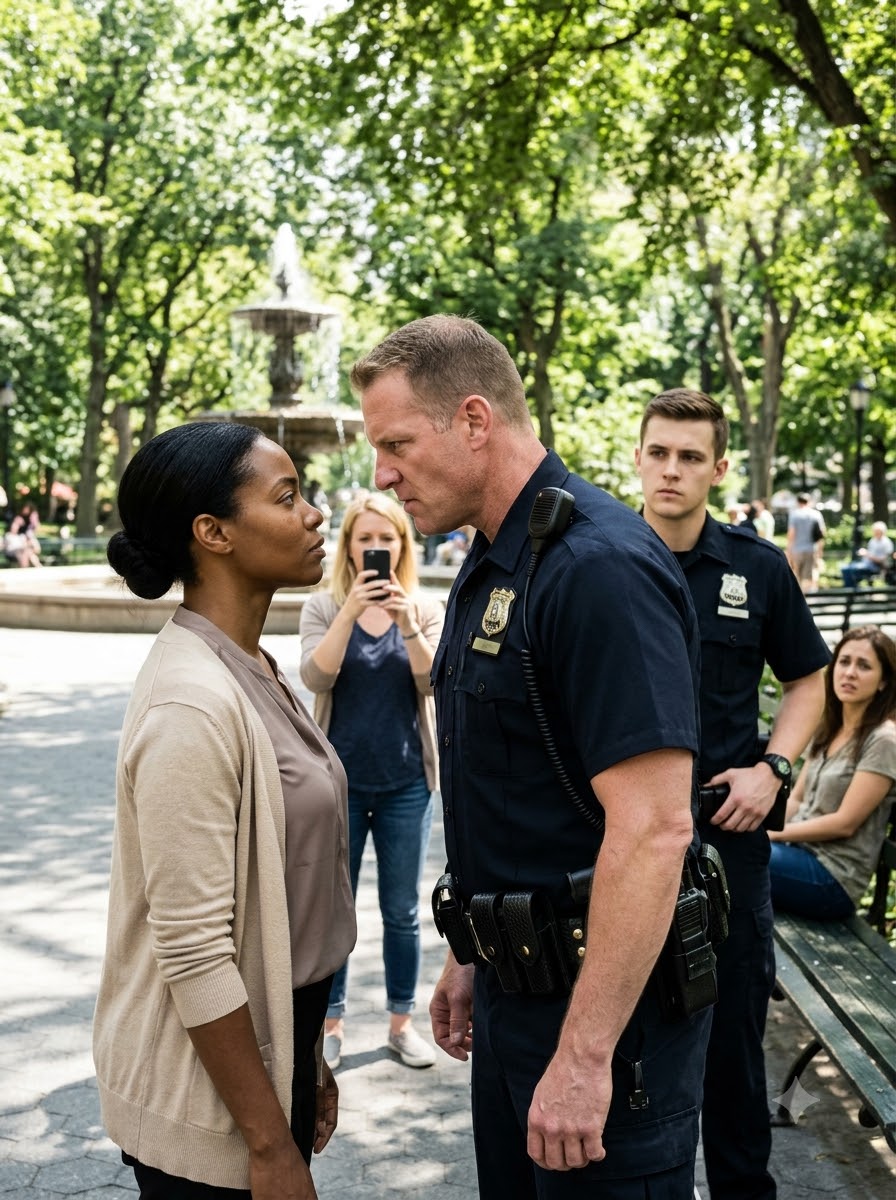
Officer Dale Britt had already wrapped his hand around Bishop’s muzzle before Ava Renwick could finish speaking.
“Sir, I asked you to verify the call before you touch my dog.”
Her tone remained steady. Ava rarely raised her voice, even when she had every reason to.
Britt paid her no attention. His eyes were fixed on the German Shepherd’s teeth, his fingers gripping the animal’s jaw so tightly that his knuckles had turned pale. He seemed almost determined to provoke the reaction he claimed to be preventing.
“Ma’am, step back. This animal matches a dangerous dog complaint.”
“Then show me the complaint.”
Ava carefully placed her briefcase beside the park bench. Its brass fastening caught the afternoon sunlight, and the scales of justice embossed into the leather were clearly visible.
Neither officer noticed.
“You received a dispatch call fifteen minutes ago,” she continued. “I heard it myself. The report described a possible stray. Bishop is wearing his identification tags, his leash was secured, and he has been sitting beside me for the past hour.”
“He’s not leashed now,” Britt replied, tightening his hold.
Bishop flattened his ears.
A faint noise came from deep in the dog’s chest. It was not quite a growl. It sounded more like confusion mixed with discomfort.
Ava had spent years teaching Bishop that fear was not a reason to lash out.
But even the best-trained animal could react instinctively to pain.
“You’re hurting him.”
“I’m controlling a threat.”
“He isn’t threatening anyone. You’re the one forcing his mouth shut in the middle of a public park.”
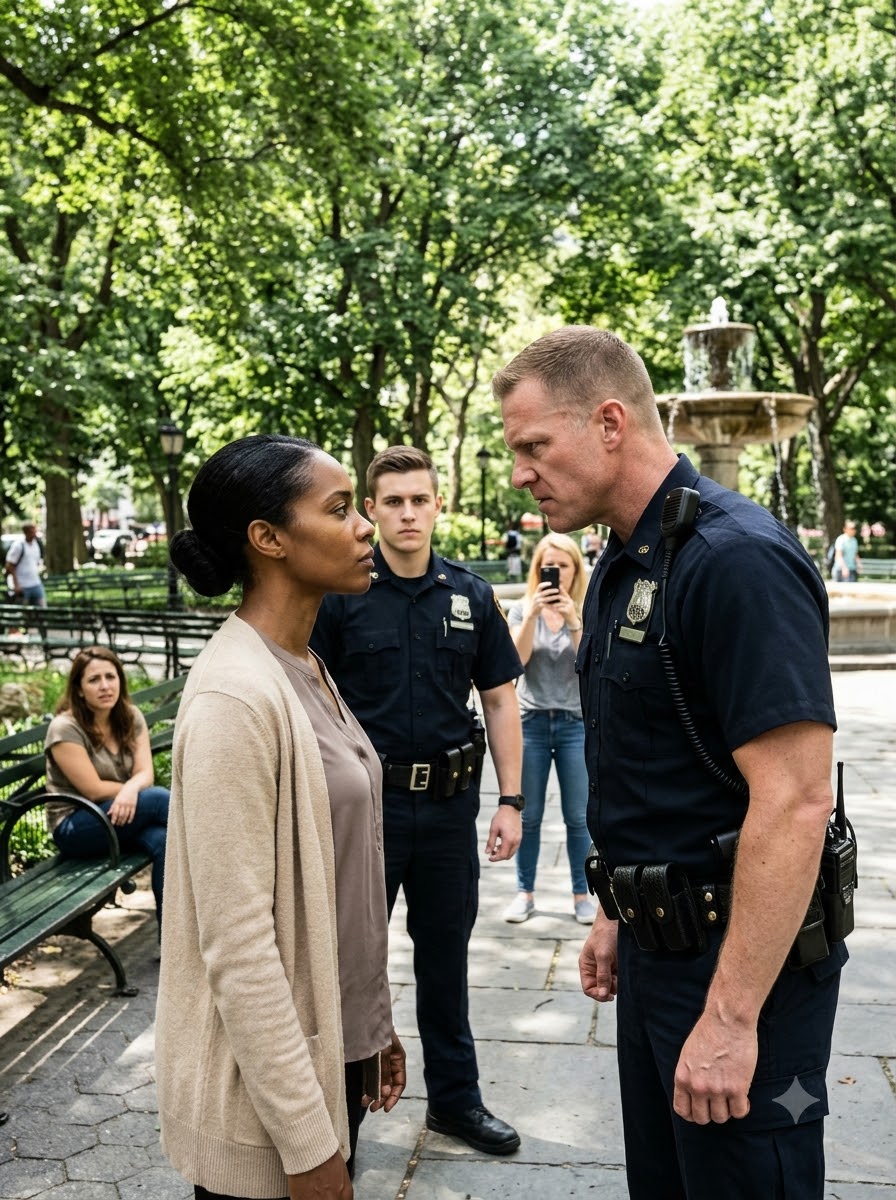
A few steps behind Britt, Officer Sam Kowalski lowered his citation pad.
He was young enough that his uniform still seemed almost new, but experienced enough to recognize that this encounter had already drifted far outside what his training required.
“Dale,” he said cautiously, “maybe we should back off. Let her—”
“I’ve got this.”
Bishop reacted a moment later.
It happened quickly.
His head jerked, his teeth brushing against the leather of Britt’s glove. There was no sustained attack, no pursuit, and no attempt to bite again.
It was the reflex of an animal trying to escape a painful grip.
But Britt stumbled backward as though the dog had launched himself at him.
And Ava saw his expression change.
The irritation disappeared.
Something more calculating replaced it.
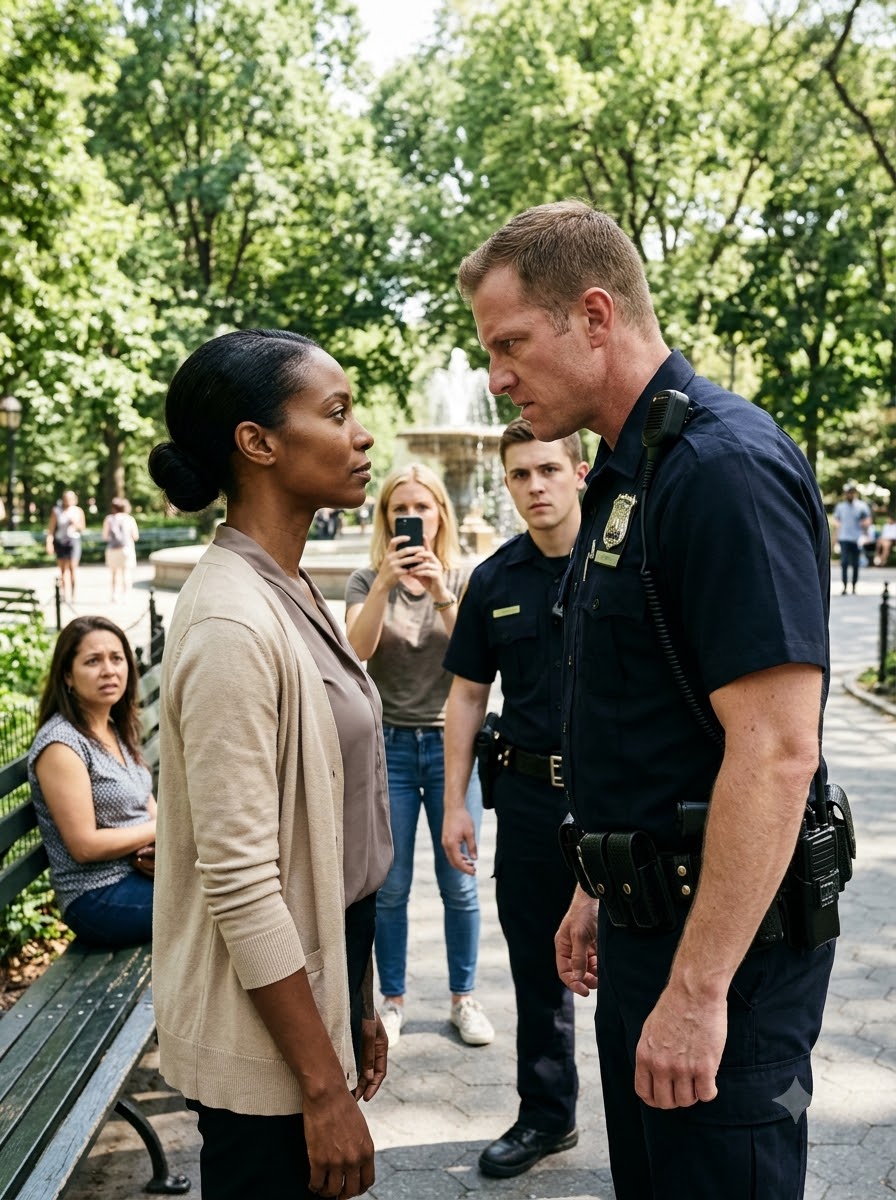
“Did you see that?” Britt shouted.
His voice carried across the walking path, drawing the attention of a man exercising another dog, two women who had stopped talking, and an elderly couple standing beside the fountain.
“That dog just attacked an officer!”
“He pulled away because you hurt him,” Ava replied. “Those are two different things, and at least six people here witnessed exactly what happened.”
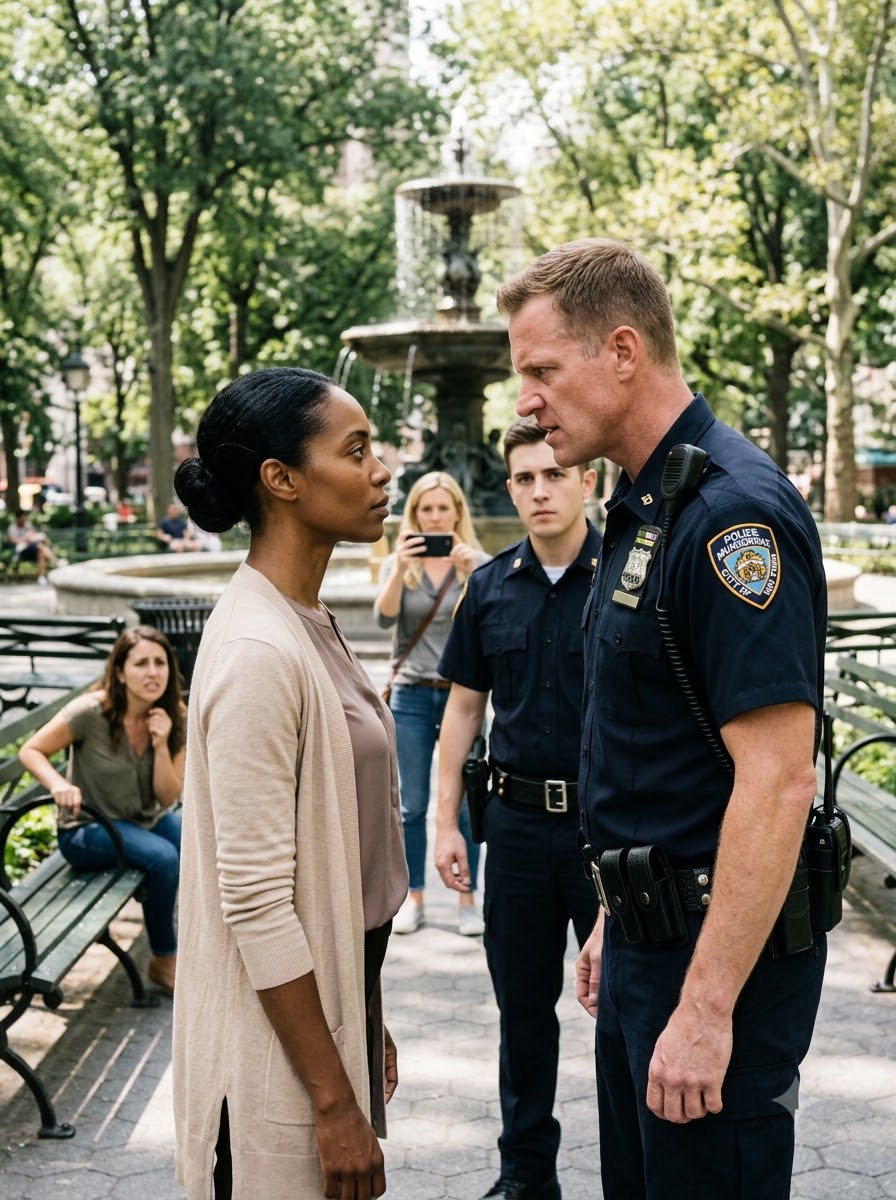
“Ma’am, stand up and put your hands where I can see them.”
Ava remained seated for another moment.
She studied him with the same composed, faintly disappointed expression she used when an attorney attempted to rush a hearing without understanding the consequences.
“I haven’t committed an offense, Officer. Neither has Bishop. I am asking you to contact your supervisor and have the original complaint read back before this situation gets any worse.”
“What you want isn’t the priority right now.”
“It should be. I’m making a reasonable request.”
Britt clenched his jaw.
He was accustomed to people surrendering to his authority after a few sharp commands. Most became nervous. Others apologized, even when they had done nothing wrong.
Ava had done neither.
“Cuff her,” he ordered Kowalski.
“Dale, on what grounds? She hasn’t—”
“Obstruction. Interfering with an officer evaluating a dangerous animal. Put it in the report.”
Kowalski’s hand hovered near his handcuffs.
He did not draw them.
His gaze moved from his partner to Ava, who remained perfectly still, her hands resting loosely together in her lap.
She looked less like someone facing arrest than someone watching an attorney approach a disastrous argument.
“This is your last opportunity to call your supervisor,” Ava said quietly.
Only the two officers could hear her.
“After this, it won’t be a matter of choice. It will become part of the record.”
Britt gave a short, mocking laugh.
“Are you threatening me?”
“I don’t make threats, Officer. I make requests. And this is the last one I intend to make politely.”
She extended her wrists.
The gesture was almost courteous.
Somehow, her willingness to comply unsettled Britt more than resistance would have.
By then, a white animal control van was turning into the park entrance.
Later, the records would establish that it had been dispatched as soon as the original complaint was received, before anyone had confirmed whether the complaint was accurate.
Two animal control employees opened the rear doors and began removing a transport crate.
They worked without urgency. Their emergency lights were off, and nothing in the information they had received suggested an immediate danger.
Bishop lowered his body, remaining where he was.
His eyes followed the crate.
Kowalski leaned toward Ava and spoke softly.
“Ma’am, is there someone you’d like us to contact?”
She looked beyond him, toward the van and the cage being prepared for her dog.
“Not yet. Just make sure they don’t take him anywhere before I return.”
The patrol car door closed before she could say anything more.
Through the window, Ava watched Bishop being lifted carefully into the crate.
The dog looked bewildered.
He had followed her commands for years, trusted her through every unfamiliar situation, and now he was being carried away while she could do nothing but watch.
Before we continue, if you believe nobody should lose a loyal companion because someone abuses their authority, take a moment to like this video, subscribe, and tell me in the comments: what would you have done in Ava’s position?
Now, here’s what happened after the patrol car doors closed.
Precinct 11 smelled of scorched coffee and damp pavement.
Ava sat in a plastic chair fastened to the floor. Her wrists were free.
Someone had removed the handcuffs during intake.
It was a small concession, but it told her something important: even the officers processing her detention were uncertain about the justification Britt had provided.
Near the counter, Kowalski stood with a pen in his hand, staring at an unfinished incident report.
Britt appeared beside him.
“I need you to confirm for the record that the dog lunged without provocation.”
Ava looked directly at him.
“I won’t confirm something that didn’t happen.”
Her voice remained calm.
“What I will state is that I never consented to you handling my dog, that your physical contact caused his reflexive response, and that several witnesses can verify the order of events.”
She paused.
“I also want the body camera footage preserved, along with any recording from the animal control vehicle.”
Britt stopped writing.
“That’s not how this works.”
“That is precisely how it works. You’re welcome to verify the procedure with your sergeant.”
His jaw tightened.
For a moment, he remembered the complaints he had received that month about stray dogs near the elementary school a few blocks away.
He remembered frightened parents and one mother who had confronted him outside a coffee shop, demanding to know why the department always waited until a child was injured before taking action.
Those memories had become his justification for acting aggressively whenever a dog complaint reached him.
But none of them changed what had happened in the park.
He resumed writing.
Near the precinct entrance, a woman in her mid-fifties approached the desk sergeant’s window.
A small terrier sat quietly at her feet, its leash wrapped twice around her wrist.
“Excuse me,” she said. “I witnessed the entire incident. The officer grabbed the dog’s face first. That woman didn’t touch anybody.”
Her voice trembled slightly, but she continued.
“My husband was a firefighter for thirty years. I know what a genuine emergency looks like. That dog wasn’t putting anyone in danger.”
Britt turned toward her.
“Ma’am, unless someone requested your statement, I’d suggest you—”
“She’s offering one now,” Ava interrupted quietly. “And I am giving mine. Both statements belong in the file.”
The woman spoke with the desk sergeant, signed her account, and eventually left.
Before going, she glanced back at Ava.
There was apology in her expression, but also relief.
She had made the difficult decision to speak when remaining silent would have been easier.
Kowalski watched without saying anything.
When Britt stepped into another room to answer a telephone call, the younger officer approached Ava.
“That tag on your dog’s collar,” he began. “The old departmental identification. It’s a genuine K-9 unit number, isn’t it?”
“Yes.”
“Britt said it was just a costume tag.”
“Britt didn’t examine it carefully enough to know.”
Ava paused.
“Or perhaps he saw enough and decided it would be easier not to acknowledge it.”
Kowalski glanced toward the doorway where his partner had disappeared.
“I asked the desk to run the number. Just a routine cross-check. I didn’t think much about it at first.”
He hesitated.
“Should I have?”
Ava studied him.
He was young, uncertain, and standing at the kind of crossroads that eventually confronts anyone who witnesses wrongdoing.
“That depends on what you choose to do next.”
Outside the security glass, the animal control van remained parked near the curb.
Two employees were transferring Bishop’s crate onto a hand truck.
The younger worker, barely into his twenties and wearing an oversized department polo, studied the intake form.
He looked at the crate.
Bishop sat against its far wall, ears lowered.
“Are we sure this is a bite case?” the young employee asked. “The form only says contact.”
His older partner glanced at the paperwork.
“We transport what the form tells us to transport.”
The younger worker did not challenge him.
He simply fastened the crate more gently than the instructions required.
He remained quiet during the drive.
Inside the precinct, Kowalski returned to Ava.
“Ma’am, they’re transferring Bishop to the shelter for an overnight hold. Standard procedure after a reported bite.”
Ava’s expression barely changed.
But her stillness became sharper.
“There wasn’t a bite. His teeth touched a glove.”
“I know. But that’s what’s written on the form.”
“Then the form is inaccurate, and people are about to make an entire series of decisions based on that inaccuracy.”
Britt returned from his call.
He looked at Ava, then signed the incident report with enough pressure to leave an indentation beneath the page.
Nervous.
Uncooperative.
Evasive.
He had used those descriptions in previous reports.
They had always been sufficient.
Through the window, Ava watched the transport crate disappear into the rear of the van.
The metal doors closed.
For a moment, she could not see Bishop at all.
“I hope somebody is still recording,” she murmured.
Kowalski instinctively touched the camera attached to his uniform.
He hadn’t turned it off.
He hadn’t deliberately switched it on again, either.
It had been recording since the encounter began in the park.
He suddenly realized that every moment might be preserved.
And he had no idea whether that recording would protect him or destroy his career.
PART 2
Before we enter the courtroom, I want to ask you something.
Do you believe Officer Britt deserves another chance if he finally admits what happened, or has he already crossed a line that cannot be forgiven?
Share your opinion in the comments. And if you’re enjoying the story, remember to like and subscribe, because what happens next changes everything.
The clerk who entered Bishop’s identification number into the department’s K-9 registry was not thinking about Ava Renwick.
She was thinking about lunch.
She wanted to finish the intake paperwork before her shift ended, and the registry system was taking much longer than usual.
Every time she entered the number, the database returned a result that did not fit the ordinary animal-control categories.
She tried again.
The same information appeared.
Retired.
Narcotics Division.
Commendation on file.
Medical retirement.
No disciplinary history.
The clerk read the record twice.
Then she abandoned her sandwich, picked up the telephone, and called her sergeant.
“You need to come look at this.”
Farther down the hallway, Ava sat across from another officer.
He was older than Britt, quieter, and possessed the exhausted patience of a man who had completed thousands of reports and learned that the smallest inconsistency could matter.
He asked her to describe the encounter from the beginning.
She did.
She repeated the same sequence of events without exaggeration or additions.
The officer listened carefully.
“You’re unusually precise,” he observed.
“I’m accustomed to precision mattering.”
He did not ask her to explain.
Instead, he studied the identification number on the intake form, checked his computer, and looked back at her.
His expression changed.
“Bishop’s record as a retired police K-9 affects the euthanasia review process,” he explained. “He cannot be subjected to an immediate assessment. There’s a mandatory formal hold and a review board procedure that requires at least forty-eight hours.”
He looked at the report again.
“And Officer Britt didn’t mention that this is a decorated service animal rather than a stray.”
“His report leaves out quite a few things,” Ava replied.
The officer nodded slowly.
“Yes. It does.”
At one point, Ava heard a low, unhappy sound coming from somewhere beyond the holding-area corridor.
She recognized it immediately.
Bishop.
It wasn’t quite a whine.
It was the sound of an animal unable to understand why everything familiar had suddenly disappeared.
Ava looked toward the guard stationed outside her room.
“Has anybody checked on my dog?”
The guard seemed surprised by the simplicity of the question.
He told her he would find out.
To Ava’s mild surprise, he actually followed through.
Two hours later, she was released.
No charges filed pending review.
Three words that could mean almost anything.
They might represent the beginning of an apology.
Or they might become an excuse to let the entire incident disappear without accountability.
Bishop was not released with her.
He remained at animal control under the special review procedure the sergeant had discovered.
In bureaucratic terms, the hold protected him from an immediate decision based on Britt’s inaccurate report.
Emotionally, it meant Ava had to walk out of the precinct without the dog who had trusted her for years.
That hurt more than the hours she had spent in detention.
Britt was waiting in the hallway.
His arms were crossed, and his jaw was set with the stubborn determination of a man who believed admitting an error would be more dangerous than continuing it.
“This isn’t finished,” he told her.
“No,” Ava replied without slowing.
“It isn’t.”
She did not explain what she meant.
She didn’t need to.
Britt did not drive home when his shift ended.
At first, he told himself he needed gasoline.
Then he decided he should get something to eat.
By approximately nine that evening, he was driving without any particular destination, letting the streets pass while he tried to untangle his thoughts.
He only realized where he had gone after pulling into the animal control parking lot.
He switched off the engine.
Then he sat in the darkness, both hands resting on the steering wheel.
Beyond the chain-link fence, a row of security lights illuminated the low kennel building.
One window remained lit near the intake office.
Somewhere inside was a German Shepherd with a decorated service record, confined in a cage too small to be comfortable.
A dog whose genuine identification tag Britt had dismissed as a costume.
He considered going inside.
Perhaps he could ask the night attendant to let him inspect the paperwork.
Perhaps he could check on the animal.
Perhaps he could explain why he was there.
But every possible explanation collapsed before he finished imagining it.
What would he say?
That he wanted to know whether the dog was all right?
To whom?
For what reason?
It would not change the report.
It would not undo the arrest.
And it certainly would not erase the moment he had grabbed Bishop’s muzzle.
He sat in the parking lot for eleven minutes, according to the clock on his dashboard.
He said nothing.
Then he restarted the engine and drove away.
If anyone had questioned him the following morning, he would not have been able to offer an explanation that made sense, even to himself.
Kowalski slept poorly that night, too.
But his reason was far more concrete.
He had requested a copy of his body camera recording through the department’s ordinary procedure.
At home, he sat at his kitchen table with the volume turned low so he would not disturb anyone.
He watched the entire encounter.
The park.
The bench.
Bishop sitting calmly beside Ava.
The officers approaching.
Then Britt’s hand closing around the German Shepherd’s muzzle.
Eleven seconds passed before the dog displayed anything that could reasonably be described as a reaction to a threat.
Kowalski watched himself standing three feet away.
He heard his own voice.
“Dale, maybe we back off.”
It sounded so quiet.
So uncertain.
Almost meaningless.
He had recognized something was wrong, but he had not acted strongly enough to stop it.
He played the footage a second time.
Then a third.
He did not telephone anyone that evening.
He did not immediately file a new report.
He simply sat with the uncomfortable realization that his silence had been recorded just as clearly as Britt’s actions.
It had a timestamp of its own.
By Monday morning, several separate pieces of information had reached the department’s legal liaison office.
There was the eyewitness statement from the woman at the park.
There was the registry alert identifying Bishop as a retired K-9.
And there was a formal request from the desk sergeant, submitted quietly, almost apologetically, asking that Britt’s incident report be examined for inconsistencies before moving any farther through the system.
Britt knew none of this.
He reported for duty as usual, his uniform neatly pressed and his familiar confidence restored.
The eleven minutes he had spent outside the shelter were already buried somewhere in his mind.
He had no intention of revisiting them.
Three miles away, Ava was studying a different set of documents.
Her calendar lay open beside several case folders.
One appointment had been circled in blue ink.
Swearing-in.
Monday.
9:00 a.m.
Courtroom Four.
Bishop was scheduled to be released that same morning.
The review board had completed its work, and the animal was cleared with only hours to spare.
But Ava did not yet know that another matter had been placed on the docket for that courtroom.
A routine citizen complaint hearing.
The complaint had been entered six days earlier, on the same evening Bishop was taken into custody, by a clerk who had no idea who the woman named in the file actually was.
Ordinarily, such a hearing might last fifteen minutes.
There might be a brief explanation, a mild reprimand, and a few forms to complete.
By the end of the week, almost everyone involved would have forgotten it.
Britt certainly expected nothing more.
Over the weekend, he had joked repeatedly about being dragged before some downtown judge over a dog that had not even broken the skin of his glove.
He repeated the joke Monday morning outside Courtroom Four.
He straightened his dress uniform while examining his reflection in the brass plate on the door.
Kowalski stood beside him, holding a folder beneath one arm.
He said nothing.
He had barely spoken since Saturday.
The folder seemed heavier than it should have.
“Relax,” Britt told him.
“This is nothing.”
The bailiff called the courtroom to order.
Britt and Kowalski took their places at the respondent’s table.
Across the aisle, a woman from the department’s legal liaison office hurriedly arranged a stack of documents.
She looked as though she had not yet found time to read them carefully.
The atmosphere was routine.
Nobody appeared to expect anything more than an administrative formality.
“All rise.”
The side door opened.
And Ava Renwick entered.
She was no longer wearing the cream cardigan she had worn in Centennial Park.
A black judicial robe covered her clothing.
Her expression, however, was exactly the same.
Composed.
Unhurried.
Entirely unsurprised by the room before her.
Britt froze halfway through adjusting his collar.
“The Honorable Judge Ava Renwick presiding,” the bailiff announced.
Kowalski’s mouth fell slightly open.
No words followed.
Britt’s expression changed in a way he could not control.
It was not simply shock.
It was the stunned recognition of a man watching a door he believed had closed permanently swing open directly in front of him.
Ava took her seat.
She arranged the files before her with the same careful precision she had shown when placing her briefcase beside the park bench.
She did not immediately look at Britt.
Instead, she studied the incident report already admitted into the record.
For several moments, the only sound was the turning of a page.
“Before we proceed,” she said, “I would like the arrest report read into the record.”
She paused.
“Particularly the section stating that the complainant consented to physical contact with her animal.”
Only then did she raise her eyes.
“Officer Britt, would you explain how that consent was obtained?”
Britt stood because courtroom procedure required him to stand.
For a moment, he could not speak.
He had prepared an explanation over the weekend.
It wasn’t an outright fabrication, at least not in the way he had rehearsed it.
It was a selective description of Saturday’s events, carefully omitting the details that would not withstand scrutiny.
Now those words felt impossible to deliver.
“She reached toward the dog,” he finally said. “I was evaluating a threat.”
“The witness statement contradicts that account,” Ava replied.
She turned another page.
“So does the desk sergeant’s request for review of inconsistencies in your report. And so does Officer Kowalski’s separately filed incident log, which I understand was completed that same evening.”
“People remember things differently under pressure,” Britt argued.
“The witness was thirty feet away. She saw what she thought she saw.”
“She described the same sequence of events on two separate occasions, six days apart, without being shown your report.”
Ava set the document down.
“That degree of consistency is not ordinarily what we associate with a confused recollection.”
The courtroom was completely silent.
“I’ll ask again. Are you telling this court that your report and Officer Kowalski’s report are both accurate, despite describing different sequences of events?”
Britt hesitated.
He looked like a man struggling through a calculation whose answer he already knew but desperately wanted to change.
“Sam’s account isn’t wrong,” he said slowly.
“He was just standing farther away. He may not have had the same view.”
“Was he far enough away that he could not see you place both hands on the dog’s muzzle before the animal reacted?”
Britt said nothing.
At the liaison table, the woman who had been sorting papers stopped moving.
Her pen hovered above an untouched legal pad.
Kowalski shifted beside his partner.
For one brief moment, Britt considered saying something honest.
That Sam had not written his report.
That the responsibility belonged to Britt alone.
The admission reached the edge of his lips.
Then stopped.
He lowered his eyes toward the table.
“Your Honor,” Kowalski said.
His voice broke the silence.
“I have something the court needs to see.”
He stood.
Then he carried the folder to the clerk’s table and placed it down with both hands.
It was the gesture of someone finally setting aside a burden he had carried too long.
“This contains a complete transcript of my body camera footage. The camera recorded the entire encounter. I didn’t realize that until Saturday night.”
The liaison officer’s pen tapped once against the paper.
It was an involuntary movement.
The small sound of someone suddenly understanding that this hearing would not be the simple formality everyone had expected.
Britt turned toward his partner.
There was no immediate anger in his expression.
Only disbelief.
The one person he had counted on to remain silent had decided to stop protecting him.
Ava accepted the folder without ceremony.
She placed it beside the incident report.
She did not open it immediately.
Instead, she rested one hand flat against the cover.
Her stillness was the same as it had been in the park while Britt held Bishop’s jaw.
“We will examine this material in full before entering any findings,” she said.
“Officer Britt, you will be given an opportunity to respond after the recording has been reviewed.”
She paused.
“This hearing is not a conviction.”
Another pause.
“It’s a record.”
Nobody spoke.
Kowalski became conscious of his own breathing.
Britt sat with both hands resting on the table, staring ahead.
The word record seemed to remain suspended in the courtroom long after Ava had spoken it.
“That is what this matter has always concerned,” she continued quietly.
“What actually happened, documented accurately by the people who were present.”
She turned toward the bailiff standing near the side entrance.
“Is the dog available for release this morning?”
“He was cleared an hour ago, Your Honor. Animal control transport is waiting for the discharge paperwork.”
“Have the paperwork brought directly to me. I’ll sign it during recess.”
Britt leaned back.
The confidence that had sustained his version of Saturday’s events for six days was finally disappearing.
He did not look at Ava.
He looked down at his hands.
The same hands that had gripped a dog’s muzzle because, at the time, it had seemed easier to assert control than to verify the truth.
“We’ll recess for thirty minutes,” Ava announced.
“The footage will be reviewed.”
She looked toward Britt.
“Officer Britt, I encourage you to use that time to decide whether the account you provided this morning is the one you want preserved in the permanent record.”
The bailiff announced the recess.
For several seconds, nobody moved.
Kowalski sat without the folder he had carried into the room.
He felt lighter.
And somehow worse.
Britt stared at the door through which Ava had disappeared.
For the second time in several days, he found himself sitting somewhere quiet, unable to construct a single explanation that led anywhere useful.
PART 3
The recording lasted eleven minutes.
Ava reviewed it privately in her chambers while the courtroom paused its ordinary business.
Outside, a clerk rearranged two unrelated hearings.
In the hallway, the department’s liaison officer made a telephone call.
She kept her voice low enough that her words could not be heard inside the courtroom.
But her tone made one thing obvious.
She was no longer confident about the report she had been sent to defend.
At the crucial point in the footage, the timestamp displayed 2:47 p.m.
Britt’s hand closed around Bishop’s muzzle.
Six full seconds passed before the recording showed anything that could reasonably be interpreted as aggression from the dog.
Ava watched the footage once.
She did not replay it.
She had experienced those eleven minutes herself.
She did not need another viewing to understand what the camera had captured.
When the hearing resumed, she offered no dramatic summary.
She did not raise her voice.
She simply stated the finding.
“The footage confirms the witness statement in every material respect.”
Then she allowed the words to settle.
Britt did not challenge her.
He had spent the thirty-minute recess considering what she had said.
For once, he had not used the time to prepare a more convincing version of the incident.
He had sat with the version that was already true.
When Ava asked whether he wished to amend his report, he stood.
“Yes, Your Honor.”
Nothing more.
And for the first time in five days, there was no performance in his voice.
No attempt to intimidate.
No rehearsed confidence.
Only an acknowledgment that the original account could no longer stand.
The court required another twenty minutes to enter the formal findings.
Ava referred the incident to the department for review on grounds that included possible falsification of an official report, unnecessary use of force, and improper detention.
She also directed that the record reflect Officer Kowalski’s voluntary disclosure of his body camera footage.
His cooperation would be considered as a mitigating factor in any proceedings involving his own conduct.
She did not promise him immunity.
She did not grant him leniency.
Those decisions were not hers to make in that hearing.
She simply ensured that the official record accurately described what he had done.
It was more than anyone involved in the original incident had managed to accomplish during the preceding week.
Two weeks later, Dale Britt surrendered his badge.
The decision came before the department had issued its final determination.
The meeting was private.
There were no cameras.
No spectators.
Only Britt, his sergeant, and a union representative who remained silent for most of the conversation.
Britt made no public statement.
He did not request one.
The eleven minutes he had spent sitting in the dark outside animal control remained the closest he had come to admitting something true about his actions before the hearing.
And even then, he had said nothing aloud.
Kowalski kept his position, although his conduct remained under review.
For the following six months, he was assigned to work with a partner twice his age.
The older officer had a peculiar habit.
Before asking an important question, he would tap his pen twice against the desk.
He was also known throughout the department for producing reports so precise that supervisors almost never had to return them for correction.
Kowalski learned more from those six months than he had expected.
He learned that writing an accurate report was not simply a clerical responsibility.
It was a decision about whether the truth would survive after everyone involved had left the scene.
And he learned that recognizing wrongdoing was not enough when someone else needed him to act.
Bishop returned home on Monday afternoon.
Four hours had passed since the hearing ended.
He rode in the back seat of Ava’s car, his head resting against the window for nearly the entire journey.
He was unusually quiet.
Not frightened exactly.
More like an animal cautiously deciding whether the familiar world had finally returned to the way it was supposed to be.
The old K-9 identification tag still hung from his collar.
At the shelter, an attendant had offered Ava a replacement.
A cleaner tag.
One without the scratches and worn edges that came from years of service.
Ava declined.
“It’s not broken,” she explained.
“It simply tells the truth about where he’s been.”
The attendant nodded and left it where it belonged.
Two weeks later, Ava received a card in the mail.
It came from Diane Cole, the woman who had approached the precinct desk to give her eyewitness statement.
Ava had not learned Diane’s name until the final hearing paperwork required it.
Inside the card was a handwritten message.
The writing was steadier than Diane’s voice had been when she spoke at the precinct.
“My husband used to say the hardest part of the job wasn’t the fire. It was the thirty seconds before you decided to go in.”
Below that, she had added:
“I’m glad I finally understood what he meant.”
Ava read the message twice.
Then she placed the card inside her desk.
She did not frame it.
She did not display it where visitors could see it.
She simply kept it.
Some things mattered enough to remember without needing to turn them into decorations.
The older intake officer who had questioned Ava after her arrest also participated in the departmental review.
His name was Marchetti.
Ava remembered seeing it on his nameplate, although she had never addressed him by name during their original conversation.
When asked to testify, he agreed without hesitation.
He described the irregularities in Britt’s report exactly as he had noticed them.
No embellishment.
No dramatic accusations.
Just the facts.
He tapped his pen twice, paused briefly, and then explained precisely what needed explaining.
Nothing more.
His testimony helped establish that concerns about the report had existed before the courtroom revelation.
The contradictions had been visible.
People simply had to be willing to acknowledge them.
Six weeks after the hearing, Ava returned to Centennial Park.
It was late afternoon.
Sunlight filtered through the oak trees at almost the same angle as it had on the day of the encounter.
Bishop walked beside her without a leash.
His movements were calm and familiar.
He did not need constant commands.
Years of training and trust had taught him how to remain close.
The walking path curved past the fountain and toward the bench where everything had begun.
The bench was empty.
Ava approached it.
Then stopped.
She did not sit down.
A woman jogging along the path slowed as she passed.
She seemed to recognize Bishop before she recognized Ava.
Perhaps it was the old K-9 tag.
Perhaps it was the particular way the German Shepherd moved beside his owner, keeping pace without needing a leash.
“That’s a beautiful dog,” the woman said.
“Thank you,” Ava replied.
The jogger smiled and continued down the path.
She asked no questions.
She did not mention the arrest.
She did not ask about the hearing.
And there was nothing in the ordinary scene that suggested she needed to.
A woman and her dog were enjoying a peaceful afternoon in the park.
That was all.
It looked as though it had never been anything else.
Near the base of an oak tree, Bishop lowered his head and sniffed the grass.
Then he sat.
The same patient posture he had adopted beside Ava before the officers arrived weeks earlier.
He waited without anxiety.
Without urgency.
Simply trusting that whatever happened next would be all right.
Ava stood beside him for a while.
She was not thinking about the courtroom.
Not about Britt’s report.
Not about the eleven minutes of footage.
Not even about the six seconds that had exposed the difference between an actual threat and an officer’s false description of one.
Instead, she found herself noticing how ordinary the park had become again.
The grass moved gently in the breeze.
Sunlight warmed the walking path.
The fountain continued running.
People passed with dogs, bicycles, and children.
The same park that had briefly become the setting for fear and humiliation had returned to being a place where people came simply to enjoy the afternoon.
It had looked this way before someone decided, without sufficient reason, that Bishop did not belong there.
And now it looked this way again.
Ava reached down and scratched behind the German Shepherd’s ear.
Bishop leaned into her hand.
He always had.
She smiled faintly.
For a few moments, neither of them moved.
Then Bishop rose, and they continued along the path.
They passed the bench.
They passed the fountain.
They headed toward the park gate as the sunlight began turning golden above the distant trees.
There was no crowd watching them.
No officer standing nearby.
No argument waiting to be resolved.
No document requiring a signature.
Nothing about that peaceful moment needed to be recorded.
And perhaps that was the most meaningful part of all.
Justice does not always arrive with shouting, flashing lights, or a dramatic announcement.
Sometimes it begins when one witness refuses to remain silent.
When one officer chooses to preserve an honest record.
When one person insists that the truth matters, even when nobody powerful appears to be listening.
Dale Britt had believed the encounter would end when he finished writing his report.
He had assumed his authority would be enough to define what happened.
But the truth survived in the accounts of ordinary witnesses, in a body camera recording, and in the decisions of people who eventually chose honesty over convenience.
Ava Renwick did not need to shout to prove her point.
She had asked for the facts to be checked from the beginning.
And when those facts finally entered the record, they spoke more clearly than any threat ever could.
Bishop had never been the dangerous one.
The real danger was the willingness to turn a false assumption into an official accusation, and then expect everyone else to accept it.
In the end, what changed the outcome was not merely that Ava was a judge.
It was that enough people finally refused to let an inaccurate account become the permanent truth.
Sometimes justice is quiet.
Sometimes it is a witness stepping forward, an officer submitting a recording, or a person refusing to look away.
And sometimes, after everything has been examined and the record has been corrected, justice looks like nothing more extraordinary than a woman walking peacefully through a park with the dog she loves.
If this story touched you, please like, subscribe, and share it so others can discover stories like this.
And before you leave, tell me in the comments which moment moved you the most.
Was it Diane finding the courage to speak?
Kowalski finally turning over his recording?
Britt recognizing Ava on the judge’s bench?
Or Bishop coming home after everything he had endured?
Until next time, thank you for being part of this journey.
