

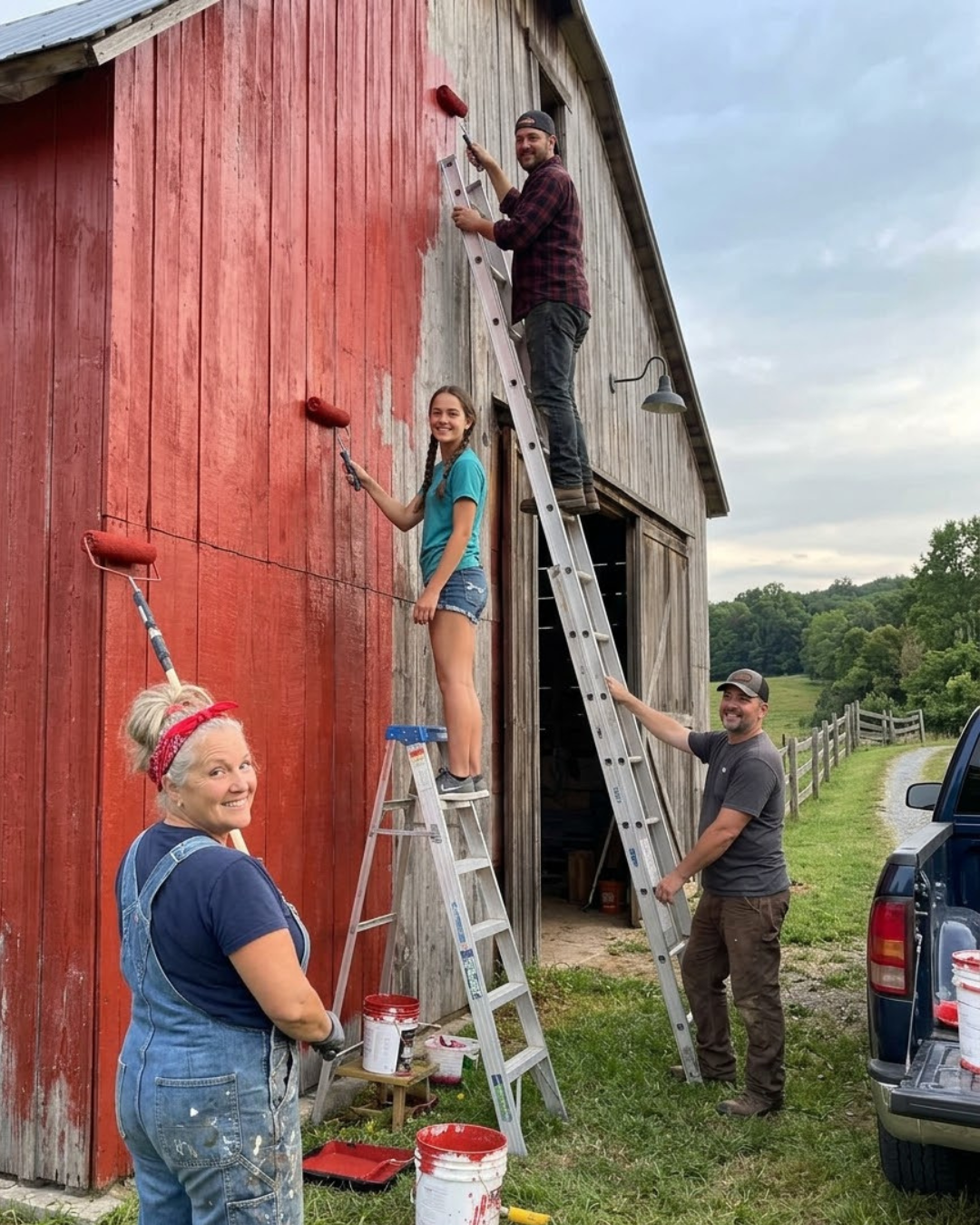
PART 1 — The Barn That Was Never Supposed to Be Gray
I first noticed it in my headlights on a Thursday evening in September.
It was almost ten o’clock when I turned onto our lane, carrying a bag of dirty hospital laundry on the passenger seat.
The yard light was burning, just as it always did. Its white glow spread over the gravel and reached halfway up the barn’s south wall.
Except that wall was gray.
Not the faded gray of weathered wood.
Fresh gray paint, smooth and uniform, covering boards that had been red for a century.
I stopped the car halfway up the lane and left the engine running.
For a long time, I sat gripping the steering wheel, unable to look away.
My husband’s grandfather, Walter Jensen, had built that barn in 1925.
He’d hauled the lumber from the railroad depot in Tracy, Minnesota, using a hay wagon pulled by two Belgian horses.
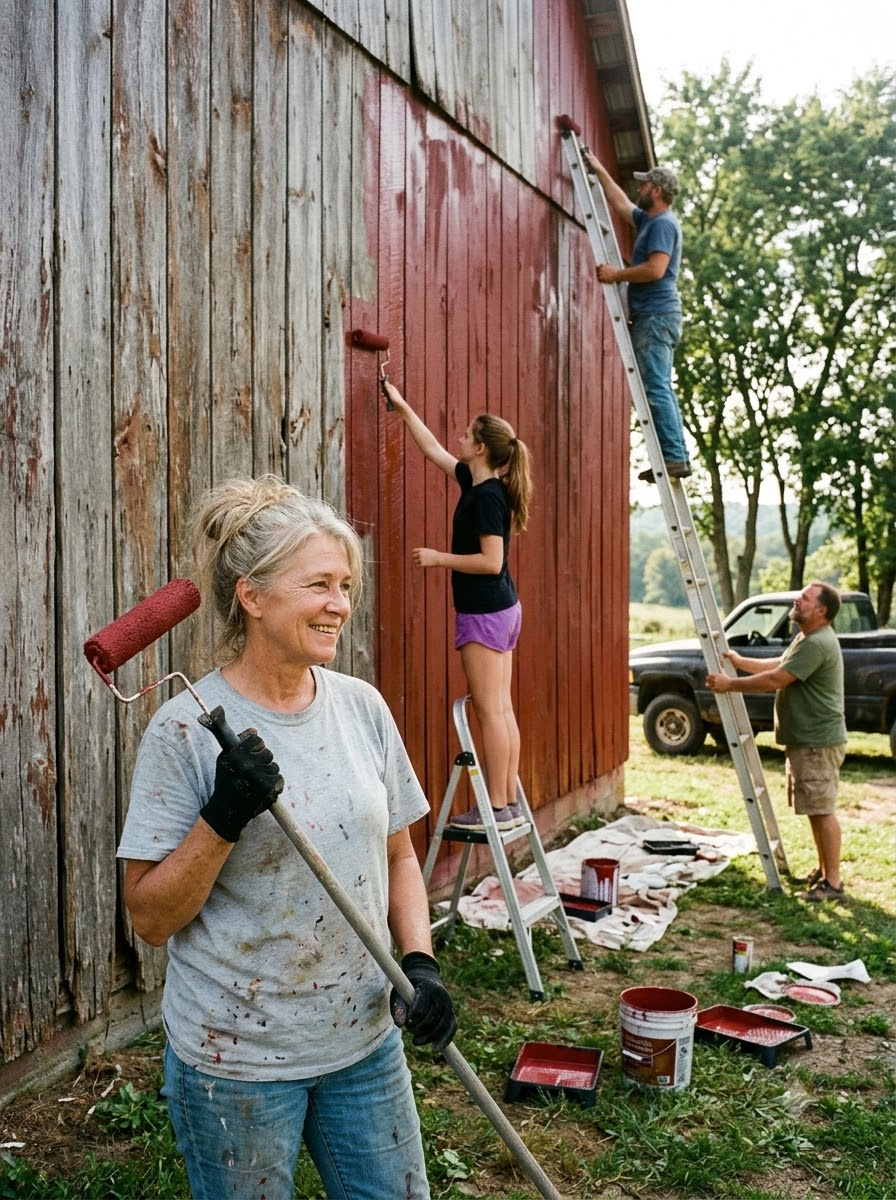
From the day it was finished, the barn had always been red.
It was red when Arlo’s father, Earl, milked forty Holsteins inside.
It was red when Arlo and I posed for our wedding photographs beside its enormous sliding door.
It appeared red on every Christmas card we’d sent.
It was red in the framed photograph displayed at the Lyon County fair office, taken when Arlo’s steer won reserve champion.
And now somebody had painted it gray.
While I’d been away for eleven days.
My name is Carol Jensen. I was fifty-eight years old and had been married to Arlo Jensen for thirty-seven years.
Together, we farmed 320 acres of corn and soybeans along a county road outside Tracy, in southwestern Minnesota.
To understand why I hadn’t stopped the painting, you need to understand where I’d spent those eleven days.
On the last Saturday in August, Arlo rose from our supper table to refill his coffee.
His right hand wouldn’t close around the coffee pot.
He stared at it in confusion.
Then he turned toward me and attempted to say my name.
But the sounds that came out weren’t words.
I’d lived on a farm long enough to recognize an emergency.
I’d called ambulances for a man trapped beneath a tractor and for a neighbor struck in the chest by a cow.
This time, I knew immediately what was happening.
I’d dialed 911 before Arlo collapsed onto the kitchen floor.
The ambulance took him to Marshall.
From there, a helicopter transported him to Sanford in Sioux Falls.
I drove seventy miles through the darkness behind that helicopter.
The radio stayed off.
I cannot remember a single mile.
Arlo had suffered a stroke affecting the left side of his brain.
The doctor explained that this controlled his right hand and much of his speech.
He spent four days in intensive care.
Afterward, they transferred him to rehabilitation, where adults relearn things they’d done without thinking all their lives.
Walking.
Buttoning shirts.
Saying simple words like cup.
I slept in a vinyl chair that reclined barely farther than a lawn chair.
I ate vending-machine snacks and occasional cafeteria meals whenever I remembered I needed food.
And I watched a man who could reverse a gooseneck stock trailer into a space with two inches of clearance spend twenty minutes trying to pick up a plastic spoon.
There was nowhere else I wanted to be.
I stayed until the nurses insisted I leave.
On the eleventh day, charge nurse Lorraine finally confronted me.
She’d been nursing for thirty years and had little patience for arguments.
“Carol. Go home for one night,” she told me. “Sleep in your own bed. Bring him his own pajamas. He’ll be right here when you get back.”
So I drove home.
And discovered our red barn had disappeared beneath gray paint.
I stepped out onto the gravel.
The sharp smell of fresh paint still hung in the cool evening air.
Even the trim had been repainted a darker gray.
The sliding door.
The haymow door.
The little window on the north end where our barn cats liked to sleep.
Every surface was gray.
I called our son immediately.
Brad was our only child, thirty-four years old, married to a lovely woman named Brooke.
He worked in real estate from an office on Main Street in Marshall.
He answered after two rings.
“Mom? Is Dad okay?”
“Dad’s the same,” I said. “I’m home for the night. I’m standing in the yard.”
He paused.
Then his voice brightened.
“Oh, good. You saw it.”
He sounded pleased with himself.
Like a child who’d cleaned the garage without being asked and was waiting for praise.
“A client of mine runs a spray crew out of Worthington,” he explained. “They did the whole thing in two days. Four thousand dollars, Mom. That’s a favor price. They’d charge anybody else nine.”
“Four thousand dollars.”
“I paid it. You don’t owe me anything. I just wanted to get ahead of things.”
“Ahead of what, Brad?”
“The listing.”
He spoke as though we’d already made the decision together.
“Buyers want gray right now. Gray and white. That’s what’s selling. Red barns read old in the pictures.”
“What listing, Brad?”
“Mom.”
His tone softened, as if he were explaining something obvious to an exhausted woman.
“You can’t run three hundred and twenty acres by yourself. And Dad isn’t going to be able to. I’ve got a photographer coming out Monday morning. I’m just trying to help.”
I hadn’t discussed selling our farm with anyone.
Not Brad.
Not Arlo.
Not our pastor.
Not even myself during those sleepless nights at the hospital.
What I felt first wasn’t exactly anger.
It was the sickening sensation of discovering someone had stolen from me while I slept.
Anger came afterward.
And I held it tightly.
Because my husband was seventy miles away in a hospital room, and his speech therapist had told me he understood almost everything people said.
The words were still inside him.
He simply couldn’t get them out.
I wasn’t going to argue with our son within Arlo’s hearing.
I wouldn’t stand in a hallway outside his room fighting over a decision my husband couldn’t speak against.
“Thank you for telling me, Brad.”
“So you’re okay with it?”
“I’m going to bed, Brad. I’m tired. Good night.”
He started answering.
I ended the call.
In thirty-four years, I’d never hung up on my son before.
But I didn’t go to bed.
Still wearing the navy flats I’d packed for the hospital, I walked toward the barn.
I’d forgotten to bring sneakers when Arlo was rushed away, and those church shoes were all I’d worn for eleven days.
I took a flashlight from the glove compartment and circled the building.
The grass was damp beneath my feet.
The painters had done a thorough job.
Every board was coated evenly. There wasn’t even a drip on the fieldstone foundation.
I pressed my palm against the boards on the north side, which still held a little warmth from the afternoon sun.
It felt like touching a horse’s neck.
Then I walked to the east end and aimed my flashlight above the haymow door.
What I found made me sit down in the wet grass.
In the summer of 1958, Arlo’s father, Earl, had painted the entire barn himself.
By hand.
With a brush.
It took him all of July.
When he finished, he climbed a ladder carrying a small can of white paint.
Above the haymow door, he painted his initials and the year.
E.J. 1958.
The letters were about a foot high and slightly crooked because he’d painted them while balanced on a ladder with a sash brush.
When Brad was three or four, Arlo used to lift him onto his shoulders so he could see those initials.
“That’s your grandpa up there,” he’d tell him. “He climbed all the way up there when he was older than I am now.”
Little Brad would wave at the writing.
He believed his grandfather lived up there.
Now the initials were gone.
Nothing remained but flat gray paint.
I sat in the wet grass and cried.
It wasn’t merely the loss of a barn’s color.
It was the photographer scheduled for Monday.
It was my son deciding, while I sat beside his father’s hospital bed, that Arlo would never come home.
And it was the terrible possibility that Brad might be right.
I didn’t know whether Arlo would walk again.
I didn’t know whether I’d ever hear him say my name.
When I finally stood, my slacks were soaked.
But I’d made a decision.
I wouldn’t call the painters in Worthington and shout at them.
I wouldn’t call Brad back to say all the hurtful things I’d been thinking.
I would paint the barn red again.
Inside the house, I found Arlo’s old Stanley tape measure in his desk.
At eleven o’clock that night, I went outside and measured the barn by flashlight.
Seventy-two feet long.
Thirty-six feet wide.
Sixteen feet from the ground to the roofline, with gambrel ends rising another twenty feet.
At the kitchen table, I used a pencil and the back of an electric cooperative envelope to calculate the surface area.
I’d managed our farm’s books for thirty-six years.
I could do the arithmetic.
I estimated roughly 4,500 square feet of siding, excluding the doors.
Then I showered and slept four hours beside Arlo’s empty pillow.
It was the deepest sleep I’d managed since August.
At seven the following morning, I waited in the Runnings farm store parking lot in Marshall for the doors to open.
Gene Haugland worked the paint counter.
He’d been mixing paint there since before the new store was built and had sold Arlo fence paint and stock-tank paint for two decades.
“Carol,” he greeted me. “How’s Arlo?”
“Working hard,” I answered. “Gene, I need barn paint. Red. The real red.”
I handed him my envelope of measurements.
He adjusted his glasses.
“That’s the old Jensen barn. On the county road.”
“It was red until Tuesday.”
He already knew.
Everyone driving that road had seen the change.
“Rough-sawn boards drink paint like a dry cow drinks water,” Gene explained. “Figure a hundred and fifty, two hundred square feet a gallon. One coat. Going red over fresh gray, one good coat’ll cover. If you back-brush it.”
“So thirty gallons?”
“Thirty, if nobody spills.”
He looked over his glasses.
“Get forty. You’ll have kids, I’m guessing?”
I hadn’t told him about recruiting anyone.
I hadn’t even thought of it yet.
“You’ll have kids,” he repeated.
Then he began pulling five-gallon buckets from a pallet.
I purchased eight pails of barn red at $177 apiece.
I also bought two gallons of white trim paint, thick-nap rollers for rough wood, extension poles, brushes, trays, rags, and canvas drop cloths.
The total came to a little over $1,700.
I paid from the household account Arlo and I had maintained at our small Tracy bank since 1989.
A teenage employee loaded the supplies into Arlo’s pickup.
“Painting a barn, ma’am?”
“Painting it back.”
He didn’t ask for an explanation.
I sat in the pickup and called Nate Ellison, the youth pastor at our Methodist church.
Nate was twenty-nine, with a beard he was still growing into and a minivan whose dented sliding door was a forbidden topic among the youth group.
He’d visited Arlo twice in Sioux Falls to pray with him.
During the second visit, Arlo had grasped Nate’s hand with his good left hand and held on for twenty minutes.
“Nate,” I asked, “How many kids could you get on a Saturday? All day? If I fed them?”
He didn’t ask why.
He’d driven past our barn on Wednesday.
“Let me make some calls, Carol. I’ll ring you back.”
An hour later, he called.
“Twenty-two kids. And four dads with extension ladders. And Carol? I need to tell you exactly how we’re going to do this. So nobody’s mom calls me on Sunday.”
He’d established safety rules.
Every teenager needed a signed parental activity form.
No one younger than sixteen would climb a ladder.
Younger volunteers would paint the bottom eight feet from the ground using rollers on poles.
Older teenagers could use ladders only up to the first-floor level, with Nate supervising continuously.
Nobody would ever climb alone.
“And the peaks?” I asked. “Those gambrel ends go up thirty-six feet, Nate.”
“Nobody’s going up there on a ladder. Not a kid. Not me. Not anybody. You need a lift.”
So I called our neighbor, Merle Rasmussen.
Merle and his wife, Pam, had farmed across the county road from us for decades.
For thirty years, Merle and Arlo had helped each other with harvesting, hauling, and fence repairs.
Merle had visited the hospital three times.
The day after Arlo’s stroke, he’d driven his combine across the road and started harvesting our soybeans without asking.
He refused payment.
“I’ll rent a lift from the rental place in Marshall,” Merle said. “The towable one. Forty-five foot. I’ll run it myself. Me and Nate and Mike Olson. Nobody else goes up in that basket.”
“Let me pay for the lift, Merle.”
He hesitated.
“You can pay for the lift.”
That told me how strongly he felt about the barn.
I paid the $350 rental charge.
That afternoon, I drove back to Sioux Falls carrying Arlo’s flannel pajamas, reading glasses, and the pillow from his side of our bed.
When I reached rehabilitation, he was in the therapy gym.
A young therapist held a gait belt around his waist while he stood between parallel bars.
He took four steps.
Then three more.
When he saw me, his face changed.
One side smiled completely.
The other struggled to follow.
“Car.”
That was his name for me.
Not Carol.
Car.
He’d called me that since we were nineteen, dancing together at the Legion hall in Walnut Grove.
It was one of the few words he’d recovered.
I didn’t mention the barn.
For thirty-seven years, I’d told Arlo practically everything, even the price of hamburger at Cash Wise.
But he was working harder than I’d ever seen him work.
I couldn’t place another burden on him when he was fighting so hard to carry his own body.
Instead, I told him the soybeans looked good and Merle was harvesting them.
I told him the barn cats were getting fat.
I said Brad had sent his greetings.
That was true.
I slept in the vinyl chair again.
At four in the morning, I kissed Arlo’s forehead while he slept.
Then I drove home in darkness.
I had a hundred-year-old barn to paint.
PART 2 — Twenty-Two Teenagers and a Hundred Years of Red
The first minivan arrived at seven-thirty Saturday morning.
By eight, cars lined the grassy edges of our driveway, and twenty-two teenagers stood in our yard wearing worn sneakers and old T-shirts.
It was one of those beautiful September mornings Minnesota offers before winter begins closing in.
The sky was blue.
There was almost no wind.
Across the road, the soybean leaves were beginning to yellow around their edges.
Nate climbed onto the tailgate of Arlo’s pickup and delivered his safety instructions.
The teenagers listened more carefully than I’d expected.
A few older boys rolled their eyes when he explained the ladder restrictions.
Nate simply stared at them until they stopped.
Then he prayed briefly for the day’s work and for Arlo.
Twenty-two young people bowed their heads in our yard, paint rollers held in their hands.
I stepped behind the pickup for a moment because I couldn’t trust myself not to cry.
By eight-fifteen, Merle had positioned the lift at the east end.
He placed wide boards beneath its outriggers to keep them from sinking into the soft earth.
He and Mike Olson went up first, brushing paint carefully along the roofline.
The four fathers set extension ladders along the south wall.
Older teenagers climbed with rollers and small paint buckets.
Nate moved constantly between the ladders, keeping watch and steadying whichever one had a young person on it.
The younger volunteers worked from the ground with long-handled rollers.
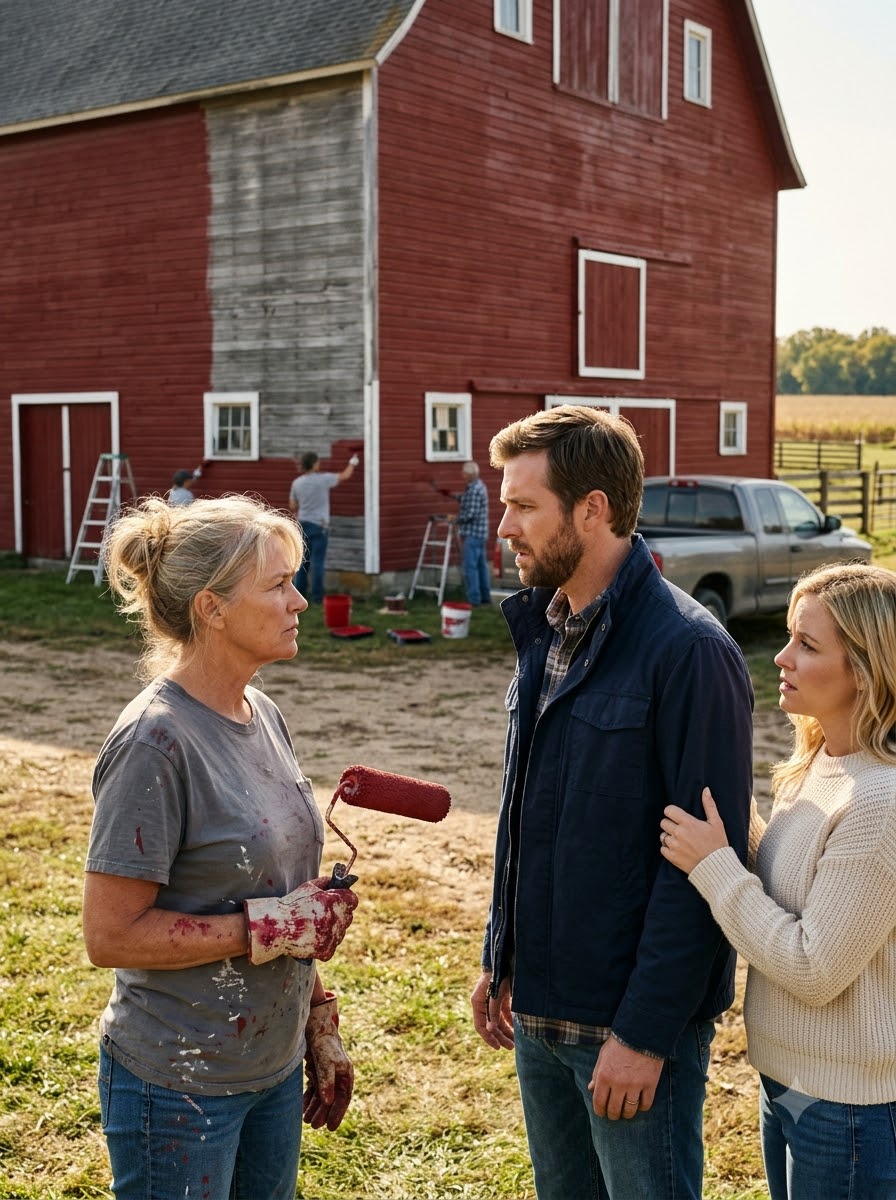
I mixed paint, filled trays, carried supplies, and moved along the barn as though I were feeding a threshing crew.
Gene had been right about back-brushing.
The teenagers rolled paint onto a section of siding.
Someone followed with a broad brush, working the color deep into the grain of the rough boards.
And slowly, the gray vanished.
Board after board.
It reminded me of watching a cloud’s shadow leave a field as sunlight returned.
By ten, the bottom of the entire south wall was red.
And it was exactly the right shade.
Not bright fire-engine red.
Not brick red.
The deep traditional barn red that turns almost brown in evening light.
I recognized some volunteers.
The Peterson twins.
Hannah, who worked at Dairy Queen.
A quiet, tall boy named Tyler whose grandfather used to haul our cattle to the sale barn in Worthington.
But most were strangers.
They were grandchildren of church members or teenagers from neighboring families.
Some had never visited our farm.
Yet they’d given up a Saturday in September to help a woman they barely knew.
At noon, women from the church kitchen arrived with a roaster of sloppy joes, two pans of dessert bars, and a large orange cooler of lemonade.
They arranged lunch on a sheet of plywood balanced across sawhorses.
The teenagers sat in the grass, splattered with red paint from their hair to their sneakers.
They ate like hungry harvest workers.
One Peterson twin finished five sloppy joes.
I counted them.
After lunch, the south wall was completely red, from the foundation to the roof.
Merle had also finished the east peak.
Someone started playing music through a Bluetooth speaker.
The teenagers sang along loudly and badly.
I didn’t recognize the songs.
But hearing them all singing together made the work seem lighter.
Shortly after one, a girl approached me beside the pickup.
I was pouring paint from our fourth five-gallon pail.
She was about fifteen, small, with a red bandana over her hair.
Paint covered both arms almost to her elbows.
Her name was Emma.
Her grandmother, Ruth, sang alto in our church choir.
“Mrs. Jensen?” she asked. “Can I ask you something? Pastor Nate said there used to be writing up over the little door. On the end. What was it?”
I set down the bucket.
Then I told her about Earl.
I explained how Arlo’s father had painted the barn himself in July 1958, climbing a ladder afterward to add his initials and the year in white paint.
I described how Arlo used to lift little Brad onto his shoulders to see those letters.
How Brad waved at them.
How he’d once believed his grandfather lived above the haymow door.
I hadn’t intended to tell the whole story.
But Emma listened so attentively that the words kept coming.
When I finished, she didn’t immediately respond.
She looked toward the east end of the barn, where Merle had just finished painting over the place those initials had once been.
Then she walked away.
I watched her speak to Nate.
Nate went to talk with Merle.
I returned to mixing paint.
There was too much work left for me to wonder what they were discussing.
By three o’clock, the west end was finished and half the north wall had been painted.
The teenagers were growing tired.
They were sunburned and moving more slowly, though a few were still singing.
One section remained especially difficult.
At the northwest corner, an old concrete stave silo stood about ten feet from the barn.
The lift couldn’t fit between them.
The ground sloped sharply toward the creek, making ladder placement unsafe.
“Leave it,” I told Nate. “We’ll get it another day. I’m not having a kid on a ladder on that slope.”
So we left a gray strip about six feet wide, running from the foundation to the eaves.
Against the newly red barn, it looked like a bandage wrapped around an injured arm.
At four o’clock, a truck turned into our lane.
I recognized it immediately.
A gray Silverado half-ton with a magnetic sign on its door.
BRAD JENSEN, REALTOR.
His phone number was printed beneath his name.
Brooke sat beside him.
The truck traveled halfway up the lane before stopping.
Brad left the engine running.
Just as I’d done on Thursday night.
From where he sat, he could see the parked cars, empty paint buckets, the lift, and the ladders.
He could see teenagers with red paint on their arms.
And he could see three sides of his grandfather’s barn restored to their original color.
Some volunteers stopped and stared at his truck.
Nate quietly instructed them to continue working.
After a long pause, Brad shut off the engine.
He climbed out and walked toward me with his hands deep in his jacket pockets.
He was built like Arlo.
He even walked like his father, putting slightly more weight on his left foot.
His face was pale.
“Mom.”
Then he stopped.
He’d looked up toward the haymow door.
Above it, freshly painted in white, were two initials and a year.
The letters stood about a foot tall.
They were a little crooked.
But they weren’t the initials Earl had painted in 1958.
They read:
A.J. 2026.
Arlo Jensen.
Emma had painted them from the lift basket while Merle held the back of her belt.
Nate had called her grandmother Ruth beforehand to request permission.
She’d completed the lettering with a sash brush in roughly ten minutes.
Until that moment, I hadn’t known any of it.
I stood looking up at my husband’s initials where his father’s had once been.
I couldn’t speak.
Neither could Brad.
He stared upward, his hands still in his pockets.
I watched his expression slowly collapse, like ice breaking apart on a stock tank in March.
“I had a photographer coming Monday,” he finally whispered.
“I know.”
“I already canceled him. I canceled him Thursday night. Right after you hung up on me.”
“I’m sorry I hung up on you. I’ve never done that before.”
“I deserved it.”
He glanced at the teenagers, the lift, and the red walls.
Then his eyes settled on the remaining gray strip.
“Mom. I didn’t do this to hurt you.”
“I know you didn’t, honey.”
“I don’t think you do.”
He removed his hands from his pockets.
They were trembling.
“I went up to see Dad on Tuesday. I didn’t tell you. You were downstairs getting coffee.”
That was news to me.
“He was trying to say something to me, Mom. He worked at it. Ten minutes. His face got all red. And all that came out was the same word, over and over. And I couldn’t tell what it was.”
He wiped his face.
“And I walked out to the parking lot and sat in my truck. And I thought, he’s not coming home. He’s never coming home to this place. And she’s going to be out here all by herself with three hundred acres and a hundred-year-old barn falling down around her.”
“It’s not falling down, Brad.”
“I know it’s not falling down.”
He almost laughed.
“I just thought if I got ahead of it. If I got it listed before winter. While land prices are up. Before you had to watch it all go to pieces. I thought I was helping.”
Brooke had joined us by then.
She gently took his arm.
“He hasn’t slept, Carol,” she explained. “He keeps saying, what if Dad doesn’t come home. He said it in his sleep last night. Three times.”
I looked at my son.
And suddenly I saw the four-year-old boy sitting on Arlo’s shoulders, waving at his grandfather’s initials.
Brad wasn’t cruel.
He’d never been cruel.
He was frightened.
And like his father, he’d responded by grabbing a tool and trying to repair whatever was in front of him.
He’d simply chosen the wrong problem to fix.
The difference was that Arlo would have asked me first.
“Brad,” I said. “I need you to hear something. And then we’re done talking about it.”
He nodded.
“You don’t get to decide your father isn’t coming home. Not you. Not me. Not the doctors. Him. He decides that. And until he does, this place stays exactly the way he left it.”
“Okay.”
“And the next time you’re scared, you call your mother. You do not call a spray crew.”
He let out a shaky laugh.
Brooke laughed too.
Then I embraced my son in front of twenty-two teenagers and a Methodist youth pastor.
He held on tightly.
He smelled like Arlo’s Old Spice.
He’d started wearing that scent in high school, apparently believing nobody would notice.
I’d noticed.
When he finally released me, he looked again toward the northwest corner.
“What’s that?”
“That’s where we ran out of hill,” I answered. “Nobody’s going up a ladder on that slope. It’ll keep.”
He studied the gray strip.
But he didn’t say anything else.
He and Brooke remained until sunset, collecting empty paint buckets, folding drop cloths, and carrying away trash.
Brad never picked up a paintbrush.
I didn’t ask him to.
At 6:45, the teenagers finished the north wall.
Everyone gathered in the yard to admire their work.
Someone began clapping.
Then everyone joined in, including the fathers and Merle, who was still in the lift basket.
Twenty-two teenagers.
One Saturday.
One red barn.
Except for a single gray corner.
Nine days later, Arlo was finally coming home.
And I had no idea what would happen when he saw what we’d done.
PART 3 — The One Word My Husband Had Been Trying to Say
Arlo was discharged from rehabilitation on a Monday.
He had a cane, a folded walker for the car, and a three-ring binder filled with exercises prescribed by his therapists.
The previous Sunday evening, Brad called.
“Mom. Could I be the one to drive Dad home? If that’s all right? You can ride along.”
I agreed.
I’d been hoping he would ask.
The following morning, Brad pushed his father’s wheelchair through the hospital’s front entrance in Sioux Falls.
He helped Arlo into the passenger seat of my car and fastened his seatbelt.
It was the same careful motion Arlo had once used when buckling Brad into a car.
I rode in the back.
For much of the journey, Arlo kept his good left hand against the dashboard, bracing himself as though expecting a sudden bump.
He’d regained a few more words.
Not many.
But enough to say yes, no, coffee, Merle, and my name in the shortened form he’d always used.
As we passed a soybean field near Pipestone, he looked out the window.
“Beans.”
Brad nodded.
“Merle’s got ours all in, Dad. Every acre.”
Arlo nodded firmly.
We reached our county road shortly before noon.
The cottonwoods along the creek had turned yellow during the weeks he’d been away.
From the back seat, I watched my husband’s head.
I knew the precise moment he saw the barn over the rise.
His entire body leaned toward the passenger window.
Brad slowed.
As we reached the end of the lane, he began turning toward the house.
Arlo lifted his left hand from the dashboard and grabbed his son’s arm.
“Stop.”
Brad immediately stopped beside the mailbox, with half the car still on the gravel road.
Arlo stared at the barn.
It was deep red again, the traditional color glowing in the midday sun.
The walls and peaks were finished.
The trim was white.
Only the northwest corner beside the silo remained gray.
And above the haymow door, painted in white, were the initials:
A.J. 2026.
Arlo studied them.
His eyes moved slowly as he read.
His mouth struggled to form a word.
“Who.”
So I told him.
I leaned forward between the front seats and explained everything plainly.
I’d promised long ago that I would always tell him the truth.
I described coming home that Thursday night and seeing gray paint in my headlights.
I told him about Gene at Runnings and the forty gallons of red paint.
About Nate’s safety rules.
About Merle operating the lift.
About the twenty-two teenagers from church.
About the sloppy joes and the Peterson twin who’d eaten five.
I told him how Emma had painted his initials with a sash brush while Merle held her by the belt.
And I didn’t conceal who’d arranged to have the barn painted gray.
Brad sat silently behind the steering wheel.
He let me tell the whole story without interrupting.
When I finished, Arlo turned slowly toward him.
Brad stared through the windshield.
“I’m sorry, Dad,” he said. “I thought you weren’t coming home. I was scared. And I did a stupid thing.”
Arlo didn’t answer immediately.
He looked toward the barn.
Then he released Brad’s arm and lifted his left hand.
Slowly, he pointed at the unfinished gray corner.
He turned back toward Brad.
And pointed again.
My son understood instantly.
For the first time in three weeks, someone had understood what Arlo wanted on the first attempt.
“Yes, sir.”
Brad drove the car into the yard and parked where his father could see the northwest corner clearly through the windshield.
He lowered Arlo’s window.
Then he walked to the machine shed, where I’d stored the remaining paint.
He returned carrying the last half-bucket of barn red, a sturdy brush, and Arlo’s extension ladder.
He didn’t immediately place the ladder on the sloping ground.
Instead, he fetched a shovel and two planks.
He dug down the uphill side and arranged the planks so the ladder’s feet would stand level.
Exactly as Arlo had taught him to do when he was twelve.
I stood at the bottom, holding the rails.
And Brad climbed.
He spent an hour and ten minutes painting that narrow strip from the fieldstone foundation to the eaves.
He used a brush instead of a roller.
He worked paint into every board, following the rough grain until no gray remained.
Arlo watched through the open car window.
Occasionally, I glanced toward him.
His eyes weren’t fixed on the barn.
They followed his son.
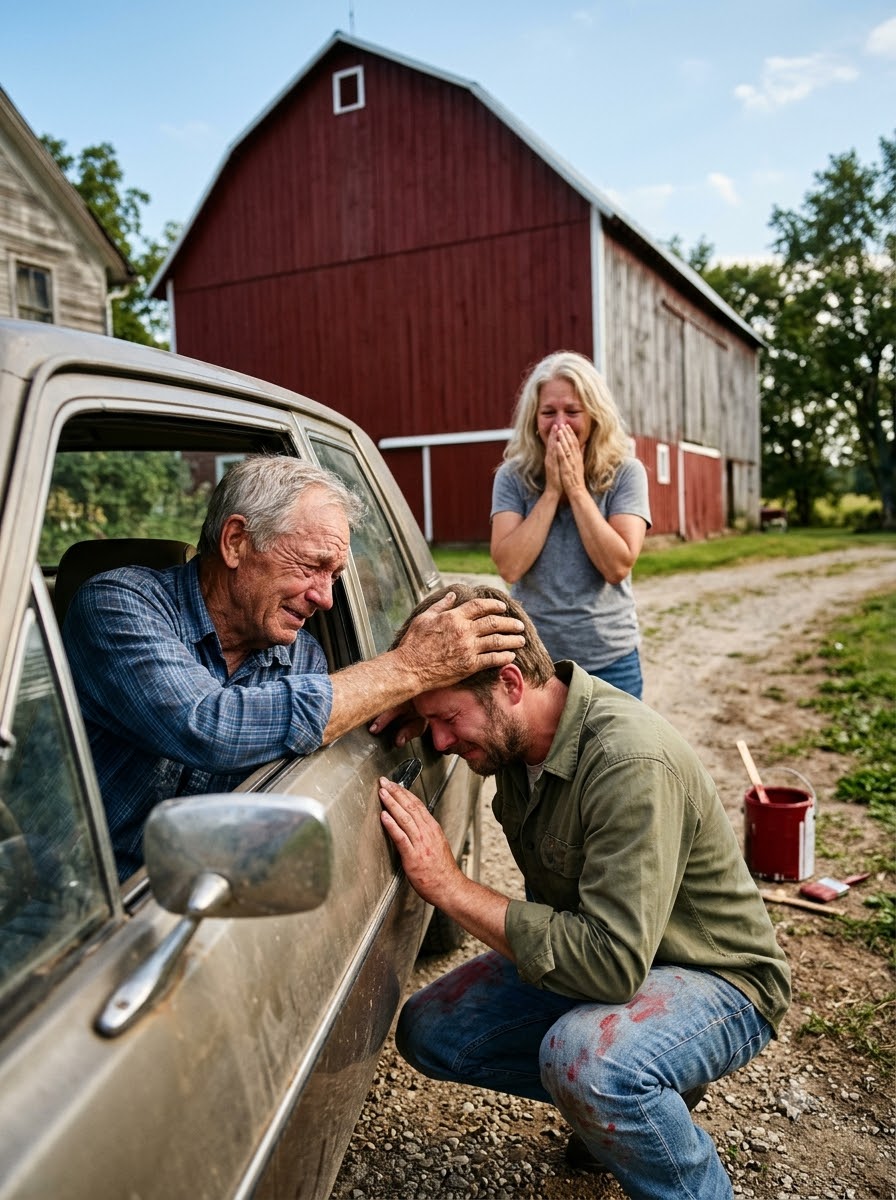
When Brad finally descended, red paint covered his good jeans and forearms.
A streak crossed his forehead where he’d wiped away sweat.
He approached the car and crouched beside the open passenger window, bringing his face level with his father’s.
Arlo reached out with his good left hand.
He rested it against the back of Brad’s neck.
It was the same gesture he’d used when Brad was small and had accomplished something difficult.
Arlo struggled to speak.
His face reddened.
Just as Brad had described from that Tuesday in the hospital.
Finally, he managed one word.
“Home.”
Brad lifted his head.
“That’s it,” he said.
He looked toward me over the roof of the car, tears filling his eyes.
“Mom. That’s the word. That’s what he was trying to say to me in the hospital. Over and over. Home.”
Arlo nodded.
His hand remained on the back of his son’s neck.
“Home.”
This time, the word came clearly.
Brad lowered his forehead against the car’s window frame and began crying.
Right there in the yard.
Arlo kept his hand on his son’s neck and let him cry.
I stood beside the ladder with both hands covering my mouth.
Eventually, Brad and I helped Arlo into the farmhouse using his walker.
He went directly to his chair beside the kitchen window.
From there, he could see the barn.
He stayed in that chair for the rest of the day.
That was three years ago this fall.
Arlo now walks with a cane.
His speech is slow, and some words still take time to come.
When that happens, he waits patiently, the way he once waited for a heifer to calve.
He doesn’t rush.
His right hand will never close around a coffee pot again.
So I pour his coffee.
He holds the mug in his left hand.
Every morning at six, we sit together at our kitchen table and look toward the red barn.
He drives the pickup on gravel roads again.
Each fall, he sits on the tailgate near the soybean field and tells Merle how to operate his combine.
Merle pretends to listen.
Brad visits most Saturdays now.
He’s learned to manage the farm’s books.
He works through soybean contracts with Arlo at the kitchen table.
The two of them argue about market prices like old farmers gathered around the co-op coffee table.
Last spring, Brad arrived carrying his toolbox and asked his father to show him how to repair the fence in the north pasture.
He wanted to learn the same way Grandpa Earl had taught Arlo.
They spent the entire day out there.
Arlo pointed with his cane.
Brad drove the fence posts.
In March, Brooke gave birth to a little boy.
They named him Earl.
Emma is now studying physical therapy at South Dakota State University in Brookings.
She told her grandmother she’d decided on that career during the day we painted the barn.
She’d been standing in the lift, looking down at our yard and thinking about the man in the hospital struggling to pick up a spoon.
Every Christmas, she sends Arlo a card.
She draws a little red barn on the envelope using red ink.
Arlo keeps every card in his desk drawer beside his tape measure.
The white initials are still above the haymow door.
A little crooked.
A.J. 2026.
We’ve touched up the paint once already.
This past July, on a Sunday afternoon, Brad brought Brooke and their baby to the farm.
He carried little Earl into the yard.
Then he lifted the boy onto his shoulders and pointed toward the haymow door.
“See that, buddy?” Brad said. “That’s your grandpa up there.”
Arlo watched from his chair on the porch.
And he laughed.
A full, whole-face laugh.
Both sides.
Down at the end of our lane, beside the mailbox where Arlo had asked his son to stop, there has never been a real-estate sign.
And there never will be.
