


PART 1: The Secret Return and the Children’s Terrifying Warning
Adrián Vega had built his reputation on being a man who feared nothing. Yet when he secretly returned to his mansion after pretending to leave for Switzerland, he discovered something that shook him more deeply than any threat from his enemies.
His 14-month-old twin sons were laughing in the arms of the nanny he had been told was mistreating them.
And when one of the boys pointed toward the housekeeper’s office and whispered, “Bad Nana,” Adrián realized the danger might have been living under his roof all along.
He stood silently behind the living room door, struggling to understand what he was witnessing.
At 42, Adrián controlled a vast collection of shipping companies, warehouses, and underground enterprises inherited from his father. Throughout the port of Valencia, his name carried a reputation that few dared challenge.
Some called him the Black King.
Men who were accustomed to controlling entire companies lowered their voices when his name entered a conversation.
But all that power had failed him in the one place where he needed it most.
His own home.
Fourteen months earlier, his wife, Julia, had died from medical complications shortly after giving birth to their twin sons, Hugo and Leo.

Her death had left Adrián devastated.
The mansion in Rocafort, once filled with Julia’s warmth, had become a carefully guarded residence where employees moved quietly and security cameras watched almost every corner.
Adrián believed he was protecting his children by surrounding them with guards, strict schedules, and constant supervision.
Yet neither boy seemed happy.
Hugo became frightened whenever a door slammed.
Leo clung desperately to familiar caregivers.
Both children cried whenever Adrián left the house, and no matter how many toys he bought or how much money he spent, he rarely saw them smile.
Whenever he expressed concern, Mercedes offered the same explanation.
“They’re sensitive children, sir,” Mercedes kept telling him. “They’ve been through too much.”
Mercedes was 59 and had served the Vega family for 16 years.
She had managed the household throughout Julia’s illness and stepped into an even larger role after her death.
While Adrián struggled with grief, Mercedes organized the staff, controlled the children’s routines, supervised their caregivers, and decided who could enter their rooms.
He had trusted her without question.
After all, she had been there during the darkest period of his life.
But that trust began to unravel one morning beside his car.
“Mr. Vega, I need to tell you something about Inés,” Mercedes said beside the car.
Adrián turned toward her.
Inés Molina was 27 and had worked as the twins’ nanny for eight months.
“What is it?”
Mercedes lowered her voice.
“She doesn’t treat the children well when you’re away. She makes them cry and then pretends to comfort them. You should see her when she doesn’t know you’re here.”
Adrián felt anger rise immediately.
The thought of someone deliberately frightening his sons was unbearable.
His first instinct was to confront Inés and dismiss her.
But something stopped him.
He had learned through years of difficult business dealings that accusations were not the same as proof.
If Inés was mistreating his children, he needed to witness it himself.
And if Mercedes was mistaken, he needed to know that too.
So he devised a plan.
He informed the household that he would be traveling to Geneva for four days.
His convoy accompanied him to the airport, where he appeared to enter the terminal for his flight.
But he never boarded a plane.
Instead, Tomás, his head of security, drove him back to the estate through a private entrance.
Adrián had prepared himself for the worst.
He expected shouting.
He expected crying.
He expected to discover the nanny behaving cruelly while she believed her employer was thousands of kilometers away.
Instead, as he approached the living room, he heard something he had almost forgotten.
His sons were laughing.
Not crying nervously.
Not making the small, uncertain sounds he had become accustomed to hearing.
They were laughing freely.
Adrián slowed his steps.
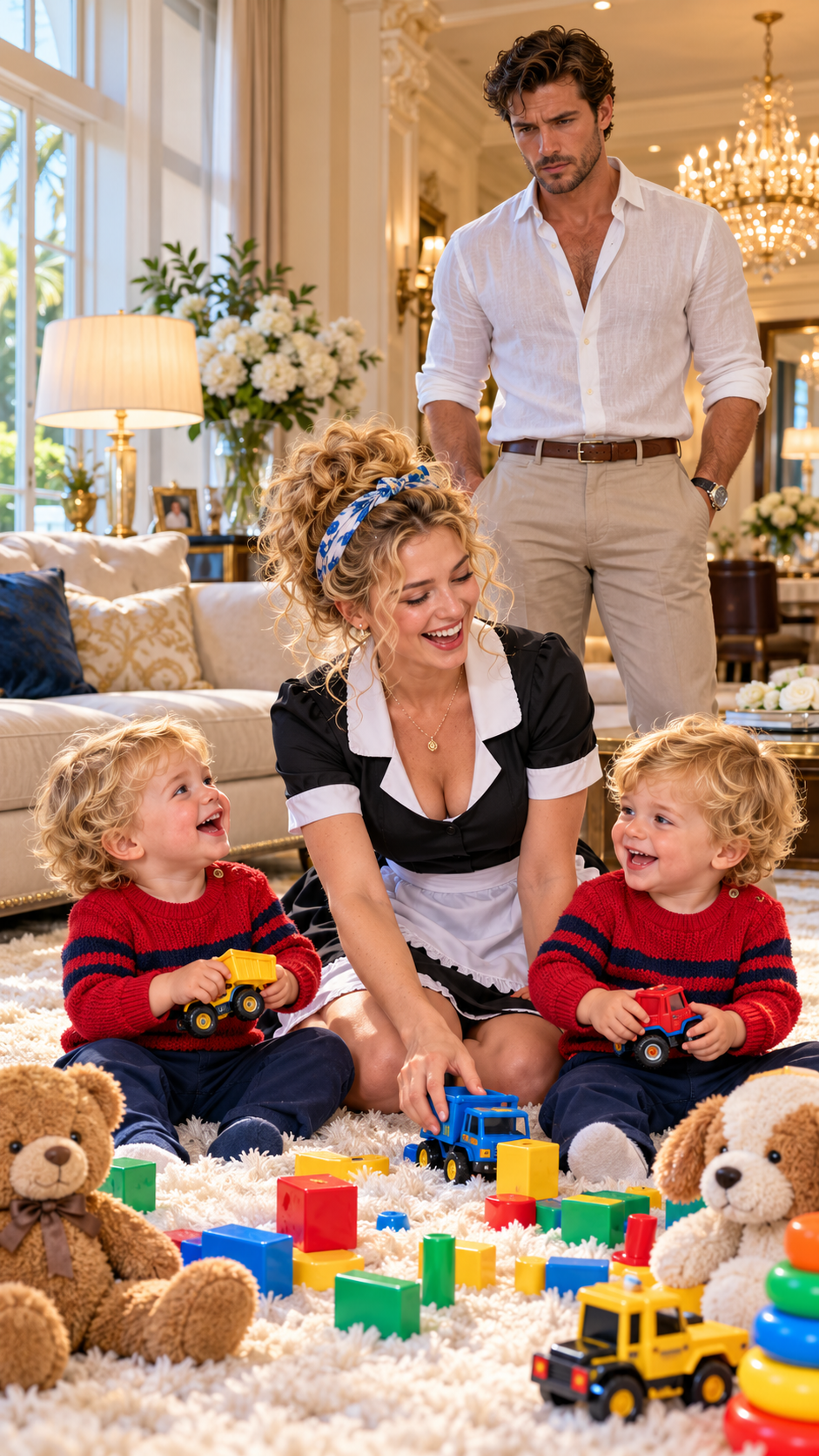
Through the doorway, he saw Inés lying on the rug with several cushions scattered around her.
She wore yellow cleaning gloves, and a green blanket hung from her shoulders like a cape.
“Help! The princes have defeated the dragon!” she exclaimed.
Hugo burst into giggles as he tugged at the blanket.
Leo sat on her stomach, clapping enthusiastically.
Inés pretended to struggle against the two little boys, making them laugh even harder.
Adrián could barely breathe.
He had spent months believing that his children were too traumatized to enjoy themselves.
Now he was watching them play with complete abandon.
For a moment, he simply stood there, overwhelmed by a mixture of relief, confusion, and grief.
Then Hugo noticed him.
“Daddy.”
Adrián stepped into the room, his eyes filling with emotion.
“Come here, champ.”
He opened his arms.
But Hugo did not come toward him.
Instead, the little boy turned back to Inés and reached for her.
“Mommy.”
Leo immediately repeated the word.
Inés stopped smiling.
The playful atmosphere vanished.
Adrián stared at her, unable to hide his shock.
“How long have they been calling you that?”
“For a few weeks now, sir.”
“And why didn’t you tell me?”
“Because Mercedes warned me that you would fire me if you found out.”
Adrián felt the ground shift beneath him.
He had feared that another woman might somehow replace Julia in his children’s hearts.
But seeing how naturally they sought comfort from Inés made him realize something painful.
His sons were not trying to erase their mother.
They were reaching toward someone who made them feel safe.
Before he could ask another question, Hugo lifted his small hand and pointed down the hallway.
“Bad Nana.”
Leo immediately pressed his face against Inés.
She held him protectively.
Adrián looked toward the hallway, then back at the nanny.
Her expression told him there was more to this than an innocent misunderstanding.
“Mr. Vega, Mercedes has been hiding things from you for months.”
Adrián turned to Tomás.
“Don’t let anyone leave the estate until we get to the bottom of this.”
Tomás nodded.
Then, from the direction Hugo had pointed, came the quiet sound of a door opening.
Mercedes stepped out of her office.
Her eyes moved from the twins clinging to Inés to Adrián standing in the middle of the living room.
For a brief moment, nobody spoke.
Adrián waited for surprise.
For guilt.
For an explanation.
Instead, Mercedes looked directly at him.
And smiled.
PART 2: The Hidden Photograph and the Truth About Inés
Mercedes approached the living room as though nothing unusual had happened.
Her movements were calm, her posture composed, and her expression gave no indication that she had just been caught in a situation she had never expected.
“Mr. Vega, what a surprise. I hope nothing went wrong with your trip.”
Adrián remained silent.
Hugo hid his face against Inés’s shoulder.
Leo watched Mercedes with frightened eyes.
Adrián noticed both reactions.
“I want to know why my sons react like this whenever they see you.”
Mercedes’s pleasant expression disappeared.
“Because that girl is turning them against me. She’s teaching them to call her Mommy. She’s taking advantage of the fact that they lost Julia.”
Inés shook her head immediately.
“I’ve never taught them that word. They started saying it on their own.”
Mercedes turned sharply toward her.
“And you’ve allowed it,” Mercedes retorted. “You should remember that you’re an employee.”
Adrián raised his hand before the argument could continue.
“Enough. Inés, take the children upstairs. We’ll talk afterward.”
Inés gathered the twins and left the room.
Adrián watched as Hugo relaxed against her shoulder.
That simple movement stayed with him.
The children had shown him, without being able to explain it in words, whom they trusted and whom they feared.
When they were gone, Adrián followed Mercedes into her office.
He had entered that room countless times over the years.
It was orderly, filled with household records, framed photographs, and carefully labeled folders.
A bookshelf displayed pictures of his parents and a photograph of Julia while she was pregnant, smiling as she leaned against him.
The sight of his late wife made his chest tighten.
“Why did you accuse Inés?” he asked.
Mercedes sighed.
“Because she’s becoming too important to the children. If she disappears tomorrow, they’ll suffer all over again.”
Adrián studied her.
That explanation might once have satisfied him.
Not anymore.
“And is that why you tell them she’ll leave if they don’t behave?”
Mercedes stopped moving.
Inés had already explained that the housekeeper frequently used the threat of separation whenever the twins cried or sought comfort.
She had also described the harsh reprimands that frightened them.
For several seconds, Mercedes said nothing.
Then she answered.
“They needed discipline.”
Adrián stared at her.
“They’re 14 months old, Mercedes.”
The words hung heavily between them.
He turned toward the household records and began examining the folders.
He no longer wanted reassuring explanations.
He wanted to know what had actually been happening inside his home.
Among the documents, he discovered a wooden box that had belonged to Julia.
The lid was slightly open.
Inside were several pieces of jewelry, old photographs, and an unfinished letter.
He recognized his wife’s handwriting immediately.
His hands trembled as he unfolded the paper.
“Adrián, don’t let our grief turn this house into a prison. Our children will need affection, even when it comes from people who don’t share our blood. Loving someone new doesn’t mean forgetting me.”
He read the words again.
Julia had understood something he had been too frightened to accept.
Love did not have to be guarded like an inheritance.
His sons could form attachments to other people without losing their connection to their mother.
He looked at Mercedes.
“Why did you never give me this?”
“You were devastated when Julia passed away. I thought it would be better to wait.”
“It’s been more than a year.”
Mercedes avoided his eyes.
Adrián placed the letter carefully on the desk.
Then he opened the bottom drawer.
Inside was another folder.
This one immediately caught his attention.
It contained the results of a private background investigation into Inés Molina.
The investigation had been conducted two months before she began working at the mansion.
Adrián frowned.
He had never authorized such an investigation.
He began reading.
Inés had previously worked at a preschool.
Her references were excellent.
There was no evidence of misconduct, dishonesty, or anything that could justify Mercedes’s accusations.
But someone had marked one section of the report.
Her parents’ names.
Mother: Elena Navarro.
Father: Daniel Molina.
Below the names was a handwritten note.
“Possible connection to the Vega family. Check old records.”
Adrián looked up sharply.
“Why did you investigate her family?”
Mercedes turned pale.
“Because I recognized her mother’s surname.”
“Explain.”
“Elena worked at one of your father’s foundations years ago.”
“And what does that have to do with me?”
Mercedes hesitated.
Far too long.
Adrián reached for another folder.
Inside was an old photograph.
Two young women stood beside each other, smiling at the camera.
One was his mother, Nuria.
The other looked so much like her that Adrián initially thought he was seeing two photographs of the same woman.
He turned the picture over.
On the back was a handwritten inscription.
“Nuria and Elena, summer of 1994.”
His heartbeat quickened.
“My mother always said she was an only child.”
Mercedes lowered herself into a chair.
“Elena was her maternal half-sister. Your grandfather never accepted that family connection.”
Adrián looked again at the photograph.
Suddenly, the background report made sense.
Elena Navarro was Inés’s mother.
Nuria was his own mother.
“Then Inés is my cousin.”
Mercedes nodded.
Adrián stood motionless.
For eight months, a member of his family had been living and working under his roof.
She had cared for his children, comforted them, and helped them rediscover happiness.
And nobody had told either of them the truth.
Then a quiet voice came from the doorway.
Inés had returned downstairs to collect medicine kept in the hallway cabinet.
She had heard the last part of the conversation.
Her face was pale.
“My mother was your mother’s sister?”
Adrián turned toward her.
He wanted to answer, but the words would not come.
Inés looked at the photograph in his hand.
Her mother had died four years earlier.
She had grown up knowing almost nothing about that side of her family.
Now she was discovering that the man who employed her was connected to her by blood.
Mercedes began crying.
“There’s something else. Julia discovered that family connection before the twins were born.”
Adrián stared at her.
Julia had known?
His wife had uncovered a family secret and somehow kept it hidden from him.
Inés looked toward the photograph of Julia on the bookshelf.
“Your wife knew who I was?”
Mercedes wiped her face.
Then she pointed toward the western staircase.
“Julia found the letters your grandfather had hidden for years. They’re behind a door that no one has opened since she was admitted to the hospital.”
Adrián felt a chill despite the warmth of the room.
His wife’s letter.
The photograph.
The investigation into Inés.
And now a hidden room containing correspondence that had been concealed for decades.
He realized Mercedes had not merely withheld information about a nanny.
She had been guarding the truth about his entire family.
And whatever waited behind that locked door might explain why.
PART 3: Julia’s Final Letters and the Family That Learned to Love Again
Adrián looked at Mercedes with an unfamiliar sense of distance.
For 16 years, he had allowed her to make decisions inside his home because he believed she had earned his trust.
She had managed the household during Julia’s illness.
She had taken responsibility for the twins while he struggled to function after his wife’s death.
And when grief made him withdraw from everyone, she had been the person he relied on most.
Now he understood that her control had extended far beyond household schedules.
She had decided what he was allowed to know.
She had concealed documents.
She had kept important information from Inés.
And she had allowed fear to influence the way his children were treated.
“Where’s the key to that room?” he asked.
Mercedes pointed toward Julia’s jewelry box.
Adrián returned to it and carefully lifted the velvet lining.
Beneath it lay a small silver key.
He stared at the object for a moment.
Julia had left it somewhere he might eventually discover it.
He asked Tomás to remain with the twins.
Then he accompanied Mercedes and Inés toward the western staircase.
The corridor was quiet.
After removing a wooden panel, they discovered a door that had been hidden from ordinary view.
Adrián inserted the key.
The lock resisted before finally turning.
Inside was a small room containing boxes, photographs, documents, and stacks of old correspondence.
The air smelled of paper and years of neglect.
On a table near the entrance lay an envelope addressed to Adrián.
He recognized Julia’s handwriting.
His chest tightened as he opened it.
“If you’ve found this room, it means someone has finally decided to stop hiding what happened in our family. Forgive me for not telling you sooner. I wanted to make sure I had proof.”
Adrián began reading the documents she had collected.
Piece by piece, a history emerged that had been hidden across generations.
Elena Navarro, Inés’s mother, was the maternal half-sister of Nuria, Adrián’s mother.

Their maternal grandfather had refused to acknowledge Elena publicly because she had been born from a relationship before his marriage.
Rather than accept her as part of the family, he had concealed her existence.
Years later, Elena began working at one of the Vega family’s foundations.
There, she met Daniel Molina, a business associate of Adrián’s father, Alonso Vega.
They fell in love.
But Alonso considered their relationship an obstacle to his business interests.
When Daniel received an opportunity to work abroad, Alonso used the separation to interfere in their relationship.
Letters were intercepted.
Messages never reached their intended recipients.
Daniel was led to believe Elena had abandoned him.
Elena was told that Daniel had begun another family.
Neither knew that the information they received was false.
When Inés was born, Elena left Valencia.
She raised her daughter modestly, never realizing how hard Daniel had tried to find them.
Inés listened without moving.
She had spent much of her childhood wondering why her father was absent.
Her mother rarely spoke about him.
And after Elena died four years earlier following a long illness, Inés believed those unanswered questions would remain with her forever.
Now she was learning that the story she had lived with was not the truth.
“All my life, I thought he didn’t love me,” she whispered.
Adrián opened another box.
Inside were letters Daniel had written from Singapore and later Madrid.
Many had been returned unopened.
He carefully unfolded one.
“If our daughter has already been born, tell her I’m still trying to find a way back. I don’t want her to grow up thinking I chose to leave.”
Inés began crying.
For years, she had believed her father had chosen a life without her.
Now, in a room she had never known existed, she was holding evidence that he had wanted to find her.
Mercedes approached.
But Inés stepped away.
“How long have you been keeping all this?”
“Julia asked me to look after it.”
“Then why did you never give it to me?”
Mercedes lowered her head.
“When you came to work here, I recognized your surname. I was afraid you’d come looking for something from the family.”
Inés looked at her in disbelief.
“I came because I needed a job. I’d finished my studies in Early Childhood Education and wanted to start over after losing my mother.”
“I know that now.”
“But for months, you treated me as though I were an intruder.”
Mercedes had no answer.
Adrián continued examining Julia’s papers.
Eventually, he found her final letter.
“Love isn’t an inheritance that needs to be protected from others. If our children ever need to love someone else, don’t be afraid. No one can take my place, because my place doesn’t disappear when someone new enters their lives.”
Adrián lowered himself into a chair.
He remembered the months following the twins’ birth.
The funeral.
The silence.
The fear that something terrible might happen to his sons as well.
He had responded by surrounding the mansion with cameras, guards, and strict routines.
He convinced himself that financial security and physical protection were enough.
He worked long hours because work was easier than returning to a house where Julia no longer waited for him.
Mercedes handled the children.
She knew their schedules.
She controlled the staff.
And Adrián allowed it because he could barely endure the thought of making another decision.
He had not learned which songs calmed Leo.
He did not know how Hugo preferred to fall asleep.
He had missed countless small moments that might have helped him become closer to his sons.
Inés had learned those things.
She knew how to make them laugh.
She understood when they were frightened.
She held them when they needed comfort.
And he had almost dismissed her because someone told him she was too important to them.
Adrián looked at Mercedes.
“Mercedes, I need you to tell me exactly what happened with the children.”
The older woman began crying.
She admitted that she had prevented Inés from comforting the twins at certain times.
She believed the boys were becoming too attached to their nanny and wanted them to learn to tolerate separation.
She acknowledged raising her voice when they cried.
She also admitted changing their routines to reduce the amount of time they spent with Inés.
“I never meant to hurt them,” she said. “I thought they needed to get used to not always having someone hold them.”
Adrián looked at her with sadness rather than anger.
“What they needed was to feel safe.”
Mercedes wiped away her tears.
“When Julia passed away, I thought it was my responsibility to keep the house exactly as she’d left it. Then Inés arrived and started changing everything. The children laughed. You started coming home earlier from work. I felt like nobody needed me anymore.”
Inés listened quietly.
“I never wanted to take your place.”
“I know.”
“Then why did you try to get me fired?”
Mercedes hesitated.
“Because I was afraid of being left alone.”
Adrián closed the folder.
“Being afraid didn’t give you the right to use my children to keep your position.”
That afternoon, he relieved Mercedes of her household responsibilities.
He arranged an independent review of the household management records and the documents she had concealed.
He also sought professional advice about the twins’ emotional well-being.
The specialists explained that children of Hugo and Leo’s age could experience difficulties with separation and changes in caregivers.
But unpredictable routines, harsh reprimands, and threats of losing familiar people could increase their insecurity.
What the boys needed was consistency.
Gentle reassurance.
Affection.
And adults who responded calmly when they were distressed.
Adrián began changing his life.
He reduced his business travel and delegated responsibilities he had previously insisted on handling himself.
He also started distancing himself from the underground enterprises that had shaped his family’s history, seeking professional guidance on how to address his responsibilities.
The mansion gradually changed.
Exterior security remained in place, but unnecessary cameras inside the family rooms were removed.
The house no longer operated like a fortress.
Instead of spending every afternoon behind his office door, Adrián began sitting on the living room rug with his sons.
At first, he was awkward.
He did not know how to entertain two toddlers.
Hugo threw wooden blocks toward him.
Leo tried stuffing toys into his pockets.
Adrián kept trying to organize their games.
Inés laughed and showed him that he did not need to control every moment.
Sometimes all he had to do was sit beside them.
Listen.
Smile.
And let them lead.
One afternoon, Hugo stumbled gently onto the rug and began to fuss.
Adrián immediately stretched out his arms.
The little boy looked toward him.
For a moment, he hesitated.
Then he crawled closer and curled against his father’s chest.
Adrián stopped moving.
His eyes filled with tears.
It was the first time in months that Hugo had sought him out for comfort without anyone encouraging him.
He held his son gently, afraid that even a small movement might interrupt the moment.
That evening, after the twins had settled down, Adrián asked Inés to speak with him.
“I want you to know something. You don’t have to stay here just because we’ve discovered we’re family.”
She looked surprised.
“What do you mean?”
“You don’t owe me anything. You can keep working here, leave, or decide what kind of relationship you want to have with me. That’s entirely up to you.”
Inés remained silent for a moment.
Then she smiled sadly.
“I want to get to know my family, Adrián. But I also want to keep taking care of Hugo and Leo.”
“Then we’ll be happy to have you close.”
Over the following weeks, more information about Inés’s parents came to light.
A former secretary from the family foundation confirmed that Daniel had tried to return to Spain to find Elena.
But by the time he received reliable information about where she was living, many years had passed.
He feared disrupting the life he believed she had built without him.
Daniel had died six years earlier.
Among his possessions was a letter addressed to Inés.
When she finally received it, she sat beside the living room window and read it slowly.
“I don’t know if I’ll ever get to meet you. I hope you’ve received all the love I wasn’t able to give you. If anyone has ever made you believe you weren’t important, don’t believe them. Your existence has always been a source of hope for me.”
Tears fell onto the paper.
She could not bring her parents back.
She could not ask them why they had made certain choices or how they had endured the years apart.
But she could finally release one belief that had followed her since childhood.
She had not been an unwanted daughter.
Her father had loved her.
He simply had not been allowed to reach her when it mattered most.
Months passed.
The household settled into a gentler rhythm.
Then Adrián received a letter from Mercedes.
She had moved near Castellón, where her sister lived, and accepted an administrative position at a nursing home.
She did not ask to return to the mansion.
Instead, she requested permission to say goodbye to the family.
Adrián discussed the request with Inés and followed the guidance of the professionals supporting the twins.
They agreed to a brief visit.
Mercedes arrived one morning carrying two small wooden toys.
She did not rush toward Hugo or Leo.
She placed the toys on a table and waited.
Hugo approached out of curiosity.
Leo remained beside Inés.
Mercedes smiled through tears.
“They’ve grown so much.”
Adrián later accompanied her toward the front door.
“I hope you find peace, Mercedes.”
She lowered her eyes.
“I’m sorry I confused taking care of them with making every decision for all of you.”
“We can’t go back to living the way we did before.”
“I understand.”
“But you can make a fresh start.”
Mercedes nodded.
Then she left.
Her departure did not erase the fear the children had experienced or the secrets she had concealed.
But it allowed the family to move forward without pretending that regret alone could undo the consequences of her choices.
Some time later, Adrián organized a small gathering in the garden to remember Julia and Elena.
There were no influential businessmen.
No guests seeking favors.
No elaborate displays of wealth.
Only people who genuinely belonged in the twins’ lives.
Inés placed a photograph of her mother beside a picture of Julia.
Hugo and Leo wandered across the grass, each carrying a white flower.
Hugo had found an old yellow glove among his toys and insisted on wearing it.
When Adrián noticed, he remembered the day he had returned secretly from his supposed trip to Switzerland.
He remembered Inés lying on the rug, pretending to be a dragon.
He remembered his sons laughing.
And he remembered how close he had come to punishing the very person who had helped them feel safe.
Inés approached with Leo in her arms.
The little boy pointed toward Adrián.
“Daddy.”
Then he turned back toward her.
“Mommy.”
Inés looked at Adrián nervously.
“Adrián, I’ve never wanted them to forget Julia.”
Adrián looked toward the photograph of his wife.
For a long time, he had believed that hearing another woman called Mommy would mean losing Julia a second time.
Now he understood that love did not work that way.
His sons’ affection for Inés did not diminish the love their mother had given them.
Julia’s place in their lives remained.
“I know, Inés. They’ll have time to learn their mother’s story. And they can also love the person who takes care of them.”
Inés smiled, visibly moved.
Hugo toddled toward his father and lifted his arms.
Adrián picked him up.
Then he sat on the grass beside Inés and Leo.
For the first time in years, the mansion was not filled with employees waiting for instructions or guards watching every movement.
There were toys scattered across the garden.
Conversations drifting through the afternoon air.
And the unmistakable sound of two little boys laughing.
Adrián watched his sons with a feeling he had once believed he might never experience again.
Peace.
He no longer wanted Hugo and Leo to grow up remembering him as the most powerful man in Valencia.
He wanted them to remember something simpler.
That he was there when they woke up.
That he comforted them when they cried.
That he listened when they tried to tell him something.
And that he made time to discover the world beside them.
That evening, after the twins had gone to bed, Adrián returned to his office.
Julia’s letter rested on the desk beside a family photograph.
He picked it up and read the final sentence again.
“Don’t turn our home into another locked room.”
For a long moment, he remained still.
He thought about all the doors he had locked in the name of protection.
All the cameras he had installed.
All the decisions he had allowed other people to make because he was too frightened to confront his grief.
Then he placed the letter beside the photograph.
He walked to the office doors and opened them.
From the hallway came the gentle sound of Inés singing to the twins.
Hugo began laughing.
A moment later, Leo joined him.
Adrián switched off the office light and followed their voices.
For years, he had believed that loving his family meant making sure nobody could take them away.
He had protected the property, the fortune, and the family name.
But he had nearly forgotten to protect the happiness of the two people who mattered most.
Now he understood that a house could be surrounded by guards and still feel lonely.
It could contain every luxury imaginable and still be missing the one thing children needed.
Love that was present.
Love that was patient.
Love that did not disappear when someone cried or reached out for comfort.
And as Adrián entered the room where his sons were waiting, he finally understood what Julia had wanted him to learn.
A home was not made safe by the number of locks on its doors.
It became a home when the people inside knew that whenever they reached out their arms, someone would be there to hold them.
