

Part 1: The Birthday Party They Came to Destroy
“Take those decorations down.”
The sharp order interrupted the celebration just as eight-year-old Elijah Brooks leaned toward his birthday cake, his cheeks filled with air, ready to blow out the candles.
His mother, Renee, stood beside him with a hand resting on his shoulder. Nearly thirty relatives, neighbors, and children had gathered beneath a pavilion in Baltimore’s Patterson Park, enjoying the warm afternoon.
Then Lieutenant Margaret Sloan marched into the middle of the party.
Before anyone could understand what was happening, she seized the cake table and overturned half of it.
The Spider-Man cake struck the pavement first.
Red frosting splattered across the concrete. Paper plates scattered beneath folding chairs, and wrapped birthday presents tumbled into a heap.
Elijah remained frozen, his mouth still open.
A moment earlier, he had been about to make a birthday wish.
Now his cake was destroyed.
Sloan kicked a nearby gift box.
The cardboard caved in beneath her boot, breaking the remote-controlled car Elijah had been begging for over the previous several weeks.
Children began crying.
“Everybody back up,” Sloan shouted. “This gathering is over.”
Three uniformed officers moved in behind her.
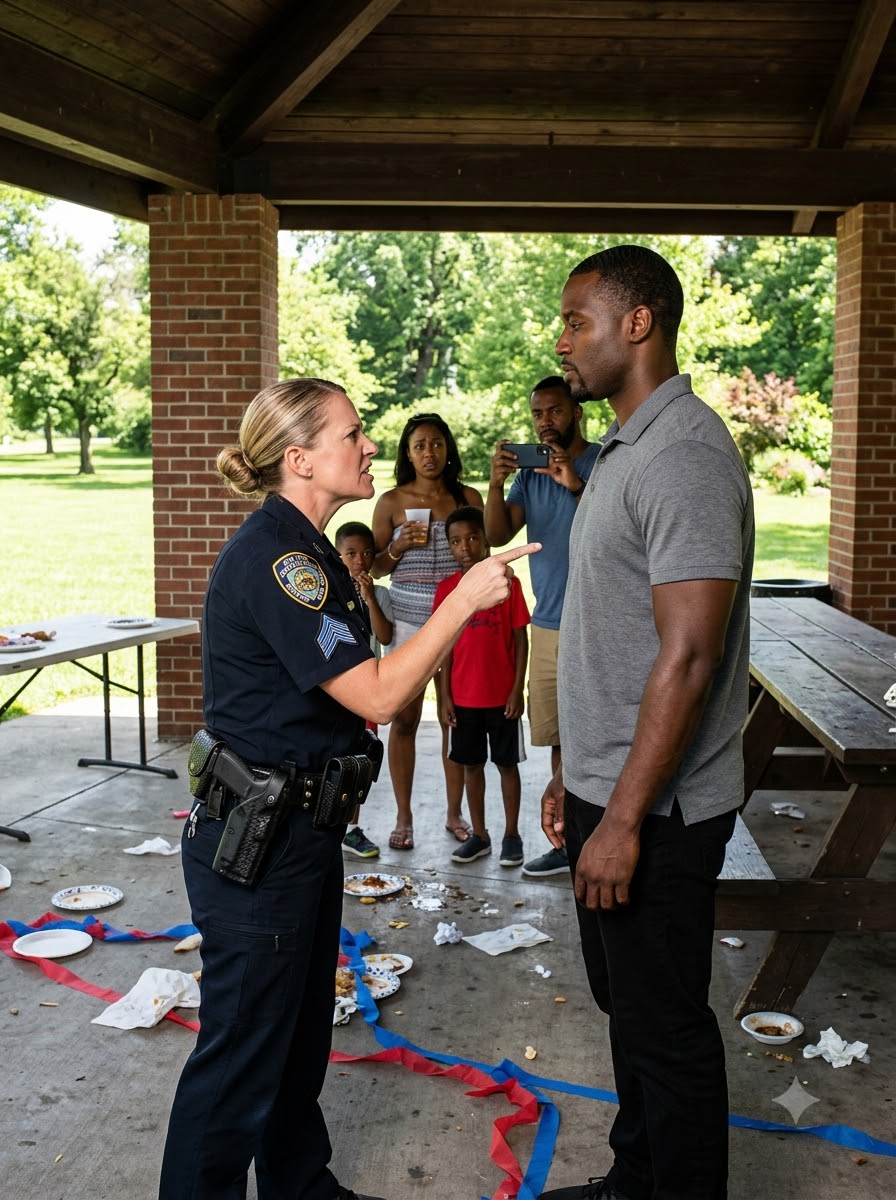
Parents pulled their children close, confused about why an ordinary birthday celebration had suddenly become the scene of an aggressive police operation.
At the rear of the pavilion, Elijah’s father stood motionless.
Adrian Brooks was forty-two, Black, tall, and broad-shouldered. Wearing casual clothes, he looked exactly like the construction supervisor his neighbors believed him to be.
His arms remained at his sides.
But Renee noticed the slight tightening of his fingers.
She recognized that expression.
Adrian wore it whenever he sensed danger before anyone else did.
Sloan pointed at him.
“You.”
Adrian turned.
“You responsible for this?”
“This is my son’s birthday party.”
Sloan laughed briefly.
“Of course it is.”
She surveyed the gathering with obvious contempt.
Coolers stood beside the picnic tables. Homemade decorations hung from the pavilion roof. Food trays covered the buffet, and children in colorful shirts clustered around their parents.
“Let me guess,” she said. “Taxpayer-funded family fun?”
Seventy-year-old Loretta Greene rose carefully from her chair.
After thirty-eight years teaching elementary school in East Baltimore, she still attended almost every neighborhood gathering, despite the arthritis that made walking difficult.
“This pavilion was reserved,” she said. “We have the permit.”
Sloan turned toward her.
“Did I ask you to speak?”
Loretta held her gaze.
Sloan smiled coldly.
“Sit down before you turn a birthday party into an arrest.”
Adrian clenched his jaw.
He forced himself to remain still.
Only two hours earlier, everything had been different.
He had spent the morning hanging red-and-blue streamers beneath the pavilion roof while Elijah ran around the picnic tables in his Spider-Man shirt and new sneakers.
Renee arranged gift bags beside a cooler, laughing as Adrian measured the distance between decorations with the seriousness of a construction inspector.
“You know he’s eight, right?” she called.
Adrian looked over.
“What?”
“You’re lining those streamers up like the governor is coming.”
Elijah raced past.
“Dad said everything has to be perfect.”
Renee smiled.
“That sounds like your father.”
Adrian stepped back to inspect the banner.
HAPPY 8TH BIRTHDAY, ELIJAH.
He adjusted one corner.
“I just want him to remember today.”
Renee watched him quietly.
There were habits her husband had never completely explained to the people around them.
He checked parking lots without appearing to look.
He chose restaurant seats facing the exits.
He noticed unfamiliar vehicles long before anyone else did.
Most neighbors assumed those instincts came from construction management and security work.
Almost nobody knew the truth.
Adrian Brooks was a special agent with the Federal Bureau of Investigation.
For eight months, he had been working deep undercover inside a Baltimore police district suspected of widespread corruption.
His assignment involved gathering evidence of narcotics protection, extortion, fabricated arrests, civil-rights violations, and officers who used their authority to intimidate the communities they were supposed to protect.
Lieutenant Margaret Sloan was a central target.
She had spent more than twenty years with the Baltimore Police Department.
In public, she portrayed herself as a hard-nosed commander committed to aggressive enforcement.
But Adrian’s investigation had documented something very different.
Sloan allegedly accepted payments from drug traffickers, directed patrol officers away from protected dealers, and ordered harassment against residents who complained about police misconduct.
She also appeared to take particular pleasure in humiliating families.
Undercover recordings captured her describing neighborhood celebrations as opportunities to “remind people who controls the block.”
Birthday parties.
Graduations.
Church fundraisers.
Youth activities.
To Sloan, any gathering that brought residents together was worth watching.
Adrian had spent those eight months living as Derrick Lawson, a construction project manager who had moved into the neighborhood with his wife and son.
Much of the cover was built around real life.
Renee was his wife.
Elijah was his son.
They genuinely lived nearby.
Adrian helped neighbors repair steps, carried groceries for elderly residents, and attended Sunday services alongside families who had become friends.
Only his occupation and name were false.
The relationships were genuine.
That made the assignment increasingly difficult.
Elijah believed his father supervised commercial construction projects.
Sometimes he proudly told classmates that his dad “built important buildings.”
Every time Adrian heard those words, guilt settled in his chest.
Eventually, the investigation would end.
Then he would have to explain why part of their family life had been constructed around a secret.
But this Saturday was supposed to be different.
Adrian had promised Renee that unless something urgent happened, he would leave surveillance feeds alone.
He had organized a treasure hunt, purchased decorations, ordered Elijah’s dream remote-controlled car, and helped load the SUV with coolers before sunrise.
For one afternoon, he wanted to be a father rather than an FBI agent.
Elijah ran toward him, waving a paper treasure map.
“Dad!”
Adrian crouched.
“What?”
“I found clue number four.”
“That was fast.”
“Because Cameron cheated.”
Across the grass, another boy shouted, “I did not!”
Elijah burst into laughter.
Adrian pulled him closer.
“Best birthday?”
“Best birthday ever.”
Adrian smiled.
Then his phone vibrated.
He nearly ignored it.
But the secure-message indicator caught his attention.
The message came from his handler, Supervisory Special Agent Monica Reed.
SLOAN’S UNIT JUST GOT DISPATCHED TO YOUR LOCATION. ANONYMOUS NOISE COMPLAINT. POSSIBLE COVER ISSUE. STAY ALERT.
Adrian read it twice.
Another message arrived.
SOURCE INSIDE DISTRICT SAYS YOUR NAME CAME UP THIS MORNING. ABORT IF FAMILY AT RISK.
His expression changed.
Renee noticed immediately.
“Adrian.”
He put the phone away.
“Nothing.”
She moved closer.
“Don’t do that.”
“Do what?”
“That thing where you say nothing while your entire body says something.”
Adrian scanned the park entrance.
No police vehicles were visible.
The music continued. Children played. Loretta laughed beside the food table.
He wanted the dispatch to be a coincidence.
After eight months investigating Sloan, he knew better.
Renee lowered her voice.
“Is it them?”
Adrian met her eyes and nodded.
She exhaled.
“Elijah.”
“I know.”
“Not today.”
“I know.”
Her gaze remained fixed on him.
“Whatever happens, remember he’s watching.”
Adrian looked toward their son, who was showing his friends the Spider-Man candles.
“I know.”
Sirens sounded in the distance.
Less than two minutes later, three patrol cars entered the park.
Sloan climbed from the lead cruiser before it had completely stopped.
Officers Daniel Price and Eric Malone followed her.
Adrian knew both men.
Price appeared in evidence involving suspected illegal property seizures.
Malone had been recorded discussing fabricated probable-cause statements.
They were familiar faces from his case files.
He could only hope they did not recognize his real identity.
Sloan entered the pavilion with the confidence of someone expecting everyone to obey.
“Anonymous complaint,” she announced. “Excessive noise, unauthorized gathering, possible public-health violations.”
Renee immediately reached for a folder beside the gift table.
“We have the pavilion reservation.”
Sloan ignored her.
Instead, she examined the buffet.
Fried chicken.
Macaroni and cheese.
Cornbread.
Potato salad.
Birthday cupcakes.
“Look at this,” she said.
Price smirked.
“Lot of food.”
Sloan shook her head.
“And hardworking people wonder where their money goes.”
Several guests exchanged confused glances.
Adrian recognized the contemptuous language from previous recordings.
But hearing it in front of his son was different.
Loretta stood again.
“This food was bought by families.”
Sloan turned toward her.
“You keeping receipts, Grandma?”
Loretta straightened.
“I paid for half that chicken myself.”
Price laughed.
Sloan pointed at the buffet.
“Health hazard.”
Renee stepped forward.
“What?”
“Food uncovered in public heat.”
“It was covered until thirty seconds ago.”
Sloan looked toward Price.
“Dispose of it.”
He swept his arm across the table.
Food containers crashed onto the concrete.
Chicken scattered beneath the chairs. Potato salad spilled beside a stroller. The sound of crying children overwhelmed the music.
Then the birthday cake was knocked over.
Elijah screamed.
“My cake!”
Renee rushed forward.
Adrian caught her gently by the arm.
“Not yet,” he whispered.
She stared at him.
“They destroyed his cake.”
“I know.”
“Adrian—”
“I know.”
Price moved toward the presents and overturned the gift table.
Packages fell to the ground.
Wrapping paper tore.
One officer stepped directly onto a box.
Several parents began filming.
Sloan noticed.
“Phones down.”
Nobody immediately obeyed.
She pointed toward Thomas Reed, a man recording near the pavilion entrance.
“Put it away.”
Thomas raised his phone.
“This is public property.”
Sloan approached him.
“You want to test how public the county jail is?”
Thomas lowered his arm.
But he continued recording.
Adrian recognized the method.
Humiliate the residents.
Provoke an angry response.
Use that response to justify arrests.
The unit had relied on that sequence before.
Sloan turned toward Adrian.
His calmness appeared to irritate her.
“You’re the father?”
“Yes.”
“Name?”
“Derrick Lawson.”
He gave his undercover identity.
Sloan studied him.
“Occupation?”
“Construction.”
“Of course.”
Adrian remained silent.
She stepped closer.
“You know what bothers me about you?”
“No.”
“You’re too comfortable.”
He looked at her.
“Most men understand when police arrive, the conversation changes.”
“It did.”
“Then why are you standing there like I’m your equal?”
Renee’s expression changed.
Adrian kept his voice even.
“Because you asked me a question.”
Sloan stared.
“So you’re smart.”
“No.”
Adrian glanced toward Elijah.
“Just trying to get through my son’s birthday.”
Sloan followed his gaze.
Elijah was crying beside the ruined cake.
She almost seemed pleased.
“You should teach your son better lessons.”
Adrian looked back at her.
“What lesson?”
“That rules matter.”
He gestured toward the reservation folder.
“We have a reservation.”
Sloan laughed.
“Everybody has paperwork when police show up.”
Renee offered another solution.
“You can verify it with the parks department.”
Sloan ignored her.
“Maybe this entire gathering needs more verification.”
Malone began opening bags beside a cooler.
Renee protested.
“You cannot search personal property.”
Malone looked at Sloan.
She nodded.
“Safety check.”
He began emptying purses and bags.
Wallets, keys, medication, and even a child’s inhaler were exposed.
No warrant had been produced.
Nobody had consented.
No specific grounds for a search had been established.
Adrian watched closely, committing each detail to memory.
Thomas objected again.
Malone approached him.
“You want to go first?”
Thomas stopped speaking.
Adrian felt his anger turning cold.
For months, he had studied conduct like this through recordings and reports.
Now it was happening to people he cared about.
Sloan returned to him.
“You still calm?”
“Yes.”
“That makes me suspicious.”
“You’ve said that.”
She smiled.
“Maybe you need help understanding authority.”
Her hand moved toward the handcuffs on her belt.
Renee stepped partly between them.
“Please.”
Sloan looked at her.
“Please what?”
“This is a child’s birthday.”
“That child belongs to him?”
Renee stared.
“He belongs to both of us.”
Sloan glanced between the parents.
“Interesting.”
Then she turned toward Elijah.
“Your dad teach you to disrespect police?”
Elijah shook his head.
Adrian spoke immediately.
“Leave him alone.”
Sloan turned.
“What?”
His voice remained low.
“I said leave my son alone.”
The pavilion fell silent.
Price shifted behind Adrian.
Malone moved to his left.
Adrian recognized the positioning.
They were preparing to contain him.
Sloan stepped closer until they were nearly chest to chest.
“Or what?”
Adrian said nothing.
She smiled.
“That’s what I thought.”
Then she seized his shoulder.
“Get down.”
Renee gasped.
Adrian looked at her.
He remembered her warning.
Elijah was watching.
He slowly lowered himself onto one knee.
“Dad?” Elijah whispered.
Sloan pushed harder.
“Both knees.”
Adrian obeyed.
The concrete pressed painfully against him.
His son stared in disbelief.
Sloan looked around at the gathering.
“This is what happens when people forget how to behave around lawful authority.”
Adrian rested his hands on his thighs.
She began patting him down.
Her movements were rough and deliberate.
It felt less like a search than a performance designed to humiliate him.
Then her hand entered his inside jacket pocket.
Adrian stiffened.
His credential case was there.
Sloan pulled it free.
She opened the leather holder.
The gold FBI shield caught the afternoon sunlight.
For one brief moment, she stopped moving.
Adrian knew his cover was compromised.
Then Sloan began laughing.
“Look at this.”
She turned toward Price and Malone.
“This guy bought himself an FBI badge.”
Adrian stared at her.
Price laughed.
Malone joined him.
Sloan read the credentials.
“Special Agent Adrian Brooks.”
She looked down at Adrian.
“That’s not even the name you gave me.”
He remained silent.
“Impersonating a federal officer.”
Her smile widened.
“That’s serious.”
Then she threw the credential case onto the concrete.
It landed beside the destroyed birthday cake.
Chocolate frosting smeared across the leather.
Sloan placed her boot on it.
For the first time, Adrian’s expression visibly changed.
Renee saw it.
“Adrian.”
He did not turn.
Sloan ground her heel against the credentials.
“Stop pretending you’re important.”
Elijah suddenly rushed forward.
“Don’t step on my dad’s badge!”
Renee caught him before he reached the lieutenant.
“Elijah!”
“Leave him alone!”
He struggled in her arms.
“That’s my dad!”
Sloan faced them.
“Control your child.”
Renee held him tighter.
“He’s eight.”
“Eight is old enough to learn respect.”
Sloan moved closer.
“Maybe Child Protective Services should explain that.”
Renee’s eyes widened.
“What?”
Sloan reached for her radio.
“Possible child endangerment.”
Adrian lifted his head.
“Do not.”
Sloan smiled.
“Excuse me?”
“Do not threaten my son.”
Something in his voice made Price stop laughing.
But Sloan moved closer to Elijah.
Then she grabbed the boy’s wrist.
He screamed.
“Mom!”
Renee pulled toward him.
Sloan tightened her grip.
“I said maybe someone else needs to teach him discipline.”
Adrian rose.
Not suddenly.
Not aggressively.
He simply stood.
Price moved a hand toward his weapon.
Malone stepped back.
Adrian looked directly at Sloan.
“Take your hand off my son.”
Her confidence faltered for an instant.
“Get back down.”
“Release him.”
“You think you’re giving me orders?”
Adrian slowly reached inside his jacket.
All three officers tensed.
Renee understood before they did.
Her husband was finished protecting his cover.
He removed his phone.
Sloan laughed.
“You calling a lawyer?”
Adrian pressed a single number.
The call connected almost immediately.
“This is Brooks.”
His voice had changed.
It was controlled, precise, and unmistakably professional.
“Special Agent Adrian Brooks, operational ID 3916.”
Sloan stopped smiling.
“Cover compromised at Patterson Park. Corrupt subject Sloan has made physical contact with my child and is threatening family separation.”
Price glanced toward the lieutenant.
Malone went pale.
Adrian kept his eyes on Sloan.
“Request immediate federal response.”
Sloan released Elijah.
The boy ran into Renee’s arms.
“You’re lying,” she said.
Adrian ended the call.
Then he bent down, retrieved his frosting-covered credentials, and wiped the leather against his jeans.
He raised the badge.
“Special Agent Adrian Brooks.”
Nobody spoke.
“Federal Bureau of Investigation.”
Price stared.
Malone looked toward the park entrance.
Sloan shook her head.
“No.”
Adrian closed the credential case.
“For eight months, my team has been investigating your unit.”
Her expression changed.
“No.”
“Drug protection.”
Adrian stepped closer.
“Extortion.”
Another step.
“Fabricated arrests.”
Sloan retreated.
“Civil-rights violations.”
Price whispered, “Lieutenant?”
Adrian turned toward him.
“Officer Daniel Price.”
Price froze.
“Three illegal cash seizures documented in the last six months.”
Then Adrian looked at Malone.
“Officer Eric Malone.”
Malone swallowed.
“Recorded discussing false probable-cause narratives on four separate occasions.”
Sloan tried to regain control.
“You don’t know what you’re talking about.”
Adrian faced her.
“I know about Harbor Street.”
She froze.
“I know about Victor Darnell.”
Her mouth opened.
“I know about the monthly payments.”
Price stared at her.
“Shut up,” Sloan snapped.
Adrian continued.
“I know which officers warned dealers before narcotics raids.”
Sirens sounded again.
Sloan looked toward the road.
Adrian spoke quietly.
“Those are not yours.”
Black SUVs entered Patterson Park.
Federal agents stepped out.
And the lieutenant who had just destroyed an eight-year-old boy’s birthday party realized that the officers approaching the pavilion were not there to help her.
Part 2: The Investigation Behind the Badge
“FBI!” an agent shouted. “Hands visible!”
Families moved away from the pavilion as the federal vehicles stopped.
Lieutenant Margaret Sloan stood rigidly beside the ruined birthday table.
Supervisory Special Agent Monica Reed approached Adrian.
“Agent Brooks.”
The name confirmed what Sloan had desperately wanted to believe was a lie.
“Status?”
Adrian glanced toward the lieutenant.
“Primary subject compromised operation and committed additional violations in front of approximately thirty witnesses.”
Reed nodded.
“Your family?”
“Safe.”
Renee held Elijah tightly against her.
The boy stared at his father with wide, confused eyes.
Reed turned toward Sloan.
“Lieutenant Margaret Sloan, place your hands behind your back.”
Sloan looked stunned.
“This is insane.”
“Hands behind your back.”
“You cannot arrest me because this man lied about who he was.”
“Undercover federal investigations are lawful.”
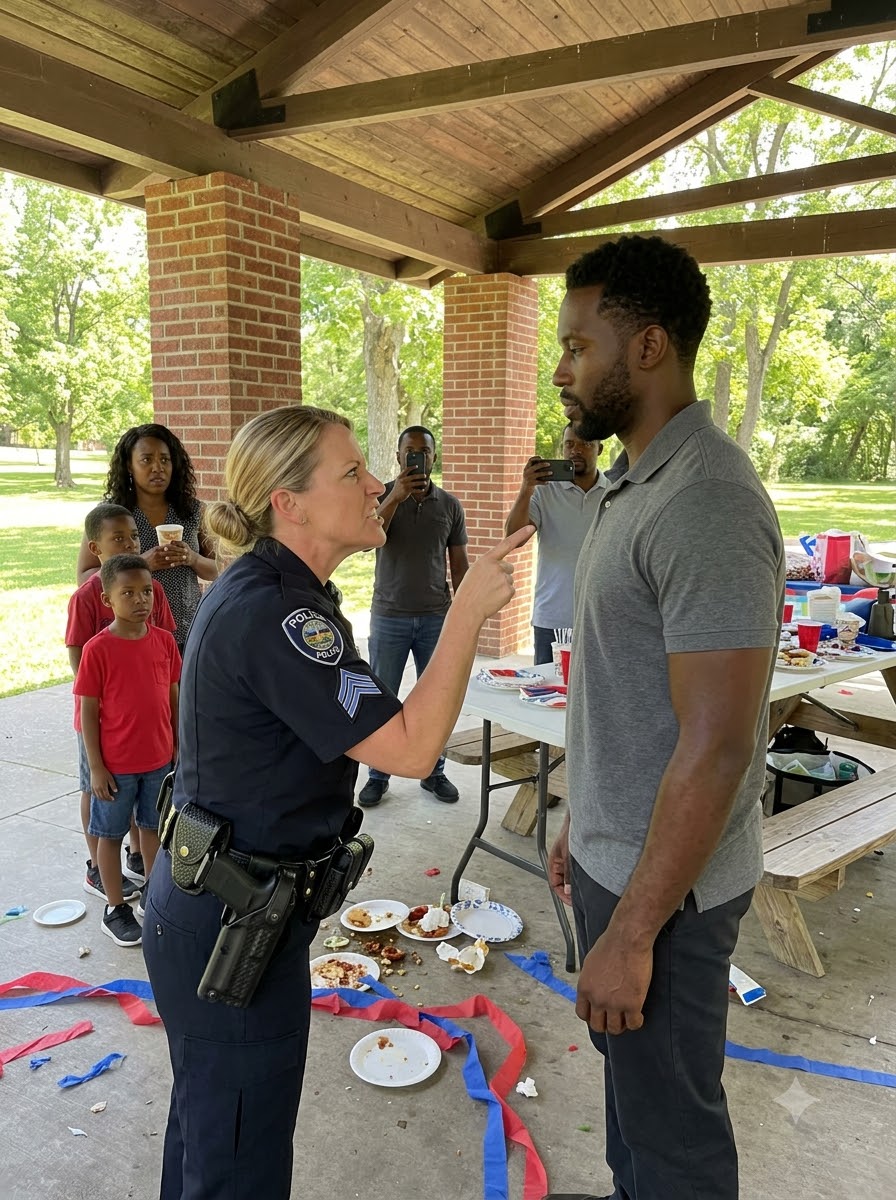
Sloan pointed toward Adrian.
“He entrapped us.”
Adrian shook his head.
“I didn’t ask you to destroy my son’s cake.”
Silence settled over the pavilion.
“I didn’t ask you to search people without cause.”
He glanced at his damaged credential case.
“I definitely didn’t ask you to step on a federal badge.”
Several people nearly laughed.
Sloan did not.
Reed placed her in handcuffs.
Price immediately spoke.
“I’ll cooperate.”
Reed looked at him.
“You’ll get that opportunity.”
Malone said nothing.
Both officers were detained.
Elijah watched as the federal agents led Sloan away.
Then he tugged at Adrian’s sleeve.
“Dad?”
Adrian turned.
The boy looked toward the badge.
“Are you really FBI?”
Adrian crouched to his height.
“Yes.”
Elijah frowned.
“But you build buildings.”
Adrian almost smiled.
“That part was a story for work.”
His son looked puzzled.
“So your real job is catching bad police?”
Adrian nodded.
“When police become criminals, yes.”
Elijah looked toward Sloan, who was being escorted away.
Then he faced his father.
“Why didn’t you tell me?”
Adrian felt the weight of the question.
He had prepared for the possibility that his identity might be exposed.
He had not prepared for how much it would hurt to see the confusion in his son’s face.
“I’ll explain everything.”
Elijah looked at the destroyed cake.
“You owe me another birthday.”
Adrian laughed.
Renee began crying.
Within an hour, video from the party appeared online.
Loretta Greene’s granddaughter had recorded the confrontation from the moment the officers entered the pavilion.
Her footage showed food being thrown onto the pavement, the birthday cake destroyed, Adrian forced onto his knees, and his FBI credentials tossed into frosting.
It captured Elijah crying.
It also captured the phone call that changed the situation.
The video spread rapidly.
Baltimore residents recognized Sloan.
Then people began sharing their own experiences.
A graduation celebration had been interrupted.
A church barbecue had been searched.
A youth fundraiser had been shut down.
Money had allegedly disappeared during traffic stops.
Individual stories multiplied into dozens, then hundreds.
That evening, the FBI issued a limited statement confirming an ongoing public-corruption investigation involving multiple Baltimore police officers.
The bureau did not identify every suspect or disclose the full scope of the case.
But Adrian’s undercover role could no longer remain secret.
The footage had already revealed it.
What the public did not yet understand was that the birthday confrontation represented only one piece of a much larger investigation.
Three days later, Adrian stood inside the Baltimore FBI field office.
An evidence wall covered nearly an entire conference room.
Photographs.
Banking records.
Surveillance maps.
Telephone logs.
Transcripts.
Monica Reed stood beside him.
“Eight months,” she said.
Adrian nodded.
“Feel worth it?”
He looked at a photograph showing Elijah’s destroyed birthday table.
“Ask me after court.”
The investigation had begun with Sloan.
It now extended far beyond her.
Federal financial analysts identified hundreds of thousands of dollars moving between narcotics organizations and police officers.
Wire recordings captured conversations about protecting certain drug dealers.
Internal messages showed officers coordinating false probable-cause statements.
Other recordings revealed that Sloan and her associates viewed neighborhood gatherings as a threat to their control.
Birthdays.
Graduations.
Church events.
Community meetings.
Anything that brought people together.
One recording captured Sloan explaining her reasoning.
“You keep people isolated, they complain alone. You let them gather, they start realizing they’re all being treated the same way.”
Investigators recognized the significance immediately.
The corruption was not limited to officers accepting money.
It also involved using police authority to maintain power through fear.
Then an officer named Miguel Santos requested a meeting.
Santos had spent fourteen years in Baltimore policing.
For the previous two years, he had secretly recorded conversations inside the department after members of Sloan’s unit beat his nephew during a traffic stop.
He arrived at the FBI office carrying a manila envelope.
Inside were memory cards, photographs, deposit records, and names.
He looked exhausted.
“I should’ve come sooner.”
Adrian sat across from him.
“Why now?”
Santos glanced toward a television showing a paused image from Elijah’s birthday.
“That kid.”
Adrian remained silent.
“I watched Sloan grab your son.”
Santos swallowed.
“My daughter is eight.”
He placed the envelope on the table.
“I’m done.”
The material he brought transformed the investigation.
Santos had recorded Sloan instructing officers on methods of intimidation.
It was not official department training.
It was private guidance on how to frighten residents without necessarily making arrests.
“Arrests create lawyers,” her voice said on one file. “Humiliation creates fear.”
Another recording described the value of embarrassing fathers in front of their children.
The purpose was to weaken the parent’s authority and change what the child believed about power.
Adrian had to leave the room after hearing it.
He could still see Elijah watching him kneel.
No eventual arrest could erase that memory.
The new evidence also pointed toward senior officials.
Deputy Chief Warren Blake appeared repeatedly in the records.
Financial investigators uncovered connections between protected drug organizations and businesses associated with people close to high-ranking officers.
Money passed through consulting companies, security contracts, real-estate partnerships, and political organizations.
The investigation expanded beyond its original targets.
Eventually, a federal grand jury returned dozens of indictments.
Sloan.
Price.
Malone.
Senior supervisors.
Several civilians.
Two prosecutors accused of helping conceal misconduct.
The case dominated local news for weeks.
Adrian disliked the publicity.
Reporters gathered outside federal buildings.
Television producers requested interviews.
Online users turned the ruined birthday cake into memes.
The image of Sloan stepping on an FBI badge circulated repeatedly.
Adrian refused most interview requests.
“My son’s trauma is not entertainment,” he told one producer.
Renee agreed.
Elijah returned to school after several days.
By then, almost everyone had heard what happened.
Classmates called him “FBI kid.”
Some were impressed.
Others asked whether his father carried weapons inside their home.
Elijah became increasingly frustrated.
“I just want people to stop asking.”
Adrian sat beside him at the kitchen table.
“I’m sorry.”
“You didn’t make the video.”
“No.”
“But you made the secret.”
Adrian looked at his son.
The boy was right.
Undercover investigations required deception, even when the purpose was lawful and important.
This time, Elijah had carried part of the cost without understanding why.
“You’re allowed to be mad at me,” Adrian said.
Elijah looked surprised.
“I am?”
“Yes.”
“Even if you caught bad cops?”
“Yes.”
The boy considered that.
“I’m mad.”
“Okay.”
“But also proud.”
Adrian smiled.
“That seems fair.”
The prosecution continued for months.
Families came forward to describe encounters with Sloan’s unit.
Loretta testified about repeated harassment.
Thomas Reed described unlawful searches.
A pastor explained how officers had disrupted a scholarship fundraiser.
A mother recalled her teenage son being humiliated during a graduation celebration.
Viewed separately, the stories had once seemed unrelated.
Presented together, they revealed a pattern.
The financial evidence was equally damaging.
Investigators traced drug-related payments into vehicles, vacations, investment properties, and luxury purchases.
Officers who had publicly mocked struggling families for supposedly relying on public money had privately enriched themselves through criminal protection schemes.
Sloan’s financial records became a major part of the prosecution.
Her salary could not account for hundreds of thousands of dollars moving through accounts linked to relatives and shell companies.
She continued denying wrongdoing.
Her attorneys alleged selective prosecution, entrapment, and political motivation.
Federal judges rejected most of those arguments.
The undercover recordings had been lawfully obtained.
The banking records existed independently.
Witnesses corroborated one another.
And the birthday-party confrontation had unfolded spontaneously before dozens of people.
Nobody had instructed Sloan to destroy Elijah’s cake.
Nobody had forced her to threaten a child.
Nobody had made her ridicule federal credentials.
She had done those things because she believed she could act without consequences.
That belief became part of the evidence against her.
Several officers pleaded guilty.
Others agreed to cooperate.
One senior supervisor resigned before being indicted.
Another attempted to destroy records, adding obstruction allegations to an already serious case.
The network that had once seemed untouchable began collapsing from within.
Nine months after Elijah’s birthday, the federal courthouse filled with families awaiting Sloan’s sentencing.
Some carried signs.
Others brought photographs.
Many simply wanted to witness the proceedings.
Elijah sat between Adrian and Renee in the front row.
He wore a small navy suit.
Inside his pocket was a folded drawing of a Spider-Man cake.
Sloan sat at the defense table.
She wore no police uniform.
She carried no badge.
She had no authority over the people in the courtroom.
When the judge invited victim statements, Adrian rose.
He approached the podium and looked directly at Sloan.
“You asked me what kind of father lets himself be humiliated in front of his child.”
Sloan stared ahead.
Adrian continued.
“I’ve thought about that question every day.”
The courtroom remained silent.
“I’m the kind of father who wanted his son to grow up in a city where a badge means service instead of fear.”
He paused.
“I’m the kind of agent who knew one angry reaction might destroy a case that could protect hundreds of families.”
Renee wiped her eyes.
Adrian glanced toward Elijah.
“But I’m also the father who has had to explain why my son watched me kneel.”
He turned back toward Sloan.
“That is the part you cannot return.”
Loretta spoke after him.
Age made her voice tremble slightly, but her words remained steady.
“You thought humiliating families would make us disappear.”
She looked toward the gallery.
“We’re all still here.”
Then Elijah asked to speak.
Prosecutors had discussed whether allowing such a young child to address the court would be appropriate.
Renee and Adrian had left the decision to their son.
He wanted to do it.
Elijah walked toward the microphone.
The stand was too high.
A clerk lowered it for him.
He looked at the judge.
Then at Sloan.
“She ruined my birthday.”
His voice was quiet.
“She broke my cake.”
He swallowed.
“She scared my mom.”
A pause followed.
“And she made my dad kneel down.”
Adrian lowered his eyes.
Elijah continued.
“But my dad wasn’t weak.”
His voice grew stronger.
“He was waiting.”
Renee began crying.
Elijah looked toward Adrian.
“He was waiting until he could stop more bad people than just the ones at my party.”
Then he turned toward the judge.
“I think police should make kids feel safe.”
Nobody spoke for several seconds after he finished.
The judge thanked him.
Sentences were imposed over the following weeks.
Sloan received a lengthy federal prison term for conspiracy, civil-rights violations, drug-related corruption, and obstruction.
Price and Malone received substantial sentences.
Several cooperating officers received shorter terms.
Senior officials faced more severe consequences where prosecutors established racketeering and organized corruption.
The city entered expanded federal oversight.
Complaint procedures changed.
Body-camera retention requirements were strengthened.
Independent review became more rigorous.
Community advocates received a formal role in oversight.
Adrian understood that none of those changes could repair public trust overnight.
Accountability was necessary.
But rebuilding trust would take much longer.
And for his family, the most important test was still ahead.
Elijah had one request for his ninth birthday.
He wanted to return to the same pavilion where everything had gone wrong.
Part 3: The Birthday They Could Not Take Away
Almost a year after the destroyed celebration, Adrian asked Elijah where he wanted to spend his ninth birthday.
He offered several alternatives.
An indoor arcade.
A science museum.
A baseball game.
Elijah rejected them.
“The park.”
Renee studied his face.
“You sure?”
“Yes.”
“Why?”
Elijah shrugged.
“Because they don’t get to keep it.”
Adrian looked at his son for a long moment.
Then he nodded.
They returned to Patterson Park.
The same pavilion.
The same relatives.
The same neighbors.
Loretta Greene brought potato salad.
Thomas Reed carried folding chairs.
Renee ordered another Spider-Man cake, even though Elijah had recently announced that superheroes were becoming “a little childish.”
Adrian bought one anyway.
Elijah laughed when he saw it.
This time, uniformed officers were present for a very different reason.
They were participating in a new community-outreach program.
Two helped carry tables.
Another inflated balloons.
One lost a basketball game to a group of teenagers.
Adrian watched carefully at first.
Years of training made that instinct difficult to suppress.
But eventually, he relaxed.
Nobody searched a purse.
Nobody demanded identification.
Nobody called the gathering suspicious.
Children ran across the grass while parents talked and laughed.
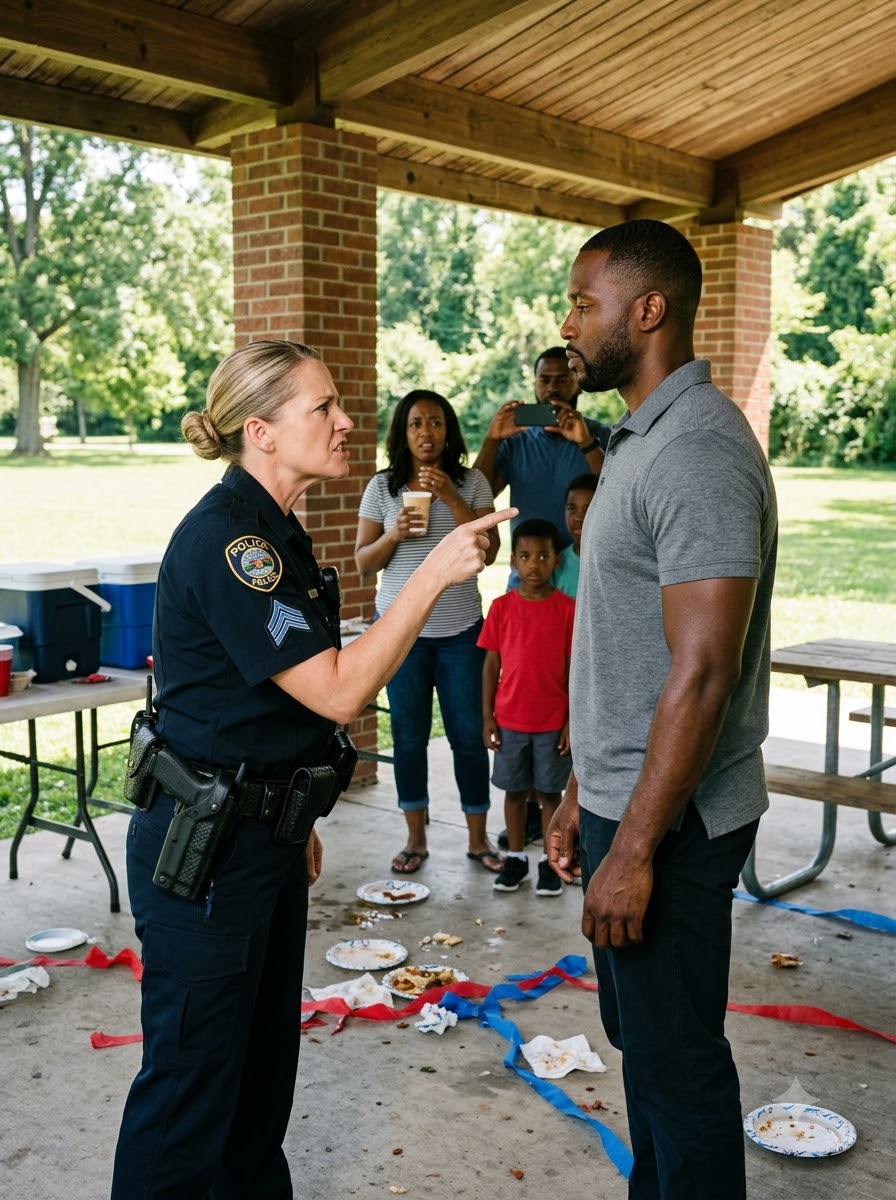
Renee walked beside Adrian.
“You scanning?”
“Maybe.”
“Agent Brooks.”
He smiled.
“Trying to stop.”
She leaned against him.
Elijah raced past carrying a soccer ball.
For a moment, Adrian remembered the eight-year-old boy from the previous year.
Frosting on his shirt.
Tears on his cheeks.
Watching his father kneel on the concrete.
Then he focused on the child in front of him.
Laughing.
Running.
Safe.
The neighborhood eventually established an annual summer celebration at Patterson Park.
Residents initially suggested naming it after Adrian.
He refused.
They proposed naming it after the FBI.
He rejected that too.
Instead, they called it Community Day.
There was food, music, children’s games, scholarship information, legal-aid booths, youth programs, and police-accountability resources.
Nothing about it was intended to be dramatic.
That was precisely what made it meaningful.
The gatherings Sloan had once tried to suppress became larger after she was removed.
Neighbors met.
Families exchanged information.
People organized and helped one another.
The community she had tried to intimidate became more connected.
Renee later helped establish a legal-support fund for families facing documented civil-rights abuses.
Loretta joined its advisory board and continued serving until her health prevented regular attendance.
Miguel Santos, whose evidence had helped expose corruption inside the department, spent years trying to address the harm he had once tolerated.
Some residents forgave him.
Others did not.
He accepted both responses.
Cooperating with investigators did not entitle him to anyone’s affection.
Adrian eventually left undercover work.
After Elijah learned the truth about his father’s occupation, maintaining another false identity felt more difficult.
He moved into public-corruption supervision and later trained younger agents.
One of his most repeated lessons concerned the human beings behind investigative records.
“Never confuse evidence with distance,” he told them.
Reports could describe suffering without making the reader feel it.
Witnessing that suffering firsthand was different.
Every case file represented real people whose lives continued long after the evidence had been collected.
Adrian understood that better than ever.
Years passed.
Elijah gradually lost interest in Spider-Man.
Then he became interested again, partly because childhood memories had begun to feel important.
He played soccer.
Disliked algebra.
Loved history.
Occasionally, classmates still mentioned the famous birthday video.
By then, Elijah had learned how to answer without allowing the incident to define him.
“That happened to me,” he would say. “It’s not everything about me.”
Adrian loved that response.
It meant more to him than any public statement issued after the arrests.
One evening, when Elijah was thirteen, he discovered Adrian’s old FBI credential case in a desk drawer.
A faint stain remained near one corner of the leather.
Chocolate frosting.
Repeated cleaning had never completely removed the mark.
Elijah held it up.
“This is the one?”
Adrian nodded.
“The one she stepped on?”
“Yes.”
Elijah examined the discoloration.
“Why didn’t you replace it?”
Adrian leaned back.
“I could have.”
“But?”
Adrian looked at the badge.
“It reminds me that authority is just an object if the person holding it forgets what it means.”
Elijah frowned.
“That sounded like something from a movie.”
Adrian laughed.
“Probably.”
His son returned the case.
Then he asked something Adrian had not expected.
“Were you scared?”
Adrian considered the question.
“Yes.”
Elijah looked surprised.
“You didn’t look scared.”
“That’s not the same thing.”
“What were you scared of?”
Adrian glanced toward the hallway, where Renee was speaking on the phone.
“That I would react too early.”
He paused.
“That they would hurt you.”
Another pause.
“That eight months of work wouldn’t be enough.”
Elijah nodded.
“Were you scared when she grabbed me?”
Adrian’s expression tightened.
“Yes.”
“More?”
“Much more.”
Elijah understood something he had not fully understood at eight.
His father had not been fearless.
He had been terrified.
But he had continued making deliberate choices despite that fear.
That was the part of the story Elijah carried into adolescence.
Not the federal SUVs.
Not the viral video.
Not the moment Sloan realized Adrian was an FBI agent.
He remembered his father waiting.
Controlling his anger.
Refusing to give corrupt officers the reaction they wanted.
Years later, journalists still contacted Adrian about the case.
Most wanted the most dramatic details.
The ruined cake.
The father forced to kneel.
The FBI badge thrown onto the pavement.
The federal vehicles arriving.
Adrian usually redirected their attention toward families whose names had never become famous.
The construction worker who lost money after repeated searches.
The teenager whose graduation celebration was interrupted.
The grandmother humiliated before her grandchildren.
The church that had to spend scholarship funds on legal expenses after police disrupted an event.
Their experiences mattered just as much.
Adrian disliked the popular version of the story in which Sloan’s greatest mistake was failing to recognize an FBI agent.
That interpretation suggested the abuse would have been less serious if Adrian had actually been a construction worker.
He believed the opposite.
Sloan had thought Adrian was an ordinary Black father.
That was precisely why she believed she could humiliate him.
She had thought Renee was an ordinary Black mother.
That was why she felt free to threaten their child.
She had looked at the families gathered beneath the pavilion and decided none of them possessed enough influence to challenge her.
Adrian’s FBI badge changed what happened afterward.
It did not change whether the conduct that came before was wrong.
He repeated that distinction when speaking to younger agents.
“If I had really been a construction worker,” he told them, “every person in that park would still have deserved the same Constitution.”
No federal position was required.
No secret authority.
No dramatic revelation.
A person’s dignity did not depend on whether they turned out to be more influential than someone had assumed.
Years later, Patterson Park looked much as it always had.
Trees shaded the pathways.
Basketball courts filled with teenagers.
Families gathered around picnic tables.
Children chased one another across the grass.
Nothing about the pavilion revealed that a birthday party there had once helped expose an extensive corruption network.
Adrian liked that.
He believed places deserved the chance to become ordinary again.
One summer afternoon, he sat beneath the pavilion while Elijah helped younger children decorate for Community Day.
A small boy struggled to untangle a string of blue lights.
Elijah approached him.
“Need help?”
The boy nodded.
Together, they separated the tangled wires.
Adrian watched from a nearby table.
Renee sat beside him.
“You’re scanning again.”
“A little.”
She smiled.
“Still working on it?”
“Always.”
Across the grass, a uniformed officer helped an elderly man carry a cooler.
The children barely noticed.
That ordinary moment meant more to Adrian than the dramatic federal response years earlier.
He had come to understand the difference between accountability and justice.
Accountability was corrupt officers being arrested, prosecuted, and punished.
It mattered.
It was necessary.
But justice also concerned what people were able to do afterward.
Celebrate without fear.
Gather without intimidation.
Question authority without expecting retaliation.
Raise children who did not automatically associate police uniforms with humiliation.
Build institutions that made future abuse harder to conceal.
And refuse to allow one terrible afternoon to define a public place forever.
Elijah’s eighth birthday had been ruined.
Nothing could change that.
The original cake was gone.
The presents had been damaged.
The fear had been real.
Adrian could not erase the memory of his son watching him kneel.
But that afternoon had also brought the investigation into public view.
Families who had believed their experiences were isolated began recognizing the same patterns.
Officers who considered themselves untouchable were forced to confront the consequences of their actions.
And a community that had been deliberately intimidated found new reasons to stand together.
Years later, Elijah asked Adrian whether he wished he had revealed his FBI badge sooner.
Adrian thought for a long time.
“Yes and no.”
Elijah frowned.
“That’s not an answer.”
Adrian smiled.
“As your father, yes.”
“And as FBI?”
“No.”
Elijah nodded.
“Because the case?”
“Because if I had revealed myself the second she arrived, people would have said the problem was one rude officer making a mistake.”
Adrian looked at his son.
“What happened afterward showed exactly who they were when they believed nobody powerful was watching.”
Elijah was quiet.
Then he understood.
The badge had not created the truth.
It had only changed who had enough power to force everyone else to acknowledge it.
That was why Adrian kept the stained credential case.
Why he preserved one photograph of the destroyed birthday party.
Why he remembered the faces of the families who had stood beneath the pavilion.
And why he continued correcting anyone who told the story as a tale about a corrupt lieutenant accidentally targeting the wrong man.
“No,” he would say.
“She targeted exactly the kind of man she thought she could get away with targeting.”
Then he would tell them about Elijah.
The birthday cake.
The terrified children.
The unlawful searches.
The recordings.
The families who had complained for years.
The residents who suffered before an FBI agent ever entered the neighborhood undercover.
Because justice did not begin when Margaret Sloan finally realized Adrian Brooks was important.
It began with the truth she had refused to recognize.
He did not need to be important.
Neither did Renee.
Neither did Elijah.
Neither did any family gathered at that birthday party.
They were people.
And that should have been enough.
