

Part 1: Handcuffed Outside His Own Home
“Sir, I live here.”
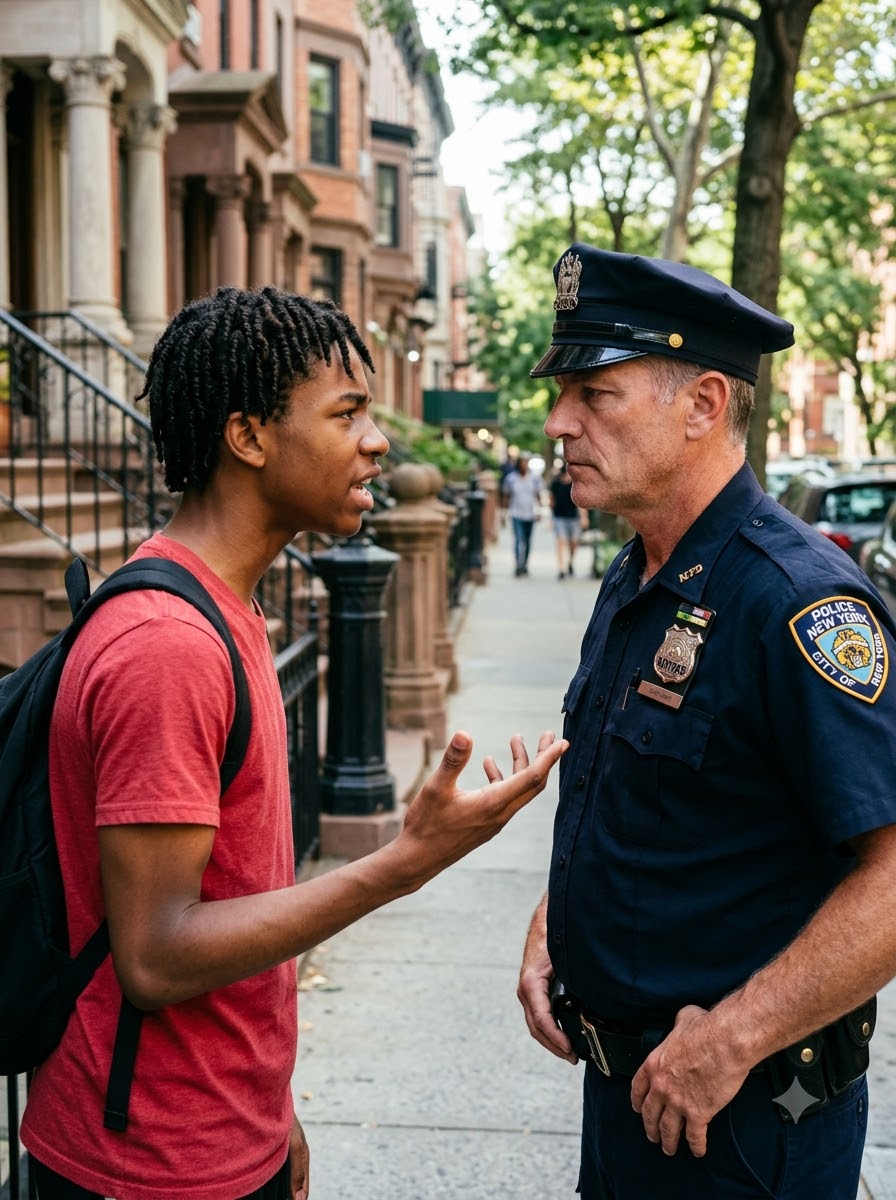
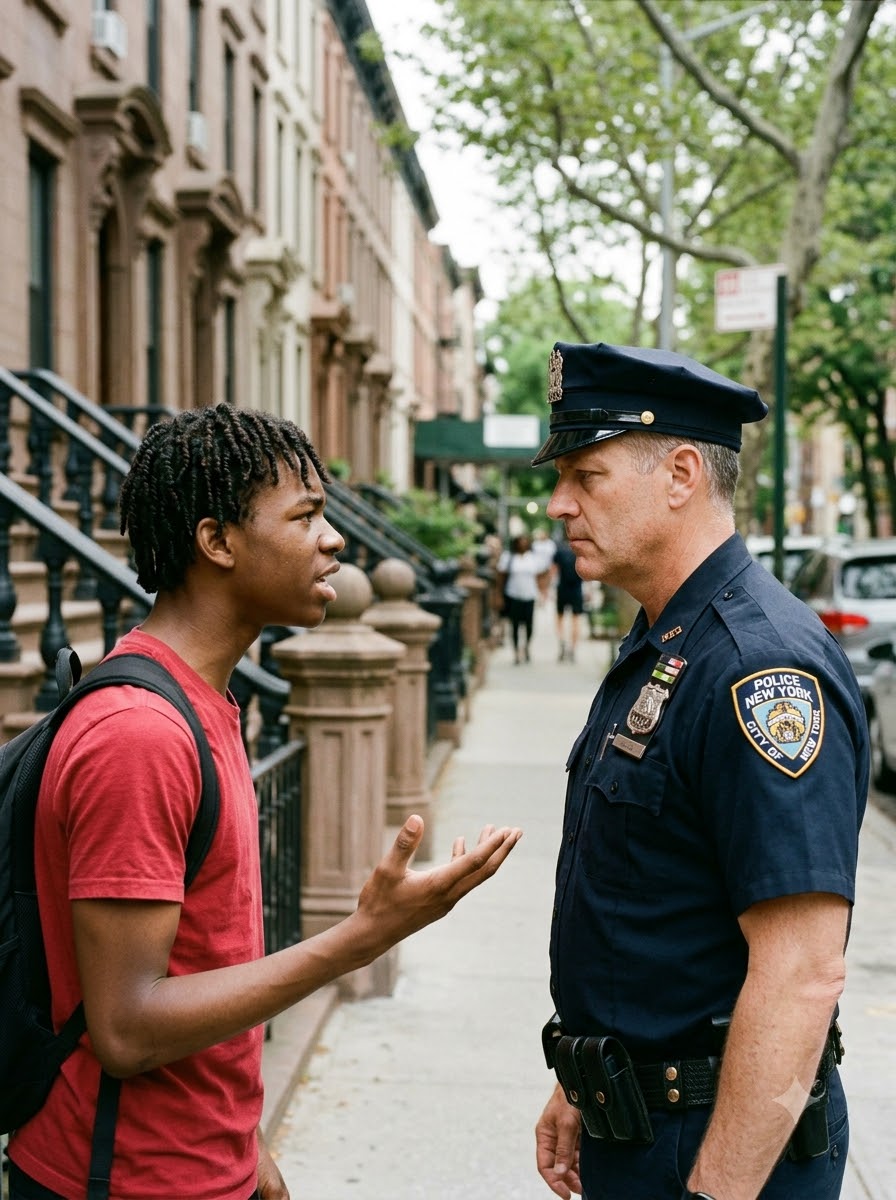
Sixteen-year-old Jordan Ellis struggled to keep his voice from trembling as Officer Victor Hale seized the front of his red T-shirt and forced him against the iron railing outside a Brooklyn brownstone.
Jordan’s black backpack pressed painfully into his shoulders. The rough stone scraped against him, and the short twists in his hair shook each time Hale pushed him harder.
“Stop lying to me,” the officer snapped. “Kids like you come through neighborhoods like this every day looking for something to steal.”
Jordan looked desperately toward the entrance of 226 Carlton Terrace.
It was his home.
He had lived there since he was seven years old. His basketball shoes were drying beside the basement steps. His mother’s yellow flowers filled the upstairs window box. A faded Yankees sticker, which he had placed on the mailbox when he was eleven, remained crooked beneath the house number.
His bicycle was chained to the very railing against which the officer was holding him.
But Hale seemed determined not to notice any of it.
“I told you this is my house,” Jordan said. “My keys are in my pocket, and my mother works for your department.”
Hale laughed.
“Perfect, then maybe she can explain why I found her son casing brownstones.”
Across the street, a grocery delivery driver stood motionless beside his van, two paper bags forgotten on the hood. Near the corner, a woman walking a small white terrier watched anxiously. Another pedestrian had already taken out a phone.
Jordan felt Hale’s knuckles digging into his chest.
He had been frightened from the moment the officer approached him. Now humiliation and anger were beginning to overwhelm that fear.
And all he had done was walk home.
Earlier that afternoon, Jordan had returned from summer tutoring and discovered that his algebra folder was missing.
He remembered leaving it in his locker at Franklin Academy.
After dropping his backpack on the kitchen chair, he had hurried back toward school, only to remember halfway there that the summer office closed early on Fridays.
He turned around, stopped at a deli for a blue sports drink, and continued toward Carlton Terrace with one earbud in.
It should have been an ordinary walk.
Three houses from his own, seventy-year-old Margaret Collins was watering the flowers on her front steps.
Margaret had recently joined a neighborhood safety committee after several packages disappeared from local porches. She had begun watching strangers more closely, convinced that being vigilant meant questioning anyone she did not immediately recognize.
She saw Jordan glance toward two houses while checking a message on his phone.
She noticed his backpack.
She noticed his red shirt.
But she failed to recognize a boy who had walked along the same block for years.
Margaret called the police non-emergency number and reported a teenager who appeared to be examining houses.
The dispatcher asked whether he had entered a yard, touched a door, damaged anything, or taken property.
Margaret admitted he had done none of those things.
Her entire description was a Black teenage boy wearing a red shirt and carrying a dark backpack.
Officer Victor Hale received the call less than five minutes away.
Nineteen years in the department had given Hale a reputation that depended heavily on whom someone asked. Certain colleagues described him as experienced, decisive, and traditional.
Others privately considered him a man who mistook suspicion for evidence and regarded ordinary questions as personal challenges.
He reached Carlton Terrace before dispatch had finished repeating the caller’s limited information.
When Hale spotted Jordan approaching number 226, he accelerated toward the curb and stopped abruptly.
“Hey, red shirt, stop right there.”
Jordan pulled out his earbud.
“Me?”
Hale slammed the cruiser door.
“Hands where I can see them.”
Jordan raised his hands to chest height.
“What happened?”
Hale approached, examining the backpack before glancing at the brownstone.
“Where are you coming from?”
“The deli.”
“Which one?”
“Martin’s Market on Bergen.”
“And where are you going?”
Jordan pointed toward the house.
“Home.”
Hale followed the direction of his finger.
“That house?”
“Yeah.”
“You live there?”
“Since I was seven.”
The officer examined the polished doorway, renovated exterior, and carefully maintained flower boxes.
Then he looked back at Jordan.
“Don’t lie to me.”
Jordan stared in confusion.
“I’m not lying.”
Hale stepped closer.
“We have a burglary complaint.”
Jordan glanced along the street.
“I didn’t burglarize anything.”
He slowly reached for his phone.
“I can call my mom.”
Before he could unlock it, Hale struck the phone from his hand.
It bounced across the pavement and landed near the bottom step.
“Did I tell you to reach into your pocket?”
Jordan froze.
“I told you what I was doing.”
Hale grabbed his backpack strap.
“Turn around.”
“Why?”
“Because I said so.”
Jordan instinctively moved one step backward toward his front door.
He was not trying to escape. He simply wanted distance from the furious officer standing inches away.
Hale treated the movement as resistance.
He grabbed Jordan’s shirt and slammed him against the railing.
“I live here,” Jordan repeated. “My house key is in my right pocket.”
Hale ignored him.
“Look at the mailbox.”
The officer tightened his grip.
“My last name is on mail inside.”
Still nothing.
“Press the doorbell.”
Hale refused.
His body camera captured every word.
It recorded Jordan offering several simple ways to verify his address. It also recorded the officer rejecting each possibility while continuing to treat the teenager as a suspect.
“I’m sixteen,” Jordan explained when Hale demanded identification. “I don’t carry a driver’s license.”
Hale asked whether he had a school ID.
“In my backpack.”
Hale pulled the bag from Jordan’s shoulders and opened it.
Instead of examining the contents carefully, he turned it upside down.
A geometry textbook, calculator, pencils, notebook, charger, water bottle, granola wrapper, and Franklin Academy student identification card spilled onto the sidewalk.
A pencil rolled beneath the patrol cruiser.
Jordan stared at his scattered belongings.
“You didn’t have to dump everything.”
Hale picked up the student card.
The photograph matched the boy standing in front of him.
The name read Jordan Michael Ellis.
“Doesn’t prove you live here,” Hale said.
Jordan looked at him in disbelief.
“My key does.”
“Keys get stolen.”
“Then ring the bell.”
Again, Hale refused.
The doorbell at 226 Carlton Terrace was connected directly to Jordan’s mother’s phone.
At that moment, Lieutenant Alicia Ellis was sitting in an office less than three miles away, reviewing field-training evaluations.
One press would have alerted her.
One press could have verified the boy’s identity.
One press might have prevented everything that followed.
But Hale never touched the bell.
A second police cruiser arrived.
Officer Daniel Ortiz, thirty years old and six years into his career, stepped onto the sidewalk.
He noticed the school supplies scattered around Jordan’s feet.
Then he saw the teenager being held against the railing.
“What do we have?” Ortiz asked.
“Possible burglary suspect, keeps lying about living here.”
“I’m not lying,” Jordan protested.
Hale pushed him harder.
“Be quiet.”
Ortiz glanced at the building number.
“Did we confirm the residence?”
Hale frowned.
“I’m handling the stop.”
Ortiz crouched and retrieved the student card.
“Jordan Ellis?”
Jordan nodded.
“Ellis?”
“My mom is Lieutenant Alicia Ellis.”
Ortiz’s expression changed.
“You mean Lieutenant Ellis from the Seventy-Ninth?”
Jordan nodded again.
“Professional standards and field training.”
Hale laughed.
“Sure she is.”
But Ortiz was no longer smiling.
Alicia Ellis was respected throughout several Brooklyn precincts.
She had spent twenty-three years in the department, including twelve in patrol, before moving into supervision and professional standards.
Her reputation was straightforward: she defended officers when the evidence justified their conduct and held them accountable when it did not.
Ortiz turned toward Hale.
“Vic, we should verify this.”
“You nervous because the kid knows a name?”
“I’m saying we should verify an address before we put cuffs on somebody for standing outside it.”
Jordan felt a flicker of hope.
Hale looked furious.
“You supervising my stop now?”
“I’m trying to stop this from becoming something it doesn’t need to become.”
The warning only angered Hale further.
He pulled Jordan away from the railing and twisted his left arm behind his back.
Jordan panicked.
“Wait, what am I under arrest for?”
“Obstruction.”
“What did I obstruct?”
Hale forced his wrist higher.
“Stop moving.”
Jordan’s voice cracked.
“I’m not moving.”
The first handcuff snapped shut.
Ortiz stepped forward.
“Hale, hold on.”
Hale ignored him and secured the second cuff.
Jordan stood restrained on his own sidewalk, surrounded by the school supplies the officer had thrown from his bag.
Then a woman spoke from the neighboring stoop.
“He lives there.”
Everyone turned.
Grace Monroe stood holding the leash of her small white terrier.
She had lived next door for twelve years and remembered Jordan as a little boy carrying a superhero lunchbox.
“That is Alicia’s son,” she said.
Hale pointed at her.
“Ma’am, stay back.”
Grace gave a disbelieving laugh.
“You’re handcuffing a child at his own front door.”
Hale ordered her not to interfere.
She refused to leave.
“Press the doorbell.”
The officer looked away.
Across the street, the delivery driver continued filming. Another neighbor raised a phone.
Ortiz finally used his radio.
“Dispatch, can you run resident information on 226 Carlton Terrace?”
Hale turned sharply.
“Daniel.”
Ortiz transmitted the request anyway.
Several seconds passed.
Then dispatch answered.
“Occupant records show Alicia Ellis and dependent Jordan Ellis at that address.”
Jordan closed his eyes.
“Thank you,” he whispered.
Ortiz looked toward Hale.
“Take them off.”
But Hale refused.
Instead, he changed his accusation.
“Address doesn’t mean he wasn’t checking the other houses.”
Jordan stared.
“You said I was lying about living here.”
“Watch the attitude.”
Jordan gave a short, incredulous laugh.
“You just keep changing what I did.”
Three phones captured his words.
Ortiz stepped between them.
“What actual behavior are you investigating now?”
“Suspicious activity.”
“What activity?”
Jordan answered before Hale could.
“Walking home?”
Hale spun toward him.
“One more comment and I’ll add disorderly conduct.”
Ortiz stared at the older officer.
“Don’t.”
“What?”
“Don’t create a charge because he questioned you.”
For a moment, neither officer moved.
Then Ortiz’s radio crackled.
“Unit 512, precinct supervisor wants your exact location immediately.”
Ortiz responded.
“Carlton Terrace at Dean.”
A pause followed.
Then the dispatcher said:
“Lieutenant Ellis is responding.”
Jordan watched the color change in Hale’s face.
Minutes earlier, the officer had laughed at the possibility that his mother worked for the department.
Now he kept glancing toward the intersection.
Three minutes later, an unmarked department sedan pulled up.
Lieutenant Alicia Ellis stepped out.
She was forty-seven, with natural curls pulled back, wearing a navy blouse, dark slacks, and department credentials clipped to her waist.
She looked toward the officers.
Then she saw Jordan.
Her son was standing in handcuffs outside their home.
His backpack lay open.
His school supplies covered the sidewalk.
Red marks were beginning to appear around his wrists.
For one terrible second, Alicia nearly lost the composure she had spent twenty-three years developing.
“Jordan.”
He turned.
“Mom.”
She stopped several feet away.
Everything inside her wanted to run to him.
But she knew the scene needed to be secured, the evidence preserved, and the officers separated from the boy before she could allow herself to react as his mother.
“Who placed him in restraints?”
Hale stepped forward.
“I did, Lieutenant. We had a possible burglary call.”
Alicia looked at him.
“Was he identified?”
Hale hesitated.
Ortiz answered.
“Yes, Lieutenant.”
“Address verified?”
“Yes.”
“Independent witness?”
“Yes.”
Alicia turned back toward Hale.
“Then why is he still handcuffed?”
And suddenly, the officer who had demanded that Jordan prove he belonged at his own home had to explain why he was still holding him prisoner after the proof was undeniable.
Part 2: The Badge That Changed Everything
Officer Victor Hale shifted his weight as Lieutenant Alicia Ellis waited for an answer.
“He became verbally confrontational.”
Jordan stared at his mother.
“I kept telling him I live here.”
Alicia looked toward her son.
“Did you hit anyone, push anyone, or physically try to run?”
“No.”
Hale interrupted.
“He stepped away when I grabbed him.”
Alicia turned back toward the officer.
“Before or after you had established legal grounds for detention?”
Hale said nothing.
She looked toward Ortiz.
“Both cameras active?”
“Yes.”
“Good.”
Then she faced Hale.
“Remove the cuffs.”
This time, he complied.
As soon as the restraints came off, Jordan began rubbing his wrists.
Alicia noticed the red marks.
She felt another wave of anger but kept her voice controlled.
“Jordan, go stand beside Ms. Monroe.”
“Mom.”
“Please.”
Jordan obeyed.
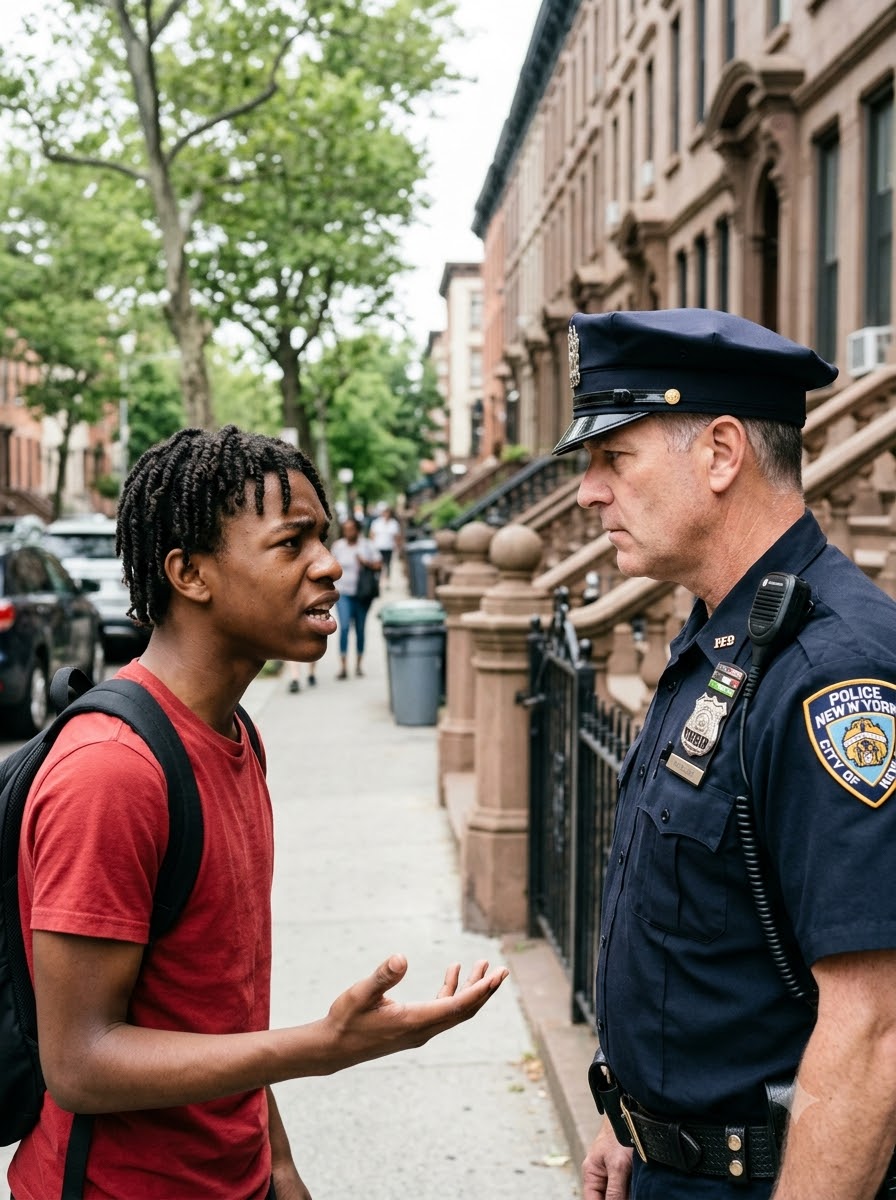
Only after he was safely away from Hale did Alicia address the officer again.
“Do not explain this case to me.”
Hale looked surprised.
“Lieutenant, you need to understand why—”
“No.”
Her voice remained calm.
“I am his mother, which makes me the least appropriate supervisor in Brooklyn to determine whether you violated policy.”
For a moment, Hale appeared relieved.
Perhaps he believed Alicia had just removed herself from the situation entirely.
Then she continued.
“So the body camera, dispatch recordings, witness video, Officer Ortiz’s camera, and an independent command will determine it.”
His relief vanished.
Alicia contacted the duty inspector and requested preservation of every recording.
She called for an independent review because the incident involved a juvenile, physical restraint, disputed legal grounds, and possible biased policing.
She also requested that Hale be removed from field duty while the preliminary assessment proceeded.
Hale’s face reddened.
“You’re pulling me off the street because that’s your son?”
“No.”
Alicia pointed toward Jordan.
“You should be worried about how you treated him before you knew whose son he was.”
Nobody answered.
Hale insisted there had been a legitimate suspicious-person call.
Alicia agreed that such a call could be investigated.
“Then you investigate it legitimately.”
He claimed that was exactly what he had done.
Alicia gestured toward the brownstone.
“He told you he lived here.”
“People lie.”
“A neighbor confirmed him.”
“Neighbors cover for each other.”
“Dispatch confirmed the household record.”
Hale fell silent.
Alicia looked directly at him.
“At what point does evidence become more important than your first assumption?”
He had no answer.
The following morning, Alicia formally removed herself from all disciplinary decisions, interviews, evidence evaluations, and charging recommendations.
She refused to give Hale any opportunity to claim that an angry mother had controlled the investigation.
An external professional standards team from another borough command took responsibility.
Investigators secured both officers’ body-camera recordings before either returned to a precinct terminal.
They also collected the dispatch audio, doorbell records, neighborhood security footage, the delivery driver’s video, and Margaret Collins’s original call.
The recordings told a remarkably consistent story.
Jordan had never threatened Hale.
He had not tried to run.
He had repeatedly offered his house key, mailbox, doorbell, and mother as ways to confirm his identity.
Hale had ignored every suggestion.
Even after obtaining the student card, he simply demanded another form of proof.
Investigators noticed something particularly disturbing.
Each time Jordan successfully answered a question, Hale became more hostile.
The facts were moving toward innocence.
The officer’s behavior was moving toward punishment.
Ortiz’s body camera provided another angle.
It showed Jordan’s textbooks scattered across the sidewalk, the school identification card, Grace Monroe confirming his residence, and Hale refusing to release the teenager after dispatch verified his address.
The investigation then turned to Margaret Collins.
She had never reported an actual burglary.
She had not claimed Jordan touched a door, entered a yard, or took anything.
Her complaint had concerned a teenager looking around.
During her interview, Margaret appeared ashamed.
“I thought he was checking houses,” she said.
The investigator asked what she had actually witnessed.
“He looked toward some doors.”
“Anything else?”
“No.”
Then came the question Margaret struggled to answer.
“Had you seen Jordan before?”
“I think so.”
The investigator asked why she had considered him suspicious.
After several seconds, Margaret admitted:
“He just looked like he didn’t belong there.”
Her exact words were preserved in the report.
Investigators began examining Hale’s disciplinary history.
During the previous seven years, thirteen complaints had been filed concerning his treatment of Black or Latino teenagers.
Nine had been classified as unfounded or unsubstantiated.
The external team reopened the recordings.
What they discovered made Jordan’s experience look less like an isolated incident and more like part of an established pattern.
In one case, a seventeen-year-old Black student had been stopped outside his grandmother’s townhouse because Hale believed he “appeared inconsistent with the residence.”
The grandmother confirmed the teenager’s identity within minutes.
Hale nevertheless detained him for almost half an hour.
Another case involved a Latino teenager walking an expensive bicycle through a neighborhood of renovated houses.
Hale suspected the bicycle was stolen.
The teenager showed him a digital purchase receipt.
The bicycle belonged to him.
In another encounter, Hale described a sixteen-year-old as “furtive” after the boy reached into his pocket.
The officer’s own camera revealed that Hale had ordered him to retrieve identification moments earlier.
That complaint had also been closed.
The same pattern appeared repeatedly.
Questions became “argumentative behavior.”
Fear became “evasive conduct.”
Requests for explanations became “refusal to comply.”
And when an original suspicion could no longer be supported, Hale frequently introduced another reason to prolong the encounter.
Six weeks later, Alicia received the completed investigative report.
She waited until the precinct had emptied before opening it.
The document exceeded two hundred pages.
She read every word.
Jordan’s case occupied only part of it.
The remaining pages described children whose parents had no influence inside police headquarters.
Teenagers whose families had complained, only to be told that the recordings showed no misconduct.
Young people who had been treated as suspicious because they appeared out of place in neighborhoods where they had every right to be.
When Alicia reached the final page, she closed the report and sat silently.
Her son’s experience had opened an investigation.
What that investigation uncovered frightened her even more.
Jordan was not the first.
He was simply the boy whose mother understood which records to demand before they disappeared into ordinary bureaucracy.
Hale was brought before a formal disciplinary hearing.
The department sustained allegations of improper detention, unjustified restraints, inadequate investigation, inaccurate reporting, and repeated violations of bias-free policing requirements.
His attorney argued that Hale had reasonably responded to a neighborhood burglary concern.
Investigators played the original dispatch recording.
No burglary had been reported.
Hale claimed Jordan repeatedly attempted to flee.
The body camera showed one backward step toward his own doorway.
He claimed the teenager became aggressive.
The recording showed Jordan frightened and repeatedly asking why he was being detained.
The hearing board terminated Hale.
A supervisor who had approved several questionable complaint closures was reassigned and later disciplined for inadequate review.
Other previously closed cases were reopened for civil evaluation.
Ortiz was offered recognition by a community organization for eventually intervening.
He declined.
“I spoke too late,” he said.
Months later, he asked Alicia for a private conversation.
They met in a small training office after shift change.
“I should’ve stopped him sooner.”
Alicia looked at him.
“You eventually did.”
Ortiz shook his head.
“Not when I first knew.”
She waited.
“I knew the moment I saw the kid’s school stuff everywhere that something was off.”
He looked down.
“I knew again when Jordan gave your name.”
Alicia nodded.
“And I still worried about embarrassing a senior officer more than I worried about the kid he had against the wall.”
Alicia remained silent before answering.
“Remember that exact moment.”
Ortiz looked up.
“The moment you know another officer is wrong, but you haven’t spoken yet.”
She leaned forward.
“That is where department culture actually lives.”
Ortiz carried those words with him.
Jordan returned to school after two weeks.
By then, videos of the incident had spread across Brooklyn and social media.
For several days, classmates treated him like a celebrity.
Jordan hated the attention.
Students repeatedly asked whether his mother had gotten Hale fired.
He corrected them.
“The video got him fired.”
Eventually, his classmates moved on.
Jordan could not.
For months, he tensed whenever a patrol cruiser slowed nearby.
He stopped wearing both earbuds outside.
When officers entered a deli for coffee, he instinctively kept his hands visible.
Alicia noticed every change.
One evening, she found him sitting on the front steps, turning his damaged phone case over in his hands.
She sat beside him.
For several minutes, neither spoke.
Then Jordan asked:
“What if you weren’t a lieutenant?”
Alicia looked at him.
“What if you worked at a hospital?”
He paused.
“Or a grocery store?”
She understood what he was asking.
“The cuffs still should have come off.”
Jordan lowered his eyes.
“That’s not what I asked.”
Alicia had no immediate answer.
“What if I told him my mom was nobody he knew?”
He looked toward the street.
“Would Ortiz have looked scared when I said your name?”
Alicia stared down Carlton Terrace.
“I don’t know.”
Jordan nodded.
“That’s what bothers me.”
His voice grew quieter.
“He stopped treating me like I was definitely lying only after he realized somebody important might show up.”
Alicia rested a hand on his shoulder.
“It bothers me too.”
Jordan looked toward her.
“Is that normal?”
Alicia considered her response carefully.
“It should never become normal.”
“That isn’t the same answer.”
“No. It isn’t.”
Before the end of the year, the department introduced several reforms.
Suspicious-person calls involving juveniles could no longer be escalated solely because someone claimed a child “didn’t belong” or “looked suspicious.”
Dispatchers had to document specific behavior.
Detentions based on vague neighborhood complaints became subject to supervisory review.
Repeated allegations against the same officer triggered outside audits after a defined threshold.
Investigators could no longer close body-camera complaints as unfounded without documenting a review of the full encounter.
Alicia advocated particularly strongly for one requirement.
When a young person told an officer, I live here, the officer had to make a reasonable attempt to verify that statement before treating it as deception, unless immediate safety conditions made verification impossible.
Keys, doorbells, neighbors, household occupants, dispatch records, and address databases could all provide confirmation.
Some officers complained that the new requirement interfered with patrol discretion.
Alicia responded by playing Hale’s body-camera footage during training.
Jordan’s voice filled the room.
“My key is in my pocket.”
Then:
“Look at the mailbox.”
Then:
“Ring the bell.”
Then:
“Call my mom.”
Alicia paused the recording.
“He gave four verification options before another officer even arrived.”
No one objected afterward.
But although the department was changing, Jordan still had to live with what had happened.
He had been restrained outside the place where he was supposed to feel safest.
And the question he had asked his mother remained unanswered:
What would have happened if she had not been a lieutenant?
Part 3: The Truth That Should Have Been Enough
Jordan never developed the interest in police reform that strangers expected him to have.
People assumed that after his experience, he would want to become a lawyer, an activist, or perhaps a police officer determined to change the system.
He wanted none of those careers.
He wanted to design buildings.
He loved geometry, architecture, and the way Brooklyn neighborhoods could change while still preserving reminders of the families who had lived there for generations.
He began filling a notebook with drawings of brownstone facades.
One drawing depicted 226 Carlton Terrace.
The iron railing.
The upstairs window box.
His bicycle.
The faded Yankees sticker beneath the mailbox number.
But he deliberately left out the patrol cruiser.
When Alicia noticed, she asked why.
Jordan shrugged.
“That’s not what I want the house to mean.”
She understood immediately.
A year after the incident, Jordan walked home on a warm afternoon with a basketball tucked beneath his arm.
He happened to be wearing another red shirt.
A patrol cruiser slowed beside him.
His body tightened before he even recognized the driver.
The window lowered.
Officer Ortiz looked out.
“Jordan.”
“Hey.”
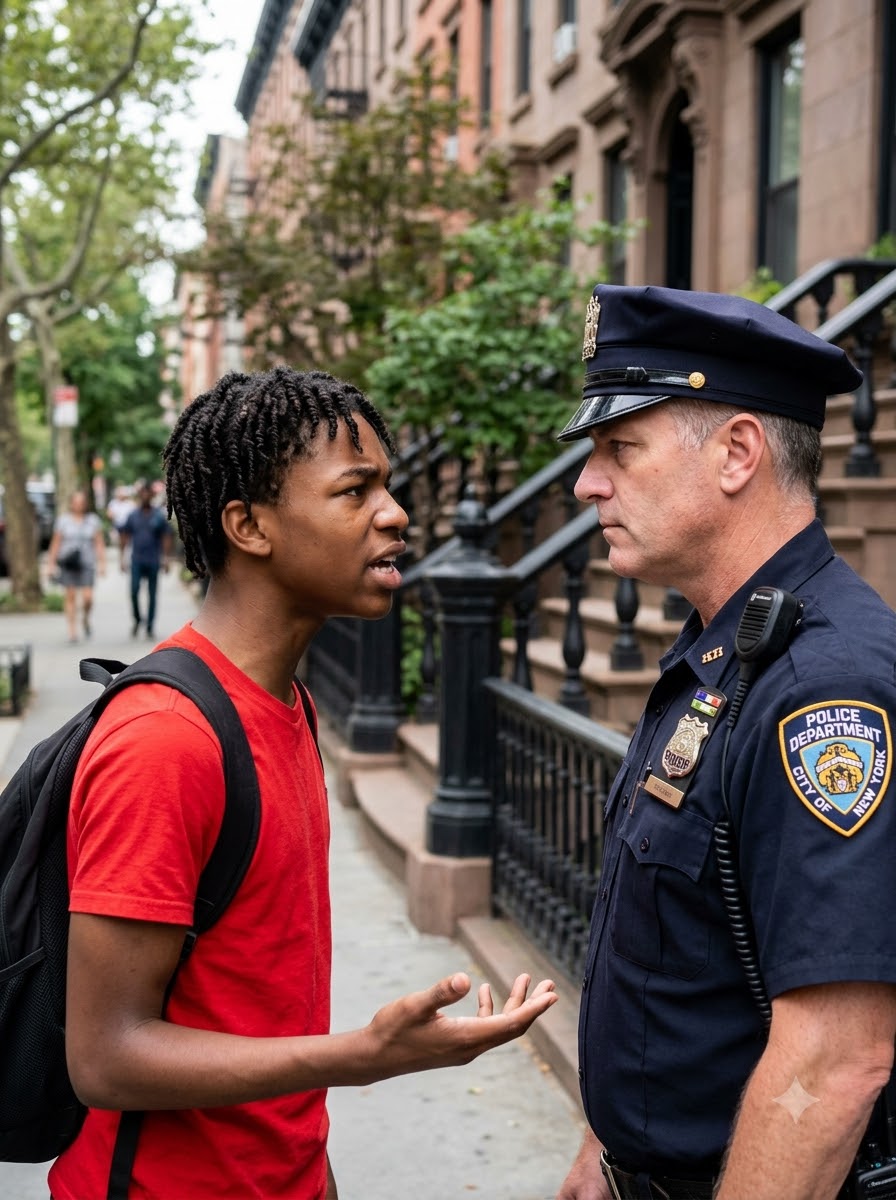
Ortiz nodded toward the basketball.
“Franklin win?”
Jordan smiled slightly.
“By nine.”
“How many you score?”
“Twenty-one.”
Ortiz looked impressed.
“Not bad.”
Jordan raised an eyebrow.
“Not bad?”
Ortiz laughed.
“Fine. Outstanding performance, Mr. Ellis.”
Jordan smiled.
Ortiz raised a hand and drove away.
There was no demand for identification.
No interrogation about his destination.
No question about whether he belonged in the neighborhood.
Jordan walked the remaining half-block, climbed his steps, unlocked the door, and went inside.
Across the street, Alicia had just returned from work in her unmarked sedan.
She witnessed the entire exchange.
She remained in the car for another minute.
That ordinary interaction meant more to her than the disciplinary decision that had ended Hale’s career.
Her son had encountered a police officer, and nothing had needed to become a police incident.
Years later, Jordan would remember less about Hale’s face than people expected.
He remembered the railing pressing against his back.
His calculator lying upside down on the sidewalk.
Grace Monroe shouting that he lived there.
Most clearly, he remembered the moment Hale learned dispatch had confirmed his address and still refused to remove the handcuffs.
That moment taught Jordan something painful about being believed.
Facts did not always prevail immediately simply because they were true.
Sometimes they first had to overcome a conclusion that someone with greater authority had already decided to accept.
Alicia carried a different lesson.
For much of her career, she had believed misconduct was mainly the result of individual officers making poor choices.
Jordan’s case showed her how institutions could allow those choices to survive by treating each complaint separately.
One teenager questioned outside his grandmother’s house might be called a misunderstanding.
One expensive bicycle suspected of being stolen might be described as caution.
One mother claiming her son had been treated unfairly might be dismissed as emotional.
But when the incidents were examined together, the pattern became impossible to ignore.
“Patterns lived between files.”
That became one of Alicia’s most frequently repeated lessons during supervisor training.
“You cannot identify a pattern if every complaint is locked in a different drawer.”
The department introduced review systems that compared complaints across precincts.
Software flagged recurring categories, locations, age groups, and officers.
Allegations involving juveniles could be examined collectively instead of disappearing inside separate files.
The reforms were not miraculous.
Officers still made mistakes.
Some complaints could not be substantiated.
Bias did not vanish because new policies existed.
But repeated conduct became more difficult to conceal.
Margaret Collins eventually visited the Ellis brownstone.
She stood outside carrying a small bakery box, looking deeply uncomfortable.
Jordan answered the door.
Alicia remained in the hallway, allowing her son to decide whether he wanted the conversation.
“I wanted to apologize,” Margaret said.
Jordan looked at the box.
“For calling the police?”
Margaret nodded.
“I thought I was protecting the block.”
Jordan looked at her.
“From me?”
She swallowed.
“I didn’t know you lived here.”
He remained quiet.
“That’s kind of the problem.”
Margaret lowered her eyes.
“I know.”
Jordan considered closing the door.
Instead, he asked the question he had been carrying for months.
“If you saw a white kid with a backpack looking at houses, would you have called?”
Margaret’s eyes filled.
“I don’t know.”
Jordan nodded.
“At least that’s honest.”
He accepted the bakery box.
They did not become close afterward.
Jordan did not need them to.
Her apology could not undo what had happened, but it forced her to confront the assumption that started it.
Margaret later resigned from the neighborhood safety committee.
Several months afterward, she returned on one condition: reports about suspicious people had to describe actual conduct rather than a feeling.
The committee adopted the rule.
Alicia found that quietly encouraging.
The city eventually settled a civil claim brought on Jordan’s behalf.
Alicia insisted that the compensation be placed into a protected education account rather than turned into a public spectacle.
Jordan joked that if the city wanted to help pay for architecture school, he would not complain.
But he also wanted the settlement to include training requirements.
His attorney asked why.
Jordan answered:
“Money helps me.”
He paused.
“Training might help the next kid.”
Alicia heard about his answer afterward.
She did not tell him how proud she was.
By Jordan’s senior year, most students had forgotten the details of his arrest.
Newer classmates had never seen the video.
Jordan preferred it that way.
He applied to architecture programs and wrote his college admissions essay about brownstones.
Not about police.
Not about handcuffs.
About home.
He described how buildings preserve memories.
A worn banister remembers the hands that held it.
A scratched doorway remembers furniture being carried inside.
A crooked sticker on a mailbox remembers a child growing up.
He wrote that home was partly made of ordinary details that revealed belonging to anyone willing to notice them.
Alicia cried while reading the essay.
Jordan pretended not to notice.
“It’s just an essay.”
She wiped her eyes.
“It’s a good essay.”
Jordan smiled.
“Better be. Application fee was ninety bucks.”
The following fall, he left Brooklyn for college.
On move-in day, Alicia drove him to campus and spent an hour trying not to worry about every possible danger he might encounter away from home.
Jordan carried boxes upstairs and reminded her that millions of students survived dormitory life every year.
Before leaving, Alicia gave him a spare key attached to the same ring that had once held the brownstone key Hale refused to consider.
Jordan recognized it immediately.
“You kept this?”
Alicia nodded.
“It was evidence for a while.”
He turned the old key between his fingers.
“It’s just a key.”
Alicia smiled.
“Exactly.”
Years passed.
Jordan became an architect and eventually returned to New York to work on affordable housing renovations.
Alicia retired after thirty years with the department.
At her retirement ceremony, speakers praised her work on training, accountability, supervision, and procedural reform.
She listened politely.
When it was her turn, she kept her remarks brief.
“People like to talk about integrity as something dramatic,” she said. “Most of the time it is a smaller decision.”
She looked toward Ortiz, now a sergeant, sitting near the back.
“It is speaking ten seconds earlier.”
Then she looked at the younger officers.
“Checking one more fact.”
Finally, her eyes settled on Jordan.
“Believing evidence before ego.”
The room fell quiet.
Alicia ended her speech there.
Outside the ceremony, Jordan walked beside her.
“You didn’t tell the story.”
Alicia smiled.
“Everybody already knows the story.”
Jordan shook his head.
“They know the version where your lieutenant badge shows up and saves me.”
Alicia looked at him.
“That’s the wrong version.”
Jordan nodded.
“I know.”
The version that spread most easily was simple.
A reckless officer handcuffed a Black teenager outside his home.
The boy said his mother worked for the police.
The officer laughed.
Then Lieutenant Alicia Ellis arrived, and everything changed.
It was a satisfying reversal.
But both mother and son understood the danger of telling it that way.
It made Alicia’s badge seem like the reason the injustice mattered.
It suggested that Hale’s greatest mistake was choosing the wrong teenager.
Jordan’s mother could have been a nurse.
A cashier.
A teacher.
She could have been unemployed.
She could have been dead.
None of those possibilities would have changed the facts on Carlton Terrace.
Jordan lived there.
He had a key.
A school identification card.
A neighbor who knew him.
A doorbell.
A verified household record.
He had offered more evidence than many frightened teenagers could have organized under pressure.
Hale ignored it because he had already reached his conclusion.
That was why Alicia spent her final years in uniform asking supervisors the same question:
“At what point does evidence become more important than your assumption?”
She never wanted the question to feel comfortable.
She wanted officers to think about it before reaching for handcuffs.
One summer afternoon, years after Alicia retired, Jordan returned to 226 Carlton Terrace carrying rolled architectural plans beneath his arm.
Alicia still owned the brownstone.
She had stubbornly rejected every suggestion that she move somewhere smaller.
Grace Monroe remained next door, although her little terrier had been replaced by a slower, considerably heavier dog.
A patrol cruiser pulled up briefly.
A young officer stepped out and looked toward Jordan.
“Excuse me, sir.”
Jordan turned.
“Yes?”
The officer pointed toward the rolled drawings.
“You working on the renovation next door?”
Jordan smiled.
“I designed it.”
The officer nodded.
“Looks good.”
Then he returned to the cruiser.
Jordan stood on the sidewalk for a moment.
No fear.
No accusation.
No assumption that he must explain why he was standing outside a brownstone.
He unlocked the front door.
From the kitchen, Alicia called:
“That you?”
Jordan laughed.
“No, random burglar with a key.”
“Very funny.”
He closed the door behind him.
The house remained what it had always been.
Flowerpots in the windows.
Bicycle marks near the railing.
The crooked Yankees sticker Alicia still refused to remove.
Home.
Years earlier, Hale had stood before all those details and decided they did not matter.
He had concluded that Jordan looked suspicious before investigating whether he belonged there.
Afterward, every fact had been forced to compete with that assumption.
Jordan learned something that afternoon he wished he had never needed to understand.
Alicia learned something about the institution she had served for most of her life.
Ortiz learned what silence could cost.
Margaret learned how fear could disguise itself as vigilance.
Each carried a different part of the experience.
But its simplest truth never changed.
A sixteen-year-old boy approaching his own front door should not need a police lieutenant for a mother before an officer considers that he might be telling the truth.
He should not need neighbors recording.
A body camera.
A dispatch confirmation.
A recognizable surname.
He should only need the facts to matter.
Jordan had those facts from the very beginning.
The system simply took far too long to listen.
