

PART 1
“Please put the formula back.”
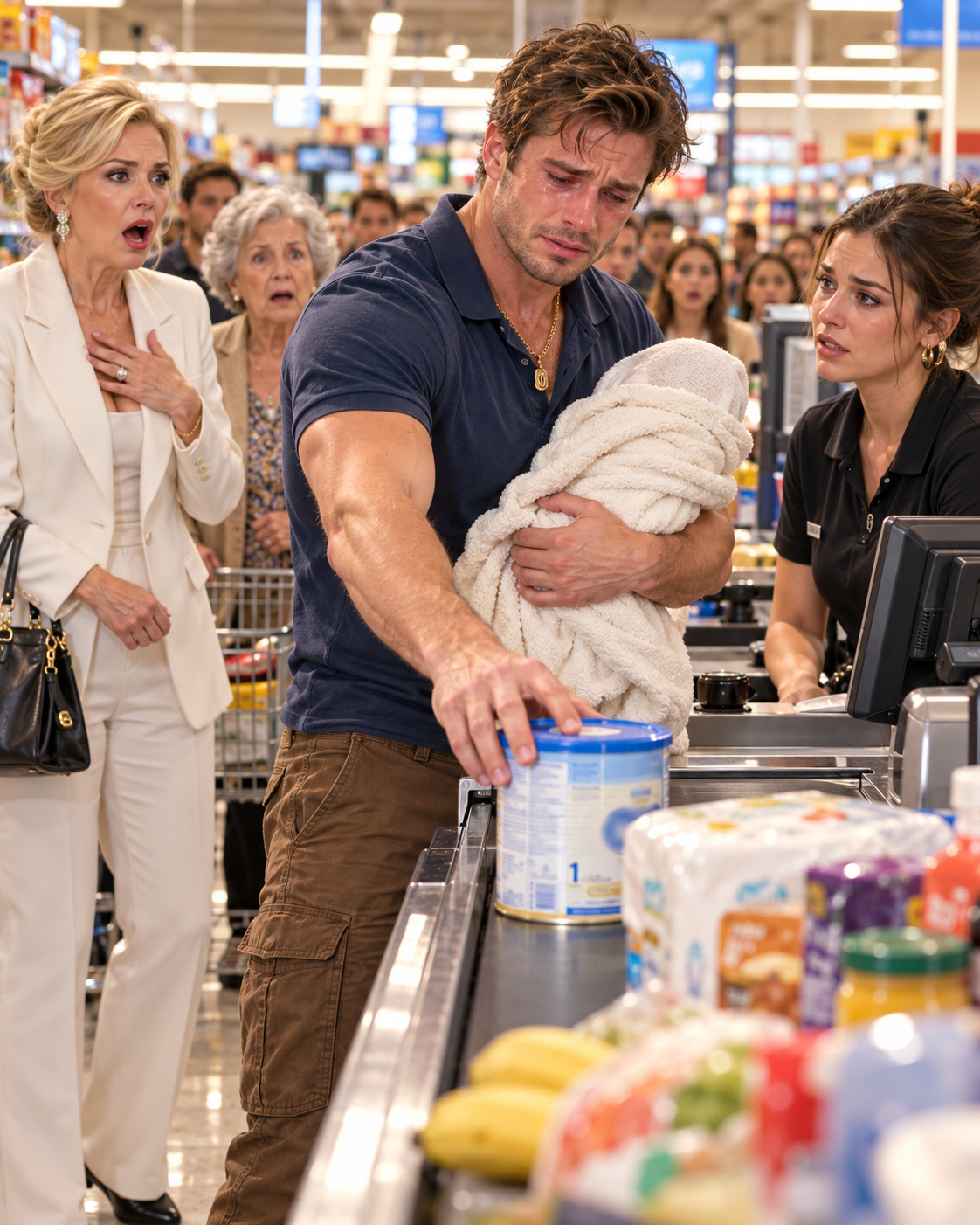
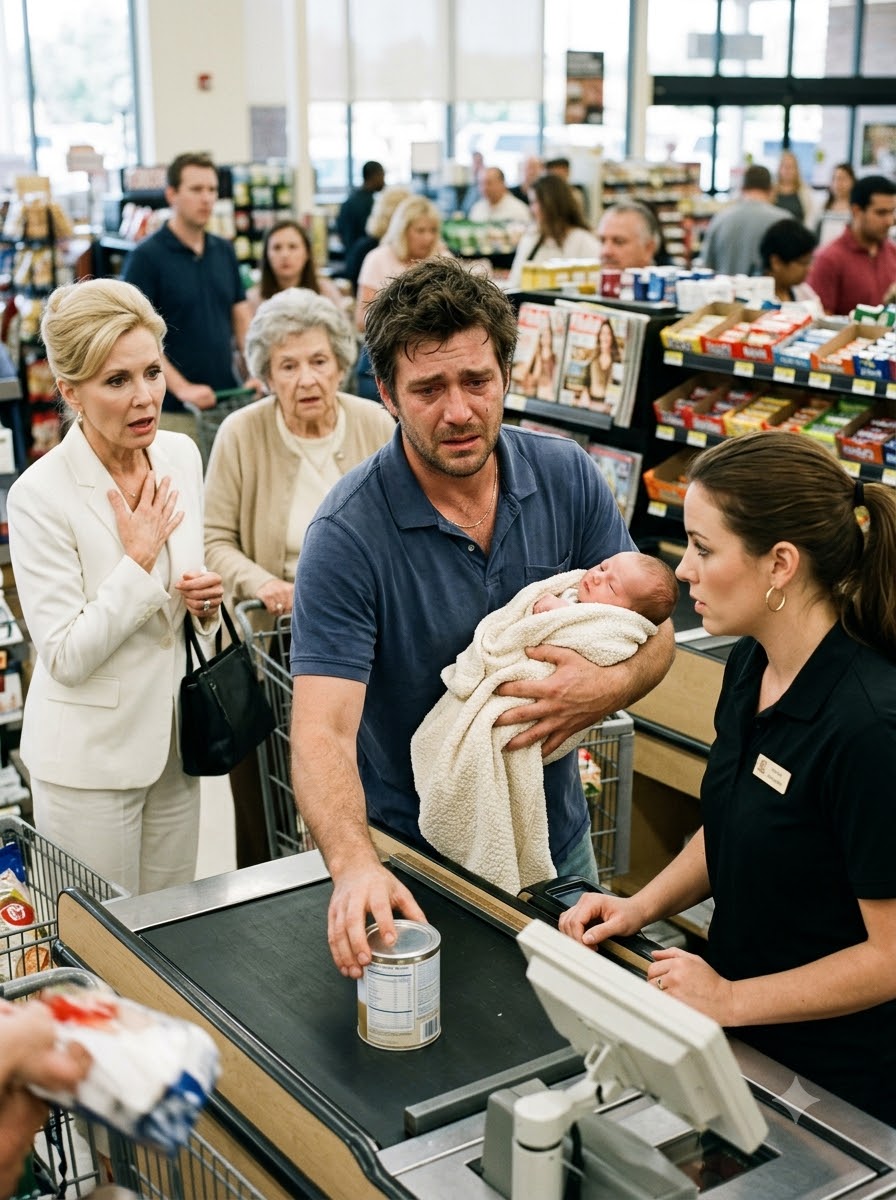
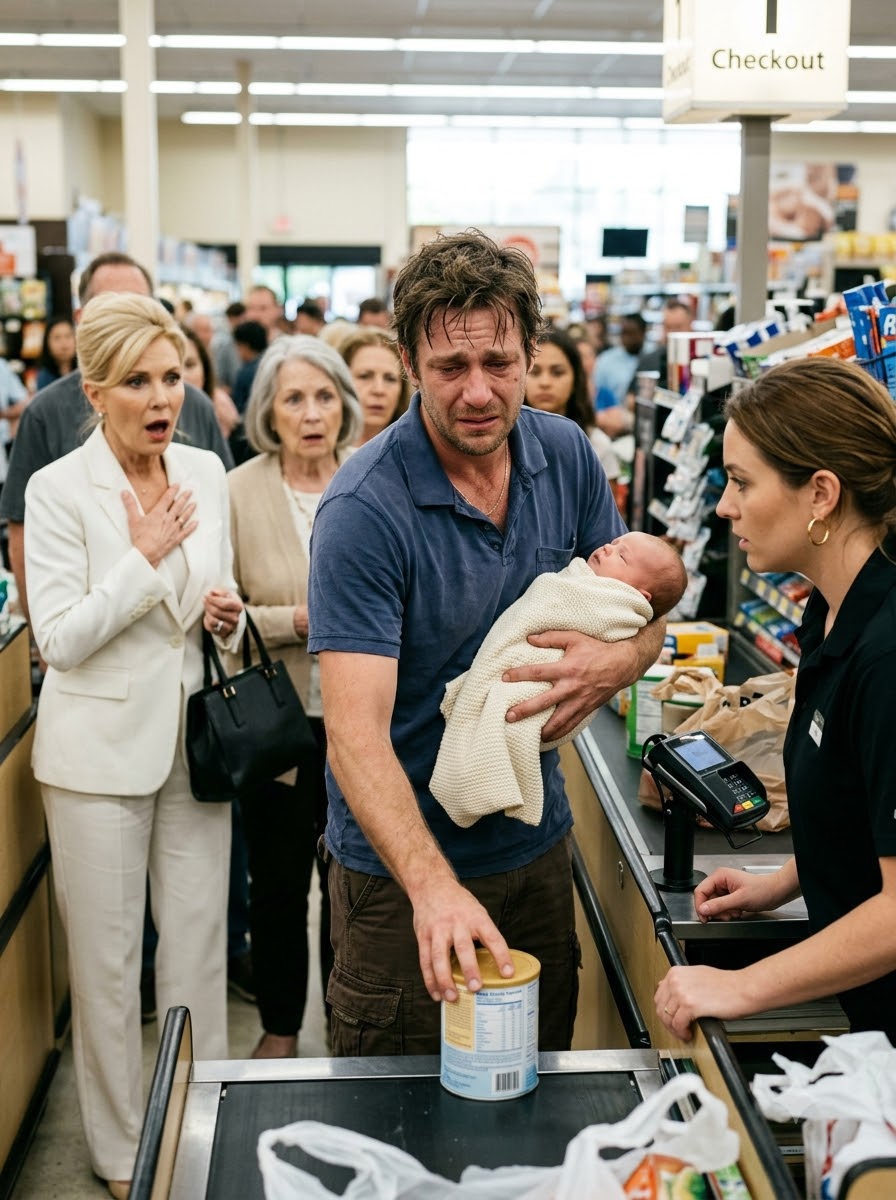
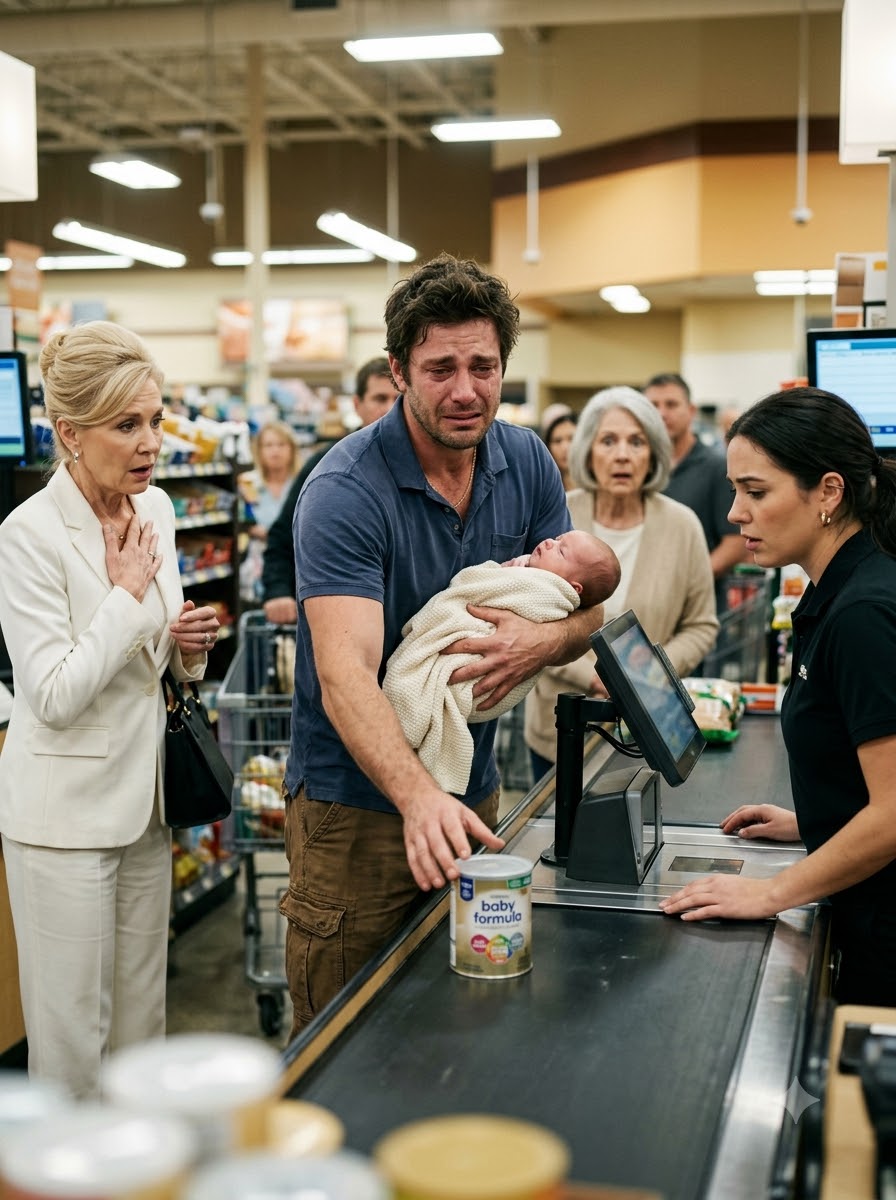
The cashier stopped scanning. The man standing in front of me lowered his head. His baby was crying. His little girl gazed up at him and whispered the words that changed my life.
“Daddy… is Benjamin going to sleep hungry again?”
The whole supermarket seemed to fall silent. The man shut his eyes.
“No, sweetheart.”
His voice cracked.
“Daddy will figure something out.”
He reached toward the can of formula. I stepped closer.
“Don’t return it.”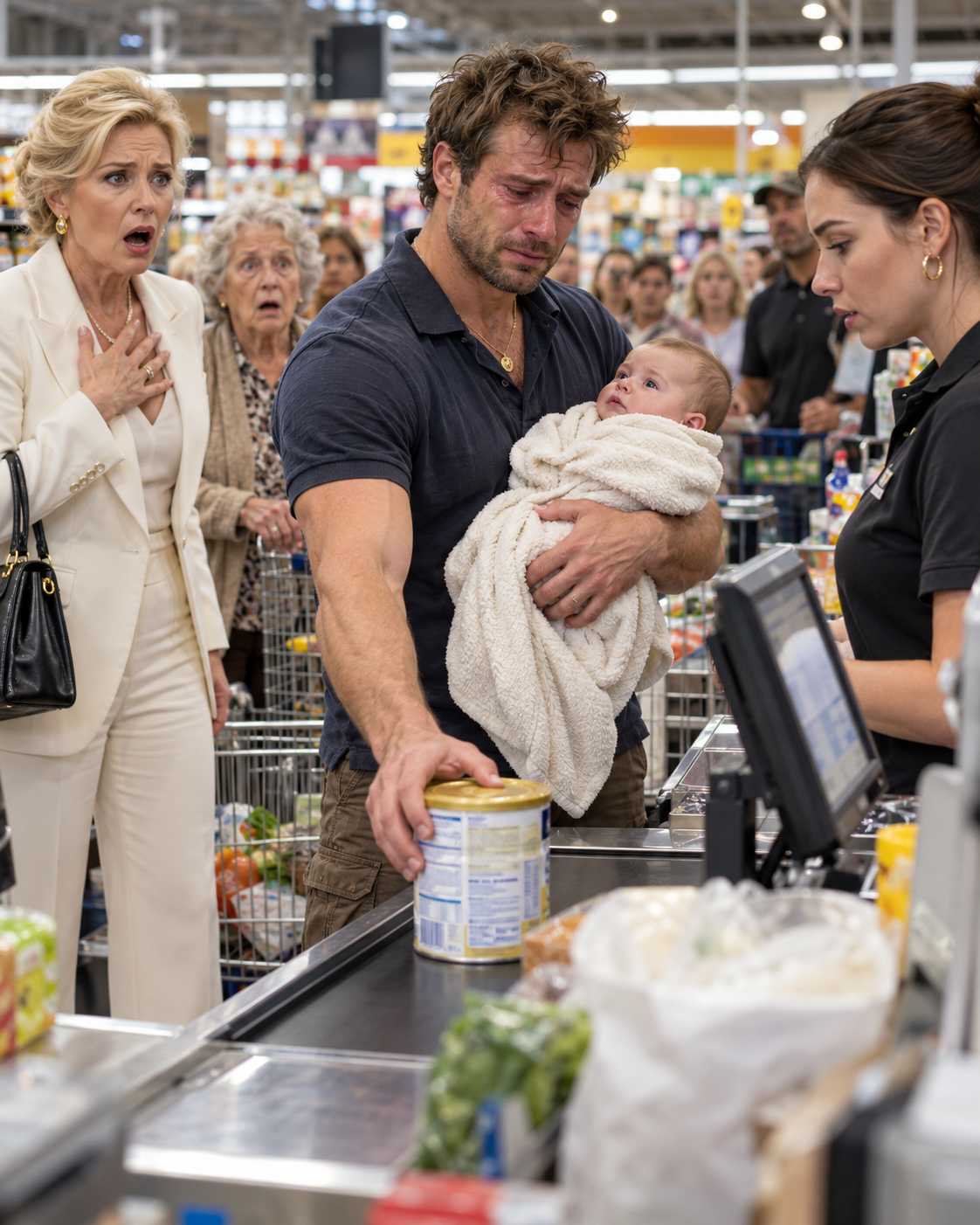
He turned around. That was the first time Daniel Brooks looked directly at me. Exhausted eyes. A faded work shirt. A four-month-old baby cradled in one arm. A four-year-old daughter holding tightly to his jeans. He glanced at my tailored black suit. My watch. My shoes. Then he immediately shook his head.
“No, ma’am.”
“I’ll pay.”
“Thank you.”
He swallowed.
“But I don’t accept charity.”
I glanced at the crying baby. Then at the little girl.
“Then don’t call it charity.”
His jaw grew tense.
“What should I call it?”
“One human being refusing to let a baby go hungry.”
He stared at me. Neither of us realized that an ordinary Wednesday evening in a grocery store outside Atlanta would mark the beginning of everything.
Part 1
My name is Evelyn Hart. At thirty-six, I was the founder and CEO of Hartwell Technologies & Properties. Three software companies. Commercial properties spread across seven states. Data centers. Hotels. A private portfolio that business magazines valued at just under $4 billion. People described me as intimidating. Disciplined. Brilliant. Cold. The last description was probably accurate.
I hadn’t always been that way. Two years earlier, I had been engaged to Andrew Clarke. A beautiful smile. An MBA from Harvard. Impeccable manners. He knew my favorite wine. Never forgot an anniversary. Sent flowers to my office. He claimed to admire that I had built Hartwell from a small property-software startup instead of relying on my father’s modest manufacturing business. Then my CFO discovered Andrew had secretly been directing Hartwell vendor contracts toward businesses connected to his friends. He had also accessed confidential investment information using my laptop. The financial losses could be recovered. The humiliation could not. He hadn’t fallen in love with Evelyn. He had fallen in love with access.
Afterward, I made my life simpler. Work. Home. Work. Board dinners. Charity galas filled with people who wanted something from me. A mansion that echoed whenever I walked through it. I convinced myself that peace was better than love.
That Wednesday, I visited a grocery store because my refrigerator held expensive sparkling water, half a lemon, and nothing that could reasonably count as dinner. My house manager could have done the shopping. My assistant could have arranged grocery delivery. I wanted to do something ordinary. Apparently, ordinary life had other ideas.
The man at the checkout tried his debit card twice. Declined. He opened his banking app. Then checked his wallet. Four dollars. He looked at the cashier.
“Can you return the formula?”
The cashier’s expression softened.
“You sure?”
He nodded.
“I thought a payment cleared today.”
His daughter tugged at his pants.
“Daddy?”
“It’s okay, Lily.”
The baby began crying even harder. That was when I stepped in. Daniel initially refused. Firmly. Almost stubbornly.
“I’ll handle it.”
“With four dollars?”
His face turned red. I immediately regretted how I had phrased it.
“That came out wrong.”
He turned his gaze away.
“I know what I look like.”
“I don’t.”
“You do.”
“No.”
I lowered my voice.
“I know what tonight looks like.”
“That is not the same thing.”
He finally met my eyes. I continued.
“Let me buy one can.”
His daughter whispered:
“Benjamin eats a lot.”
Daniel closed his eyes. That settled the argument.
“One can.”
“Three.”
“No.”
“Two.”
He looked miserable.
“One.”
The cashier offered a faint smile.
“Sir.”
He sighed.
“Two.”
I put bread in the cart. Bananas. Milk. Peanut butter. Eggs. Daniel objected to every item. Eventually, I stopped adding things because kindness becomes control when the person receiving it no longer has the freedom to refuse. That lesson would become important later.
Outside, Daniel thanked me. Then he began walking toward the road.
“You don’t have a car?”
“No.”
“Bus?”
“Yes.”
“With two children?”
He nodded.
“It’s four stops.”
“It’s almost ten.”
“We’re fine.”
His daughter was already struggling to stay awake on her feet.
“You aren’t.”
He stiffened. I raised both hands.
“Sorry.”
Then I asked:
“Would you let me drive you?”
He looked at my SUV. Then at Lily. Then Benjamin. Finally, he answered:
“One ride.”
“Agreed.”
The drive began awkwardly. Daniel sat in the back with the children. I asked:
“How old?”
“Benjamin is four months.”
“And Lily?”
“Four.”
Lily corrected him immediately.
“Four and three quarters.”
I smiled.
“Important distinction.”
“Yes.”
Daniel nearly smiled as well. Then Benjamin started crying. Daniel prepared his bottle with water the cashier had warmed before we left. He fed his son gently. Without irritation. Without embarrassment. Only patience. I watched through the rearview mirror.
“Are you doing this alone?”
I asked. Then quickly added:
“You don’t have to answer.”
Daniel stared out the window.
“Their mother left shortly after Benjamin was born.”
I remained quiet.
“She wasn’t ready for this.”
“This?”
He gave a humorless laugh.
“Bills.”
“No sleep.”
“Me losing my job.”
“All of it.”
“What happened to your job?”
“Distribution warehouse.”
“Closed six weeks ago.”
“Severance?”
“Three weeks.”
I looked at him.
“And housing?”
Silence. He gave me directions. Left. Right. Then onto a road that gradually stopped being paved. Finally, he said:
“Here.”
I slammed on the brakes. There was no house. Only an unfinished apartment development. Concrete columns. Plastic sheeting. No proper doors. My chest tightened.
“You live here?”
Daniel looked ashamed.
“Temporarily.”
“With babies?”
“There’s an enclosed maintenance room.”
“The property caretaker lets us use it.”
“It stays dry.”
I switched off the engine.
“Daniel.”
“We’re okay.”
“No.”
He stiffened.
“You said you weren’t judging.”
“I’m not.”
I looked toward the dark building.
“I’m terrified.”
“For what?”
“Your children.”
His expression hardened.
“I keep them safe.”
“I can see that.”
“Then—”
“Benjamin is four months old.”
Silence.
“There’s no heat.”
“Mosquitoes.”
“Anyone can walk in.”
Daniel glanced toward Lily.
“I know.”
That response destroyed whatever anger remained inside me. He knew. He hated the situation more than I did. He simply had no better choice. I made a decision. Possibly reckless. Definitely impulsive.
“Put the groceries back in the car.”
His head whipped around.
“No.”
“I have a detached guesthouse.”
“No.”
“Two bedrooms.”
“No.”
“Separate entrance.”
“Evelyn—”
“It’s empty.”
“I’m not moving into some billionaire woman’s house.”
I froze.
“How do you know I’m a billionaire?”
He looked at my watch. Then my SUV. Then me.
“I can Google.”
Fair.
“I’m not asking you to move in forever.”
“No.”
“One night.”
“No.”
“For the kids.”
His expression changed. I hated bringing them into it. But I also understood the alternative. I softened my voice.
“One night.”
“Tomorrow morning we figure out something else.”
Daniel looked at Lily sleeping against the window. Then Benjamin. His pride gave way. Not to me. To fatherhood.
“One night.”
PART 2
One night became two weeks. But not the way people later told the story. I did not move Daniel into my bedroom. I did not hand him a black credit card. I did not announce that his problems were over. The guesthouse sat seventy feet behind my main residence. Two bedrooms. Small kitchen. Laundry. Separate security code. My house manager, Mrs. Caldwell, brought clean sheets and baby supplies that first night. Daniel tried to refuse half of them. She ignored him. Mrs. Caldwell had raised four children and survived two husbands. Nobody intimidated her.
“You can argue after the baby eats.”
Daniel obeyed. The next morning, I called my attorney. Not romantic. Not generous. Practical.
“If a stranger and his children stay in my guesthouse temporarily, what do I need?”
My attorney paused.
“Evelyn.”
“Yes?”
“Why is a stranger with children in your guesthouse?”
“Long story.”
“Of course.”
We created a simple temporary occupancy agreement. Fourteen days. No rent. No employment obligation. No expectation of repayment. Either side could end it. Then I asked our employee-assistance consultant for names of emergency family-housing nonprofits. Daniel hated that.
“I can find my own place.”
“With what deposit?”
“I’ll work.”
“Where?”
“I’m looking.”
“With Benjamin?”
Silence.
“Let me connect you to people.”
He stared.
“Connect.”
“Yes.”
“Not solve.”
The distinction mattered.
“Okay.”
That afternoon, Daniel interviewed with a logistics company. Not mine. He found it himself. They liked him. Could not accommodate irregular childcare. Second interview. Same problem. Third. Same. I finally asked:
“What did you do before the warehouse?”
“Maintenance.”
“Furniture repair.”
“Loading.”
“Delivery.”
“Some carpentry.”
“Can you fix things?”
He looked offended.
“I can fix almost anything.”
My estate maintenance supervisor happened to need temporary help. I disclosed everything.
“Do not hire him because I’m asking.”
“I’m not asking.”
The supervisor interviewed Daniel. Tested him on an irrigation fault. Electrical safety. Door hardware. Basic carpentry. Daniel got the temporary position. Not because I ordered it. Because he was good. He earned $28 an hour. His first paycheck arrived Friday. That evening he knocked on my front door. Envelope in hand.
“What is this?”
“Guesthouse rent.”
“No.”
“Evelyn.”
“The agreement says no rent.”
“I’m working now.”
“For five days.”
“I need to contribute.”
I looked at the envelope. Then at him.
“Buy groceries.”
“I already did.”
“Save for an apartment deposit.”
“I will.”
“Then buy diapers.”
“Already done.”
I sighed.
“You are exhausting.”
“Likewise.”
He smiled. That was the first time. It changed his entire face. Life settled into strange rhythms. I came home at seven instead of eleven. Lily began waiting near the garden.
“Miss Evelyn!”
She would run toward me. Then stop because Daniel had taught her not to jump on adults without permission.
“Can I hug?”
“Yes.”
Always yes. Benjamin began recognizing me too. His entire body kicked when I held him. I had never spent time with babies. The first time he spit up on my silk blouse, I froze. Daniel nearly died laughing.
“That shirt probably costs more than my first car.”
“It does.”
“Sorry.”
I looked at Benjamin. Then laughed.
“Worth it.”
One evening, I found Daniel repairing an old rocking chair inside the guesthouse.
“Where did you get that?”
“Storage shed.”
“It was broken.”
“Exactly.”
I ran my fingers over the repaired joint.
“Why fix it?”
“Lily likes when I rock Benjamin.”
He continued sanding.
“Couldn’t afford one.”
Something about that hit me harder than all his poverty. Not because he lacked furniture. Because he kept creating comfort from whatever he could reach. Then he asked:
“Why do you live alone?”
I stiffened.
“Large question.”
“You ask invasive ones too.”
Fair. I told him about Andrew. Not the corporate details. Enough. When I finished, Daniel said:
“That must have hurt.”
No admiration for my empire. No questions about numbers. No: How rich are you exactly? Just: That must have hurt.
“Yes.”
I looked at my hands.
“I thought money protected me.”
“And?”
“It attracted better-dressed thieves.”
Daniel smiled. Then became serious.
“Money doesn’t change character.”
“It gives character options.”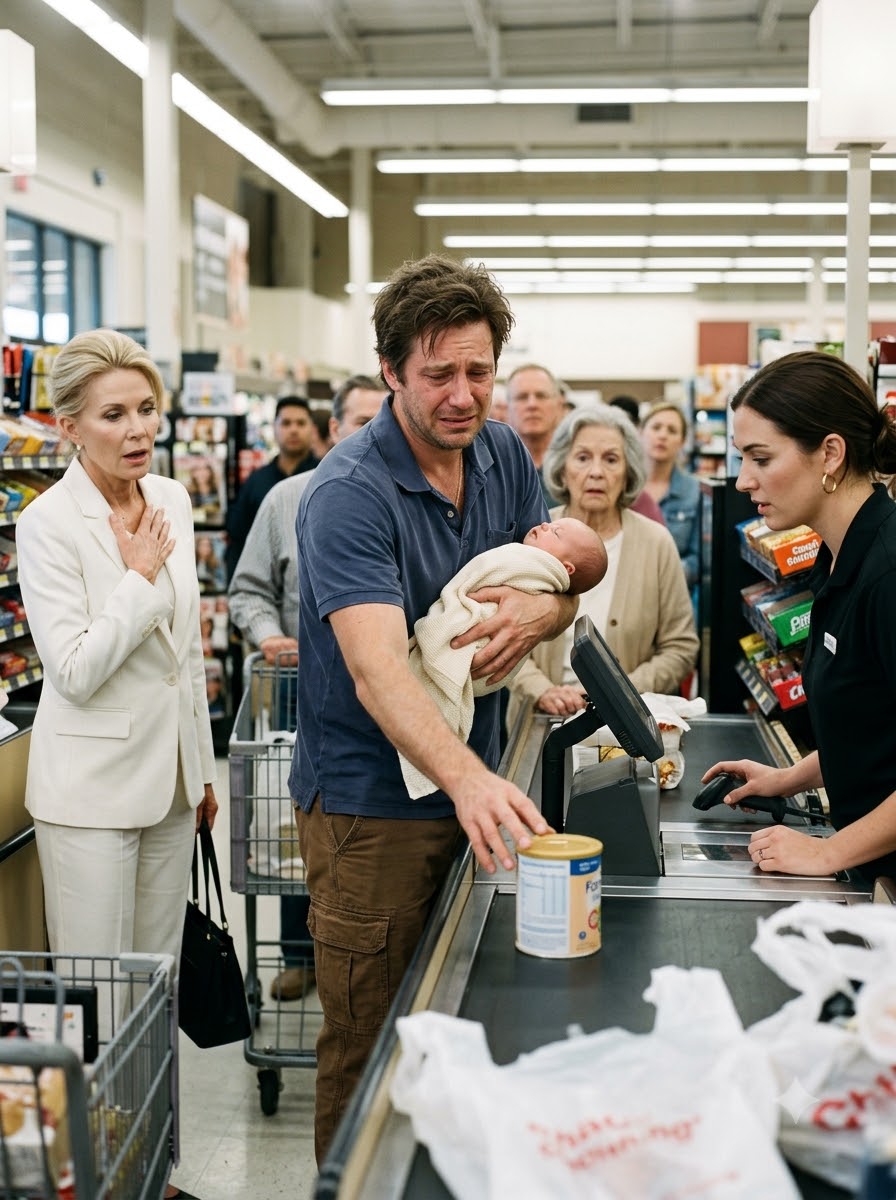
I looked at him.
“That sounds learned.”
“It is.”
At the end of two weeks, Daniel moved out. That surprised me. I had expected resistance in the opposite direction. He found a small two-bedroom apartment with a reduced deposit through a housing program. Nothing beautiful. Safe. Clean. Near a daycare that offered sliding-scale tuition. He had saved almost every dollar he earned. Mrs. Caldwell cried when Lily left. Denied it.
“I have allergies.”
“In December?”
“Severe.”
Daniel loaded his bags into a borrowed maintenance truck. Then faced me.
“I don’t know how to thank you.”
“Don’t.”
“I mean it.”
“So do I.”
He frowned.
“Why?”
“Because I don’t want gratitude becoming debt.”
He looked at me for a long time. Then nodded.
“Okay.”
That should have been the end. It wasn’t. Daniel stayed with estate maintenance through the full ninety-day temporary contract. Then the supervisor recommended him for permanent work. Daniel declined. I was shocked.
“Why?”
He stood outside my office in work clothes.
“I want something that can become mine.”
“What?”
“Repair business.”
He had noticed a gap. Small restaurants and independent retailers needed reliable maintenance without corporate service contracts. Plumbing fixes. Furniture. Light carpentry. Appliance replacement. Emergency repairs. He already had tools. Skills. Contacts. He needed insurance. Licensing for work within his scope. A vehicle. Working capital. I almost said: I can fund it. Then remembered the guesthouse. Connect. Not solve. So I asked:
“What do you need from me?”
“Nothing.”
“Daniel.”
He smiled.
“Okay.”
“Advice.”
That startled me.
“Business plan.”
“Pricing.”
“Contracts.”
“Cash flow.”
Those I could give. We met every Thursday after work. Coffee shop. Public. Neutral. He brought handwritten numbers. I destroyed them.
“This price loses money.”
“It covers labor.”
“Not insurance.”
“Fuel.”
“Tools.”
“Taxes.”
“Administrative time.”
He stared.
“Maybe poverty was easier.”
“No.”
“It was not.”
He laughed. He secured a microbusiness loan. Bought a used cargo van. Named the company Brooks Repair & Maintenance. Terrible name. I told him.
“It says what I do.”
“So does ‘Guy With Wrench.’”
He refused to change it. His first month: Seven clients. Second: Fourteen. Third: Twenty-one. Then one of Hartwell’s hotel managers independently added him to an approved small-vendor pool after another contractor missed three calls. I disclosed my relationship to the procurement team. At that point our relationship was still officially: Friendship. Unofficially: Dangerous.
Daniel came to my house less often after moving out. That helped. When he did, it was usually with the kids. Dinner. Garden. Mrs. Caldwell forcing food onto everyone. One rainy evening, Lily fell asleep on my couch. Benjamin slept against Daniel’s chest. We sat quietly. I whispered:
“This is what I wanted.”
Daniel looked at me.
“What?”
I gestured.
“Noise.”
“Toys.”
“Someone leaving crayons where I step on them.”
He smiled.
“Your mansion was too clean?”
“It was dead.”
He looked toward Lily.
“You’d be a good mother.”
My chest tightened.
“Don’t say that casually.”
“I didn’t.”
Silence. Then:
“You’re a good person, Evelyn.”
I laughed softly.
“You don’t know my board.”
“I know the woman who paid for formula and then argued with me for twenty minutes because I refused eggs.”
“That woman is impulsive.”
“She is.”
“Controlling.”
“Sometimes.”
“Terrible with babies.”
“You improved.”
I smiled. Then he said:
“I should go.”
Something in his voice changed. I knew why. So did he. The problem was simple. I had helped him when he was desperate. There would always be a question: If he wanted me, was it love? Gratitude? Security? Dependence? I had been used for money before. Daniel had received life-changing help from me. Neither of us could ignore that. So he left. And for the next four months—nothing romantic happened. That restraint saved us.
PART 3
Daniel’s business became profitable before our first date. That fact mattered more to him than me. His apartment lease was in his name. His childcare was paid from his income. His debt was manageable. Brooks Repair employed one part-time technician. Then two. He no longer worked for my estate. One Thursday, he arrived at the coffee shop without spreadsheets.
“Where are the numbers?”
“No numbers.”
“Then why are we here?”
He looked nervous. I had seen him climb onto hotel roofs during storms. This was worse.
“Dinner.”
“We are having coffee.”
“No.”
He swallowed.
“I’m asking you to dinner.”
I stared.
“As?”
“Not business adviser.”
“Not landlord.”
“Not woman-who-saved-my-kids.”
“That title needs shortening.”
He smiled.
“As Evelyn.”
My heart started pounding.
“Are you sure?”
“Yes.”
“No gratitude problem?”
“I will always be grateful.”
He leaned forward.
“But gratitude is not what makes me think about you at two in the morning.”
My face warmed.
“That was dangerously smooth.”
“I practiced.”
“Of course.”
I said yes. First date: Small restaurant. No private room. He paid. I let him. Second: Walk through the botanical garden. Third: His apartment. He cooked. Badly. Lily told him in front of me:
“Daddy usually burns chicken.”
“Thank you, Lily.”
“You said honesty matters.”
I laughed. Months passed. Daniel never asked about my wealth. He knew enough. Public articles existed. But he never asked: How much? What will I inherit if we marry? What can Hartwell do for my business? In fact, he refused two Hartwell jobs because the procurement manager had reported directly to me.
“Conflict.”
He said.
“That’s excessive.”
“It makes me sleep better.”
I respected it. Then his ex-wife returned. Her name was Rachel. She appeared at Daniel’s apartment after nearly a year away. He called me afterward.
“She wants to see the kids.”
My stomach tightened.
“What do you want?”
“I don’t know.”
“Then don’t decide tonight.”
He paused.
“Thank you.”
Rachel had left during severe postpartum depression combined with financial stress. That was a reality Daniel had never fully explained. Not because he lied. Because pain simplified memory. She had also made choices that hurt the children. Both could be true. She entered therapy. Requested supervised contact. Daniel spoke to a family-law attorney. Not my attorney. A neutral one. Lily saw her mother gradually. Benjamin did not know her. The process was emotional. Slow. Sometimes ugly. I stayed out unless Daniel asked me to listen. One night he said:
“I made her the villain because that was easier.”
“She left.”
“Yes.”
“That hurt.”
“Yes.”
“But she was also sick.”
“Yes.”
“And now?”
“I don’t know.”
I took his hand.
“You don’t have to know yet.”
He looked at me.
“That is something rich people say.”
I laughed.
“No.”
“It is something therapy says.”
“You go to therapy?”
“After Andrew?”
“Yes.”
“You never told me.”
“You never asked.”
He smiled. Good. Our relationship grew because neither of us needed rescuing anymore. That was when the outside world discovered us. A photographer captured Daniel and me leaving a children’s museum with Lily and Benjamin. Headline: BILLIONAIRE CEO’S MYSTERY MAN REVEALED. Then: FROM HOMELESS SINGLE DAD TO BILLIONAIRE’S BOYFRIEND. I hated it. Daniel hated it more. Clients called. Some joked. One cancelled.
“Don’t want drama.”
Another asked whether Hartwell secretly owned his company. It did not. Online comments were worse. Gold digger. Strategic romance. He found the richest woman in Atlanta. One article claimed I had “installed” him in a business. False. But believable enough to hurt. Daniel stopped answering my calls for one day. Then two. I finally drove to his workshop. He was sanding a cabinet.
“What are you doing?”
“Working.”
“You disappeared.”
“I needed time.”
“To decide what?”
He stopped.
“Whether I can live inside your world.”
That terrified me.
“Do you want to leave?”
I asked. Daniel looked away.
“I don’t know.”
The workshop smelled like sawdust and paint. His van sat outside. The business he had built without me.
“I can have our communications team correct the articles.”
“No.”
“Why?”
“Because that proves their point.”
“What point?”
“That one call from Evelyn Hart can change reality.”
“That is literally what a communications department does.”
He almost smiled. Then:
“I spent a year getting to a place where I could look at myself and know I was supporting my children.”
“I know.”
“And now everybody thinks I slept my way into a business.”
“I know.”
“I hate it.”
“I know.”
He put the sanding block down.
“And I hate that some part of me still wonders whether life would collapse if you disappeared.”
That hurt. Not because I thought he wanted my money. Because he was afraid of becoming dependent again. I understood.
“What do you want?”
“Distance between our finances.”
“We already have that.”
“More.”
“Okay.”
He looked surprised.
“Okay?”
“Yes.”
“No Hartwell contracts for Brooks Repair for one year.”
“That seems unnecessary.”
“It matters to me.”
I breathed.
“Okay.”
“I keep my apartment.”
“You were keeping it anyway.”
“Yes.”
“We don’t move in.”
“I wasn’t asking.”
“Good.”
I laughed.
“So romantic.”
He smiled. Then became serious.
“And when people ask about us…”
“We tell the truth.”
“What truth?”
“That I met you when I couldn’t buy formula.”
He winced.
“That your help mattered.”
“That I built my company afterward.”
“That we didn’t date until I was stable.”
He looked at me.
“No shame.”
I nodded.
“No shame.”
So that became our story. Not: Billionaire saves poor man and marries him. Too simple. Too insulting to both of us. The truth: A woman bought formula. Then housing resources mattered. A temporary job mattered. Childcare mattered. Daniel’s skill mattered. His discipline mattered. My business advice mattered. Distance mattered. Time mattered. Love came later. The story got less viral once it became complicated. Good.
Meanwhile, Hartwell faced a crisis. A major merger failed. A trusted senior executive leaked pricing information to a competitor. Two board members wanted me removed from negotiations. Old Evelyn would have stayed at the office for forty-eight hours. New Evelyn went home at midnight. Daniel was there because Lily had left a stuffed rabbit at my house. He saw my face.
“What happened?”
“I lost the deal.”
He waited.
“My strategy lead sold us out.”
He placed a mug of tea beside me. No advice. No: Everything happens for a reason. No: I can fix it. He simply sat. After several minutes, I said:
“Maybe trust is a liability.”
“No.”
I looked at him.
“You’re just tired.”
He continued.
“You’re competing against people willing to become worse versions of themselves to win.”
“That doesn’t make keeping your heart a weakness.”
I stared. He had nothing to gain from that sentence. No contract. No house. No company stock. Just me. I started crying. Quietly. Daniel moved closer. Then stopped.
“Can I?”
I nodded. He held me. For the first time since Andrew, I allowed someone to comfort me without wondering what it would cost.
PART 4
Rachel eventually asked for expanded custody time. Daniel struggled. Lily had become attached to me by then. That created another danger. I was not her mother. I refused to behave like one in the custody dispute. Rachel and I met once. Neutral family therapist’s office. She looked at me.
“So you’re Evelyn Hart.”
“Yes.”
“My daughter talks about you.”
“I care about her.”
Rachel’s eyes filled.
“I know.”
Then:
“She calls your house the happy house.”
That hurt. I didn’t know what to say. Rachel continued.
“I was very sick after Benjamin.”
“I know.”
“I also abandoned them.”
Silence.
“Both are true.”
“Yes.”
She looked surprised that I agreed.
“I hate you sometimes.”
I nodded.
“I probably would too.”
That almost made her laugh. Eventually, Daniel and Rachel reached a parenting plan through mediation and court approval. Supervised visits became daytime visits. Then scheduled parenting time. Slowly. Carefully. Nobody “won.” The children gained another parent who was working to become safer. That was the best outcome available.
Daniel and I kept dating. Two years after the supermarket, his company had eight employees. He bought a modest home. Not with my money. Not with a gift. Mortgage. Down payment. Tax return. Everything documented. He invited me over the first evening. No furniture in the living room yet. Lily ran through the empty house.
“My room is purple!”
Benjamin, now two, shouted:
“Purple!”
Everything was purple according to Benjamin. Daniel stood beside me.
“Remember the concrete building?”
“Yes.”
“I used to lie awake there planning this.”
My eyes filled. He smiled.
“Do not cry.”
“Too late.”
Then he handed me something. A receipt.
“What is this?”
Supermarket. Same chain. Two cans of infant formula. Bread. Bananas. Eggs. Milk. I stared.
“I went back.”
“Why?”
“Paid it forward.”
He shrugged.
“A young couple came up short.”
My throat closed.
“I didn’t tell them about you.”
“Good.”
“I told them somebody once helped me.”
He smiled.
“That was enough.”
That night, he asked me to move in. I said no. He stared.
“Wow.”
“I love you.”
“Excellent follow-up.”
“I am not leaving a secure home to move into yours while Rachel’s custody agreement is still settling and your children are adjusting.”
He considered.
“That is annoyingly sensible.”
“I’m a CEO.”
“I thought you were supposed to be impulsive.”
“Only in supermarkets.”
We waited. Another year. Then Daniel proposed. Not at my mansion. Not at a restaurant. At the grocery store. I hated him. He took me to aisle twelve. Baby formula.
“Absolutely not.”
He laughed.
“What?”
“You are not proposing beside powdered milk.”
“I am.”
“Daniel.”
He took out a small ring. Not enormous. He could afford more. He didn’t need to prove anything.
“Three years ago, you stood here and asked permission to help me.”
My eyes filled.
“You saw the worst night of my life.”
He continued.
“I thought accepting anything meant losing my dignity.”
“You taught me receiving help isn’t the same as being owned.”
I swallowed.
“And you taught me giving isn’t love if it becomes control.”
He smiled.
“Seems we’re both exhausting.”
“Very.”
“Evelyn Hart.”
He got down on one knee.
“Will you marry me?”
A cashier recognized us. Started crying. I stared at Daniel. Then at the formula.
“This is objectively the least glamorous proposal in billionaire history.”
“That is a yes?”
“Yes.”
People applauded. I hated all of them.
Marriage discussions forced us into one final uncomfortable subject. Money. Real money. My attorneys prepared a prenup. Daniel expected it. Still hated reading it. Not because he wanted my assets. Because legal language made our love sound like a corporate risk.
“I understand why.”
He said.
“But this paragraph basically says if I become evil, you keep the hotels.”
“That is one interpretation.”
“You have too many hotels.”
“Unrelated.”
He hired his own attorney. Required. We negotiated. No games. No emotional tests. His business remained his. Hartwell remained mine. Joint assets would be clearly defined. Children protected. No punitive nonsense. No hidden clauses. Rachel remained Benjamin and Lily’s mother. That boundary also went into estate planning. If something happened to Daniel, I did not automatically replace her parental rights. Important.
Then another question.
“Do you want children?”
Daniel asked.
“With you?”
“That is usually how this conversation works.”
I smiled.
“Yes.”
“But?”
“I’m scared.”
“Of pregnancy?”
“Partly.”
“And?”
“That your children will think I’m replacing their mother.”
He nodded.
“We ask them.”
We did not make children decide adult reproduction. We talked. Age appropriately. Lily asked:
“Would you still love me?”
I nearly cried.
“Exactly the same.”
“What if your baby is a girl?”
“Exactly the same.”
“What if I get annoying?”
“That already happened.”
She laughed. Benjamin shouted:
“Purple baby!”
Still his favorite category. We married four years after the supermarket. Small ceremony. One hundred guests. That qualified as microscopic by my corporate world’s standards. Mrs. Caldwell sat in the front row. Daniel’s workshop team came. Rosie—our grocery cashier—attended too. I had tracked her down and invited her. She cried when Daniel hugged her.
“You remember?”
He asked.
“Of course I remember.”
She looked at me.
“Rich lady with wine.”
I laughed.
“Yes.”
Daniel leaned over.
“She judged your groceries.”
“She was right.”
My father gave me away. Rachel attended the reception briefly because Lily wanted her there. Some people thought that was strange. Healthy families often look strange to people who prefer simple villains. Before dinner, Lily gave a speech. She was seven. This was a terrible decision.
“My daddy used to be really poor.”
Everyone laughed. Daniel covered his face.
“And Miss Evelyn was really rich.”
More laughter.
“And now Daddy is less poor.”
I nearly fell out of my chair.
“And Evelyn is still rich.”
Correct. Then Lily became serious.
“But she bought Benjamin milk when he was little.”
She looked at me.
“And she asked before she helped.”
That sentence surprised me. Children notice everything.
“She is my bonus person.”
Rachel wiped her eyes. So did I.
“And Daddy says families aren’t about who saves who.”
“They are about who stays.”
Daniel started crying openly. Lily smiled proudly.
“That’s all.”
Best wedding speech of my life.
Five years after the supermarket, I returned to that store alone. Different suit. Same aisle. I stood in front of the baby formula longer than necessary. A young father beside me looked confused by the prices. He picked up one can. Put it back. Checked another. I wanted to interfere. Old instinct. Then remembered what Daniel taught me. Ask.
“Excuse me.”
He looked wary.
“Yes?”
“Do you need help?”
He shook his head.
“No.”
I nodded.
“Okay.”
And walked away. That mattered. Helping does not mean deciding someone needs saving because they look poor. Daniel was never a project. That was the mistake people made when they retold our story. They said: Billionaire rescues homeless father. I hated that headline. I paid for formula. I gave him a temporary safe place. Introduced resources. Shared business knowledge. Those things mattered. But Daniel saved himself too. He got up. Worked. Accepted help without surrendering his dignity. Learned. Built. Parented. Failed. Tried again. And he changed me. Before him, I believed generosity was easy because money made it easy. I learned that real generosity sometimes means not writing the check. Not making the call. Not removing every obstacle. Sometimes love says: I can do this for you. Sometimes it says: I know you need to do this yourself.
Hartwell continued growing. Brooks Repair became Brooks Facilities Group. Thirty-four employees. Then forty-eight. Daniel refused acquisition offers twice. One from Hartwell. Technically our procurement team approached independently. He came home laughing.
“Your company tried to buy me.”
“My company has excellent taste.”
“I said no.”
“Rude.”
He remained completely separate financially. By choice. Not because I doubted him anymore. Because independence was part of what made him proud. We eventually had a daughter together. Grace. Lily chose the name. Benjamin wanted Purple. Overruled. Our house became noisy. Very noisy. The mansion I once thought felt like a graveyard became impossible to keep clean. Crayons. Shoes. School bags. Baby toys. Daniel leaving tools in places tools absolutely did not belong. Mrs. Caldwell retired. Then returned two months later because:
“I cannot watch you people destroy this kitchen.”
Fair. One rainy evening, Daniel and I stood on the terrace. Same place where years earlier he had told me keeping my heart did not make me weak. He handed me tea.
“What?”
I asked.
“Nothing.”
“You’re staring.”
“You look happy.”
“I am.”
He smiled.
“Remember when you said money was safer than love?”
“I said many stupid things.”
“True.”
I hit his shoulder. Then looked through the glass. Lily was helping Grace color. Benjamin was building something dangerous with couch cushions. The home breathed. That was the only word for it. Alive. Daniel asked:
“If you could go back to that grocery store, would you still step forward?”
“Yes.”
“Even knowing everything?”
I thought about the public scrutiny. The custody complications. The trust issues. The work. The arguments.
“Yes.”
Then:
“But I’d buy only two cans.”
He laughed.
“You bought four.”
“Three.”
“Four.”
“The cashier added one.”
“Still your card.”
I smiled. Then he asked:
“Why did you really help me?”
“I’ve told you.”
“No.”
“Why?”
I considered. At the time, I thought it was because Benjamin was hungry. That was true. But not complete.
“I recognized you.”
He frowned.
“We had never met.”
“Not your life.”
“The feeling.”
“What feeling?”
“Being at the end of something.”
He became quiet.
“I had money.”
“You didn’t.”
“But I knew what it felt like to stand somewhere and realize the thing you trusted wasn’t going to save you.”
Daniel took my hand.
“And?”
“I think helping you reminded me I was still capable of caring.”
He smiled.
“So you were selfish.”
“Extremely.”
“Good.”
He kissed my forehead. People still occasionally asked whether Daniel would have loved me if I were poor. I stopped answering. Because it is the wrong question. The better question is: Would we still treat each other with dignity if neither of us had anything useful to offer? I know Daniel’s answer. I saw it every time he fed his daughter before himself. Every time he refused money but accepted knowledge. Every time he sat with me after a failed billion-dollar deal and asked for nothing. And he knew mine. Because before I knew whether Daniel could ever be anything to me—before romance—before gratitude—before business—before family—I saw a father at a cash register trying to choose between pride and feeding his baby. And I did one small thing. I asked if I could help. Sometimes that is how lives change. Not through grand gestures. Not through billionaire miracles. Through one person noticing another person at the exact moment the world has decided not to. And refusing to walk past.
