

PART 1
The envelopes were waiting beneath our plates when we sat down for Easter dinner.
There was one at every place setting, each labeled with a name in my mother-in-law Judy’s familiar, rounded handwriting. She had been a schoolteacher, and even her handwriting looked as though it belonged on a classroom blackboard.
Kim was the first to open hers.
She was the oldest of Ron and Judy’s children, divorced for two years and raising two little boys in a rented trailer behind the grain elevator.
When she saw what was inside, she covered her mouth with her hand.
Jeff opened his next.
He had lost his job at the Caterpillar plant the previous fall and was now driving a propane delivery truck part-time. He read the contents, lifted his eyes toward his father, and sat there unable to speak.
Then Stacy opened hers.
At twenty-six, she was the youngest, still struggling with loans from nursing school.
She burst into tears and pressed her napkin against her face.
Ron, my father-in-law, stood at the head of the table with one hand resting on Judy’s chair.
“Twenty thousand dollars each,” Ron said from the head of the table.
He smiled at his children.
“Toward a house. Your mother and I sold the forty acres down by the creek. We want to see you kids settled while we’re still alive to see it.”
The room erupted.
Everyone was getting out of their chairs, hugging, laughing, and crying.
The Easter ham sat forgotten on the table, slowly cooling beside the scalloped potatoes.
Kim’s sons kept asking what had happened, but their mother was crying too hard to explain.
My husband Nate and I had received one envelope to share.
I slipped my thumb beneath the flap and opened it.
Inside was a greeting card.
A little bluebird decorated the front.
Judy had written a message inside:
You two have always been so capable. We never worry about you. Love, Mom and Dad.
There was no check.
No money.
Nothing else.
I checked the envelope again.
I worked as a hospital billing clerk, where checking numbers twice was practically a requirement of the job.
So I checked twice.
Then I passed the card beneath the edge of the tablecloth to Nate.
He read it.
After a moment, he read it again, more slowly.
He folded the card once and tucked it into his shirt pocket.
His ears had turned bright red.
I knew that look.
It was the same expression he wore when a bolt snapped in his hand at work or when a customer called him son in that condescending way some older men had.
Across the table, Ron raised his coffee cup toward us.
“That’s the truth, you two,” he said. “That’s a compliment. You never gave us one day’s worry. Either one of you.”
Judy smiled proudly at me.
And that was what made the whole thing so difficult.
She genuinely believed she had given us something wonderful.
She had probably spent time selecting that particular card, thinking about the message she wanted us to hear.
In her mind, being the children nobody worried about was an honor.
I sat there surrounded by the smell of roasted ham, Easter lilies, and potatoes, trying to understand how a compliment could make me feel so small.
“Thank you,” I said. “It’s a lovely card.”
The question was right there, waiting behind my teeth.
Why had the others received twenty thousand dollars while we received a greeting card?
But asking for a gift felt wrong.
A gift was supposed to be freely given.
And this was Easter Sunday.
Judy had been awake since five that morning preparing dinner for everyone.
So I thanked her.
Then I passed the rolls to Kim.
I want something understood.
I was happy for Kim.
I was happy for Jeff and Stacy too.
Kim’s boys had been sharing a bed in that trailer. She needed a proper home more than almost anyone I knew.
Jeff was struggling to recover from losing his job.
Stacy had worked hard to finish nursing school.
I didn’t begrudge any of them their good fortune.
I just wished Nate and I hadn’t been made to feel invisible while everyone else celebrated.
My name is Emily Schafer.
I was thirty-three that Easter, and Nate was thirty-four.
At the table, Nate didn’t say a single unkind word about his parents.
He finished his dinner.
He helped Ron carry the folding chairs back into the basement.
When we left, he kissed Judy on the cheek.
He remained silent during the drive home.
We passed the city limits sign, and the houses gave way to dark fields on either side of the road.
The soil had been freshly turned, waiting for corn.
Finally, Nate spoke.
“How much have we got?” he said.
“Six thousand two hundred,” I said.
I knew our savings balance without checking.
“What’s rent again?”
“Seven twenty-five.”
He continued driving.
Nate was a diesel mechanic.
He approached problems the same way he approached engines: identify what was wrong before reaching for a wrench.
After another stretch of silence, he said:
“I’m not mad at Kim.”
“I know.”
“I’m not even mad at them. They think they said something nice.”
“They did say something nice.”
“Yeah.”
He reached into his shirt pocket, removed the card, and placed it on the dashboard.
The bluebird faced upward.
“I’d just like to be worried about one time,” he said. “Just to see what it’s like.”
I laughed.
Then the laughter disappeared.
I turned toward the passenger window so Nate wouldn’t have to see my face.
A little farther down the road, he spoke again.
“Then we need second jobs,” he said. “I’ll take harvest calls. Field service. Guys will pay cash to get a combine running at ten o’clock at night.”
“I’ll take the diner,” I said. “Patty’s been after me for a year to wait tables out at the truck stop.”
“You’re on your feet all week.”
“I sit all week,” I said. “That’s the trouble with billing.”
And that was our entire discussion.
There were no elaborate plans.
No speeches about proving anyone wrong.
No promises that someday his parents would regret what had happened.
We simply decided to work.
For the next two years, I reported to the hospital at seven-thirty every weekday morning.
I processed insurance claims, corrected billing errors, and argued with insurance companies until four in the afternoon.
On Friday and Saturday nights, and again on Sunday mornings, I waited tables at the truck stop along the highway.
I learned how to balance four dinner plates along one arm.
I discovered which seed corn salesmen tipped generously and which ones left religious pamphlets instead of cash.
I also learned that exhaustion could do strange things to a person.
Once, I fell asleep standing beside the pie display.
For about forty seconds, I managed to stay upright by hooking an elbow over the top.
Nate worked his regular hours at the truck repair shop.
During harvest season, from September until Thanksgiving, he accepted emergency calls from farmers whose equipment had broken down.
He drove into fields after dark, carrying tools and spare parts.
One night, he replaced a combine’s feeder house chain using only a flashlight while sleet blew across the field.
Another night, he rebuilt an injection pump on the tailgate of his truck after midnight.
He came home at two in the morning with three hundred dollars in cash stuffed into his coveralls.
A farmer’s wife had also insisted he take an entire pumpkin pie.
Nate ate half of it while standing over our kitchen sink.
We ate an extraordinary number of eggs during those two years.
We stopped buying things we didn’t need.
We repaired what we could.
And Nate sold his bass boat.
He didn’t ask me first or announce that he was making a sacrifice.
One Saturday, the boat sat in our yard on its trailer.
The following Saturday, only a rectangular patch of dead grass remained.
Our savings account had grown by thirty-six hundred dollars.
I knew how much he loved that boat.
That was why I never asked him whether he regretted selling it.
We continued attending Sunday dinners at Ron and Judy’s whenever my shifts allowed.
And we never mentioned what we were doing.
At first, keeping quiet was Nate’s decision.
Eventually, I understood why.
If we told his parents we were saving for a house, it might sound like we were asking them to reconsider the Easter gifts.
It might sound like a bill arriving two years after the purchase.
Neither of us wanted money we had to request.
During those two years, Kim bought a small ranch-style house on Maple Street.
It had a fenced backyard where her boys could play.
Jeff and his wife used their gift for a down payment on a house in a new subdivision.
Stacy left hers in the bank while she completed nursing school.
We attended both housewarming parties.
I brought casseroles.
And I was genuinely happy for them.
At Jeff’s party, Judy squeezed my arm affectionately.
“You two will be next,” she said. “You’re so good with money.”
“We’re working on it,” I said.
That was all I told her.
The following March, I was eating a sandwich at my desk when I opened the county newspaper.
I had developed the habit of reading legal notices.
A hospital billing clerk spends enough time examining fine print that the eye eventually goes there automatically.
That day, the county trustee had published a list of surplus properties scheduled for auction.
These were parcels whose property taxes had gone unpaid for years.
No one had redeemed them, and the county had eventually taken possession.
Most were vacant lots.
One was a burned-out filling station.
But one listing caught my attention.
A house.
Two and three-tenths acres.
Located on the county road north of town.
Everyone knew the property as the Miller place.
Dale Miller had died there years earlier.
His children had moved to Arizona and Oregon, and eventually stopped responding to the tax notices.
The farmhouse had been empty for six years.
You could see it from the blacktop.
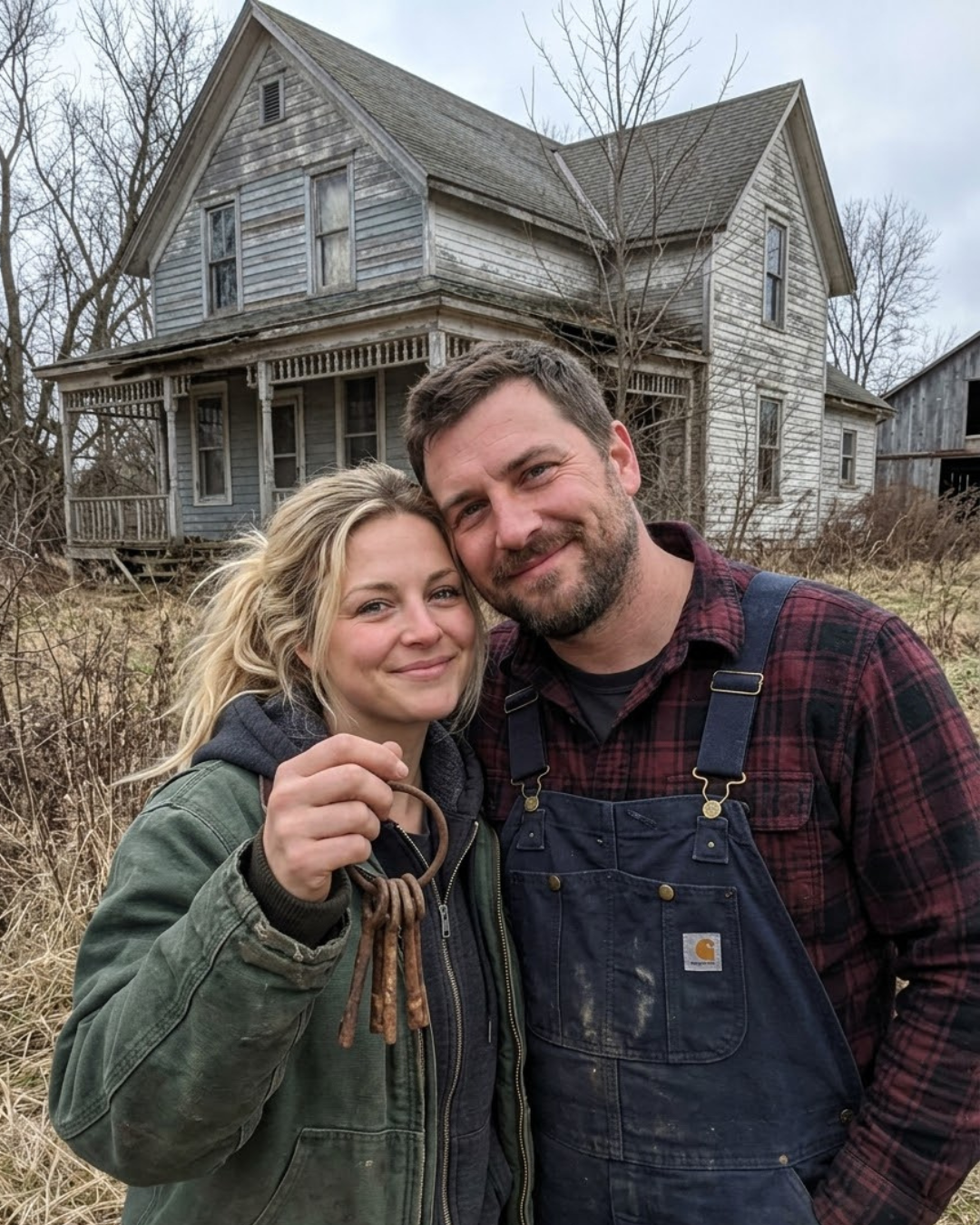
A tall white house, its paint fading gray.
The front porch sagged in the middle like an exhausted horse.
I drove Nate out there that evening.
The county wouldn’t allow prospective buyers inside before the auction.
You had to make your decision based on what you could observe from outside.
And whatever you bought, you accepted exactly as it stood.
Weeds reached my hips.
An old cistern stood beside the house, covered by a concrete lid.
Near it, a stubborn cluster of red shoots had begun pushing through the ground.
Nate walked slowly around the building.
He lay on his stomach and shone a flashlight beneath the porch.
Then he stepped back toward the road and studied the roofline.
He tilted his head the way he did when inspecting a driveshaft.
“Ridge is straight,” he said. “Foundation’s limestone, and it hasn’t moved. The porch is shot. And I bet the wiring’s older than Dad.”
He rubbed his jaw.
“Good bones, Em.”
I looked at the house.
“What would it go for?”
“What have we got?”
“Forty-two thousand and some change.”
“Then that’s what it’d go for,” he said. “Or it goes to somebody else.”
The auction took place on a Thursday morning in April.
Ten o’clock.
On the courthouse steps.
County property sales had been held there for as long as anyone could remember.
The auctioneer was a man named Dobbs.
He was around sixty, wore a tan windbreaker, and carried a clipboard.
His voice was powerful enough to reach the bank across the square.
About twenty people had gathered.
Most were interested in the vacant lots.
Near the front stood a landlord from the neighboring county.
He wore a quilted vest and kept his hands in his pockets.
I recognized him as a landlord by his boots.
They were far too clean to belong to a man who worked in fields.
I had taken a vacation day from the hospital.
Nate had come directly from a repair job, grease still covering his forearms.
The terms of the auction were printed on a sheet.
Full payment was due that day.
Certified funds were required.
The property came with no warranties.
The county deed would be mailed after recording.
In my purse was a cashier’s check for forty thousand dollars.
Beneath it was a bank envelope containing another two thousand in cash.
Much of our remaining savings had come from my tips.
I had never gotten around to exchanging all those twenties, fives, and ones for larger bills.
Dobbs read the parcel number aloud.
“House and two and three-tenths acres. Known locally as the Miller farm. Who’ll give me twenty thousand?”
The landlord in the quilted vest raised one finger.
“Twenty-five,” Nate said.
The bidding moved upward.
Thirty thousand.
Thirty-five.
Thirty-eight.
At thirty-eight thousand, the landlord stopped raising his finger.
He began calling out each number instead.
I took that to mean he was becoming more careful.
“Forty,” Nate said.
“Forty-one,” said the vest.
Nate looked toward me.
I had told him forty-two thousand was the absolute limit.
Beyond that, we would have nothing left.
Not enough for a furnace filter.
Not enough for a can of paint.
“Forty-one five,” Nate said.
Dobbs looked toward the landlord.
The man glanced down at his paperwork.
For a moment, I watched him consider whether that old farmhouse and its collapsing porch were worth another five hundred dollars.
Then he shook his head.
“Sold,” Dobbs said. “Forty-one thousand five hundred. Your name, sir?”
“Schafer,” Nate said. “Nathan and Emily. Both names.”
At the county clerk’s counter, I handed over the cashier’s check.
Then I counted fifteen hundred dollars from my envelope.
Most of it was in twenties.
At the bottom were fives and ones that still carried a faint smell of the truck stop fryer.
The deputy clerk counted everything twice.
She didn’t make a single remark.
I loved her for that.
She wrote out our receipt.
“The deed will come in the mail in six or eight weeks,” she said. “But the sheriff’s office had the keys from when they boarded up the back door.”
She pushed a manila envelope toward us.
“Nobody’s going to mind if you start mowing.”
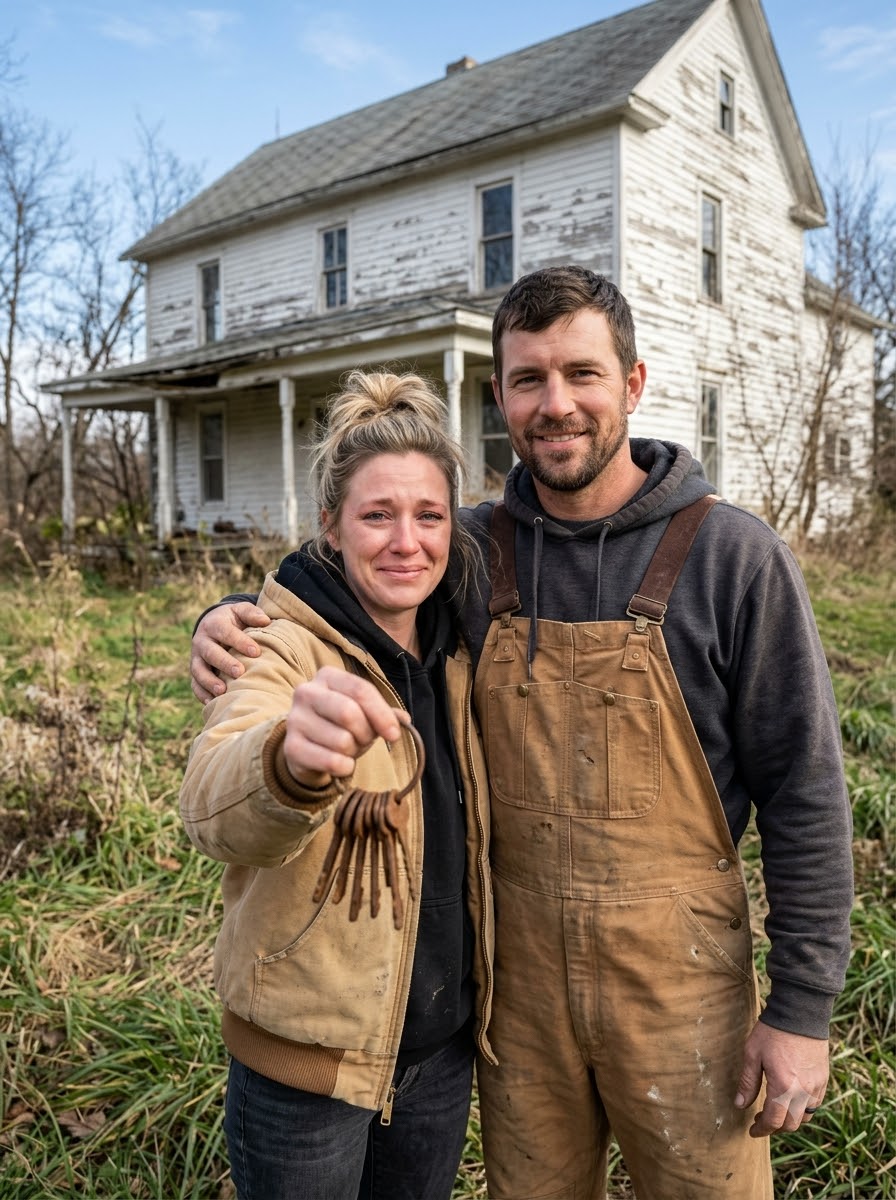
Inside was a ring holding seven old keys.
Two were skeleton keys.
None had labels.
We drove straight to the farmhouse with the truck windows rolled down.
At the foot of the porch steps, we stood holding the keys between us.
Nate’s hand was trembling.
So was mine.
“Capable,” he said.
“Don’t,” I said.
Then we both began laughing.
I laughed so hard that I had to sit on the lowest porch step.
Fortunately, it held.
We still didn’t tell anyone.
By then, silence had become more than a rule.
It was a habit.
And if I’m being fair, pride had something to do with it.
I wanted to invite everyone to dinner someday and give them an address.
I wanted them to see a finished house.
Not a request for help.
But that house was nowhere near finished.
The fourth key opened the front door.
The smell hit us immediately.
Mice.
Damp plaster.
And the lingering trace of someone’s old pipe tobacco.
A seed company’s calendar still hung on the kitchen wall.
It was turned to July, six years in the past.
Wallpaper peeled from the front room in long, curling strips.
The electrical fuse box was mounted in the cellar stairwell.
It supplied only sixty amps to the entire house.
When Nate removed the first fuse, he found a penny wedged behind it.
“Well,” he said. “That’s one way.”
Behind the plaster, the wiring was even worse.
Knob-and-tube.
Old cloth-covered wires threaded through porcelain supports.
Some of it was eighty or ninety years old.
The insulation crumbled like crackers.
Before becoming a diesel mechanic, Nate had completed two years of electrical training at vocational school.
He went to the county office and obtained a homeowner’s electrical permit.
With his first paycheck after the auction, he bought a new two-hundred-amp panel.
Then he began rewiring the house himself.
Every evening after work, he drove to the farmhouse.
He ate whatever supper I’d packed in a cooler.
Then he worked until eleven.
There was no usable electricity inside yet.
Only a temporary power pole outside.
So he wore a headlamp.
Room by room, he drilled through the old studs.
They were genuine oak two-by-fours, hard as iron.
He pulled new cable through the walls and secured it carefully.
I never saw him rush a single staple.
While Nate handled the electrical work, I stripped wallpaper.
There were five layers in the front room.
Beneath the oldest layer, someone had once written a column of numbers directly on the plaster.
A long-forgotten calculation, preserved behind decades of wallpaper.
I worked until the skin on my thumbs split.
Then I wrapped them in tape, went to my shift at the diner, and returned afterward.
I was still working both jobs.
The purchase had consumed nearly everything we owned.
And repairs weren’t free.
Electrical cable cost money.
So did a well pump.
A septic contractor.
A dumpster.
There was one evening in May when I sat on an overturned five-gallon bucket in what would eventually become our kitchen.
I only intended to rest my feet for a minute.
When I opened my eyes, an hour had passed.
My cheek was pressed against the plaster wall.
Nate’s work jacket covered my shoulders.
He hadn’t woken me.
He was standing on a ladder six feet away, still working.
His headlamp was turned down low so the light wouldn’t disturb me.
The county electrical inspector arrived during the first week of June.
His name was Larry.
He was a quiet man who examined every room with a flashlight and spoke fewer than ten words.
When he finished, he signed the inspection card and placed it in the front window.
“Who’d you say did this?” he asked Nate.
“I did.”
“Hm,” Larry said. “You want a job?”
The power company installed our meter that Friday.
Nate switched on the main breaker.
I stood in the kitchen and reached for the light switch.
One bare bulb flickered to life above the empty space where our kitchen table would someday stand.
I stared at it.
That single bulb felt brighter than every chandelier I’d ever seen.
The same week, my phone rang at my hospital desk.
“Emily. This is Opal.”
Opal was Nate’s grandmother.
Ron’s mother.
She was eighty-eight years old and lived in the senior apartments behind the Methodist church.
She still did her own laundry.
Every morning, she read the county newspaper from beginning to end using a magnifying glass.
Including the legal notices.
I’d always been a little intimidated by Opal.
She was small, upright, and never wasted words.
“Opal? Is everything all right?”
“The paper finally printed the trustee’s sales,” she said. “It says Schafer, Nathan and Emily, bought a house and two and three-tenths acres on the north road.”
She paused.
“Is that the Miller place?”
I glanced around the billing office as though someone might overhear us.
“Yes ma’am. We haven’t told anyone yet. We wanted to get it fit to see first.”
Silence.
It lasted so long that I wondered whether the call had disconnected.
Then Opal spoke.
“Come get me Sunday after church,” she said. “And don’t tell Ronald.”
I tried to explain.
“Opal, it’s not safe yet. The porch is bad. There’s plaster down everywhere.”
“I have walked on worse,” she said.
Then she hung up.
I had no idea why an eighty-eight-year-old woman would insist on seeing a dilapidated farmhouse before it was safe for visitors.
And I certainly didn’t understand why she wanted to keep the visit secret from her own son.
But that Sunday, at a quarter past eleven, I parked outside the Methodist church.
Opal came down the walkway wearing her navy dress and good shoes.
Her pocketbook hung from one wrist.
She allowed me to help her into the truck.
Then she sat with both hands folded over her purse.
She didn’t speak during the entire six-mile drive.
She stared straight through the windshield.
When I turned into the farmhouse lane, she made a small sound.
I thought the truck had jolted over a rut.
Nate was waiting in the yard.
He had cut back the weeds and laid two planks over the worst section of the porch.
He approached the truck to help his grandmother climb down.
She raised one hand.
“I can manage steps, Nathan.”
She refused my arm too.
Slowly, she crossed the planks, steadying herself against the porch post.
Then she stepped through the front door.
And I noticed something strange.
Opal didn’t look around like someone visiting a house for the first time.
She walked straight through the front room.
Turned left.
Then right.
She passed through a doorway where we hadn’t even installed a door yet.
Her feet seemed to know the route.
She stopped in the middle of the kitchen.
Directly beneath our single bare light bulb.
She looked at the window where the sink had once stood.
Then at the doorway leading to the small room off the kitchen.
The room Nate and I had been calling the back bedroom.
Finally, she walked to the pantry.
She placed her palm against the inside of its door frame, where the old varnish had darkened almost to black.
And she began to cry.
There was no sobbing.
No dramatic change in her expression.
Tears simply ran down her face.
In eleven years, I had never seen Opal cry.
Not even at her husband’s funeral.
“Opal,” I said. “What is it? Do you need to sit down?”
She was moving her thumb slowly down the wooden frame.
As though searching for something.
About four feet above the floor, her thumb stopped.
“Emily,” she said. “Did nobody ever tell you whose house this was?”
“The Millers’,” I said. “Dale Miller’s.”
She looked toward the little bedroom.
Then she said something that changed the meaning of every board, window, and nail in that house.
“The Millers bought this house at a sale in the fall of 1961,” Opal said. “They got it for a good deal less than it was worth. They were decent people about it. And I never held it against them.”
She drew a breath.
“Before that, it was Henry Brandt’s. My father’s. He built that porch himself. With his own hands.”
She pointed toward the small room.
“I was born in that room right there. In March of 1937. With a neighbor woman for a midwife. Because the roads were mud up to the axles, and the doctor couldn’t get out.”
Nate appeared in the kitchen doorway.
His cap was in his hand.
Opal didn’t look surprised to see him.
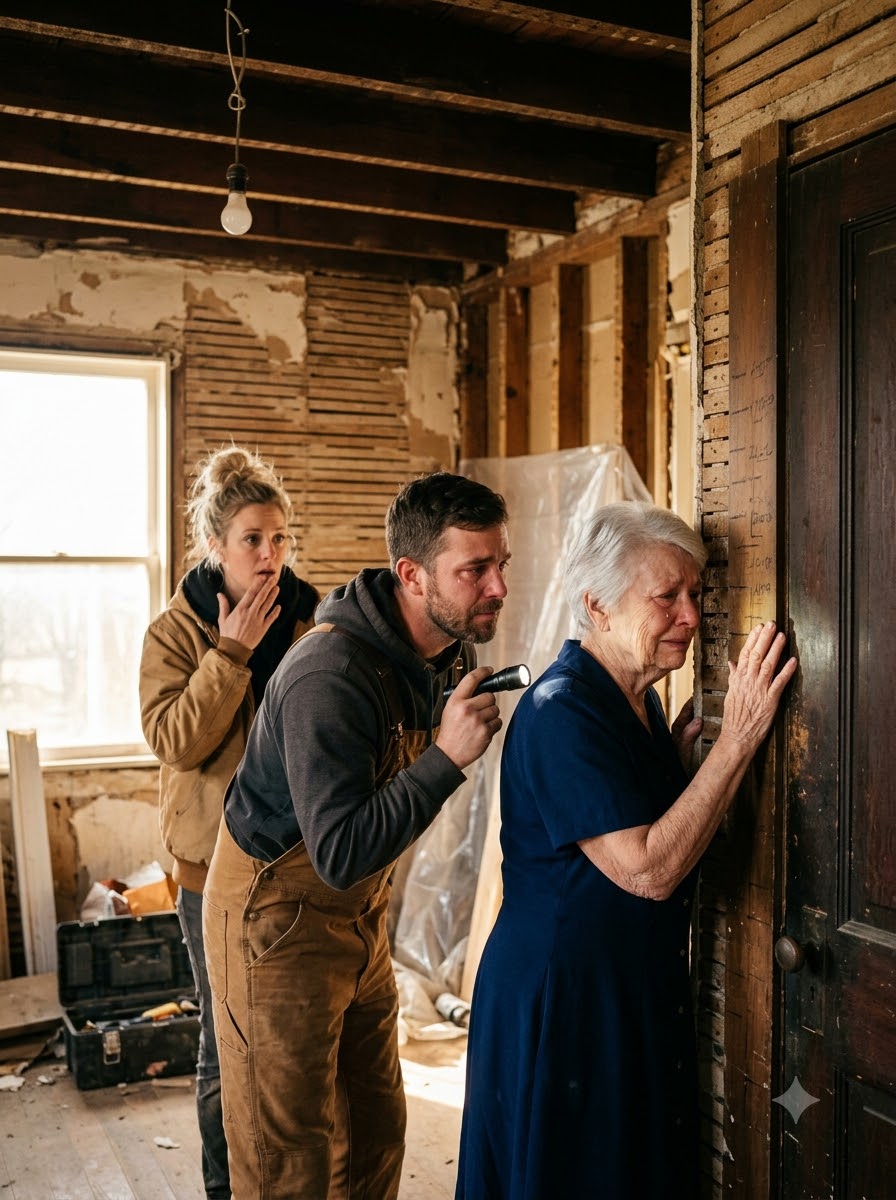
“Bring your light, Nathan,” Opal said. “Hold it here.”
He raised his headlamp toward the spot beneath her thumb.
And suddenly we could see them.
Pencil marks.
A ladder of short horizontal lines, one above another.
Beside each was a date written in a man’s square handwriting.
I had scrubbed that door frame a dozen times.
I thought the marks were scratches.
Nate began reading.
His voice trembled.
“Opal, six years, 1943.”
He lifted the light.
“Opal, nine years. Opal, twelve.”
Then he lowered it.
Near the bottom was another mark.
This one was written in a woman’s hand.
“Ronnie,” Nate read. “Four years. 1960.”
Opal touched the line.
“I made that one,” Opal said. “The next year, we were gone.”
And standing in the kitchen of the house we had bought with two years of exhausting work, she began telling us why Nate’s father had spent his entire life refusing to look at it.
PART 2
Opal insisted on telling the story while standing.
She wouldn’t sit until she’d finished.
Her father, Henry Brandt, had died in 1957.
He left the farm to Opal and her husband, Walt Schafer, Nate’s grandfather.
It had been a substantial property.
One hundred and sixty acres.
And the farmhouse where Opal had been born.
Walt was a hardworking man who wanted to make the farm more successful than it had been under his father-in-law.
He borrowed money against the property to purchase a new tractor and construct a building for hogs.
For a while, the future must have seemed promising.
Then two terrible years came one after another.
Disease spread through the hogs.
The losses mounted.
And the bank called the loan.
“They sold it right on the courthouse steps,” Opal said. “The same steps you two stood on.”
She turned toward the kitchen window.
“Walt stood out there in the yard the week after, while they auctioned off all the machinery. I stood right here in this kitchen so I wouldn’t have to watch. And Ronald was five years old. He stood out there holding his father’s hand the entire time.”
She pointed through the glass.
“I could see the two of them. Right through that glass.”
Nate stood motionless.
“Dad never said a thing,” Nate said. “Not one time. We drove past this house every single Sunday of my life on the way to Aunt Carol’s.”
Opal nodded.
“Your father has not turned his head toward this house since he was five years old,” Opal said. “Watch him sometime. He looks at the other side of the road. Walt did the same until the day he died.”
She slowly shook her head.
“They decided it was a shame. And they buried it. And I let them. Because back then, a man’s pride was about all he had left.”
Her fingers returned to the pencil marks.
“I am eighty-eight years old,” she said. “I had made my peace that I would never stand in my mother’s kitchen again.”
Then she looked from Nate to me.
“And you two children went and bought it with your own money. And told no one.”
Her gaze dropped to the tape wrapped around my thumbs.
“Whose money was it? Not Ronald’s.”
“No ma’am,” I said. “Ours. Two years of it.”
Opal studied us.
“I heard about the envelopes,” Opal said. “At Easter. I told Ronald at the time exactly what I thought about it. He said you two didn’t need it.”
Nate spoke quietly.
“We didn’t need it,” Nate said quietly. “That’s not the same as not wanting to be thought of.”
Opal gave one firm nod.
It was the way a teacher might acknowledge a child who had finally solved a difficult problem.
Then she allowed me to bring her the overturned bucket.
She sat on it in her good navy dress, right in the middle of her mother’s kitchen.
Nate knelt on the filthy floor.
And wrapped his arms around her.
I stepped outside onto the porch planks.
I needed a moment alone.
Beside the old cistern, the cluster of red shoots had grown larger.
I stood looking at it for a while.
Later, Opal told me what it was.
Rhubarb.
Her mother had planted it in 1931.
That little patch had survived the loss of the farm, the Miller family’s years there, and six seasons of abandonment.
It had been waiting beside the cistern the whole time.
Opal told Ron about our purchase herself.
I wasn’t present for that conversation.
What I know came from Judy afterward.
On Monday morning, Opal telephoned her son.
“Ronald. You will drive me out to my father’s house on Saturday.”
According to Judy, Ron tried to sit down in a kitchen chair without pulling it out first.
He nearly missed the seat entirely.
They arrived at ten o’clock that Saturday.
I watched Ron’s truck slow near the entrance to our lane.
Then it stopped on the blacktop.
It remained there for almost a full minute.
Finally, it turned in.
Ron Schafer was sixty-nine that year.
He was a large, square-shouldered man who had worked as a union carpenter for thirty-eight years.
He climbed out of the truck and helped Opal down.
Then he stood motionless in the yard.
His eyes moved from the cistern to the porch corner.
Then to an empty patch of grass beside the old machinery shed.
There was nothing there anymore.
But he stared as though he could still see something.
Judy had come with them.
She stood beside the truck, one hand pressed against her collarbone.
Nate climbed down from his ladder.
“Dad.”
Ron looked at him.
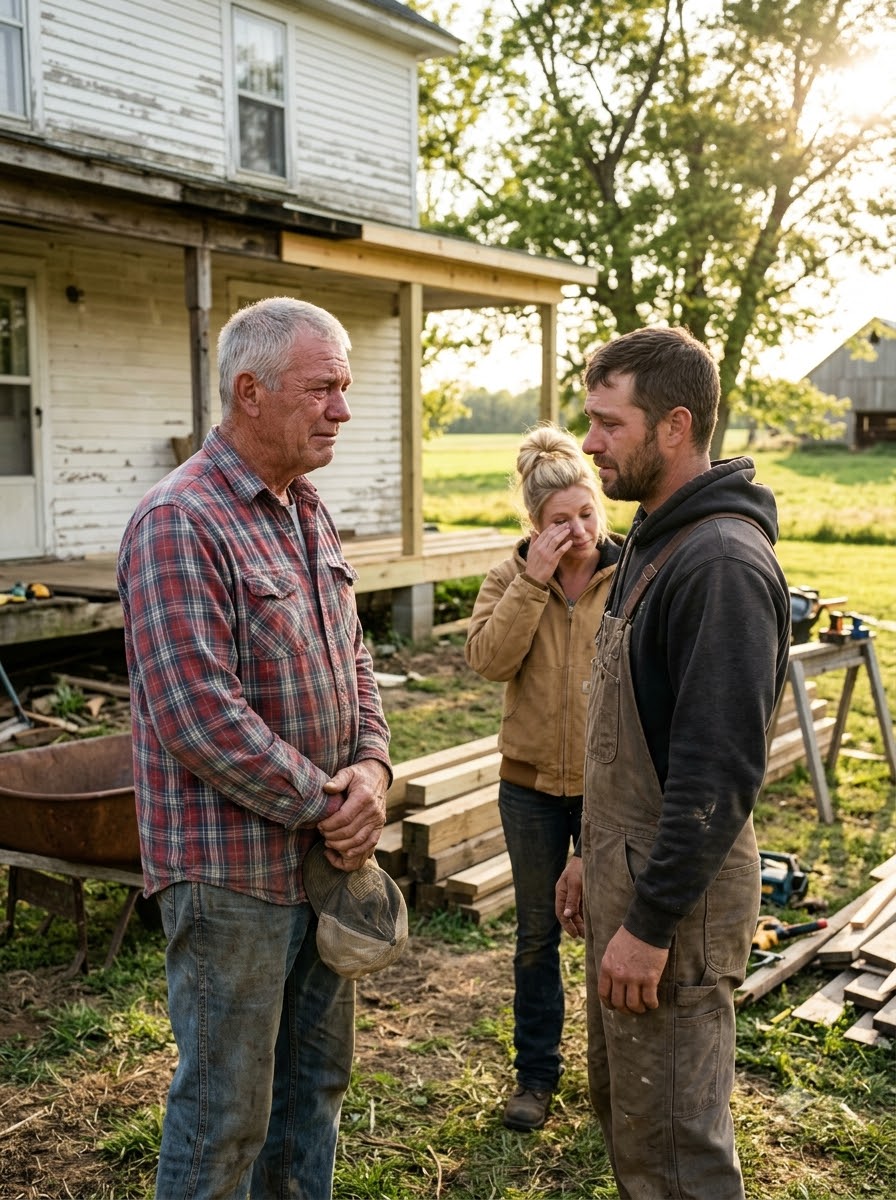
“You bought it,” Ron said. “You bought this place. And you never said one word to me.”
Nate shook his head.
“We didn’t know what it was. I swear to you. Nobody ever told me.”
“No,” Ron said. “I don’t guess anybody did.”
Opal walked inside alone.
Judy followed.
A minute later, I heard Judy crying in the front room.
The three of us remained outside.
Ron studied the damaged porch with a carpenter’s eye.
I could almost see him measuring the sagging beam and calculating what needed replacing.
Then his gaze moved to the new electrical meter.
The conduit ran perfectly straight.
Our inspection permit was visible in the front window.
“You do all that?” he asked Nate.
“Nights.”
Ron turned toward me.
“And she’s been out at the truck stop.” Ron nodded at me. “Judy saw her out there once. Carrying plates. I told her she had to be mistaken.”
He shook his head.
“Two years of that. You should’ve told us you wanted a house. We would’ve—”
He stopped.
Nate looked directly at him.
“You’d have what, Dad?”
There was no anger in his voice.
He was simply asking the question.
But Ron was standing in the same yard where he’d watched his father’s livelihood disappear when he was five years old.
I could see that memory written across his face.
He was struggling to find the right words.
And what came out was wrong.
“I don’t see what there is to be sore about,” Ron said. “We told you the truth. We said you were capable. Well. Look.”
He gestured toward the farmhouse.
“Look at this. Was I wrong? Kim was about to lose those boys’ roof. Jeff was going under. You two never needed one thing from anybody. And I was proud of it. And I said so. That card was the nicest thing I knew how to say.”
Nate lowered his eyes.
His ears were turning red again.
I hadn’t intended to say anything.
Two years earlier, I had thanked Ron and Judy for that card.
I’d planned to leave the matter there forever.
But I remembered waking up against the plaster wall with Nate’s jacket over my shoulders.
I remembered the empty patch of grass where his boat had once stood.
I looked at the tape on my thumbs.
And I spoke.
“Ron,” I said. “It was a nice thing to say. I know you meant it.”
I kept my voice quiet.
I didn’t want Opal to hear an argument inside the house where she’d been born.
“But capable people get tired too,” I said. “You just never hear about it. Because we’re the ones who don’t call.”
Ron looked at me.
“I’m not asking you for anything,” I said. “I didn’t then. I’m not now. I just want you to know it cost something. It didn’t come easy because we’re us. It came hard. And we did it anyway.”
I held his gaze.
“Those are two different things.”
Ron said nothing.
His jaw moved as though he were trying to find an answer.
Then he went inside and brought his mother back out.
He helped her into the truck.
Judy climbed in too.
They drove away.
Ron stared straight down the lane the entire time.
Nate put his arm around my shoulders.
“Well,” he said. “That’s said.”
I felt awful.
“I shouldn’t have said it.”
“You should’ve said it at Easter two years ago,” Nate said. “I should have.”
He kissed the top of my head.
There was sawdust in my hair.
“Come hold the ladder.”
And we went back to work.
The following Saturday, I arrived at the farmhouse at seven in the morning.
Nate was already there.
He told me that twenty minutes before seven, a truck had come up the lane.
His father’s truck.
The bed was packed with equipment.
Sawhorses.
A table saw covered with a tarp.
Two twenty-ton bottle jacks.
Cribbing blocks.
The old worm-drive saw Nate had been forbidden to touch as a boy.
And a four-foot carpenter’s level in a canvas sleeve.
When I reached the porch, Ron was lying on his back beneath it.
Only his boots were visible.
He slid out slowly.
Cobwebs clung to his eyebrows.
He stood, brushed himself off, and removed his cap.
“Emily,” he said. “I’d like to try that again. If you’ll let me. I’ve had a week to work on it. And I had my mother helping me. And she wasn’t gentle.”
I nodded.
“All right,” I said.
He pointed with his cap toward the empty patch of grass near the machinery shed.
“My dad stood right over there in 1961 and watched them sell his plow,” Ron said. “Not one soul put a hand out to him. Not his brothers. Not the church. Nobody.”
He turned his cap between his hands.
“I was five years old. And I made up my mind standing there. If a child of mine was ever going under, I’d be there with money in my hand before they ever had to ask.”
He looked at me.
“Kim was going under. Jeff was. Stacy had those loans. You two weren’t. So I figured I was done with you.”
He paused.
“I had it all worked out that help is for people who are drowning. It never once came into my head that help is for the ones who are swimming hard, too.”
His gaze moved toward the farmhouse.
“I gave you two a pat on the head. And I gave them the farm ground. And I called it a compliment. And you thanked me for it.”
His voice grew rough.
“I’ve thought about that thank you every night this week.”
I tried to interrupt.
“Ron—”
He raised his hand.
“Let me finish. I’ve only got it memorized the one way.”
It was the nearest thing to a joke I’d ever heard him make.
He took a breath.
“I’m not going to write you a check,” he said. “I could. Judy wanted to bring one this morning. But you’d be right to tear it up. And I’d be buying my way out cheap.”
He looked up at the old house.
“You two bought my grandfather’s house with tip money and a bass boat. A check from me now would just be me trying to put my name on it.”
He settled his cap back onto his head.
“What I can do is build. That front beam is rotted clean through, and the porch posts are standing on nothing. That porch is going to hurt somebody. And my mother means to sit on it.”
Then he looked me straight in the eyes.
“I’d take it as a kindness if you’d let me work on this house. Saturdays. As long as it takes.”
I couldn’t find my voice.
I simply nodded.
Ron turned toward the house.
“Nate,” Ron called. “Bring me that jack. And don’t you touch my saw.”
Nate grinned.
“I’m thirty-six years old, Dad.”
“Then you’re old enough to know better.”
And just like that, they went to work.
Ron returned for eleven Saturdays.
I know because I marked each one on the feed store calendar hanging from a nail in our kitchen.
It occupied the same spot where the old seed company calendar had hung.
During the first three Saturdays, Ron and Nate rebuilt the porch.
They raised the porch roof an eighth of an inch at a time using jacks and cribbing blocks.
They removed the rotted front beam.
Every failing post came out.
Ron refused to replace the old fir with treated pine.
Instead, he drove forty miles to a lumberyard where he found tongue-and-groove fir flooring.
He paid for it himself.
When I tried to object, he gave me a look.
“That’s lumber. Not a check.”
I closed my mouth.
He made new porch posts to match the one original post that could still be saved.
He turned them on his lathe at home during the evenings.
When he brought them out, they were wrapped carefully in a moving blanket.
He carried them as though they were newborn babies.
On the fourth and fifth Saturdays, he repaired the windows.
He removed the old sashes and laid them across sawhorses in the yard.
One by one, he reglazed them.
He taught me to use a putty knife properly, keeping the edge straight and smooth.
On the sixth Saturday, he hung doors.
During the seventh, eighth, and ninth Saturdays, he built kitchen cabinets.
They were simple cabinets.
Face-frame construction.
The same kind that had stood in that kitchen when his grandmother was young.
Before painting them, Ron asked Opal what color the originals had been.
“Cream,” she said. “With a green line.”
So he painted them cream.
Then he added the green line himself, slowly, with a quarter-inch brush.
He also refused to let anyone sand the pantry door frame.
He carefully masked the wood around the pencil height marks.
Then he varnished up to their edges.
And stopped.
Those marks remained untouched.
Judy began coming out every Saturday after that first visit.
She brought hot dinners in a roaster.
She also brought her sewing machine.
Over the following weeks, she made curtains for nine windows.
On the fourth Saturday, she found me alone near the pump.
She reached for my hands.
The tape was still wrapped around my sore thumbs.
She held both hands gently.
“I picked out that card,” she said. “I stood in the drugstore for a quarter of an hour, finding exactly the right one. I thought you’d keep it.”
Her chin trembled.
“I never once asked myself what it would feel like to open it at that table. In front of everyone. I’m so sorry, honey.”
I looked at her.
“I did keep it,” I told her.
And I had.
The bluebird card was still in a drawer at our rented duplex.
I hadn’t been able to throw it away.
It was both a reminder of how we’d been hurt and proof that Judy had meant to say something loving.
I understood that better now.
Kim arrived on the sixth Saturday with her two boys.
They spent the day pulling old nails.
Jeff came on the eighth Saturday with a borrowed trencher.
He dug a route for a new water line from the well.
Stacy came out and painted the entire upstairs.
We hadn’t asked any of them to help.
I suspected Opal had been making telephone calls.
Those Saturdays accomplished something between Nate and Ron that no conversation could have managed.
They rarely discussed their feelings.
They didn’t spend hours talking about the Easter dinner.
They simply worked beside each other.
One held a board.
The other measured it.
One reached for a tool.
The other handed it over.
And slowly, the silence between them changed.
Around the ninth week, I came around the corner carrying two glasses of iced tea.
I found Ron showing Nate how to fit a cabinet against an uneven wall.
Their heads were bent close together.
“Your great-grandfather never owned a level,” Ron was saying. “Look at this wall. The man built by eye.”
Then Ron laughed.
He was standing in the same yard where he’d watched his father’s farm equipment auctioned away.
But this time, his face was turned fully toward the house.
And he was laughing.
On the eleventh Saturday, the last of the tools were loaded back into Ron’s truck.
The porch was solid.
The windows were repaired.
The kitchen cabinets were finished.
The doors hung properly.
Ron removed the carpenter’s pencil from behind his ear.
Then he walked into the pantry.
He asked Nate to stand against the old door frame.
Above all the marks left by previous generations, he drew a new line.
Beside it, he wrote:
Nate, 36 yrs.
Then he added the year.
He handed the pencil to me.
I stood Ron against the same door frame.
And marked his height too.
It was such a small thing.
Just two pencil lines on an old piece of wood.
But I understood what they meant.
For decades, Ron had refused to look toward that house.
Now he was leaving his own mark inside it.
We gave notice at our rented duplex.
During the second week of October, we moved into the farmhouse.
That same day, I gave Patty my notice at the truck stop.
She cried.
Then she gave me a key to the pie case as a keepsake.
I considered it the highest honor that establishment could possibly award.
By Thanksgiving, the farmhouse finally felt like a home.
But we still had no idea what Opal would say when she sat down in her mother’s house with the entire family gathered around her.
PART 3
We decided to host Thanksgiving at the farmhouse.
Not because every room was perfectly finished.
There were still small repairs waiting.
There would probably always be something to fix in a house that old.
But the kitchen was warm.
The electrical system was safe.
The porch no longer sagged.
The windows closed properly.
And there was room for the family.
We arranged the Thanksgiving table in the little room just off the kitchen.
It was the only room downstairs large enough once all the table leaves had been installed.
But even if another room had been bigger, I think we would have chosen that one.
It was the room where Opal had been born in March of 1937.
The room where her mother had needed a neighbor woman to act as midwife because the muddy roads prevented the doctor from reaching the farm.
And now, nearly ninety years later, the same room was going to hold another family gathering.
Seventeen people came.
Kim brought her two boys.
They sat at a card table beside the main table, delighted to have a place of their own.
Jeff stood at the counter carving the turkey.
Ron claimed his hands were too tired to do it himself.
That wasn’t true.
He had spent eleven Saturdays rebuilding half our house.
But Jeff took the carving knife anyway.
Stacy helped carry dishes.
Judy moved between the kitchen and dining room, checking that everyone had enough to eat.
And Nate kept looking around the room with an expression I hadn’t seen on his face before.
It wasn’t quite pride.
Or relief.
It was something quieter.
For the first time, he was standing inside a home we owned.
A home he had helped rebuild with his own hands.
On the table was a bowl of rhubarb sauce.
Judy had made it using rhubarb from the patch beside the old cistern.
She’d cut it in June and kept it in her freezer.
The same rhubarb Opal’s mother had planted in 1931.
I kept looking at that bowl.
It seemed impossible that something planted before Opal was born could still be feeding her family.
The farm had been lost.
The Millers had lived there.
The house had stood empty for six years.
The porch had rotted.
The wiring had become dangerous.
And still, every spring, the rhubarb pushed its red shoots through the earth.
Opal arrived wearing her navy dress.
The same dress she’d worn the first day I brought her to see the house.
Nate carried her chair into the room himself.
He placed it at the head of the table.
She sat down slowly and looked around.
Her eyes moved across the cream cabinets and the thin green lines Ron had painted.
She looked at the curtains Judy had sewn.
Then she glanced toward the kitchen window.
I knew what that window meant to her.
In 1961, she had stood behind it while her husband’s machinery was auctioned in the yard.
Her little boy had stood outside holding his father’s hand.
She had watched through that glass because she couldn’t bear to stand beside them.
Now that little boy was sixty-nine years old.
And he was standing beside her chair, preparing to say grace.
Ron rested one hand on the back of Opal’s chair.
Everyone quieted.
Even Kim’s boys stopped talking.
Ron bowed his head.
“Lord,” he said. “We thank you for this house—”
Then he stopped.
His mouth moved slightly, but no more words came.
He stood there in his clean, pressed shirt.
A big man who had spent thirty-eight years working as a carpenter.
A man who could lift heavy beams, straighten crooked walls, and build cabinets that fit perfectly into a house where nothing was square.
But at that moment, he couldn’t finish a sentence.
Nobody moved.
Kim’s youngest son began to ask a question.
She gently touched his shoulder.
He fell silent.
Opal reached up.
She laid her small hand over Ron’s.
Then she continued the prayer.
“And for the children who brought us back to it,” she said. In a perfectly steady voice. “And for the ones who are tired, Lord, and do not say so. Teach us to look. Amen.”
Ron swallowed.
“Amen,” Ron said.
For a moment, the room remained quiet.
Opal looked down the long table.
She studied every face.
Her son.
Her grandchildren.
Their spouses.
The little boys sitting at the card table.
Then her gaze returned to the kitchen window.
The one through which she had watched her family lose everything.
“I was born six feet from this chair,” she said.
She paused.
Then she unfolded her napkin.
“Somebody pass me those potatoes.”
Everyone laughed.
And just like that, Thanksgiving dinner began.
There was turkey.
Potatoes.
Rhubarb sauce.
Too much food.
Too many people trying to talk at once.
Kim’s boys asked questions about the house.
Jeff told a story that made Stacy laugh so hard she nearly spilled her drink.
Judy kept insisting people take another helping.
Ron sat beside his mother.
And every so often, I caught him looking around the room.
He seemed to be memorizing it.
I thought about the Easter dinner two years earlier.
Back then, Nate and I had sat at his parents’ table watching everyone else open envelopes containing twenty thousand dollars.
We had opened a card.
A bluebird.
A compliment.
A reminder that because we were capable, nobody thought we needed anything.
That evening, Nate had driven us home past the dark fields and asked how much money we had saved.
Six thousand two hundred dollars.
That was where our journey began.
There had been no miracle.
No unexpected inheritance.
No wealthy stranger arriving to solve our problems.
There had been hospital billing claims, truck stop shifts, broken combines, and late-night repairs.
There had been eggs for dinner.
A bass boat sold without ceremony.
A farmhouse bought at a county auction for forty-one thousand five hundred dollars.
A cashier’s check and fifteen hundred dollars counted out in small bills.
There had been peeling wallpaper, dangerous wiring, and a bare bulb hanging above an empty kitchen.
There had been nights when I was too tired to remain awake.
And nights when Nate worked quietly beside me, careful not to disturb my sleep.
But there had also been Opal’s tears.
Ron’s apology.
Judy’s curtains.
Kim’s boys pulling nails.
Jeff digging the new water line.
Stacy painting upstairs.
And eleven Saturdays during which a father and son learned to work together again.
I hadn’t expected any of that when we first bought the house.
We had only wanted somewhere to live.
Instead, we had brought an entire family back to a place it had lost sixty years earlier.
After Thanksgiving, life settled into a different rhythm.
I was no longer waiting tables at the truck stop.
I still worked at the hospital.
Nate still repaired diesel engines.
We still watched our expenses.
Owning a house didn’t mean we suddenly had money to waste.
But we no longer paid rent on a duplex that would never belong to us.
When something broke, we repaired it because it was ours.
When we made improvements, we knew they would remain.
Sometimes I stood in the kitchen and looked at the cream cabinets.
At the green lines Ron had painted so carefully.
At the pantry door frame with its pencil marks.
Opal, six years, 1943.
Opal, nine years.
Opal, twelve.
Ronnie, four years, 1960.
And now Nate’s height, marked by his father.
Ron had allowed me to add his mark too.
There was something deeply comforting about that old door frame.
It held evidence of people who had lived, grown, struggled, and changed.
It reminded me that a home wasn’t simply a building.
It was a place where people could leave a mark and know it would remain.
The bluebird card had survived the move.
I kept it in a kitchen drawer with rubber bands, birthday candles, and other little things that never seemed to belong anywhere else.
Occasionally, I came across it while searching for something.
I never threw it away.
Judy had once told me how carefully she’d selected it.
How she’d stood in the drugstore for fifteen minutes looking for exactly the right words.
She had intended it as a compliment.
And in a strange way, the card had become part of the story of our house.
Not because it had given us the money to buy it.
But because it had helped us understand what we wanted.
We wanted a place of our own.
We wanted to be seen.
And we wanted our family to understand that being dependable didn’t mean we never needed care.
By February, I had begun thinking about the card for another reason.
There was something I wanted to tell Judy and Ron.
Something I wanted them to discover in a way they would remember.
I waited until I was certain.
Then one afternoon, I opened the kitchen drawer and took out the bluebird card.
The front was still bright.
Inside, Judy’s familiar handwriting remained exactly as it had been that Easter.
You two have always been so capable. We never worry about you. Love, Mom and Dad.
I read it again.
Then I picked up a pencil.
Beneath her message, I wrote one line.
We are still very capable. But come August, you will have somebody new to worry about.
I slipped the card into a fresh envelope.
Addressed it to Judy.
And mailed it back.
I didn’t call ahead.
I didn’t explain.
I simply waited.
Ron arrived at our front door within an hour of the card reaching them.
He had his carpenter’s level with him.
I opened the door and found him standing on the porch.
He didn’t make a grand announcement.
He didn’t ask a dozen questions.
He simply informed us that the upstairs back bedroom was going to need shelves.
Apparently, that was how Ron Schafer intended to prepare for becoming a grandfather again.
I stepped aside and let him in.
Nate was laughing before his father even reached the stairs.
Ron began examining the room, measuring the walls, and discussing where shelves might fit.
He had opinions about the best height.
The safest brackets.
The amount of storage a child would eventually need.
I watched him work and thought about the man who had once said Nate and I never gave him a day’s worry.
Now he had arrived with a level before we could even ask for help.
And this time, he wasn’t waiting for anyone to be drowning.
Before he left, Ron went into the pantry.
I found him standing in front of the old door frame.
He was looking at the height marks.
The ones his grandfather had begun.
The ones Opal had made.
The ones that had survived the sale of the farm.
The ones he had finally added to after returning home.
He stood there for a long time.
Then he lifted his level.
He measured the space above the existing marks.
And I understood what he was thinking.
There would be another child in this house.
Another birthday.
Another pencil line.
Another date written beside a name.
Someday, a little boy or girl would stand with heels against that old door frame while someone balanced a pencil above their head.
Maybe Ron would make the first mark.
Maybe Nate would.
Perhaps Opal would still be there to watch.
I hoped she would.
I thought of her mother’s rhubarb growing beside the cistern.
Of the porch Henry Brandt had built.
Of Walt and Opal losing the farm.
Of five-year-old Ronnie holding his father’s hand while the machinery was sold.
Of Ron spending a lifetime looking away whenever he passed the house.
And of Nate and me, unknowingly buying it with savings earned during two years of work.
All those years, the house had been waiting.
Not for us specifically.
But for someone willing to bring it back to life.
We had bought it because the foundation was sound and the roof ridge was straight.
We hadn’t known anything about the family history hidden inside its walls.
We hadn’t known that beneath the dark varnish on the pantry frame were pencil marks belonging to Nate’s grandmother.
Or that the little room off the kitchen was where she had been born.
Or that his father had spent sixty years carrying the memory of losing that place.
We only knew it was a house we could afford.
And that we were willing to work for it.
The Easter gifts had once made us feel forgotten.
But standing there now, I no longer thought about what we’d been denied.
I thought about what had returned.
A grandmother to her mother’s kitchen.
A father to the home he’d lost as a child.
A son to his father’s side.
And a family to a table large enough for everyone.
The card with the bluebird had begun as a compliment that hurt.
Now it had become the way we announced a new life.
I watched Ron measure the old door frame.
He was taking his time.
He always did when something mattered.
There was room on that door frame for a good many more marks.
He measured.
