

Part 1 — Abandoned in Kyoto
Something was wrong before I even opened my eyes.
The hotel room was far too quiet.
The space beside me, where my husband should have been sleeping, felt cold.
I opened my eyes and sat up immediately.
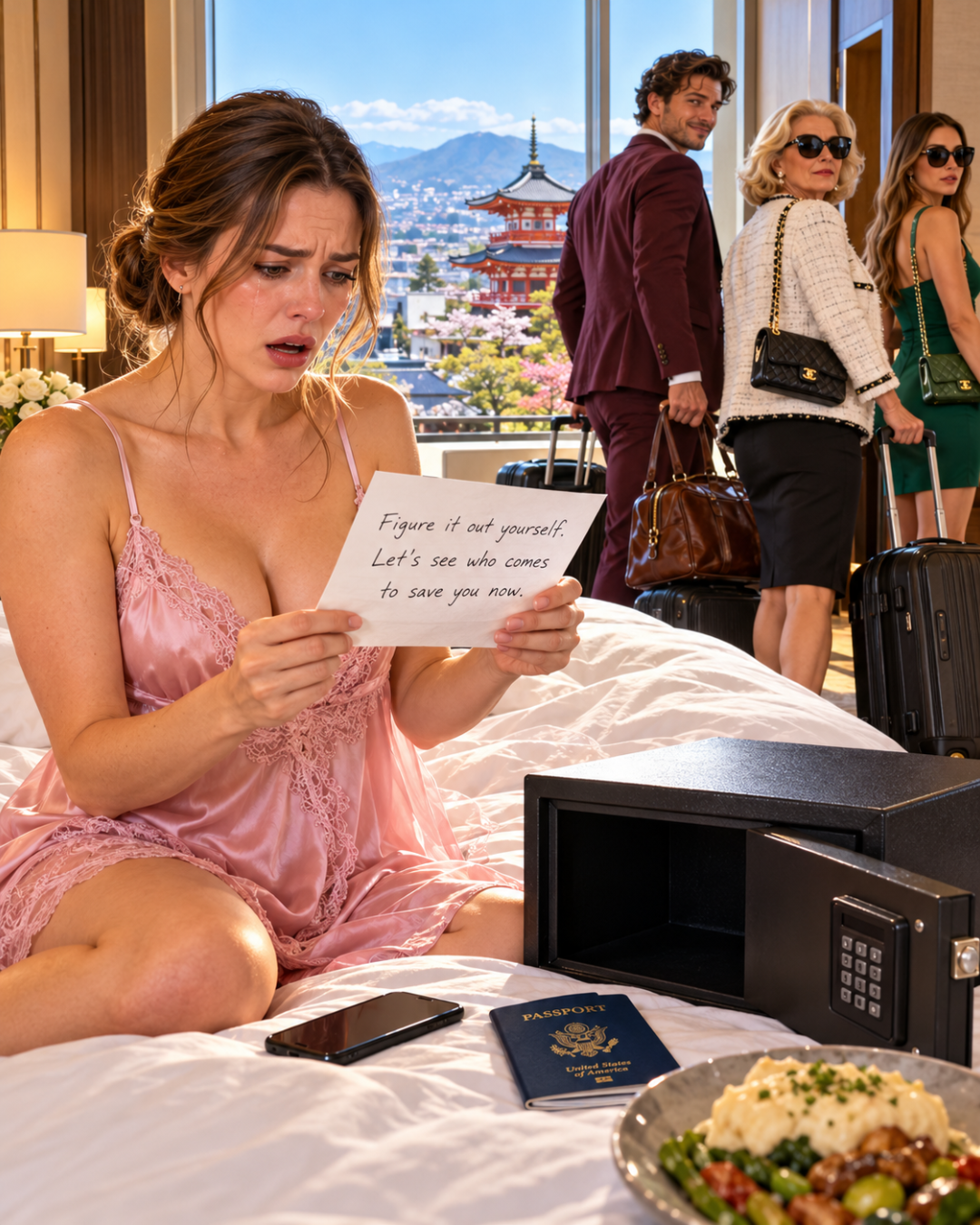
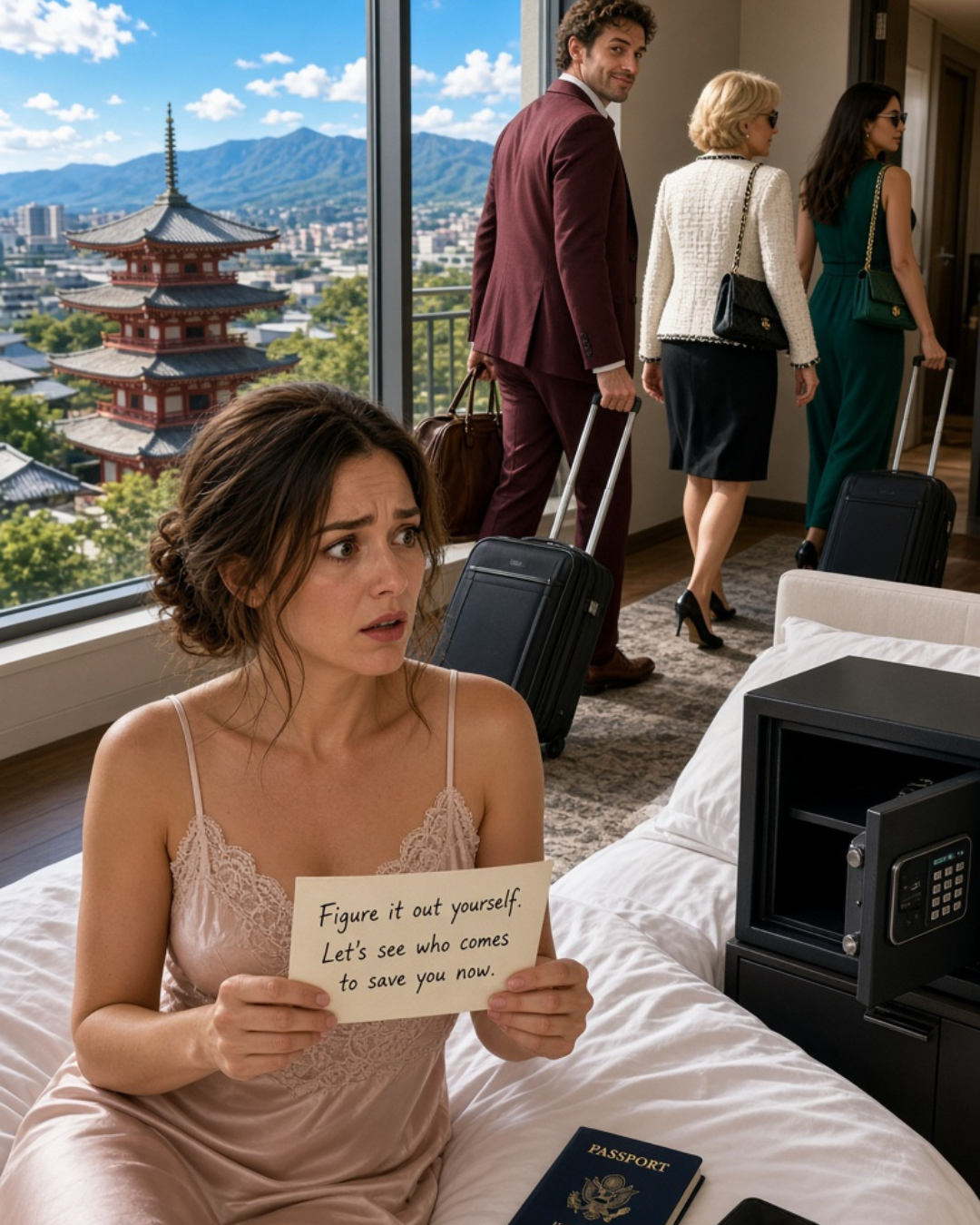
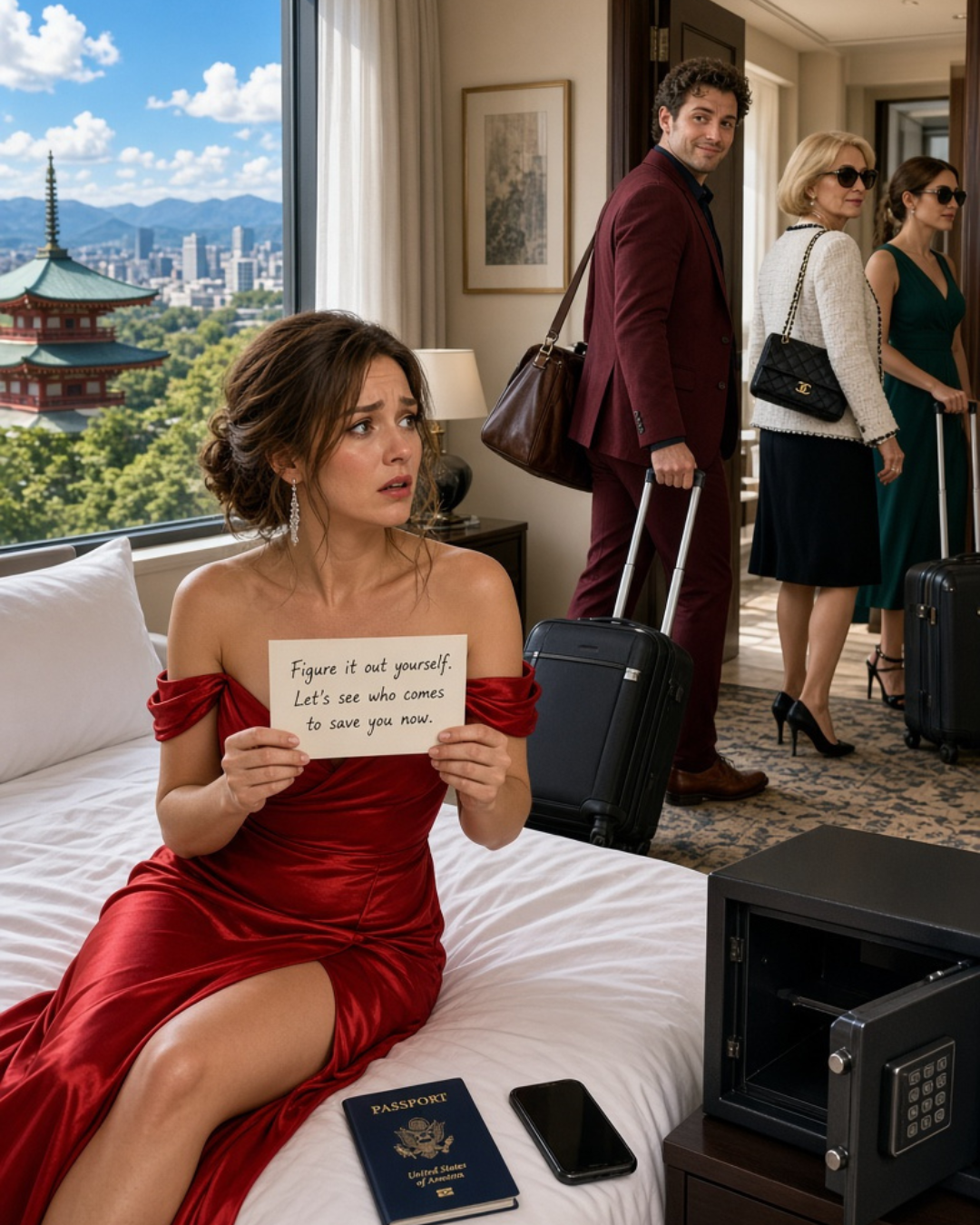
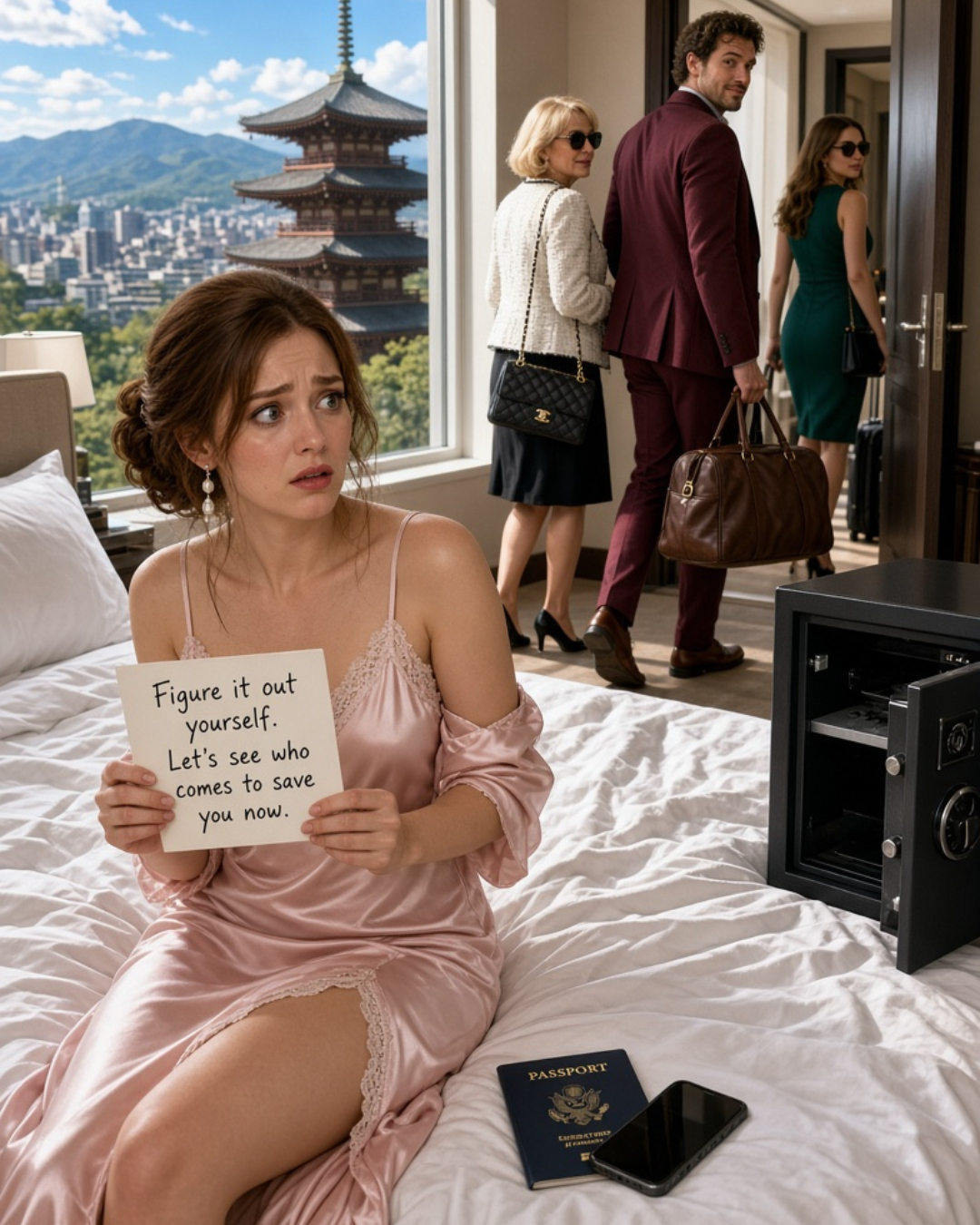
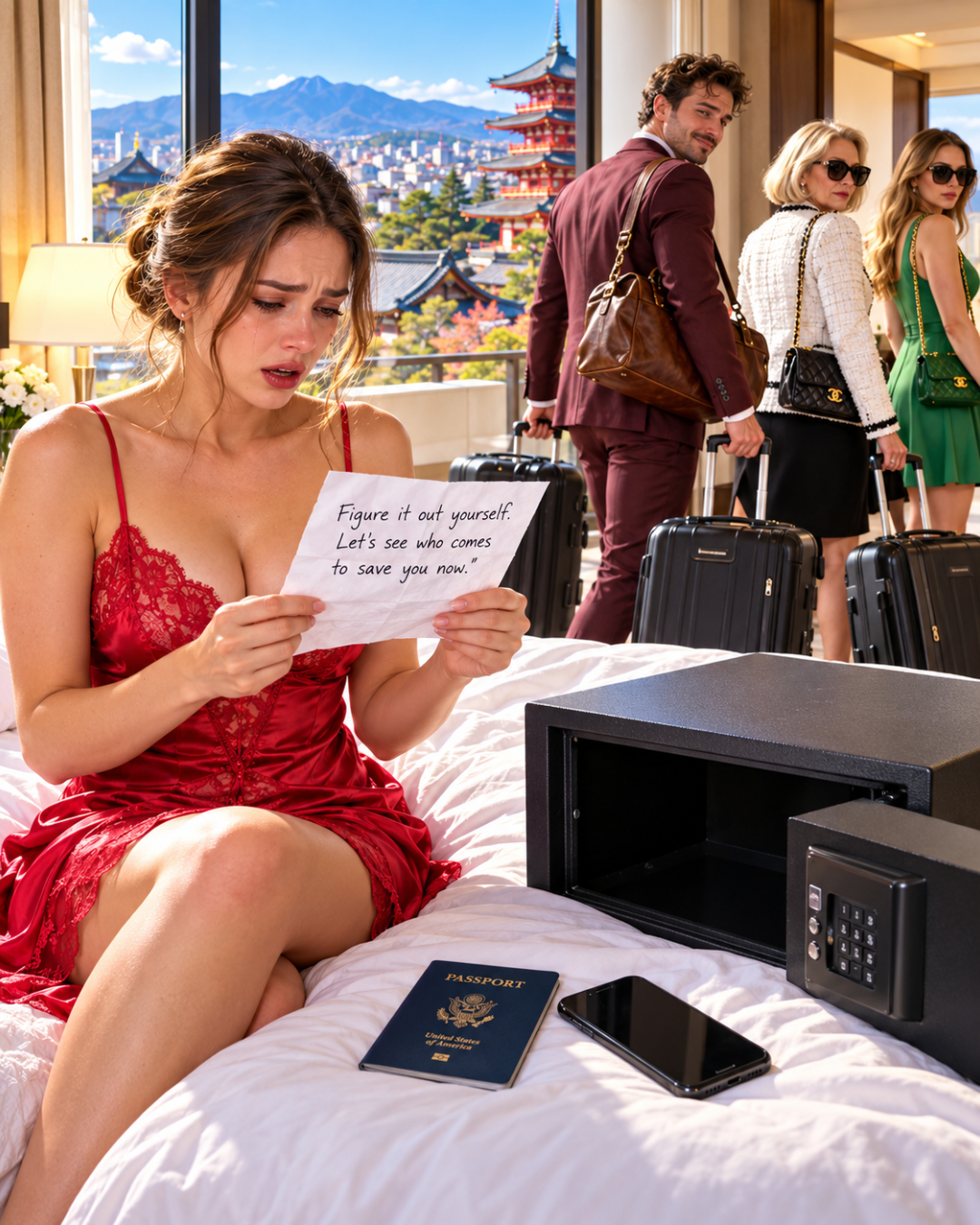
Derek’s suitcase was missing.
So were the bags belonging to his parents and sister.
My phone had disappeared from the bedside table, and when I checked the zippered pocket of my carry-on luggage, my passport was gone too.
My heart began racing.
Then I noticed two handwritten notes on the desk.
The first was from Derek.
You’re on your own. Deal with it.
The second was written in my mother-in-law Linda’s unmistakable handwriting.
Let’s find out who bothers coming to rescue you.
I stared at those words.
For several seconds, I couldn’t seem to draw a full breath.
Then the strange behavior from the previous evening came rushing back.
Linda had insisted that I finish the plum wine she’d ordered.
Derek had been unusually cheerful.
His sister Marissa had casually asked what time I normally woke up.
And his father had repeatedly checked the airline application while pretending to look for restaurant recommendations.
Suddenly, all those little details made sense.
They hadn’t acted spontaneously.
They had planned this.
I hurried to the hotel telephone and called reception.
The employee spoke limited English, but we managed to communicate.
“Yes, ma’am. Your relatives departed at 5:20 this morning.”
“And my flight reservation?”
A short pause followed.
“I’m sorry. Your booking was canceled.”
I closed my eyes.
After three years of marriage, Derek had finally done what his family had wanted for a long time.
He’d helped them prove that they could abandon me whenever they chose.
His parents had never approved of my independence.
I earned more money than Derek.
The house we lived in had belonged to me before our marriage.
And I’d refused to add his name to the deed, something his family had repeatedly criticized.
Throughout our vacation, Linda had made comments about my being too independent to behave like a proper wife.
Now I understood what they’d meant by teaching me a lesson.
They believed they’d left me in a foreign country with no passport, no phone, no accessible money, and no flight home.
They expected me to panic.
They expected me to beg.
They probably imagined me calling them in tears, apologizing for every boundary I’d ever set.
But they had overlooked one important detail.
For eight years, I’d worked as a corporate security director for an international logistics company.
My job involved responding to emergencies across twenty-two countries.
Missing travel documents.
Emergency evacuations.
Financial fraud.
Security breaches.
Compromised devices.
Unexpected international crises.
I’d dealt with all of them professionally.
And because of that experience, I knew exactly what to do.
I also had something Derek knew nothing about.
An emergency verification phrase that I’d memorized specifically for situations involving compromised personal security.
I went downstairs and asked the hotel staff for permission to use a computer.
Once I was seated, I accessed my employer’s protected emergency portal.
A security question appeared.
Emergency verification phrase?
I entered the six-word code.
BLACK MAPLE. LEVEL THREE. FAMILY COMPROMISE.
Then I pressed Enter.
The screen turned red.
A notification appeared.
CRISIS PROTOCOL ACTIVATED.
I stared at the confirmation.
For the first time since waking up, I felt completely calm.
My husband and his family thought they’d left me helpless.
They had no idea what they’d actually set in motion.
I studied the message before whispering to myself, “Now we’ll find out who really needs rescuing.”
Less than four minutes later, a secure messaging window opened.
Maya Chen, our regional security director in Tokyo, appeared on the screen.
“Claire, have you been hurt?”
“No.”
“Is anyone preventing you from leaving?”
“No. My husband and his relatives took my passport and phone, canceled my return flight, and departed without me.”
Maya’s expression hardened.
“Was any company-owned equipment involved?”
“My phone has corporate authentication applications and encrypted access to client systems.”
Her entire demeanor changed.
Derek had probably imagined that stealing my phone would merely prevent me from contacting anyone.
But the device contained protected corporate authentication applications.
By taking it without permission, he’d potentially created an international security incident.
And unlike a family argument, that was something my employer could not ignore.
Maya instructed me to remain at the hotel.
Within thirty minutes, two representatives arrived.
One was a bilingual attorney appointed by my company.
The other was a security specialist carrying a sealed emergency identification package.
Because my passport had been taken rather than accidentally misplaced, they began coordinating with Japanese authorities and my embassy.
At the same time, our security department remotely disabled every corporate credential associated with my missing phone.
The device Derek had taken was no longer useful for accessing company systems.
Then Maya asked another question.
“Where are they traveling?”
“Los Angeles.”
“Do you know their flight?”
I smiled slightly.
Derek had been so proud of upgrading his parents to business class using rewards from our shared travel account that he’d announced the flight details several times.
Of course I knew which aircraft they were on.
Maya’s team contacted airline security before the flight reached Los Angeles.
Meanwhile, I received access to a secured device so I could examine my financial accounts.
That was when I discovered that stealing my phone and passport hadn’t been Derek’s only mistake.
At 4:47 that morning, he’d transferred $42,000 out of our shared emergency savings account.
The transaction description was almost unbelievable.
FAMILY REIMBURSEMENT.
I stared at it.
Then I nearly laughed.
For months, Derek had argued that his parents deserved financial compensation for supposedly supporting our marriage.
Apparently, he’d decided that abandoning me in Japan was the perfect opportunity to pay them.
Unfortunately for him, he’d chosen the wrong account.
Those savings were designated for documented household emergencies under our postnuptial agreement.
Yes, Derek and I had signed a postnup.
And apparently, he’d forgotten what it said.
That wasn’t entirely surprising.
He had a habit of signing documents without reading them carefully.
Our agreement included provisions concerning deliberate theft, fraudulent behavior, concealed marital assets, and interference with my employment security.
Violating those provisions could trigger immediate financial separation and responsibility for applicable legal expenses.
By moving $42,000 from the emergency account while leaving me stranded abroad, Derek had created a financial record that would be very difficult to explain.
At 11:15 that morning, my attorney in California joined our conference call.
“Claire, we’ve reviewed your travel account activity. Derek canceled your reservation alone, then used your saved payment information to rebook his relatives on an earlier flight.”
“Can you identify which device accessed the account?”
“We have the device identifier.”
It was Derek’s personal tablet.
The same tablet registered to our household network.
The one he always insisted he never used for banking or financial matters.
Every action he’d taken was leaving a trail.
By the time his flight was crossing the Pacific, I already had arrangements underway for replacement travel documentation.
A new return flight had been booked.
My missing corporate phone had been disabled remotely.
The suspicious $42,000 transfer had been reported.
And my attorney had prepared a formal legal notice.
Derek, meanwhile, was probably enjoying his business-class flight, congratulating himself for teaching me a lesson.
Then, at 3:06 that afternoon, Maya forwarded an email.
Derek had sent it to my corporate address using the aircraft’s onboard Wi-Fi.
The subject line read:
Hope You Learned Something
The message itself was brief.
Perhaps you’ll finally realize you’re nowhere near as powerful as you imagine.
I leaned back in my chair.
“Oh, Derek,” I murmured.
“You really should have checked who actually held the power.”
He believed the worst part of his plan was already over.
He thought I was still trapped in Kyoto, trying to figure out how to get home.
What he didn’t realize was that by the time he landed in Los Angeles, the consequences of his decisions would already be waiting for him.
Part 2 — The Homecoming He Never Expected
Two days later, I returned to Los Angeles.
I was exhausted, but I wasn’t frightened anymore.
My travel documentation had been addressed through the appropriate emergency procedures.
My company had secured its systems.
My attorney had organized the necessary records.
And the financial investigation was already underway.
Derek had left me in Japan expecting me to be helpless.
Instead, I’d returned with documentation of nearly everything he’d done.
When I arrived at the house we’d shared, I found him standing outside the front entrance.
More precisely, he was standing there because his key no longer worked.
The locks had been legally changed.
I’d purchased the property four years before our wedding, and it had remained in my name.
My attorney had already begun separation proceedings and obtained temporary protective orders concerning the property, my finances, and company equipment.
Derek looked furious.
Linda stood nearby, glaring at me as though I were the person who’d done something wrong.
“This whole thing is absurd,” she complained. “We were only trying to teach you a lesson.”
I looked directly at her.
“You took my passport without permission.”
Her expression tightened.
“We only wanted to make sure you couldn’t leave immediately.”
“That’s still theft.”
For a moment, she had no response.
Derek stepped forward.
“You blocked the bank accounts!”
“I secured my individual accounts. The shared emergency account was restricted after your forty-two-thousand-dollar transfer.”
His face darkened.
“That money was supposed to help my parents!”
“I’m aware.”
He stared at me.
I could almost see him trying to understand why I wasn’t crying or begging him to come home.
He’d expected to be the person making demands.
Instead, he was standing outside a house he didn’t own, trying to explain a transfer he had no right to make.
My attorney approached and handed him a folder.
Inside were copies of our postnuptial agreement.
The bank transaction records.
The hotel’s written report.
Documentation concerning my missing passport.
Airline booking records.
And the email he’d sent from the plane.
Derek began looking through the documents.
At first, he appeared irritated.
Then confused.
Then visibly worried.
With each page, his confidence weakened.
The folder contained far more than accusations.
It contained records.
Dates.
Transactions.
Device identifiers.
And written evidence of his intentions.
He’d thought taking my phone and passport would make it impossible for me to act.
Instead, his actions had created exactly the kind of evidence my attorney needed.
But there was another consequence Derek hadn’t considered.
The phone he’d taken contained company authentication applications and encrypted access to protected client systems.
As a result, my employer had initiated an internal security investigation.
The report documented that Derek had knowingly removed a device containing restricted business credentials.
He’d transported it without authorization.
And he’d prevented me from reporting the incident immediately by leaving me without a means of communication.
For my company, that was a serious matter.
For Derek, it became even worse.
He worked for one of my employer’s contracted vendors.
That connection meant the security investigation could affect his professional responsibilities.
Three days later, the vendor suspended him while reviewing the findings.
A week afterward, his employment was terminated for breaches of contractual security and professional conduct requirements.
I didn’t have to call his boss.
I didn’t have to invent accusations.
I didn’t have to exaggerate what happened.
The investigation documented his actions, and his employer made its own decision.
Linda, however, saw things differently.
She called me in a rage.
“You’ve ruined my son’s career!”
I answered calmly.
“No, Linda. He made his decisions. The investigation simply documented them.”
She threatened to sue me.
My attorney told her that her lawyer was welcome to contact our office.
No such call ever arrived.
The financial investigation continued.
Eventually, the bank reversed the $42,000 transfer.
The money Derek had labeled as family reimbursement was returned.
Our postnuptial agreement also became central to the separation proceedings.
Because of the conduct documented during the Kyoto incident, Derek was responsible for most of the legal expenses associated with our separation.
He challenged the matter for three months.
He argued.
He resisted.
He tried to avoid the financial consequences.
But the records were difficult to dispute.
Finally, his own attorney advised him to reach a settlement.
Throughout those months, I kept remembering the two notes left in our Kyoto hotel room.
Derek’s message.
You’re on your own. Deal with it.
And Linda’s.
Let’s find out who bothers coming to rescue you.
They’d written those words believing I would be frightened and powerless.
They’d expected humiliation to make me obedient.
Instead, they’d revealed how little they understood me.
For eight years, my job had required me to remain calm during emergencies.
I’d learned to document problems before reacting emotionally.
I’d learned to protect sensitive information.
I’d learned to contact the right people and follow established procedures.
Derek knew what I did for a living.
He simply never respected it enough to understand what it meant.
He saw my independence as an insult.
His family saw it as a flaw they needed to correct.
They resented that I earned more.
They resented that I owned the house.
They resented that I refused to surrender financial control merely to make Derek feel important.
And when I wouldn’t change, they decided to punish me.
What they never considered was that leaving someone stranded overseas without identification was more than a cruel prank.
It had legal, financial, and professional consequences.
Consequences that couldn’t be undone by calling the entire thing a lesson.
I didn’t enjoy watching Derek lose his job.
I didn’t celebrate Linda’s anger.
But I wasn’t going to accept responsibility for decisions they had made deliberately.
The final time I saw Derek, we were seated in a conference room overlooking downtown Los Angeles.
He looked tired.
The confidence he’d displayed in Kyoto was gone.
The man who had once believed he could abandon me and fly home without consequences now seemed exhausted by the process he’d created.
For a while, he said very little.
Then he looked at me.
“Did you really need to take things this far?” he asked.
I folded my hands on the table.
“You abandoned your wife overseas without identification and left a message telling her to figure everything out herself.”
He lowered his eyes.
I stood.
“So that’s exactly what I did.”
And with that, I walked away.
I didn’t need another argument.
I didn’t need him to admit that his family had been wrong.
I didn’t need an apology he might never sincerely offer.
The legal settlement was moving forward.
My finances were secure.
My career remained intact.
And the house I’d owned before marrying him was still mine.
Derek had wanted to make me understand how powerless I was without him.
Instead, he’d demonstrated exactly how much I could accomplish on my own.
For the first time in three years, I no longer felt the need to defend my independence.
I could simply live it.
Part 3 — The Lesson I Actually Learned
Six months later, I returned to Japan.
This time, I traveled alone.
There was no family itinerary to follow.
No one criticizing my choices.
No husband checking whether I was being independent enough to offend his parents.
No mother-in-law making comments about what a proper wife should do.
I arranged the trip myself.
I carried my passport.
I had my own telephone.
My own travel plans.
And complete control over when I would leave and where I would go.
One morning, I wandered through Kyoto as the sun rose.
The city was quiet.
Soft morning light touched the streets.
And for the first time, I could appreciate the place without associating it entirely with the worst betrayal of my marriage.
I thought about the morning Derek abandoned me.
The cold space beside me in the hotel bed.
The missing luggage.
The empty place where my phone should have been.
The realization that my passport had disappeared.
The two notes waiting on the desk.
I remembered how frightened I’d been for those first few seconds.
Not because I didn’t know how to handle an emergency.
But because the people responsible were supposed to be my family.
A stranger stealing my belongings would have been frightening.
A husband deliberately doing it, with his parents and sister helping him, was something else entirely.
They hadn’t simply left me behind.
They’d arranged the circumstances to make me feel helpless.
They wanted me to experience fear.
They wanted me to understand that they could take away my sense of security whenever they pleased.
And they expected me to thank them when they eventually decided to help.
I had spent three years trying to maintain peace with Derek’s family.
I listened to Linda’s remarks about my independence.
I tolerated the criticism about earning more than my husband.
I explained why I wasn’t adding Derek to the deed of a home I’d purchased before our marriage.
Again and again, I tried to make them understand that having boundaries didn’t mean I loved Derek less.
But they didn’t want an explanation.
They wanted control.
And when they couldn’t persuade me to surrender it voluntarily, they tried to frighten me into doing so.
That realization hurt more than the financial losses or legal proceedings.
Because it meant the marriage I’d believed I was protecting hadn’t been the marriage Derek wanted.
He didn’t want a partner who could stand beside him as an equal.
He wanted someone who would feel grateful for his approval.
Someone whose independence could be treated as a problem.
Someone who would eventually give in when his family applied enough pressure.
For a long time, I’d wondered whether I could have handled things differently.
Perhaps I could have ignored more of Linda’s comments.
Perhaps I could have tried harder to make Derek feel comfortable with my career.
Perhaps I could have been less defensive whenever his family questioned my finances.
But standing in Kyoto again, I understood that none of those changes would have solved the real problem.
My independence hadn’t caused Derek to steal my passport.
My salary hadn’t forced him to take my phone.
Owning my home hadn’t made him cancel my flight.
And refusing to put his name on the deed hadn’t required him to transfer $42,000 out of our emergency savings.
Those were decisions he made.
Deliberately.
With the help of people who believed I deserved to be humiliated.
I could acknowledge that truth without continuing to punish myself for it.
By then, Derek had moved into a modest apartment near his parents.
Linda continued telling relatives that I’d exaggerated what happened in Kyoto.
According to her version, the entire incident had been an innocent family disagreement that I’d transformed into something much larger.
But once the circumstances became known, fewer people believed her.
The hotel records existed.
The canceled reservation existed.
The bank transfer existed.
The security investigation existed.
And Derek’s email, sent from thirty-five thousand feet above the Pacific, still existed.
Perhaps you’ll finally realize you’re nowhere near as powerful as you imagine.
That sentence had once been intended to hurt me.
Now, when I remembered it, I could almost smile.
Because the truth was that I’d never needed to prove I was more powerful than Derek.
I simply needed to be capable of protecting myself.
And when the emergency came, I was.
That winter, I received a promotion at work.
It felt especially meaningful after everything that had happened.
The same career Derek’s family had criticized had helped me navigate the crisis they’d created.
The skills I’d spent years developing had given me options when they tried to take mine away.
I didn’t need to boast about it.
The promotion itself was enough.
To celebrate, Maya sent me a bottle of plum wine.
When I opened the package, I found a handwritten note attached.
FOR EMERGENCIES ONLY.
I laughed.
Of all the things she could have chosen, she’d sent the same kind of wine Linda had insisted I drink on the night before the abandonment.
But this time, the bottle represented something completely different.
There was no manipulation.
No hidden plan.
No family waiting for me to become vulnerable.
Just a gift from someone who had answered my emergency call when I needed professional help.
I poured myself a glass and watched the evening lights spread across the city.
I thought about how quickly everything had changed.
One morning, I’d awakened alone in a Kyoto hotel room with my passport and phone missing.
My husband and his family had flown home without me.
They’d canceled my reservation.
They’d taken money from our shared emergency savings.
And they’d left handwritten messages intended to humiliate me.
They expected me to be desperate.
Instead, I’d contacted my company’s security team.
I’d protected my professional credentials.
I’d arranged the necessary documentation.
I’d secured my finances.
I’d involved the appropriate authorities and legal representatives.
And I’d returned home prepared to address what they’d done.
The consequences that followed weren’t the result of some elaborate revenge scheme.
They came from the records Derek had created through his own choices.
The unauthorized transfer.
The missing company-authenticated device.
The canceled flight.
The written message.
The postnuptial agreement he’d signed.
The professional obligations he’d violated.
He had believed he could control the story by leaving me without a telephone or passport.
But the facts existed whether or not he wanted them examined.
That was what ultimately mattered.
I also realized something about the meaning of being rescued.
Linda had written:
Let’s find out who bothers coming to rescue you.
She intended those words to make me feel unwanted.
As though my value depended on whether someone else cared enough to come for me.
But being able to protect myself didn’t mean I had to handle everything without help.
Maya helped me.
The company attorney helped me.
The security representative helped me.
My California attorney helped me.
The hotel staff assisted me.
Professionals followed the procedures that existed for exactly this kind of emergency.
I hadn’t been powerless.
And I hadn’t been alone.
The difference was that I didn’t have to beg the people who had harmed me to undo what they’d done.
I could turn to people who understood the situation and knew how to respond.
That distinction changed the way I thought about my marriage.
Derek had wanted me dependent on him.
He’d wanted to be the person who decided when I deserved help.
When I deserved access to money.
When I deserved to travel.
When I deserved to feel safe.
But genuine love doesn’t work that way.
A loving partner doesn’t create an emergency just to enjoy being the one who ends it.
A loving partner doesn’t steal your identification to teach you humility.
And a loving family doesn’t leave you stranded overseas to test whether you’ll come crawling back.
For years, I’d defended my independence as though it were something I needed to justify.
Now I understood that it had never required an apology.
I could love someone and still own my home.
I could be married and still have a career.
I could support a family without surrendering control of my finances.
I could accept help without becoming helpless.
And I could walk away from a relationship that demanded fear as the price of belonging.
Kyoto no longer felt like the place where my marriage had been destroyed.
It felt like the place where I’d finally seen that marriage clearly.
The first time I’d visited, Derek’s family had controlled the itinerary.
The second time, I decided where to go.
The first time, I’d awakened frightened and confused.
The second time, I walked through the city feeling calm.
The first time, they’d taken my passport.
The second time, it remained safely in my possession.
And the first time, Derek had believed he was teaching me a lesson.
He had.
Just not the one he intended.
He taught me that someone who loves control more than partnership can become dangerous when boundaries are enforced.
He taught me that financial independence is not something to be ashamed of.
He taught me that preparation matters.
And he taught me that I should never confuse a person’s willingness to rescue me with their willingness to keep me safe.
Those lessons stayed with me long after the separation was finalized.
I finished my glass of plum wine.
Outside, the city lights glowed against the evening sky.
I thought about Derek.
About Linda.
About the note they’d left on the hotel desk.
About the confident email he’d sent from the plane.
And about how certain they’d been that I would have no choice but to beg for help.
They’d wanted to prove that nobody would come to my rescue.
In one respect, they’d been right.
I hadn’t needed someone to rescue me.
I already knew how to protect myself.
