

PART 1
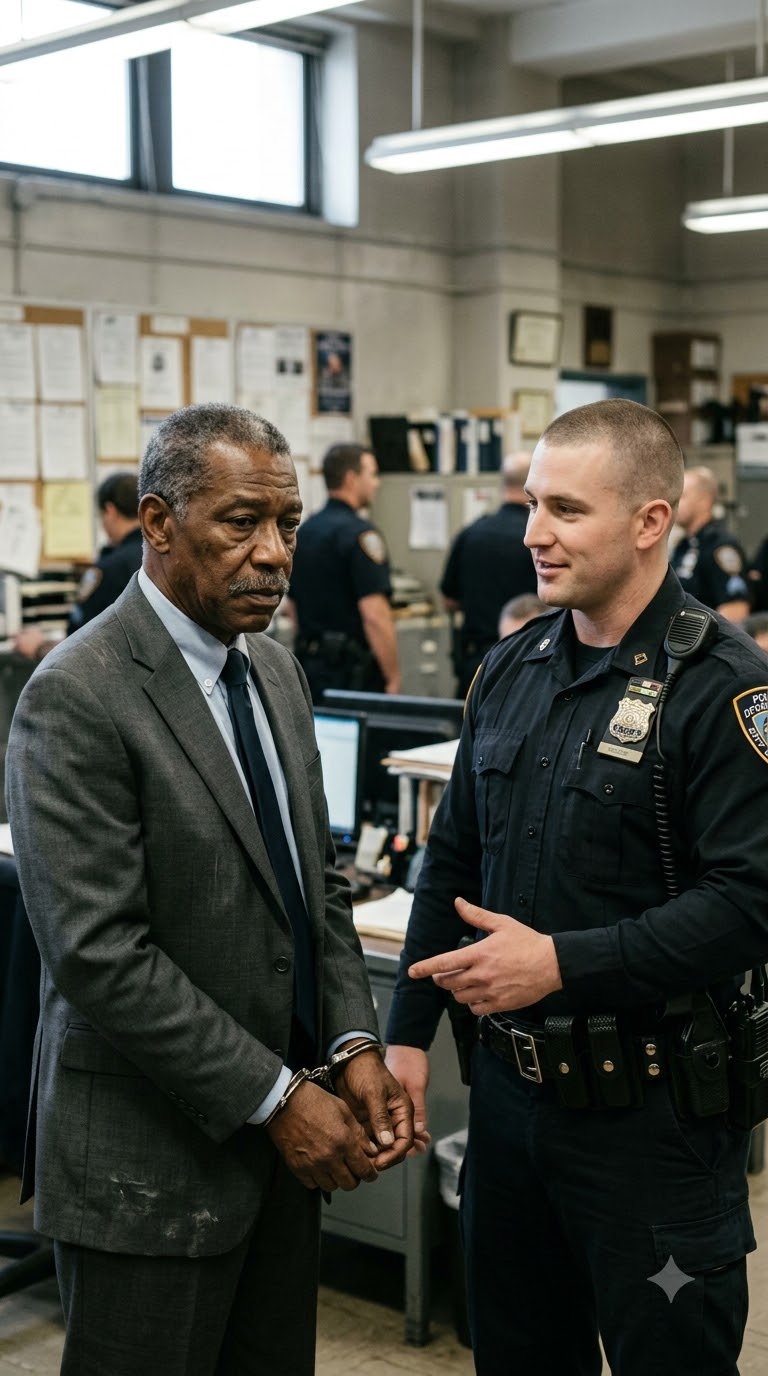
At 7:41 on a Monday morning, the handcuffs clicked into place around Marcus Hale’s wrists. Nineteen minutes later, he was supposed to introduce himself as the Briar Glen Police Department’s new chief.
The lobby of the police department in Briar Glen, Ohio, was smaller than Marcus had pictured. Fluorescent lights hummed above him, casting a pale glow over a front desk crowded with computer monitors, coffee cups, charging cables, and a plastic tray stuffed with paperwork. A wooden bench rested against one wall beneath framed photographs of former police chiefs. At the far end of the room, a frosted-glass office door still bore a brass nameplate that had not yet been updated. Marcus had been told his name would be installed sometime that week.
He certainly hadn’t expected to enter his new office in handcuffs.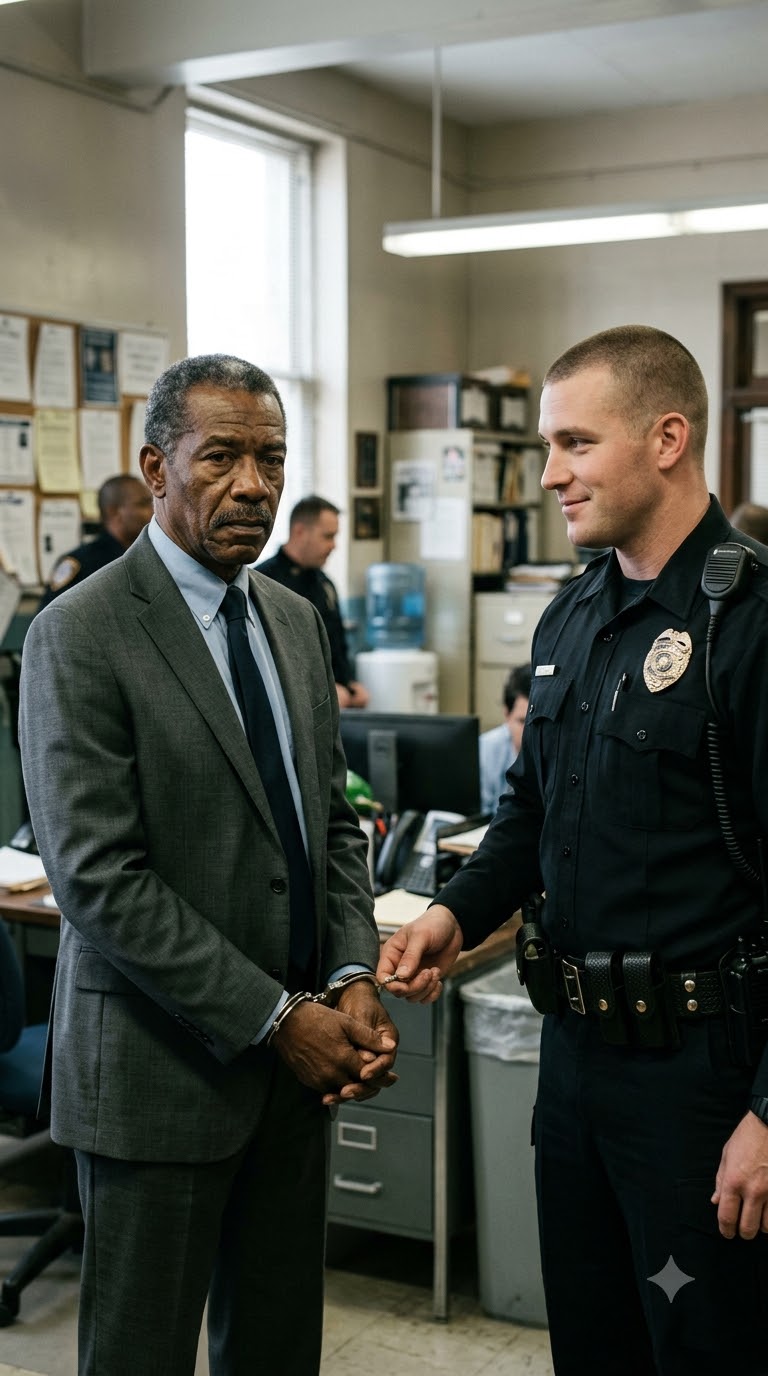
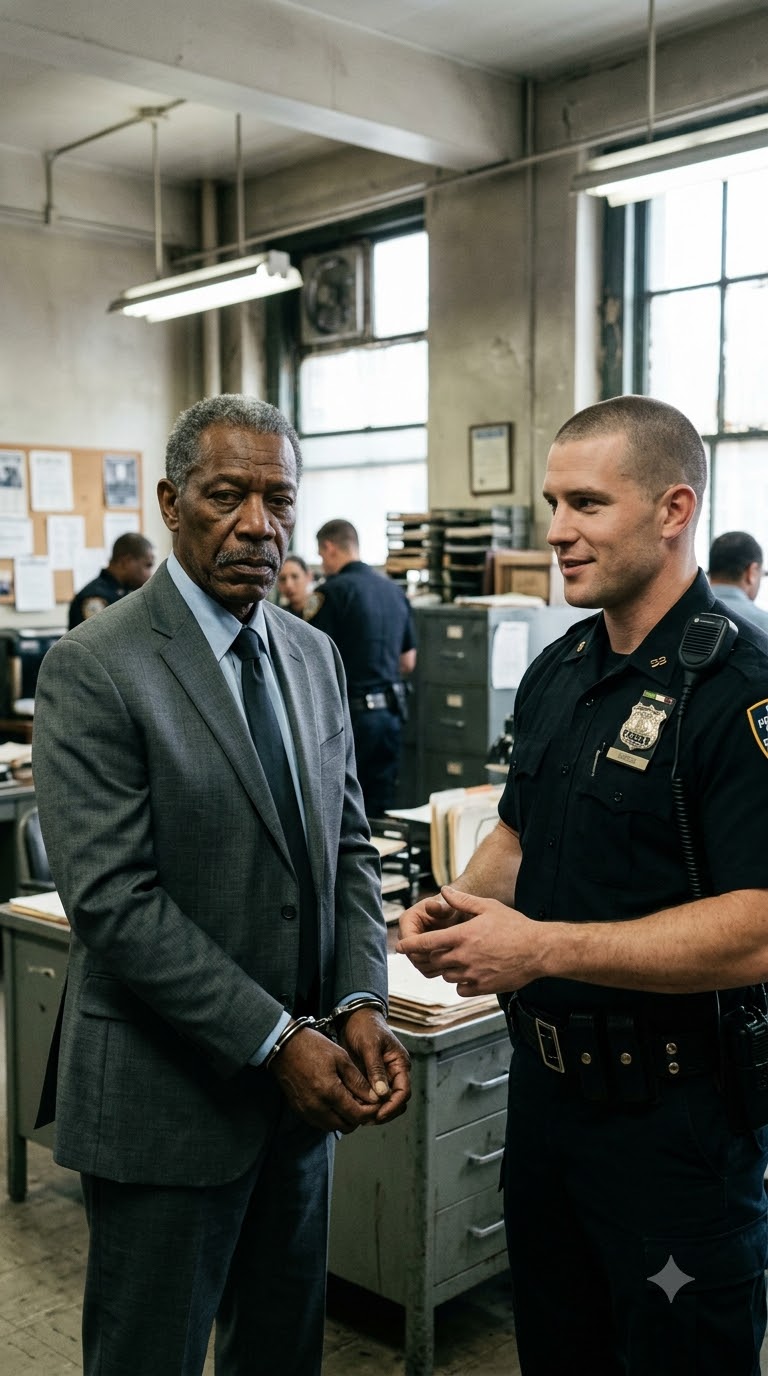
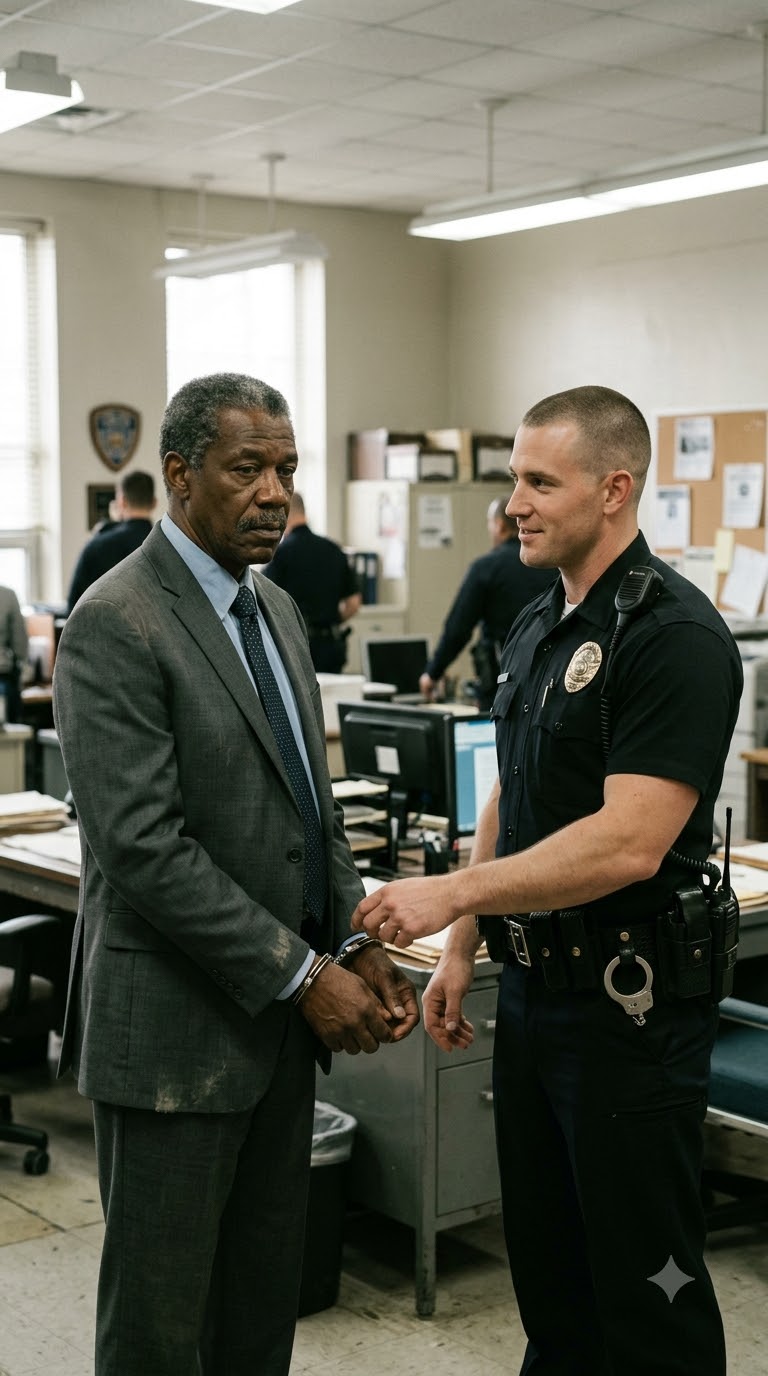
He stood in the middle of the lobby wearing a well-tailored gray suit, a white shirt, a navy tie, and polished black shoes. His brown leather briefcase sat on the floor beside his right foot. At fifty-eight, Marcus carried himself with a quiet precision that often led people to underestimate how much he noticed. His short gray hair was neatly trimmed, his mustache carefully groomed, and his expression so controlled that it seemed to irritate Officer Kyle Mercer almost immediately.
Kyle, thirty-one, was broad-shouldered and wore his hair in a buzz cut. He already had a grin on his face, as though the morning had unexpectedly provided him with some entertainment.
“Restricted area, pal,” he said, tightening the cuffs by one notch. “Sit down.”
Marcus looked directly at him without displaying any anger.
“Call City Hall. Ask for my name.”
Kyle’s grin widened.
“Sure. And while we’re at it, maybe we’ll ask if the governor sent you.”
Behind the front desk, Officer Jenna Walsh stopped typing. At thirty-two, with brown hair secured in a tight bun, she had the tired posture of someone who had already answered three absurd questions before eight in the morning. Two other officers standing near the report counter glanced toward the commotion. One raised his eyebrows. Neither intervened.
When Kyle ordered him to sit, Marcus lowered himself onto the wooden bench, resting his cuffed hands in his lap. His briefcase remained on the tiled floor where it had fallen when Kyle seized his arm.
The leather had collected scratches along its corners over the years, and under the fluorescent lighting, its worn brown surface appeared almost black. Marcus’s late father had given it to him twenty-seven years earlier, when he had been promoted to lieutenant. Since then, Marcus had carried it into precincts, city halls, funerals, budget meetings, crime scenes, and even a hospital waiting room where his wife had died before sunrise.
He watched Kyle nearly kick the briefcase aside as the officer returned to the front desk.
“Careful with the case,” Marcus said.
Kyle laughed.
“You worried about your résumé?”
Marcus didn’t answer.
Jenna glanced between the two men.
“What exactly happened?”
“He walked past the public counter toward the admin hallway,” Kyle explained. “Wouldn’t identify himself properly. Says City Hall knows him.”
“I gave you my name,” Marcus replied.
Kyle turned around.
“You gave me a name. That’s different.”
Marcus held his gaze for a moment before looking away. He had encountered men like Kyle throughout his career, men who mistook eye contact for defiance and silence for weakness. Experience had taught Marcus that the fastest way to understand a room was often to stop trying to win it.
Jenna reached for the desk telephone.
“What name?”
“Marcus Hale.”
Kyle leaned against the counter and called toward the two officers at the back.
“Guy thinks he’s the mayor.”
One of them laughed automatically. The other remained quiet.
Jenna dialed City Hall’s direct line, keeping her eyes on Marcus as the call connected. He recognized the instant the person on the other end understood what she was asking. First, Jenna’s shoulders stiffened. Then the color drained from her face.
“Yes,” she said slowly. “He’s here.”
A pause followed.
“No, ma’am. I understand.”
Another pause.
Jenna rose from her chair.
“Kyle,” she said, her voice suddenly thin, “he’s the new chief.”
Kyle’s smile disappeared.
The atmosphere changed so abruptly that Marcus could almost feel the air shift around him. One officer in the background lowered his coffee cup. The other glanced at the rear office door before looking back at Marcus. Jenna remained standing behind the counter, the telephone pressed to her ear.
“He starts today,” she added.
Kyle stared at Marcus as if the quiet man on the bench had somehow become an entirely different person.
“Chief?”
Marcus said nothing.
Kyle fumbled for the handcuff key. His fingers shook so badly that he missed the keyhole on his first attempt. Finally, the cuffs sprang open with a faint metallic click.
Red impressions circled Marcus’s wrists.
He didn’t rub them or make any comment.
Kyle stepped back.
“Sir, I—”
Marcus rose, bent down, and picked up his briefcase. With his thumb, he brushed a small speck of dust from the leather.
“Briefing at eight,” he said. “Everyone.”
His voice never rose, and he didn’t look at Kyle.
Instead, he walked past the front desk, opened the rear office door, entered, and closed it behind him.
For nearly ten seconds, nobody in the lobby moved.
Inside the office, Marcus set his briefcase on the desk and rested both hands against the wooden surface. The room smelled faintly of furniture polish and old paper. Cardboard boxes still covered part of the floor, left behind by the retiring chief, Ray Connelly, who had departed three days earlier after twenty-two years with the department.
A city employee had arranged a clean legal pad and two pens in the center of the desk. Beside them lay a temporary keycard, a building map, and a welcome folder from Mayor Evelyn Brooks.
Marcus lowered his gaze to the red marks around his wrists.
He had been stopped, questioned, searched, doubted, and underestimated before. Some of that came with the profession. Some of it came with being a Black man in rooms where people believed authority was supposed to look a certain way.
Over the years, he had learned not to turn every insult into a crusade. Anger could turn a long career into a succession of battles that others would remember inaccurately. He had seen good officers lose sight of their responsibilities because they allowed personal pride to dictate their decisions.
But this morning was different.
Not because he was the new chief.
It was because he had watched four officers decide that Kyle’s confidence mattered more than taking a moment to verify the facts.
His phone vibrated on the desk.
Mayor Brooks.
He answered.
“Hale.”
“Marcus, I am so sorry.”
“I’m in the office.”
“I heard what happened.”
“That was fast.”
“Jenna called my assistant. My assistant called me. Kyle apparently handcuffed the man whose appointment I spent six months defending to council.”
Marcus almost smiled.
“That does make the story travel.”
“I can come over.”
“No.”
“You sure?”
“Yes. Let me handle my department.”
Silence lingered on the line before the mayor responded.
“That sentence is exactly why I hired you.”
Marcus looked toward the frosted glass. Shadows moved on the other side as officers began arriving for the shift change.
“Give me until noon,” he said.
“You have it.”
After ending the call, Marcus opened his brown leather briefcase. Inside were three things he had carried with him on every first day that mattered: a photograph of his father in a Cleveland police uniform, an old fountain pen that no longer worked properly, and a folded index card his wife, Elaine, had slipped into his academy notebook thirty-five years earlier.
He unfolded the card.
You don’t have to be louder than the room. You just have to know why you’re standing in it.
Marcus read the words twice.
Then he placed the card beside the legal pad, took a seat, and began writing.
He did not write Kyle Mercer’s name.
He wrote three words across the top of the page.
Facts. Accountability. Culture.
At eight o’clock, every officer on duty was seated in the briefing room.
Marcus entered carrying his briefcase and the legal pad. He had removed his suit jacket and draped it over his arm, but otherwise, he looked exactly as he had when he first entered the building.
The room fell silent as he approached the front.
Some officers looked uncomfortable. Others appeared curious. Kyle sat in the second row, his back rigid, his hands clasped between his knees. Jenna sat near the aisle, looking as though she had been awake all night.
Marcus set down his briefcase.
“Good morning.”
A scattered chorus of greetings answered him.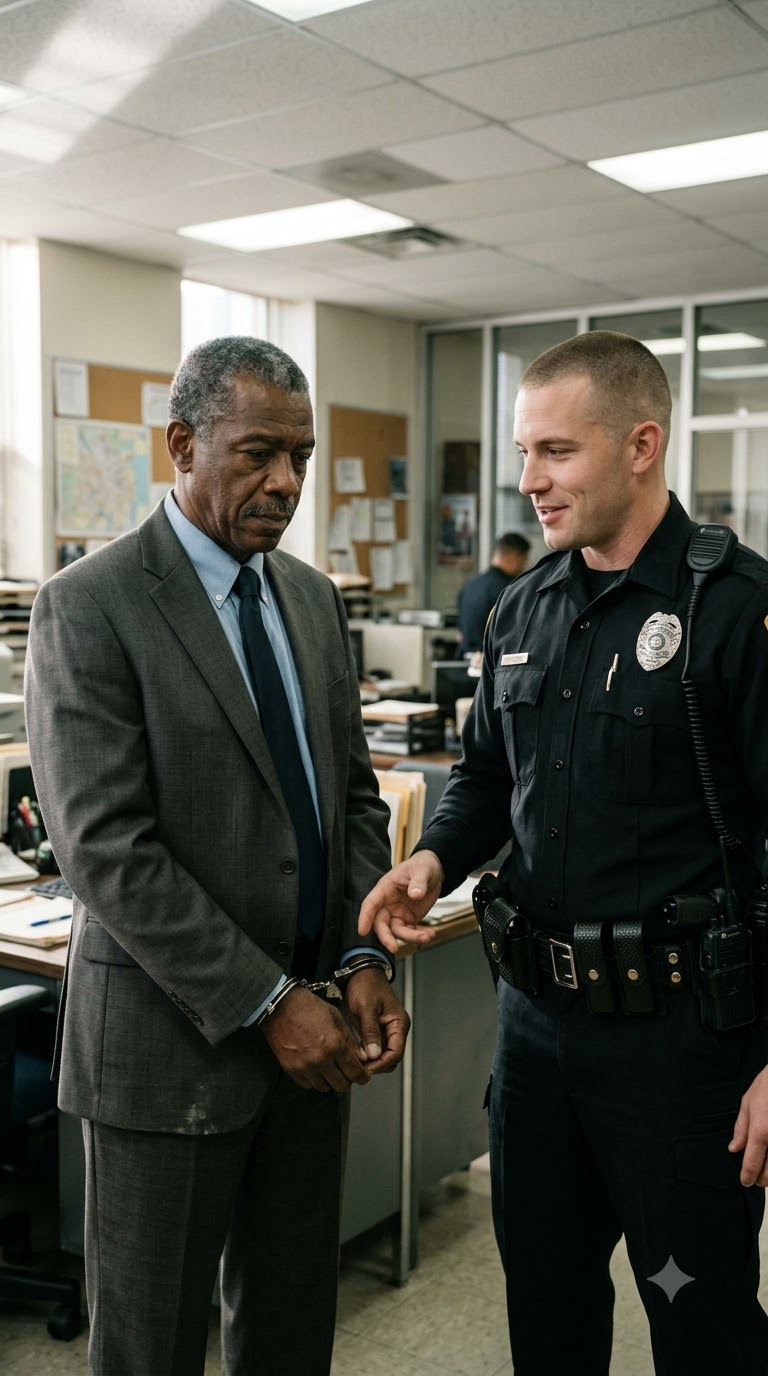
“My name is Marcus Hale. Most of you already know that. For those who don’t, I was appointed chief of this department last week, and today is my first official day.”
He paused and looked around the room.
“I have spent thirty-five years in law enforcement. I’ve worked patrol, investigations, internal oversight, and command. I’ve testified in court, delivered death notifications, sat with grieving parents, and watched officers make decisions that changed the course of entire families.”
He let the words settle.
“I know what this job demands. I also know what happens when we forget why we wear the badge.”
Kyle shifted in his chair.
Marcus noticed but continued.
“This morning, an officer detained and handcuffed me in the lobby without first verifying my identity or establishing a legitimate basis for that action.”
Nobody moved.
“I want to be clear about something. I am not standing here because I’m offended that someone failed to recognize me. You are not required to know my face. You are not required to know my name before I introduce myself. And you should never make decisions based on someone’s suit, skin color, age, or apparent social standing.”
His gaze moved across the room.
“You are required to exercise judgment. You are required to follow policy. You are required to distinguish between a person who makes you uncomfortable and a person who has actually given you a lawful reason to act.”
He placed both hands on the table.
“Today, I was the person in handcuffs. Tomorrow, it could be a contractor, a delivery driver, a family member looking for a missing child, or someone who has spent the last twelve hours trying to report a crime.”
The room remained silent.
“What happened this morning will be reviewed. There will be documentation, interviews, and an examination of the decisions made by everyone involved. That process will be fair, and nobody will be punished simply because I happen to be chief.”
Kyle’s eyes lifted.
“But fairness does not mean ignoring misconduct. It does not mean pretending a bad decision was harmless because the person who suffered it turned out to have a title.”
Marcus opened his legal pad.
“We’re going to begin this administration with three expectations. Facts before assumptions. Accountability without favoritism. And a culture in which every person who walks through our doors is treated with dignity.”
He closed the pad.
“That’s all for now. Supervisors, remain behind. Everyone else, report to your assignments.”
Chairs scraped against the floor as officers stood. Conversations began in low voices, but nobody seemed eager to linger.
Kyle remained seated until the room had nearly emptied.
“Chief?”
Marcus turned toward him.
Kyle stood, swallowing hard.
“Can I speak to you privately?”
“Yes.”
The remaining supervisors filed out, leaving the two men alone.
Kyle looked at the floor.
“I made a mistake.”
Marcus waited.
“I thought you were trying to get into a restricted area. You didn’t have a badge visible, and you wouldn’t tell me why you were there.”
“I gave you my name.”
“I know.”
“You could have called City Hall before putting me in handcuffs.”
“Yes, sir.”
“Did you have a reason to believe I was armed, dangerous, or about to commit a crime?”
Kyle hesitated.
“No, sir.”
“Then why did you handcuff me?”
Kyle’s jaw tightened. For a moment, it looked as though he might offer an excuse. He glanced toward the door, then back at Marcus.
“Because I thought you were challenging me.”
Marcus nodded slowly.
“And what did you believe I was challenging? Your authority, or your pride?”
Kyle’s face reddened.
“I don’t know.”
“That’s something you need to figure out.”
Marcus picked up his briefcase.
“You’ll receive written notice of the review. Until then, you’ll remain on administrative assignment, consistent with department policy. This isn’t a verdict. It’s a precaution while we establish exactly what happened.”
Kyle looked up.
“Am I going to lose my job?”
“That decision will depend on the facts, your record, the findings, and the applicable procedures. I’m not going to promise you an outcome before the investigation begins.”
Kyle nodded, though his expression suggested he had hoped for a different answer.
“I’m sorry, Chief.”
Marcus studied him for a moment.
“An apology is a beginning, Officer Mercer. It isn’t the conclusion.”
Then he walked out.
By nine o’clock, the story had spread throughout the department.
By nine-thirty, someone had told a dispatcher that the new chief had been arrested in his own lobby.
By ten, a patrol officer had posted a vague message online about a disastrous first day at Briar Glen PD. The post didn’t identify Marcus, but it was enough to attract questions from residents who knew about the upcoming appointment.
At ten-fifteen, Mayor Brooks called again.
“I’ve got two council members asking whether the department is in chaos,” she said.
“Tell them the department is being reviewed.”
“They want a statement.”
“They can have one when we know the facts.”
“Marcus, the council will ask whether this is a personnel problem or a racial discrimination problem.”
“Then tell them we won’t prejudge either question. We’ll examine the evidence and make our findings.”
The mayor sighed.
“You really intend to do this by the book.”
“That’s why there is a book.”
After the call, Marcus summoned Jenna to his office.
She entered with a folder pressed against her chest.
“Chief, I want to apologize for what happened.”
“Why?”
Her expression faltered.
“Because I didn’t stop it.”
Marcus gestured toward the chair across from his desk.
“Sit down, Officer Walsh.”
She sat, keeping the folder in her lap.
“I saw what was happening,” she said. “I knew you had given him your name. I knew he could have called City Hall. I thought about stepping in, but I didn’t want to challenge him in front of the others.”
“Why?”
“Because Kyle has a reputation for taking things personally. I didn’t want to become the next person he decided was a problem.”
PART 2
Marcus leaned back.
“Has this happened before?”
Jenna looked at the folder.
“Not exactly like this.”
“What does that mean?”
She hesitated, then opened it.
“There’s been a pattern. Not always handcuffs. Sometimes it’s people being kept waiting, being spoken to harshly, or being told to leave because an officer thinks they’re lying. I’ve seen Kyle dismiss complaints before checking them. I’ve also seen supervisors tell people to let things go because he gets results on the street.”
“Have any of those incidents been documented?”
“Some. Others weren’t.”
“Why weren’t they?”
“People didn’t think anything would happen.”
Marcus remained quiet for several seconds.
“Do you have specific examples?”
“Yes.”
“Names, dates, reports, witnesses?”
“Some of them.”
“Bring me what you have. Don’t embellish anything, and don’t leave out anything that reflects badly on you or anyone else. If you’re uncertain about a detail, say so. I want facts, not a story designed to make anyone look good.”
Jenna nodded.
“I understand.”
“One more thing. You were right to call City Hall when you realized there was a problem. But you shouldn’t have needed to hear who I was before recognizing that something was wrong.”
Her eyes lowered.
“I know.”
“Next time, act on what you see. Not on the rank of the person involved.”
She stood.
“Yes, Chief.”
When she reached the door, Marcus called after her.
“Officer Walsh.”
She turned.
“You did make the call. That matters. Now we need to make sure the next person doesn’t have to rely on a phone call to be treated fairly.”
For the next two hours, Marcus worked through personnel files, incident reports, staffing schedules, and the department’s use-of-force policies. He requested records of complaints against Kyle and asked the internal affairs lieutenant to preserve all relevant documentation.
He also requested a list of complaints that had been closed without a full investigation.
By noon, he had enough information to understand that the morning incident was unlikely to be the only problem he would face.
At 12:17, a woman arrived at the front desk carrying a worn canvas bag. She appeared to be in her early sixties and wore a faded blue coat despite the mild autumn weather. Her gray hair was tucked beneath a knitted hat, and her hands trembled as she unfolded a sheet of paper.
The officer on duty listened for less than a minute before telling her that she would need to come back another day.
The woman looked toward the hallway.
“Please,” she said. “I’ve been here before. I just need somebody to listen.”
Marcus had been walking toward the break room when he heard her voice.
He stopped.
“What seems to be the problem?”
The woman turned. She looked him over, taking in his shirt, tie, and briefcase.
“I filed a complaint three weeks ago,” she said. “My grandson was stopped walking home from work. He was carrying groceries for me, and the officer said he matched a description. They searched him, questioned him, and let him go. But nobody will tell me why they stopped him or what happened to the complaint.”
Marcus glanced at the paperwork in her hands.
“What is your name?”
“Linda Porter.”
“Ms. Porter, I’m Marcus Hale. I’m the chief. Would you come into my office so we can review your complaint?”
Her eyes widened slightly.
“You’re the chief?”
“Yes, ma’am.”
She looked toward the front desk, then back at him.
“I’m sorry. I didn’t mean to bother you.”
“You’re not bothering me.”
He led her to his office and offered her a chair. He asked an administrative assistant to bring water, then listened as Linda explained what had happened.
Her grandson, Daniel, was twenty-two. He worked evenings at a grocery store and often stopped at her apartment on his way home. On the night of the incident, an officer had approached him outside a convenience store, ordered him to place his hands against a wall, and searched his backpack.
Daniel had asked why he was being stopped. The officer had told him to stop talking.
After the encounter, Daniel had become reluctant to walk home alone. He had missed two shifts because he was afraid of encountering the same officer again.
Linda had filed a written complaint, but she had received no acknowledgment beyond a reference number.
Marcus wrote down the details.
“Do you know the officer’s name?”
“No. He was tall, with dark hair. My grandson said there was another officer sitting in the patrol car.”
“Do you have the complaint number?”
She handed him the paper.
Marcus read it, then entered the number into the department’s records system. The complaint had been marked as resolved nine days earlier. The attached summary consisted of a single sentence: Subject contacted and released without further incident.
There was no recorded interview with Daniel, no explanation of the original stop, and no indication that anyone had contacted Linda.
Marcus felt his jaw tighten, but he kept his voice even.
“Ms. Porter, I can’t tell you what the investigation will find. I can tell you that we’ll review the report and determine whether the stop and the handling of your complaint followed department policy.”
“Will somebody actually call us?”
“Yes.”
She studied him carefully.
“People always say that.”
“I understand why you might not believe me. I’ll make sure you receive a reference number for this review and the name of the person responsible for contacting you.”
He wrote the information on a card and handed it to her.
Linda took it with both hands.
“Thank you.”
As she stood, she looked toward the door.
“Chief, I heard what happened to you this morning.”
Marcus paused.
“You did?”
“My neighbor’s son works here. He said an officer put you in handcuffs before finding out who you were.”
Marcus didn’t deny it.
Linda’s expression changed.
“Then maybe you understand a little better now.”
She did not sound triumphant. She sounded exhausted.
Marcus watched her leave, then returned to his desk and opened a fresh page in his notebook.
At the top, he wrote: Complaints that were closed without meaningful review.
Underneath it, he added Linda Porter’s case number.
The incident in the lobby had taken nineteen minutes of his first day. The consequences of what he had seen since then were likely to take months to address.
He had known the department needed improvement before accepting the appointment. During the selection process, he had reviewed staffing shortages, declining public confidence, and a rise in complaints about inconsistent enforcement.
What he hadn’t known was how many people had already stopped expecting anyone to listen.
That afternoon, Marcus met with the department’s command staff.
Lieutenant Paul Dwyer, a veteran supervisor who had served under Chief Connelly for nearly fifteen years, sat at the head of the table. Beside him were the internal affairs lieutenant, the patrol supervisor, and the department’s training coordinator.
Dwyer spoke first.
“Chief, with respect, we need to be careful about the message we’re sending. If officers think every mistake will lead to an investigation, they’ll hesitate when they need to act.”
Marcus folded his hands on the table.
“Accountability isn’t the same as punishment.”
“No, sir. But the optics of this morning—”
“I’m less interested in optics than in what happened.”
Dwyer paused.
“Officer Mercer is aggressive, but he’s effective. His arrest numbers are strong, and he’s made several significant drug seizures.”
“Are his reports accurate?”
“As far as I know.”
“Have you personally reviewed them?”
“Not all of them.”
“Have you reviewed the complaints filed against him?”
“Some.”
“Have you examined the complaints that were dismissed?”
Dwyer shifted in his chair.
“Those matters were handled under the previous administration.”
“That wasn’t my question.”
The room grew quiet.
Marcus opened a folder.
“I don’t intend to assume every complaint is justified. I don’t intend to assume every officer is guilty. But I also won’t accept a culture in which productivity is used to excuse conduct that would be unacceptable from anyone else.”
He looked at Dwyer.
“If an officer produces good arrest numbers while violating policy, those numbers don’t erase the violations. If an officer has a clean record because supervisors fail to document complaints, the absence of a record doesn’t prove the absence of a problem.”
The internal affairs lieutenant nodded slightly.
Marcus continued.
“We’ll review the records, interview witnesses, and identify where our procedures failed. We will also examine how supervisors responded when officers raised concerns. This review is not limited to Kyle Mercer.”
Dwyer crossed his arms.
“You’re talking about reopening old cases.”
“Where the evidence and applicable rules permit it, yes.”
“That could put this department under a microscope.”
Marcus met his eyes.
“Then let’s make sure there’s nothing we need to hide.”
The meeting lasted another hour.
By the end, the command staff had agreed to preserve relevant records, conduct a preliminary review of unresolved complaints, and submit recommendations for changes to the department’s intake and complaint-tracking procedures.
Marcus also ordered a temporary suspension of discretionary performance incentives tied solely to arrest totals until the department could determine whether its evaluation system encouraged the wrong priorities.
It was not a popular decision.
But Marcus hadn’t taken the job to make every decision popular.
Over the following days, the investigation into the lobby incident proceeded without public theatrics.
Investigators interviewed Kyle, Jenna, the two officers who had witnessed the arrest, and the desk employee who had initially directed Marcus toward the administrative hallway.
They reviewed lobby security footage, dispatch records, access procedures, and the department’s written policies.
The video confirmed the central facts.
Marcus had approached the desk calmly. He had given his name when asked. Kyle had ordered him to stop, accused him of entering a restricted area, and placed him in handcuffs without conducting the available identity check or documenting a specific reason that justified the escalation.
The footage also showed Jenna looking toward the phone before Kyle had even finished explaining his actions.
The two officers who witnessed the encounter admitted that they had not intervened. One said he had assumed Kyle knew something he didn’t. The other acknowledged that he had laughed at Kyle’s joke because he didn’t want to attract attention.
The findings were uncomfortable, but they were not complicated.
Kyle had acted without an adequate basis. Jenna had recognized a problem but hesitated to challenge it. The other officers had chosen silence over intervention.
And the department’s procedures had allowed a single officer’s assumptions to carry more weight than a simple verification step.
When the review concluded, Kyle was formally disciplined under the department’s established procedures. He was removed from patrol duties, required to complete additional training, and placed on a monitored performance plan. The department also referred the incident for the independent review required by its policies.
The disciplinary decision took account of the seriousness of the conduct, Kyle’s personnel history, and the findings of the investigation. Marcus did not personally decide the outcome, and he did not ask the review team to recommend a particular penalty.
Kyle submitted a written statement accepting responsibility for handcuffing Marcus without first establishing a sufficient basis for doing so. He also acknowledged that he had allowed his perception of disrespect to influence his judgment.
It was not a complete transformation.
Marcus understood that one statement could not undo years of habit, and a disciplinary notice could not instantly change the culture of a department.
But it was a beginning.
The broader review revealed additional problems.
Some complaints had been marked as resolved without documented interviews. Others had been closed after officers submitted brief explanations that were never independently checked. In several cases, supervisors had accepted vague descriptions of encounters without requesting supporting records.
None of those findings automatically proved that an officer had committed misconduct. Each case required its own examination.
Still, the pattern was undeniable: the department had become too comfortable treating the absence of a proven problem as proof that no problem existed.
Marcus responded by establishing a clearer complaint process. Residents would receive written acknowledgment of their complaints, an explanation of the review procedure, and contact information for the person responsible for following up. Cases could not be marked complete without a documented basis for the decision.
He also introduced regular supervisory audits and required officers to complete refresher training on lawful stops, professional communication, de-escalation, and the appropriate use of restraints.
Most importantly, he created a procedure allowing officers to report concerns about a colleague’s conduct without having to route every concern through that colleague’s immediate supervisor.
The policy did not grant automatic immunity to anyone making a report. False or deliberately misleading allegations would still be investigated. But a good-faith report could no longer be dismissed simply because it challenged someone with a strong reputation or a high arrest count.
At the next department meeting, Marcus addressed the officers directly.
“Some of you may believe these changes mean I don’t trust you,” he said. “That’s not what they mean. Trust is not a substitute for oversight. Oversight is how we demonstrate that our trust is justified.”
He paused.
“If you make a mistake, report it. If you see a colleague making a mistake, intervene when it is safe and appropriate. If you believe a policy is wrong, raise the issue through the proper channels. What you cannot do is decide that your pride matters more than the rights of the person standing in front of you.”
No one applauded.
Marcus hadn’t expected them to.
He was not interested in a room full of people agreeing with him for ten minutes and returning to their old habits the moment he left.
He wanted different decisions in the field, at the front desk, and in the reports that nobody outside the department would ever read unless something went wrong.
Three weeks later, Marcus received a call from the training coordinator.
“Chief, we have an issue with the new complaint process.”
“What kind of issue?”
“Some officers say the forms take too long. Others are concerned that the additional documentation will keep them from responding quickly to calls.”
“Are they right?”
“The forms could be streamlined. But the essential information can be recorded without adding much time.”
“Then streamline them. Keep the safeguards.”
The coordinator hesitated.
“And Mercer has asked to meet with you.”
Marcus looked at the calendar on his desk.
“Schedule it.”
PART 3
Kyle arrived that afternoon in plain clothes. He looked thinner than he had on the morning of the incident, though Marcus couldn’t know whether the change came from stress, lost sleep, or something else. His posture was less confident, and he held a folder in both hands.
“Chief.”
“Officer Mercer. Sit down.”
Kyle took the chair across from him.
“I completed the first training module.”
“Good.”
“I also reviewed the lobby footage.”
Marcus waited.
“I didn’t realize how quickly I escalated things until I watched it.”
“That’s one reason we review footage.”
Kyle opened the folder.
“I’ve written down some of the things I remember from other encounters. Some of them may have been handled properly. Others might not have been.”
He placed several pages on the desk.
“I want them reviewed.”
Marcus did not reach for the papers immediately.
“Why?”
Kyle looked uncomfortable.
“Because I don’t want to keep making the same mistakes.”
“That is a reasonable goal. But understand what you’re asking. These reports will be examined. If the evidence shows that you violated policy, the department will address it. You won’t receive special treatment for bringing the information forward.”
“I understand.”
“And you won’t be punished simply for identifying a concern in good faith.”
Kyle nodded.
“I know.”
Marcus finally took the pages.
“Then we’ll have them reviewed.”
For the first time since the morning of the arrest, Kyle looked directly at him without appearing to challenge him.
“Chief, I also owe you an apology that isn’t about losing face in front of the department.”
Marcus said nothing.
“I saw a man who didn’t look like he belonged in the place I was guarding, and I decided he was a problem before I had enough information. When you asked me to call City Hall, I treated it like a joke because I thought you were trying to make me look foolish.”
Kyle swallowed.
“I was more concerned with being in control than with finding out what was actually happening. I put you in handcuffs because I didn’t like the way the conversation was going. That’s the truth.”
Marcus studied him.
“Thank you for being honest.”
Kyle’s shoulders eased slightly.
“Does that mean you forgive me?”
“No.”
The answer landed harder than Kyle expected.
Marcus continued in the same calm voice.
“Forgiveness isn’t something you can request as part of a personnel review. I can acknowledge that you’re taking responsibility. I can give you the opportunity to demonstrate that you understand what went wrong. Whether I forgive you personally is a separate matter, and it won’t determine the outcome of the investigation.”
Kyle lowered his gaze.
“I understand.”
“Good. Focus on the work.”
Kyle left the office carrying no promise of reinstatement, no guarantee of a second chance, and no public declaration that everything had been resolved.
What he had was a process.
Marcus believed that was more useful than either humiliation or easy reassurance.
Meanwhile, the review of Linda Porter’s complaint led investigators to the original patrol report. The stop had been initiated after an officer reported that Daniel matched a general description provided during a nearby investigation. The available documentation did not establish a sufficiently specific connection between Daniel and the reported incident.
Investigators also found that the complaint had been marked resolved without an interview with Daniel or a documented review of the circumstances surrounding the search.
The department could not reconstruct every detail of the encounter, and the evidence did not support every allegation Linda had raised. But it did establish that the original complaint had not received the review required by policy.
Marcus arranged for the department to contact Linda and Daniel, explain the findings, and document the corrective steps taken.
He did not promise that the review would erase Daniel’s fear or restore his confidence in the police.
When Linda returned to the department, Marcus met with her and her grandson in a small conference room.
Daniel was a lean young man with short dark hair and a guarded expression. He answered questions carefully, glancing at his grandmother whenever the discussion returned to the night of the stop.
Marcus explained what the review had established and what remained uncertain.
“I can’t change what happened to you that night,” he said. “I also can’t tell you that every officer will make the right decision every time. What I can do is make sure the department documents what happened, corrects the failures we can establish, and gives you a clear way to report any future concerns.”
Daniel looked at him for a long moment.
“Would you have listened if you hadn’t been handcuffed yourself?”
The question was direct, without anger or apology.
Marcus did not answer immediately.
“I would like to believe I would have,” he said. “But believing that isn’t enough. The department should have listened before I arrived, and it should continue listening after I leave.”
Daniel glanced down at the table.
“My grandmother said you might understand.”
“I understand something about being judged before people have all the facts. That doesn’t mean I know exactly what you experienced.”
For the first time, Daniel’s expression softened slightly.
“That’s fair.”
It wasn’t a dramatic reconciliation. There was no handshake that suddenly repaired everything, no speech that made Daniel eager to trust the department again.
But when the meeting ended, he agreed to provide a formal statement for the record. Linda left with copies of the review findings and the name of the supervisor responsible for follow-up.
Marcus watched them walk through the lobby.
The same lobby where, weeks earlier, he had sat with his hands cuffed in his lap while officers laughed at a joke about the governor.
The furniture hadn’t changed. The fluorescent lights still buzzed overhead. The wooden bench remained beneath the framed photographs of former chiefs.
But the front desk now displayed a printed notice explaining how residents could file complaints, request information, and obtain a reference number for their case.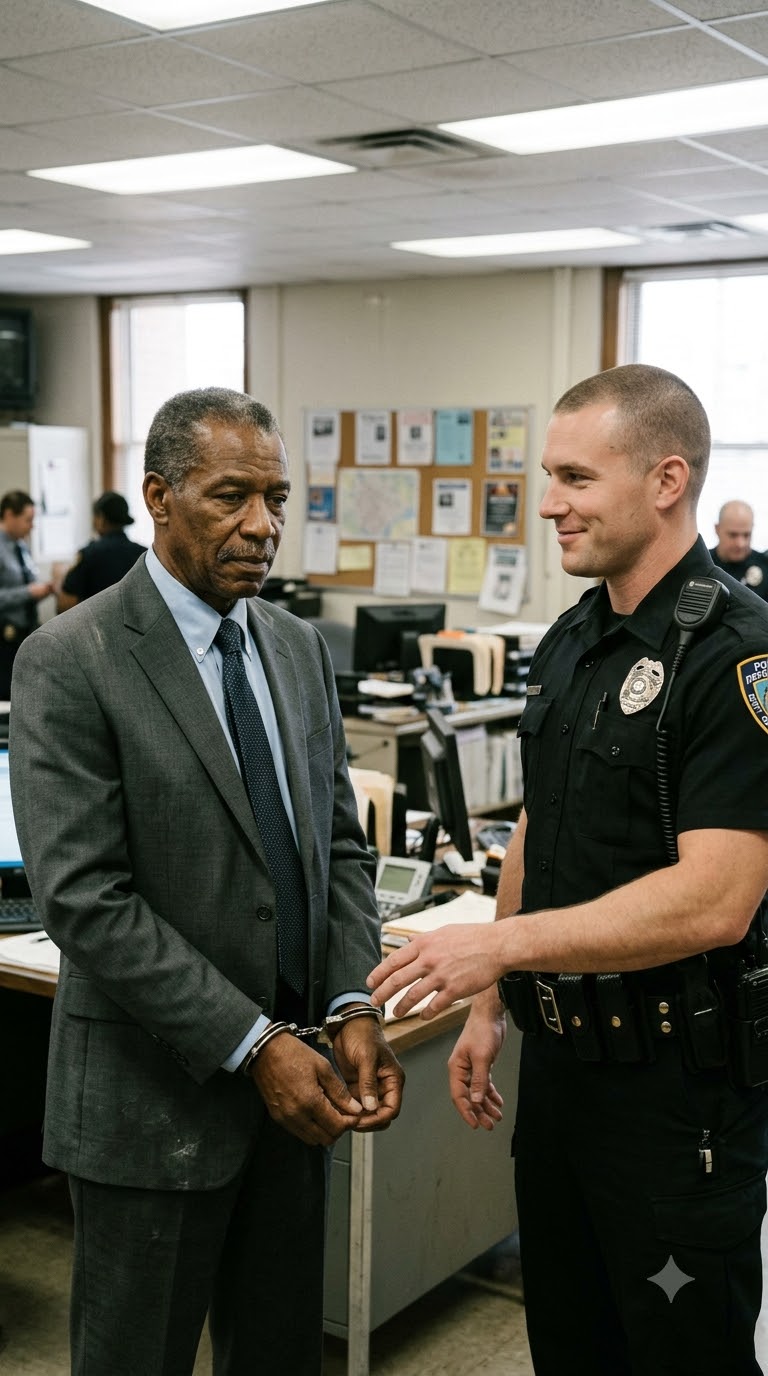
It was a small change.
Marcus knew that.
A notice on a wall could not make an officer more honest or a supervisor more courageous. A revised form could not repair a family’s confidence overnight. A training session could not guarantee that the next person who walked through the door would be treated fairly.
The real test would come in the moments when nobody was watching.
Six weeks after Marcus’s first day, the department held a public meeting at the municipal building. Residents had requested an opportunity to discuss the complaint review and the new policies. Some arrived angry. Others were skeptical. A few supported the changes but worried that the department was becoming too cautious.
Marcus stood at the front of the room beside Mayor Brooks and the department’s internal affairs lieutenant.
He did not promise that misconduct would never happen again.
He explained what the department had found, which procedures had changed, how complaints would be tracked, and how residents could request updates. He also acknowledged that the review was incomplete and that some older cases lacked enough evidence to support definitive conclusions.
One man asked whether Marcus intended to fire every officer who had made a mistake.
“No,” Marcus replied. “A mistake, an honest disagreement, negligence, and deliberate misconduct are not the same thing. They should not all receive the same response. But none of them should be ignored simply because the person involved wears a uniform.”
A woman in the second row asked whether the department would investigate complaints against senior officers with the same seriousness as complaints against patrol officers.
“Yes,” Marcus said. “The standard applies to everyone.”
Another resident asked what would happen if a supervisor ignored a report.
“That failure would also be reviewed,” Marcus answered. “A process is only as reliable as the people responsible for following it.”
The room remained tense, but people continued asking questions. For nearly two hours, Marcus listened, answered what he could, and acknowledged what he could not yet know.
When the meeting ended, Mayor Brooks walked with him toward the exit.
“You didn’t give them the reassurance they wanted,” she said.
“I gave them the information we have.”
“Some people won’t be satisfied.”
“Some people have waited years to be heard. They don’t owe us immediate trust.”
The mayor looked at him.
“You know this is going to take time.”
“Yes.”
“And it may cost you political support.”
Marcus adjusted his briefcase.
“Then we’ll have to earn it another way.”
As autumn turned toward winter, the department’s reforms began to show modest results. Complaints were acknowledged more consistently. Supervisors documented their reviews. Officers had clearer instructions about when to seek assistance and how to handle uncertain situations without allowing frustration to dictate their decisions.
Not every officer welcomed the changes.
Some complained that the new procedures created unnecessary paperwork. Others resented the additional scrutiny. A handful of experienced employees retired rather than adjust to the new expectations.
Marcus did not treat every departure as a victory, nor did he assume every criticism was resistance to accountability. He asked for feedback, revised inefficient procedures, and maintained the safeguards that had prompted the reforms in the first place.
Kyle’s administrative assignment continued while the department reviewed the additional incidents he had submitted. His future remained uncertain. He attended training, completed written assessments, and met regularly with a supervisor who evaluated his judgment and communication as well as his technical performance.
The process was neither quick nor painless.
Marcus believed it shouldn’t be.
A person who had misused authority needed more than a lecture. The department needed evidence that its standards would hold even when the employee involved was experienced, productive, or popular.
Jenna, meanwhile, became more vocal during briefings. She began asking questions when reports lacked essential information and challenging assumptions that had previously passed without discussion. She also acknowledged her own failures during the internal review rather than portraying herself as a bystander who had done everything correctly.
Marcus never publicly praised her as a hero for making the phone call.
He knew that doing so could send the wrong message, suggesting that the only reason to intervene was to be recognized afterward.
Instead, he made it clear that speaking up was part of the job.
Several months after the incident, the brass nameplate on the chief’s office door was finally replaced.
CHIEF MARCUS HALE.
Marcus stood in the hallway for a moment, looking at the letters.
Then he opened the door and went inside.
The brown leather briefcase sat beneath his desk, its worn corners and scratches unchanged. His father’s photograph rested beside the legal pad. The old fountain pen remained in a drawer, still unable to write.
And Elaine’s index card lay in the top drawer where he could reach it without searching.
You don’t have to be louder than the room. You just have to know why you’re standing in it.
On a quiet Thursday afternoon, Marcus found a new message waiting in his inbox. It was from Kyle, who had completed another stage of his review.
The message contained no excuses, no request for special consideration, and no complaint about the time the process was taking. Kyle had submitted the documentation requested by his supervisor and acknowledged two additional reports that required examination.
Marcus forwarded the message to the appropriate reviewer without comment.
The case was not finished.
Neither was the department’s work.
That evening, as Marcus prepared to leave, Jenna appeared at his doorway.
“Chief, do you have a minute?”
“Of course.”
She stepped inside.
“I wanted to tell you something about the morning you arrived.”
Marcus set down his pen.
“Go ahead.”
“When I called City Hall, I wasn’t trying to protect you because you were the chief. At least, I don’t think I was. I called because I finally realized I needed to do something.”
Marcus listened.
“But I keep thinking about how long I waited before making that call. If you had been someone else, I might have kept my mouth shut.”
“That possibility is worth thinking about.”
She nodded.
“I don’t want to be that person anymore.”
“Then keep making the next decision correctly.”
She gave a small, uncertain smile.
“That’s it?”
“What else would you like me to say?”
“I don’t know. Something more encouraging.”
Marcus’s expression softened.
“Officer Walsh, courage isn’t always a dramatic moment. Sometimes it’s a phone call. Sometimes it’s asking a question when everyone else is pretending not to notice. Sometimes it’s admitting that you failed to do those things yesterday and choosing not to repeat the failure today.”
Jenna looked down, absorbing his words.
“Thank you, Chief.”
After she left, Marcus gathered his things and turned off the office light.
He walked through the lobby one final time before heading home. A young man stood at the front counter, holding a folded document and looking uncertain about whether to approach the desk.
The officer on duty greeted him and asked how he could help.
The young man began explaining his problem.
Marcus stopped near the entrance, listening for a moment. The officer asked a question, checked a record, and called a supervisor to clarify a detail. Nobody raised their voice. Nobody assumed the young man was lying simply because his explanation was incomplete.
The interaction was ordinary.
That was what made it matter.
Marcus stepped outside into the cool evening air.
He knew the department still had work to do. He knew that some residents would remain skeptical, that some officers would struggle with the changes, and that a single morning of misconduct could never be balanced against a handful of improved procedures.
He also knew that the department’s future would not be decided by his appointment, his title, or the nameplate on his door.
It would be decided by the choices people made when they believed no one important was watching.
On his first morning, Kyle Mercer had seen a quiet man in an expensive suit and decided that the man did not belong.
Jenna Walsh had seen something wrong and hesitated because she feared the consequences of speaking up.
Two officers had witnessed the encounter and laughed rather than intervene.
The turning point had come when a desk clerk picked up a telephone and called City Hall.
But the lesson Marcus carried away was not that everyone should learn to recognize the chief.
It was that the man in handcuffs should never have needed to be the chief for anyone to question whether the handcuffs belonged there.
Authority was not proven by how quickly someone could force another person to obey. It was proven by the judgment to know when force was justified, the humility to recognize a mistake, and the courage to correct it even when doing so was uncomfortable.
Marcus had entered Briar Glen’s police department expecting to introduce himself.
Instead, his first day had introduced him to the work ahead.
He intended to finish it.
Not by demanding that people respect his title.
Not by making an example of one officer and pretending the problem had disappeared.
And not by asking the public to trust promises that the department had yet to fulfill.
He would do it the same way he had built his career: by examining the facts, accepting accountability, and insisting that every person who came through those doors deserved to be treated as a human being before being treated as a suspect.
Because a badge could grant authority.
A title could grant responsibility.
But neither could make a person worthy of trust.
That had to be earned, one decision at a time.
