

PART 1
Álvaro Santamaría’s furious shout echoed through the living room so unexpectedly that his three daughters immediately rushed behind the new housekeeper.
They clung to her as though their own father, the man who had spent nine months desperately trying to protect them, had suddenly become someone they needed protection from.
Álvaro had returned to his luxurious villa in Pozuelo de Alarcón nearly two hours ahead of schedule.
He was still discussing a major real estate transaction over the phone when he pushed open the living room door.
Then he stopped.
The furniture had been moved against the walls.
A portable ballet barre stood near the enormous window.
Music drifted from a small speaker.
And in the center of the room, his six-year-old triplet daughters—Julia, Candela, and Marta—were dancing around Irene Vega.
Irene was twenty-eight years old.
Álvaro had hired her just twelve days earlier to clean the house and assist with the children’s daily care.
All three girls were laughing.
Not politely smiling.
Not forcing themselves to appear cheerful.
They were laughing with the kind of happiness Álvaro had almost forgotten they were capable of feeling.
He hadn’t heard that sound in nine months.
Everything had changed after his wife, Laura, died in a road accident while returning from Ávila.
Since her death, the enormous family home had become a place filled with silence.
Julia had stopped speaking entirely.
Candela experienced severe anxiety attacks whenever she heard an ambulance or police siren.
Marta had gradually lost interest in eating.
Álvaro had approached their suffering the same way he managed problems in his business empire.
He hired specialists.
He established strict schedules.
He organized appointments, meals, and activities into carefully structured routines.
Every day became another set of tasks to complete.
He had also forbidden music.
Laura had worked as a dance teacher.
The songs she once played throughout the house reminded Álvaro so painfully of her absence that he couldn’t bear hearing them.
And now, standing in the doorway, he heard one of those melodies again.
“Turn that off.”
Irene stopped moving.
The girls immediately fell silent.
“They were only playing.”
Álvaro’s expression remained severe.
“I hired you to take care of the house, not to turn it into a dance academy.”
Candela grabbed Irene’s skirt and held on tightly.
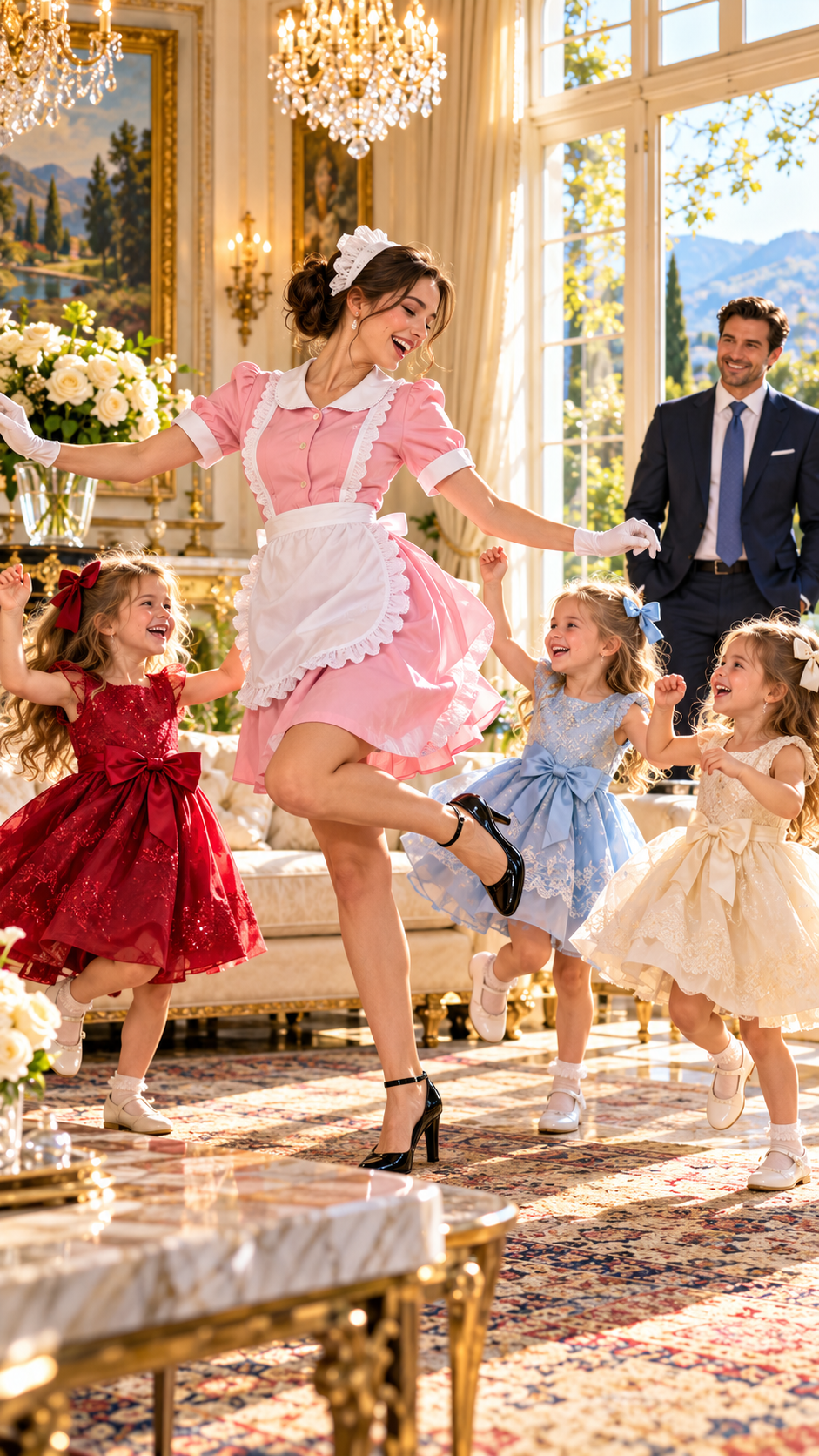
Irene glanced down at the frightened child before answering.
“They needed to move,” Irene replied. “They’ve spent far too long asking permission even to be happy.”
The words struck Álvaro harder than he wanted to admit.
“Don’t ever play their mother’s music again.”
Irene took a slow breath.
“Remembering someone shouldn’t become a punishment.”
Álvaro was seconds away from dismissing her.
But then Julia moved.
The little girl who hadn’t spoken a single word in nine months reached both arms toward Irene.
Tears streamed silently down her cheeks.
Álvaro stared at his daughter.
He wanted to believe his rules were protecting her.
Yet the sight of Julia clinging to the housekeeper made him question something he had refused to examine for months.
That evening, after the children had gone to bed, he opened the security system on his computer.
He began reviewing footage from throughout the day.
He watched Irene prepare dinner.
He saw her patiently encourage Marta until the little girl finished half her meal.
He watched her sit on the floor beside Candela during an anxiety attack, remaining close until the child could breathe calmly again.
Then he reached footage recorded later that night.
The house was quiet.
Everyone else appeared to be asleep.
Irene sat alone and opened her handbag.
She removed a pair of old, worn ballet shoes.
Then she took out a faded photograph.
It showed a little girl dancing.
Álvaro leaned closer to the screen.
The following morning, he asked Irene about the photograph.
She explained that the child was herself.
Years earlier, she had earned a scholarship to study dance in Madrid.
But when her mother became seriously ill, Irene abandoned her studies so she could care for her.
“Some dreams have to wait,” she said.
Álvaro didn’t know how to answer.
He had spent years believing that money could solve almost any difficulty.
Irene had given up something precious because her family needed her.
And she spoke about that sacrifice without bitterness.
That night, a powerful storm swept through the neighborhood.
Electricity failed across part of the area.
Álvaro was away from home and couldn’t return immediately.
He opened the security application on his phone.
Before the connection failed, he saw his daughters huddled together in a darkened room.
All three appeared frightened.
Then Irene entered.
She carried blankets, candles, and her old ballet shoes.
She approached the girls and began arranging everything around them.
A moment later, Laura’s favorite song started playing.
Álvaro stared at the screen.
Julia lifted her head.
For the first time in nine months, she opened her mouth as though she were about to speak.
And at that exact instant, the security image froze.
PART 2
By the time Álvaro reached the villa, he was completely soaked.
He rushed inside, expecting frightened children, confusion, and chaos.
Instead, he discovered something entirely different.
Three mattresses had been placed together on the floor.
Candles stood safely inside glass containers.
Blankets were spread across the makeshift sleeping area.
Irene sat among the girls, turning every burst of thunder into what she called “applause from the sky.”
The triplets were calm.
They weren’t hiding beneath their beds.
They weren’t crying.
They were listening to Irene and smiling.
Álvaro remained in the doorway, unable to speak.
The following morning, Irene prepared herself to be dismissed.
She knew she had ignored his explicit instructions about playing Laura’s music.
When Álvaro asked to speak with her, she expected the worst.
“You disobeyed me,” Álvaro said. “But I was wrong.”
Irene looked at him in surprise.
He didn’t offer a long explanation.
But for the first time, he acknowledged that his rules had been hurting the children rather than helping them.
Over the following weeks, music gradually returned to the house.
Marta began eating more consistently.
Candela’s anxiety attacks became less frequent.
Julia started expressing herself through gestures, clapping, and other small attempts to communicate.
The changes were not miraculous.
They were gradual.
But they were real.
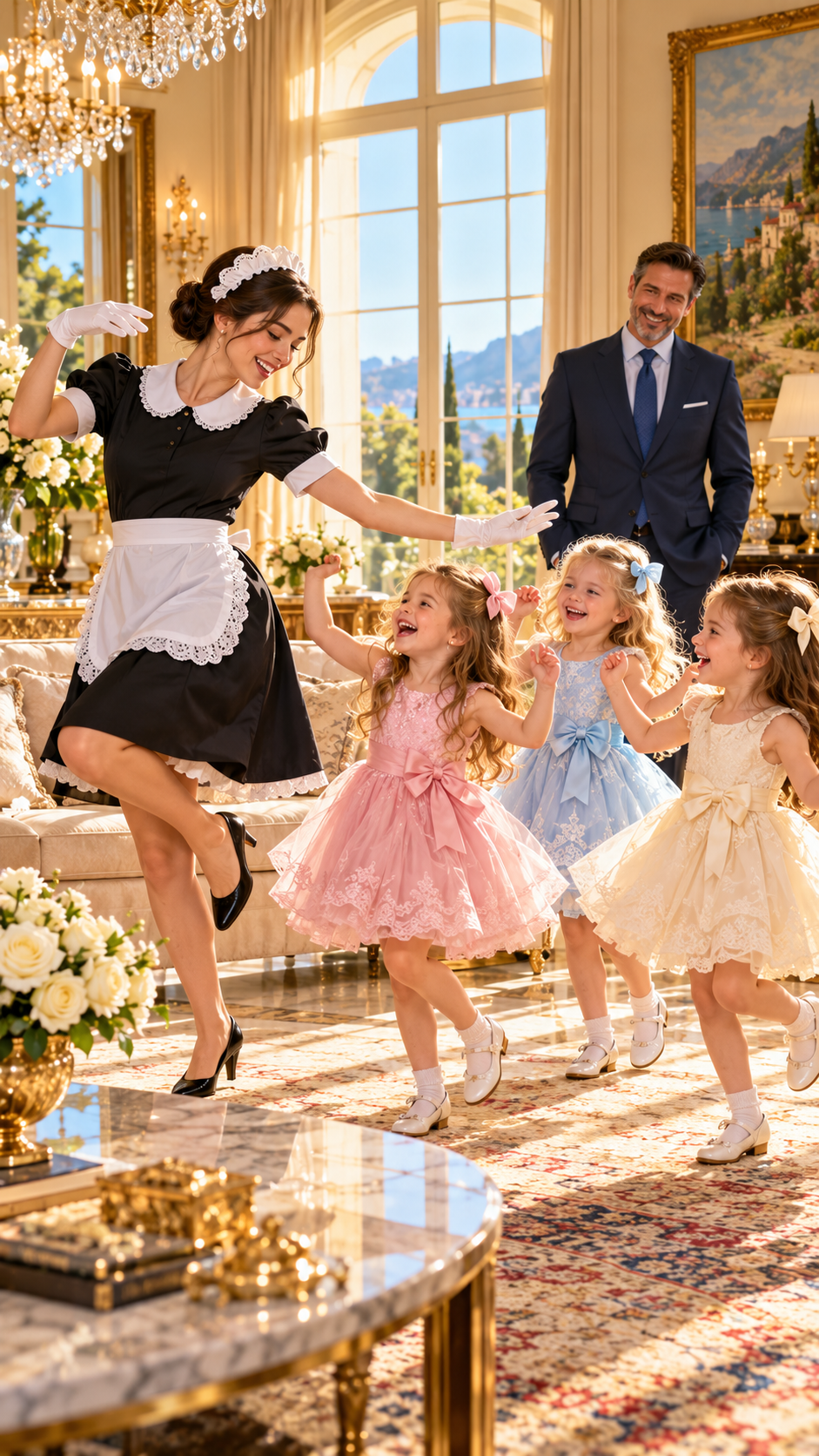
And the house no longer felt quite so empty.
Then Mercedes arrived.
Mercedes was Laura’s mother.
She had always been fiercely protective of her daughter’s memory and believed she knew what was best for the triplets.
When she entered the living room and saw the girls dancing with Irene, her face tightened with disapproval.
“It looks like a circus.”
She produced several photographs taken from outside the property.
Then she turned toward Álvaro.
“That woman has no qualifications to work with vulnerable children. If you don’t fire her today, I’ll seek legal action tomorrow.”
Irene overheard the threat.
She understood immediately what could happen.
If Mercedes turned the situation into a legal battle, Álvaro might be forced to defend his parenting decisions.
And the children, who were only beginning to recover emotionally, could become trapped in another painful family conflict.
That evening, Irene packed her suitcase.
She folded her uniform neatly and placed it on the bed.
Then she wrote a short note.
“I won’t allow anyone to use me as an excuse to separate your daughters from you.”
She left quietly.
The following morning, Julia went looking for her.
When she discovered Irene’s empty bedroom, she ran into the hallway.
Álvaro arrived just as his daughter stopped and lifted her head.
For nine months, Julia had remained silent.
But now, overcome by the fear of losing another person she loved, she opened her mouth.
And shouted a single word.
“Irene!”
PART 3
Julia’s cry left Álvaro completely motionless.
For nine months, he had arranged appointments with therapists, psychologists, physicians, and specialists.
He had spent enormous amounts of money trying to help his daughter recover her voice.
Yet the first word she spoke after all that silence wasn’t “Daddy.”
It was the name of the woman who had just walked out of their lives.
Álvaro looked at Julia.
Then at Candela and Marta, who were standing nearby.
He finally understood that Irene hadn’t simply been another employee.
She had become someone the girls trusted.
Someone who made them feel safe enough to laugh, move, and begin expressing themselves again.
Mercedes was still downstairs, speaking with her lawyer over the phone.
Álvaro entered the living room holding Julia’s hand.
Candela and Marta followed.
“Hang up.”
Mercedes looked toward him.
“What?”
“Hang up the phone and get out of my house.”
She slowly lowered the device.
“You’re throwing me out over a housekeeper?”
Álvaro shook his head.
“No. I’m throwing you out because you’ve turned my daughters into a battle you’re determined to win.”
Mercedes straightened.
“I’m protecting Laura’s daughters.”
“No. You’re trying to decide how they should remember her.”
She rose from her chair.
“Do you know what my daughter would say if she saw a stranger dancing with them as though she were their mother?”
Álvaro looked toward a photograph hanging near the staircase.
Laura stood barefoot in the living room, holding the triplets when they were only two years old.
For months, he had avoided looking at that picture.
The memories were too painful.
But now he forced himself to face it.
“Irene never tried to take her place.”
Mercedes crossed her arms.
“Well, the girls are already far too attached to her.”
Álvaro answered without hesitation.
“Precisely because you and I managed to make this house feel like a permanent funeral.”
Mercedes went pale.
He walked toward the entrance and opened the door.
“You can file whatever you want. I’ll submit the psychologist’s reports, the complete security recordings, and the messages where you threaten to turn this into a scandal if I don’t do exactly what you say.”
Mercedes gripped her handbag.
“You’ll regret this.”
“Maybe. But not today.”
She left without saying goodbye to her granddaughters.
Álvaro hurried upstairs.
Irene’s bedroom was empty.
Her wardrobe had been cleared.
Her uniform lay folded on the bed beside a drawing the girls had made.
Underneath was the note.
“I’m not leaving because I don’t love them. I’m leaving because I don’t want to become the excuse someone uses to take them away from their father.”
Álvaro immediately contacted Teresa, Irene’s mother.
At first, Teresa hesitated to answer his questions.
Eventually, she explained that Irene had visited her small apartment in Vallecas to leave money for her medication.
Afterward, she had gone to Méndez Álvaro bus station.
A cousin had offered her temporary employment in Cuenca.
Her bus was scheduled to depart at 6:40 that evening.
Álvaro checked the time.
6:16 p.m.
He asked his sister Elena to look after the girls.
Then he rushed to his car.
He didn’t wait for his chauffeur.
He didn’t bother putting on a jacket.
And he ignored the business messages accumulating on his phone.
At 6:35 p.m., he spotted Irene standing beside the bus.
“Irene!”
She turned.
Her expression wasn’t one of relief.
She looked concerned.
“You shouldn’t be here. Mercedes could use this against you.”
Álvaro reached her, breathing heavily.
“Julia spoke.”
Irene stopped moving.
“What?”
“She shouted your name.”
Tears immediately filled her eyes.
But she continued holding her suitcase.
“That doesn’t change the problem.”
“It changes things for me.”
Álvaro took a deep breath.
“For months, I believed I was protecting my daughters by keeping them away from anything that might hurt them. I took away the music. I put Laura’s clothes away. I stopped talking about her. I turned every day into a routine because I thought that if everything remained under control, nothing would ever fall apart again.”
Irene listened quietly.
“But I wasn’t preventing them from suffering. I was teaching them that being sad was the only proper way to love their mother.”
The driver announced that the bus was preparing to leave.
Irene glanced toward it.
“I can’t be the reason for a family war.”
“I don’t want you to be.”
Álvaro stepped back slightly.
He made no attempt to grab her hand or prevent her from leaving.
Instead, he offered her a choice.
“Come back with a different contract. As an educational support worker. The activities will have professional supervision. Resume your studies. If you find something better in a year, I’ll help you leave without standing in your way.”
Irene gave him a sad smile.
“And your mother-in-law?”
“She’ll have to learn that loving someone doesn’t mean controlling their life.”
For years, Irene had made decisions based on necessity.
Her mother’s illness.
The rent.
The need to earn enough money to survive.
Now, someone was offering her the freedom to decide what she wanted.
She turned toward the driver.
And asked him to remove her suitcase from the bus.
When they returned to Pozuelo, the triplets were waiting near the entrance.

Marta ran toward Irene first.
Candela followed immediately.
Julia remained where she stood.
Irene knelt in front of her.
“Hello.”
Julia looked into her eyes.
Then she spoke.
“Irene.”
The word was quiet.
But it was unmistakable.
Álvaro began crying.
Then Julia walked toward him.
She reached up and touched his cheek.
“Daddy.”
That single word broke through every defense he had built around himself.
Álvaro dropped to his knees and embraced all three daughters.
He made no effort to conceal his tears.
Irene stood a short distance away.
For the first time since entering that household, she fully understood what the family needed.
Nobody had to replace Laura.
They simply needed permission to keep living while remembering her.
Recovery did not happen overnight.
Julia didn’t suddenly begin speaking fluently.
Some days, she managed several words.
On others, she withdrew into silence again.
Candela continued trembling when she heard sirens.
Marta still struggled with food on difficult days.
But the atmosphere inside the house had changed.
Álvaro stopped treating recovery like a business target.
He resumed therapy himself.
He reduced his work-related travel.
And he began speaking about Laura without immediately leaving the room.
One evening, Marta asked him a question.
“Did Mommy know she was going to leave?”
Álvaro felt the familiar urge to avoid answering.
But this time, he sat beside his daughters.
“No.”
Marta looked at him.
“Was she scared?”
“I don’t know.”
Then she asked something even harder.
“Are you scared?”
Álvaro looked at all three girls.
“Very.”
Candela appeared surprised.
“Daddies don’t get scared.”
He gave her a faint smile.
“This one does.”
The triplets moved closer.
They leaned against him.
And that conversation helped them in a way that months of pretending everything was under control never had.
Irene also began establishing clearer boundaries.
She refused to move permanently into the villa.
Instead, she continued living in Vallecas with Teresa.
She accepted the revised contract, but insisted that her duties be clearly defined.
Activities involving the girls would be supervised by their psychologist and a specialist in children’s movement and body expression.
She also decided to resume the studies she had abandoned years earlier.
Álvaro offered to pay for a private school.
Irene shook her head.
“I want to earn my place myself.”
“I can help you.”
“Helping someone doesn’t mean doing everything for them.”
Álvaro smiled.
“I should write that down.”
“Start by remembering it.”
Meanwhile, Teresa began receiving more consistent medical treatment through newly arranged social assistance and Irene’s employment.
Álvaro offered to cover every expense.
Again, Irene declined.
She agreed only to let him pay for several consultations while they waited for the assistance to begin.
“I don’t want gratitude to turn into a debt.”
Álvaro understood.
He was slowly learning that generosity could become another form of control when it ignored the wishes of the person receiving it.
Mercedes eventually carried out her threat.
She requested urgent legal measures, arguing that Álvaro had entrusted the care of three emotionally vulnerable children to a domestic employee without appropriate qualifications.
But the evidence did not support the picture she attempted to present.
The triplets’ psychologist documented the progress they had made since music and movement were reintroduced.
The complete security footage showed that Irene had not performed medical interventions or attempted to replace professional treatment.
And the home’s security system had captured a conversation in which Mercedes threatened to “destroy Álvaro’s reputation” unless he sent the girls to the residential care facility she had chosen.
The court determined that the children would remain in their father’s care.
It also made clear that significant decisions about their well-being should follow professional recommendations rather than family disputes.
Afterward, Mercedes disappeared from their lives for nearly two months.
Then, one afternoon, she called.
For once, she didn’t mention lawyers.
“I want to see the girls.”
Álvaro remained quiet for a moment.
“Ask them.”
Mercedes sounded confused.
“I’m their grandmother.”
“Exactly. Ask them.”
Eventually, the triplets agreed to see her.
Mercedes arrived on a Sunday.
She brought no expensive presents.
Only a bag of churros.
When she entered the living room, she saw Julia drawing, Candela playing, and Marta sitting on the floor beside Irene.
Mercedes stopped.
Irene stood.
The older woman took a breath.
“I owe you an apology.”
Irene looked at her.
“Yes, you do.”
Mercedes seemed surprised by the direct answer.
“I treated you as though cleaning houses for a living made you less suitable to be around my granddaughters.”
Irene remained calm.
“You also tried to get me fired without asking them what they needed.”
Mercedes lowered her head.
“I know.”
Irene didn’t embrace her.
“Apologizing is good. Respecting boundaries will be better.”
Mercedes nodded.
Their relationship wasn’t repaired that afternoon.
It improved gradually.
Mercedes began asking questions before making decisions.
She stopped behaving as though Laura’s memory belonged exclusively to her.
One Sunday, Julia showed her a drawing.
It featured five female figures.
Three were the sisters.
One was Laura.
The fifth had a ponytail.
Mercedes pointed toward it.
“Who’s this?”
“Irene.”
Mercedes swallowed.
“And Mommy?”
Julia pointed toward the largest figure.
“Mommy is here.”
For the first time, Mercedes began to understand what she had resisted for so long.
The girls’ affection for Irene did not erase their love for Laura.
A child’s heart wasn’t a room with space for only one person.
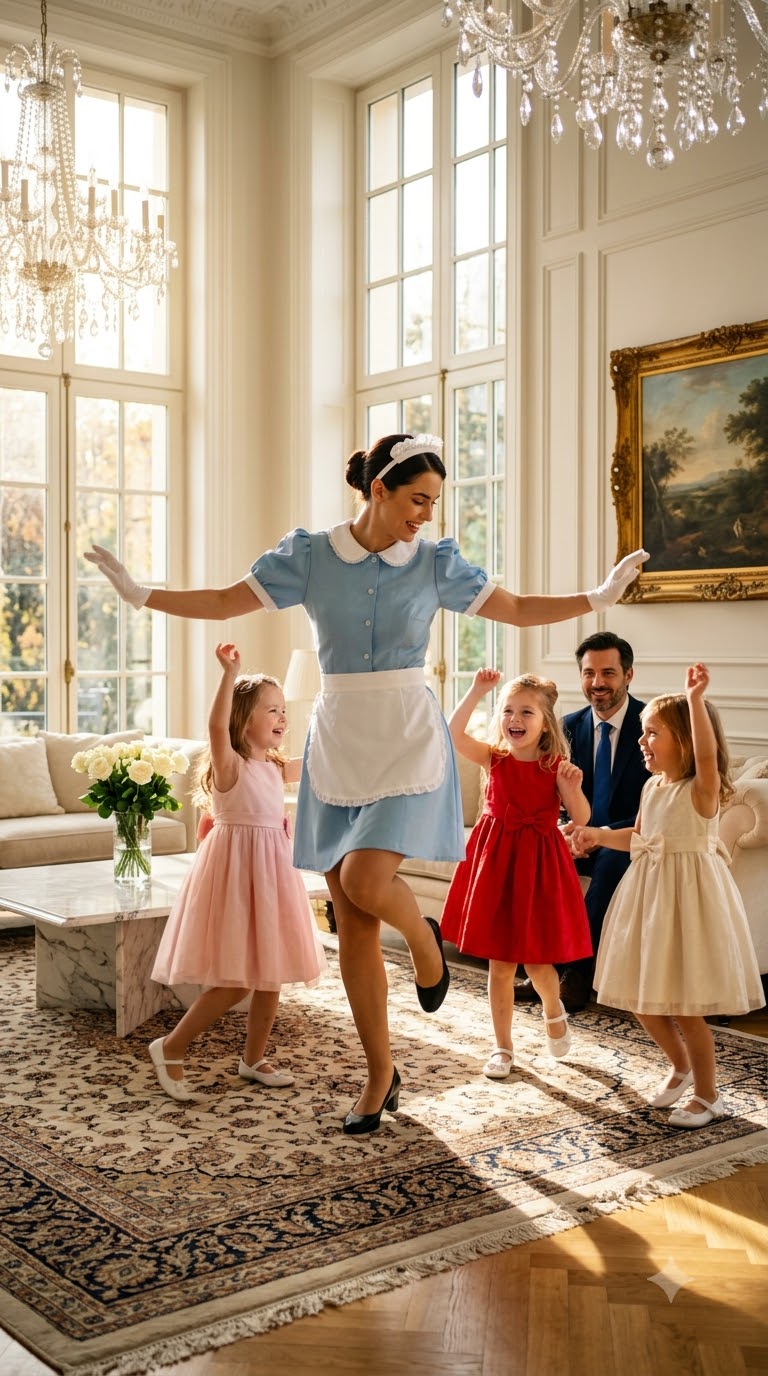
Six months later, the living room looked completely different.
Children’s drawings covered one wall.
The ballet barre still stood beside the enormous window.
Laura’s old piano had been opened again.
Julia was speaking more frequently.
Candela had begun sleeping alone.
And one evening, Marta asked for another serving of croquettes.
Everyone looked at her with such visible emotion that she finally protested.
“I just want more!”
The entire room erupted in laughter.
Irene had also been accepted into a program that allowed her to continue her education.
At the same time, she began volunteering with an organization in Vallecas that supported children experiencing grief.
The experience inspired a new idea.
She wanted to establish workshops where children who struggled to express their feelings verbally could explore those emotions through music and movement.
When she told Álvaro, he immediately offered financial support.
“How much do you need?”
Irene shook her head.
“That’s not how this works.”
“I can pay for the entire space.”
“That’s exactly why I don’t want you to.”
Álvaro frowned.
“Why?”
“Because then it would become your project.”
She placed a simple business plan in front of him.
“Help me find sponsors. Teach me how to make it sustainable. But don’t come in with a check and turn my idea into another thing you control.”
Álvaro examined the document.
“Are you telling me how to do business?”
Irene smiled.
“Someone had to.”
Several months later, the first workshop opened in a modest neighborhood community center.
Fourteen children attended.
Teresa arrived carrying two Spanish omelets and took a seat in the front row.
The triplets adored her.
They had even begun calling her “Grandma Tere.”
At first, Mercedes wasn’t pleased.
But eventually, she learned to accept that the girls could love more than one grandmother figure without loving her any less.
Álvaro’s relationship with Irene changed as well.
Not suddenly.
Not through a dramatic confession.
Their understanding of one another developed slowly.
He stopped seeing her merely as the woman who had helped his daughters recover.
He began recognizing her as a person with ambitions, convictions, vulnerabilities, and a future of her own.
Irene, meanwhile, discovered another side of the businessman who had once dismissed her for playing music.
She saw a father learning to listen.
A man struggling to overcome his grief.
And someone who secretly practiced dance steps when he believed nobody was watching.
One afternoon, the triplets organized a small performance.
They insisted that Álvaro participate.
He managed less than two minutes before collapsing onto the floor in defeat.
Irene offered him her hand.
“You own four companies, and you can’t even move your own two feet.”
Álvaro laughed.
“I never said I knew how to do everything.”
He accepted her hand.
For a moment, he held it slightly longer than necessary.
Irene didn’t pull away.
But neither of them tried to turn the moment into a promise.
They had both learned that genuine affection didn’t require rushing.
Then Julia approached the piano.
She pointed toward Laura’s photograph.
“Daddy.”
Álvaro turned.
“Yes?”
“Can Mommy hear us when we dance?”
Months earlier, he would have found an excuse to leave.
He might have pretended to receive a business call.
Or changed the subject.
But this time, he knelt beside her.
“I don’t know where she is.”
Julia waited.
“But I like to think that if she can, then yes.”
Candela began playing Laura’s favorite song.
Marta reached for Mercedes and pulled her toward the center of the room.
Teresa started clapping.
Irene stood near one end of the living room.
Álvaro remained still.
Then Julia walked toward him.
She held out her hand.
“Dance, Daddy.”
Álvaro looked toward Laura’s photograph.
For almost a year, he had believed that honoring his wife’s memory meant preserving the silence left behind by her death.
He thought that removing her music and avoiding her name would somehow protect the family from further pain.
Now he understood how wrong he had been.
Remembering someone didn’t require life to remain frozen at the moment they were lost.
It meant allowing the things they loved to continue.
Laura had loved music.
She had loved dancing.
And more than anything, she had loved watching her daughters laugh.
Álvaro took Julia’s hand.
He began to dance.
Awkwardly.
Terribly.
Without the slightest sense of rhythm.
The triplets burst into laughter.
Irene laughed with them.
And for once, Álvaro didn’t care whether he was doing anything correctly.
When the song ended, nobody rushed to silence the speaker.
Julia asked to hear it again.
Álvaro walked toward the music player.
For months, he had lowered the volume whenever something reminded him of Laura.
He had been afraid that hearing those memories too clearly would make the loss unbearable.
But now he looked around the room.
He saw his daughters dancing.
He saw Irene smiling.
He saw Laura’s photograph.
And instead of turning the music off, he reached for the volume control.
Then he turned it up.
