

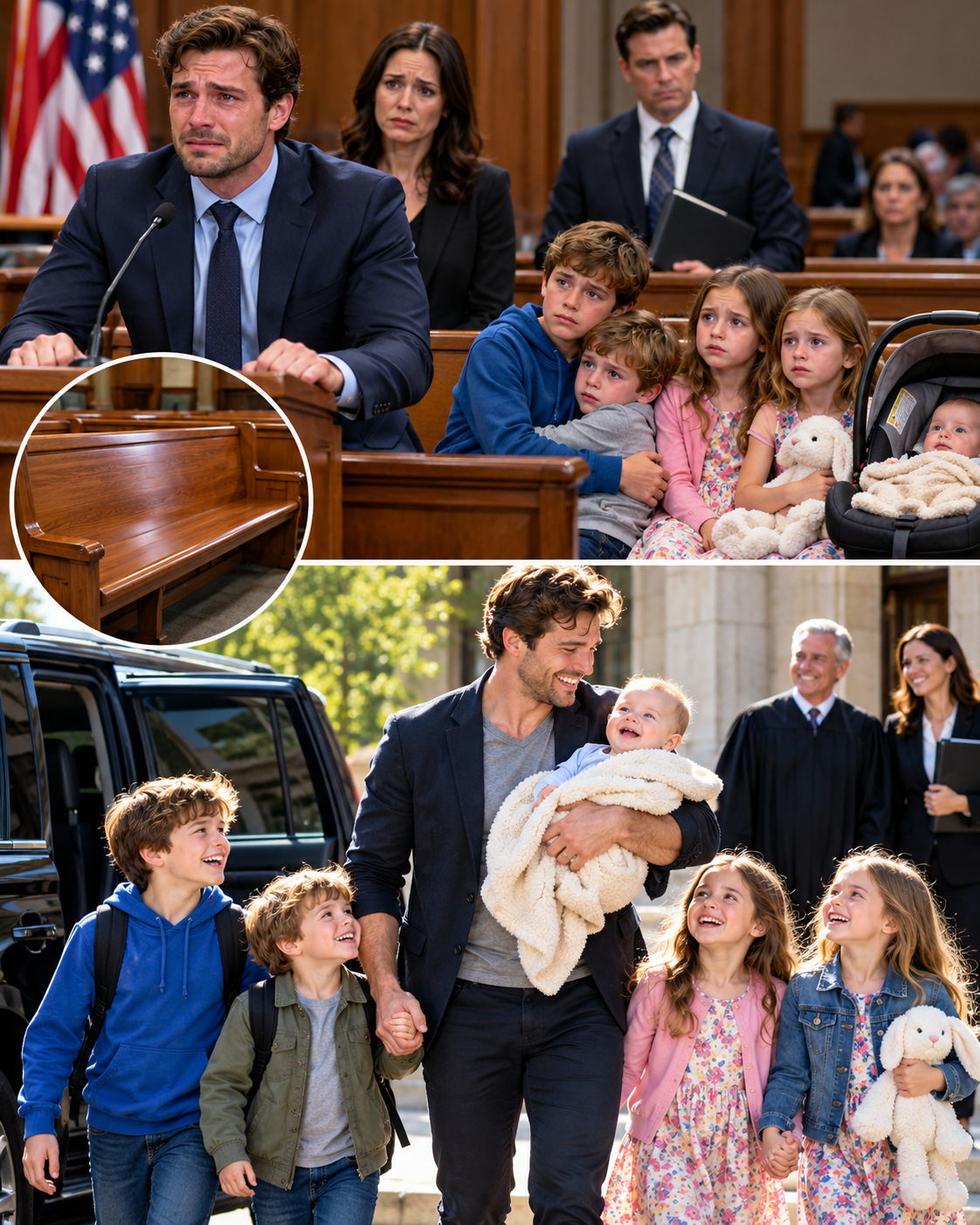
PART 1: FIVE CHILDREN, FOUR CARS
I was twenty-nine, single, and standing inside a family courtroom, asking a judge to place five children I’d never even spoken to in my care.
Even I understood how unbelievable it sounded.
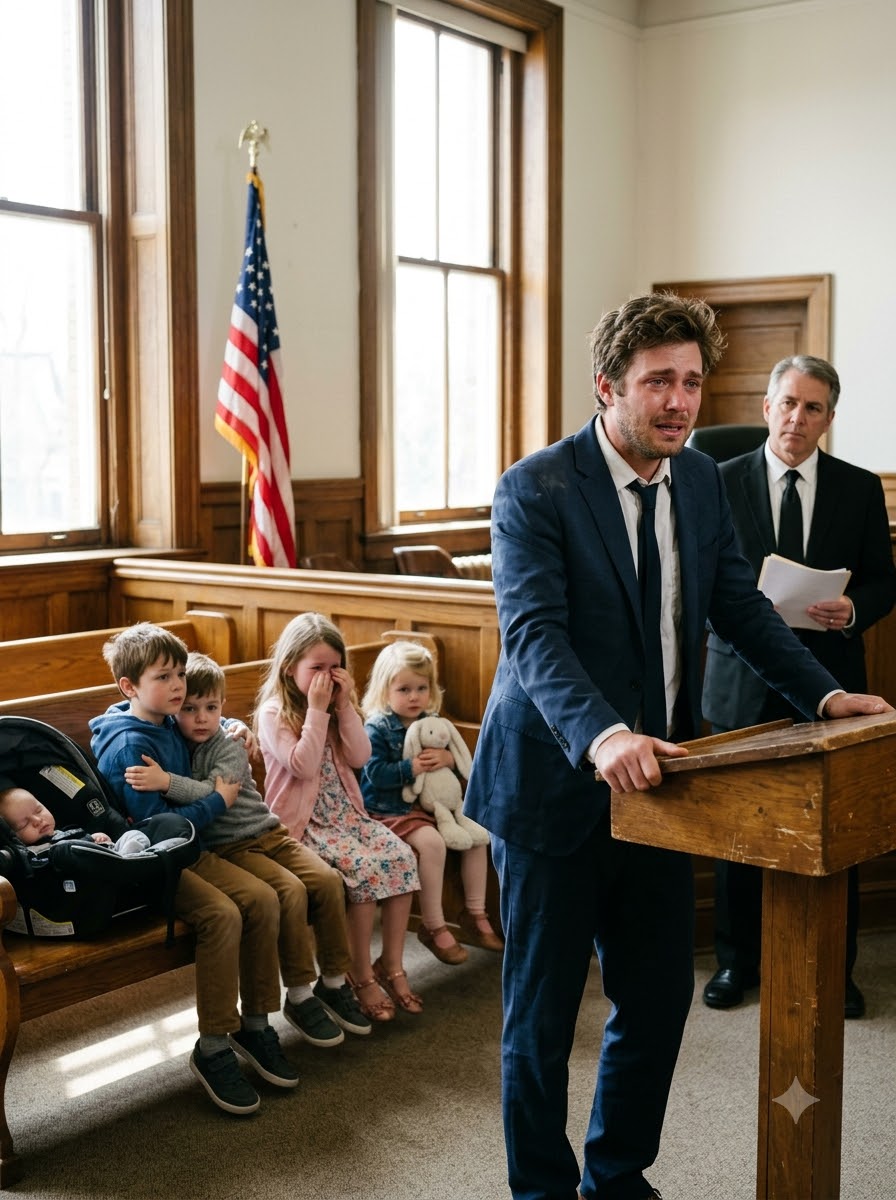
Across the room, six-year-old Noah sat on a polished wooden bench, holding his four younger siblings as close as his small arms would allow.
Caleb was pressed against his right side. Lily rested her head on his shoulder, quietly crying into the sleeve of an oversized sweater. Emma sat near his knee, gripping a plastic rabbit by one ear.
At his feet, baby Jack slept inside a carrier provided by the county.
Five children.
The oldest was only six.
The youngest had barely begun learning how to walk.
Three weeks earlier, they’d lost both parents.
And before the afternoon was over, they might lose the only family they had left.
Each other.
Noah understood that possibility.
That was what hurt most.
Adults sometimes assume children don’t comprehend complicated terms like temporary custody, foster capacity, placement, or jurisdiction.
Maybe they don’t understand the legal definitions.
But they understand suitcases.
They notice when unfamiliar adults whisper in corridors.
They recognize the expressions people wear when they refuse to make eye contact.
And Noah knew there were four vehicles waiting outside.
I’d seen them through the courthouse windows when I arrived.
Four county cars parked beside the curb.
Four drivers.
Four different destinations.
In the official documents, the arrangement was called separate placement.
Noah and Caleb would likely stay together because one foster family had two available beds.
Lily would be sent to a licensed home twelve miles west.
Emma would travel nearly forty miles north.
And Jack would be placed with an experienced infant foster family near the state line.
The professionals described the plan as practical, available, and temporary.
But nothing felt practical about forcing a six-year-old boy to decide which sibling he should hug first because he didn’t know when he’d see them again.
And there was nothing temporary about the memory of watching your family disappear in different directions.
I understood that long before anyone in the courtroom knew why.
“Mr. Carter.”
My attorney, Rachel Greene, gently touched my arm.
I’d been staring at Noah.
I forced myself to turn toward the judge.
County attorney Martin Hale stood near a table covered with files.
He was in his mid-forties, with gray beginning to show at his temples. His tie remained perfectly straight despite the oppressive August heat.
He wasn’t an unkind man.
For the previous week, I’d almost wished he were.
It would’ve been easier to fight someone cruel.
Instead, Hale was measured, cautious, and frustratingly reasonable.
“Your Honor,” he said, “the county does not question Mr. Carter’s sincerity.”
Judge Miller watched him over his glasses.
“But sincerity is not the standard.”
“No,” Judge Miller said. “It is not.”
Hale glanced in my direction.
“Mr. Carter has no parenting experience. He is not currently a licensed foster parent. He has never completed foster-parent training. He owns and operates a small carpentry business that historically requires long workdays. He is a single adult proposing to assume responsibility for five children, all under seven years old, all of whom have experienced recent and severe trauma.”
Every statement was accurate.
He didn’t need to exaggerate.
“He has not met these children,” Hale continued. “He does not know their routines, developmental needs, medical histories in any meaningful sense, behavioral challenges, fears, attachments, or individual responses to grief.”
I looked toward the bench.
Noah was counting again.
His lips moved almost imperceptibly.
One finger touched Caleb’s sleeve.
Then Lily’s hand.
Then Emma’s hair.
Finally, the edge of Jack’s carrier.
One.
Two.
Three.
Four.
Five.
“Furthermore,” Hale said, “Mr. Carter made several substantial life changes immediately after seeing a single photograph of these children.”
I knew what was coming.
“He sold his vehicle.”
My jaw tightened.
“He purchased a used passenger van.”
Judge Miller glanced down at the report.
“He withdrew a significant portion of his personal savings.”
Rachel shifted beside me.
“He moved equipment out of the workshop attached to his home and converted that space into sleeping quarters.”
“Which passed inspection,” Rachel said.
Hale nodded.
“It passed an expedited preliminary safety inspection. That is not the same as demonstrating long-term parenting capacity.”
Judge Miller raised his hand.
“Counsel, one at a time.”
Rachel sat back.
Hale continued.
“Mr. Carter’s actions may sound admirable. They may even be admirable. But rapid, dramatic decisions are not always evidence of preparedness. Sometimes they are evidence of impulse.”
Impulse.
That word struck harder than everything else.
As though I’d purchased a motorcycle on a whim.
As though five grieving children were another unfinished project that might end up abandoned behind my garage.
Hale turned slightly toward me.
“Good intentions cannot change the fact that these children are exceptionally vulnerable. If they are placed with Mr. Carter and the arrangement fails after several days or several weeks, they will experience another removal. Another loss. Another adult they trusted disappearing from their lives.”
He paused.
“That harm could be worse than placing them separately now in stable, experienced homes.”
For an instant, I hated him.
Then I hated myself for understanding part of his argument.
Because I was frightened.
More frightened than I’d ever admitted.
I’d installed childproof cabinet locks.
Covered every electrical outlet.
Bought five car seats after spending forty minutes watching installation tutorials in a store parking lot.
I’d stood in the supermarket’s children’s section for an entire evening, trying to understand the difference between diapers for twelve-month-olds and those for toddlers.
I’d researched pediatricians, daycare waiting lists, elementary school enrollment, trauma therapy, booster-seat regulations, choking hazards, medication storage, bedtime routines, and night terrors.
I’d even learned that children could develop fierce emotional loyalties to particular brands of chicken nuggets.
I had prepared as thoroughly as I knew how.
But preparation wasn’t the same as experience.
I didn’t know what Lily sounded like when she woke from a nightmare.
I didn’t know whether Emma wanted someone to hold her when she cried or preferred not to be touched.
I didn’t understand why Caleb had barely spoken since his parents died.
I didn’t know whether Jack could fall asleep without someone nearby.
And I had no idea how to persuade Noah that being six years old didn’t mean he had to become a father to four younger children.
Rachel stood.
“Your Honor, the county is correct about one thing.”
Hale glanced toward her.
“My client has no previous parenting experience.”
That wasn’t exactly the opening I’d hoped for.
Rachel looked at me briefly.
“But Mr. Carter has not pretended otherwise. He has not minimized the difficulty of this placement. In fact, the record shows the opposite.”
She raised a folder.
“He has rearranged his business operations so his foreman can manage job sites. He has accepted reduced income in order to work primarily from home. He has secured daycare placements. He has contacted the elementary school the older children would attend. He has identified a pediatric practice willing to accept all five children. He has attended emergency orientation sessions with the county. He has scheduled the remaining required training.”
She turned a page.
“His home inspection found no major deficiencies. His background check is clean. His financial records show manageable debt and adequate reserves even after the expenditures he has already made.”
Hale rose slightly.
“Those facts are not disputed.”
Rachel nodded.
“Then what is really being disputed is whether one inexperienced adult can be safer for these children than separating them from one another.”
“That is an oversimplification.”
“So is calling separation practical.”
Judge Miller’s expression sharpened.
“Ms. Greene.”
Rachel inhaled.
“Yes, Your Honor.”
She lowered her voice.
“No placement is risk-free. But these children have already suffered the permanent loss of both parents. Their strongest remaining attachment is to one another. That should carry substantial weight.”
I looked toward Noah.
He was rubbing Lily’s back in slow circles.
It was the comforting gesture of an experienced adult.
Except he wasn’t an adult.
He was a little boy who had somehow learned that his own grief needed to wait.
Judge Miller turned several pages.
“The county’s proposed visitation schedule?”
Hale answered.
“Weekly sibling visitation initially, Your Honor, with the possibility of increased contact depending on transportation and foster-family availability.”
Weekly.
A single visit each week.
That was what their family would become.
A scheduled appointment.
Judge Miller looked toward the children.
Noah stiffened when he realized the adults were watching him.
Lily whispered something into his ear.
He leaned closer.
“What?”
She repeated herself.
I couldn’t hear the words.
Noah glanced toward the courtroom doors.
Then at the adults.
Then back at his sister.
“No,” he whispered.
Lily began crying harder.
Noah wrapped one arm around her and reached for Caleb with the other.
Emma immediately grabbed his shirt.
For one heartbreaking moment, all four younger children were physically connected to him.
Then he began counting.
“One, two, three, four, five.”
He touched each sibling.
“One, two, three, four, five.”
My throat tightened.
Judge Miller was watching too.
Nobody spoke.
Noah counted a third time.
“One, two, three, four, five.”
I dug my fingernails into my palms.
Because I knew that count.
Not those children.
Not that courtroom.
But the counting.
The terror concealed beneath it.
The desperate belief that if you kept track of everyone, perhaps nobody could disappear.
Judge Miller lowered his gaze to the file.
Then he looked directly at me.
“Mr. Carter.”
I stood.
“Yes, Your Honor.”
“There is one question I have not been able to answer from any of these reports.”
I waited.
He removed his glasses.
“You are twenty-nine.”
“Yes, sir.”
“You have never been married.”
“No, sir.”
“No children.”
“No.”
“Until three weeks ago, your life appears to have been relatively uncomplicated. You operated your business, owned your home, traveled occasionally, and according to your references, had considerable personal freedom.”
Several people turned toward me.
Judge Miller leaned forward.
“Then you saw a photograph.”
“Yes.”
“And within days, you volunteered to take responsibility for five children you had never met.”
“Yes.”
“You sold your pickup truck.”
“Yes.”
“You converted your workshop.”
“Yes.”
“You withdrew most of your liquid savings.”
I swallowed.
“Yes.”
“You reorganized your business.”
“Yes.”
“And you did all of that knowing there was no guarantee the county would even recommend placement with you.”
“Yes.”
The judge studied me.
“Why?”
I’d prepared for almost every question I could imagine.
Financial stability.
Employment.
Childcare.
Discipline.
Education.
Transportation.
Safety.
Rachel and I had practiced answers until midnight.
But nobody had asked me that question.
Not in a way that demanded the truth.
Rachel turned toward me.
I could feel her watching.
Judge Miller spoke again.
“People do not usually dismantle the life they have built for strangers without a deeper reason, Mr. Carter.”
The courtroom seemed to contract around me.
“I am not suggesting the reason is improper. But I need to understand it.”
I stared at the microphone.
There were things I’d never told anyone.
Not my employees.
Not my closest friends.
Not women I’d dated.
Not the neighbors who invited me to Thanksgiving after noticing I always claimed to be working.
Whenever someone asked where I’d grown up, I named the county.
Whenever someone mentioned my parents, I said they were gone.
Whenever anyone asked whether I had brothers or sisters, I changed the subject.
My house contained no childhood photographs.
No graduation portrait with proud parents standing beside me.
No family Christmas cards.
No shoebox filled with birthday letters from grandparents.
I’d built my adult life the way I built cabinets.
Measured.
Orderly.
Strong.
Without unnecessary openings.
Then I looked at Noah.
He was still holding Lily.
Still reaching for Caleb.
Still watching the courtroom doors.
And suddenly, I wasn’t looking at a stranger.
I was looking at myself.
My seven-year-old legs hadn’t reached the floor either.
I remembered the smell of courthouse cleaning polish.
The scratch along the wooden bench beneath my fingertips.
The sound of an adult explaining that there weren’t enough available beds.
I remembered trying not to cry because the younger children were already crying.
I remembered counting.
For twenty-two years, I’d pretended that frightened little boy no longer existed.
Now he was sitting twenty feet away.
Judge Miller waited.
I straightened, although my knees felt weak.
Rachel whispered, “Ethan?”
I shook my head slightly.
I couldn’t explain everything to her first.
Not anymore.
I approached the microphone.
Every footstep sounded unnaturally loud.
Judge Miller watched carefully.
“Take your time, Mr. Carter.”
I gripped the edge of the podium.
“My reason isn’t that I think love fixes everything.”
My voice was rough.
“It doesn’t.”
Hale’s expression shifted.
“I don’t think buying beds makes me a father. I don’t think I know these children because I saw their picture. And I’m not standing here because I think I’m some kind of hero.”
I looked at Noah.
For the first time, he looked directly back at me.
His eyes were dark.
Watchful.
Much older than they should have been.
My hands began shaking.
Judge Miller noticed.
“Mr. Carter,” he said quietly, “emotion alone will not decide this case.”
“I know.”
I drew a breath.
“Emotion isn’t what I’ve been hiding.”
The courtroom fell completely still.
I looked at the five children.
Then I finally spoke the words I’d avoided for more than twenty years.
“I know what happens when no one comes, Your Honor.”
My voice cracked.
“Because when I was seven years old, I sat on a bench exactly like that one.”
Across the courtroom, Noah stopped counting.
And for the first time in twenty-two years, I was about to tell strangers the story I’d spent my entire adult life trying to forget.
