

PART 1
The first time I met eight-year-old Sophie Bennett, she was standing at the counter of a small diner just outside Burlington, Vermont. Snow clung to the shoulders of her worn red coat, slowly melting into the fabric, while she carefully held three crumpled dollar bills between her fingers.
I had stopped there because I couldn’t bring myself to go home.
For the past five years, it had become a familiar routine. After work, I would drive past the turnoff to my house, searching for an ordinary place where nobody knew me well enough to question why a man with a comfortable life seemed so determined to stay away from it.
That evening, I chose a diner.
Sophie had chosen it because her mother needed something warm to eat.
“Could you make the soup smaller?” she asked the woman behind the counter. “I only need enough for one person.”
The waitress glanced at the money in her hand.
“Honey, it’s six dollars.”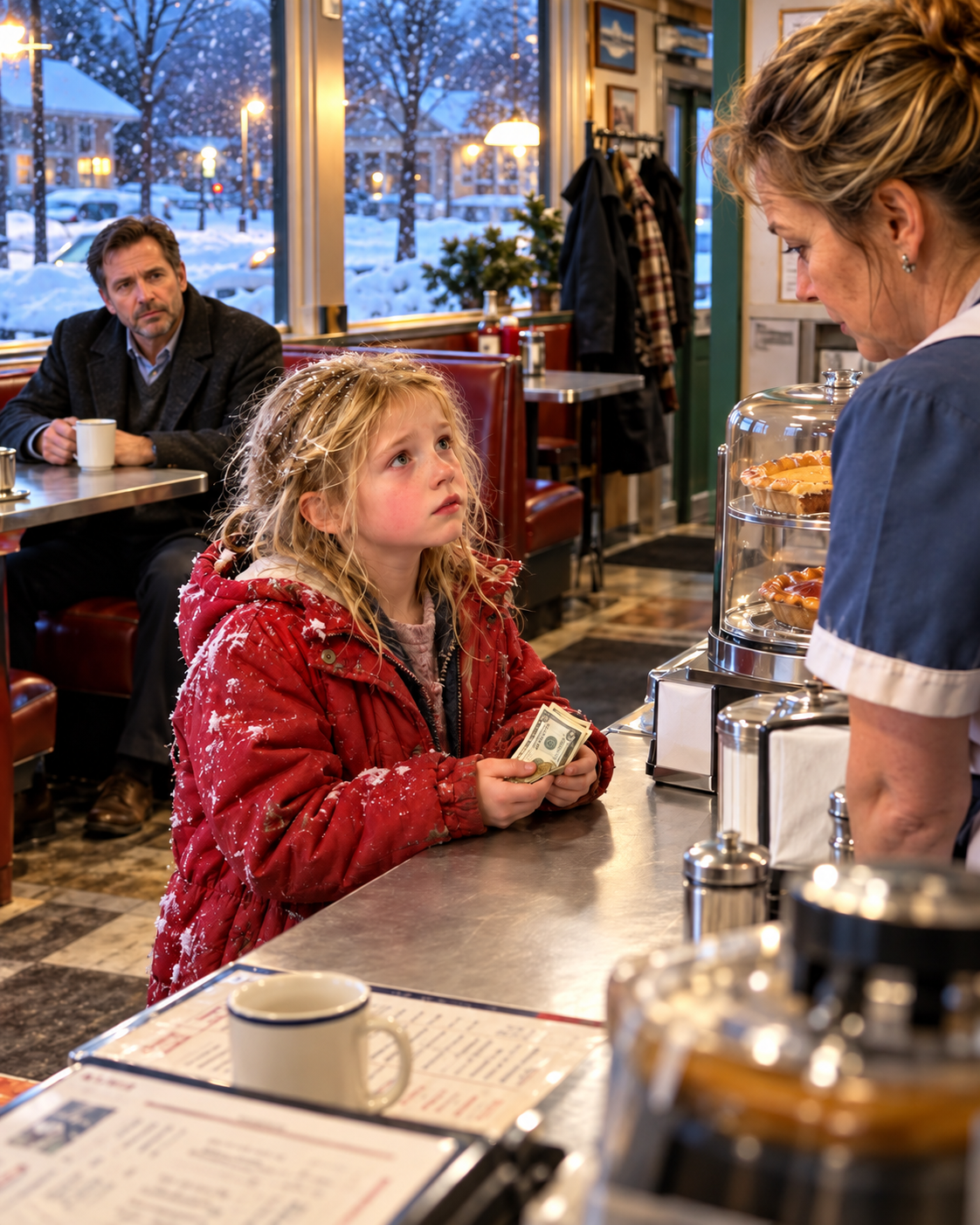
Sophie counted her bills again, although I suspected she already knew exactly how much she had.
“I have three dollars and twelve cents.”
“I’m sorry.”
“Could I bring the rest another day?”
The waitress let out a tired sigh. She wasn’t trying to be unkind. She simply had a line of hungry customers waiting during the dinner rush, and she didn’t have the authority to make exceptions.
“I can’t do that.”
Sophie nodded quietly.
Then she asked, “Could I clean a table or something?”
That was when I put down my coffee.
The waitress’s expression softened immediately.
“You’re much too young for that, sweetheart.”
Sophie whispered that she understood, gathered her money, and turned toward the door.
She didn’t cry.
That was what I remembered most.
A child crying because she cannot afford a bowl of soup is heartbreaking. But a child who has already learned that tears won’t change anything carries a different kind of sorrow.
As Sophie walked past my booth, she noticed a napkin lying beneath the neighboring table. She stopped, bent down, picked it up, and tossed it into the trash.
My wife, Caroline, used to do things like that.
She returned abandoned shopping carts. She remembered the names of waiters. She wrote handwritten thank-you notes. Once, during a rainstorm, she spent several minutes outside a grocery store helping an elderly stranger load bags into his trunk while I sat in our car, wondering what was taking her so long.
Caroline had been gone for five winters, but the smallest gestures could still bring her back so vividly that I sometimes felt I might turn around and find her standing beside me.
I got to my feet.
“Excuse me.”
Sophie stopped.
Her expression turned cautious.
“What kind of soup were you trying to buy?”
“Chicken noodle.”
“Good choice.”
I walked up to the counter.
“Two large containers of chicken noodle, please, and some bread.”
Sophie immediately shook her head.
“No, thank you. I only need one bowl.”
“The second container can be tomorrow’s lunch.”
“I can’t pay you.”
“You don’t have to.”
My answer seemed to make her even more suspicious.
“My sister says we’re not supposed to take things from people we don’t know.”
Despite everything, I smiled.
“Your sister sounds sensible.”
She said nothing.
I held out my hand.
“I’m Andrew Whitmore.”
Sophie studied it but didn’t shake it.
“Sophie Bennett.”
“There. Now we know each other slightly better.”
That earned me the faintest smile.
At forty-nine, I owned a regional architectural firm that designed schools, libraries, senior communities, and public buildings throughout New England. I was accustomed to solving complicated problems involving budgets, schedules, engineers, attorneys, and contractors.
Yet I understood almost immediately that simply handing Sophie money would be the wrong approach.
So I tried something Caroline might have suggested.
“How about a trade?”
Sophie narrowed her eyes.
“What trade?”
“I buy the soup tonight. Someday, when somebody needs help and you have something useful to offer, you help them.”
“What if I don’t have money?”
“Most useful things aren’t money.”
She thought about that.
Then, with the astonishing perceptiveness children sometimes possess, she looked directly into my face.
“Then why do you look lonely?”
I had known her for perhaps four minutes.
And somehow, in those four minutes, she had noticed something that most adults had spent five years politely pretending not to see.
I looked away first.
“Maybe I am,” I admitted.
Sophie didn’t tell me that everything would be all right. She didn’t offer an empty promise or try to make me feel better.
Instead, she nodded as though loneliness were something she understood.
“My mom gets lonely, too,” she said. “But she says it helps when someone sits with you.”
Something tightened in my chest.
“Your mother sounds like a wise woman.”
“She is. She just gets tired a lot now.”
The waitress placed the containers of soup and the bread into a paper bag. I paid the bill, then helped Sophie put on her gloves.
“Where do you live?” I asked.
She pointed toward the road beyond the parking lot.
“Not far. We can walk.”
“It’s snowing pretty hard. Would your mother mind if I drove you?”
Sophie hesitated.
I could practically hear her sister’s warning echoing in her head.
“Can I call her first?”
“Of course.”
I gave her my phone and turned away while she dialed the number from memory. She spoke quietly, explaining that a man had bought the soup and wanted to drive her home.
After a short conversation, she handed the phone back.
“Mom says thank you. She says you can drive us, but she wants to see you before I get out.”
“That seems perfectly fair.”
We stepped outside into the swirling snow.
As I opened the passenger door, Sophie paused and looked at the silver compass hanging from the key ring in my hand.
“That’s pretty,” she said.
I glanced down.
It had belonged to Caroline. She had given it to me on our tenth wedding anniversary, joking that I was the only man she knew who could design an entire building but still get lost driving to the grocery store.
“Thank you. My wife gave it to me.”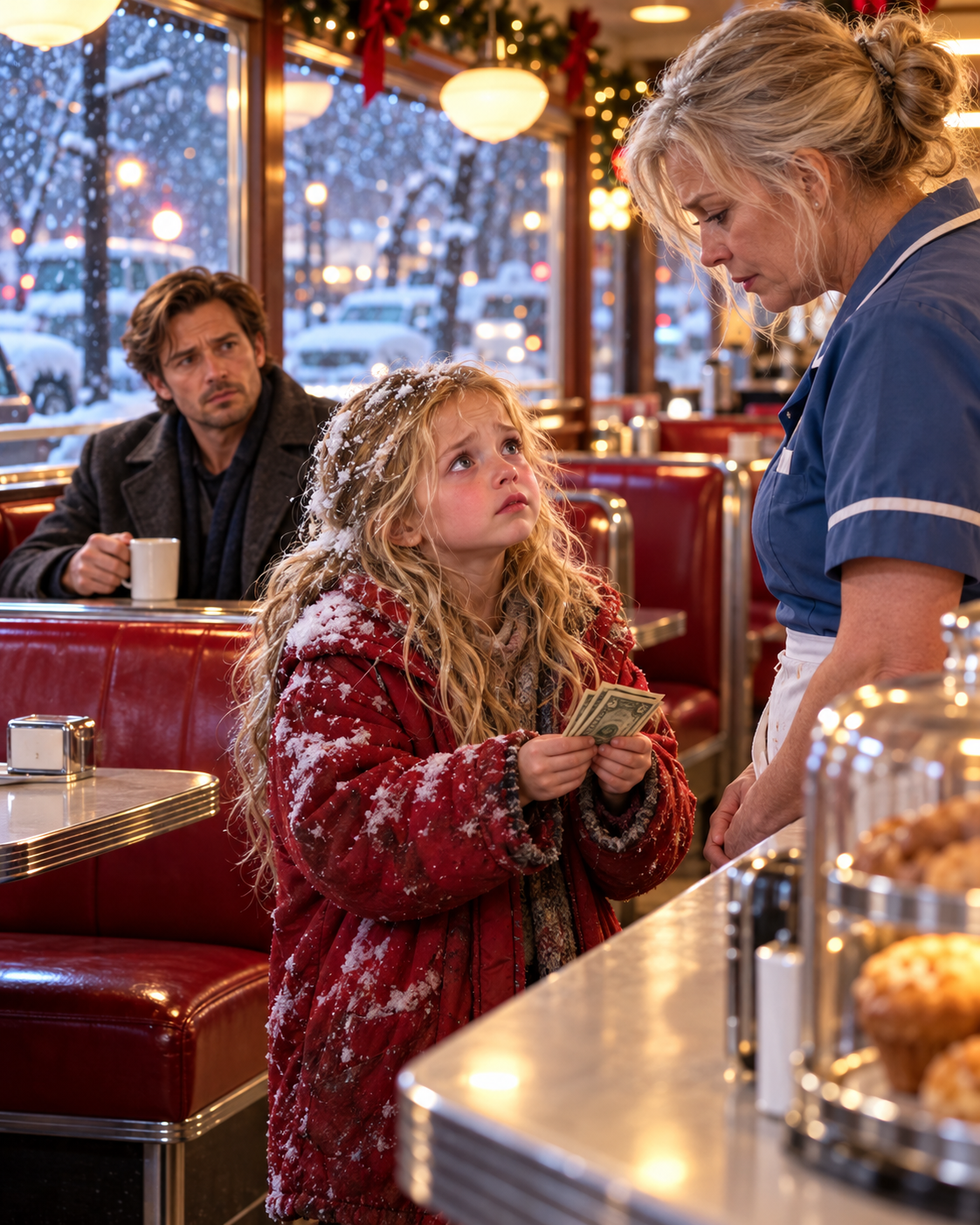
“Where is she?”
I swallowed.
“She passed away.”
Sophie looked at me with a seriousness that seemed far too old for her face.
“My dad died before I could remember him,” she said. “Mom says people don’t stop loving us when they die. They just can’t come home anymore.”
For the first time that evening, I had no answer.
I simply opened the door for her.
The drive took less than ten minutes. We left the main road and turned onto a narrow street lined with modest houses, their roofs buried beneath fresh snow. At the end of the block stood a small blue house with a porch light flickering in the wind.
Sophie pointed.
“That’s ours.”
A woman stood behind the front window, watching us approach.
She was pale and thin, with dark hair pulled into a loose knot. Even from the driveway, I could see the strain in her face.
I carried the soup to the porch while Sophie hurried ahead to unlock the door.
Her mother opened it before I could knock.
“I’m Emily Bennett,” she said. “You must be Andrew.”
“Yes. I hope I haven’t caused any trouble.”
“No. Sophie told me what happened.” Her eyes moved to the bag in my hand. “You have no idea how much this means to us.”
She looked as though she wanted to say more, but a sudden coughing fit interrupted her. She turned away, covering her mouth with a handkerchief.
Sophie immediately reached for her arm.
“Mom, you need to sit down.”
Emily nodded and let her daughter guide her toward the sofa.
I placed the soup on the kitchen counter, then noticed a prescription bottle beside a stack of unopened envelopes. The room was clean, but the furniture was worn, and a space heater hummed beside the couch.
Emily noticed me looking.
“I’ve been sick for a while,” she explained. “It’s been difficult to work consistently.”
“I’m sorry to hear that.”
“It’s temporary, I hope.”
She smiled at Sophie, but I saw the fear beneath it.
I asked whether they had enough food for the next few days. Emily immediately tried to reassure me that they would manage.
Then Sophie quietly opened the refrigerator.
Inside were a carton of milk, half a loaf of bread, and a few containers holding what looked like leftovers.
Emily closed her eyes.
“Sophie.”
“I’m sorry, Mom. I thought he should know.”
I felt an old, familiar ache in my chest.
Five years earlier, Caroline and I had discussed starting a charitable foundation to help families facing sudden illness, housing insecurity, and financial hardship. She had wanted it to provide practical assistance without forcing people to sacrifice their dignity.
I had agreed with her.
Then she died, and I buried myself in work until the idea became another unfinished conversation.
I looked at Emily.
“I won’t pretend I can fix everything,” I said. “But I know people who might be able to help you find the right resources. If you’d be comfortable with that, I’d like to make a few calls.”
Emily studied me for a long moment.
“Why would you do that for strangers?”
I thought about the question.
“Because somebody once taught me that helping people is not supposed to require a reason.”
Caroline’s words, almost exactly.
Emily’s expression changed slightly.
“Your wife sounds like she was a wonderful person.”
“She was.”
I stayed only long enough to make sure they had everything they needed for dinner. Before leaving, I wrote my phone number on a piece of paper and placed it beside the soup.
Sophie walked me to the door.
“Thank you for keeping your promise,” she said.
“What promise?”
“You said the second soup was for tomorrow.”
I laughed softly.
“You’re welcome, Sophie.”
She hesitated before asking one last question.
“Will you come back?”
I looked at her small face, at the hope she was trying so hard not to show.
“If your mother is comfortable with it, yes.”
She smiled.
