

PART 2
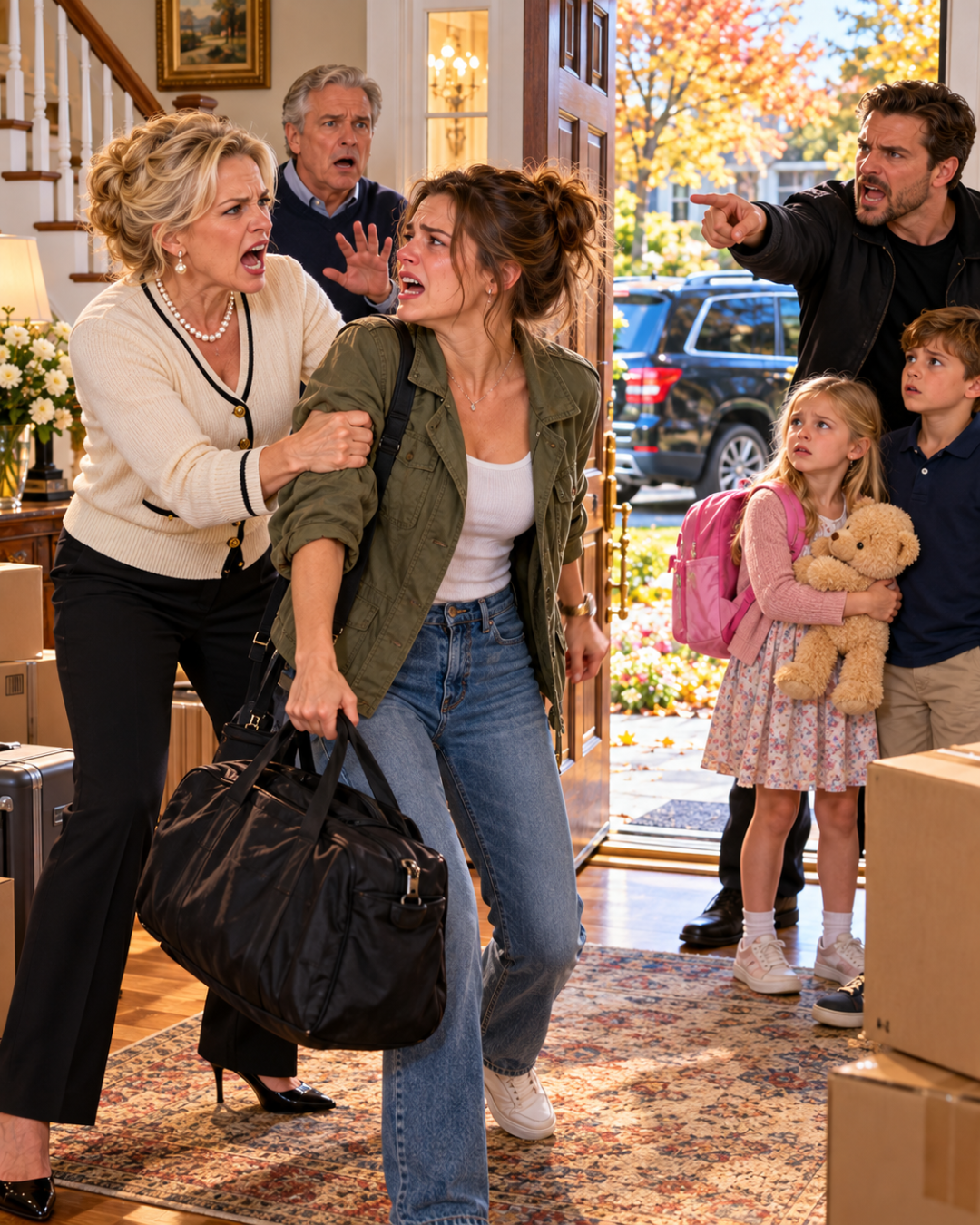
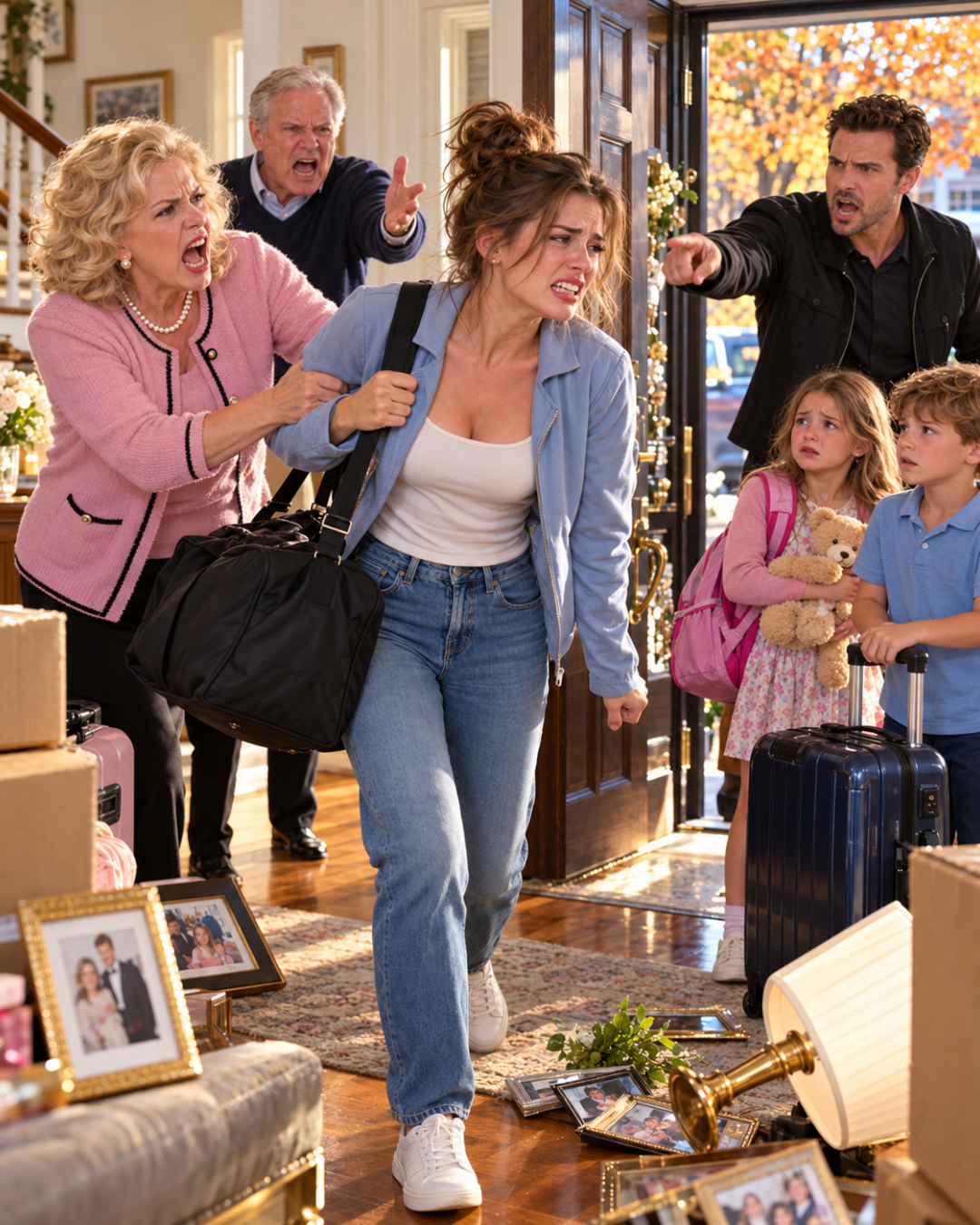
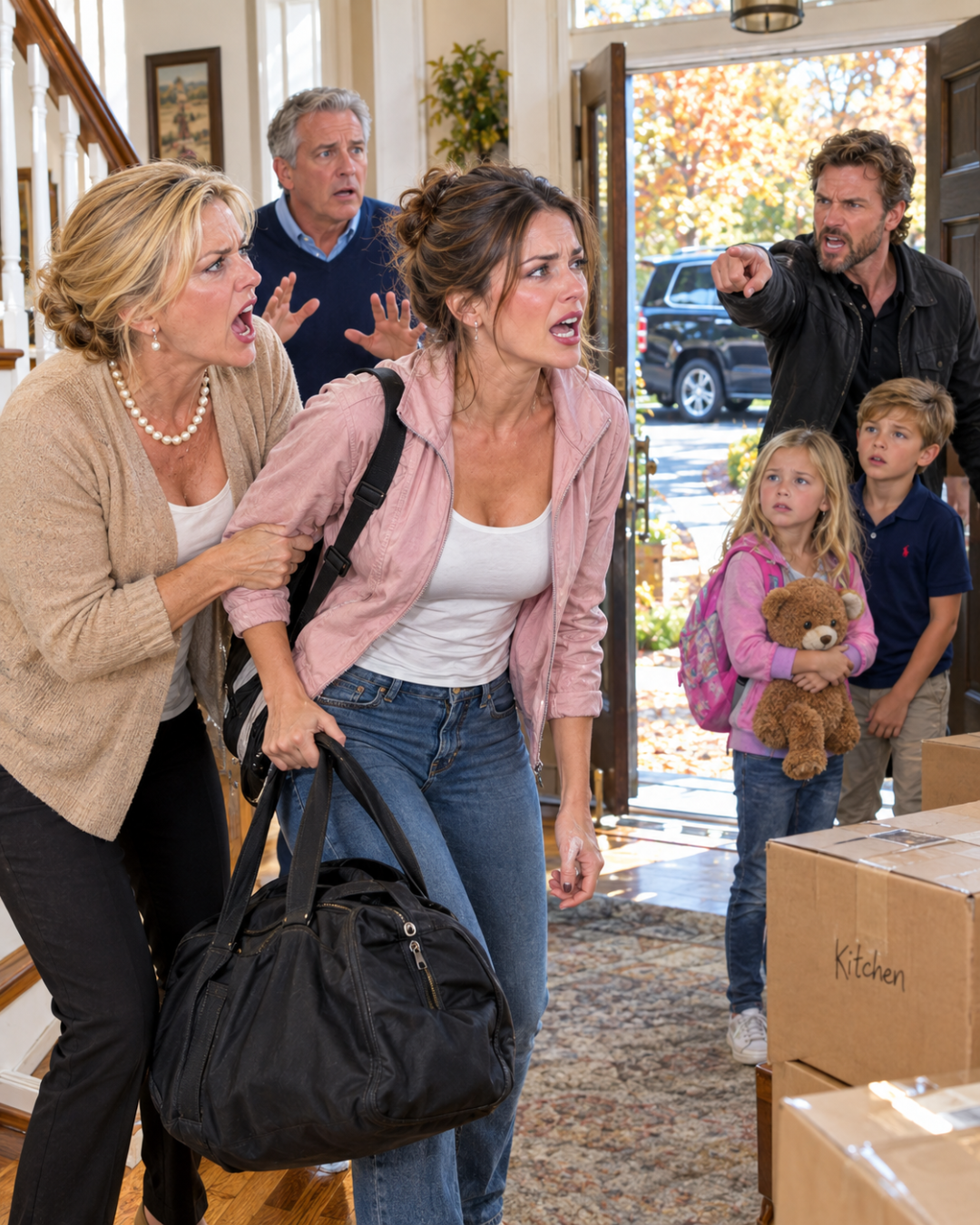
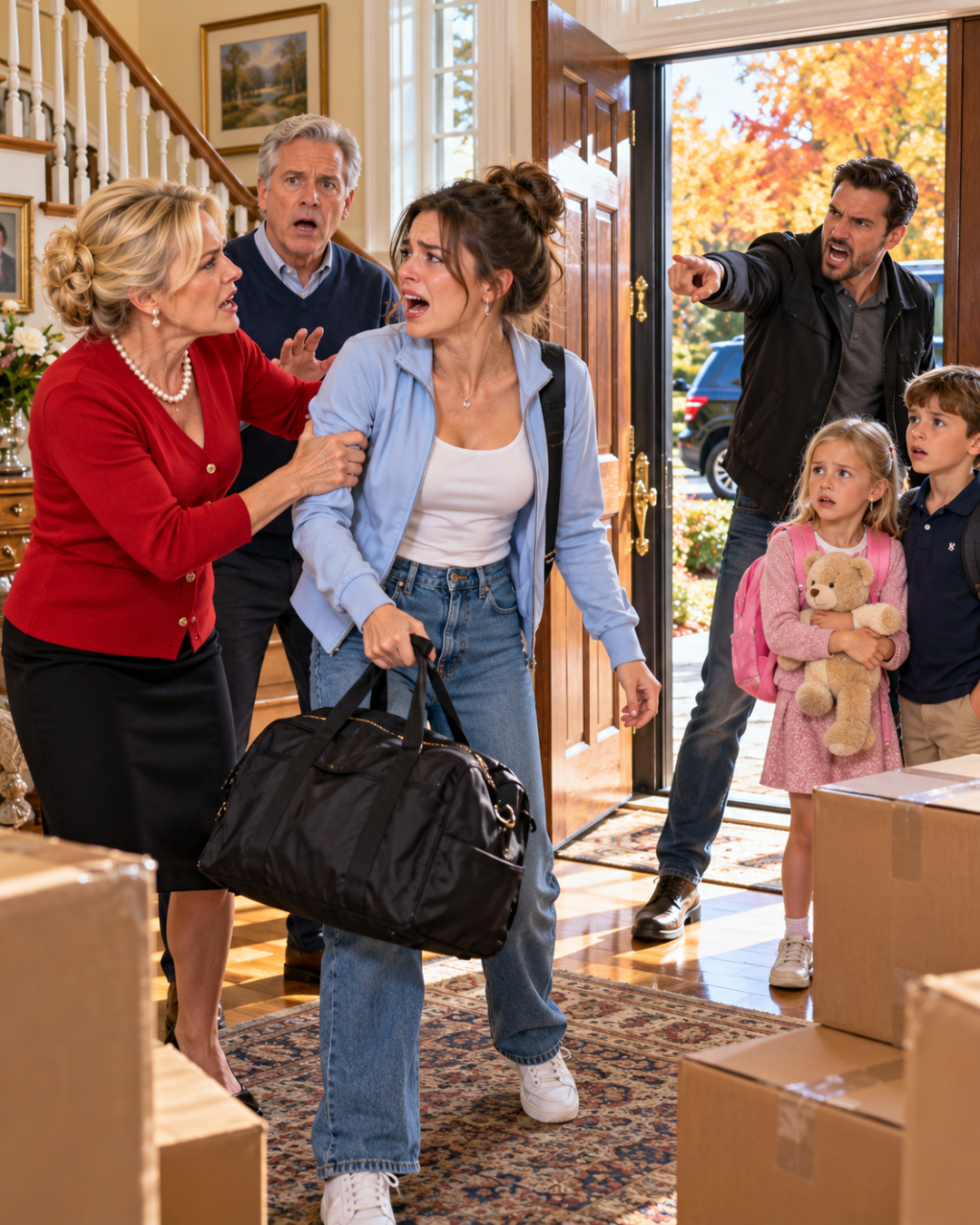
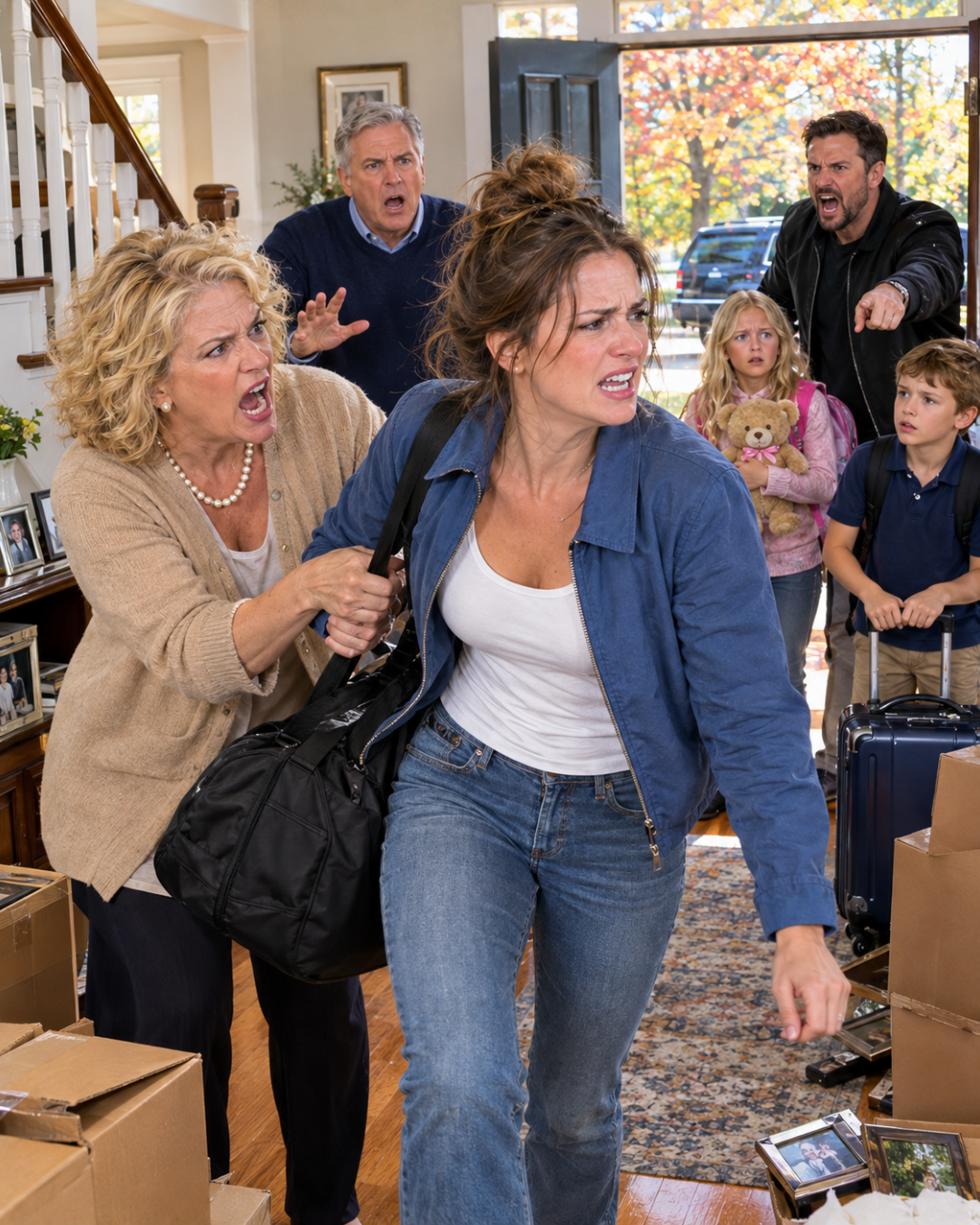
The front door opened wide, and a rush of late-September air swept through the hallway, bringing with it the scent of damp leaves and car exhaust.
Derek had arrived early.
He stood on the porch with a duffel slung over one shoulder and a booster seat dangling from one hand. He looked thinner than he had the last time I’d seen him, at Christmas two years earlier. Behind him stood my nine-year-old niece, Maddie, all long limbs and elbows, holding her little brother Theo by the wrist. Theo was six, wearing a dinosaur backpack so enormous it seemed to be carrying him instead.
“Surprise,” Derek said, but there was no surprise in his voice. He sounded exhausted, and the word sounded rehearsed, as though he’d practiced saying it during the drive.
My mother’s face brightened the way it used to whenever Derek returned home from college. She moved around me as though I were a piece of furniture and wrapped him in a hug before bending down to squeeze the children.
“Look at you two,” she said. “Look how big you are. Grandma has your rooms all ready.”
Rooms. More than one. My bedroom, the office, and the guest room. I noticed she didn’t call it “Aunt Naomi’s room.” In fact, she didn’t mention my name at all.
Then she straightened, turned around, and did exactly what I’d expected.
She reached for the box.
It sat at the foot of the staircase, exactly where she’d placed it Wednesday night so I’d be forced to pass it every time I came downstairs. A medium-sized moving box, sealed with tape, with my name written across one side in her neat, slanted handwriting. NAOMI. Like inventory. Like something labeled before being sent away.
Five identical boxes were stacked in the garage. She had packed every one herself.
And she’d made certain I knew that.
“Here,” she said, lifting the box and pressing it toward me with both hands. “Your things. I did most of the work for you. Your father can help you load the car. Let’s not make a scene in front of the children.”
Maddie looked at the box.
Then she looked at me.
“Aunt Naomi?” she said. “Are you going somewhere?”
I didn’t reach for it.
For three years, I’d been taking things from my mother.
Her tone.
Her sighs whenever I came home late from work.
Her little remarks about how “some people” never needed to worry about paying rent.
Her blame when the furnace stopped working, as though my presence in the house had somehow worn it down.
I wasn’t taking anything else.
“You should open it, Mom,” I said.
She frowned. “What?”
“The box. You packed it. You should open it.”
“Naomi, I don’t have time for—”
“Open it,” I said again, and although I never raised my voice, something in my tone made my father place his coffee mug on the hall table.
Derek looked from me to our mother.
“What’s going on?”
My mother’s jaw tightened. She wasn’t accustomed to anyone giving her instructions inside her own house, especially with her son watching. But she also couldn’t tolerate the possibility of appearing as though she had something to hide.
So she placed the box on the small bench near the door, dug her fingernails beneath the tape, and tore it open.
I watched her expression.
Every night that week, lying awake in a bedroom that no longer felt like it belonged to me, I’d imagined this moment.
I’d imagined anger.
I’d imagined shouting.
In my weaker moments, I’d even pictured her crying, pulling me into her arms, and telling me she hadn’t meant any of it.
What I had never imagined was the silence.
Because the box she’d packed with my sweaters, books, and framed college diploma no longer contained any of those things.
I’d removed them Tuesday afternoon while she was at book club. Everything I wanted to keep had been taken out and carried, one box at a time, to my car.
Then I’d replaced the contents of the first box with something else and taped it shut exactly as she’d left it.
At the top was a ring of keys.
The front door key.
The back door key.
The key to the shed where I’d stored the replacement gutters I’d paid for the previous spring.
The garage door opener with its cracked plastic clip that I’d glued together twice.
Beneath the keys sat a thick blue binder.
Across its cover, I’d written two words in black marker.
Three Years.
And beneath the binder, positioned face-up so there was no possibility she could overlook it, lay a printed email thread.
The bold subject line appeared at the top.
Room Setup.
My mother didn’t move.
For what felt like a very long time, she simply stood there gripping the torn cardboard flap and staring into the box as though it had spoken aloud.
My father stepped closer.
He was sixty-four, quiet by nature, a retired high school shop teacher who had spent most of his marriage allowing my mother to handle “the house stuff” and “the family stuff,” which essentially meant everything.
He picked up the email and adjusted his reading glasses.
I watched his eyes move across the page.
I watched him reach Derek’s sentence.
Just make sure Naomi is out before the kids arrive. I don’t want her ruining the vibe.
Then he reached my mother’s reply.
Once she’s finally out, this house can feel like family again. It will finally be ours.
His hand began trembling slightly.
He read the words again.
“Linda,” he said. “What is this?”
“It’s a private conversation,” my mother said, reaching for the page.
My father didn’t release it.
“She had no right to go through my email.”
“It’s the household account,” I said. “The one you set up so I could pay the utilities. The one I’ve logged into every month for three years to pay the gas bill, the water bill, and the internet. You gave me the password, Mom.”
The color had drained from Derek’s face.
He lowered the booster seat onto the porch.
“Naomi,” he said. “That’s not—I didn’t mean it like—”
“Like what?” I asked.
And I truly wanted an answer.
I wanted someone in my family to explain what those words could possibly have meant other than exactly what they said.
His mouth opened.
Nothing came out.
Maddie tugged at her father’s sleeve.
“Dad, what’s a vibe?”
Theo had become fascinated with the dog-shaped doorstop and wasn’t listening at all.
I crouched until I was eye level with my niece.
She had Derek’s nose and her mother’s serious gray eyes. The last time I’d seen her, she’d still been small enough for me to carry on my shoulders at the county fair.
“Hey, Maddie,” I said softly. “I want you to know something, okay? None of this is because of you or Theo. Not one little bit. The grown-ups made some grown-up mistakes, and we’re going to have to fix them. But you two are always, always welcome wherever I am. Got it?”
She studied my face with the careful seriousness children have when deciding whether an adult is telling them the truth.
“Are you mad at Grandma?”
For a moment, I considered lying.
Then I thought about how many lies had already filled that house.
“I’m sad at Grandma,” I said. “That’s a little different.”
She nodded slowly, as though she understood.
When I stood again, my mother had recovered her voice.
“This is emotional blackmail,” she said. “That’s what this is. You’ve been sneaking around behind my back, going through my things, keeping receipts like some kind of—”
“Like some kind of what?” I said. “A parasite?”
The word struck the hallway like a plate shattering on the floor.
Derek flinched.
My father shut his eyes.
“You called me that on Sunday,” I said. “At dinner. Over pot roast. In front of Dad. So I want to be very clear about what’s in that binder, because I think this family has been confused about it for a long time.”
There was no reason for me to open the binder.
I knew every page inside because I’d spent four nights arranging it at Sophie’s kitchen table while she sat across from me with her reading glasses pushed into her hair and a legal pad covered in numbers.
“The furnace,” I said. “January, three years ago. It died during the cold snap. You called me crying because the repair company wanted four thousand dollars and you didn’t have it. I paid it the same day. The invoice is on page one.”
My mother remained silent.
“The property taxes. Two years ago you fell behind, and the county sent the letter about the tax sale. You didn’t tell Dad. You told me. I emptied my savings account. Eleven thousand, two hundred dollars. I was saving for a down payment on a condo. I told myself I’d rebuild it. I never did, because every few months there was something else.”
My father slowly turned toward her.
“Linda. You told me that was handled.”
“It was handled,” she snapped.
“By me,” I said. “It was handled by me.”
I continued.
I wasn’t trying to hurt her.
I was simply speaking aloud, for the first time, everything I’d silently carried for years.
And once the words began coming, it felt like finally putting down heavy grocery bags after carrying them uphill for far too long.
“The roof patch after the hailstorm. The water heater. The gutters. The new dishwasher when the old one flooded the kitchen floor. The car insurance on Dad’s truck for fourteen months when the premium went up. The internet. The electric bill every summer when the air conditioner ran all day. I never asked you for rent receipts, Mom, because I wasn’t paying rent. I was paying for the house. And I never asked for a thank you, because I thought that’s what family did.”
I paused to breathe.
“The total is thirty-eight thousand, six hundred and forty dollars. Every page has a receipt, a bank statement, or an invoice. Sophie checked all of it.”
“Sophie,” my mother repeated, saying the name sharply. “You went to a lawyer?”
“I went to a friend who happens to be a lawyer.”
“So that’s it,” she said, her voice rising. “You want the house. That’s what this is. You’ve been planning this. Three years of ‘helping’ so you could stand in my doorway and threaten to take my home out from under me.”
“I don’t want your house.”
“Then what do you want?”
It was the first genuine question she’d asked me in longer than I could remember.
And I already knew my answer because I’d spoken those same words in Sophie’s office Monday morning and felt something inside my chest finally open.
“I want my life back,” I said.
Sophie had helped me draft it, but every word belonged to me.
My father found it, unfolded the page, and read it aloud because my mother refused.
There was nothing dramatic about it.
That was intentional.
It stated that I was moving out immediately, exactly as they’d requested.
It explained that the utilities and home internet, which had remained in my name for three years, would either be transferred or canceled on October fifteenth, giving them two weeks to establish their own accounts.
It stated that the automatic quarterly property tax payment coming from my checking account had already been canceled.
And it requested repayment of thirty-eight thousand, six hundred and forty dollars, under whatever reasonable payment schedule they could afford, without interest, recorded in a straightforward written agreement.
The final paragraph was the section I’d rewritten nine times.
I am not doing this to punish you. I am doing this because for three years I paid for a place in this family, and I have just learned that I never actually had one. I’d rather be owed money than owe anyone my self-respect. If you ever want a relationship with me that isn’t a transaction, my door will be open. But it will be my door.
When my father finished, complete silence filled the hallway except for Theo quietly making roaring sounds at the dog-shaped doorstop.
My mother’s face had turned strangely blotchy.
“You stopped the tax payment,” she said.
It wasn’t a question.
It was realization.
And that was when the fifty-three missed calls finally made sense.
Monday morning, after driving around for half the night and sleeping three hours in my car in a grocery store parking lot, I’d turned my phone back on.
Notifications flooded the screen like water rushing from a burst pipe.
Fifty-three missed calls.
Twenty-nine came from my mother.
Eleven came from Derek.
Two were from a number I didn’t recognize, which turned out to belong to Derek’s ex-wife’s sister, who apparently still had my number from their wedding and had been asked to “check on” me.
The remaining eleven were from my father.
My mother’s voicemails began angrily.
Where are you? You can’t just walk out in the middle of dinner. You’re being dramatic.
Then her tone became colder.
If you’re trying to make a point, it isn’t working.
But sometime around three in the morning, everything changed.
Naomi, call me back. It’s about the house. Something’s wrong with the account.
I hadn’t changed anything yet.
Not Sunday night.
All I’d done was read the email thread.
But the household email account recorded when messages were opened.
And while lying awake that night, my mother had checked.
She had seen that the “Room Setup” thread was opened at 9:47 p.m., from a laptop sitting in a car along Route 9, while she believed I was upstairs sulking.
She knew I’d seen everything.
And sometime during those early-morning hours, she’d also remembered that the quarterly property tax installment—the payment that had prevented the county from putting the house on the tax sale list two years earlier—came automatically from my checking account.
On October first.
Three days away.
She hadn’t called fifty-three times because she missed me.
She had called fifty-three times because she suddenly realized she was about to lose the person keeping the lights on, just one week before she needed her most.
Derek’s calls were harder to understand.
Half his messages were angry, repeating my mother’s complaints.
Why are you upsetting Mom? She’s been crying all night.
But his final voicemail, recorded at 6:12 that morning, sounded completely different.
He sounded as though he were sitting alone inside a parked car.
Nay. It’s me. I, uh… I need to talk to you. Please call me.
He hadn’t called me Nay since childhood.
My father’s messages were the ones I’d replayed most often.
Eleven calls.
Only one voicemail.
Twenty seconds.
Naomi. It’s Dad. I don’t know what happened at dinner, not all of it. I’m sorry I didn’t say anything. I should have said something. Please just let me know you’re safe. That’s all. You don’t have to call back. Just text me that you’re safe.
I had sent him two words.
I’m safe.
Less than a minute later, he replied.
Thank you. I love you.
Sitting alone in that grocery store parking lot, I cried harder than I had at dinner.
Now, back in the hallway, my mother held my letter, one edge crumpled inside her fist.
“You can’t just stop paying,” she said. “The first of the month is Thursday. The county will—do you have any idea what you’re doing to your father?”
“I’m not doing anything to Dad,” I said. “Dad has a pension. You have your Social Security. Derek is here now, and he’s going to be the head of the household. That’s what you said on Sunday. You said he needed to feel like the head of a household again.”
I turned toward my brother.
“Heads of households pay the property taxes, Derek.”
He looked as though I’d slapped him.
For one brief, ugly second, satisfaction flickered through me.
Then something heavier replaced it.
Because Derek wasn’t angry.
He wasn’t smirking.
He looked like a man who had driven two thousand miles with two children in the back seat, only to discover at the finish line that the ground he’d been promised wasn’t solid.
“Mom,” he said quietly. “You told me the house was paid off.”
My mother turned toward him.
“It is paid off. The mortgage is paid off.”
“You told me there were no bills. You said I could stay here while I got back on my feet and I wouldn’t have to worry about anything. You said Naomi was just—”
He stopped.
“Just what?” I asked.
He swallowed.
“You said Naomi was just living here for free and that she’d been taking advantage of you and Dad. You said she wouldn’t leave. You said I’d have to be firm about it or she’d make the kids feel unwelcome.”
The words remained suspended between us.
For an entire week, I’d hated my brother for his email.
For ruining the vibe.
For describing me as though I were an ugly stain someone needed to remove from the carpet.
And suddenly, standing there in that hallway, I realized he’d been given a story too.
Our mother had told each of us a different version of the other.
“Linda,” my father said.
His voice was so quiet I almost missed it.
“Is that true?”
She raised her chin.
“I was trying to make room for my grandchildren.”
“By lying to our son about our daughter?”
“I didn’t lie. She does live here for—”
“She paid for the furnace,” my father said.
He was looking through the binder now, turning pages.
His hands had stopped trembling.
“She paid the taxes. I didn’t know about the taxes, Linda. You told me you’d moved some money around. You let me believe we were fine.”
“We were fine.”
“Because of her.”
I’d never heard my father speak that loudly in my entire life.
He wasn’t shouting.
He never shouted.
But he spoke those three words as though hammering a nail into wood.
And they held.
I picked up my purse.
My car was parked along the curb that morning with the last of my belongings already packed inside: a laundry basket filled with shoes, my grandmother’s quilt, and the houseplant I’d somehow managed to keep alive since college.
My new apartment was twenty minutes away.
Second floor of a converted brick building near the river.
The radiator clanked.
The kitchen window overlooked a maple tree whose leaves were beginning to turn red.
It was small.
It belonged to me.
“I’m going to go now,” I said. “Sophie’s contact information is in the binder. If you want to talk about a repayment schedule, she’ll help put it in writing. It doesn’t have to be fast. It just has to be real.”
“You’re really doing this,” my mother said.
The sharpness had disappeared from her voice.
For the first time, she sounded uncertain.
“After everything I’ve done for you. I raised you. I fed you. I gave you a roof when you had nowhere to go.”
That final sentence was a story she’d repeated so often that she’d begun believing it herself.
Three years earlier, I hadn’t had nowhere to go.
I’d had a lease on a nice apartment across town.
I’d had a savings account I was proud of.
I’d returned home because my father needed knee surgery and my mother told me she couldn’t care for him by herself.
I’d planned to stay for three months.
Then the furnace failed.
Then the property taxes came due.
Then there was always another emergency.
And three months had quietly stretched into three years so gradually that I never recognized the moment it happened.
I could have told her all of that.
I’d practiced saying it.
Instead, I said the only part that mattered.
“I know you raised me, Mom. I’m grateful. I’ll always be grateful. But being grateful doesn’t mean I have to keep paying for the privilege of being called names at dinner.”
I walked around her toward the front door.
Derek stepped aside.
As I passed, he spoke almost in a whisper.
“Nay, I’m sorry.”
I didn’t respond.
Not because I thought he was lying.
Because I wasn’t ready to know whether I could forgive him.
Maddie rushed after me onto the porch.
“Aunt Naomi, wait!”
I turned around.
She held out one small hand.
A friendship bracelet rested in her palm, woven from blue and green embroidery thread, slightly crooked.
“I made two in the car,” she said. “One for Theo but he won’t wear it. You can have it.”
I knelt and held out my wrist.
It took her three attempts to tie the knot.
When she finally finished, she looked up.
“Will I see you again?”
“Yes,” I said, and I meant those words more deeply than anything I’d said all week. “I promise.”
He moved slowly because of his knee, so I waited beside the driver’s door while the wind pushed a handful of early autumn leaves along the sidewalk.
For a while, he didn’t speak.
He simply stood there with his hands buried in the pockets of his old canvas jacket—the one with a paint stain on the elbow that he had always refused to throw away.
“I should have known,” he finally said.
“You couldn’t have known, Dad. She didn’t tell you.”
“I should have asked.” He shook his head. “That’s the thing, Naomi. I didn’t ask. For thirty-eight years I let your mother run the checkbook, and the calendar, and the holidays, and the phone calls with your grandmother, and I told myself that was a partnership. It was just easier. It was easier to let her handle things. And when things got hard, it was easier not to look.”
His eyes moved toward the house, then toward the maple tree in the front yard he’d planted the year I was born.
“When you moved back after my surgery, I was so glad to have you home. I thought it was the best thing that ever happened to this family. And the whole time, you were holding it up with your bare hands, and I didn’t even notice.”
“It’s okay, Dad.”
“No, it isn’t.” His voice remained gentle but firm. “It’s not okay. And I’m going to stop pretending it is.”
He reached inside his jacket and removed an envelope.
The paper was worn soft, as though he’d folded and unfolded it countless times.
“I was going to give you this for your birthday,” he said. “Then I thought I’d wait for Christmas. Then I thought I’d wait until the right time. I think I’ve been waiting for the right time for about three years.”
I opened the envelope.
Inside was a check for five thousand dollars from his personal credit union account.
It had been dated eighteen months earlier.
“I sold my table saw,” he said. “And the lathe. I told your mother I was getting rid of stuff in the garage. I knew you’d spent money on the furnace, and I wanted to pay you back. I just never had the nerve to give it to you, because I knew your mother would be upset that I’d done it behind her back.”
I stared at the check.
My father had loved that table saw almost more than anything else he owned.
He’d used it to build my childhood bookshelf.
He’d built Maddie’s first dollhouse with it.
“Dad,” I said. “You didn’t have to—”
“Yes, I did. And I’ll do the rest too. Whatever the schedule is. I’ve got the pension, and I can pick up some work at the lumber yard on weekends, they’re always asking. We’ll pay it back, Naomi. All of it. Not because a lawyer says so. Because it’s right.”
I wrapped my arms around him.
He smelled like coffee and sawdust, exactly the way he’d smelled my entire life, even though the saw was gone now.
“I’m not mad at you,” I said against his shoulder.
“You should be a little mad at me,” he said. “But thank you.”
When I finally drove away, I glanced into my rearview mirror.
My father stood on the sidewalk with one hand raised.
Behind him, through the front window, I could see my mother’s silhouette.
She stood completely still.
Still holding the open box.
The Quiet Weeks
I barely slept during my first night in the apartment.
Not because I was exactly sad.
Because my body kept expecting something.
My mother’s footsteps outside the room.
Her sigh in the hallway whenever I returned from work after nine.
The little knock against the wall telling me to lower my music, even on nights when no music was playing.
Instead, there was only the clanking radiator, the river somewhere beyond the darkness, and the faint scratching of a maple branch against my window.
Around two in the morning, I climbed out of bed and made myself a grilled cheese sandwich.
I ate it standing barefoot at the counter.
Nobody told me it was too late to eat.
Nobody asked whether I planned to wash the pan.
I washed it anyway because I wanted to.
Then I stood in my kitchen holding the dish towel and quietly laughing at absolutely nothing.
It turns out freedom doesn’t always arrive with fireworks.
Sometimes freedom is a grilled cheese sandwich at two in the morning and realizing that the only person you need to explain yourself to is you.
The weeks that followed were strange but peaceful.
I returned to work.
I’m a project coordinator for a regional medical supply company, which is essentially a sophisticated way of saying I prevent everyone else’s schedules from collapsing.
My boss, Gloria, was a practical woman in her fifties who kept a bowl filled with peppermints on her desk.
That Monday, she called me into her office and asked why I’d unexpectedly taken two days off.
I told her the truth.
Not every detail.
Enough.
She listened, unwrapped a peppermint, and said, “You know what I did when I was thirty-four? I moved out of my mother-in-law’s basement and my husband thought I’d lost my mind. Best decision I ever made. He came around eventually.”
Then she pushed the peppermint bowl toward me.
“Take the afternoon off Friday. Go buy yourself a real couch.”
So I bought myself a real couch.
Dark green.
Secondhand.
One cushion sagged slightly.
I adored it.
I opened another savings account and arranged an automatic transfer.
Two hundred dollars from every paycheck.
It wasn’t much.
But it was the first money I’d managed to save purely for myself in three years.
Every time the notification appeared on my phone, something inside me settled a little more firmly into place.
Sophie came over on the second Saturday carrying a pizza and a bottle of sparkling cider.
We sat together on my green couch and ate directly from the box.
“Your dad called me,” she said.
I lowered my slice.
“What did he say?”
“He wants to sign the repayment agreement. He’s proposing five hundred a month, plus the five thousand he already gave you, plus whatever he makes from weekend work at the lumber yard.”
She tilted her head.
“That’s actually a very good offer, Naomi. Most people in these situations fight it for years.”
“What about my mom?”
Sophie hesitated.
“She hasn’t called.”
I nodded.
That was exactly what I’d expected.
My mother was many things, but someone who quickly admitted fault wasn’t one of them.
“There’s something else,” Sophie said. “Your dad asked me a question. He wanted to know how to put your name on the deed.”
I nearly choked on the cider.
“What? No. I told you, I don’t want the house.”
“I told him that. He said he figured you’d say that.”
She smiled slightly.
“He said, and I’m quoting, ‘I don’t want her to have the house. I want her to know she was always part of it.’ He asked if there was a way to make sure that if anything ever happened to him, your contributions would be protected. So we talked about his will.”
For a long moment, I couldn’t say anything.
“Your father is a good man,” Sophie said gently. “He just forgot, for a while, that being a good man sometimes means being a loud one.”
My brother arrived at my apartment on a Wednesday evening in mid-October.
When the buzzer sounded, I glanced at the small video screen.
There he was.
Standing on the front steps in a gray hoodie, holding a paper bag from the Chinese restaurant down the street.
He looked directly at the camera like a kid waiting outside the principal’s office.
For a moment, I considered ignoring him.
Then I remembered Maddie tying that friendship bracelet around my wrist on the porch.
I pressed the button.
Derek climbed the stairs slowly.
When I opened my door, he extended the bag toward me.
“Sesame chicken,” he said. “Extra sauce. You still like it that way?”
“I still like it that way.”
He remained in the doorway for a moment, taking in the apartment.
The green couch.
My houseplant on the windowsill.
The single framed photograph hanging on the wall, showing me and our grandmother at the lake when I was ten.
“This is nice, Nay,” he said. “It’s really nice.”
We sat together on the couch with the food between us.
For a while, neither of us spoke.
The radiator clanked.
Outside, a passing car played an old country song through its radio.
Eventually, Derek set his fork down.
“I need to tell you some things,” he said. “And I need you to let me get through all of it before you say anything. Okay?”
I nodded.
“Jess left in March,” he said.
Jess was his ex-wife.
“She didn’t just leave me. She moved to Arizona with some guy from her gym. She said she needed a fresh start. She signed over custody without even fighting. The kids haven’t heard from her since July.”
My chest tightened.
“Derek, I didn’t know.”
“I know you didn’t. I didn’t tell anyone. Well, I told Mom.”
He rubbed both hands across his face.
“Then in May, the company I worked for downsized. Twenty years in software and I’m suddenly the guy they let go because they can hire two kids out of college for my salary. I couldn’t make rent on the apartment. I sold the car. I sold the furniture. By August, I was sleeping on a buddy’s pullout couch with Maddie and Theo in sleeping bags on the floor.”
His voice cracked on the final words.
“I called Mom because I didn’t know what else to do. And she said, ‘Come home. Come home and we’ll take care of you.’ And she said you’d been living there for three years, taking advantage of her and Dad, and that you’d gotten comfortable. She said you’d resent the kids. She said you’d make them feel like they didn’t belong.”
He looked directly at me.
“And I believed her, because I wanted somebody to be the bad guy who wasn’t me.”
He swallowed.
“That email. The ‘vibe’ thing.”
He shook his head.
“I wrote that at two in the morning on my buddy’s couch, feeling like the biggest failure on the planet. And I was so ashamed, Nay. I was so ashamed that I was coming home at forty with nothing, and you were the successful one, and I didn’t want my kids to see their dad next to his little sister who had her life together. It was easier to believe you were the problem. It was easier than looking at myself.”
He inhaled deeply.
“That’s not an excuse. It’s just the truth. I’m sorry. I’m so sorry.”
I sat completely still.
I’d spent so much energy being angry with my brother.
But looking at him now, I saw a man who’d been dropped again and again within a few short months.
By his wife.
By his employer.
By his own idea of the man he was supposed to be.
And I recognized something else.
I understood what my mother had done.
She had found each of our weakest places and pushed against them.
She told Derek that I believed I was better than him.
She told me I should consider myself lucky simply to have somewhere to live.
She placed us on opposite sides of a table.
And both of us sat exactly where she’d directed us.
“You know what’s funny?” I said finally. “I never thought I had my life together. I thought you did. You had the house in Seattle and the wife and the kids and the big job. Every Christmas I felt like the one who didn’t measure up.”
Derek let out a short, tearful laugh.
“Seriously?”
“Seriously. Mom used to say, ‘Why can’t you be more like your brother?'”
“She used to say to me, ‘Naomi would never forget to call on my birthday.'”
We stared at each other.
Then we started laughing.
Really laughing.
The kind of laughter that makes your stomach hurt.
Derek had tears running down his face, and I had to put my sesame chicken aside before I spilled it.
When we finally caught our breath, he said, “I told Mom I’m paying rent. Real rent. I started at the hardware store on Monday, just part-time until I find something in my field, but it’s a paycheck. I’m putting the utilities in my name. And I told her if she ever says one more word about you in front of my kids, we’re leaving.”
“What did she say?”
He sighed.
“She cried. Then she went to her room. Then she didn’t talk to me for two days.”
He shrugged.
“Dad made pancakes for the kids both mornings. I think he’s having a good time, honestly. He built Theo a birdhouse out of scraps.”
I smiled.
Before Derek left, he reached into his hoodie pocket and removed a folded piece of paper.
“Maddie made you something,” he said.
It was a colored-pencil drawing.
A small brick building stood beside a tree.
A stick figure with long brown hair was drawn in the window.
Across the top, in careful, uneven letters, she’d written:
AUNT NAOMI’S HOUSE. EVERYBODY IS ALLOWED.
I put it on my refrigerator that night.
I’ve never removed it.
The Visit
My mother came to see me in December.
It was the month’s second Sunday, and the first real snowfall of the year had arrived overnight, covering the street until everything looked like a greeting card.
I was sitting on my green couch with coffee and a library book when the buzzer sounded.
I looked at the screen.
My heart stopped.
She stood on the front steps wearing her good camel-colored wool coat, the one she normally reserved for church and funerals.
A covered glass dish rested between her hands.
Snow gathered across her shoulders.
For an entire minute, I stood there.
Then I pressed the button.
She climbed the stairs slowly.
When I opened the door, she was slightly breathless.
Up close, she looked older than I remembered.
New lines had appeared around her mouth.
Her hair, normally perfectly colored, showed a strip of gray at the roots.
“I made pot roast,” she said.
Of course she had.
I almost laughed.
For a second, I nearly answered with something sharp.
The last time you made pot roast, you called me a parasite.
Then I noticed her hands gripping the glass dish.
They were trembling.
“Come in, Mom,” I said.
She entered and looked around just as Derek had.
The green couch.
The houseplant.
The photograph of Grandma and me at the lake.
Maddie’s picture on the refrigerator.
Her eyes remained on the drawing for a long time.
AUNT NAOMI’S HOUSE. EVERYBODY IS ALLOWED.
She placed the pot roast on the kitchen counter.
She didn’t remove her coat.
“I don’t know how to do this,” she said.
“Do what?”
“Apologize.”
She pronounced the word almost as though it belonged to another language.
“I don’t think I’ve ever done it. Not really. Not to anybody.”
I stayed quiet.
I pulled out one of my two kitchen chairs and motioned toward it.
She sat down without removing her coat, purse resting on her lap as though she might have to leave at any second.
“Your grandmother,” she began, then stopped.
She started again.
“My mother. You remember how she was?”
I remembered.
Grandma Ruth had been thin and hard, a woman who wore disappointment like perfume.
She’d been kind to me in her own way.
But I’d heard the stories.
I’d heard how she spoke to my mother during holidays.
“When I was nineteen,” my mother said, “I lost my job at the bank. I had to move back home for six months. And every single day of those six months, she let me know what I was costing her. The electricity. The groceries. The hot water when I took a shower. She’d stand outside the bathroom door and knock and say, ‘Some of us have to pay for that, Linda.'”
She lowered her eyes toward her hands.
“And the day I finally moved out, she stood in the doorway and said, ‘Well, it’s about time. I was starting to think I’d raised a parasite.'”
Silence filled the kitchen.
“I swore I would never say that to my own children,” my mother whispered. “I swore it. And then I opened my mouth at dinner, and it just came out. Her word. In my voice. I heard it, and I couldn’t take it back, and instead of taking it back I just… kept going. Because if I admitted how wrong it was, I’d have to admit everything else.”
“Everything else?”
She drew in an unsteady breath.
“That I needed you,” she said. “That I couldn’t pay the taxes, and I couldn’t fix the furnace, and your father’s pension wasn’t enough, and I was so ashamed of that. I was so ashamed that my own daughter was holding up my house. Every time you paid for something, I felt smaller. And I started to resent you for it. Isn’t that terrible? You saved us, and I hated you a little for it, because it meant I couldn’t pretend I was the one in charge.”
Tears streamed down her cheeks.
She didn’t brush them away.
“When Derek called, I thought, here’s my chance. My son needs me. I can be the mother again. I can be the one who saves someone. And to do that, I needed you out of the way. So I told him a story about you. And I told myself the same story, until I believed it.”
Finally, she looked at me.
“You weren’t the parasite, Naomi. I was. I was living off of you and calling it kindness. And I’m sorry. I’m so sorry. I don’t expect you to forgive me. I just couldn’t let another Christmas go by without saying it.”
In every version inside my head, I was calm and dignified.
Either I forgave her beautifully, or I gave her one devastating final sentence and sent her away.
Reality was different.
I simply sat opposite her at my tiny kitchen table and began crying too.
For a while, we cried together.
Neither of us spoke.
The radiator clanked.
Across the street, a child was building a snowman while his mother called him inside for lunch.
Eventually, I reached across the table and took my mother’s hand.
Her fingers were still cold from outside.
“I’m not going to pretend it didn’t happen, Mom,” I said. “It happened. It hurt more than anything has ever hurt me. And I’m not coming back to live at the house. Not ever.”
She nodded, pressing her lips together.
“And I’m not going to pay your bills anymore. Dad and I have the repayment agreement, and I’m going to let him keep it, because he wants to, and because I think he needs to. Derek’s paying his share now. You’re going to be okay. But I’m done carrying the house.”
“I understand,” she whispered.
“But I’ll come to dinner,” I said. “If you want me to. Not every week. Not because I owe it. Because I want to see Maddie and Theo, and I want to see Dad, and I want to see you. I’ll love you from my own address, Mom. That’s the best I can do. And honestly, I think it might be better than what we had before.”
She squeezed my hand hard enough that it almost hurt.
“That’s more than I deserve,” she said.
“Maybe,” I said. “But it’s what I’ve got.”
We ate the pot roast together at my little kitchen table, directly from the glass dish, using two forks.
It was the best pot roast she’d ever made.
I told her.
She laughed through her tears and said she’d forgotten the rosemary.
Spring
It’s April now.
The maple tree beyond my kitchen window is covered in tiny green leaves again.
My savings account has slightly more than three thousand dollars in it, not including what my father has repaid, which I’ve placed into a separate account I’ve named, only half as a joke, The Furnace Fund.
Dad hasn’t missed a single payment.
Every Saturday morning at seven, he reports to the lumber yard, and he says he hasn’t felt this good since before his knee operation.
In the evenings, he builds birdhouses with Theo.
They’ve sold eleven at the farmers’ market.
Theo keeps his share of the money in a coffee can and says he’s saving for a real telescope.
Derek found a job in February.
It’s an IT position with the county school district.
Not as prestigious as his old Seattle job, but it comes with good benefits, and he’s home every evening by five-thirty.
He and the children are looking at a small rental house two streets from my parents.
He says he wants Maddie and Theo to remain close to their grandparents, but he also wants them to grow up somewhere that belongs to them.
“I learned that from you,” he told me.
Maddie spends every other Friday at my apartment.
It’s become our regular date.
We make grilled cheese sandwiches and watch old movies on my green couch.
She tells me about her teachers, her friends, and the boy in her class who keeps stealing her pencils.
Last month, she asked why I’d moved away from Grandma’s house.
I considered the question for a long time.
Then I answered.
“Because sometimes,” I said, “the people who love you forget how to show it. And sometimes the kindest thing you can do, for them and for yourself, is to step back far enough that they can see you clearly again.”
She nodded with complete seriousness.
Then she asked whether we could have ice cream.
My mother and I speak twice every week now.
Usually brief conversations.
She tells me about her garden and her book club.
She’s started talking with a counselor from church, a retired social worker named Beverly, and she says it’s the most difficult thing she’s ever done.
Some days, she’s still sharp with me.
Old habits don’t disappear overnight.
I’m not naive enough to expect them to.
But last Sunday, during family dinner, something happened that I want to remember forever.
All of us were sitting around the table.
Dad.
Mom.
Derek.
Maddie.
Theo.
And me.
My mother had made pot roast again.
This time, she’d remembered the rosemary.
Theo knocked over his milk.
Maddie groaned.
Derek stood to get a towel.
Then my mother rose from her chair, lifted her glass of iced tea, and cleared her throat.
“I want to say something,” she said.
The table became silent.
Even Theo stopped playing with his napkin.
“Last fall, at this table, I said something to Naomi that I will regret for the rest of my life.” Her voice wobbled, but she kept going. “I want my grandchildren to hear me say this out loud, so they never forget it. Your Aunt Naomi is the reason this house still has a roof. She’s the reason there was heat in the winter when your grandpa’s knee was hurt. She’s the reason we still have a family table to sit at. She gave this family everything, and we didn’t say thank you.”
She turned toward me.
“So thank you, Naomi. For everything. And for coming back to this table, even though you didn’t have to.”
I couldn’t speak.
I simply nodded.
My father reached across and placed his hand on my shoulder, exactly as he’d done when I was a child frightened by thunderstorms.
Maddie lifted her glass of milk.
“To Aunt Naomi!”
“To Aunt Naomi!” everyone said, even Theo, who didn’t entirely understand what was happening but loved any opportunity to clink glasses.
When I reached my apartment, I climbed the stairs, unlocked my door, and hung my keys from the small brass hook I’d screwed into the wall beside the doorframe during my first week there.
One key.
One lock.
One name on the lease.
For a moment, I simply stood there looking at it.
For three years, I’d believed loving my family meant giving until nothing remained for me.
I’d believed that if I paid enough, repaired enough, sacrificed enough, eventually I would earn my place at their table.
I’d believed my worth depended on how much weight I could carry.
I had been wrong.
You don’t earn a place in your family by keeping the roof from collapsing.
You belong simply because you’re there.
And when the people you love forget that, sometimes the most loving thing you can do is gently put down everything you’ve been carrying, walk away, and trust that the people who truly matter will eventually find their way back.
Mine did.
Slowly.
Imperfectly.
But they did.
My mother once called me a parasite.
But the truth was that I’d never been living off my family.
I’d been keeping them alive.
And the day I finally stopped was the day all of us finally began learning how to truly live.
I switched off the kitchen light, glanced one more time at Maddie’s drawing hanging on my refrigerator, and smiled.
AUNT NAOMI’S HOUSE. EVERYBODY IS ALLOWED.
Even me.
Especially me.
THE END
