

Stand up. You can’t sit here. Move along. Now. I’m waiting for my 2:00 haircut.
That bench belongs to the barber shop. Care. Neighbors called. Hands where I can see them. I’m reaching slowly for my ID.
Don’t turn this into a mistake.
Major Samuel Carter, US Army retired, had earned the right to rest. At 72, he still carried himself straighter than men half his age, the result of a lifetime devoted to service. He had spent 30 years in uniform, from the suffocating jungles of Vietnam, where he received a Bronze Star for valor, to the command tents of Desert Storm, where he coordinated the logistics that kept armored divisions advancing across the desert. He had traveled the world, advised generals, and guided young soldiers who were now grandparents themselves.
His life had always been defined by discipline, honor, and a quiet dignity that could not easily be shaken. And for 40 of those years, every third Wednesday at 2:00 p.m., he had an appointment at The Gentleman’s Cut, a barber shop that had occupied Oak Street long before trendy cafes and glass-fronted boutiques started transforming the block.
That afternoon, the April sunlight felt warm against his face. As usual, he had arrived 15 minutes early and settled onto the plain wooden bench outside the shop. To Samuel, it was more than somewhere to wait.
It was a familiar observation post, somewhere he could sit and watch the neighborhood move around him. He nodded to faces he recognized, his presence as established on the street as the aging brick walls of the building itself. Through the window, George, his barber and friend of 30 years, lifted a hand in greeting.
Samuel returned the wave, a small, satisfied smile touching his lips. He was exactly where he belonged, a quiet fixture in a community he had watched evolve over decades.
But the change next door felt different.
Artisan Roast had opened 6 months earlier, a sleek minimalist cafe filled with polished concrete and pale wood, standing in sharp contrast to the barber shop’s old-fashioned character. Its manager, Kevin Maxwell, was 28, ambitious, and intensely focused on maintaining what he called the brand aesthetic. To Kevin, his customers represented his own success: young, affluent, mostly white professionals willing to spend $7 on a latte without hesitation.
Standing behind the shining espresso machine, Kevin glanced through the window and saw what he considered a problem.
He didn’t see a decorated veteran or a respected neighborhood elder. He saw an elderly black man wearing simple slacks and a polo shirt, sitting on a bench, and immediately decided he was an unwanted presence. Within Kevin’s carefully arranged world of Instagrammable moments, Major Carter disrupted the image. In Kevin’s mind, he was bad for business.
Kevin Maxwell’s uneasiness slowly hardened into anxiety. He moved restlessly behind the counter, wiping a surface that was already spotless while repeatedly looking toward the window. Major Carter remained exactly where he had been. He simply sat quietly, watching cars and pedestrians pass.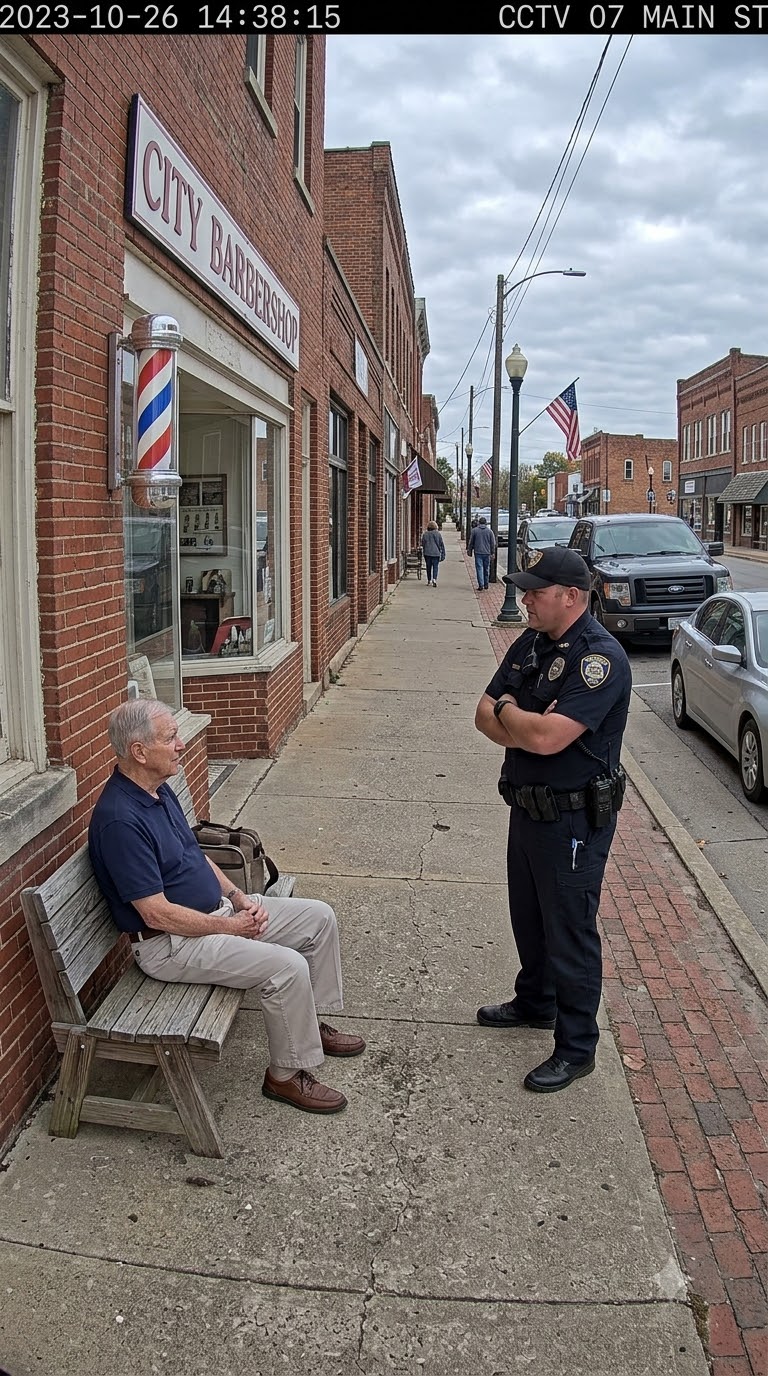
To anyone reasonable, he looked completely peaceful.
But Kevin viewed everything through the lens of brand identity and profit margins, and the major’s presence began to feel like a threat. He pictured potential customers passing the cafe, noticing an elderly man lingering outside, and deciding that his upscale business wasn’t the clean, secure environment they wanted.
The entire scenario existed only because of Kevin’s prejudice, yet in his mind it became unquestionable fact.
He had noticed George waving to the man, but that detail contradicted the conclusion he’d already reached, so he ignored it.
Kevin had already decided.
This man didn’t resemble his customers. He wasn’t carrying a laptop or holding an expensive phone. He didn’t match the profile.
Therefore, he didn’t belong.
The fact that the bench actually belonged to the barber shop, which Major Carter had been visiting since before Kevin was even born, seemed irrelevant to him.
This was about atmosphere.
This was about control.
After another 5 minutes of watching the major do nothing more dangerous than sit in the sunshine, Kevin finally acted. He pulled his phone from his pocket and tapped the screen with complete certainty that he was justified.
He called the police non-emergency line.
“Hi, I’m the manager at Artisan Roast on Oak Street.” He began, adopting a carefully concerned tone. “There’s an individual who has been loitering outside our establishment for about 20 minutes now. He’s making some of my customers feel uncomfortable.”
The dispatcher asked the routine questions.
Was the man aggressive?
Was he asking people for money?
“No. Not exactly.” Kevin hedged careful with his words.
“He’s just there. Staring. It’s just a little unsettling for the vibe we’re trying to create here. I’ve had a couple of patrons mention it.”
The final statement wasn’t true, but it gave his complaint the weight he believed it needed.
The call was recorded, and a patrol unit was sent to investigate a suspicious person.
Officer Nathan Cole had spent 10 years with the Oak Creek Police Department. At 35, he carried the heavy cynicism of someone convinced there was very little left in the world that could surprise him. His view of people was straightforward. There were good guys, bad guys, and an inconvenient gray area between them that he rarely had patience for.
His professional history was complicated.
He had received commendations for arrests, but there was also a shadow file containing seven citizen complaints accumulated over the previous decade. Those complaints described a recurring pattern: overly aggressive questioning, stopping people in minority neighborhoods over minor violations, and a confrontational manner that tended to intensify situations instead of calming them.
None of those complaints had been formally sustained.
They had been closed with comments such as, “Officer acted within department policy.” or “Insufficient evidence.”
Still, the pattern existed for anyone willing to examine it.
When the report of a loitering individual on Oak Street came through, Cole immediately placed it into a familiar category. Oak Street was changing rapidly through gentrification. The newer businesses attracted a different kind of clientele, people who were quicker to contact police over situations longtime residents might have overlooked.
In Cole’s mind, his responsibility was to satisfy these new, high-paying taxpayers, and that frequently meant removing anyone who didn’t fit the neighborhood’s newer, cleaner image.
He didn’t consider himself prejudiced.
He considered himself practical, someone maintaining order in a world always threatening to descend into disorder.
He was simply doing his job.
As he drove his patrol car toward Oak Street, Cole had already constructed an image of the person he expected to encounter. He was already rehearsing what he would say to make that person leave.
He wasn’t planning to ask questions.
He intended to give an order.
Officer Cole pulled over and stepped onto the curb, immediately fixing his attention on the person he had come to find.
What he saw matched exactly what he’d expected: an elderly black man seated on a bench.
Everything else—the man’s neat appearance, his dignified posture, and the fact that he sat directly outside the barber shop—became secondary to the one detail that matched the complaint.
For Cole, the complaint had effectively proven itself.
He marched toward the bench with one hand resting on his belt, his face set in stern authority.
He offered no greeting.
He didn’t ask the man what he was doing.
Instead, he stopped directly in front of Major Carter, cutting off the afternoon sunlight, and spoke in a flat, detached voice.
“You need to move along.”
“You can’t sit here.”
Major Carter raised his eyes, his composed expression showing only a brief trace of surprise. Throughout his life, both inside and outside the military, he had encountered plenty of young men overflowing with arrogance.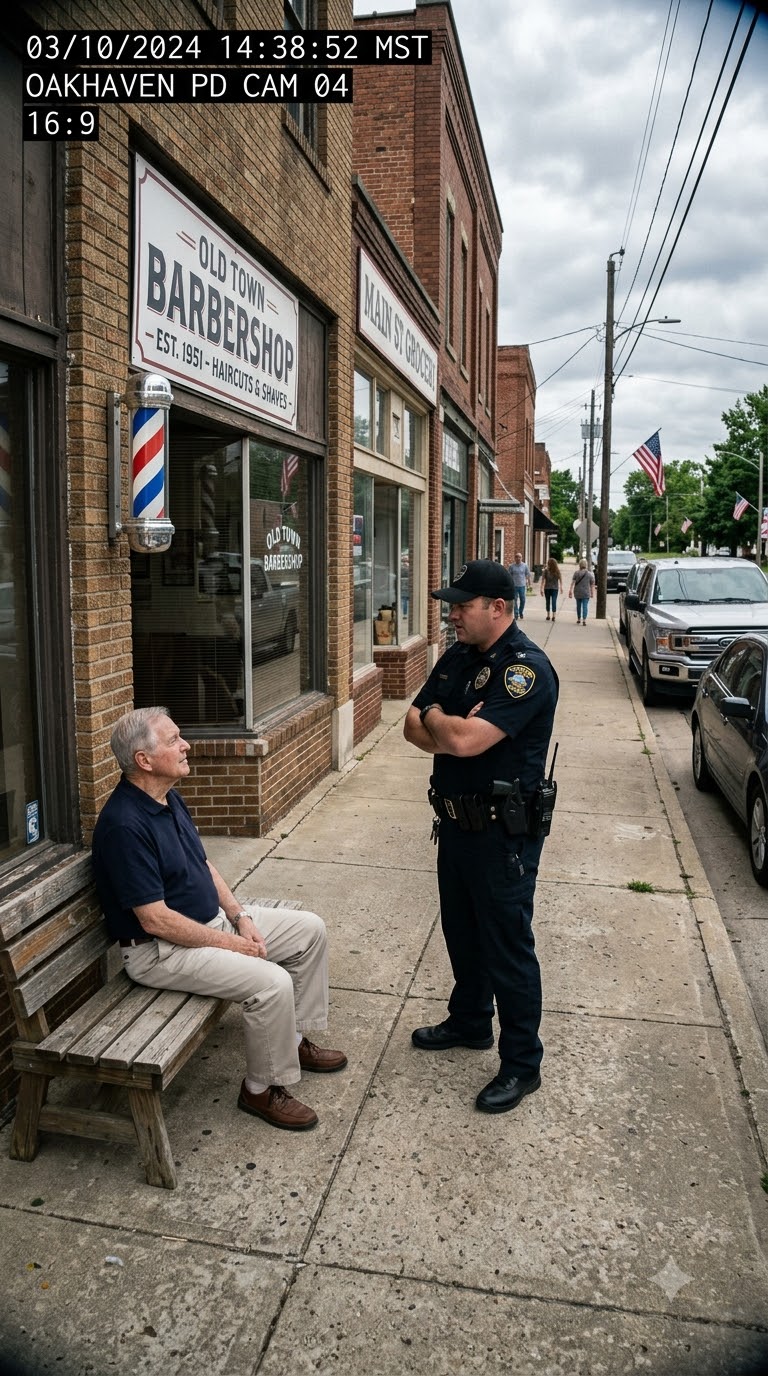
He recognized the type.
“Good afternoon, Officer.”
His voice remained steady and deep.
“I’m just waiting for my haircut.”
He tipped his head slightly toward the barber shop window, where George was visible working on a customer.
“My appointment is at 2:00. I’m a few minutes early.”
Samuel presented the explanation as nothing more than a fact, assuming it would immediately resolve whatever misunderstanding had occurred.
He was simply a customer waiting for an appointment.
There was nothing complicated about it.
But Officer Cole wasn’t interested in that explanation.
Instead of interpreting Samuel’s calm demeanor and clear answer as cooperation, he took it as resistance to his authority.
In Cole’s mind, an actual vagrant would have lowered his head and walked away.
This man was explaining himself, behaving as though he had every right to remain where he was.
Cole’s jaw tightened.
“I don’t care about a haircut.” He said, his tone becoming sharper.
“The business next door called. Said you’re making people uncomfortable. I’m telling you it’s time to go.”
To Cole, Samuel’s composed posture now looked like passive defiance, strengthening his determination to force compliance.
Major Samuel Carter understood exactly what was happening.
He had witnessed moments like this in military briefing rooms and distant countries—situations where reason had disappeared and one man’s ego was moving toward a serious mistake.
Samuel could sense the confrontation escalating, not because of anything he had done, but because of the rigid assumptions of the officer standing over him.
He made a deliberate decision to calm the situation by providing information that, under any reasonable circumstances, should have ended the confrontation immediately.
“Officer,” he said, keeping his voice even and respectful. “My name is Samuel Carter.
I’m a retired major in the United States Army. If you just have a word with my barber George inside, he’ll tell you I’ve been a customer here for 40 years.”
Officer Cole gave a short, disbelieving laugh.
“Sure you are, old-timer. Everyone’s a war hero when they’re in a jam.”
The contempt in his words was unmistakable.
With one dismissive remark, he treated the major’s 30 years of military service as nothing more than a convenient fabrication.
“I’ve given you a lawful order to leave. Are you going to comply?”
Samuel was frustrated, but he kept control of himself and exhaled slowly.
“I have my military ID right here.” he said, beginning a careful, deliberate reach toward his back pocket for his wallet. “You can see for yourself.”
Cole needed nothing more.
“Don’t you reach for anything!” he barked, reacting instantly.
He surged forward and clamped a powerful hand around Major Carter’s arm.
The sudden force sent pain shooting through the 72-year-old man’s shoulder.
“I’m getting my wallet.” the major stated, his voice now sharp with indignation.
The disturbance caught George’s attention. He dropped his scissors and hurried out of the barber shop.
“Hey, what the hell is going on?
That’s Sam Carter. Let go of him.”
Cole paid no attention.
Certain that he was confronting an uncooperative suspect, he forced the major’s arm behind his back.
The hard metallic snap of handcuffs carried across the sunny sidewalk.
As Cole pulled the elderly man to his feet, pedestrians drawn by the shouting were already taking out their phones and recording.
The drive to the police station passed in a silent haze of humiliation.
Major Carter sat in the rear of the patrol vehicle while the tight cuffs pressed painfully into the fragile skin around his wrists. His thoughts churned between disbelief and anger.
He had survived circumstances far worse than this.
But this humiliation felt different.
This wasn’t the disorder of combat.
This was betrayal by the same system of law and order he had spent his life defending.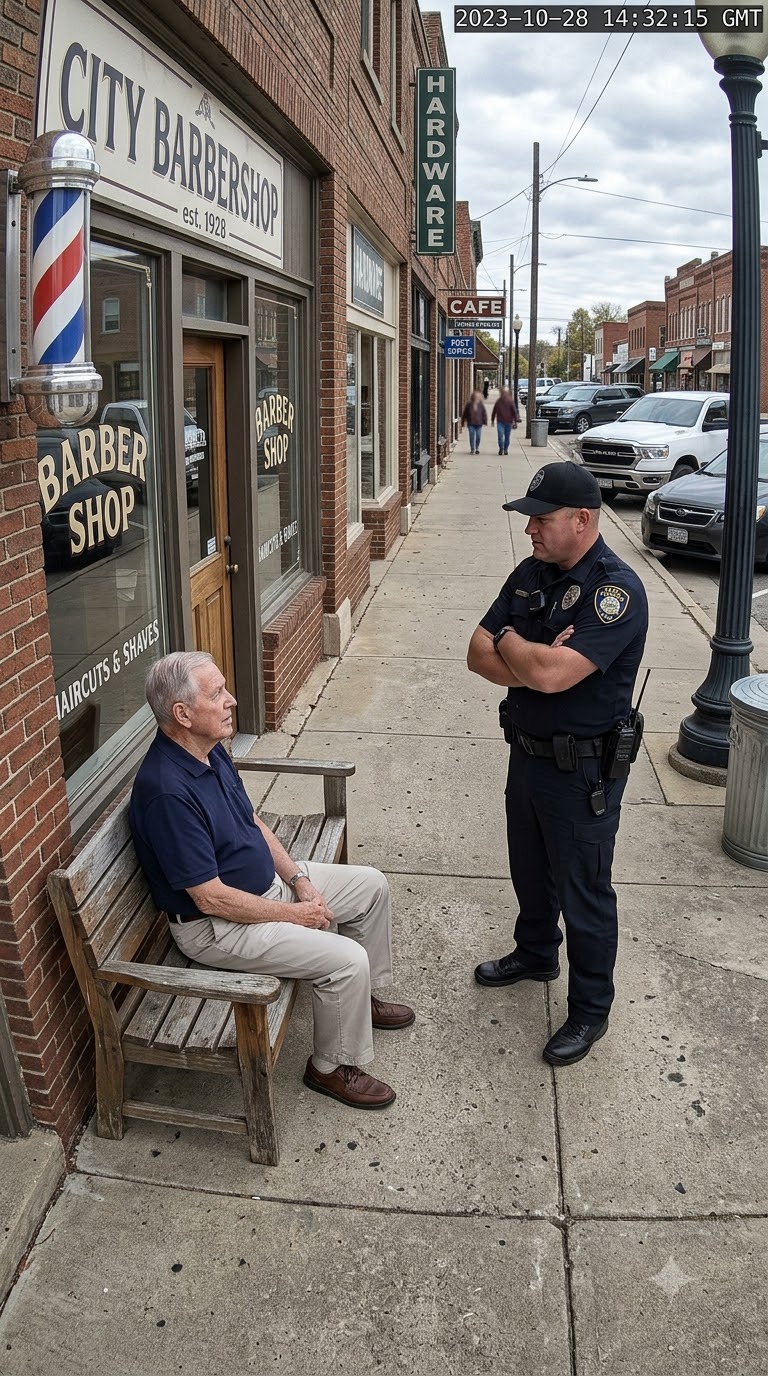
At the precinct, Officer Cole escorted him toward the front desk with unmistakable satisfaction.
“Got a trespasser who refused to comply.” he announced to the desk sergeant.
The sergeant, a man in his late 50s named Kowalski, raised his eyes from the paperwork in front of him.
He was a Marine veteran, and his expression tightened as he studied the elderly man standing in handcuffs, immediately noticing the dignity in his posture despite the humiliation of the moment.
“What’s his name?” Kowalski asked, his voice low and rough.
“Says his name is Samuel Carter.” Cole replied dismissively while removing the contents of the major’s pockets and setting his worn leather wallet on the counter.
Kowalski picked it up and opened it.
The first item he noticed was the blue identification card bearing the bold words United States Uniformed Services, Major, Retired.
The color drained from Kowalski’s face.
He had encountered enough military identification cards to recognize an authentic one instantly.
His eyes shifted from the card to the elderly man and then toward Officer Cole.
“Cole.” he said, his voice dangerously quiet. “Do you have any idea who you just arrested?”
Before Cole could respond, Kowalski had already reached for the phone.
“Captain, you need to come to the front desk. Now.”
Captain Eva Rostova appeared less than a minute later.
A direct, uncompromising commander, she immediately assessed the situation.
Then she looked at Major Carter.
Horrified recognition crossed her face.
She knew him from the city’s Memorial Day ceremonies, where he regularly appeared as an honored guest.
“Major Carter. What in God’s name is happening?” she demanded.
She spun toward Cole, her voice turning cold.
“Explain this. Now.”
Cole stumbled through his explanation about receiving a loitering complaint while Rostova grabbed the identification card from Kowalski.
She stared at Cole with open contempt.
“You arrested Major Samuel Carter for waiting for a haircut?
Take those cuffs off him. Immediately.”
A visibly shaken Cole struggled with the keys.
Then Rostova’s phone began vibrating.
Kowalski’s followed.
A watch commander emerged from his office and looked toward them.
“Captain.” he said, his expression grim.
“You better look at this. A video of this arrest is already all over social media. It’s going viral.”
The backlash erupted almost immediately.
Within an hour, shaky cellphone recordings appeared on every local news station’s website and raced across Facebook and Twitter.
The images were devastating and difficult to misunderstand: a calm elderly black man being roughly placed in handcuffs by a white police officer on a bright afternoon while his longtime barber begged the officer to stop.
Then a headline intensified the outrage:
“Decorated 72-year-old Army Major Arrested for Loitering Outside His Own Barbershop.”
Public anger across the city was immediate and enormous.
Veterans organizations responded first, releasing harsh public statements. Local VFW and American Legion posts, including veterans who had once served under Major Carter’s leadership, demanded Officer Cole’s immediate dismissal and a public apology from the city.
Civil rights organizations, including the NAACP and ACLU, denounced the arrest as an unmistakable example of racial profiling, arguing that the incident demonstrated how even decades of decorated military service could not shield a black man from systemic bias in America.
National media outlets soon picked up the story, placing the small city of Oak Creek at the center of a national controversy.
Consequences arrived quickly for those responsible.
Artisan Roast’s corporate office was flooded with furious phone calls and confronted with a growing online boycott campaign. The company released a strong apology and announced that Kevin Maxwell had been terminated immediately.
It also promised mandatory anti-bias training for managers throughout the company.
The Oak Creek Police Department came under enormous pressure.
Journalists gathered outside the station, and Captain Rostova held a press conference in which she publicly apologized to Major Carter and promised a complete internal investigation.
But the public wanted more.
Apologies weren’t enough.
They demanded accountability.
Through persistent reporting by investigative journalists, Officer Nathan Cole’s previously sealed record of seven complaints eventually reached the press, exposing the institutional failures that had allowed an officer with a troubling pattern of behavior to remain on patrol for a decade.
With encouragement from his family and overwhelming backing from the community and veterans nationwide, Major Samuel Carter made another deliberate decision.
The issue was no longer simply his personal humiliation.
It was about principle.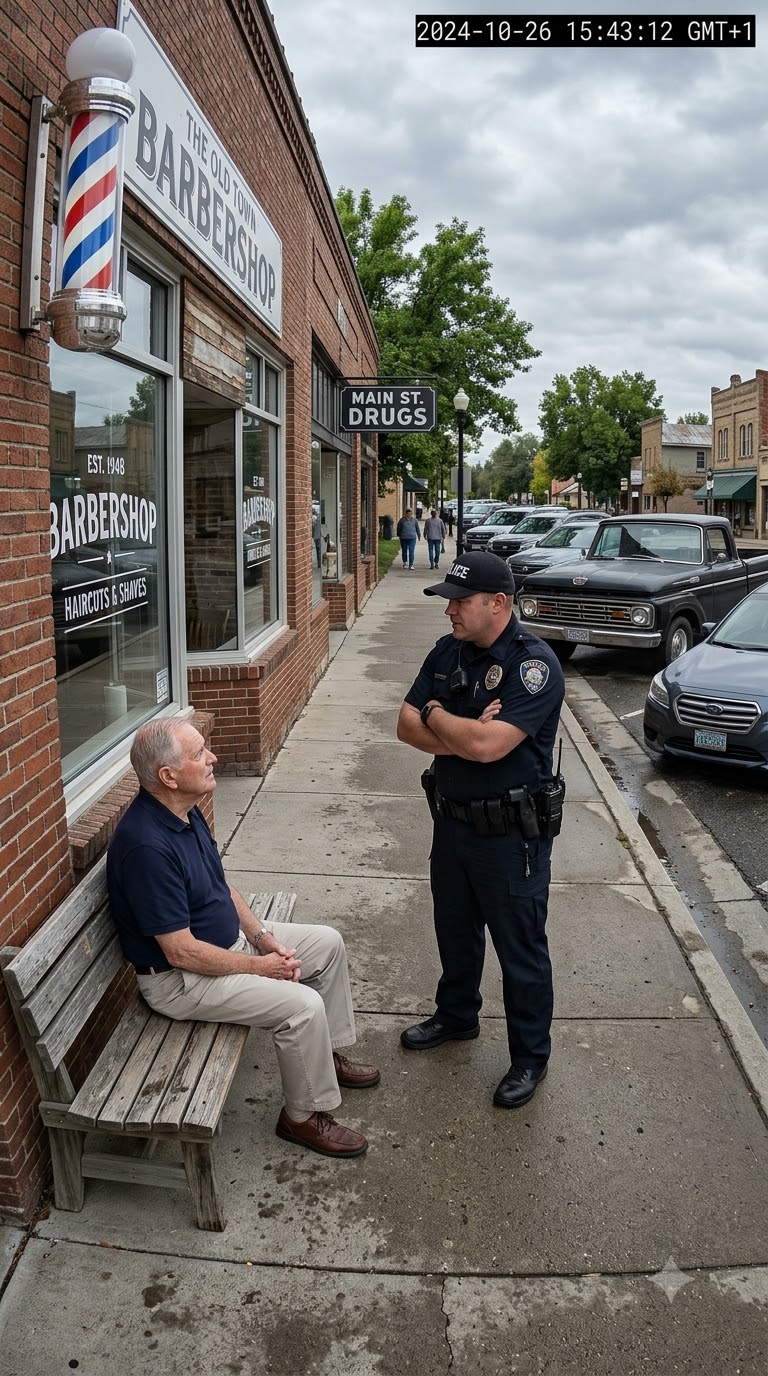
He hired a prominent civil rights attorney and filed a federal lawsuit against the city of Oak Creek, Officer Nathan Cole, and Artisan Roast’s parent company.
The allegations were broad and severe: unlawful arrest, false imprisonment, excessive force, and violation of his civil rights through racial discrimination.
The suit also accused the police department of failing to discipline an officer despite a documented pattern of biased conduct.
Confronted with undeniable video footage, a decorated plaintiff whose reputation was beyond question, and an escalating public relations disaster, city attorneys recognized how difficult the case would be to defend.
A settlement followed within months, becoming one of the largest in the city’s history.
But Major Carter had never viewed money as his only objective.
As part of the agreement, he demanded institutional reform.
Officer Nathan Cole was fired from the Oak Creek Police Department, and his name was entered into a national database of de-certified officers, effectively ending his career in law enforcement.
The police department was required to enter a consent decree with the Department of Justice, requiring a sweeping overhaul of training programs with particular emphasis on de-escalation, implicit bias, and community policing.
Kevin Maxwell, whose prejudiced phone call had triggered the entire chain of events, struggled to find employment in his profession afterward.
His name remained permanently associated with the viral incident.
Major Carter’s case became a turning point, forcing the rapidly gentrifying city to confront prejudices hidden beneath its newly polished exterior.
The cameras have disappeared now, and the attorneys have packed away their case files.
Major Carter still visits The Gentleman’s Cut every third Wednesday for his haircut.
And when he arrives early, he still sits on the bench outside, letting the warm sunlight fall across his face.
He won.
By every legal and public measure, justice was served.
Yet victory cannot erase the memory of cold metal tightening around his wrists or the pain of watching an entire lifetime of honorable service dismissed by someone who saw nothing beyond the color of his skin.
The settlement secured his grandchildren’s education, and the reforms might protect another person from enduring the same humiliation.
But no court judgment can completely restore the peace that disappeared on that sunny afternoon.
It remains a quiet and painful reminder that some of life’s deepest battles aren’t fought on distant battlefields.
Sometimes, they’re fought on the sidewalks of home.
