

PART 1
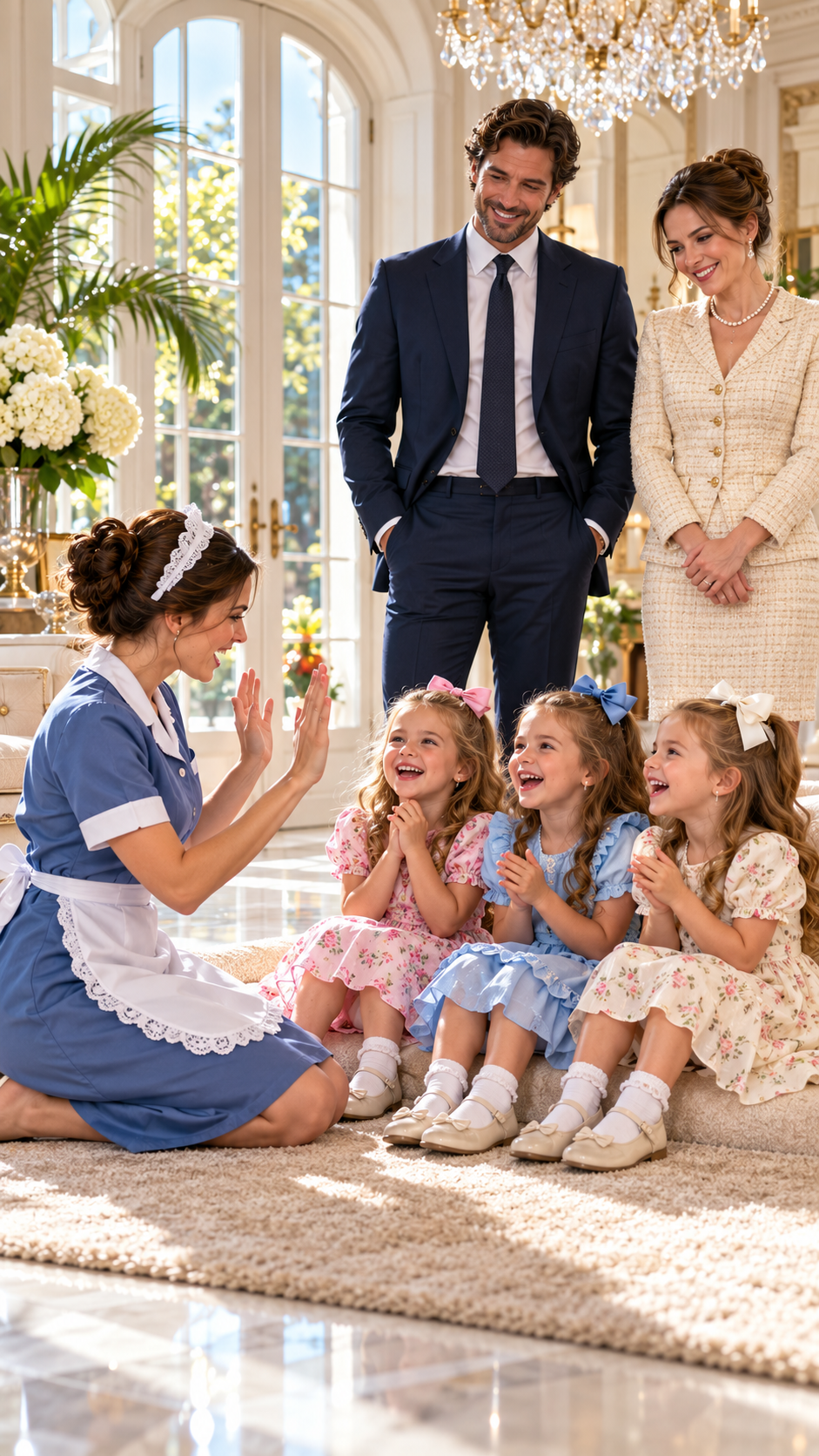
The day Adrián Montes came home early from a meeting and found his sister-in-law gripping the housekeeper by the arm while his three 4-year-old daughters cried, clinging to her, he understood that the real danger inside his house carried the same in-law surname as he did.
“Let her go, Patricia.”
Adrián’s voice froze the living room of his house in Majadahonda.
Patricia, his late wife’s sister, yanked her hand away. In front of her stood Rosa, a 36-year-old woman who came three times a week to clean and help with the girls. Lucía, Irene, and Alba, identical triplets except for small gestures only those who knew them well could tell apart, were clinging to her apron.
“You don’t know what she was doing,” Patricia said. “That woman is making them depend on her.”
Rosa didn’t answer. She crouched down and spoke softly to the little girls.
“Do you remember the three sparrows in the storm?”
The girls nodded.
Adrián felt a knot in his chest.
Eighteen months earlier, his wife, Elena, had died in a traffic accident on her way back from Segovia. Since then, the triplets had changed. Lucía wouldn’t let anyone touch her hair. Irene hid food in drawers. Alba woke up at night asking if her mother knew how to find her way home.
Adrián had paid for therapists, private specialists, and everything money could buy.
Rosa had only been there for one month.
And yet, as she finished the story of the sparrows, Alba stopped trembling. Irene sat down beside her. Lucía let Rosa brush a lock of hair away from her forehead.
Adrián had gone almost a year without being able to do that.
“How do you do it?” he asked.
“I don’t try to convince them they shouldn’t be afraid,” Rosa answered. “To them, the fear is real. I just remind them that someone stays.”
Patricia let out a dry laugh.
“Lovely. A cleaner becomes indispensable to three rich little girls, and then we all end up supporting her for life.”
Adrián’s mother, Teresa, who had just come in behind him, hardened her expression.
“Since Elena died, you only show up when the girls’ inheritance is being discussed.”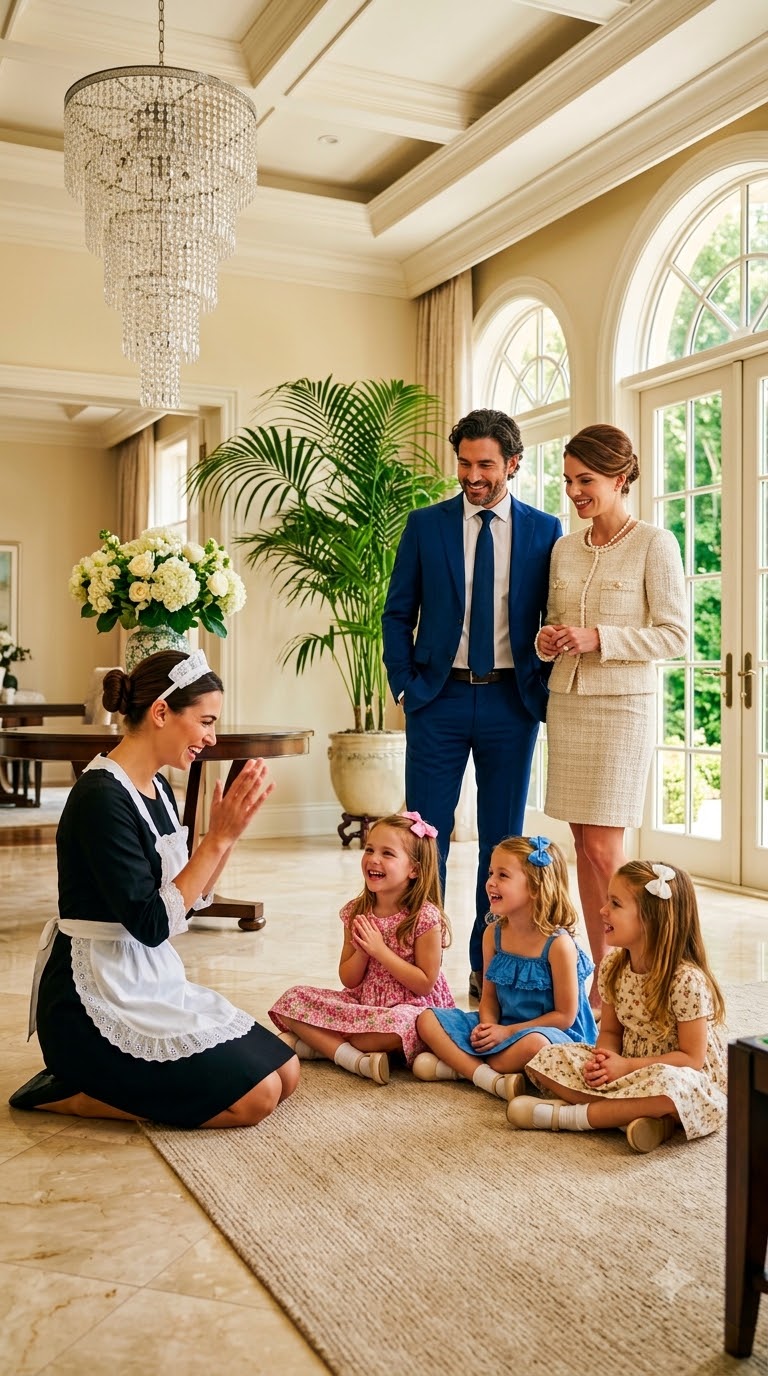
Patricia went pale.
Elena had inherited shares in a family healthcare company worth several million. After her death, the shares were placed in her daughters’ names. Adrián administered the assets until they came of age, but the will provided that if he was declared unfit to exercise custody, another relative could assume it temporarily.
Patricia had been reminding him of that for months.
“Someone has to think about their future,” she shot back. “Adrián spends half the day working.”
The remark stung because it was partly true.
Then Alba started crying again.
“I promised I wouldn’t say it.”
Adrián knelt down.
“Say what, sweetheart?”
Patricia took one step forward.
“Children invent stories when they’re upset.”
Lucía ran toward the playroom. She came back with a cloth doll and opened a zipper hidden in its back.
She pulled out a small empty bottle.
“Aunt Patri puts this in our juice so we’ll sleep.”
Adrián read the label.
It was a controlled sedative.
When he looked up, Patricia was already walking toward the door.
Then Rosa pointed to her bag.
An old phone was sticking out.
Adrián recognized it at once.
It was Elena’s phone.
The same one Patricia had sworn disappeared the night of the accident.
PART 2
Adrián locked the door from the security app.
“Put the phone on the table.”
Patricia clutched it to her chest.
“It was my sister’s.”
“You said it had been lost.”
Teresa took the girls out to the garden with Rosa while Adrián called the pediatrician and his lawyer. Patricia ended up handing over the phone.
“I only wanted them to sleep. Their crises were unbearable.”
The medical tests indicated repeated exposure to the sedative. There was no serious emergency, but the pediatrician warned that it could explain some of the drowsiness and confusion they had been suffering.
For twelve days, Patricia disappeared.
The girls began to sleep better.
Then the police arrived.
Patricia had reported the theft of one of Elena’s bracelets, valued at €18,000.
The jewelry turned up inside Rosa’s backpack.
“I had never seen it,” she whispered.
Patricia showed up with a lawyer.
“First she wins the girls over. Then she starts taking things.”
For a moment, Adrián hesitated.
Rosa saw it on his face.
“Don’t do anything foolish. I promised your daughters I would never disappear without saying goodbye.”
Hours later, Teresa remembered a small camera she had installed in the playroom.
The recording showed Patricia hiding the bracelet in Rosa’s backpack.
But the next video was even worse.
Patricia appeared pouring drops into the three girls’ glasses and rehearsing with them what they should say if anyone asked whether their father was taking good care of them.
PART 3
Rosa was released that same night.
Adrián was waiting for her outside the police station with Teresa. When he saw her come out, he held her gaze for only a few seconds before looking down.
“I’m sorry.”
Rosa stopped.
“Why?”
“Because for a few minutes I thought that maybe the bracelet…”
He didn’t finish.
“That maybe I had stolen it.”
Adrián nodded.
Rosa didn’t raise her voice.
“Sometimes all it takes is for someone to have less money for it to be easier to suspect that person.”
Adrián lowered his head.
“You’re right.”
When Rosa walked into the house, Lucía was the first to run toward her. Irene came right behind. Alba stayed still for a few seconds.
“Are you leaving again?”
Rosa crouched down.
“Not today.”
“Tomorrow?”
“Tomorrow I’ll tell you where I’m going and when I’ll be back.”
Alba hugged her.
Adrián understood then that his daughters didn’t need grand promises, but small certainties: knowing who would pick them up, who would be there at dinner, and who would come back after walking out the door.
For months he had tried to ease the loss with money and specialists. Rosa was giving them something simpler: predictability.
The next day, with authorization from the investigators, a technician managed to access Elena’s old phone. Teresa remembered a combination her daughter-in-law used for several accounts, and that helped guide the recovery.
There were hundreds of messages.
At first they seemed like family arguments.
Patricia asked for money.
Elena refused.
Patricia insisted that the company shares should stay “in the family’s hands” and that leaving millions locked in the names of three little girls was absurd.
But three weeks before the accident, the tone had changed.
Elena wrote:
“If you use my daughters to pressure me again, I’ll talk to my lawyer.”
Patricia replied:
“When Adrián disappears for work again, you’ll need help. You can’t do everything alone.”
Several deleted audio files also turned up.
In one, Patricia was speaking with a financial advisor.
“If Adrián loses custody, I could temporarily administer the shares.”
“You wouldn’t be able to take money out without oversight.”
“Not directly. You create services, consultancies, representation expenses. No one asks too many questions if the paperwork looks normal.”
“We’re talking about several million.”
“Exactly.”
Adrián felt cold.
Teresa had to sit down.
The most disturbing file had been created forty-seven minutes before Elena’s accident.
Patricia could be heard:
“Sign the power of attorney and we stop arguing.”
Then Elena:
“Tomorrow I’m going to change my testamentary instructions. You will not administer anything of my daughters’.”
“You’re making a mistake.”
“My mistake was trusting you for too long.”
The audio ended there.
Adrián immediately asked whether Patricia could be connected to the accident.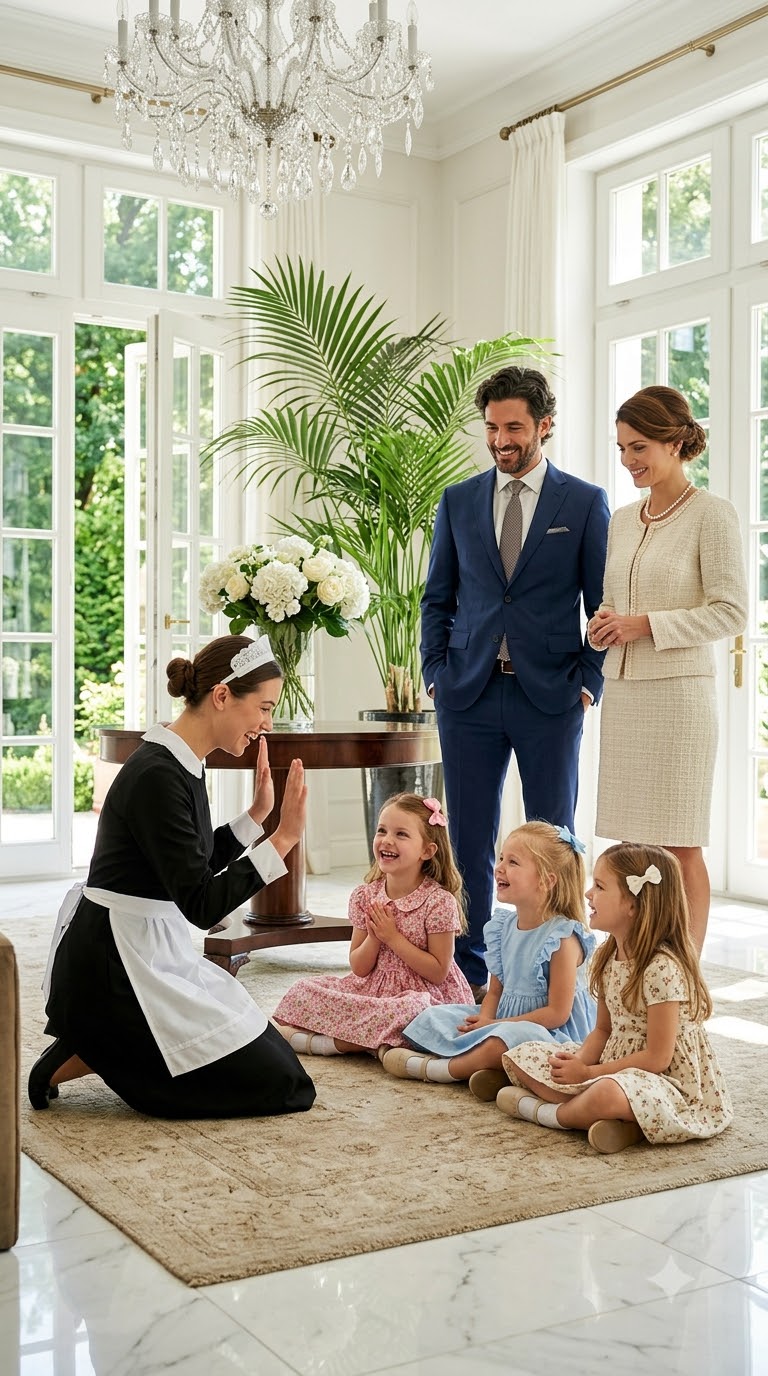
The police were cautious: there was no evidence that Patricia had caused the collision. It had been raining that night, and the original report spoke of a loss of control of the vehicle.
“Let her answer for what can be proven,” Adrián said. “I don’t need a lie to punish another one.”
And there was already plenty: the sedative, the bracelet, the instructions given to the girls, and the conversations about their inheritance.
Patricia was located two days later in a hotel in Toledo.
When she came out accompanied by officers, several journalists were waiting at the door. Seeing the cameras, she lost control.
“I was the one looking after those girls! Adrián lives for his company! Elena’s estate should be administered by her family!”
That sentence finally revealed what she had spent months trying to disguise as concern.
But Patricia’s departure did not magically fix the house.
Lucía started hiding cookies again.
Irene checked several times every night whether the front door was locked.
Alba asked before going to sleep:
“Can Aunt Patri come back?”
Adrián always gave the same answer.
“Not without permission.”
And he repeated it as many times as necessary.
Rosa took the girls to a new child psychologist who worked through play. The specialist asked one thing of all the adults: to stop demanding that the little girls “get over” the loss.
“They don’t have to forget their mother in order to be all right,” she explained. “They need to take in that the absence exists and, at the same time, that their life is still safe.”
That idea changed Adrián as well.
One night Adrián set a folder in front of Rosa.
“If this is a raise out of guilt, I don’t want it.”
Inside was a permanent contract as a caregiver, a salary almost three times higher, vacation time, a regulated schedule, and support for her to resume Early Childhood Education, studies Rosa had left when her father fell ill.
“I don’t want you to buy me for having taken good care of your daughters.”
“I’m not trying to buy you. I want to recognize the work you’re already doing.”
Rosa closed the folder.
“I’ll accept on one condition.”
“Whatever you want.”
“You have to be present.”
Adrián fell silent.
“I’m not going to become your daughters’ mother because you have meetings,” she continued. “And I don’t want you to use me to avoid the hard parts of being a father.”
The remark stung because he knew it was possible.
“I would never ask you to replace Elena.”
“Maybe not in words. But it’s easy to get used to it when someone else does well what you’re afraid to do.”
Adrián took a deep breath.
“Then let’s make an agreement. If I start hiding in work again, you tell me.”
“I will.”
“Even if it bothers me.”
“Especially if it bothers you.”
Rosa accepted two days later.
Over the months that followed there were no miracles, only routines. Breakfast at 7:30, school, therapy two days a week, play, dinner, and stories. On Fridays Adrián finished before 5:00 p.m., and on Sundays he didn’t open his work email.
At first it was hard for him. He kept looking at his phone as if a postponed meeting could sink the company. Nothing sank. And his daughters began to see that he knew how to come back too.
One Tuesday, Lucía let her father put her hair in a ponytail.
It came out crooked.
Rosa burst out laughing.
“It looks like an antenna.”
Adrián picked up the brush to do it again.
Lucía pulled away.
“No.”
“Sweetheart, it’s terrible.”
“Dad did it.”
And she left for school with the ponytail slanted.
Adrián stood still in the hallway for a few seconds.
Irene gradually stopped hiding food once she understood there would always be breakfast the next day.
Alba kept asking the hardest questions.
“Did Mom know something was going to happen to her?”
“No.”
“Was she scared?”
Adrián no longer invented comfortable answers.
“I don’t know.”
“Did she love us when she left?”
“Very much.”
“Then why didn’t she come back?”
That question had no answer capable of erasing the pain.
Rosa was nearby that afternoon.
“There are people who want to stay and can’t,” she said. “That’s different from people who can stay and choose to leave.”
Alba thought it over.
Then she rested her head on Adrián’s arm.
Six months later, the family planted a small olive tree on a plot of land near the house, in memory of Elena.
The girls brought three paper birds.
The story of the sparrows had become something of their own.
Lucía placed hers on a branch.
Irene left another by the trunk.
Alba held the third.
“Is Rosa going to be our new mom?”
Adrián knelt down.
“No.”
“Why not?”
“Because your mother is Elena, and no one has to replace her.”
Alba pointed at Rosa.
“Then what is she?”
Adrián smiled.
“Rosa.”
“We already know that.”
Teresa laughed.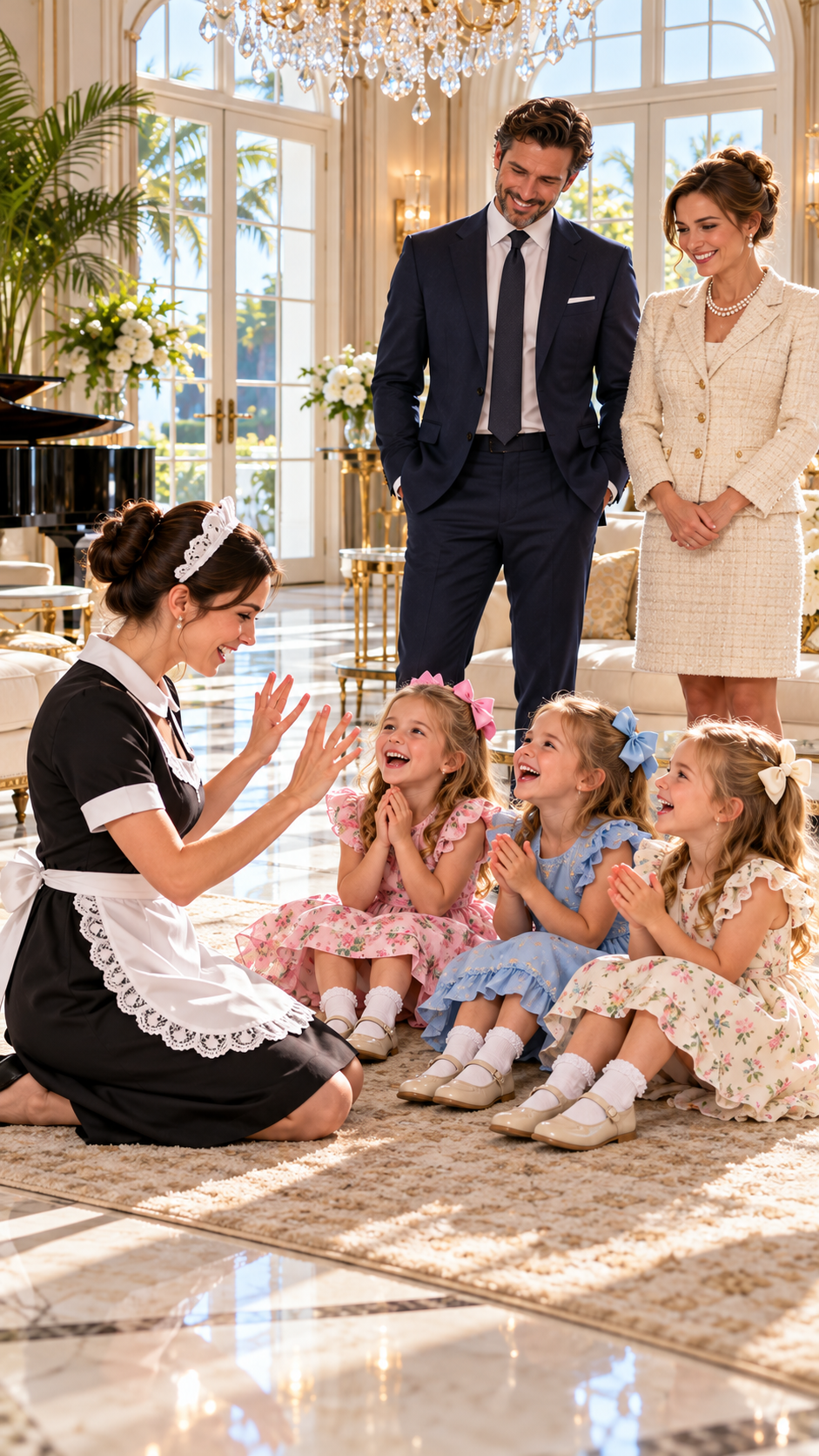
Adrián looked at his daughters.
“I mean she doesn’t need to take anyone’s place. She has her own.”
The three of them seemed to understand that answer better than the adults.
Meanwhile, the case against Patricia moved forward.
The evidence against Patricia kept accumulating. Adrián refused to feed rumors about the accident and also asked that the major operations involving his daughters’ estate be reviewed by two independent professionals.
“You’re not obligated to,” his lawyer reminded him.
“That’s exactly why I want to do it. I’ve learned that no one should have too much power without someone being able to ask questions.”
When the triplets turned five, Adrián wanted to organize a huge party at a hotel in Madrid.
The girls protested.
“At home,” Lucía said.
“With cake,” Irene added.
“And without boring adults we don’t know,” Alba finished.
The party was small, with omelet, croquettes, chocolate, and a cake decorated with three sparrows. When Rosa arrived, Lucía greeted her laughing.
“You’re not working today. You can eat cake before dinner.”
“I like that rule.”
Before they blew out the candles, Adrián asked for attention.
There were no journalists.
No partners.
No lawyers.
Only close family and a few people who had been with the girls over that year.
“For a long time I believed that being a good father meant paying for everything they needed,” he said. “The best doctors. The best school. The safest house.”
He looked at his daughters.
“Then I discovered there are things you can’t buy.”
Rosa lowered her gaze.
“Listening is also taking care. Staying is also taking care. And asking for forgiveness is part of being a father.”
He took out a folder.
Rosa’s eyes widened.
“If this is another contract…”
Everyone laughed.
“No.”
Inside was the enrollment for a degree in Early Childhood Education in a format compatible with her schedule.
Rosa fell silent.
“I can’t accept this.”
“It isn’t a reward.”
“Then what is it?”
“A chance you left behind to take care of your family. You helped my daughters get a part of theirs back. Let me make it easier for you to continue with yours.”
Rosa ran her fingers over the paper.
“I don’t need a degree to love them well.”
“I know. But I also don’t want anyone to look at your uniform again and decide how much you’re worth.”
Rosa finally accepted on the condition that she would pay back part of the cost when she could.
Adrián knew arguing would be useless.
“Deal.”
Then it was time for the candles.
The three girls closed their eyes.
Irene blew too early.
“Cheat!” Alba shouted.
They lit them again.
This time they blew together.
“What did you wish for?” Teresa asked.
“You can’t say,” Irene answered.
Lucía raised her hand.
“Mine you can.”
Everyone waited.
“I wished that no one would ever leave this house again without saying goodbye.”
The garden fell silent.
Rosa came closer and kissed her forehead.
Alba took one of the sugar sparrows from the cake and handed it to Adrián.
Another went to Rosa.
The third she left between herself and her sisters.
“This one is ours.”
“And what does it mean?” Adrián asked.
Alba looked around the table.
“That now the nest has room for everyone.”
That night, after the guests had gone, Adrián walked past the bedroom.
The door was ajar.
For months he had wanted to close it because light came in from the hallway.
Rosa always said the same thing:
“If they need to call, they have to know someone can hear them.”
The three girls were asleep.
Lucía’s hair was messy.
Irene was hugging a pillow.
Alba still had a little paper sparrow beside the bed.
Rosa appeared at the end of the hallway with some books.
“Everything all right?”
Adrián nodded.
“Yes.”
“Then go to sleep.”
Rosa walked toward her room, but before going in she turned around.
“Adrián.”
“Yes?”
“Don’t close the door.”
He looked at his daughters again.
“I wasn’t going to.”
A long time before, Adrián had believed that millions of euros, lawyers, and specialists could shield his daughters’ lives.
Patricia wanted to control their inheritance.
Rosa only wanted them to stop being afraid.
And in the end it was precisely the woman they had tried to accuse for wearing a uniform who taught the whole family something no will could guarantee:
A house can be worth millions.
But it only becomes a home when the one who is afraid knows she can call from a room and that, on the other side of the door, someone will be there to answer.
