

By 5:18 that morning, the Georgia heat had already settled over the training grounds like a heavy blanket.
The sun hadn’t even cleared the horizon, yet sweat was already collecting beneath my collar. Gravel crunched beneath hundreds of boots. Canvas straps creaked. The air smelled of dust, hot rubber, and damp uniforms.
My name is Rowan Mercer.
At five-foot-three, I was the smallest recruit in infantry selection.
And for six weeks, Staff Sergeant Cole Vega had made sure I never forgot it.
“She’s not making it.”
“She looks like she should be asking for a hall pass.”
Those comments had started during my first week.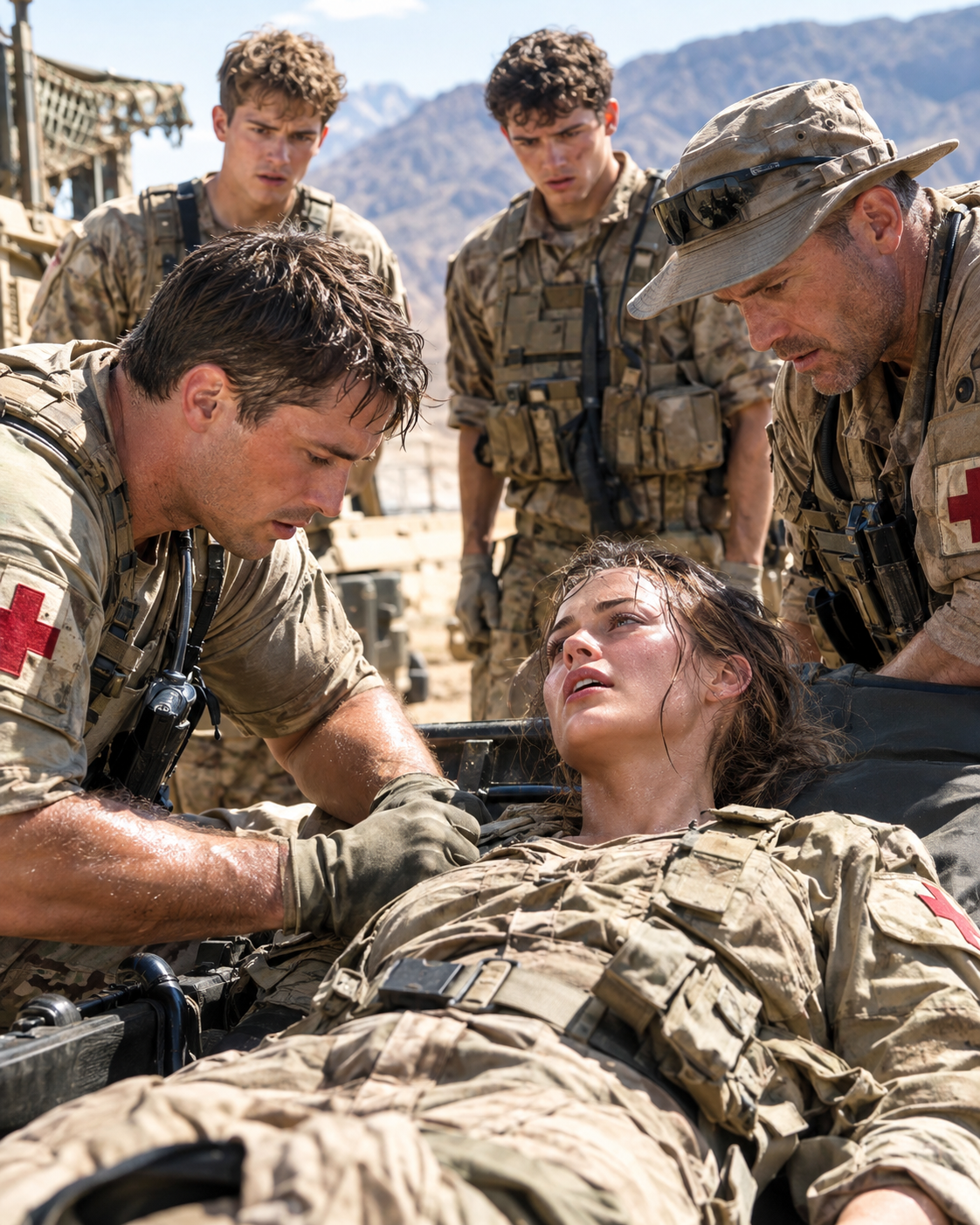
By the second, they had become routine.
By the third, I had learned that reacting only made things worse.
Vega seemed to enjoy finding new ways to remind me that I didn’t look like the people around me.
During weapons training, he once stopped behind me while I was adjusting my stance.
“Mercer, you planning to fight the enemy or apologize until they surrender?”
The others laughed.
I didn’t.
I simply corrected my stance and continued.
That was what I had learned to do.
Keep moving.
Keep quiet.
Never explain more than necessary.
Especially when it came to the secret beneath my uniform.
Everyone had noticed that I kept my collar fastened even when the Georgia heat became unbearable.
Everyone else opened theirs whenever they could.
I never did.
When recruits changed shirts during medical training, I always found a private corner. I changed quickly, carefully, and usually before anyone else entered the room.
Then I disappeared back into formation.
Vega noticed.
Of course he did.
“Mercer’s hiding something,” he announced one afternoon.
Several recruits looked over.
“Probably a reason she shouldn’t be here.”
A few people laughed.
I kept cleaning Georgia mud from my rifle.
What none of them understood was that some pain becomes easier to carry than the judgment that comes after people see it.
I knew what happened when people saw an injury.
They didn’t just see the injury.
They saw weakness.
They started adjusting their expectations.
They began deciding what you couldn’t do before you had the chance to prove what you could.
I had spent too many years fighting that exact assumption.
So I said nothing.
By week six, most of the recruits had stopped caring about whatever secret I was hiding.
Vega hadn’t.
That morning, the twelve-mile ruck march was scheduled under a heat warning.
Medics were stationed along the route, and instructors had been briefed to watch for signs of heat exhaustion.
Completion times would be added to our selection records.
For everyone else, it was another difficult exercise.
For me, it was the morning I had been dreading since I arrived.
At 6:03, Vega stepped directly into my path.
His expression was already familiar.
Cold.
Measuring.
Waiting for me to fail.
“You sure you don’t want to save us the paperwork, Mercer?”
“I’m good, Sergeant.”
“No,” he said. “You’re stubborn. There’s a difference.”
The whistle sounded.
We moved.
For the first six miles, I reduced the entire world to three things.
Boot.
Breath.
Road.
Left foot.
Right foot.
Breathe.
Repeat.
The ruck pressed against my shoulders.
The straps dug into my body.
Sweat soaked through my shirt, and every movement sent a sharp pull through the part of my body I had spent six weeks desperately keeping hidden.
I ignored it.
At mile four, I ignored the ache.
At mile six, I ignored the burning.
At mile seven, I stopped noticing the sweat.
At mile eight, my fingers began trembling around my canteen.
Vega saw it.
“Look at that. Mercer’s hands are tired.”
Nobody laughed.
That silence bothered me more than the jokes.
At mile nine, my breathing became shallow.
At mile ten, small white flashes appeared around the edges of my vision.
The road shimmered beneath the heat.
The marching boots around me sounded distant, as though everyone had suddenly moved several hundred feet away.
Vega came alongside me.
“You quit now, and at least you’ll be honest for once.”
“I’m not quitting.”
“Then move.”
So I moved.
One more mile.
Then another half.
I told myself I could make it.
I had made it this far.
Stopping now would turn every cruel thing Vega had said into something that looked like proof.
Then the road tilted.
Or maybe I did.
“Mercer!”
My knees hit the dirt.
The ruck dragged me sideways, and the world became a blur of boots, sky, and brown earth.
Someone shouted for a medic.
Hands pulled the weight from my shoulders.
I tried to push myself upright.
I couldn’t.
My arms refused to cooperate.
The ringing in my ears grew louder.
Then I heard Vega.
“I knew it.”
A medic dropped beside me.
He checked my pulse, touched my forehead, and immediately looked toward the others.
“She’s burning up. Cut the jacket.”
“No.”
The word came out barely above a whisper.
The medic looked at me.
“Mercer, I need to see what’s going on.”
“No.”
I reached weakly for my collar.
The trauma shears slid underneath the fabric.
I tried to stop them.
I didn’t have the strength.
The blade cut straight down the front of my uniform.
Vega stood above me.
For six weeks, he had watched me as though he were waiting for the moment when I would finally prove him right.
Now he was about to see whatever I had worked so hard to conceal.
The medic pulled the torn fabric apart.
His hands stopped.
His expression changed.
Completely.
Vega looked down.
The arrogance disappeared from his face.
For the first time since I had met him, Staff Sergeant Cole Vega looked genuinely stunned.
Beneath my uniform was a medical compression garment wrapped carefully around my torso.
But it wasn’t simply a compression garment.
Along my left side, beneath the fabric, was a long surgical scar extending from beneath my ribs toward my back.
Another scar disappeared beneath the edge of the garment.
The medic stared for half a second longer before his professional instincts took over.
“Easy,” he said. “Nobody move her yet.”
Vega didn’t answer.
The medic carefully examined the scar.
Then he looked at me.
“How long ago?”
I swallowed.
“Eight months.”
His eyes widened.
“Eight months?”
I nodded.
Vega finally spoke.
“What happened?”
I closed my eyes.
It was the question I had spent six weeks trying to avoid.
And now there was nowhere left to hide.
“I had surgery.”
The medic glanced at Vega.
“For what?”
I hesitated.
Then I said it.
“Internal reconstruction.”
Silence.
The medic’s expression became serious.
“What kind?”
I took a breath.
“The kind that wasn’t supposed to leave me standing here.”
Nobody moved.
I stared at the sky.
For six weeks, I had carried that secret beneath my uniform because I didn’t want anyone deciding that surviving something made me fragile.
The scar had been the result of a major abdominal operation after an accident that had nearly ended my career before it began.
I had spent months in rehabilitation.
Doctors had warned me that recovery would be slow.
Some had suggested I choose a different path.
My physical therapist had told me something I remembered every morning.
“You don’t have to prove you’re invincible. You just have to prove you’re recovering.”
I had taken that sentence with me to selection.
But I had never told Vega.
I hadn’t told the other recruits.
I hadn’t told anyone because I was terrified the information would become a weapon.
Now everyone knew.
The medic gently pressed two fingers against my wrist.
“Why didn’t you tell the cadre?”
“Because I passed medical clearance.”
“That doesn’t answer the question.”
I looked toward Vega.
“It would’ve changed how people treated me.”
The medic understood immediately.
Vega didn’t speak.
I could see the realization moving across his face.
Every joke.
Every insult.
Every time he had accused me of hiding something.
He had been right.
I had been hiding something.
But he had been completely wrong about what it meant.
The medic looked at the compression garment.
“You’ve been training like this?”
“Yes.”
“How long?”
“Since I was cleared.”
“And the pain?”
I didn’t answer.
The medic looked at Vega.
“She should never have been pushed this far without knowing this.”
Vega’s jaw tightened.
“She was medically cleared.”
“She was medically cleared for training,” the medic said. “That doesn’t mean she should conceal a significant surgical history from the medical staff during an event like this.”
I closed my eyes.
That was the part that hurt.
Not because he was wrong.
Because he was right.
I had spent so much time proving that I belonged that I had stopped considering what proving it might cost.
The medic placed an oxygen mask near my face.
“Mercer, listen to me. You’re not failing anything right now.”
I opened my eyes.
“What?”
“You’re receiving medical attention. That’s not failure.”
I looked toward Vega.
He was still staring at me.
Finally, he crouched down.
His voice was quieter than I’d ever heard it.
“Why didn’t you tell me?”
I almost laughed.
The question was so absurd that for a moment I couldn’t believe he’d asked it.
“You spent six weeks telling me I didn’t belong.”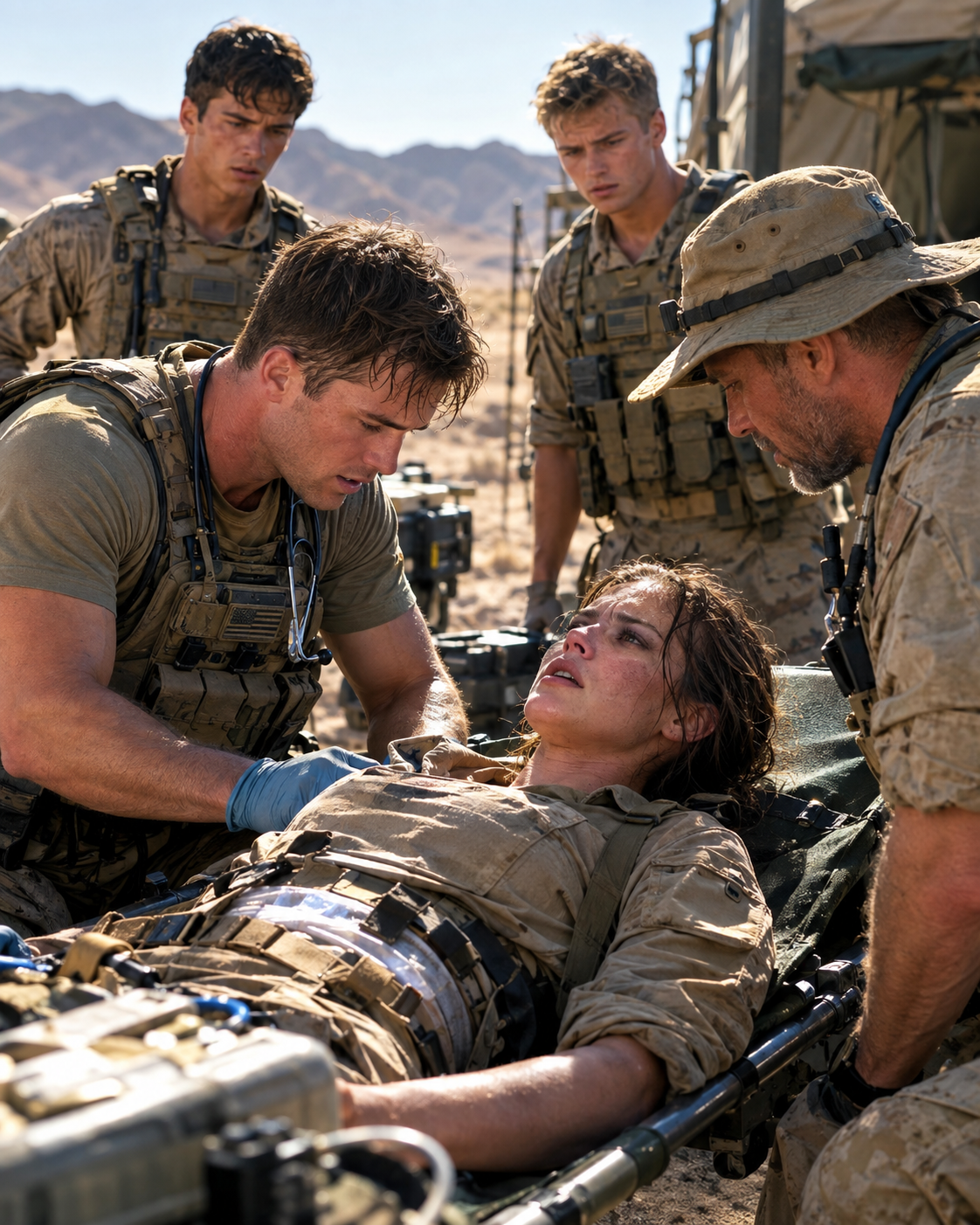
His face tightened.
“I didn’t know.”
“Exactly.”
The words came out weakly.
“You didn’t know, so you decided.”
He looked away.
The medic began preparing me for evacuation.
A few minutes later, the ambulance arrived.
As they lifted me onto the stretcher, I saw Vega standing beside the road.
He didn’t say anything.
For once, he didn’t have a joke.
He didn’t have an insult.
He simply watched.
I was transported to the base medical facility and eventually transferred to a hospital for further evaluation.
The doctors found that I was severely dehydrated and suffering from heat exhaustion.
The surgical site had also become badly irritated beneath the pressure and friction of the ruck.
I spent the next two nights under observation.
On the third morning, someone knocked on my hospital-room door.
I expected a nurse.
It was Vega.
He stood there in uniform.
No clipboard.
No training schedule.
No expression of authority.
Just Cole Vega.
He didn’t enter immediately.
“Can I come in?”
I stared at him.
That was the first time he had ever asked me.
I nodded.
He stepped inside.
For several seconds, neither of us spoke.
Then he pulled a chair beside the bed.
“I owe you an apology.”
I said nothing.
“I know that doesn’t fix anything.”
“No.”
He nodded.
“I know.”
He looked at the floor.
“I thought I had you figured out.”
“You did.”
He glanced up.
“I thought you were hiding weakness.”
“I was hiding an injury.”
“I know.”
Another silence.
Then he said something I hadn’t expected.
“I was wrong.”
I looked at him.
He didn’t try to soften it.
Didn’t qualify it.
Didn’t blame the heat, the training, the pressure, or my failure to disclose everything.
“I was wrong about you,” he said.
I swallowed.
“Why did you hate me?”
His expression changed.
“I didn’t hate you.”
“It felt like it.”
He looked toward the window.
“When I saw you on day one, I thought you were going to quit.”
“Why?”
“Because everyone who looks different in this environment gets tested.”
I frowned.
“That sounds like an excuse.”
“It is.”
He paused.
“I’ve watched people come through here who were physically capable but mentally unprepared. I thought if I pushed you hard enough, I’d find out which one you were.”
“You didn’t push me.”
His eyes lifted.
“You tried to break me.”
He didn’t argue.
“That may be true.”
The honesty surprised me.
“I thought if you were going to leave, I’d rather have you leave early than after someone depended on you.”
I stared at him.
“And you thought humiliating me was the way to prepare me?”
“No.”
He shook his head.
“I thought pressure revealed character.”
“It reveals character,” I said quietly, “but it also reveals the character of the person applying the pressure.”
He looked down.
For the first time, Vega had no response.
I wasn’t trying to win.
I was simply telling him the truth.
After a long silence, he stood.
“I’ll make sure the selection board knows what happened.”
“Why?”
“Because I don’t want this incident written as a failure.”
I looked at him.
“What will it be written as?”
He hesitated.
“An injury.”
I nodded.
“That matters.”
“I know.”
He walked toward the door.
Then he stopped.
“Mercer?”
“Yes?”
“You still want to go back?”
I didn’t hesitate.
“Yes.”
He nodded.
“I figured you would.”
Then he left.
Three weeks later, I returned to the training grounds.
My doctors had cleared me for a modified training schedule.
The selection cadre had documented restrictions.
The ruck march was no longer something I was allowed to attempt without medical oversight.
I understood.
For the first time, I wasn’t trying to prove that I could ignore pain.
I was learning that discipline sometimes meant admitting when pain mattered.
The recruits had changed too.
Nobody laughed when I walked into formation.
Nobody asked about the scar.
Nobody stared at my collar.
Some gave me a nod.
Others simply moved aside.
That was enough.
Vega was different.
He still corrected my stance.
He still demanded precision.
He still expected me to meet standards.
But now, when he pushed me, it was because he expected me to succeed.
Not because he wanted to watch me fail.
One morning, during weapons training, I made a mistake.
Vega immediately called me out.
“Mercer.”
I looked over.
“Your elbow.”
I corrected it.
“Again.”
I reset.
“Better.”
One of the recruits nearby smiled.
Vega noticed.
“What?”
“Nothing, Sergeant.”
“Then keep working.”
The recruit turned away.
I almost smiled.
Weeks passed.
My body continued recovering.
The scar remained.
So did the memory of that road.
But something else changed.
I stopped treating the scar like something shameful.
It was no longer evidence of weakness.
It was evidence that I had survived something.
I had spent so much time worrying that other people would see it and decide what I was capable of that I had forgotten something important.
They didn’t get to decide.
I did.
The final evaluation came several weeks later.
The selection course required endurance, navigation, weapons proficiency, teamwork, and judgment under pressure.
I completed every event within my medical limitations.
I wasn’t the fastest.
I wasn’t the strongest.
But I finished.
When the results were posted, I stood near the board with several other recruits.
My name was there.
I stared at it for several seconds.
Then I heard footsteps behind me.
Vega.
He stopped beside me.
“You made it.”
I nodded.
“I did.”
He looked at the list.
Then at me.
“You know what I got wrong about you?”
I waited.
“I thought belonging meant looking like everyone else.”
I looked at him.
“And now?”
He gave a small shake of his head.
“Now I think belonging means earning your place without pretending to be someone you’re not.”
I smiled faintly.
“That almost sounded wise.”
He gave me the smallest grin.
“Don’t tell anyone.”
For the first time, I laughed.
Months later, I would still remember that morning in Georgia.
Not because I collapsed.
Not because a medic cut open my uniform.
Not because Vega finally realized he had been wrong.
I remembered it because that was the day I learned something I should have understood much earlier.
Strength isn’t always about how much pain you can tolerate.
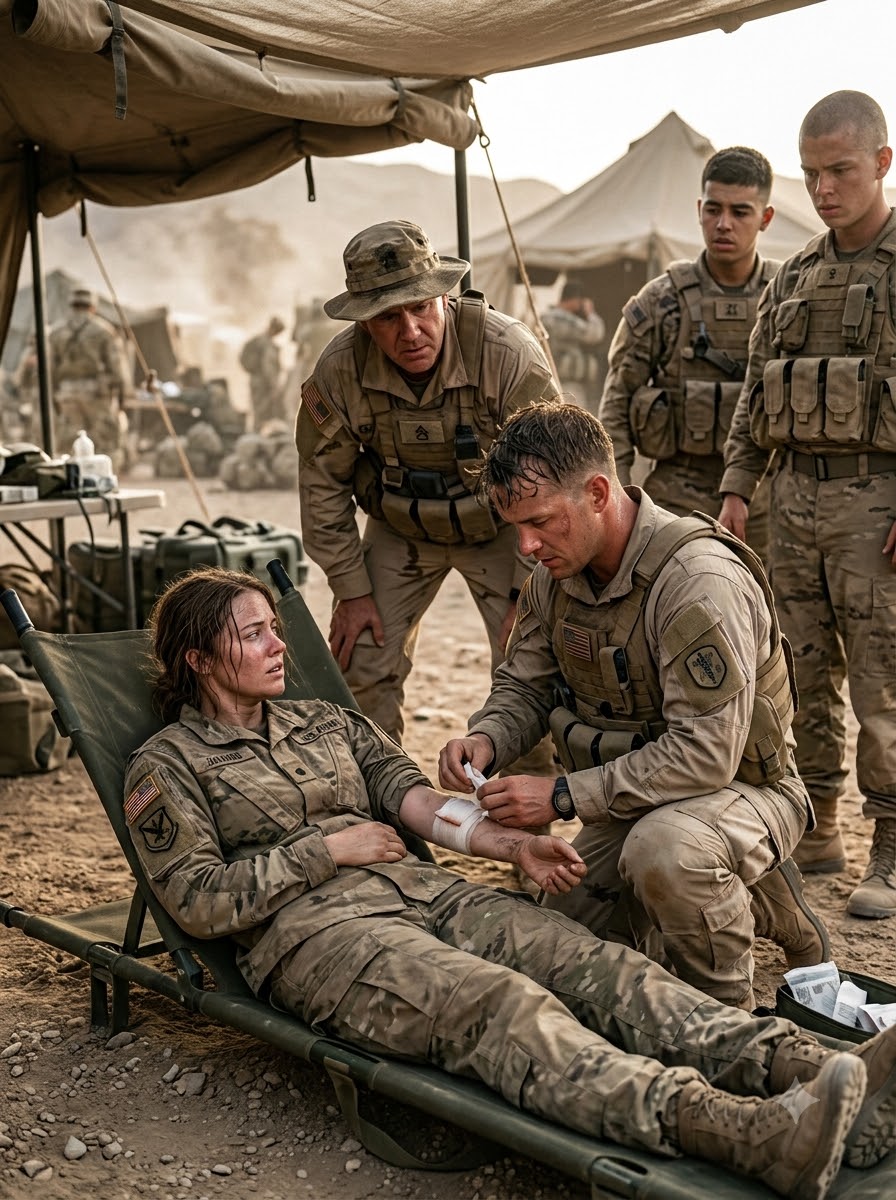
Sometimes strength is knowing when to stop.
Sometimes it’s admitting you need help.
Sometimes it’s allowing someone to see the scar you have spent years hiding.
And sometimes, strength is standing back up after everyone around you has already decided you won’t.
My scar never disappeared.
It wasn’t supposed to.
Neither did the memory.
But eventually, I stopped hiding both.
Years later, I would meet young recruits who reminded me of myself.
Quiet ones.
Small ones.
People who kept their heads down because they were afraid that if anyone discovered what they had survived, someone would use it to decide what they couldn’t become.
Whenever I saw them, I remembered the Georgia road.
I remembered the medic’s voice.
I remembered Vega standing over me, saying, “I knew it.”
And I remembered what happened afterward.
So when one recruit finally approached me and asked whether I thought she belonged there, I didn’t give her the answer everyone expected.
I didn’t tell her she had to be fearless.
I didn’t tell her she had to ignore pain.
I didn’t tell her that weakness had no place in uniform.
I simply told her the truth.
“You don’t have to prove you’re invincible.”
She looked confused.
I smiled.
“You just have to be honest about what you’re carrying.”
She glanced down.
Then back at me.
“And if people judge me?”
“They might.”
“Then what do I do?”
I looked toward the training field.
“Keep earning your place.”
She nodded.
And walked away.
I watched her disappear into formation.
For the first time, I understood why that morning had happened the way it did.
Not because I had failed.
Not because Vega had been right.
But because sometimes the moment that exposes your greatest vulnerability becomes the moment that finally frees you from it.
I had entered selection determined to prove that my scar didn’t define me.
I left knowing something better.
It never had the power to define me in the first place.
Only I did.
