

PART 2
I did not sleep much that first night.
Years in the Army teach you to sleep anywhere: on cargo floors, in the back of trucks, sitting upright in plastic chairs with your helmet in your lap. But they also teach you something else. They teach you to notice when a room feels wrong, even when nothing in it has moved.
My childhood bedroom felt wrong.
The quilt my mother made was still folded at the foot of the bed. My high school track medals still hung from a nail by the window. But the top drawer of the desk, the one where I kept old letters and a spare key to my storage unit, was closed differently than I had left it. The key was still there, but the envelope under it had been turned face up.
I lay awake listening to the house breathe. The refrigerator hummed. The ceiling fan clicked every fourth turn. Somewhere down the hall, my father snored the way he always had, deep and steady, like a man who believed nothing in his home could hurt him.
I had believed that once, too.
At 5:40 the next morning, I woke up the way I always do, without an alarm, with my mind already dressed before my body was. I pulled on a sweatshirt and walked downstairs in my socks, planning to make coffee and sit on the back porch while the sky turned from gray to gold.
The kitchen light was already on.
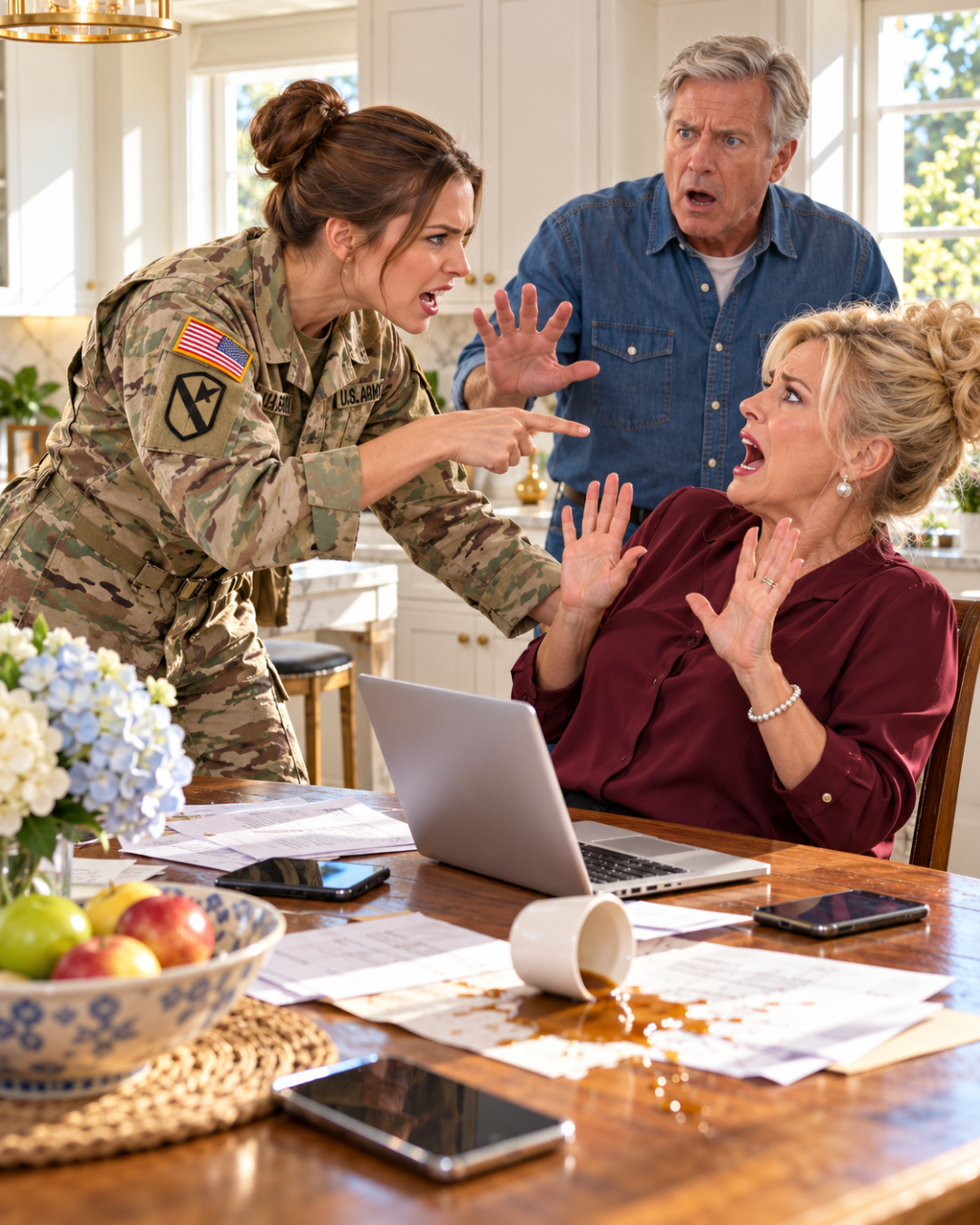
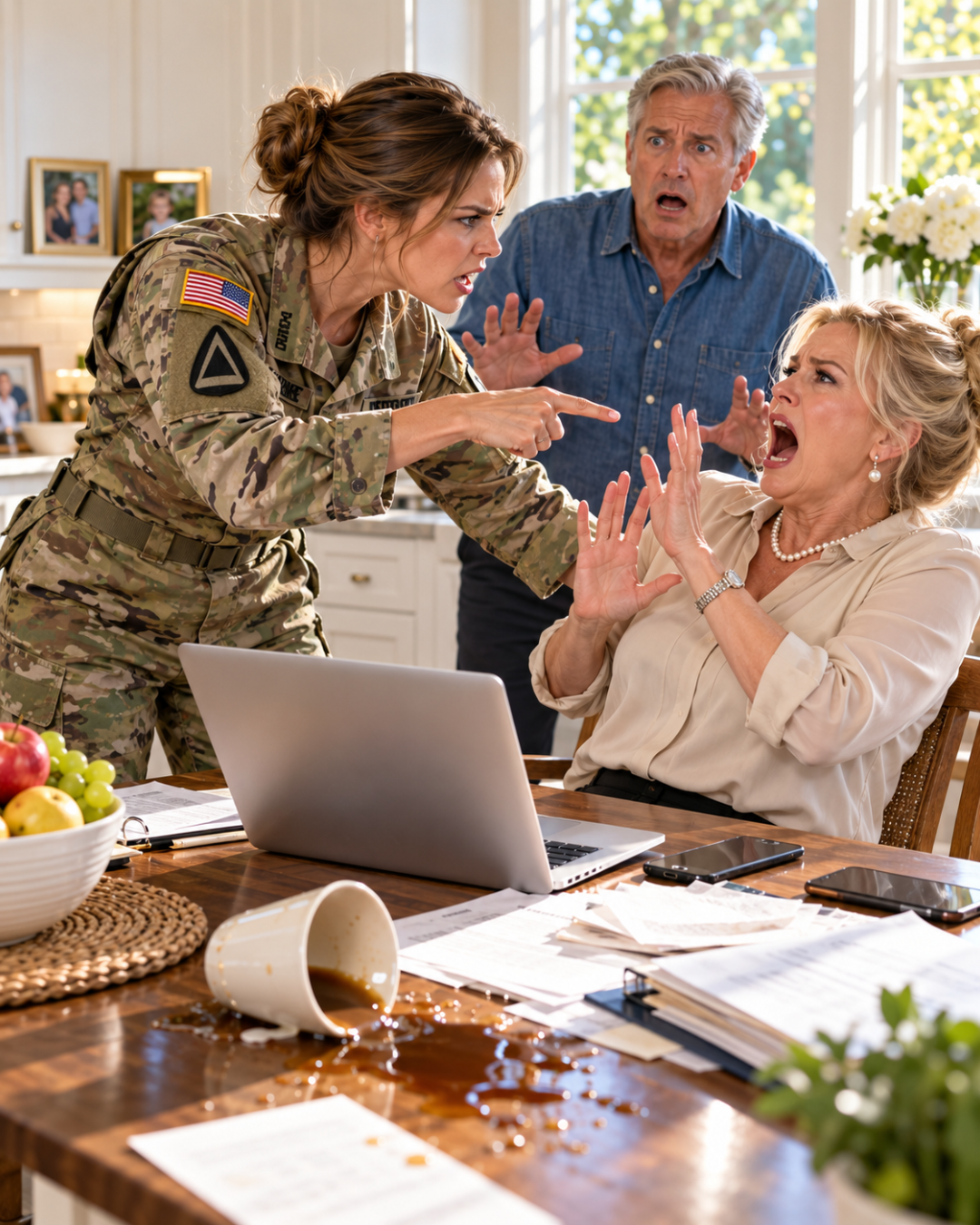
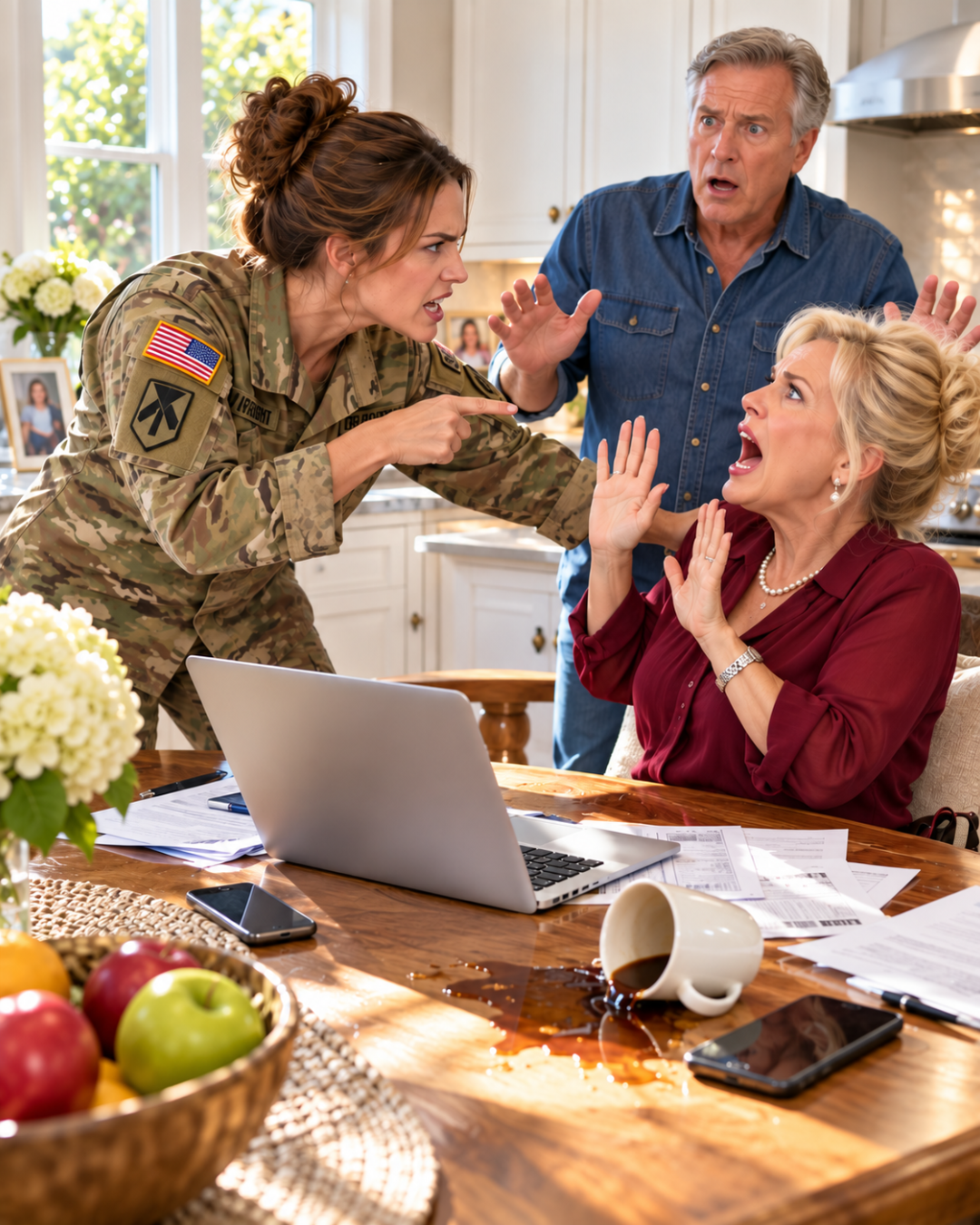
Marlene was sitting at my father’s little desk in the corner, the one where he paid the bills and kept his fishing magazines. His old laptop was open in front of her. My phone, which I had left charging on the counter overnight, was lying face up beside her hand.
On the laptop screen was the login page for my bank.
Under it, in bright blue letters, were the words: Forgot your password? We’ll send a verification code to your device.
She had not heard me come down. She was leaning toward the screen, lips moving slightly, typing something slowly with two fingers.
That was the moment I told you about. The moment I did not scream, did not cry, and did not let her see even a flicker of panic.
I pulled out a chair at the kitchen table, sat down, folded my hands, and waited.
It took her almost a full minute to feel me there.
When she finally turned, she jumped so hard the desk chair rolled back into the wall. Her hand flew to her chest.
“Claire! Good Lord, you scared me half to death.”
“Good morning, Marlene.”
She glanced at the laptop, then at my phone, then at me. I watched her decide, in about two seconds, which version of the truth she was going to try.
“I was just checking something for your father,” she said. “His email. This old computer is so slow.”
“That’s my bank’s website.”
“Is it?” She squinted at the screen as if she had never seen it before. “Well, I must have clicked the wrong thing.”
“And that’s my phone.”
“It was buzzing. I didn’t want it to wake anybody.”
I nodded slowly, the way I nod when a young lieutenant is giving me an explanation we both know is not going to survive the next question.
“It was buzzing,” I said, “because you requested a password reset. But that code won’t go to that phone, Marlene. Two years ago I changed my security settings. The code goes to a device I keep on me.”
I turned my wrist so she could see my watch. On its little screen was a message from my bank: A password reset was requested for your account at 5:31 AM. If this wasn’t you, contact us immediately.
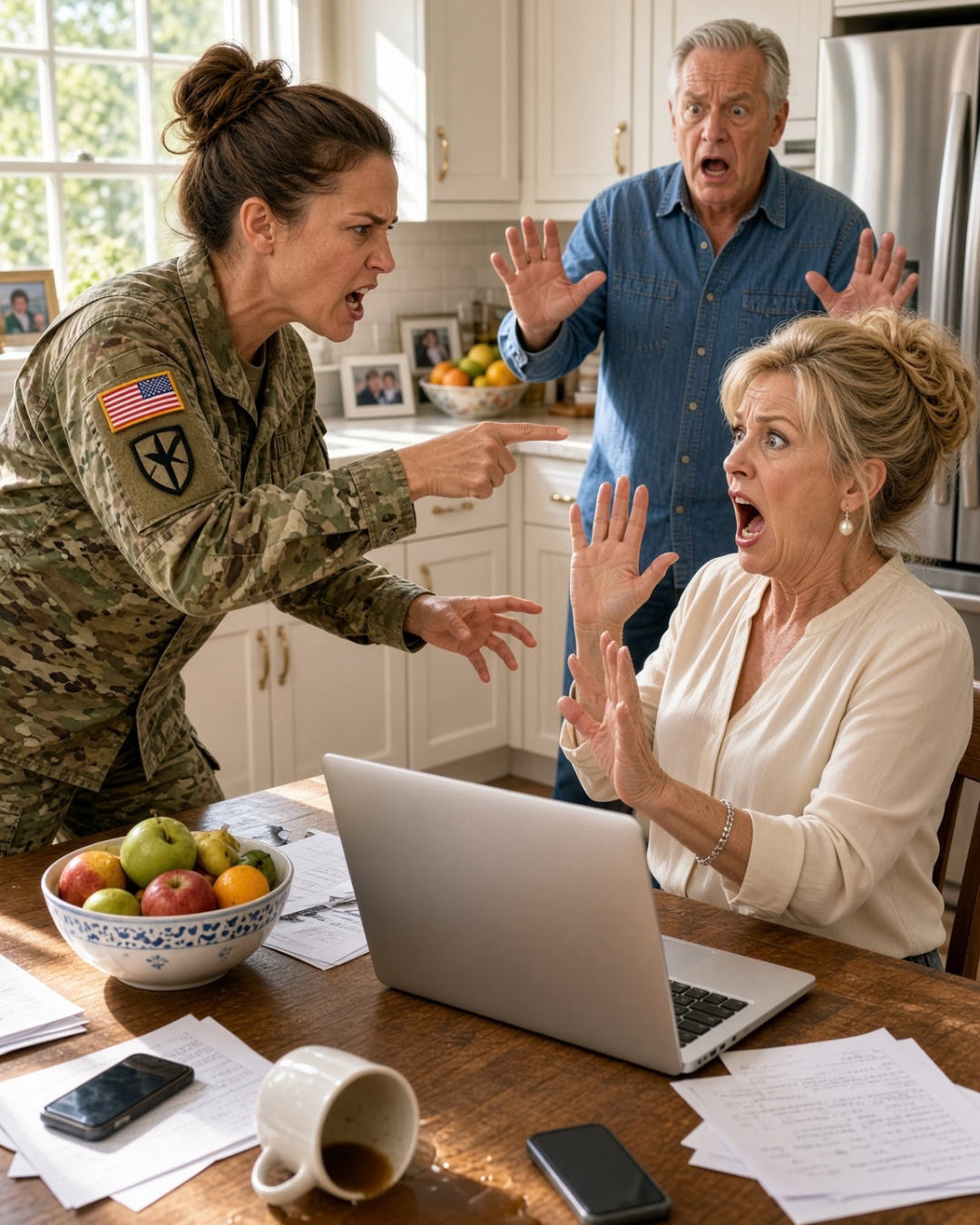
The color drained out of her face so fast it was almost fascinating to watch.
“I think,” I said quietly, “you should go wake up my dad.”
She did not go right away. First she tried to laugh. Then she tried to be offended. Then she tried to tell me I was being dramatic, that I had always been suspicious of her, that soldiers see enemies everywhere because it is their job.
I let her talk. I did not raise my voice once.
When she was finished, I said, “Marlene. Go get him. Or I will.”
She went.
My father came into the kitchen five minutes later in his undershirt and pajama pants, his gray hair sticking up on one side, reading glasses shoved on top of his head. He looked from me to his wife and back again, and I saw in his face the expression he had worn for most of my adult life whenever things got tense: the look of a man hoping that if he stayed very still, the storm would pass without needing him.
“What’s going on?” he asked. “Marlene says you’re upset about something on the computer.”
“Sit down, Dad.”
He sat.
And that was when I said it. I looked him straight in the eye and asked, “Do you know why the Army pays me?”
He blinked. “Because you work for them, honey.”
“Tell your wife to stop talking about my money,” I said. “It’s mine, not hers. She needs to know her place. If she crosses that line again, I won’t be polite. I’ll go to the bank’s fraud department, and I’ll go to the sheriff’s office, and I’ll hand them everything. Do you understand?”
My father broke into a cold sweat. I could see it beading along his hairline. His hands, the same hands that had taught me to ride a bike and bait a hook and change a tire, started to tremble against the tabletop.
“Claire,” he said, “whatever this is, I’m sure there’s a misunderstanding.”
“There isn’t.”
“She was probably just trying to help—”
“Dad.” I kept my voice low. “Help with what? Why would anyone need to reset the password on my bank account while I’m asleep upstairs?”
He opened his mouth. Nothing came out.
Behind him, Marlene stood with her arms crossed tightly over her robe. “I don’t have to stand here and be accused in my own kitchen,” she said.
“You don’t have to stand,” I said. “You can sit. Because I’m about to show my father something, and I think you’ll want to see his face when he reads it.”
I went upstairs and came back down with a brown accordion folder I had carried in the bottom of my duffel bag for six years.
It went everywhere with me. Germany. Kuwait. A base in a country I still cannot name in public. It was the one thing I never left in storage, because the day I left it behind was the day I would stop being able to prove what I had done and why.
I set it on the table in front of my father and opened the first section.
“Six years ago,” I said, “I was overseas. It was two in the morning where I was stationed, and I got an email from a woman at a bank here in Charlotte. Not my bank. Yours.”
My father frowned. “Mine?”
“She found my name in an old file from when I co-signed your truck loan after Mom died. She said she wasn’t supposed to contact me, but she was worried. Your house was four months behind on payments. There was a second loan against it, a home equity line of credit for sixty-two thousand dollars, and nearly all of it had been drawn out. The house was about to go into foreclosure.”
The kitchen went completely silent.
My father stared at me. “That’s not possible. The house was paid down. Your mother and I…” His voice cracked. “We were almost done with it.”
“I know you were.”
I slid a photocopy across the table. A loan application. His name at the top. His signature at the bottom.
Except it was not his signature. Anyone who had seen my father sign a birthday card could tell. He wrote his capital D like a big open sail, and this one was small and tight and careful, like someone practicing.
He picked it up. His hands were shaking so badly the paper rattled.
“I didn’t sign this.”
“I know, Dad.”
“I never signed this.” He turned slowly in his chair. “Marlene?”
She did not answer. She was staring at the folder as if it had teeth.
“I called the bank from overseas that week,” I continued. “I asked them not to tell you anything yet. I brought the account current. And then I set up an automatic transfer from my own account to pay the mortgage and the equity loan every month, so the house would never be in danger again.”
I turned to the next page. A bank statement, one of seventy-two. At the bottom, highlighted in yellow, was a line I had looked at so many times I could see it with my eyes closed.
Recurring Transfer — “Donovan House” — $1,640.00
“Every month,” I said. “For six years. Out of my pay.”
My father made a sound I had never heard him make before. It was not quite a word. It was the sound of a man realizing that the floor he had been standing on for years had been held up by somebody else’s hands.
“Why didn’t you tell me?” he whispered.
That was the hardest question, and I had rehearsed the answer in my head a hundred times, in tents and on runways and in the back of transport planes.
“Because you had just lost Mom,” I said. “Because you were finally smiling again. Because I thought if I told you your new wife had forged your name on a loan against the house Mom picked out, it would break something in you that I couldn’t fix from seven thousand miles away. So I decided to fix the part I could.”
I swallowed.
“And because I kept hoping it was a one-time thing. That maybe she panicked about something, made a terrible mistake, and would stop. I told myself that if the house was safe, the rest could wait until I came home.”
I looked at Marlene.
“But it didn’t stop. Did it?”
For a long moment, I thought she would storm out. She had the look of someone measuring the distance to the door.
Instead, she sat down hard in the chair across from me, and for the first time since I had known her, her face looked exactly as old and tired as she actually was.
“You don’t understand,” she said.
“Then help me understand.”
“My son,” she said. “Tyler. He started a business. A landscaping company, down in Rock Hill. He had equipment loans, trucks, a crew. And then his partner walked off with the money, and the bank came after Tyler for all of it. He was going to lose everything. His house. His kids were going to have to change schools.” Her voice rose. “What was I supposed to do? Let my grandchildren end up on the street?”
My father stared at her. “You told me Tyler was doing fine.”
“Because you would have said no!” She turned on him. “You always say no to anything that isn’t about you and your precious routine. So I took care of it myself.”
“With my house,” my father said. “With Evelyn’s house.”
The sound of my mother’s name in that kitchen hit all three of us like a dropped plate.
Marlene’s jaw tightened. “It’s been my house, too, for eleven years.”
“Then why did you forge his name on it?” I asked quietly.
She did not answer that.
“And the money since then?” I asked. “The credit card in Dad’s name that I found on his credit report two years ago? The one I paid off and closed? The phone calls to my bank last spring, pretending to be me, trying to get my balance? Those were for Tyler, too?”
She looked at me with open resentment now, the polite mask finally gone.
“You have so much,” she said. “You don’t have a husband. You don’t have children. You don’t even live here. You come home twice a year and act like a guest, and meanwhile the Army keeps sending you all that money for doing who knows what. Your father sits in this house getting older, and you’re sitting on a fortune you’ll never spend. Somebody in this family should get some use out of it.”
There it was.
Not a misunderstanding. Not a slip of the fingers on a slow laptop.
A belief. A quiet, long-standing belief that what I had was really hers to manage, because I was absent, because I was single, because I was a woman in uniform who apparently did not need anything.
I had faced hard things in my career. I had sat across tables from people who wanted very bad things to happen. But something about hearing that sentence in my mother’s kitchen made my chest ache in a way no briefing room ever had.
I took a breath and asked the question again, this time to both of them.
“Do you know why the Army pays me?”
Neither of them spoke.
“It pays me,” I said, “because for thirteen years I have gone where I was told, when I was told, and I have not been able to tell the people I love where I was. It pays me because I have missed eleven Thanksgivings and nine Christmases. It pays me because I have written letters to the parents of soldiers who did not come home, and then gone back to work the next morning because the rest of my people still needed me.”
My voice stayed steady. My hands did not.
“That bonus you asked about the minute I walked in the door? It’s hazard pay. Do you know what hazard pay is, Marlene? It’s what they pay you for being somewhere a reasonable person would never choose to be. Part of it went to your husband’s mortgage. And the rest of it went to something else.”
I pulled the last page from the folder and turned it toward my father.
It was a letter on the letterhead of a community college outside Charlotte.
Dear Lieutenant Colonel Donovan, thank you for your continued support of the Evelyn Donovan Memorial Nursing Scholarship. This year, your gift has allowed four students to complete their clinical training…
My father’s lips parted. His eyes filled so fast I thought he might not be able to finish reading it.
My mother had been an ER nurse for twenty-six years. She used to come home at two in the morning smelling like hospital soap, kick off her shoes by the door, and eat cold cereal standing up at this exact counter. She was the reason I believed service meant something.
“Four students,” my father whispered. “Every year?”
“Every year since I made major,” I said. “One of them is working at the same hospital Mom did. She sent me a picture of her first badge.”
My father took off his glasses and pressed the heels of his hands against his eyes. His shoulders shook silently.
And across the table, for the very first time, Marlene looked away from me.
I want to tell you that my father stood up in that moment, pounded the table, and took charge like a hero in a movie.
He did not.
He sat there for a long time, holding my mother’s scholarship letter in one hand and the forged loan application in the other, like a man trying to understand how both of those papers could exist in the same world.
Finally, he said, very quietly, “Marlene. I think you need to go stay with your sister for a while.”
“Frank—”
“I’m not shouting,” he said. “I’m not going to shout. But I need you to go.”
“This is her doing,” Marlene said, pointing at me. “She’s been waiting years to turn you against me.”
My father shook his head slowly. “No. She’s been waiting years for me to notice.” He looked down at the folder. “She’s been paying for my house, Marlene. My daughter. From wherever she was. While I told everyone at church how proud I was of her and never once asked what it cost her to be what she is.”
He turned to me, and his eyes were red.
“I’m so sorry, Claire-bear.”
Nobody had called me that since I was nine years old.
I had held myself together through every part of that morning. But that name nearly undid me.
Marlene packed two suitcases that afternoon. I stayed out on the back porch while she did it, not because I was afraid of what she would say, but because I did not want her last memory of that house to be me watching her like a guard.
Before she left, she came out onto the porch and stood by the screen door.
“You’re going to call the police,” she said. It was not a question.
I thought about it for a long time before I answered.
“The bank already has a fraud report from this morning,” I said. “That part isn’t up to me anymore. They’ll investigate the reset attempt. As for the loan against the house, that’s Dad’s name, Dad’s signature, and Dad’s decision. Not mine.”
She looked out at the yard. The old oak tree my mother planted the summer I was born was throwing long shadows across the grass.
“I really did think I was saving Tyler,” she said, almost to herself.
“Maybe you did,” I said. “But you didn’t have the right to save him with things that weren’t yours.”
She nodded once, stiffly, and walked back into the house. A few minutes later, I heard her car pull out of the driveway.
My father did not watch her go. He was sitting at the kitchen table, turning the pages of my folder one by one, reading every single statement from the beginning.
The next ten days of my leave were not the quiet vacation I had planned.
They were better.
On Thursday, my father and I drove downtown and met with an attorney, a soft-spoken woman named Denise Holloway who had handled estate paperwork for my mother years before. She read through everything in my folder, then leaned back in her chair and let out a long breath.
“Mr. Donovan,” she said, “your daughter has documented this better than most investigators would. This is a clear case of forgery. We can go several ways with it.”
My father sat very straight in his chair.
“I don’t want to destroy her,” he said. “I’m angry. I’m hurt. But I don’t want to spend my last good years trying to ruin somebody.” He glanced at me. “What I want is for my daughter to stop paying for my mistakes.”
“It wasn’t your mistake, Dad.”
“I married her,” he said simply. “I gave her the checkbook because I didn’t want to deal with the mail after your mother passed. I stopped opening envelopes. I stopped asking questions. That part’s on me.”
Denise nodded slowly. “Then let’s make it right.”
Over the following days, she drew up a formal repayment agreement for the equity loan, a legal separation filing, and a notice to every credit bureau freezing my father’s credit. My father signed each document with his big, open-sail D. I watched him do it and thought about how much steadier his hand looked than it had that first morning.
On Friday, we went to my father’s bank together, and he sat across a desk from a young loan officer and asked, clearly and without embarrassment, “I’d like to see every account that has my name on it. All of them. I want to understand my own money.”
It took three hours. By the end, he had a notebook full of handwriting and a look on his face I had not seen since I was a teenager, the look of a man who had decided to stop drifting.
On the drive home, he said, “I want to take over the house payment, Claire.”
“Dad, you don’t have to—”
“Yes, I do.” He gripped the steering wheel. “I’ve got my pension and my Social Security. I’ll sell the boat. I haven’t taken it out in three years anyway. I’m a grown man, and I’m going to pay for the roof over my own head.”
I looked out the window so he would not see my face.
For six years, I had carried that house like an extra rucksack I never got to take off. I had calculated my deployments around it. I had skipped buying a home of my own because of it. I had never once resented it, because it was my mother’s house and my father’s peace. But I had not realized how heavy it was until he offered to lift it off my shoulders.
“Okay,” I said. “Okay, Dad.”
On Saturday morning, he did something he had never done in all my years of service.
He sat down across from me at breakfast, poured two cups of coffee, and said, “Tell me about it.”
“About what?”
“About where you’ve been.” He paused. “What you can tell me, anyway. I know there’s plenty you can’t. But I never asked, Claire. Not really. I’d ask how the food was, or whether it was hot there, and then I’d change the subject.”
“Why?” I asked softly.
He stared into his coffee for a long moment.
“Because I was scared,” he said. “After your mother, I couldn’t stand the thought of losing somebody else. If I didn’t know where you were, I didn’t have to picture it. I could pretend you were at some office somewhere pushing papers.” He shook his head. “That wasn’t fair to you. You were carrying all of it alone, and I let you, because it was easier for me.”
So I told him.
Not everything. Not the parts that belonged to other people or to files with locks on them. But I told him about the young sergeant from Ohio who taught half my unit how to make real Southern biscuits in a field kitchen with ingredients that had no business turning into biscuits. I told him about the night we drove for nine hours without headlights. I told him about the letters I wrote, and the families I met afterward, and the way one mother held my hands and thanked me for bringing her son’s belongings home even though I could not bring him.
I told him about promotion day, when I had stood in front of my commander and realized there was no one in the audience who belonged to me.
My father listened to all of it. He did not change the subject once.
When I finished, he reached across the table and covered my hand with his.
“Next promotion,” he said, “you tell me the date. I don’t care where it is. I’ll get on a plane. I’ve never been on a plane longer than two hours, but I’ll figure it out.”
I laughed through tears. “It could be a long flight.”
“Then I’ll bring a book.”
The day before I left, Marlene’s son Tyler showed up at the house.
I saw his pickup truck pull into the driveway from the kitchen window, and for a second every muscle in my body tightened. I did not know him well. I did not know what his mother had told him.
But when my father opened the front door, Tyler stood on the porch with his cap in his hands, looking like a man walking into a courtroom.
“Mr. Donovan,” he said. “Ma’am.” He nodded at me. “I didn’t know. I swear to God, I didn’t know where she got that money. She told me it was from an inheritance. An aunt in Tennessee.” He swallowed hard. “She called me last night and told me the truth. All of it.”
He held out an envelope.
“It’s not much. It’s the first payment. I’ve got my business back on its feet now, and I’ve got a steady contract with the county. I’ll pay back every dollar. It might take me a few years, but I’ll do it. My kids aren’t going to grow up thinking it’s okay to live off what somebody else earned.”
My father took the envelope. For a moment, he looked at it without opening it. Then he held out his other hand, and Tyler shook it.
“That’s a good man’s decision,” my father said. “Come by for supper sometime. Bring the kids.”
After Tyler drove away, my father stood on the porch for a long time.
“She’s going to counseling,” he said finally. “Marlene. Her sister made her go. She wrote me a letter. Said she doesn’t expect anything from me, but she wanted me to know she’s trying.”
“How do you feel about that?” I asked.
He thought about it carefully, which was new, too.
“I feel like it’s good for her,” he said. “And I feel like whatever happens next with her and me, it’s going to happen with my eyes open. No more letting other people handle what’s mine to handle.” He looked at me. “And no more letting my daughter carry what’s mine to carry.”
That evening, we drove out to the cemetery where my mother is buried.
It sits on a gentle hill outside town, surrounded by old magnolia trees, and in late afternoon the light comes through the branches in long golden slants. My father brought a bundle of white hydrangeas from the yard, the same kind my mother used to cut and put in mason jars on the windowsill.
He knelt in the grass beside her headstone, his knees cracking, and set the flowers down.
“Evie,” he said softly, “I let things slide. I’m sorry. Our girl had to hold the house up while I wasn’t paying attention.” His voice wobbled. “But I’m paying attention now. I promise you that.”
I stood behind him with my hands in my pockets, looking at the words carved into the granite. Evelyn Grace Donovan. She took care of everyone.
For years I thought that line was only about her.
Standing there, I realized that it was also a warning. People who take care of everyone often end up forgetting to let anyone take care of them.
My father stood up slowly and brushed the grass off his pants. Then, without saying anything, he pulled me into a hug. Not the quick, back-patting airport hug he usually gave me. A real one. The kind where you feel someone’s heartbeat.
“I’m proud of you,” he said into my hair. “Not because of your rank. Not because of your money. Because of who you are. You’re your mother’s daughter, and you’re mine, and I’m the luckiest old man in North Carolina.”
I held on for a long time.
He drove me back to the airport on a clear, cool morning two days later.
At the passenger drop-off lane, he got out of the truck, which he never does, and pulled my duffel bag from the back himself.
Then he reached into his jacket and handed me a folded piece of paper.
“What’s this?”
“Open it.”
It was a printed bank confirmation from that morning. At the top was his name. Below it, a single line.
Mortgage Payment — Paid by Account Holder — $1,640.00
Underneath, in his big, looping handwriting, he had written: I’ve got it from here, Claire-bear. Go take care of your soldiers. Your old man can take care of his own house.
I did not trust myself to speak. I just nodded, folded the paper carefully, and slid it into the front pocket of my jacket, right over my heart.
“One more thing,” he said.
He took off his faded ball cap, the same one he had worn since I was sixteen, and put it on my head.
“I’ll get it back from you at your next promotion,” he said. “So you’d better tell me when it is.”
“Yes, sir,” I said, and my voice broke on the second word.
He laughed, hugged me one more time, and stood there on the curb waving until I disappeared through the terminal doors.
Four months later, I was promoted to full Colonel in a small ceremony on a base in Georgia.
It was a gray, windy day, the kind that makes flags snap hard against their poles. I stood at the front of the room in my dress uniform, listening to my commander read the order, and I looked out at the rows of chairs.
In the third row sat a tall, gray-haired man in a borrowed suit that was a little too big in the shoulders, clutching a paper program in both hands like it might blow away.
Beside him sat a young woman in navy blue hospital scrubs. It was the scholarship recipient who worked at my mother’s old hospital. My father had found her through the college, called her himself, and asked if she would like to come.
When it came time for someone to pin the new rank on my shoulders, my commander turned toward the audience and asked if there was a family member present.
My father stood up so fast he dropped his program.
He walked to the front with his hands shaking, and together with my commander, he pinned the silver eagle onto my uniform. He had to try twice. Nobody in the room minded.
When he finished, he stepped back, looked me up and down, and then, very slowly and very awkwardly, raised his right hand to his forehead in the worst salute I have ever seen in my life.
It was also the most beautiful one.
The room broke into applause. I heard the young nurse laugh through her tears. And I thought about my mother, standing at the kitchen counter at two in the morning, eating cold cereal in her scrubs, telling me that the people who serve are not the ones who never need anything. They are the ones who keep giving anyway, and who deserve to have someone give something back.
After the ceremony, my father handed me a small box wrapped in brown paper.
Inside was his old ball cap, freshly washed, and a note.
You told me I could have this back at your promotion. Changed my mind. It’s yours now. Your mother would want you to have something from home that you don’t have to pay for.
People sometimes ask me what I learned from those two weeks.
Here is what I tell them.
Money was never really the point. Marlene thought it was. She thought the numbers in my account were a prize sitting unguarded because I was far away and alone. What she never understood was that every dollar in that account had a story behind it: a missed holiday, a long night, a promise kept to someone who could not keep their own.
My father did not understand at first, either. Not because he did not love me, but because loving someone and truly seeing them are not the same thing. Sometimes the people closest to us stop asking questions because they are afraid of the answers.
But silence is not the same as peace. And protecting someone’s feelings is not the same as protecting them.
The bravest thing my father ever did was not standing up to his wife. It was sitting across from his daughter at a kitchen table, pouring two cups of coffee, and saying, “Tell me about it,” and then actually listening.
These days, he calls me every Sunday. He asks where I am, as much as I am allowed to say. He tells me about the tomato plants, and Tyler’s kids who come over on Saturdays to help him rake leaves, and how the scholarship board invited him to speak at this year’s graduation.
And every month, without fail, he sends me a text with a photo of the same confirmation screen.
Paid by Account Holder.
Underneath, always the same four words.
Still got it, Colonel.
I have saved every single one.
THE END.
