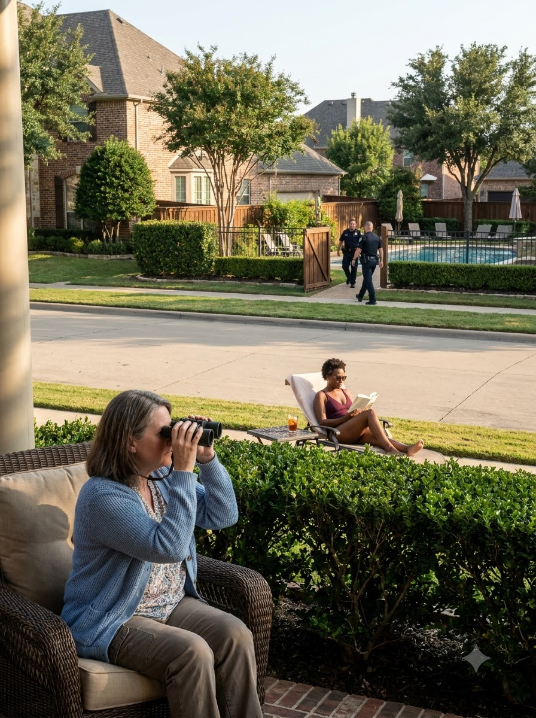
Margaret Collins liked to inform people that her long tenure on Willow Creek Lane gave her an innate sense for when something was amiss. Having spent twenty-one years on the street—enduring re-roofing projects, divorces, send-offs for college, water restrictions, and countless neighborhood disputes over fence dimensions—she considered herself informally certified in local matters.
At fifty-five, she spent the majority of her time on her front porch, typically accompanied by iced tea, a gardening magazine, and binoculars she claimed were meant for watching birds. Most residents were fully aware that the lenses were rarely focused on wildlife.
The neighborhood was situated outside Frisco, Texas, within a meticulously planned subdivision where established trees shaded broad walkways and nearly every backyard featured a pool behind an eight-foot privacy fence. Neighbors exchanged waves during morning strolls, kept track of which teenager operated which vehicle, and learned within a single day if anyone installed an unauthorized mailbox. Margaret cherished that steady rhythm because it provided a sense of predictability. To her mind, predictability was virtually identical to safety.
The corner residence directly across from her had been occupied by George and Linda Patterson for fourteen years. The retired educators finally put the property up for sale after George’s severe arthritis turned pool upkeep into more of a burden than an enjoyment. Margaret joined their farewell gathering, brought a lemon pound cake, and listened as Linda noted they were relocating closer to their daughter in Santa Fe. Three weeks later, the FOR SALE sign was gone, yet no one on Willow Creek Lane seemed to know who had purchased the home.
That unsettled Margaret more than she cared to admit. No moving van had remained parked outside for an entire day, no family had introduced themselves on the neighborhood Facebook group, and no welcoming memo had been issued by the HOA. She had noted a dark SUV in the driveway twice and caught fleeting glimpses of a woman entering through the garage. Whomever had moved in appeared to have no interest in making a proper introduction.
On a humid Saturday afternoon in late August, Margaret stepped onto her porch in a broad straw hat, holding a glass of lemonade. She settled into a wicker chair, opened a mystery novel, and managed to read for roughly six minutes before her curiosity took over. The corner property was quiet, though faint jazz music drifted over the fence from the rear yard. Margaret reached for her binoculars.
A Black woman was resting by the pool. Appearing to be in her mid-forties, athletic yet unconcerned with making an impression, she wore a dark burgundy swimsuit and large sunglasses. An open paperback rested against one thigh, and a glass of iced tea sat on an adjacent table. Nothing in her conduct implied she was concealing herself from anyone.
That reaction made Margaret feel even more suspicious rather than less. She lowered the binoculars and sat forward. The woman appeared comfortable in a manner Margaret felt people should only display when everyone else understood the reason for their presence.
“Who is that?” she whispered. No one replied, as she was by herself.
Margaret retrieved her phone. She told herself her call had nothing to do with the woman being Black, even though that detail would be among the first she shared. She reasoned that she was calling simply because the Pattersons had moved away and she had never met the new occupant. By the time the non-emergency operator answered, Margaret had translated her uncertainty into concern.
“Frisco Police, non-emergency line.” Margaret smoothed her voice into the gentle, sensible tone she used when aiming to sound helpful rather than intrusive.
“Yes, hello. I think someone may be trespassing at a house on Willow Creek Lane.” The operator requested the street address.
Margaret provided it. Then came the predictable inquiry.
“What makes you believe someone is trespassing?” Margaret peered through the binoculars once more.
“There’s a woman in the backyard by the pool.” The operator paused.
For illustration purposes only
“Do you know the homeowner?” Margaret hesitated. “The house recently sold.”
“Have you seen anyone enter by force?” No.
“Broken window?” No.
“Damaged gate?” Margaret checked again. “Not that I can see.”
The operator hesitated. “What exactly is the woman doing?” Margaret felt foolish for a brief moment.
“She’s lying beside the pool.” The silence from the line made Margaret defensive.
“I just don’t think she lives there.” The operator requested a physical description.
Margaret offered one. “Black female, maybe mid-forties, swimsuit, sunglasses.”
“Any weapon?” No.
“Threatening anyone?” No.
“Trying doors or windows?” No.
Margaret tightened her grasp on the receiver. “She just looks out of place.”
The operator made no remark regarding that observation. She noted Margaret’s name and explained that an available patrol car would check the location. Margaret offered her thanks and disconnected, feeling both relieved and oddly unsettled. She had expected that filing the report would make the circumstances feel more undeniably improper.
Instead, the woman turned a page of her book. She took a drink of tea. She dipped a foot into the water and went on reading.
Margaret kept watching. Beneath all her conviction, a smaller thought kept recurring. What if she lives there?
Margaret brushed the thought aside. Neighbors introduced themselves.
Neighbors made their presence known. Neighbors did not simply show up behind privacy fences and expect the street to accept them without an explanation.
At least, that was the reasoning Margaret offered herself.
The woman was Dr. Camille Harrison. She was forty-six, divorced, intentionally childless, and had spent twenty-three years working in federal law enforcement. Three months earlier, following assignments in counterintelligence, organized crime, and domestic security across multiple cities, she had been named Deputy Director of the Federal Bureau of Investigation. That Saturday marked the first uninterrupted afternoon she had managed to take for herself in nearly six weeks.
Her new responsibilities frequently pulled her between Washington and regional offices. She had bought the Texas residence partly because her older sister lived twenty minutes away, and partly because she wanted a location that did not remind her of Washington. Camille retained an apartment in Virginia for work, but Texas was intended as the space where she could sit beside a pool, read fiction, and occasionally forget that her phone rang at two in the morning when crises arose. She had relocated quietly because quiet was her primary goal.
The moving crew had delivered the majority of her items on a Thursday while she was away in Washington. Her sister had managed the delivery. Camille arrived the following Friday evening, slept six hours, spent Saturday morning unpacking containers, and decided by noon that she was finished working. By two o’clock, she was poolside, listening to Miles Davis over the outdoor speakers.
She caught the sound of the side gate opening at 2:41. The noise was subtle, but decades in federal service had conditioned her to detect shifts in her environment before her conscious mind named them. Camille lowered her book and glanced toward the entrance. Two uniformed officers entered the backyard.
One was Officer Daniel Reyes, forty-two, with fifteen years on the force. The other was Officer Colin Price, twenty-nine, still young enough to look uneasy whenever a call differed from the description provided by dispatch. Both came to a stop several feet from the patio area.
“Ma’am?” Reyes called out. Camille removed her sunglasses.
“Yes?” Reyes ensured his hands remained visible.
“We received a report that someone may be trespassing at this property.” Camille glanced toward the residence, then back to him.
“This property?” Reyes gave a nod.
“Yes, ma’am.” Camille set her book onto the lounge chair.
“I live here.” Price looked over at Reyes.
Reyes asked, “Okay. Do you have identification showing this address?”
Camille nearly chuckled. Not because the request was entirely unreasonable following a report of trespassing, but because she could already envision precisely how the call had originated. She stood up unhurriedly.
“Sure.” She stepped toward a weatherproof cabinet near the patio kitchen where her small tote bag was resting.
Reyes monitored her closely. Camille noted his posture. She opened the tote, pulled out a leather wallet, and paused.
“May I ask something before I hand this over?” Reyes gave a nod.
“Do you normally enter people’s fenced backyards and ask residents sunbathing beside their own pools to prove they belong there?” Price glanced off to the side.
Reyes replied, “We’re responding to information we received.” Camille nodded in understanding.
“I understand that.” She met his gaze directly.
“I’m asking what information made this response necessary beyond one neighbor not recognizing me.” Neither officer responded right away.
Camille offered a dry smile. “That’s what I thought.”
She unclasped the wallet.
Reyes first caught sight of a driver’s license. The address matched the location.
Then Camille flipped to the federal credentials positioned beneath it.
The gold badge reflected the afternoon light.
FEDERAL BUREAU OF INVESTIGATION.
Price read the position title first. His expression shifted instantly.
Reyes took another look. Then his gaze returned to Camille.
“Deputy Director?” Camille nodded.
“That would be me.”
For several seconds, neither officer said anything. Camille had witnessed that reaction before under different circumstances. People altered their posture when presented with a title that raised the stakes of making an error.
She took little pleasure in that reaction.
“I bought the property four weeks ago,” Camille stated. “Closing documents are inside if you actually need them.”
Reyes shook his head. “Your license is enough.”
“Good.” Camille slipped the wallet back inside her bag.
Price cleared his throat. “We apologize for the interruption.”
Camille looked toward the gate. “Who called?”
Neither officer offered an immediate response. Camille was well aware the department was unlikely to identify a caller on the scene.
She glanced toward Margaret’s home instead. The porch remained partially visible through a gap in the hedge. A light straw hat moved out of sight behind a post.
Camille gave a subtle smile. “Never mind.”
Reyes followed her line of sight. His expression provided all the confirmation she needed.
“Could you do me a favor?” Camille asked.
“Yes, ma’am.” She put her sunglasses back on.
“Tell whoever called that the woman by the pool lives here.” Reyes gave a nod.
“And perhaps remind them that not recognizing someone is not evidence of a crime.” Price nodded in quick agreement.
“Yes, ma’am.”
The officers departed. Camille waited until the latch on the gate clicked into place before taking her seat again.
She attempted to resume reading. She managed half a page.
Then she closed the book.
Across the street, Margaret stepped behind a porch column and watched for the officers to return to their vehicle. She anticipated one of them stopping to explain what had occurred. Neither did.
Reyes walked straight to the squad car. Price got into the passenger side.
The cruiser pulled away.
Margaret felt her stomach tighten.
She cast a look toward the corner residence. Camille remained beside the pool.
No handcuffs. No police escort.
No argument.
Nothing.
Margaret went indoors and pulled the door shut.
The air conditioning felt unexpectedly intense against her humid skin. She carried her lemonade into the kitchen, set it down on the counter, and stood there attempting to make sense of what had transpired.
Her phone vibrated.
A text from Lorraine Baxter, two doors down, came through.
Police on Willow Creek? Everything okay?
Margaret did not reply.
A second message followed.
Was it the new neighbor?
Margaret turned her phone face down.
Then curiosity overcame her restraint.
She pulled up her tablet and ran a search for the name she had overheard an officer repeat.
Camille Harrison FBI.
The primary image loaded instantly.
Camille was standing behind a podium in Washington, dressed in a dark suit. Another image displayed her alongside the Attorney General.
A third showed her giving testimony before a Senate committee.
The color drained from Margaret’s face.
She opened an article.
Camille R. Harrison appointed FBI Deputy Director after 23-year career.
The text detailed counterterrorism investigations, overseas postings, major organized crime cases, and her recent Senate testimony regarding domestic security threats. Margaret read several paragraphs without fully processing the words.
Then the reality sank in.
She had reported the Deputy Director of the FBI to the local police for reading by her own pool.
Margaret covered her face with her hands.
Her initial reaction was humiliation.
Her second was fear.
Only later would she recognize that those feelings were still predominantly centered on herself.
By four o’clock, word had spread across the neighborhood Facebook group. A passerby walking a dog had taken a photo of the two patrol vehicles parked outside Camille’s home.
The text read: Apparently our new neighbor had an interesting welcome committee today.
Replies followed rapidly.
What happened?
Please tell me nobody called cops because they didn’t recognize her.
Then a user shared a screenshot of Camille’s official FBI bio.
Oh my God.
Somebody called police on the Deputy Director of the FBI at her own house?
Margaret closed the application.
Her doorbell rang at 5:18.
She stood frozen.
For a brief second, she contemplated pretending the house was empty.
Then she glanced through the peephole.
Camille Harrison stood on the porch in relaxed linen pants and a plain white T-shirt. No sunglasses. No badge.
Margaret pulled the door open halfway.
“Good evening.” Camille’s tone was composed.
“Hi.” Margaret hated how small her voice sounded.
“I thought we should meet.” Margaret swallowed hard.
“Yes.” Camille waited.
Neither woman spoke for a few moments.
Margaret eventually said, “I’m sorry about earlier.”
Camille looked at her. “What are you sorry for?”
The question caught Margaret off guard.
“For calling the police.” Camille nodded.
“Why did you call?”
Margaret started with the excuses she had rehearsed.
“I didn’t recognize you.” Camille waited.
“The house was recently sold.” Another pause.
“You hadn’t introduced yourself.” Camille lifted an eyebrow.
Margaret pressed on regardless. “I thought someone might have gotten through the gate.”
“Did you see me climbing the fence?” No.
Chapter 2
“Breaking anything?” No.
“Hiding?” Margaret looked down.
“No.”
“Did you walk across the street and ask whether I lived there?” Margaret did not answer.
Camille’s voice stayed calm. “You decided police were the appropriate first introduction.”
Margaret’s face burned. “I honestly thought I was protecting the neighborhood.”
Camille nodded. “I believe you thought that.”
Margaret looked relieved too quickly. Camille noticed.
“That doesn’t make the decision harmless.”
The relief disappeared.
Camille leaned slightly against the porch railing. “Do you know what bothers me most?”
Margaret shook her head.
“It isn’t that you didn’t know my title.” She looked toward her own house.
“It’s that the title changed how embarrassing the situation became for you.”
Margaret opened her mouth.
Camille continued. “If I were a schoolteacher, would you be less embarrassed?”
Margaret said nothing.
“If I delivered packages, would calling police have been more reasonable?”
“No.” Her answer came quietly.
“If I were somebody’s nineteen-year-old daughter house-sitting for the weekend, would the risk to me have been less important?”
Margaret looked at the floor.
Camille nodded. “Exactly.”
Margaret finally whispered, “I didn’t mean for anyone to get hurt.”
“I know.” Camille straightened.
“Most harmful assumptions don’t begin with somebody saying, ‘I want to hurt someone.’”
Margaret looked at her.
“They begin with somebody being very certain about a story they never verified.”
That sentence stayed between them.
Camille stepped back from the porch.
“I’m not here to yell at you.” Margaret looked surprised.
“I spend enough of my life around conflict.” Camille continued.
“But I am asking you not to watch my backyard with binoculars.”
Margaret’s face went crimson.
Camille almost smiled.
“Yes, I saw them.”
Margaret nodded. “Okay.”
“And if something genuinely dangerous happens at my house, call the police.”
Margaret looked up.
“But me existing there is not dangerous.”
“No.” Margaret swallowed.
“It isn’t.”
Camille nodded once.
“That’s all I wanted to say.”
She walked back across the street.
Margaret remained in the doorway until Camille disappeared behind the hedges.
The next morning, Margaret did not sit on the porch.
For the first time in years, the binoculars stayed untouched on the wicker table.
Her phone started buzzing before nine. Lorraine wanted details.
Another neighbor, Beth Carmichael, wrote, Is it true she’s FBI?
A third message came from Sanjay Patel, who lived near the entrance.
Why were the police called in the first place?
Margaret ignored all of them.
Avoiding questions did not stop people from creating answers.
By lunchtime, most of Willow Creek Lane understood the basic story.
Margaret called police. Camille lived there.
Camille happened to be a senior FBI official.
People began behaving differently around Margaret.
Some waved less. Others stopped conversations when she approached.
The same social surveillance Margaret had spent years directing outward was now pointed toward her.
At three that afternoon, Margaret walked to the mailbox.
Sanjay was washing his pickup nearby. He looked over.
“Afternoon.”
Margaret smiled cautiously. “Hi, Sanjay.”
He turned off the hose.
“My daughter saw the neighborhood post.”
Margaret felt her stomach tighten.
“She asked me whether somebody would call police if she came to water my plants while I was traveling.” Margaret looked at him.
“I told her no.”
Sanjay wiped his hands on his shorts.
“Then I realized I couldn’t honestly promise that.”
He turned the hose back on.
Margaret stood beside the mailbox holding a stack of advertisements she suddenly forgot how to read.
The next day, Officer Daniel Reyes returned.
Margaret saw the cruiser and immediately assumed Camille had filed a complaint. She opened the door before he reached it.
“Officer.” Reyes removed his sunglasses.
“Ms. Collins. I wanted to follow up about Saturday’s call.”
Margaret crossed her arms defensively. “Am I in trouble?”
“No.” He paused.
“But I want to clarify something.”
Margaret waited.
“Calls reporting suspicious activity become part of the department record.” She nodded.
“If repeated calls involve the same person without evidence of actual criminal behavior, the pattern can be reviewed.”
Margaret’s face tightened.
“Reviewed how?”
“For possible misuse of emergency services, harassment, or discriminatory targeting, depending on the facts.” Margaret looked toward Camille’s house.
“I only called once.”
“I know.” Reyes’s voice remained neutral.
“I’m not here to threaten you.”
He paused.
“I’m telling you that the police department cannot become a tool for managing which neighbors make you uncomfortable.”
Margaret’s face grew hot.
“I thought she might be trespassing.”
Reyes nodded. “The dispatcher asked you whether there was forced entry.”
Margaret said nothing.
“She asked whether anyone was being threatened.” Silence.
“She asked whether you saw criminal conduct.”
Margaret looked away.
Reyes continued. “The only thing you were certain about was that you didn’t recognize her.”
He let the sentence settle.
“That is something worth thinking about.”
Margaret nodded slowly.
Reyes returned to his cruiser.
That afternoon, she brought the binoculars inside.
She placed them in a hall closet.
The act did not change anything about what she had already done.
Still, it felt like removing a weapon from a habit she no longer trusted.
The hardest part came at night.
Public embarrassment gave Margaret something to resist. Private silence gave her nowhere to hide.
She replayed the conversation with Camille.
If I were a teacher.
If I delivered packages.
If I were somebody’s nineteen-year-old daughter.
Margaret realized she had been relieved when she learned Camille was important.
That realization made her feel worse than the Facebook comments.
Because it meant some hidden part of her had considered the mistake more serious after discovering Camille possessed institutional power.
She began asking herself a question she disliked.
What if Camille had not had a badge?
Would the officers have believed her immediately?
Probably.
Her driver’s license matched the address.
But what if she had been Camille’s niece?
A housekeeper?
A friend?
A contractor?
How long would the interaction have lasted?
Margaret did not know.
The uncertainty bothered her.
Several days later, an email arrived from Camille through the neighborhood list.
Saturday afternoon, 3 p.m. Open house for anyone on Willow Creek Lane. Food, iced tea, music, and introductions. No agenda. I’ve realized some of us have lived near each other longer than we’ve actually known each other. Come by if you’d like.
Margaret read it twice.
Lorraine replied first.
Sounds lovely.
Sanjay added a thumbs-up.
Several families confirmed.
Margaret did nothing.
Saturday afternoon arrived anyway.
At 2:45, Margaret stood inside her kitchen wearing a blue blouse and holding a plate of lemon bars.
She had baked them that morning.
Then spent two hours deciding not to go.
At 3:12, she walked to the front door.
At 3:17, she stepped outside.
The walk across Willow Creek Lane felt longer than the street had ever been.
Children were already running through Camille’s backyard.
Music played softly.
Tables held barbecue, salads, chips, fruit, and enough desserts to supply a church picnic.