

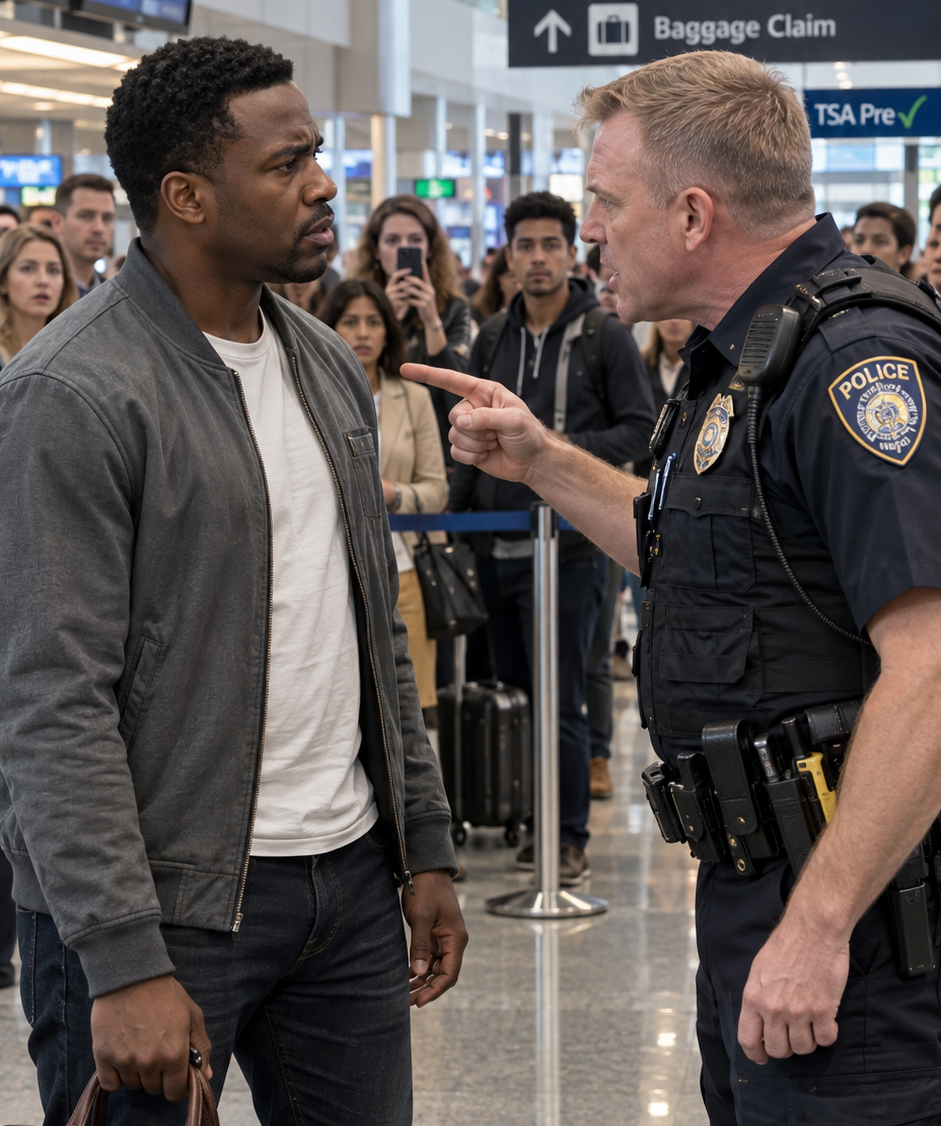
Before the man carrying it had even reached baggage claim, Officer Connor Vale had already concluded the charcoal suitcase couldn’t be his. He registered the pricey leather briefcase first, then the plain black jacket, the dark jeans, and the Black man’s face above them — and in his mind, the rest of the narrative wrote itself. “Step away from the carousel,” Vale said as he moved directly into the man’s path toward the exit.
“Guys dressed like you don’t usually walk out of here carrying luggage like that.”
He spoke quietly enough that most of the travelers near Carousel 12 didn’t catch it right away. Sixteen years into his career with the Meridian Capital Airport Police Department, Vale had come to believe authority landed harder when it wasn’t shouted. At forty-six, broad-shouldered and perpetually wary-eyed, he’d earned a reputation for turning up cash, narcotics, and suspicious travelers that other officers supposedly missed. What airport leadership rarely looked into was how often Vale seemed to settle on who looked suspicious before any suspicious act had actually taken place.
A pace or two behind him stood Officer Luis Ortega, forty, with nearly ten years in airport policing. Shorter and quieter than Vale, Luis noticed more than his partner did, though he’d also come to understand that staying quiet could turn into cowardice when it was used to dodge conflict with a stronger personality. From his angle he could already make out the burgundy ID tag looped through the suitcase handle. Stamped into the leather in large silver letters were the initials: A.J.M.
Those initials belonged to Adrian Joseph Mercer, fifty-six, thirty-four years into his career with the Federal Bureau of Investigation and currently its Deputy Director. His federal credentials sat in his jacket’s inner left pocket, near enough to settle any legitimate question about who he was almost instantly. His briefcase held an encrypted government laptop, several secure briefing files, and a small walnut box carrying a birthday gift for his mother. None of the people gathered around Carousel 12 knew any of that yet.
To the crowd waiting on bags that Tuesday morning, Adrian read as just another exhausted traveler. He was tall, thinner than he’d been a decade before, dressed comfortably after two days of meetings in Chicago, and moved with the restrained confidence of a man who’d learned not to let being watched dictate his behavior. Seventeen minutes later, FBI agents would seal off every secure service exit along the east terminal of Meridian Capital International Airport because of what Connor Vale was about to do. The incident that would eventually expose years of unlawful airport policing began with nothing more than one officer deciding a suitcase looked too expensive for the man walking beside it.
Meridian Capital sat roughly halfway between Baltimore and Washington — busy enough to move millions of travelers a year, small enough that longtime staff eventually knew each other’s faces. At 8:26 that morning, Carousel 12 was packed with families, consultants, college students, service members, and business travelers, all waiting under fluorescent light as recorded announcements echoed through the baggage level. Burnt coffee smell drifted from a nearby kiosk, kids perched on their carry-ons, and a maintenance worker fought with a vending machine refusing to take dollar bills. Nothing in the room hinted that one of the airport’s largest federal civil-rights investigations was already underway.
Thirteen minutes before Vale walked up to Adrian, he and Luis had both switched off the video feeds on their body cameras. The units stayed powered on, their GPS kept logging location, and the internal system recorded every activation command — but the actual video sensors had been deliberately shut off through a two-button sequence. Vale did it first. Luis followed suit nine seconds later.
Neither man reported a malfunction. Neither called dispatch, filed an equipment note, or told a supervisor. More significantly, this wasn’t the first undocumented stop of their shift. Before eight that morning, they’d already stopped two Black male travelers in separate parts of the terminal, questioned them about who owned their luggage, and searched a backpack and a roller bag.
They’d found nothing illegal. Neither stop showed up in the official activity database. Luis had stood next to Vale through both encounters and said nothing while the cameras stayed dark.
At 8:11, Vale used his personal phone to send a message to a private group chat shared by several members of the airport interdiction team: Solo premium at Twelve. Black male, no family, expensive hard case. Looks easy before shift change. Attached was a still image pulled from an internal airport camera, showing Adrian coming down an escalator toward baggage claim. At that point, Adrian had done nothing more suspicious than walk through an airport with luggage.
No stolen-bag complaint existed. No airline employee had called police. No passenger had accused Adrian of touching anyone else’s belongings. Vale had picked him out from a video image, turned off his own body camera, and moved toward him before any criminal event had even occurred.
Adrian knew nothing of this. He’d spent the previous two days in Chicago at an interagency briefing on international cybercrime and wanted nothing more than to get home. His wife, Dana Mercer, a cardiologist, had texted that morning to say she might miss dinner because of an emergency procedure. Adrian’s mother, Evelyn Mercer, was turning eighty-four the next day.
Inside the walnut box sat a silver bracelet engraved with a single word: Steady. It was a word his father had used all through his childhood — not as praise, but as instruction. When fear showed up, be steady. When anger showed up, be steady enough to decide what happens next.
His father, James Mercer, had spent close to thirty years with the postal service in Annapolis. He’d raised Adrian and his two sisters in a narrow brick house where arguments were tolerated but excuses rarely lasted more than a few minutes. Adrian meant to stop by Evelyn’s place before sunrise the next morning and leave the bracelet next to her coffee machine. That gift was on his mind when his suitcase finally showed up on the carousel.
The charcoal suitcase rolled up ninety seconds after he arrived at Carousel 12. Adrian lifted it off the belt, checked the burgundy tag, then pulled up the airline app on his phone and confirmed the tracking number out of habit. He’d flown too many times to trust his memory when airports were full of identical bags. Then he took the handle and turned toward the exit.
Vale cut directly into his path after three steps. Adrian stopped, set the suitcase down beside his right leg, and kept both hands in view. “Can I help you, Officer?”
“Move away from the luggage.” Adrian looked down at it.
“This is mine.” Vale’s eyes shifted from the suitcase to the leather briefcase.
“We’ve had expensive bags disappearing around this terminal.” Adrian glanced at the identification tag.
“My initials are on the handle.” His tone stayed even. “I also have the airline receipt on my phone.”
Vale didn’t so much as glance at the tag. “Step away.”
Adrian took his measure. Decades of conducting interviews had taught him that the opening seconds of an encounter often revealed more than anything explained afterward. A genuine officer investigating an actual theft would have wanted the baggage tag, the receipt, the flight number, and identification right away. Vale seemed oddly indifferent to all four.
“What is the theft report number?” Adrian asked. Vale’s face tightened.
“You don’t need that.”
“If there’s a reported stolen bag, there should be an incident number.” He said it evenly, without accusation. “I’m asking because my identification and receipt can resolve this quickly.”
Vale closed the distance by a step. “You ask a lot of questions.”
“That tends to happen when police stop people without explaining why.” Adrian’s calm didn’t waver.
Behind his partner, Luis watched. He knew no theft call had come in — he’d been listening to the radio all morning.
Vale’s eyes went back to the briefcase. “Open that.”
“No.” Vale seemed caught off guard.
Adrian went on. “It contains federal equipment, and I’m not consenting to a search.”
“Federal equipment?” Vale let out a short laugh.
“Yes.” Adrian’s tone stayed level.
“My identification is inside the left side of my jacket.” He raised both hands slowly, to chest height. “I’m going to open the jacket with my left hand, then reach into the inner pocket with my right.”
It was precisely the kind of move he’d spent years teaching younger agents to make. Clear. Predictable. Slow.
His left fingers had just reached the zipper when Vale knocked his arm away. The briefcase dropped from Adrian’s right hand and struck the polished floor hard enough that nearby passengers turned to look. Its brass corner bounced once before it slid under the edge of a metal bench.
Adrian didn’t go after it. Instead he raised both palms at once. “My name is Adrian Joseph Mercer.”
A woman in a flight-attendant’s uniform paused near the carousel. Two men on their way to ground transportation slowed their pace. Luis shifted his weight.
Adrian held Vale’s gaze. “I am the Deputy Director of the Federal Bureau of Investigation.”
Something flickered across Vale’s face for a second. Adrian had spent decades interviewing witnesses, suspects, diplomats, and criminals — he knew the difference between disbelief and recognition.
Vale understood exactly what the title meant. Then he chose to treat it as a lie.
“Sure.” He smiled. “And I run Homeland Security.”
Luis spoke quietly: “Connor.” Vale glanced back over his shoulder.
Luis said nothing further. That silence would gnaw at him later.
Adrian pressed on. “Contact the FBI Baltimore Field Office or Washington headquarters.”
He gave a name. “Executive Assistant Director Valerie Price can verify my identity.”
Vale ignored him. “Put the suitcase down.”
“It’s already on the floor.” Adrian glanced at it. Vale’s jaw tightened.
Nearby, an off-duty flight attendant named Grace Nolan started filming. Forty-three, with two decades on commercial routes behind her, she’d developed a sharp instinct for the moment an ordinary disagreement turned into something else. Her phone caught the burgundy luggage tag clearly, then she zoomed in on the two officers.
Both body-camera lights were dark. Grace frowned but kept filming. Six feet away, a middle-school principal named Rebecca Sloan rose from a bench and pulled out her phone too.
“Officer.” Rebecca pointed toward the luggage. “His initials are on the tag.”
Vale turned to face her. “Ma’am, stay out of this.”
“I can read them from here.” Rebecca lifted her phone higher. “Why haven’t you looked?”
“That’s enough.” Vale’s voice went sharp. Rebecca held her ground.
A retired mechanical engineer named Harold Finch had been near the exit, waiting for his daughter. His first instinct when police approached Adrian was the same one most people default to when authority steps into an unfamiliar situation: the officers probably know something the rest of us don’t. He kept watching for another half minute. That assumption got harder to hold onto.
Adrian offered evidence. Vale brushed it aside. Witnesses backed up what was plainly visible. Vale grew more irritated.
Harold stepped nearer without crowding the officers. “I’ve watched this from the beginning.”
Vale looked at him. “Then keep watching from farther back.”
Harold crossed his arms. “That’s exactly what I’m doing.”
Across the baggage area, a twenty-seven-year-old consultant named Jason Reed started livestreaming. He’d originally grabbed his phone assuming the confrontation would wrap up fast and make a good story to tell friends. Within ninety seconds, more than two thousand people were watching. Comments piled up faster than he could keep track of.
Why are both cops’ cameras off?
The bag literally has his initials.
Did he say FBI Deputy Director?
Vale lifted his radio. “Possible luggage-theft suspect at Carousel 12.”
Adrian said nothing, waiting. Vale kept going. “Male refusing instructions, potentially using fraudulent federal credentials.”
Luis glanced at his partner. There was still no theft report on record. Vale was fabricating one as he spoke.
When Vale finished, Adrian spoke. “Ask dispatch for the original call.” Vale’s eyes narrowed.
“You don’t know what we have.”
“I know there was no theft dispatch before you approached me.” His voice stayed even. “And I know both your cameras were deliberately disabled before this contact.”
Without thinking, Luis touched his body camera. That small gesture landed in Grace’s recording. Adrian caught it.
“Two functioning cameras don’t stop recording seconds apart accidentally.” He looked from Vale to Luis. “Your audit logs will show exactly when you turned them off.”
The mood shifted. Onlookers who’d been unsure now understood Adrian wasn’t just objecting to how he was being treated — he was pointing to hard, technical evidence.
Jason swung his livestream toward the officers’ dark camera units. His viewer count crossed six thousand. Grace repositioned herself to keep the luggage tag in frame.
Vale glanced around. Eight phones were now aimed at him. Whatever cover he’d expected his dark body camera to give him was already gone.
Adrian saw him calculating. That worried him more than the earlier arrogance had. Officers rattled by evidence sometimes escalate, because backing down starts to feel like admitting guilt.
“Look at the bag tag.” Adrian spoke quietly. “Compare it with my airline receipt.”
Vale ignored him. “Move over there.”
“Call the Bureau.” Silence.
From behind the wall of phones, Rebecca called out, “Why won’t you verify anything?”
Vale jabbed a finger toward her. “You are interfering with an active police investigation.”
“I’m recording from ten feet away.” she shot back. “That’s witnessing.”
Harold cut in. “The easiest explanation is sitting right in front of you.”
Vale turned to Luis. “Take him to secondary.”
Luis hesitated. “Connor.”
“I said secondary.”
Chapter 2
Adrian looked toward Vale. “Am I under arrest?”
“You’re being detained.” Vale seized his upper arm.
The crowd responded before Adrian did. Grace called out, “Don’t do that.”
Rebecca called, “He hasn’t moved.”
Jason’s livestream feed shook as he moved closer. Vale’s grip tightened.
Adrian didn’t move at all. “Officer Vale, you are making a decision that every recording here will preserve.”
“You people always think cameras scare us.” Vale hauled him toward the secured corridor.
Adrian answered, “Evidence should scare anyone who plans to lie.”
Luis trailed behind. A third officer showed up near the gray service door.
Officer Noah Bennett — thirty-two, fairly new to airport interdiction — froze the moment he took in the scene. His body camera was running. He clocked Adrian’s raised hands, Vale’s grip, the luggage tag, and the dark indicator lights on the other two officers.
Noah didn’t join in restraining Adrian. Investigators would later spend a good deal of time examining that decision. In the moment, it simply meant one fewer set of hands pushing the situation further.
Inside the service corridor, Vale pulled out his handcuffs. Adrian turned on his own, without being forced, and put both hands behind his back. The cuffs clicked shut, painfully tight around his wrists.
He didn’t twist away or resist. He’d spent decades teaching agents that once someone else controlled the physical situation, discipline mattered — because uncontrolled anger could easily become useful evidence in someone else’s version of events. His breathing stayed slow even as humiliation rose through his chest.
From the corridor entrance, Grace filmed the cuffs closing. Jason’s livestream caught the same moment. Rebecca shouted that everyone present had witnessed Adrian cooperating.
Vale steered him toward a gray security door. Before they passed through it, his boot caught the fallen briefcase and sent it skidding farther across the floor. The main lid stayed shut, but the walnut gift box slid free from a side compartment that had been jarred open.
Grace saw it happen. She kept her phone recording in one hand while bending down with the other. The wooden box’s lid had come open.
Inside lay the silver bracelet. STEADY caught the light of the terminal.
Grace shut the box and kept hold of it. She had no idea who Evelyn Mercer was. She only knew the item plainly belonged to the man being led away.
The gray door swung shut. For three seconds, Carousel 12 went nearly silent.
Then everyone started talking over each other. Jason turned his phone camera on himself.
“They just took him through the service hallway.” His tone had changed — the entertainment was gone. “Both body cams were off.”
He panned toward the suitcase. “His initials are on the bag.”
Grace uploaded her full recording to two cloud accounts right away. Then she sent a copy to her sister, a lawyer in northern Virginia. She didn’t know whether anyone would later try to make the footage disappear.
She just knew original files carried weight. Rebecca opened a notes app and started writing down everything she remembered before comparing notes with anyone.
Harold did likewise. Neither one wanted their memory of events bleeding into the other’s. Facts came first.
Behind the door, the airport noise dropped away. Vale marched Adrian down a fluorescent corridor, one hand pressing against the cuffs. Adrian’s right shoulder began to ache from the angle.
Adrian adjusted his stride a little. Vale’s grip tightened. “Stop pulling.”
“I’m balancing.” Adrian looked straight ahead. “Luis saw it.”
Luis stayed quiet. With every step, that silence weighed more. He’d started the morning telling himself he was just deferring to his senior partner.
The excuse was starting to crack. Adrian noticed.
These kinds of hallways were nothing new to him — white walls, badge-locked doors, metal furniture, cameras that made authority feel permanent. He’d walked through hundreds of spaces just like it as an investigator.
Being walked through one in handcuffs gave him a completely different understanding of it. Authority felt entirely different once it was being exercised on his own body.
He thought back to another airport, nearly thirty years before. As a young FBI agent passing through Atlanta, he’d been stopped by security near a restricted vehicle area and asked whether he belonged there. His credentials had ended that encounter almost instantly.
His training supervisor at the time — Daniel Mercer, no relation despite sharing a name — had later asked him a single question. “Did the badge fix what happened?”
Adrian said it had ended the stop. Daniel nodded.
“That’s not the same thing.” Adrian had remembered the sentence ever since.
His father had grasped that same distinction. James Mercer once delivered mail to an office building where the property manager forced him to use the service entrance, even though white carriers were allowed through the front lobby. No written policy backed the rule.
When the management changed, the rule quietly vanished. James told Adrian that power often showed itself most clearly through rules nobody would admit were rules at all. “A badge might make them treat you differently,” he said. “Pay attention to what that tells you about how they were willing to treat you before they saw it.”
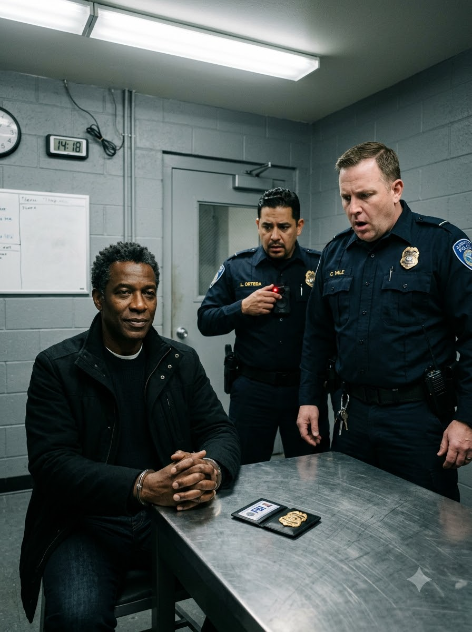
Interview Room 3 held a steel table, two chairs, a ceiling camera, and no windows. Vale clipped one of Adrian’s cuffs to a metal ring bolted under the tabletop, then emptied out his pockets.
Phone. Wallet. Watch.
Wedding ring. Federal credential case.
Vale set each item on the table. The federal credential wallet finally came open.
Luis leaned in without meaning to. The gold FBI badge caught the fluorescent light. Adrian’s photo sat next to his printed name.
ADRIAN JOSEPH MERCER — DEPUTY DIRECTOR, FEDERAL BUREAU OF INVESTIGATION.
Luis whispered, “Connor, verify it.”
Vale stared at it. Three seconds ticked by.
Then he said, “People counterfeit federal credentials.”
Luis looked at him. “Not like that.”
Vale spun toward him. “You suddenly an expert?”
Adrian spoke. “Call Valerie Price.”
Vale moved to a computer terminal. “You’re not directing my investigation.”
“Verification isn’t direction.” Adrian leaned slightly against the chair.
“What flight reported the stolen luggage?”
Vale ignored him.
“What color was the missing bag?” No response.
“What passenger reported it?”
Keys clicked.
“What is the complaint number?” Vale continued typing.
Adrian looked toward Luis. “Every legitimate theft report would answer at least one of those questions.”
Luis swallowed. “There wasn’t a dispatch.”
Vale’s hands stopped. “What?”
“There was no baggage-theft call.” Luis’s voice was quiet but clear.
Vale stared at him. “Stay out of this.”
“I was there.” Luis looked toward Adrian. “He’s right.”
Something had changed. One man had finally admitted what everyone already understood. Truth often slips into institutions through embarrassingly small openings.
Vale turned back to the computer. Adrian watched him type but couldn’t see the screen.
A few minutes passed. Then Adrian asked, “Are you writing the initial report now?”
Vale said nothing. From where he stood, Luis could see part of the monitor.
A sentence appeared on the screen: Anonymous female passenger advised officers she observed male removing luggage from multiple carousels. Witness departed before identification obtained.
Luis checked the timestamp. No anonymous woman had ever existed. Adrian had already been restrained for nearly twenty minutes before Vale typed that sentence.
Luis reached for his body camera and switched it on.
The light turned red. Vale didn’t notice right away.
Adrian did notice. He kept quiet.
Luis’s pulse picked up. Switching on a camera shouldn’t have felt like an act of rebellion. That realization scared him more than anything else had.
Vale kept writing. “Subject became verbally combative when asked for identification.”
Adrian said, “I offered identification before you touched me.”
Vale paid him no attention. Luis’s camera was now catching the terminal screen at an angle.
The text itself might not be fully legible later. But the timestamp would be clear enough — and so would the fact that Vale was writing the report after the arrest, not before.
Adrian glanced at Luis. Luis’s expression said enough on its own.
“You’re building the justification now.” Vale stopped typing.
“Shut up.” Adrian leaned back as far as the table cuff allowed.
“That means the justification did not exist when you detained me.”
Vale shot to his feet. Before he could cross the room, three electronic tones sounded from the corridor as a secure-radio frequency came alive.
“All East Terminal units hold current positions.” Another voice followed. “Federal protective detail entering controlled area.”
Vale’s eyes cut to Adrian. For the first time, what Adrian saw in his face was fear, not annoyance.
