

The Johnson Farm
Chapter 1
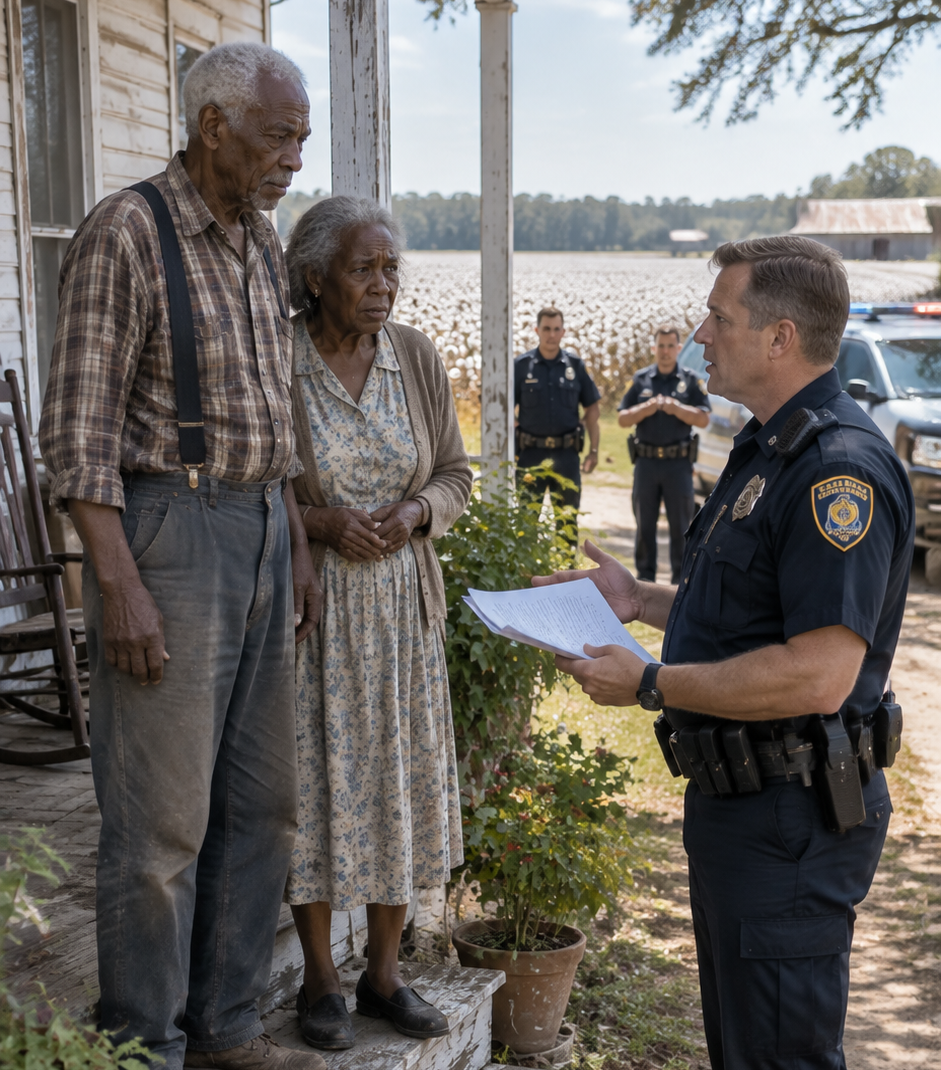
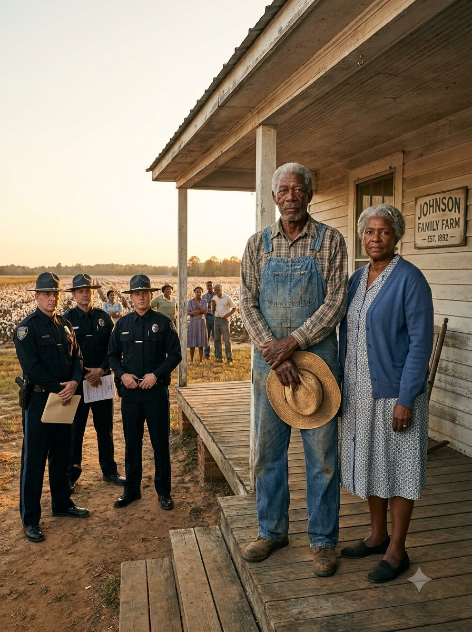
The Alabama sun hung low over the Johnson family farm, casting a golden light across rows of corn and cotton. The old farmhouse stood quietly amid the fields, its porch creaking in the breeze, the air rich with the smell of turned earth. Elderly Mr. and Mrs. Johnson worked with the steady rhythm of people who had spent a lifetime rooted in this soil. Mr. Johnson, tall and silver-haired, ran his fingers over the cotton bolls, while his wife, Clara, hummed an old gospel hymn as she gathered eggs from the henhouse. Their quiet presence spoke of endurance — a legacy built on sweat, sacrifice, and resilience.
Their son, Tyron, had left the farm years earlier to build a life in the city. His parents missed him, though they understood his need to find his own path. His military service was something rarely spoken of at home — a closed chapter, tucked away like the old photographs on the mantle.
The calm of the afternoon broke when police vehicles rolled up the gravel drive. Three officers stepped out, faces hard, and their leader approached the porch.
“Afternoon,” he said, his tone impatient. “We’re here about a complaint regarding trespassing on disputed land, Mr. Johnson.”
Mr. Johnson straightened. “This is our land,” he said quietly, though tension colored his voice.
Clara joined him, eyes narrowing. “We’ve lived here for over fifty years. This farm belongs to the Johnson family.”
The officers were cold, dismissive. “We have reports that you’re encroaching on property claimed by the neighboring development company,” the leader said. “We are here to investigate and ensure the law is upheld.”
The accusation hung heavy in the air. This was more than a land dispute — it carried the weight of something deeper, a tension simmering beneath the whole community.
“Sir,” Clara said, her voice firm. “We’ve paid our taxes, tended this land, and preserved it for decades. We have every right to be here.”
The officer’s eyes drifted toward the barn and the fields beyond, as if searching for something. Neighbors gathered cautiously in the distance, faces tight with concern. Word had already spread of rising tension between law enforcement and Black farmers in the area — whispers of intimidation and pressure to sell that no one had dared say aloud until now.
“We’ve seen others harassed,” Clara said, her voice softening as she noticed the watching crowd, “threatened with losing their homes. This isn’t just about land. It’s about something more.”
The officer’s jaw tightened. “We’re just doing our job. If you have nothing to hide, there’s no reason to resist.”
But the Johnsons and their neighbors knew better. The farm was their heritage — a symbol of survival through hardship and systemic injustice. To lose it would mean losing a piece of who they were.
Inside, later, Clara gripped the edge of the kitchen table. “We have to stand our ground,” she whispered.
That evening, in the lamplight of their kitchen, Clara took her husband’s hand. “We can’t just stand by and let this happen,” she said. “They think they can come here, threaten us, and take what’s ours without question. We have to be ready for whatever comes next.”
“You’re right,” Mr. Johnson said slowly. “But we need to be careful. These officers aren’t just here by chance. They’re part of something bigger. We’ve heard the rumors — other families have been pressured, harassed, even forced off their land. We’re not the only ones.”
That Sunday, the pews of the local Baptist church were fuller than usual. Reverend Thomas addressed the congregation, his voice grave. “We are facing challenges that go beyond our fields and homes,” he said. “Our brothers and sisters who have farmed this land for generations are being threatened by those who seek to take what is rightfully theirs. It is our duty to stand with them, to protect our heritage and our neighbors.” Farmers nodded, some wiping away tears. The church, long a sanctuary, now felt like the front line of something larger.
Back at the farm, Clara gathered a few trusted neighbors around the kitchen table, maps and documents spread before them. “We can’t let this intimidation continue,” she said firmly. “If they think we’ll back down, they’re wrong. We need to document everything — police visits, any threats, anything suspicious. The more information we have, the better prepared we’ll be.”
Mrs. Jenkins, an elderly neighbor with sharp eyes, nodded. “I’ve seen it myself. Farmers from down the road have had their land appraised way below market value, then pressured to sell. It’s a pattern, and it’s happening all over.”
“It feels like a coordinated effort,” Mr. Johnson added. “Police, developers, maybe even some local officials, working together to push us out.”
Chapter 2
The group spent the evening planning — watch shifts, detailed logs of every encounter with police, outreach to civil rights organizations. Eventually the conversation turned to Tyron.
“Tyron always had a sharp mind,” Mr. Johnson said quietly. “He was different — disciplined, focused. I sometimes wonder if he could help us now.”
Clara smiled wistfully. “He’s a Marine. We don’t talk about it much, but his training could make a world of difference. Maybe it’s time to reach out to him.”
Over the following days, the family and their neighbors compiled records of every police encounter — license plates, officer names, timestamps — and photographed survey markers placed suspiciously close to their property lines. Clara organized gatherings at the church and community center, and more people came forward with stories of harassment aimed at displacing Black farmers across the county.
A local reporter stopped Clara after one meeting. “We’re just trying to hold on to what’s ours,” she told him. “This land represents more than crops. It’s our history, our family, our future, and we’re not going to give it up without a fight.” The reporter promised to cover the story.
At night, Clara often sat by the window, wondering if Tyron knew what was happening back home — if he might return. “We’re not alone in this,” she reminded her husband one evening. “Our neighbors, our church, even strangers who believe in what’s right — they’re all with us.”
Mr. Johnson managed a tired smile. “And soon, maybe Tyron will be with us, too.”
At dawn a few days later, a knock came at the door. Clara opened it to find a tall man in uniform on the porch — recognition dawning as she realized who it was.
“Tyron, you’re home,” she said, tears filling her eyes as she embraced him.
“I’m here, Ma,” he said, steady and warm. “I heard what’s been happening. I’m ready to help.”
His arrival changed the mood in the house entirely. Tyron, a decorated Marine commander, brought both hard-won discipline and a strategic mind. At the kitchen table, he listened as his parents and neighbors laid out the maps, documents, and photographs — evidence of a coordinated campaign to force them off their land.
“This isn’t just random,” he said, tracing the survey lines. “It’s coordinated. The police, developers, maybe even some officials — they’re trying to push you out for commercial gain.”
“We suspected as much,” Mr. Johnson said grimly, “but hearing it from you, it changes things.”
Tyron stood. “We need to take control of the narrative and the situation. First, we de-escalate any immediate confrontations with the officers. I’ll meet with them directly — show them we’re organized and prepared. But make no mistake, we won’t back down.”
In the days that followed, Tyron reached out to community leaders, veterans’ organizations, and civil rights advocates, building a coalition to protect the farming community. He arranged a meeting with the officers involved in the disputes. In the tense conference room, he spoke with calm authority.
“I’m Tyron Johnson,” he began. “I’m here to make it clear that my family and community know their rights and will defend them. We’re not looking for conflict, but we won’t be intimidated. It’s in everyone’s best interest to resolve this peacefully and lawfully.”
The officers shifted uneasily, their usual posture of dismissal faltering.
“We want to work with you, not against you,” Tyron continued. “But if this escalates, be assured we have the means and support to defend our land.”
Word of the meeting spread quickly, lifting morale across the community. Neighbors who had felt isolated began organizing patrols and sharing information more openly.
But as Tyron dug deeper — with help from allies in local government and veterans’ networks — troubling records surfaced: contracts, emails, financial transactions pointing to collusion between developers and officials, using the police as a tool of intimidation.
“This goes beyond harassment,” Tyron told his family one evening, the room heavy with the news. “It’s systematic corruption designed to erase our community.”
The discovery galvanized the coalition. Tyron coordinated with legal advisers and civil rights groups, preparing for legal challenges, public campaigns, and strategic advocacy. At a packed gathering in the church fellowship hall, he spoke to the crowd.
“We have the truth on our side,” he said. “But truth alone isn’t enough. We must be vigilant, united, and ready to act. This farm, this land, is our heritage, and we will defend it.”
The crowd answered with applause. That evening, as the sun set over the cotton fields, Clara found Tyron on the porch.
“Thank you for coming back,” she said softly.
He turned, smiling. “I never left in my heart. This is home.”
Chapter 3
In the days that followed, the farm became a hub of coordinated resistance — the kitchen table now covered in maps, legal papers, and radios. Tyron moved among the growing coalition with quiet precision.
One afternoon, he gathered the group in the barn, now serving as a strategy room. Veterans sat beside farmers, lawyers, and church leaders.
“We’re setting up a monitoring network,” Tyron explained, tracing routes on a map. “Volunteers will patrol property lines, report any suspicious activity, and document interactions with law enforcement. Every detail counts.”
A young man raised his hand. “What about the legal side? Are we ready if this goes to court?”
“We’ve partnered with civil rights attorneys who specialize in land rights and police misconduct,” Tyron said. “They’re preparing filings to challenge any illegal actions, but evidence is key. We need detailed logs, photos, and witness statements.”
Clara added, “Community meetings will continue. We’ll keep neighbors informed and engaged. Public support can put pressure on officials who might otherwise ignore us.”
The coalition grew — veterans from across the state brought manpower and intelligence, while nightly patrols kept watch over the farmland. Clara cataloged every report meticulously and helped organize public forums where people shared their stories openly.
At one packed gathering, Tyron addressed the crowd. “We’re not just fighting for land,” he said. “We’re standing against a system that seeks to erase our history and silence our voices. But together, we have the power to change that.” Testimony after testimony followed — officers’ late-night visits, neighbors pressured to sell, families afraid for their future — painting a picture of injustice too large to ignore.
Surveillance recordings, phone records, and financial documents kept surfacing, revealing patterns of coordinated harassment. One evening, as Clara reviewed a stack of testimonies, Tyron entered, his expression serious but hopeful.
“We’re ready to take this public,” he said. “The evidence is strong and the community is united. This needs to be more than a local fight. It’s a matter of justice.”
Clara nodded, pride in her eyes. “It’s time.”
Support began pouring in — legal counsel, funding, volunteers — from civil rights organizations and veterans’ networks nationwide. The coalition planned a town hall, inviting officials, media, and residents to hear firsthand accounts and demand accountability.
On the morning of the event, Tyron stood outside the church watching neighbors arrive — farmers, families, veterans in uniform. Clara joined him. “Look at them,” she said softly. “This is what we’re fighting for.”
Tyron smiled. “And we’re stronger than ever.”
Inside, the meeting opened with prayer and hymns before the testimonies began — raw accounts of threats and intimidation, one after another. Tyron spoke last, his presence commanding silence.
“We stand here not just as individuals, but as a community united,” he declared. “We will not be pushed out or silenced. Our land is our legacy, and we will defend it with every resource at our disposal.”
The sanctuary erupted in applause as reporters outside captured the moment, carrying the story of the Johnson family and their neighbors far beyond the county.
In the weeks that followed, legal filings advanced, investigations opened, and support kept growing. Eventually, the case reached the courthouse steps, crowded with farmers, neighbors, veterans, and allies carrying banners of solidarity. Inside, the coalition’s legal team laid out months of evidence — logs, photographs, financial records, testimonies — exposing how sheriffs and deputies had colluded with developers to seize land from Black farmers through intimidation.
Tyron sat beside his parents as the indictment was read aloud, naming the sheriff and several deputies on charges of conspiracy, corruption, and abuse of power. A collective exhale swept through the courtroom — years of fear beginning, at last, to lift.
Back at the farm, neighbors gathered under the old oak tree to celebrate. Elijah Johnson, the family patriarch, addressed them. “This victory is not just ours,” he said, his voice steady. “It belongs to every farmer, every neighbor who refused to be silenced. We have reclaimed our land and our dignity.”
Clara stood beside him, eyes bright. “Our journey isn’t over. We must continue to protect what’s ours and help others who face similar battles.”
In the weeks after, the community built on their victory — legal clinics, educational programs on land rights, and farming cooperatives took shape, with the church becoming a hub of ongoing support. Tyron began working with veterans’ groups and civil rights organizations to train other communities facing similar harassment, carrying his leadership beyond his family’s farm.
One evening, the Johnsons gathered on their porch as the sun dipped over the cotton fields, laughter replacing the tension that had once filled the air. Tyron’s wife, Denise, prepared to speak at an upcoming agricultural justice conference, eager to carry their story forward.
Elijah looked out over the land, a quiet fulfillment settling over him. “We fought not just to keep this farm,” he said, “but to honor those who came before us, and to protect the future for those who will come after.”
The Johnson family stood together as twilight faded into night — their fields a testament to endurance, justice, and the unbreakable spirit of community.
