

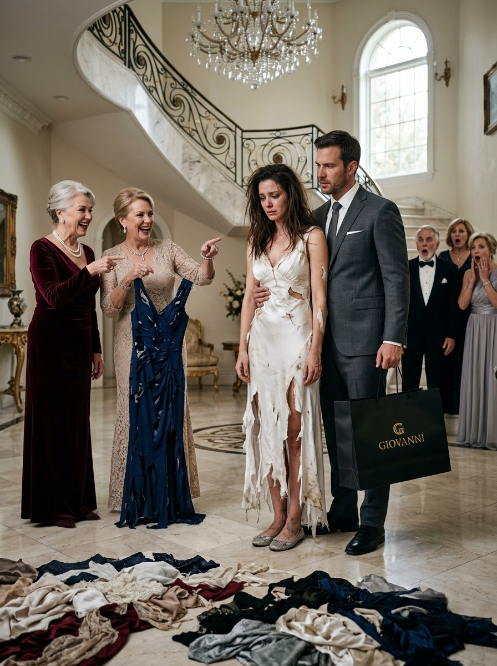
Part 1: The Dress They Destroyed
The afternoon before my brother’s wedding, I stood in my childhood bedroom staring at the only formal dress I’d brought with me.
Every piece of clothing in my suitcase had been deliberately ruined. Someone had taken scissors and sliced large, clean holes through my dresses, my blouses, even the cardigan I’d planned to wear to breakfast the next morning. The cuts were too precise to be an accident.
“You weren’t really planning to wear that to the rehearsal dinner, were you?”
I turned and found my mother, Patricia, standing in the doorway with her arms crossed. Her face told me everything I needed to know. She made no effort to hide what she’d done.
Her eyes drifted to the ruined navy-blue dress in my hands.
“Honestly, Claire, I think it suits you better now,” she said. “At least it makes an honest statement.”
“What kind of statement?”
She gave me a cold smile.
“Desperate.”
I drew a slow breath, trying to steady my hands.
“Why would you destroy my clothes?”
My mother hardly reacted.
“You always find a way to make everything about yourself. This weekend belongs to your brother. For once in your life, you need to understand your place.”
Before I could answer, my aunt Linda appeared behind her, wineglass in hand. She glanced at the ruined dress and laughed.
“Your mother may have done you a favor,” she said. “Perhaps some lonely man at the wedding will feel sorry for you. You might finally get a date.”
Their laughter filled the room.
At thirty-eight, I should have been strong enough to shrug them off. But some wounds never fully close, especially when they’re reopened again and again by the people who were supposed to love you.
For most of my life, my family had treated me as the disappointing one. My younger brother, Michael, was praised for everything. When he pulled average grades, my parents applauded his effort. When I graduated at the top of my class, they said I was showing off.
Michael’s mistakes were chalked up to youth. Mine were treated as proof something was wrong with me.
After decades of being compared, criticized, and dismissed, I had learned to keep the most precious parts of my life away from them.
That included my marriage.
For fourteen months, I had been quietly married to Jonathan Whitmore, a wealthy businessman whose name turned up regularly in the financial papers. He’d built a national logistics company out of a modest family business and had become one of the country’s most respected executives.
Jonathan had no interest in publicity, and neither did I. We’d married in a small ceremony with only a handful of close friends present.
I never told my family, because I knew exactly what would happen. My mother would suddenly claim she’d always believed in me. Michael would try to pitch Jonathan on one of his shaky business ideas. Aunt Linda would tell everyone she was the one who’d introduced us.
More than anything, I wanted one part of my life their cruelty couldn’t reach.
To them, I was still poor, lonely Claire — the daughter who’d never married, who’d never accomplished anything worth mentioning.
Four hours earlier, after finding my ruined clothes, I’d texted Jonathan a short message telling him what had happened.
His reply was four words.
“Send me the address.”
By late afternoon, I sat quietly on the edge of the bed while the house buzzed with wedding preparations. Hair dryers hummed downstairs. Relatives carried flowers and garment bags through the halls. My mother laughed in the kitchen as though nothing had happened.
Then the doorbell rang.
“Claire!” she shouted. “Get the door. You’re not doing anything useful.”
I went down and opened it.
Jonathan stood on the porch in a charcoal-gray suit. His expression shifted the instant he saw my faded shirt, torn jeans, and exhausted face.
“Are you all right?” he asked.
I nodded, though I wasn’t sure anymore that I could hold back the tears.
“You really came.”
“Of course I came.”
He leaned in and kissed my cheek.
The moment Jonathan stepped inside, Aunt Linda dropped her wineglass. It hit the hardwood floor and shattered, silencing every conversation in the house.
My father lowered his newspaper. Michael froze halfway down the stairs. My mother went still near the kitchen doorway.
They all knew who he was.
Jonathan calmly held out his hand to my father.
“Jonathan Whitmore,” he said. “Claire’s husband.”
No one said a word.
My mother looked at me as if I’d suddenly turned into a stranger. Michael stared at Jonathan, then at the plain wedding band on my finger that no one had ever bothered to notice.
Every cruel joke they’d ever made about my being alone seemed to hang in the silence between us.
Jonathan reached into his coat and handed me a small velvet box. Inside was a key, not jewelry.
He nodded toward a garment bag his driver had set beside the door.
“I heard what happened,” he said. “We’ll replace everything in your suitcase tomorrow. For tonight, I thought you might like this.”
Inside the garment bag was an elegant deep-green evening dress — beautiful without being showy, exactly the kind of dress I’d have picked for myself.
Then Jonathan turned to look directly at my mother.
“I will not tolerate anyone mistreating my wife,” he said evenly. “Not with cruel words, and certainly not with scissors.”
He rested one arm gently around my waist.
“Come on, Claire. Let’s get ready.”
As he led me toward the door, he glanced back at my stunned family.
“We have a wedding weekend to remember.”
Part 2: The Husband No One Expected
By the time Jonathan and I reached the waterfront restaurant for Michael and Rebecca’s rehearsal dinner, word had already started to spread.
Relatives whispered as we walked into the dining room. Several guests recognized Jonathan instantly; others quietly searched his name on their phones under the table.
Jonathan held my hand as we made our way to our seats. He wasn’t trying to impress anyone — that was never who he was. His quiet confidence spoke for itself.
My mother arrived a few minutes later with Aunt Linda. Neither woman looked my way. Michael grew visibly uneasy, especially after a college friend leaned over and murmured something in his ear.
Rebecca kept glancing between Jonathan and me, clearly confused. For two years she’d believed everything Michael had told her about his unsuccessful, unmarried older sister.
Once dinner was served, everyone tried to act normal. That lasted until Michael stepped up to the microphone to welcome the guests.
“Tomorrow will be one of the most important days of our lives,” he began. “But tonight is about laughter, love, and family.”
His eyes moved toward me, and I recognized the look on his face.
For years, Michael had entertained people with embarrassing stories about me. He always called it harmless teasing. If I objected, I was told I was too sensitive.
“I thought we might begin with a story about my wonderful sister, Claire,” he said.
Jonathan shifted slightly beside me, but I touched his hand, silently asking him to wait.
Michael raised his glass.
“Claire once tripped over her own shoelace at my graduation and knocked over an entire cake table. We’re hoping she doesn’t create another disaster this weekend.”
A few guests gave polite laughs.
“And you should have seen what she planned to wear earlier today,” he went on. “It was something between secondhand fashion and homeless chic.”
This time, almost nobody laughed.
Michael hadn’t yet noticed that the room’s mood had shifted. What used to pass for playful family teasing now sounded plainly cruel.
Jonathan rose calmly from his chair.
“Actually,” he said, “if anyone should offer a toast to Claire, it should be me.”
Michael’s smile faded.
Jonathan looked at me before turning to face the guests.
“To Claire, a woman who stayed kind even when others were unkind to her. A woman who carried herself with dignity while the people closest to her tried to make her feel small.”
My mother lowered her eyes.
“She has more grace in one ruined dress than many people manage to develop in an entire lifetime.”
Aunt Linda nearly choked on her wine.
Jonathan lifted his glass.
“To my wife, and to the importance of knowing your value, even when your own family refuses to recognize it.”
He touched his glass gently to mine.
The small sound seemed to carry across the whole room.
Michael stood frozen at the microphone, staring at us.
“Your wife?”
“Yes,” Jonathan replied. “Claire and I have been married for over a year.”
“You never told us,” my mother said.
I looked across the table at her.
“You never asked if there was anything good happening in my life.”
She had no answer for that.
Jonathan sat back down and returned to his dinner. He hadn’t raised his voice or insulted anyone. He’d simply spoken the truth, and the truth carried far more weight than anger ever could.
For the first time in my life, I wasn’t the one being humiliated at a family gathering.
And the wedding hadn’t even started yet.
Part 3: A Wedding No One Would Forget
The next afternoon, Michael and Rebecca were married in an elegant ceremony beneath crystal chandeliers. The ballroom overflowed with flowers, soft music, and nearly three hundred guests.
Jonathan and I slipped in quietly and took our assigned seats. We had no intention of disrupting the celebration.
Even so, attention followed him wherever he went. Business owners, investors, and a few local officials stopped by our table to greet him. Each time someone shook Jonathan’s hand and called him by name, my parents looked a little more uncomfortable.
They were finally starting to understand that the man beside me wasn’t just wealthy. He was respected.
More importantly, he respected me.
The ceremony went smoothly. During the reception, Rebecca’s father stood to welcome the guests and thank everyone who’d helped make the day happen.
Then he looked toward our table.
“I would also like to recognize Mr. Jonathan Whitmore. It is a genuine honor to have you with us today.”
Every face in the ballroom turned toward us.
My mother’s smile vanished. Aunt Linda carefully set down her wineglass. Michael looked like he wished he could disappear beneath the table.
Jonathan stood and thanked Rebecca’s father.
Then he paused.
“Actually, the honor belongs to me,” he said. “I had the privilege of marrying the strongest woman I have ever known.”
His eyes found mine across the table.
“My wife spent many years being treated as though she were not good enough. But a person’s worth is not determined by relatives who refuse to see it. Character is revealed by how we treat people when we believe they have nothing to offer us.”
The room went completely silent.
Jonathan never named my mother, my aunt, or Michael. He didn’t need to. Everyone understood exactly who he meant.
After a long pause, my father slowly rose from his chair.
“Claire,” he said, “I owe you an apology.”
His voice shook as he looked around the ballroom.
“I should have protected you. I saw what was happening, but staying silent was easier than confronting it. I failed you as a father.”
My mother stayed seated beside him. At first, I thought she’d say nothing at all.
Then she pushed back her chair and stood.
Tears had gathered in her eyes.
“I destroyed something I can never replace,” she said. “I convinced myself that tearing you down would somehow help your brother succeed. I told myself you were strong enough to endure it.”
She shook her head.
“But the truth is that I was cruel to my own daughter. I was wrong.”
The ballroom was so quiet her words seemed to echo from wall to wall.
I walked toward my parents.
For years I had imagined what I might feel if they ever admitted what they’d done. I thought it would feel like victory. Instead, all I felt was the weight of every year we’d lost.
“I never needed either of you to be perfect,” I said. “I only needed you to be my family.”
My father bowed his head. My mother began to cry.
Neither of them made excuses. For once, they didn’t accuse me of being too sensitive or claim it had all been a joke. They simply owned what they’d done.
That didn’t erase the past, and it didn’t mean forgiveness would come right away. Some relationships take more than one apology to mend. Trust has to be rebuilt slowly, through action rather than promises.
But it was a start.
Jonathan came to my side and slipped his hand into mine.
“Are you ready to leave?” he asked quietly.
I nodded.
“Yes. I am.”
We walked toward the ballroom doors together. Hundreds of guests watched us go, but for once, I didn’t feel embarrassed or invisible.
Just one day earlier, I’d stood alone in my childhood bedroom holding a dress my mother had destroyed. Now I was walking out with my head held high beside a man who had never measured my worth by money, appearances, or family approval.
Outside, the evening air was cool and calm.
Jonathan looked at me with a small smile.
“Do you think they’ll ever forget this wedding?”
I laughed for the first time all weekend.
“No,” I said. “I don’t believe any of us will.”
