

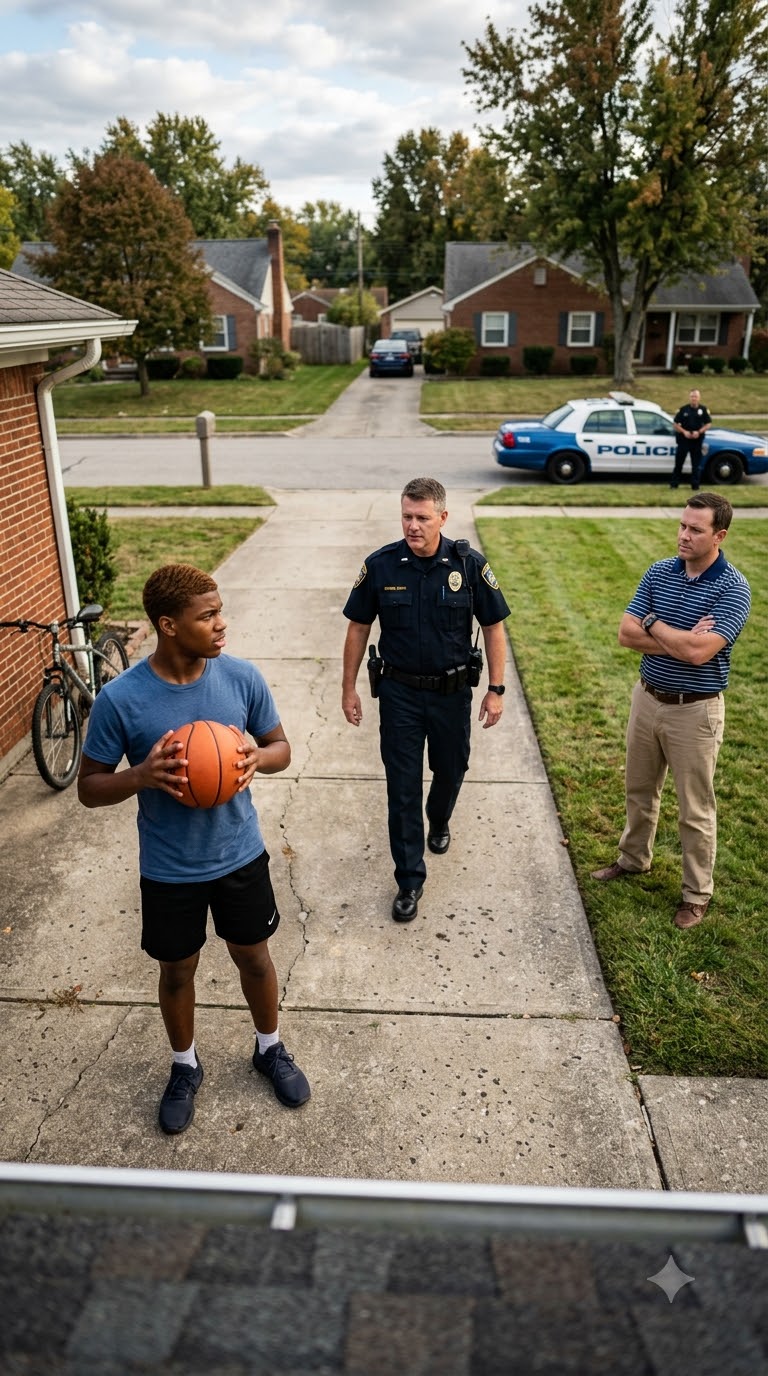
Sirens ripped through Brier View Court, breaking the stillness of the quiet Atlanta cul-de-sac with sharp flashes of blue and red. Porch lights flicked on as curtains shifted behind windows. Neighbors lifted their phones, their pale screens glowing in the humid darkness. Under the flashing lights, 16-year-old Malik Johnson, still damp with sweat from a half-court sprint, was pinned against the hood of a squad car. His cheek pressed against the paint, his breathing shallow.
Officer Briggs placed two fingers between his shoulder blades, forcing him downward as though Malik were evidence rather than a teenager. Identification. Briggs’s voice was clipped and cold, accusing him of trespassing and looking suspicious. The words piled up, as if the accusation alone were enough. Across the street, Richard Whitmore, the HOA president, stood in his driveway with his arms folded.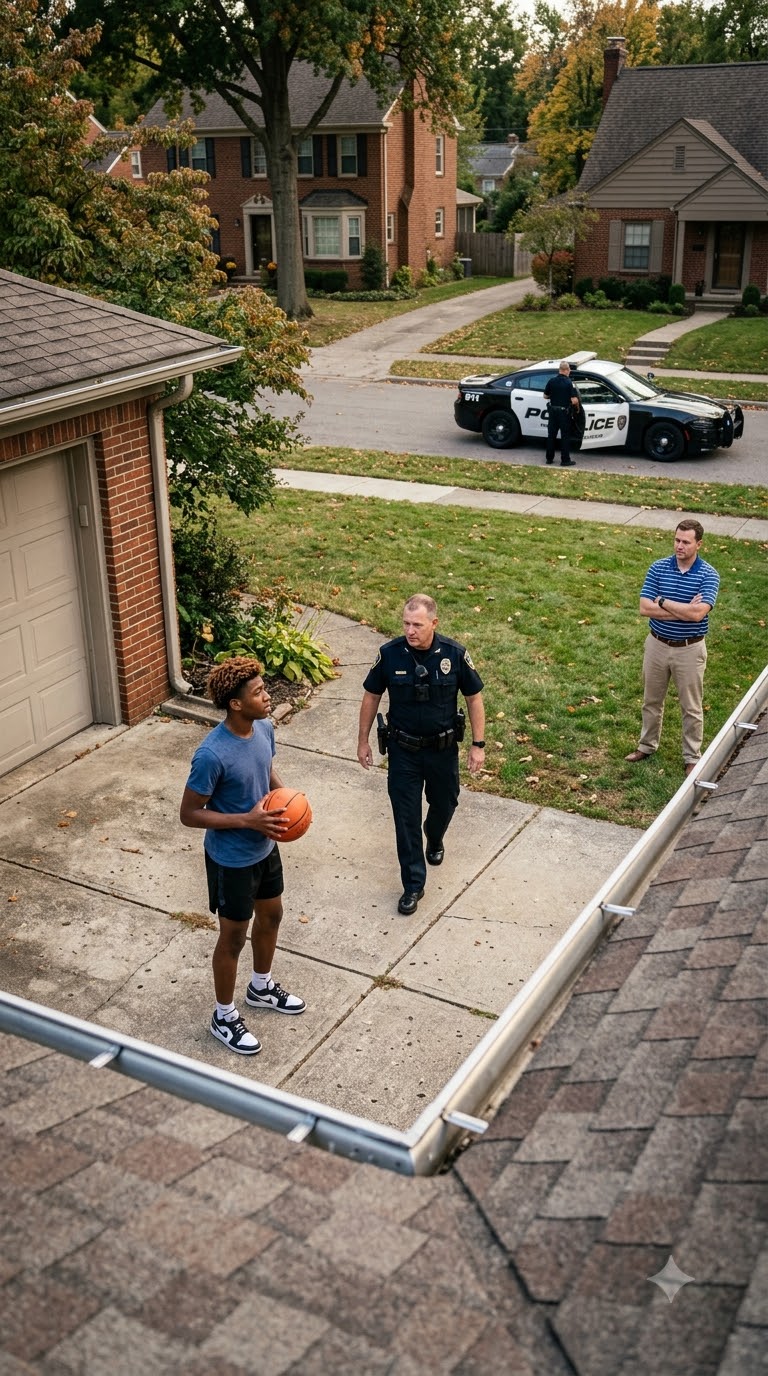
His mouth curved into a smug expression—not amusement or surprise, but the satisfaction of a man watching his rules being enforced. Several neighbors glanced toward him, waiting for his reaction before daring to speak. The Johnson family’s front door flew open. Angela Johnson hurried outside, her robe billowing and slippers scraping against the concrete. “Malik,” she screamed.
“What are you doing to my son? ” Briggs didn’t even turn toward her. Back up, ma’am. His grip tightened until Malik hissed from the pain. Angela raised her chin. He lives here.
His key is in his pocket. Check the mailbox if you’ve forgotten our name. A neighbor started to speak. Officer, that boy belongs, but the sentence died beneath Briggs’s glare. Phones continued recording, yet nobody stepped forward.
Malik attempted to follow the breathing rhythm his coach had taught him. Four in, hold, four out. But fear interrupted the pattern. His heart pounded against the metal beneath him. Richard shifted his stance, pretending to drink from an empty mug while projecting the confidence of someone who believed he was in control.
He spoke just loudly enough for a nearby neighbor to hear. Standards have to be enforced. Then the atmosphere changed, the way it often does just before a storm. The Johnson family’s door opened wider. Two men stepped outside.
They did not rush, but there was unmistakable weight in their stride. No uniforms. No words. Just presence. They moved down the porch steps with quiet certainty. Conversations faded. Even some phones dropped slightly.
Briggs noticed them and immediately straightened, setting his feet firmly. One man moved with subtle precision, positioning Angela behind him. The other raised one hand, somewhere between a signal and a warning, and the neighborhood seemed to understand both. Richard’s smug expression faltered. He nervously adjusted a cufflink that required no attention.
Pinned against the hood, Malik felt the pressure against his back. The shift wasn’t mercy, but attention turning elsewhere like a changing tide. He moved his eyes just enough to catch glimpses of squared shoulders and calm movements. He had no idea who the men were. He only knew the entire night seemed to change around them.
A dog barked once, then abruptly fell silent. The cul-de-sac seemed to hold its breath. The men stopped close enough to speak. One nodded toward Angela. Relief spread across her face as though she had finally surfaced from deep water.
The morning had started like any other day in Brier View Court. Lawns were trimmed to identical lengths, sprinklers ticked through their arcs, and everything reflected the kind of uniform order the HOA valued. Malik Johnson occupied the driveway with his basketball. The steady bounce of the ball echoed against tidy fences while his sneakers squeaked over the blacktop. This was his space, even if some neighbors wished otherwise.
Inside, Angela stirred a pot of stew as the scent of onions and herbs filled the modest house. On the dining table sat the photograph she never moved. Marcus Johnson in his Marine uniform. Husband, father, gone for years, yet somehow still present throughout their home. Angela placed her fingers against the glass and whispered as though he could still hear her, “Keep watching over him. ” Across the street, Richard Whitmore stepped onto his porch holding a coffee mug.
His eyes swept over the cul-de-sac with the practiced authority of someone convinced the neighborhood belonged to him. When his gaze settled on Malik, his jaw tightened. Bringing down property values,” he muttered. A woman walking her dog heard him but lowered her head and continued on. Everyone understood that challenging Richard came with consequences.
Fines, warnings, exclusion. From the kitchen window, Angela watched Malik make another shot and smiled. Yet her stomach tightened when she noticed Richard staring. She knew that expression. She had encountered it at PTA meetings, in grocery stores, and during traffic stops.
It was the look of someone measuring her family against a standard they were never allowed to satisfy. Later, Malik came bounding inside and reached for some water. Angela pushed a glass toward him. “Stay close today,” she said, keeping her tone casual. “Why?
I was just shooting hoops. ” “Because your favorites for dinner,” she answered with a smile. “Easier to say that than admit Richard’s stare had carried more than annoyance. ” That evening, Richard’s voice carried over the hedges while he spoke on the phone. That boy will ruin this place. If the board won’t act, I will. A neighbor trimming roses paused briefly, then bent lower, as though silence might protect him.
The cul-de-sac appeared peaceful beneath the fading daylight, but something darker had already begun forming. By late afternoon, the heat hung heavily over Brier View Court. A gray sedan pulled up in front of the Johnson residence. Its doors opened without urgency, and two men stepped out, their movements deliberate. Steady. Angela noticed them through the window and opened the door before they could knock.
Mrs. Johnson, the taller man asked. I’m David Cole. This is Marcus Reed. We served with your husband.
Angela’s fingers tightened around the doorknob before relaxing. Come in, she said quietly. They carried no flowers. Instead, they brought a small case and a sealed envelope bearing a unit crest. Inside the case was a bent fragment of shrapnel mounted in black velvet.
Reed carefully placed it on the table. Your husband pulled me behind a wall when the blast hit. “That’s why I’m here,” he said. His voice was straightforward, without drama, yet heavy with truth. Malik remained near the doorway, staring at the case.
“You knew my dad? ” Cole nodded. “We knew his courage and his laugh. ” Both memories carried more weight than rank. Angela straightened Marcus’ photograph on the shelf. Reed pushed the sealed envelope toward her, containing a letter from the colonel and several photographs. We’ve been meaning to bring them for a long time.
The men talked about old memories. Bitter coffee. Endless rain. A sandbag prank that left a captain embarrassed for weeks. Then came the memory that settled over the room like stone.
“Your father kept the line,” Cole said. He did not step back. Malik stared at the coin. Reed placed it in his hand, heavy and cold, etched with a motto. “It’s not a prize,” Reed said.
“It’s a reminder. Shoulders down. Breathe. Four in. Hold out. ” Malik whispered.
Coach teaches us that too. Reed gave a faint smile. Your father taught half the platoon. Outside, neighbors watched. That was one of Brier View Court’s specialties—watching.
A small group gathered near a mailbox. Phones rose. Whispers drifted through the air. Who are they? Recruiters?
Looks like trouble. Across the street, Richard Whitmore stood with folded arms, his eyes narrowed. He evaluated the men just as he evaluated lawns and fences, treating everything as something that needed correction. Their posture, Angela’s closeness to them, the way Malik straightened while listening—all of it unsettled him. Control liked to be admired.
It hated being ignored. When Cole and Reed eventually left, they walked with the same quiet confidence that would later reshape the night. Angela called softly after them. “Thank you. ” From his porch, Richard muttered, his jaw tense. “This isn’t the look we want on Brier View.
I’ll handle this. ” As the sun disappeared behind the rooftops, sprinklers hissed across the lawns, covering the street in golden light. Richard Whitmore was not watching the sunset. He stood inside his study with the blinds tilted, staring at the Johnson house as though it were an unwanted mark on his neighborhood. His wife stood in the doorway holding a glass of wine. “You’re pacing again,” she sighed.
Richard tightened his jaw. “Did you see them? ” “Two strange men staying late, walking the street like they belong here. They seemed polite, she said. Angela has every right. Polite isn’t the point.
Richard’s tone became sharper. It starts small. Then everything changes. The pause in his speech revealed what he refused to say directly. He picked up his phone, repeating the polished phrases he had used in board meetings and turned into weapons during HOA votes.
Authority was the language he understood best. He dialed. 911. What’s your emergency? Richard lowered his voice, disguising his intent beneath false urgency.
Yes, I need officers at Brier View Court. Young black male loitering near one of the homes, acting suspicious. I don’t feel safe. The dispatcher asked for more information. Richard narrowed his eyes toward Malik, who was bouncing a basketball near the hoop.
Tall, about 16, baggy shorts. Doesn’t look like he belongs here. Neighbors are concerned. Another lie delivered smoothly. The response came quickly.
Units dispatched. Richard ended the call and exhaled with satisfaction. His authority had summoned uniforms. He stepped outside where two board members were trimming hedges. “I made the call,” he said casually, as though he had merely requested lawn service.
“For safety, standards have to be upheld. ” One neighbor frowned. “Richard, that boy lives there. ” Richard’s smile became thinner, never touching his eyes. Believe me, problems like this grow. Better to stop them now. The faint sound of police radios traveled down the block.
A low engine hum followed. Conversations on porches stopped. Heads turned. Inside, Angela froze when she heard the sound. Her chest tightened the same way it had years earlier when a patrol car had followed Marcus for too long.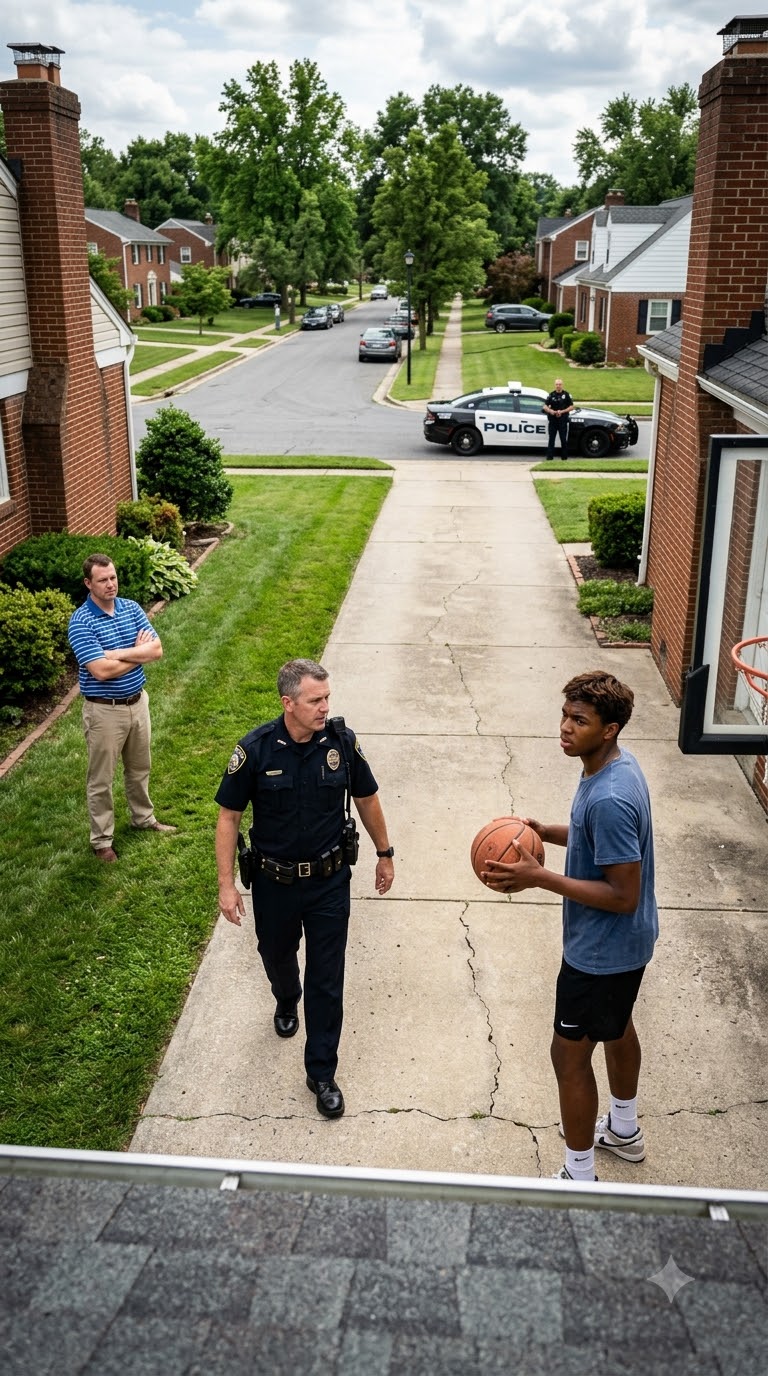
She whispered her son’s name, Malik, as headlights curved into the cul-de-sac. Two cruisers entered with flashing blue and red lights, washing over the siding and mailboxes. Richard folded his arms, a satisfied smile pulling at his lips. In his mind, order had arrived. The cruisers came to a hard stop, their lights continuing to spin.
Blue and red reflections swept over white siding and perfectly kept lawns, transforming Brier View Court into a stage. Neighbors leaned farther out, phones raised, their glowing screens resembling watchful eyes. Briggs was the first to emerge—broad, tense-jawed, slamming the door with the force of authority. His partner came around the other side, his hand brushing his holster. Malik stood frozen, basketball still in his hands.
“Hey,” Briggs barked, moving quickly toward him. “What are you doing here? ” Malik blinked. “Playing ball. This is my house. ” Briggs crossed the distance in two strides. “Don’t get smart.
Where’s your ID? ” “In the house,” Malik answered carefully. “It’s inside. ” That brief pause was enough. Briggs seized Malik’s wrist and jerked him forward. The basketball rolled into the gutter. “Stop resisting,” he shouted, even though Malik had not moved.
Angela’s scream ripped through the cul-de-sac. “Get your hands off my son! ” She ran down the steps, her robe flaring behind her. Brig swung his arm and shoved her off balance into the grass. Gasps spread through the neighborhood. Phones lifted even higher.
A woman pressed a hand against her chest. Someone whispered, “This is too much. ” Yet nobody stepped closer. From his driveway, Richard leaned toward a neighbor. This is why I run this HOA, he said, smuggness curling in his voice. Standards matter.
His grin grew as Angela struggled back onto her feet. Briggs forced Malik against the hood, the metal trembling beneath the boy’s cheek. Malik cried out, “Mom! ” Angela staggered forward, her fists clenched. “He lives here. That’s my son. ” Her voice broke with fury.
The second officer stepped between them. “Mom, stand back. I will not. ” She answered, trembling with rage. “You’re assaulting him. ” Neighbors murmured from their porches, their voices filled with both sympathy and fear.
One whispered, “That’s the Johnson boy. ” Another hissed, “Don’t interfere. You’ll make it worse. ” Richard shook his head as if disappointed, but satisfaction gleamed in his eyes. “Always trouble,” he muttered loudly enough for others to hear. Malik’s chest rose and fell rapidly. The breathing technique his coach had taught him had collapsed into panic.
His ribs struck the hood with every breath. Briggs twisted his arm tighter, his voice low and severe. Where’s your ID? Tell me. In my pocket, Malik gasped.
I can’t reach. The pressure increased. Malik’s voice broke again. His cry traveled across the cul-de-sac, raw and desperate. Mom. The sound cut through the night more sharply than the sirens. Neighbors recoiled. Some lowered their phones while others gripped them even tighter. Angela’s knees almost gave way when she heard it. And above everything else, Richard smiled.
The cul-de-sac was still carrying Malik’s cry when the atmosphere suddenly shifted. Two men walked across the Johnson family’s lawn, shoulders squared, hands clearly visible, their pace deliberate. They weren’t running. There was no reason to. Their presence alone was enough to command attention.
Cole surveyed the scene in measured arcs. Malik was pinned down. Angela was trembling. Briggs maintained his position. The crowd remained at a distance.
Reed briefly raised his hand, somewhere between a signal and a warning. Without anyone saying it aloud, the entire neighborhood sensed the change. “Officer,” Cole said evenly, his voice steady as stone. “Ease your pressure. He can’t breathe properly in that position. ” Briggs stiffened and refused to look up.
“Step back. This is police business. ” “Avery, you Reed’s tone cut through, calm, but surgical. Your leverage isn’t control. It’s pain. And everyone here can see the difference. ” Angela gripped the porch railing, her voice breaking.
Please, that’s my son. Malik felt the coin in his pocket pressing against his thigh. He tried to count four in, hold out, but his breathing came in jagged bursts. Richard moved forward from his driveway, swelling with authority. “Officers, you have the board’s full support,” he called loudly enough for the neighbors to hear.
“His words rang thin, desperate, as if speaking them could keep control in his hands. Neighbors murmured from porches, “They’re helping. Who are they? ” Phones turned back toward the Johnson house. Briggs widened his stance, his jaw tightening. Last warning.
Move back or I’ll detain you for interfering. Cole remained completely still. No one’s interfering. We’re speaking. Cameras will show the difference.
Reed widened his stance slightly, guiding Angela safely behind their line. The movement was protective rather than aggressive. Briggs noticed the adjustment, then looked back, frustration building. Richard tried once more, raising his voice. This household has been a problem.
I made the call for safety, but his words fell flat, met only by the neighbors cold silence. Cole lowered his voice, forcing everyone nearby to listen carefully. “Release him now. ” Briggs sneered, curling his lip. He moved closer to Malik and increased the pressure simply to demonstrate that he still controlled the moment. His eyes remained fixed on Cole and Reed.
His voice threw down the challenge like smoke. And who the hell are you supposed to be? Cole did not react to Briggs’s sneer. Slowly, he reached inside his pocket. He withdrew a worn leather wallet.
With deliberate movements, he opened it. There was no cash or ordinary card inside, but an ID bordered in brass. Sergeant David Cole, Third Battalion, Seventh Marines. He motioned toward his partner. That’s Captain Marcus Reed.
We served with this boy’s father. Gasps spread throughout the cul-de-sac. Screens zoomed closer, catching the glint of the badge. Briggs snorted, attempting to dismiss it. Means nothing here.
You’re civilians now. Reed offered no argument. He pressed a button on his phone and held it up so everyone could hear. Colonel Abrams. Static hissed.
Then a voice came clearly through the darkness. Low, firm, unmistakable. This is Colonel Abrams. That boy is Marcus Johnson’s son. Treat him with the respect his father earned.
Stand down now. The command settled over the street like an order carved into stone. Neighbors whispered his name. Marcus Johnson, the Marine who never returned home. For years, they had seen Angela’s framed photograph through the window.
Tonight, they remembered. Richard rushed forward, desperate to take control of the story again. This is absurd. That family has been trouble from the start. A neighbor’s phone immediately answered him.
On speaker, Richard’s own voice played back. There’s a black kid loitering. Suspicious. Send someone quick. The recording spread through the humid air, thin but impossible to deny.
A heavy silence followed. Angela covered her mouth with one hand. Malik raised his head from the hood, his eyes wide. The truth had emerged not from them, but from the very neighbors who had remained silent for far too long. Cole fixed his gaze on Richard, his voice hard as steel.
You called this down on a child. A fallen Marines’s child. Reed lowered his phone. His voice was sharp enough to cut. “And you,” he nodded at Briggs, just assaulted him before witnesses.
The words landed like a gavel, final and echoing. Briggs’s grip weakened beneath the weight of the cameras and Colonel Abrams’s command still hanging over the cul-de-sac. There was nowhere left for him to hide. His hands slipped from Malik’s shoulder. “Slow,” Cole instructed, his voice firm, but calm.
“Let him breathe. ” Malik lifted his cheek away from the hood. A red imprint from the steel remained across his skin. His breathing was ragged but beginning to steady. Angela pulled him into her arms, her trembling hands moving along his forearm as she counted each breath like proof. He nodded because she needed that reassurance.
Reed looked toward Briggs’s partner. Supervisor, call it in. The officer hesitated before raising his radio. The word supervisor crackled through the device, shifting the balance on the street once again. Phones had been recording since the first blue flash, but now every lens focused more tightly on Angela’s robe, the coin clenched in Malik’s fist, and the brass name plate shining on the mailbox.
Captions appeared across live streams. HOA calls cops on resident teen Marines step in. Views climbed as people watched in real time. Richard stepped forward with his palms raised, pretending to be reasonable. This is a misunderstanding, he said, pitching his voice to sound measured.
I only called for safety. There have been incidents. The crowd shifted uneasily. A board member interrupted him sharply. Richard, the boy lives here.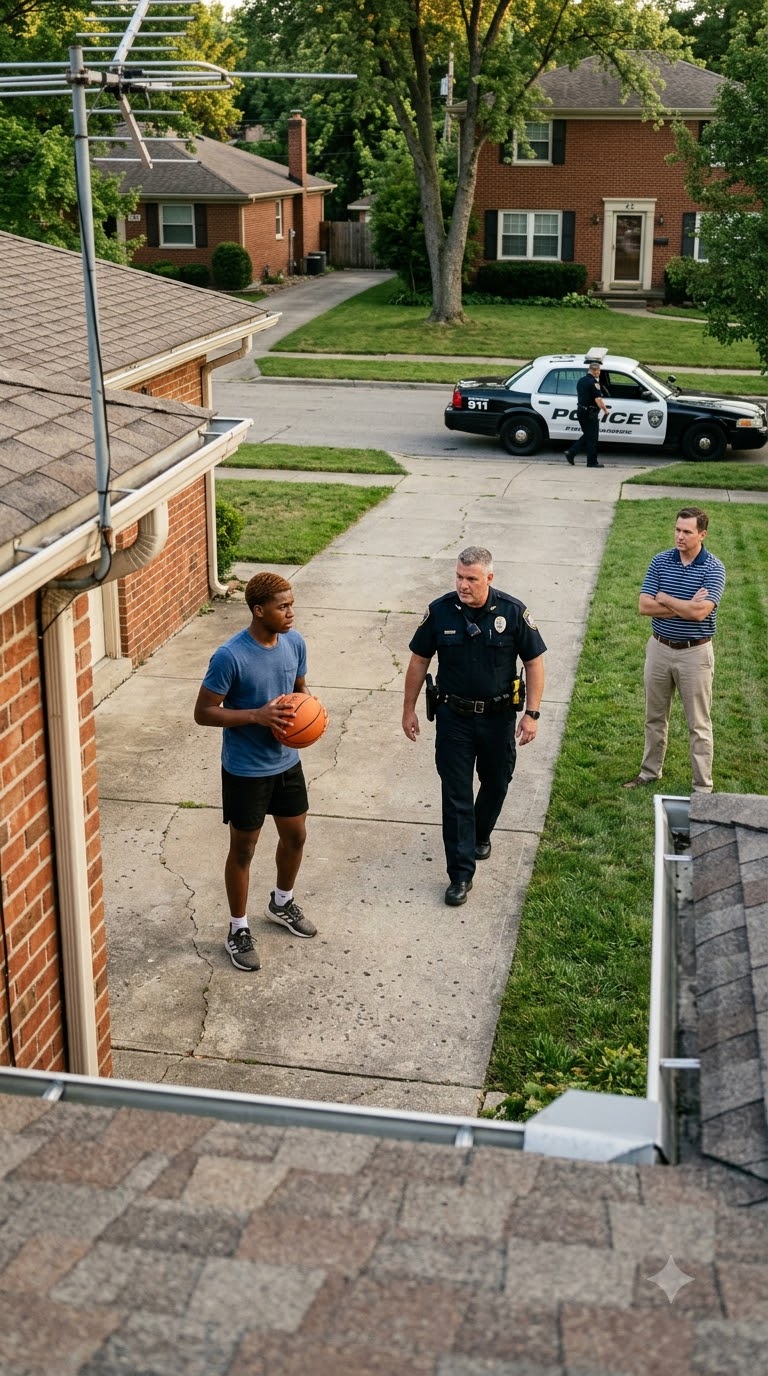
Everyone knows it. Neighbors murmured their agreement. They remembered the fines over flower pots. The warnings about fences.
The birthday banner Richard had forced someone to remove that very night. Those rules suddenly looked less like neighborhood standards and more like weapons in the wrong hands. Briggs began moving toward his cruiser, his eyes darting around. Reed stepped into his path, not blocking him, simply making his presence known. Badge number.
Incident number, he demanded. Briggs stopped. His partner quietly gave the numbers, while Reed repeated them aloud, clearly enough for every camera to capture. It wasn’t a threat. It was a record. Angela finally found her voice.
My son was playing basketball in his own driveway. A phone call turned that into a crime. Richard tried to cut in. I’m the HOA president. The reporter who had arrived moments earlier interrupted him with a more direct question.
Sir, do you stand by your own words, calling him suspicious, saying he doesn’t belong? A neighbor immediately air dropped the recording to her phone. She played it back over the live microphone. Richard’s voice came through again, damning and small. His smirk disappeared.
His words abandoned him. The authority he had worn like a crown fractured in front of everyone. Cole turned toward the street, not performing, but speaking as a witness. Marcus Johnson gave his life so men could come home. Tonight, his son was pressed against a hood because someone decided a feeling was a fact.
The street grew louder with murmurs. A woman near the mailbox wiped tears from her eyes. Another man finally spoke, his voice steady. We watched that boy grow up on this block. Richard’s silence became its own sentence.
The supervisor’s vehicle slowly entered Brier View Court, headlights sweeping across stunned faces. He stepped out with a clipboard tucked beneath one arm, studying the scene with the exhausted expression of someone wishing this had happened on another shift. “Everyone hold your place,” he ordered. Angela kept one hand on Malik’s shoulder, holding him close. His chest still heaved, but the coin clenched in his fist helped steady him. Cole and Reed remained beside them, silent and unmoving.
The sergeant’s pen moved across the paper, every written word seeming to puncture the humid air. Witnesses confirm the boy lives here. Incident escalated beyond necessity. His attention moved toward Briggs. Effective immediately, your suspended pending investigation.
Gasps and murmurs spread from the porches. Briggs stiffened, his jaw working, while his partner quietly stepped backward, separating himself from the consequences. For the first time that evening, the cruiser lights went dark. Brier View Court returned to its ordinary colors. Richard stepped forward, his voice strained.
This is all being blown out of proportion. I acted in the neighborhood’s best interest. A board member answered him, trembling but resolute. No, Richard, you lied. We all heard the recording.
Another neighbor stepped from his porch, now emboldened. You find me for my garden fence. Said it was about values. Now we know whose values you meant. Murmurs swelled, turning into open resistance.
Years of silence finally broke. Richard opened his mouth, then shut it again. His words, “The ones that used to control the cul-de-sac found no purchase. ” On the sidewalk, the HOA board gathered closely. Their decision was spoken quietly, but it carried like thunder. Effective immediately, Richard Whitmore is removed as president.
Richard turned sharply, disbelief covering his face. “You can’t. We just did,” the treasurer replied, voice steadier than ever. The neighbors watched the crown fall. The man who had governed through intimidation now stood alone, stripped of the authority he had accumulated.
Angela and Malik headed toward their porch. Neighbors moved aside for them, some offering awkward apologies and quiet expressions of regret. We should have spoken sooner. He didn’t deserve this. Angela gave a faint nod, keeping her hand firmly around Malik’s arm.
She brushed his hair away from his face, her voice trembling. Your father would be proud tonight. Malik’s jaw tightened. He pressed the coin firmly into his palm until it left an imprint. The cul-de-sac, once controlled by Richard’s whispers, now carried something different.
Not fear, change. The street had emptied of officers and flashing headlights, but its silence no longer felt the same. Nobody looked toward Richard’s home anymore. His blinds were closed, his shadow gone. On the Johnson porch, Angela sat beside Malik on the steps.
Dinner had grown cold inside, but neither of them cared. Malik turned the coin over and over in his hand, its edges pressing into his skin. Each turn seemed to carve something deeper. Memory, responsibility, the strength to carry his father’s name forward. Cole leaned against the porch railing, arms folded, watching him with a faint smile.
You did well, he said. Malik looked up, still shaken. I didn’t do anything. You endured, Cole replied. That counts.
Reed nodded, his voice quiet but certain. Your father taught us the same thing. Courage isn’t always loud. Sometimes it’s just staying upright when someone wants to crush you. Angela gently touched Malik’s cheek where the hood had left its mark.
Your father would have said the same,” she whispered. “That real courage is standing when the world leans hard against you. ” Neighbors slowly passed by, offering small gestures—a wave, a nod, a basket left beside the porch rail. Too late for that moment, but not too late for change. Cole straightened, his boots heavy against the wooden steps. Well check in again before we leave town, he promised.
Reed placed a hand on Malik’s shoulder. Your father’s story belongs to you now. Carry it like he carried us. Malik nodded, his eyes wet as he tightened his grip on the coin. The Marines stepped away from the porch and disappeared into the darkness with the same quiet gravity they had carried when they arrived.
Angela slipped an arm around Malik and drew him close. “Tonight proved something,” she murmured. “Hate can knock. It can shout.
It can bring lights and uniforms, but it doesn’t get the final word. ” Malik rested his forehead against her shoulder. His breathing returned to its rhythm. Four in, hold out. The cul-de-sac seemed to breathe along with him.
When hate arrives wearing authority, truth can still speak. When fear comes with flashing lights, honor can stand taller. Justice is not a favor, it’s a truth earned by standing. When hate knocks, truth and honor answer louder.
