

Part 1: The Mother They Expected To Break
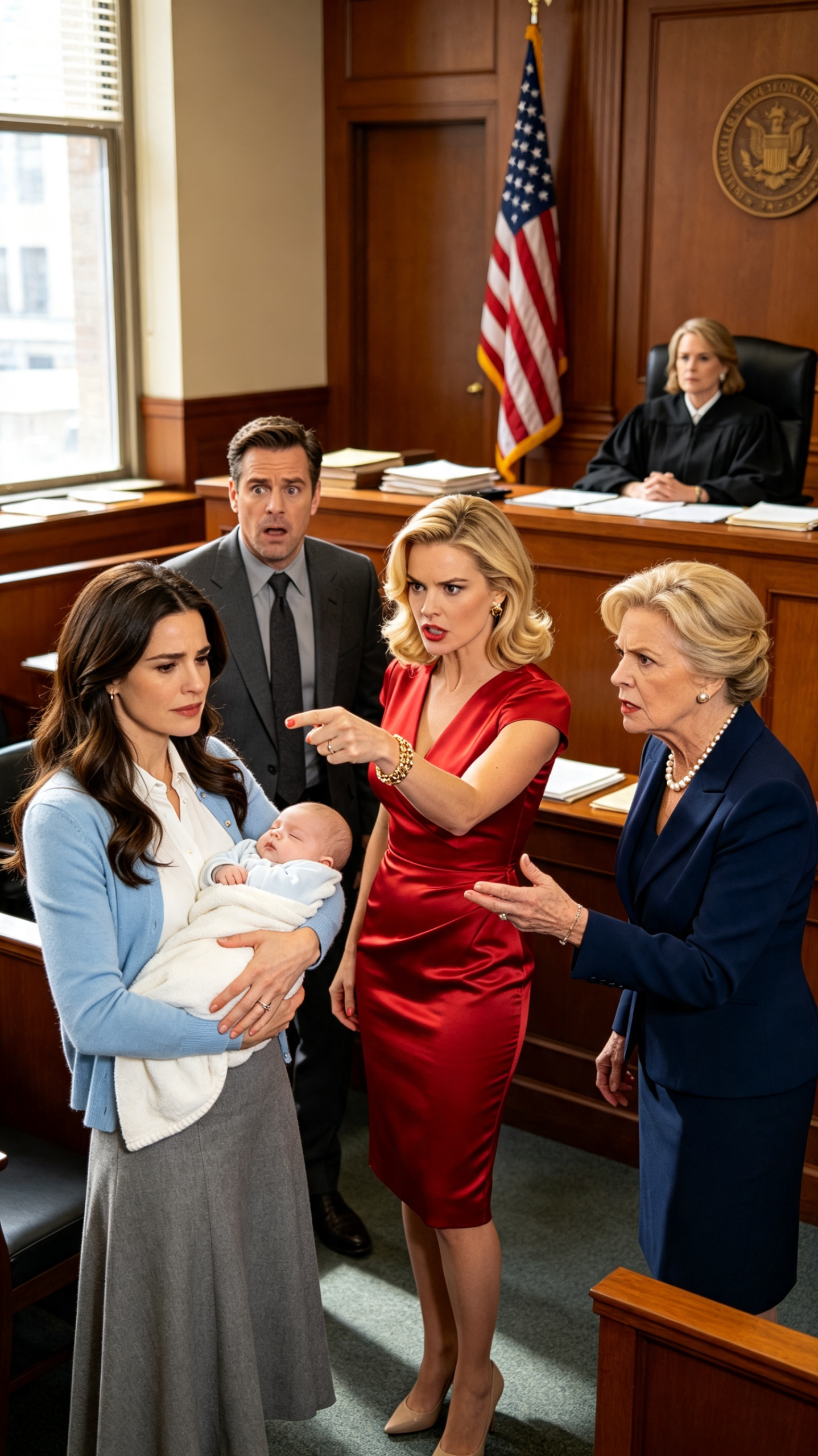
I walked into the family courthouse in downtown Denver carrying my five-day-old daughter against my chest, while everyone seated beside my husband looked at me with the quiet amusement usually reserved for someone confidently stepping toward a defeat they believed was already guaranteed.
His attorney was the first to smile.
That expression stayed more vivid in my memory than the polished stone beneath my feet, the uncomfortable weight of the diaper bag pulling against my shoulder, or the sharp pain moving through my abdomen whenever I walked too quickly after giving birth.
It was a calm, professional smile from a man who believed the frightened woman approaching his table had already lost custody, credibility, and any control over what happened next.
My husband, Vincent Caldwell, leaned toward his attorney and whispered something that caused both men to laugh.
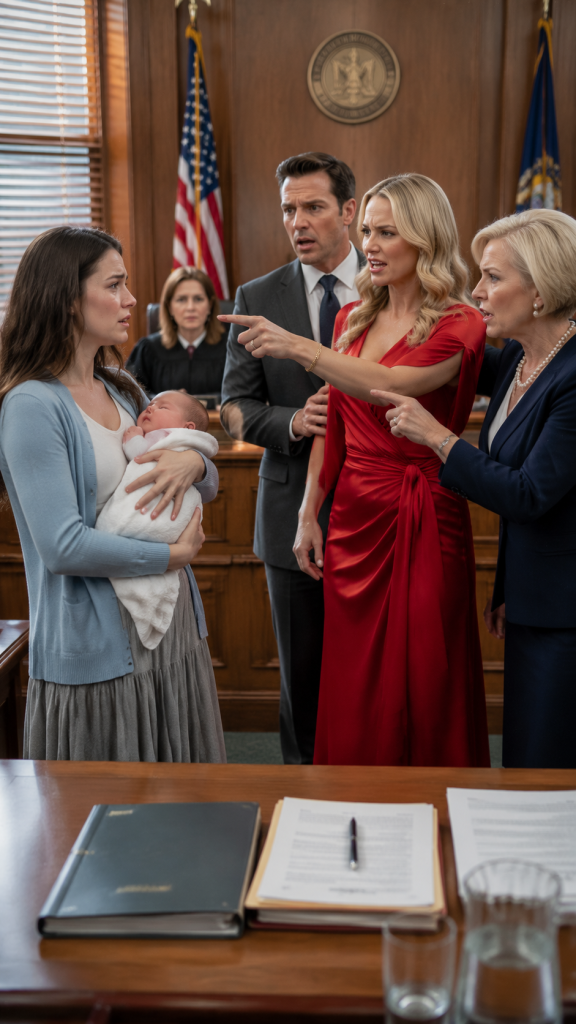
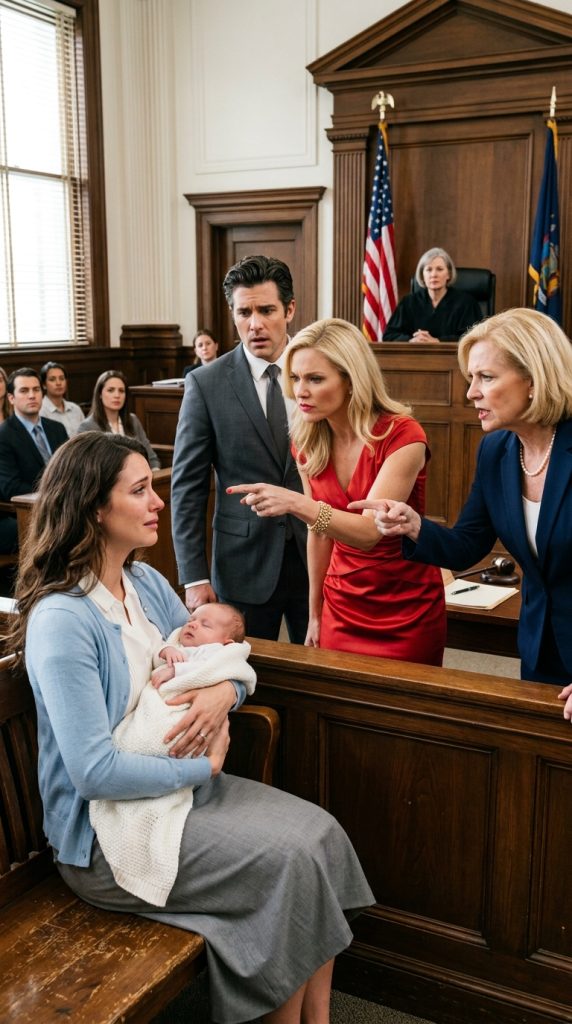
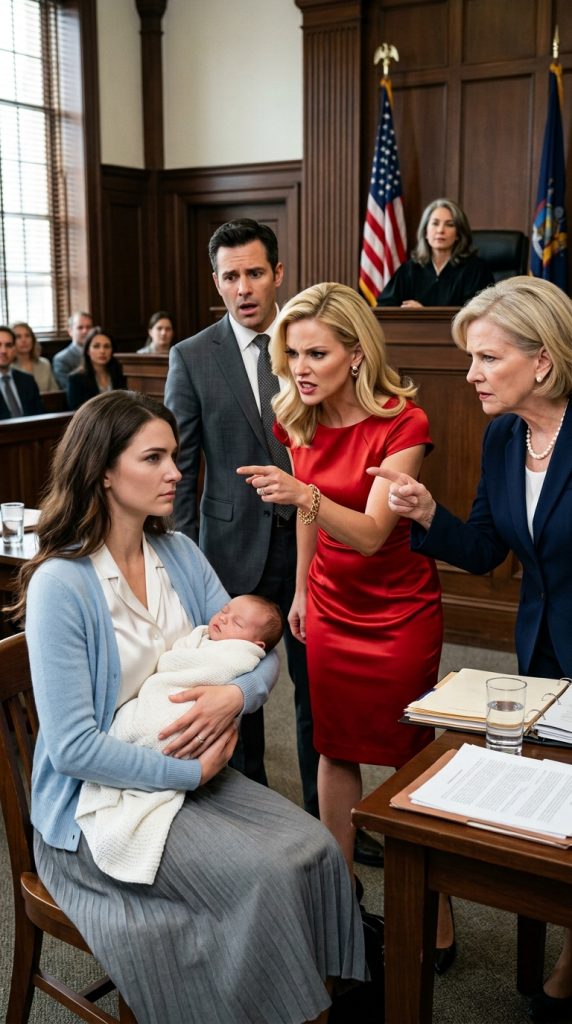
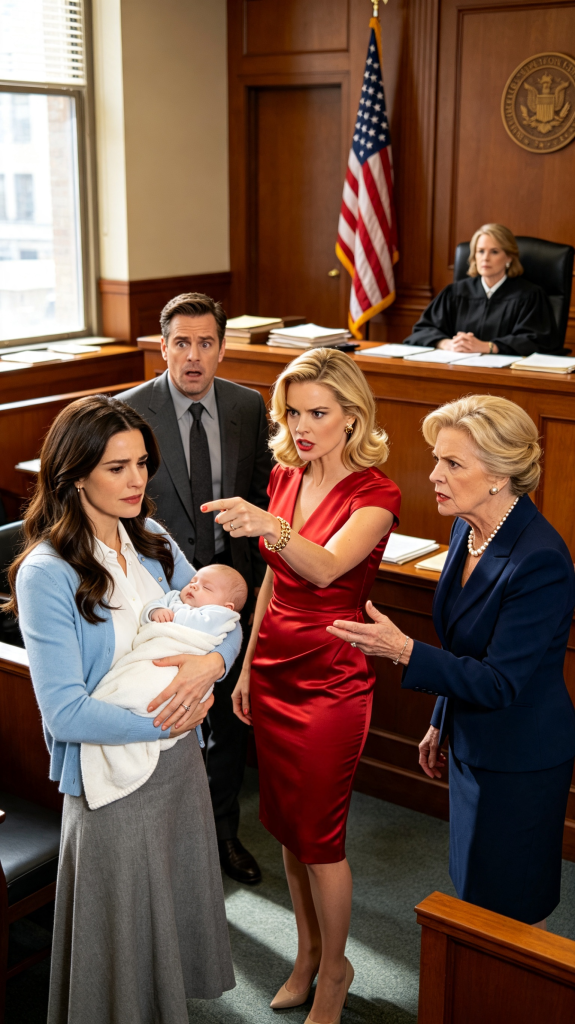
His mother, Lenora Caldwell, sat beside them in a tailored navy coat with a strand of cream pearls around her neck. Her posture was so flawless that she looked almost frozen in place, like a sculpture carved from stone.
Across from them sat Vincent’s girlfriend, Sabrina Hale, wearing a gold bracelet that had once belonged to me.
Vincent had placed that bracelet around my wrist during our fourth wedding anniversary and told me it was meant for the future mother of his children.
Now it rested on Sabrina’s arm while his actual daughter slept against my chest.
My name is Meredith Sloan, and before I married Vincent, I worked as a forensic analyst for the Colorado Attorney General’s financial crimes division.
I investigated hidden companies, forged signatures, disguised transactions, fraudulent trusts, and executives who believed money could somehow make impossible numbers disappear.
Vincent knew I had experience in finance.
He never respected my work enough to understand what I had truly done.
For six years, I lived as Mrs. Vincent Caldwell, the quiet wife in a mansion overlooking Cherry Creek.
I attended charity events, hosted investor gatherings, and learned how to recognize Vincent’s moods before they became visible to anyone else.
When he raised his voice, I made mine smaller.
When he broke something, I cleaned up the pieces before the household staff arrived.
When he grabbed my arm hard enough to leave marks, I covered them with long sleeves and told people pregnancy had made my skin unusually sensitive.
Control entered our marriage slowly enough that, at first, it looked like protection.
Vincent took control of our household finances because he claimed pregnancy meant I needed to rest.
He discouraged me from driving alone because he said Denver traffic made him anxious.
His mother chose my doctors, watched what I ate, and repeatedly reminded me that the Caldwell family had waited for decades for a direct heir.
When the ultrasound confirmed that I was carrying a healthy baby girl, Lenora’s disappointment lasted only a few minutes before she decided the child could still serve the family’s future.
After that appointment, Vincent began discussing guardianship, inheritance, and psychological stability with an interest he had never shown toward childbirth classes or my pregnancy.
Five days before the courthouse hearing, I gave birth by myself.
Vincent never came to the hospital.
His attorney contacted me twice, and both messages came with conditions.
Vincent would visit the baby if I signed a temporary custody agreement.
He would acknowledge paternity if I agreed to a psychiatric evaluation arranged by Lenora.
He would allow me to stay in the family housing during recovery if I returned to the Caldwell estate and stopped mentioning the abuse, financial transfers, or forged documents I had recently uncovered.
Every offer was a threat disguised as kindness.
When I refused, his attorney, Conrad Pierce, entered my hospital room while I was still trying to learn how to feed my daughter without aggravating the stitches from my emergency delivery.
He placed a stack of papers beside my bed.
“Family courts value stability, Mrs. Caldwell,” he said. “They become particularly cautious when a mother has no independent income, no permanent residence, and a recorded history of emotional distress.”
That so-called recorded history consisted of three counseling appointments after Vincent pushed me into a bedroom door during my second trimester.
At the emergency clinic, he told the doctor I had slipped while carrying laundry.
I confirmed his explanation because I was afraid of what would happen once we returned home.
When anxiety and sleeplessness continued afterward, I secretly sought therapy.
Vincent later discovered references to those appointments and turned my responsible decision to seek help into evidence that I was unstable.
That was how men like him built invisible prisons.
They created fear through intimidation, then pointed to that fear as proof that the woman could not be trusted.
The emergency petition accused me of taking our daughter from the hospital without Vincent’s permission, refusing reasonable custody arrangements, fabricating abuse to gain financial benefits, and using the newborn as leverage against a respected property developer.
Lenora wanted me completely removed from the Caldwell family.
Sabrina had already prepared a nursery inside the east wing of the estate, sharing a picture of an ivory rocking chair with the caption:
“Sometimes the child meant for you arrives through an unexpected storm.”
My daughter was not Sabrina’s unexpected blessing.
Her name was Audrey, and she belonged to herself before she ever belonged to a family name.
That morning, I wore a loose cream cardigan that concealed the fading bruises near my shoulder.
My hair was pulled back, and my face remained pale from blood loss, sleepless nights, and the overwhelming exhaustion of postpartum recovery, when a woman’s body has already sacrificed everything while the world still expects her to stand.
Audrey slept beneath a gray blanket, unaware that three adults had spent weeks trying to separate her from me before she was even old enough to recognize my face.
Judge Eleanor Price looked down over her glasses.
“Mrs. Caldwell, do you have legal representation today?”
Conrad’s smile grew wider.
Vincent let out a quiet, dismissive laugh.
“Not at this table, Your Honor,” I answered.
Vincent laughed again because he believed I had walked into court completely alone.
What he did not know was that my legal team was waiting outside with federal investigators, forensic reports, banking records, and sealed filings that would be activated once the first stage of the hearing established the necessary facts.
I entered without an attorney beside me because the opening statement needed to come directly from my own voice.
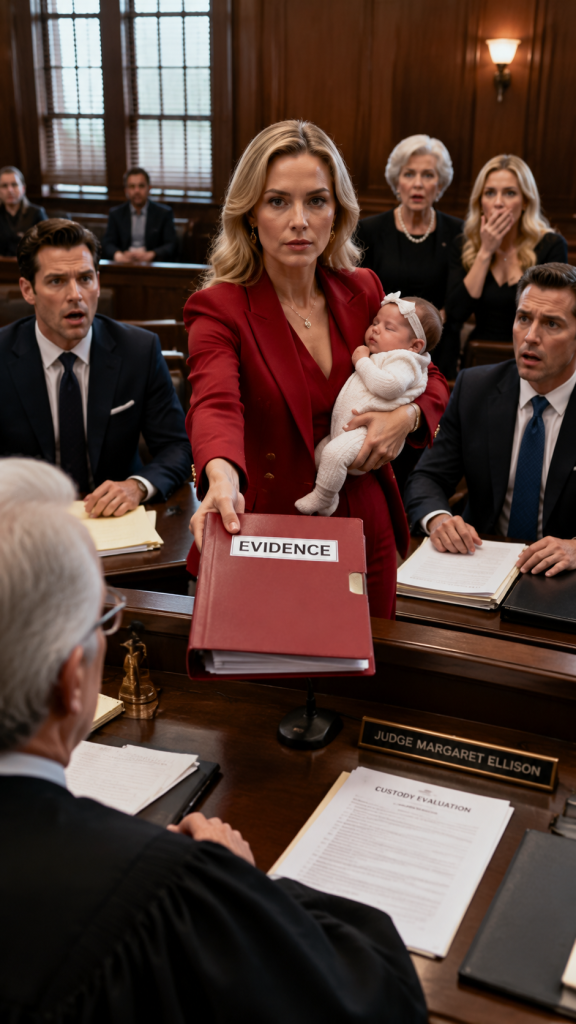
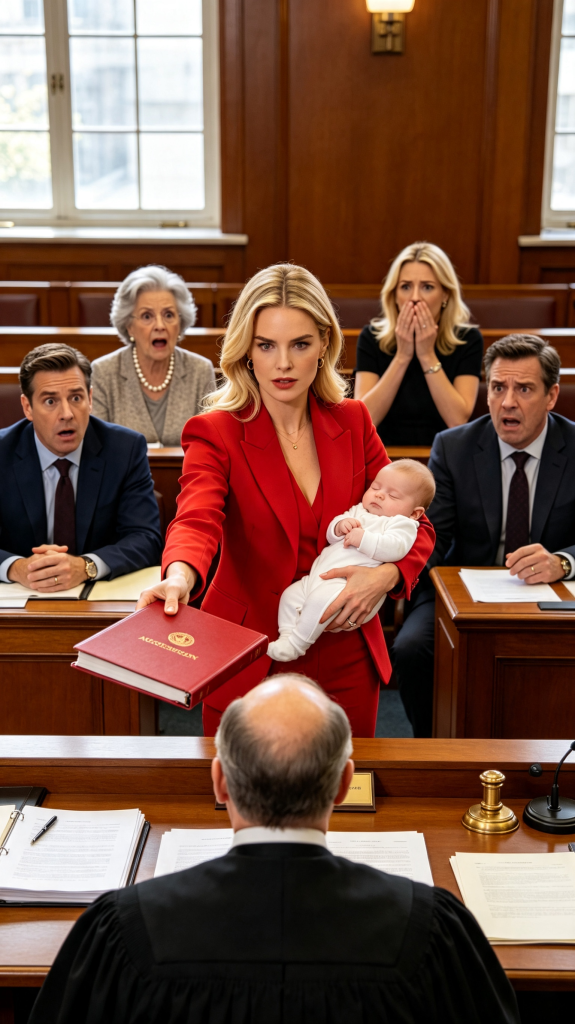
I reached into the diaper bag and pulled out a thick blue binder organized with numbered tabs.
Conrad noticed it immediately.
“A collection of emotional accusations prepared during recovery?” he asked loudly enough for everyone in the gallery to hear.
I ignored him.
I walked slowly toward the bench and placed the binder in front of the judge.
Then I turned toward Vincent.
“Your Honor, my daughter is not the reason I am asking for protection.”
The entire room fell silent.
I placed one hand gently over Audrey’s blanket.
“She is the evidence that everything in my husband’s petition is false.”
For the first time since the day we married, uncertainty appeared openly across Vincent’s face.
Part 2: The Blue Binder Opens
Judge Price opened the binder without reacting to Conrad’s display.
The first section contained a certified paternity report.
Vincent’s petition suggested that we had been separated for nearly a year and that he had reasonable doubts about whether Audrey was biologically his child.
He used that accusation to imply both infidelity and emotional instability while asking the court for temporary control until paternity could be verified.
The report confirmed Vincent’s paternity without any uncertainty.
But the hospital visitor records revealed something else entirely.
Although Vincent testified under oath that he had not seen me for eleven months, records showed that he had visited the maternity clinic six separate times under a false identity connected to one of his property-management companies.
Security footage showed him entering restricted areas, and nurses documented his presence during two separate prenatal emergencies.
One hallway camera captured him placing his hand against my stomach while I stood against the wall, frightened and visibly uncomfortable.
That same afternoon, he told Sabrina he was attending business meetings in Phoenix.
He told the court he had never been near me.
Judge Price turned to the next section.
The medical records documented four separate injuries during the final eighteen months of our marriage: a fractured wrist, a shoulder injury, bruising around my ribs, and a concussion that was recorded as the result of falling against a bathroom cabinet.
Every report described me as anxious, uncertain, and repeatedly looking toward my husband before answering questions.
Two nurses documented that Vincent insisted on staying in the room.
Another noted that I appeared ready to reveal something before he interrupted.
Behind those reports were photographs with dates attached, taken by a nurse named Teresa Bowman.
During my final emergency visit, Teresa asked me whether I felt safe at home.
I could not answer.
I just started crying.
With my permission, she photographed the injuries and gave me the contact information for a confidential advocate.
“You do not need enough courage to leave today,” she told me. “You only need enough courage to preserve the truth until you can use it.”
That sentence became the first page of the binder.
Conrad stood from his chair.
“Medical records do not establish who caused an injury.”
Judge Price lifted her hand.
“Counsel, you will have an opportunity to respond.”
I spoke softly.
“The messages in the next section establish intent.”
The judge turned the tab.
Inside were authenticated text messages and emails.
One message from Vincent stated:
“Sign the custody transfer before the delivery, or I will make sure every doctor and judge sees you as mentally unstable.”
Another message read:
“People trust money, reputation, and consistent witnesses. They do not trust emotional women with therapy records.”
A message from Lenora stated:
“Dr. Franklin is prepared to describe her as irrational if she refuses the evaluation. The child must remain with the family.”
Vincent responded:
“Once the baby is inside the estate, Meredith becomes unnecessary.”
A quiet murmur spread throughout the courtroom.
Lenora leaned closer to her son.
“Those conversations were private.”
The word almost made me laugh.
Privacy had protected everything that happened inside the Caldwell estate.
Privacy meant employees looked away whenever Vincent raised his voice.
Privacy meant Lenora could call bruises a normal marital disagreement.
Privacy meant I apologized for creating tension after her son frightened me.
Privacy meant the truth stayed hidden behind expensive walls.
The next section contained audio recordings captured through the nursery monitor after Vincent began entering my room late at night during the final weeks of my pregnancy.
His voice sounded calm.
Controlled.
“You will sign because motherhood does not make you capable. Courts prefer financial stability, and I can provide more stability than you can imagine.”
My recorded voice shook.
“Why are you trying to take her before she is born?”
His answer came immediately.
“Because you forgot your position in this family.”
Conrad objected, claiming the recording could have been manipulated.
“It was examined by Northbridge Digital Forensics,” I said.
His expression shifted.
His own firm had used that laboratory in multiple commercial cases.
He knew their standards.
He understood the recording would withstand examination.
Judge Price turned to another tab.
The financial section began.
For the first time, Vincent stopped pretending he was completely confident.
Part 3: The Career He Assumed I Had Forgotten
Before I married Vincent, I spent eight years tracking financial trails that influential people hoped would vanish forever.
I knew how fraud appeared when it was broken down into ordinary-looking transactions. I knew how shell companies borrowed legitimacy from respected names. I knew that forged signatures were often designed to look more deliberate than authentic ones.
Pregnancy had never taken that knowledge away from me.
Fear had only delayed the moment when I decided to use it.
While I was mostly confined inside the Caldwell estate, I began reviewing household expenses because numbers helped me stay focused.
That was when I discovered repeated consulting payments sent from Caldwell Development Group to newly created companies registered at empty properties.
The amounts were carefully kept below the limit that would require board approval.
Several payments appeared on the exact same dates every month, while the descriptions of the vendors were changed just enough to avoid immediate attention.
Then I discovered two credit facilities opened under my name.
The signatures looked convincing enough to fool someone who did not know my handwriting.
But I noticed the details immediately.
The loops were too identical.
The pressure patterns were too even.
Vincent had forged them.
A deeper review revealed that he had moved marital assets into three consulting companies connected to unfinished developments outside Colorado Springs.
One company was officially owned by a former chauffeur.
Another was registered under Lenora’s housekeeper, who had no idea the company even existed.
The third listed me as the managing partner.
He was preparing to portray me as involved in financial crimes while simultaneously convincing everyone that I was mentally incapable.
If investigators reviewed those accounts, my forged signatures would create suspicion.
If I fought for custody, Vincent could claim I was motivated by money.
If I stayed quiet, he could continue moving assets while building a case that I was unstable.
The binder contained bank statements, corporate registrations, wire confirmations, signature comparisons, and the identity theft report I filed six days before Audrey was born.
Judge Price studied the documents carefully.
“Mrs. Caldwell, how did you lawfully obtain these records?”
“Several accounts were opened in my name, Your Honor. I requested records as the listed account holder and filed a formal identity-theft complaint. Other materials were obtained through authorized requests connected to an active investigation.”
Vincent pushed himself to his feet so suddenly that his chair slammed against the railing.
“You calculating parasite!”
Audrey startled and shifted beneath the blanket.
The judge immediately struck the gavel.
“Sit down immediately, Mr. Caldwell.”
Vincent remained standing for another moment before finally lowering himself back into his chair.
For years, he had appeared untouchable because everyone around him adjusted reality to protect that image.
Now he looked exactly like what he had always been beneath the expensive suit, wealth, and family reputation.
A frightened man watching his carefully created story collapse.
Conrad tried another approach.
“Even if there is a financial disagreement, my client still has the resources, residence, and family support necessary to provide stability.”
Judge Price looked down at another document.
“According to this employment verification, Mrs. Caldwell is not unemployed.”
Conrad stopped speaking.
“She recently accepted a senior advisory position with the Rocky Mountain Financial Enforcement Task Force.”
Vincent stared at me as if he was seeing a completely different person.
Maybe he was.
Or maybe I had finally returned to the woman I had been before he taught me to ask permission for everything.
Judge Price continued.
“Several assets connected to Caldwell Development Group have been frozen while a federal fraud investigation proceeds.”
Lenora inhaled sharply.
The clasp holding her pearl necklace broke.
Small white pearls scattered across the courtroom floor, rolling beneath chairs and tables.
Sabrina looked from Vincent to the bracelet around her wrist.
“You said the investigation was finished,” she whispered.
Vincent did not answer her.
The judge moved on to the housing claim.
Vincent’s petition stated that I had no stable residence because I had abandoned the marital estate.
The binder contained messages from Lenora.
“The estate is not available to emotional women who refuse family guidance. Security will deny entry unless you sign.”
A message from Vincent followed.
“You may see the nursery after the transfer is complete.”
Sabrina’s expression changed instantly.
“You told me she refused to come home,” she said.
Vincent turned toward her sharply.
“Be quiet.”
Everyone in the courtroom heard the command.
This time, it was not directed at me.
Part 4: The Woman Beside Him Learns The Truth
Sabrina stood before Judge Price could continue.
“He told me Meredith abandoned the baby,” she said. “He said she refused treatment and disappeared after delivery.”
Lenora grabbed her wrist.
“Sit down before you embarrass yourself.”
Sabrina pulled away, and the gold bracelet caught the courtroom lights.
She looked at it differently now.
It was no longer a symbol that she had been chosen.
It was evidence that someone else had been intentionally erased.
I did not forgive her in that moment.
Forgiveness should never be demanded immediately from someone who has just discovered the truth.
But I understood something.
Vincent had created different cages for both of us.
Mine was built from fear.
Sabrina’s was built from vanity, promises, and the satisfaction of believing she had won.
Judge Price ordered her to either sit down or leave the courtroom.
She sat.
But the damage to Vincent’s case had already spread.
Conrad requested a recess and additional time to review the binder.
Judge Price denied the delay for the emergency custody decision.
“Your client placed his financial resources, residence, and credibility at the center of his petition,” she said. “Evidence challenging those claims is directly relevant.”
She closed the binder.
“The petition contains significant inconsistencies and appears to include materially misleading statements. The evidence raises serious concerns regarding coercion, threats, financial misconduct, domestic violence, and planned interference with the mother-child relationship immediately after birth.”
Vincent lowered his head and covered his face with his hands.
Judge Price granted me temporary physical and legal custody.
She issued protective orders against Vincent and Lenora, required supervised contact, and ordered my address to remain sealed.
For the first time since Audrey was born, I felt like I could finally take a full breath.
Relief did not feel like happiness.
It felt like a hand finally releasing its grip around my throat.
I stood slowly, holding Audrey close.
Vincent looked up.
“Meredith.”
He said my name as if remembering it could somehow bring his control back.
I turned toward him.
“I did not do this to you. You did it yourself because you believed pregnancy made me forget how to read records. You believed love made me incapable of protecting myself, and you believed silence meant surrender.”
Fear appeared in his eyes.
“I can fix this.”
“No. You can face it.”
I walked away without turning back.
Outside the courthouse, sunlight stretched across the steps.
Audrey opened her eyes briefly, dark and unfocused, as the brightness reflected softly across her face.
“We are safe for today,” I whispered. “Tomorrow, we will keep building safety again.”
At the bottom of the steps stood Dana Whitfield, the federal attorney overseeing the Caldwell investigation and my former supervisor from the state financial crimes division.
“You handled that well,” she said.
“I nearly fainted twice.”
“That still qualifies as handling it well.”
I laughed.
Then I cried.
And Dana simply stood beside me without asking me to stop.
Part 5: The Investigation Behind The Custody Battle
The public version of the story became simple within a few days.
Headlines described a wealthy developer who lost custody after his wife revealed shocking evidence in court.
But the reality behind it was far slower and far more complicated.
Vincent’s downfall did not begin in the courtroom.
It started much earlier, with invoices that looked ordinary enough to escape attention.
After I contacted Dana, she gave me clear instructions: preserve every original document, record every threat, avoid direct confrontation, and stay safe long enough to reveal the truth in the proper order.
That became my private mission.
Survive.
Organize.
Speak.
Search warrants were carried out at Caldwell Development Group’s headquarters, the family estate, and two storage facilities connected to shell companies.
Investigators recovered falsified loan documents, hidden financial records, forged signatures, and payments made to Dr. Nathan Franklin, the psychiatrist who had prepared statements about my mental condition without ever conducting a legitimate evaluation.
The records revealed that Lenora had paid Franklin through her charitable foundation.
In exchange, he created language designed to support future guardianship proceedings and custody claims against me.
Conrad’s involvement also came under investigation because several statements included in the custody petition conflicted with documents that were already available within his own firm’s records.
Three weeks after the hearing, Sabrina reached out to me through her attorney.
She returned the bracelet during a meeting at Dana’s office.
Without the designer clothing and carefully prepared appearance, she looked younger.
And far less certain.
“I knew he was married,” she said. “I convinced myself the marriage had already ended because believing him gave me the life I wanted.”
I said nothing.
“I decorated the nursery.”
“I know.”
Her eyes filled with tears.
“They told me you did not want the baby and could not safely care for her. I liked being chosen enough that I never asked why another woman had to disappear for my dream to become real.”
Her apology did not erase what happened.
But it also did not create another wound.
“What will you do now?” I asked.
“Testify.”
And she did.
Sabrina provided messages showing Lenora referring to me as temporary and describing Audrey as a family asset that could legally be reclaimed.
She also revealed that Vincent had promised her ownership in one of the shell companies after he gained custody.
The betrayal in their relationship and the financial scheme had never been separate.
They had always been connected.
Part 6: Learning Safety After Winning Protection
Temporary custody did not instantly transform motherhood into something peaceful.
Court orders existed on paper.
Real protection came through enforcement, support, secure routines, and time.
For months, every noise outside my apartment made me wake up.
Unknown phone numbers caused my stomach to tighten.
Whenever Audrey cried longer than usual, I worried someone would use it as evidence that I was unstable.
Whenever I forgot a bottle or broke down from exhaustion, Conrad’s warning returned in my thoughts.
Trauma has a way of turning ordinary human mistakes into proof against yourself.
Teresa, the nurse who first helped me document my injuries, visited twice a week during those early months.
She never treated me like I was helpless.
She reminded me that healing came through small, consistent actions: feeding my baby, resting before reaching exhaustion, writing down concerns, breathing through fear, and asking for help without feeling guilty.
“Good mothers are not calm every minute,” she told me. “Good mothers return, repair, learn, and remain present.”
Audrey grew into a serious little baby with wide eyes and a habit of wrapping her fingers around mine as if she were carefully studying me.
She loved the sound of running water, hated yellow socks, and slept best when I hummed the songs my grandmother used to sing.
Sometimes happiness arrived so suddenly that it scared me.
Sometimes I cried because loving her had almost cost me everything.
Both feelings were real.
The criminal investigation against Vincent continued expanding.
Several Caldwell executives cooperated with investigators.
Dr. Franklin lost his license after authorities proved he accepted payments for misleading evaluations.
Lenora faced legal consequences connected to witness intimidation, forged documents, and the planned custody strategy.
Vincent eventually pleaded guilty to financial fraud, identity theft, obstruction, and conspiracy.
The evidence involving domestic violence permanently affected his parental rights.
He received supervised visitation after completing treatment and psychological evaluations.
He missed the first scheduled visit.
Then he missed two more.
Some people fight harder to possess something than they fight to build a relationship with it.
That was one of the most painful lessons I learned.
I once believed Vincent wanted Audrey because he loved her deeply.
Over time, I realized he wanted her as proof of his legacy, his ownership, and his ability to maintain control over me.
When fatherhood required schedules, diapers, supervision, humility, and consistency, his determination disappeared.
I began writing letters for Audrey to read when she was older.
I wanted her to know the truth without forcing her to carry my anger.
One letter said:
“Your father harmed me, but you were never part of that harm. Your birth did not destroy my life. It revealed what needed to be removed from it. You were loved before the courthouse, throughout the fear, and after the truth became public.”
At night, after Audrey fell asleep, I sometimes opened the blue binder.
I did not open it because I wanted to return to the pain.
I opened it because I wanted to honor the exhausted woman who created it inside a hospital room while recovering from childbirth, caring for a newborn, and fighting against sleep.
She had been terrified.
But she organized the truth anyway.
Part 7: When Evidence Became A Lifeline For Others
Three years later, I returned to the same courthouse for an entirely different purpose.
Denver County invited me to help establish a legal-medical partnership designed to support postpartum mothers facing coercive custody threats, financial abuse, false mental-health accusations, and identity theft.
Teresa, Dana, family-law advocates, and hospital administrators worked together to create the documentation system.
The program became known as the Blue Binder Project.
During the opening ceremony, Audrey sat on Teresa’s lap holding two toy trains, watching me with the same serious expression she had always carried.
“Three years ago, I entered this building believing I had to prove I was not the unstable woman powerful people described,” I told the audience. “Now I understand that no mother should have to carry that burden alone. Courts, hospitals, financial institutions, and advocates must recognize when professional language is turned into a weapon.”
I looked toward my daughter.
“Audrey was not simply the reason I asked for protection. Her existence revealed the lies created to erase me. But no child should have to become evidence before a mother receives the attention and support she deserves.”
After the ceremony ended, a young woman approached me carrying a newborn carrier with shaking hands.
“My husband says nobody will believe me,” she whispered.
I remembered Teresa’s expression in that hospital room years earlier.
“Then we begin by believing you while we carefully document what happened.”
That answer became the foundation of everything that followed.
My life changed through ordinary moments.
Audrey started preschool, learned how to ride a scooter, and eventually asked why some children had fathers waiting to pick them up while others did not.
I answered honestly, but I never placed responsibilities on her that belonged to adults.
Vincent became a distant name appearing in supervised visitation reports and unanswered calls.
Lenora continued sending letters that my attorney reviewed and preserved.
Sabrina testified completely, moved to another state, and eventually began working with a nonprofit organization helping women leave controlling relationships.
Her apology was not perfect.
But her actions carried more meaning than her words.
I did not rebuild my life around finding another relationship, although love eventually found its way back through a pediatric occupational therapist named Aaron Blake.
He met Audrey before he ever invited me to dinner, and he never treated my survival as something he could repair through affection.
He listened slowly.
Patiently.
He never demanded the entire story before I was ready to trust him with it.
But the heart of my ending was never another man.
It was another life.
A secure apartment became a small home with green curtains.
The blue binder became educational material.
My forensic experience became a career dedicated to protective investigations.
Fear became a system that helped other women preserve evidence before powerful families could rewrite their stories.
On Audrey’s sixth birthday, she noticed the old binder stored inside a locked cabinet.
“Why do you keep that?” she asked.
I sat beside her among wrapping paper and scattered toy animals.
“It helped keep us safe when you were a baby.”
She thought about my answer.
“Was I brave?”
“You were extremely small.”
She frowned.
“Small people can still be brave.”
I pulled her into my arms.
“Yes, they can.”
That evening, after she fell asleep, I stood outside her bedroom and listened to her calm breathing.
I remembered walking into that courthouse carrying her while everyone around me treated her like a possession, a weapon, an inheritance symbol, and a legal argument.
Then I made the promise again.
She would never be used as a reason to erase me.
She would never grow up believing love meant control.
She would understand that truth could be frightening without becoming something shameful.
She would know that I fought not because I hated her father, but because I loved both of us enough to reject the lies attached to her name.
The blue binder did not save me by itself.
I saved myself, with the support of people who believed evidence should protect vulnerable people instead of becoming another tool for those with power.
The binder simply gave the truth a structure strong enough to stand.
Sometimes, that is where freedom begins.
THE END
