


The black luxury sedan moved through a wide avenue in Milwaukee with a flawless shine reflecting the glass storefronts and passing city lights, carrying the quiet confidence of something that belonged exactly where it was. That confidence lasted only another moment before the engine suddenly jolted, coughed loudly, and stopped beside the curb as if fate had chosen that exact second to turn against its owner.
The engine trembled one final time before becoming completely silent, while the dashboard lights weakened and disappeared without warning. The city continued rushing around it as usual, but the atmosphere near the vehicle quickly changed as people’s curiosity replaced their previous lack of interest.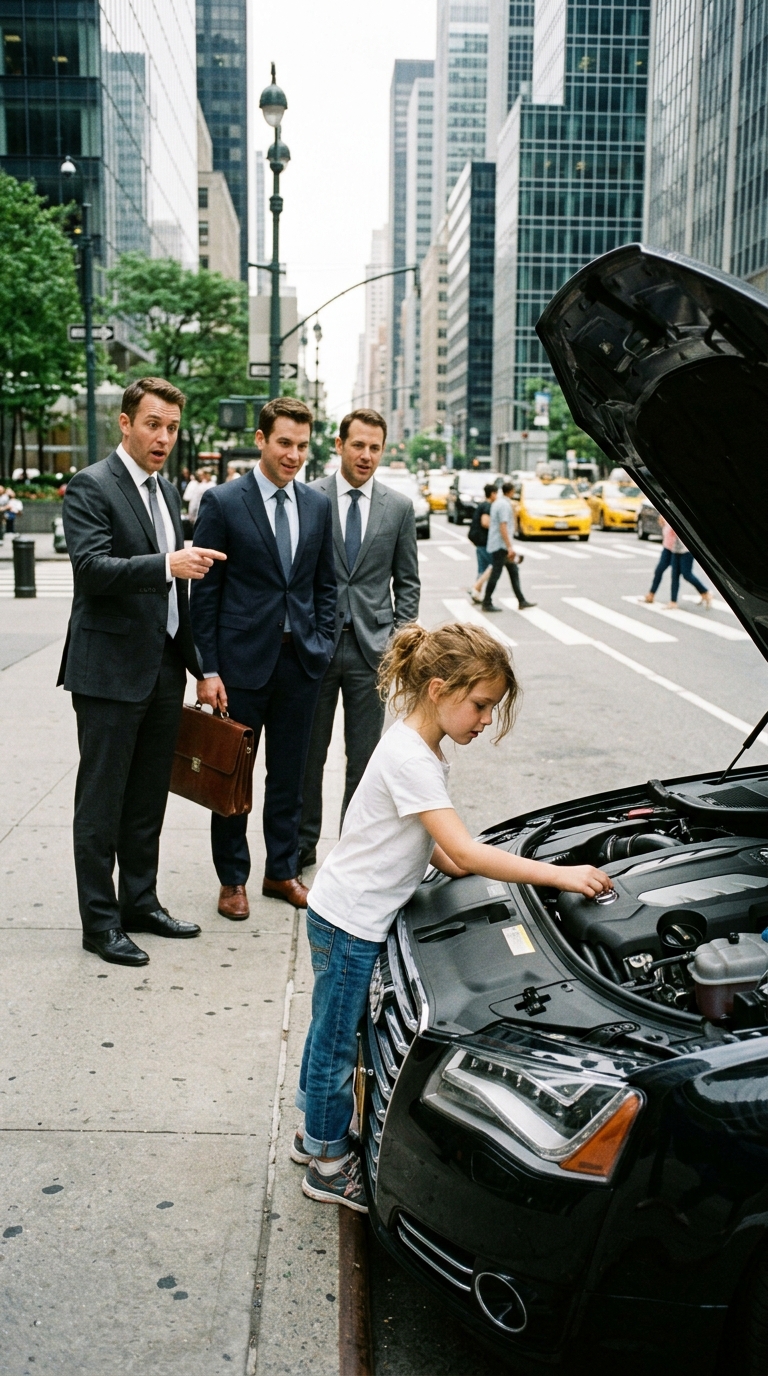
Raymond Pike stood beside the driver’s door wearing a perfectly fitted pale gray suit that seemed completely out of place among the rough street surroundings and impatient morning traffic. He was the type of man whose image appeared on business conferences and financial broadcasts, recognized by people who connected him with success even when they did not remember his name.
A horn sounded behind him, followed by another, and Raymond slowly exhaled while muttering, “Of course this happens right here at the worst possible moment.” His eyes scanned the growing line of vehicles behind him, realizing that attention was spreading much faster than he wanted.
Three young men nearby had already stopped to observe, with one holding up his phone while another smiled openly at the sight of a rich man struggling in public. One of them shouted, “Try it again, maybe it just needs encouragement,” and the others immediately laughed.
Raymond gave a controlled smile that failed to completely cover his frustration, then returned to the driver’s seat and pressed the ignition button while listening carefully. The car answered with a weak click and nothing else, and when he tried once more, the same empty sound returned.
When he stepped outside again, the slight change in his expression was obvious to those paying attention, because his confidence had weakened just enough for people to notice. That was when a girl walking along the sidewalk slowed down near the scene without intending to become involved. She appeared to be around twelve years old, maybe slightly older, with a careful way of carrying herself that suggested she had learned to move cautiously through places that were not always welcoming. Her name was June Parker, and her oversized sweater hung loosely around her while she held a thin plastic bag tightly against her side.
Her shoes showed signs of wear, and her hair was unevenly tied back with loose strands falling across her face, while her eyes remained lowered in the familiar habit of someone who understood that attention could bring unwanted consequences. Raymond noticed her immediately and called out, “Hey, you there,” without considering how the moment might appear from her perspective.
June stopped at once, her shoulders becoming tense before she even turned around, and when she faced him her voice sounded quiet and defensive as she said, “I did not take anything.” The young men immediately burst into laughter, clearly expecting a reaction like that, and one repeated her words mockingly while continuing to record.
Raymond gave a brief laugh, more from routine than genuine amusement, because he had always used humor to maintain control whenever situations became uncomfortable. He pointed toward the stalled vehicle and said, “Looks like we need volunteers today,” while the small crowd became increasingly interested.
He crossed his arms and added casually, “I will give you one hundred million dollars if you can fix my car,” and the enormous number instantly made the reactions around him louder. Nearby people turned around, phones rose into the air, and someone repeated the amount as if the unbelievable offer made the joke even funnier.
June did not laugh or react, and she only glanced at the front of the car before lowering her eyes again and saying, “I cannot.” One of the young men leaned closer and asked, “What was that,” clearly enjoying the situation more than they should have.
She held the plastic bag tighter and repeated, “I cannot,” before stepping back slightly as if creating distance would end the conversation. The men moved just enough to stay in her way, not threateningly, but enough to make leaving feel more difficult.
Raymond noticed the change in the atmosphere and the increasing number of people watching, yet instead of ending the situation, he continued treating it like entertainment. He said casually, “You can walk away, but that might look interesting on camera,” making June’s fingers shake slightly.
She looked at the phones, then at the open hood, and finally back at him before speaking again with a firmer voice that showed more determination than before. “If I look at it, you stop talking, no jokes, and no filming in my face,” she said, refusing to back down despite the attention surrounding her.
The laughter weakened as people realized she was serious, and Raymond lifted his eyebrows with slight amusement before answering, “Fine, you have one minute.” The crowd became quieter as everyone watched more carefully, unsure of what would happen next.
June slowly stepped closer to the open hood, but she was too short to see clearly and quickly searched for something to stand on. She noticed a small wooden stool beside a newspaper stand, pulled it over, and climbed onto it carefully.
Her sleeve touched the polished exterior of the car, and she immediately pulled back as if expecting someone to criticize her for touching something valuable. Nobody spoke, and she leaned forward, carefully listening near the engine despite the constant noise of the street.
She remembered the clicking sound from earlier and recognized it as something she had heard before, usually related to power failing to reach the right place. Her eyes moved across the engine with complete concentration, relying on experience instead of official training.
At home, damaged items were rarely replaced quickly, so she had learned to pay attention to small signs, listen closely, and understand which problems could still be repaired. She checked the battery first and noticed a cable that was slightly loose, not fully disconnected but unstable enough to interrupt the power connection.
One of the young men laughed quietly and said, “She really thinks she knows what she is doing,” and June paused for a moment as her shoulders tightened. Then she whispered, “Please stop,” with a voice carrying more exhaustion than fear, and the street around her became noticeably quieter. She reached into her hair and removed a bent bobby pin, carefully using it to guide the cable back into position before covering her hand with her sleeve to tighten the connection as firmly as she could. Her arms shook from the effort, but she continued until the cable finally felt stable.
Raymond watched with growing attention, his initial amusement slowly turning into genuine interest as he realized she was not pretending. June stepped down from the stool and moved away from the vehicle before saying, “Try it now, and do not touch the gas.”
Raymond hesitated for a moment, then returned to the driver’s seat while the crowd leaned closer. One of the young men lowered his phone without realizing it, and the atmosphere shifted from mockery to anticipation.
He pressed the ignition button, and the engine immediately came back to life with a smooth, steady sound that removed any doubt about what had happened. The silence afterward was not uncomfortable but filled with disbelief, as everyone tried to understand what they had just seen.
Raymond glanced at the dashboard, then through the windshield, and finally toward June, who had already picked up her bag and turned slightly as if she was preparing to leave. The same people who had laughed moments earlier now appeared uneasy, but none of them spoke.
Raymond slowly stepped outside and asked, “How did you know, who taught you that,” his voice now missing the confidence he had shown before. Before June could answer, one of the young men muttered, “Maybe she loosened it herself,” attempting to save his pride.
June raised her eyes and looked straight at Raymond for the first time, and the sincerity in her expression made it impossible for him to hide behind his usual confidence. She quietly said, “You said that money because it was funny, because you did not think someone like me could do anything.”
Her words carried more impact than any angry accusation could have, leaving Raymond unable to respond despite everyone watching. June adjusted her bag and walked away, ready to leave the moment behind. “Wait,” Raymond called, “what is your name,” but after a brief pause she turned and disappeared into the crowd without answering. The young men quickly left as well, their earlier excitement replaced with discomfort.
Raymond remained beside the running car, listening to the engine while repeating her words in his mind. The sentence followed him for the rest of the day, appearing during meetings, conversations, and quiet moments when he could not ignore it.
That evening, he returned to the same street and found it much quieter, with the newspaper stand closed and streetlights reflecting softly across the pavement. Nearby, an older mechanic was closing a small garage, and Raymond approached him with a question.
“Can I ask you something,” he said, and the mechanic studied him carefully before answering, “Depends what you are looking for.” Raymond described the girl, and the mechanic slowly nodded before saying, “Sounds like June Parker, she helps her grandfather with repairs.”
He gave Raymond an address on the south side of Milwaukee and added, “If you go, leave the performance behind.” The following morning, Raymond drove there alone without his usual assistance, uncertain about what he would discover.
The house was small and weathered, with a tilted porch and a yard that showed signs of care despite limited means. June opened the door slightly, her expression guarded as she immediately recognized him.
Inside, her grandfather Harold Finch sat near the window, observing carefully while Raymond spoke. “I came to apologize and to thank you,” Raymond said, keeping his voice calm and respectful.
Harold watched him closely as June stayed silent, and after a moment Raymond placed an envelope on the table. “This is for her future and for your care,” he explained, “because respect should have come before anything else.”
June looked at the envelope without reaching for it and said, “You do not have to do that because I fixed your car,” while Raymond answered, “I know, I am doing it because I was wrong.” Harold leaned back slightly and said, “That is the first honest thing I have heard today.”
They drank a simple cup of coffee together, and Raymond listened as June explained how she had learned by observing and helping throughout the years. Before leaving, he asked, “What do you want to be,” and after thinking carefully she answered, “Someone people do not laugh at before hearing me.”
That response remained with him longer than any achievement he had ever earned, changing the way he viewed others in quiet but meaningful ways. Over time, June enrolled in a technical program and continued developing her skills, while her home improved and her grandfather received the care he needed.
Years later, she stood inside her own workshop with customers waiting, keeping the old bent bobby pin in a drawer as a reminder of where everything began. It was never about the tool itself, but about the moment that changed the direction of two lives.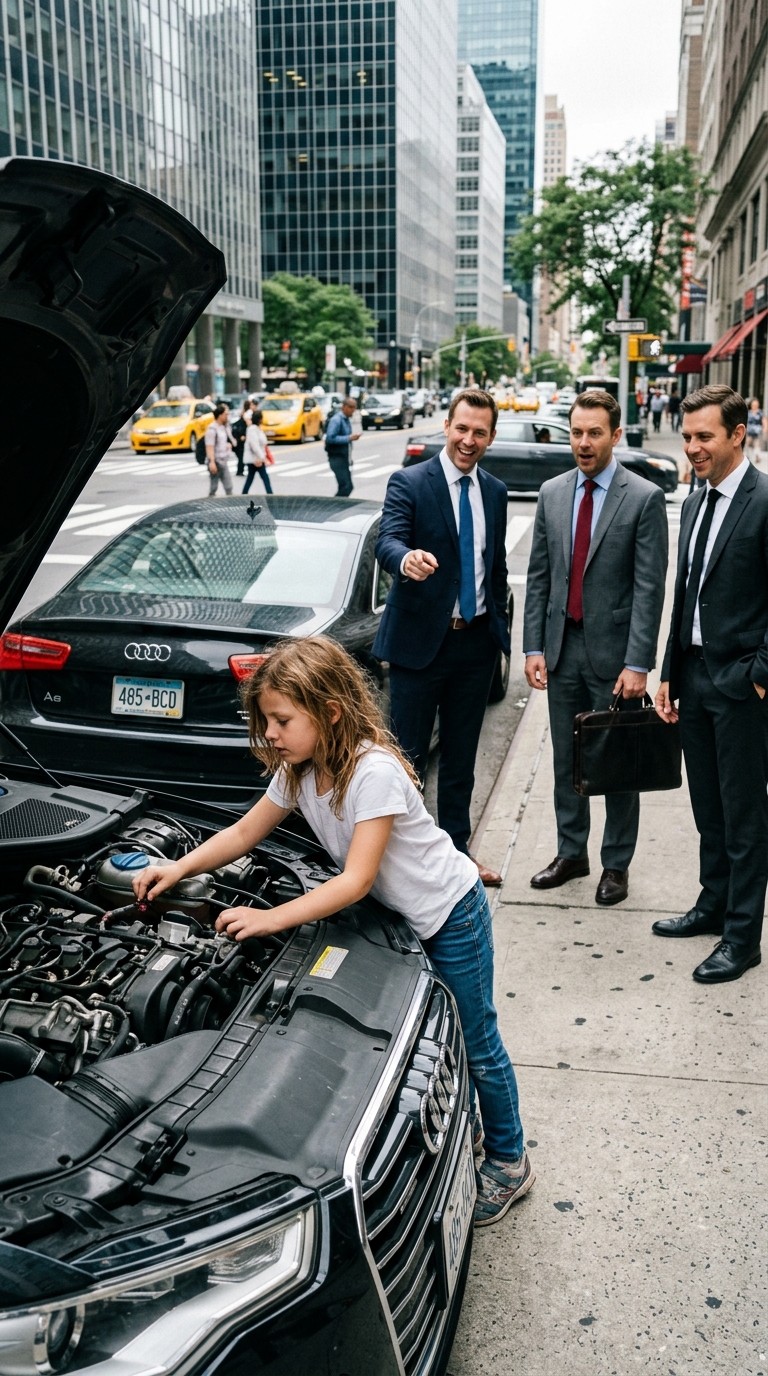
Some people remain at the center of attention without truly understanding much, while others stay unnoticed despite carrying abilities and strength far beyond what anyone assumes. It is a mistake to judge someone’s value by appearance or social position, because the truth often exists in places people rarely choose to see.
A thoughtless joke may last only seconds for one person but remain for years with another, which is why respect should never require someone to prove their worth first. True maturity begins when people choose to recognize those who are ignored and listen before deciding who deserves to matter.
In the end, the lesson remained clear and unforgettable: never underestimate someone whose value you have not yet discovered, because someday you may realize they carried exactly what you needed to understand.
