

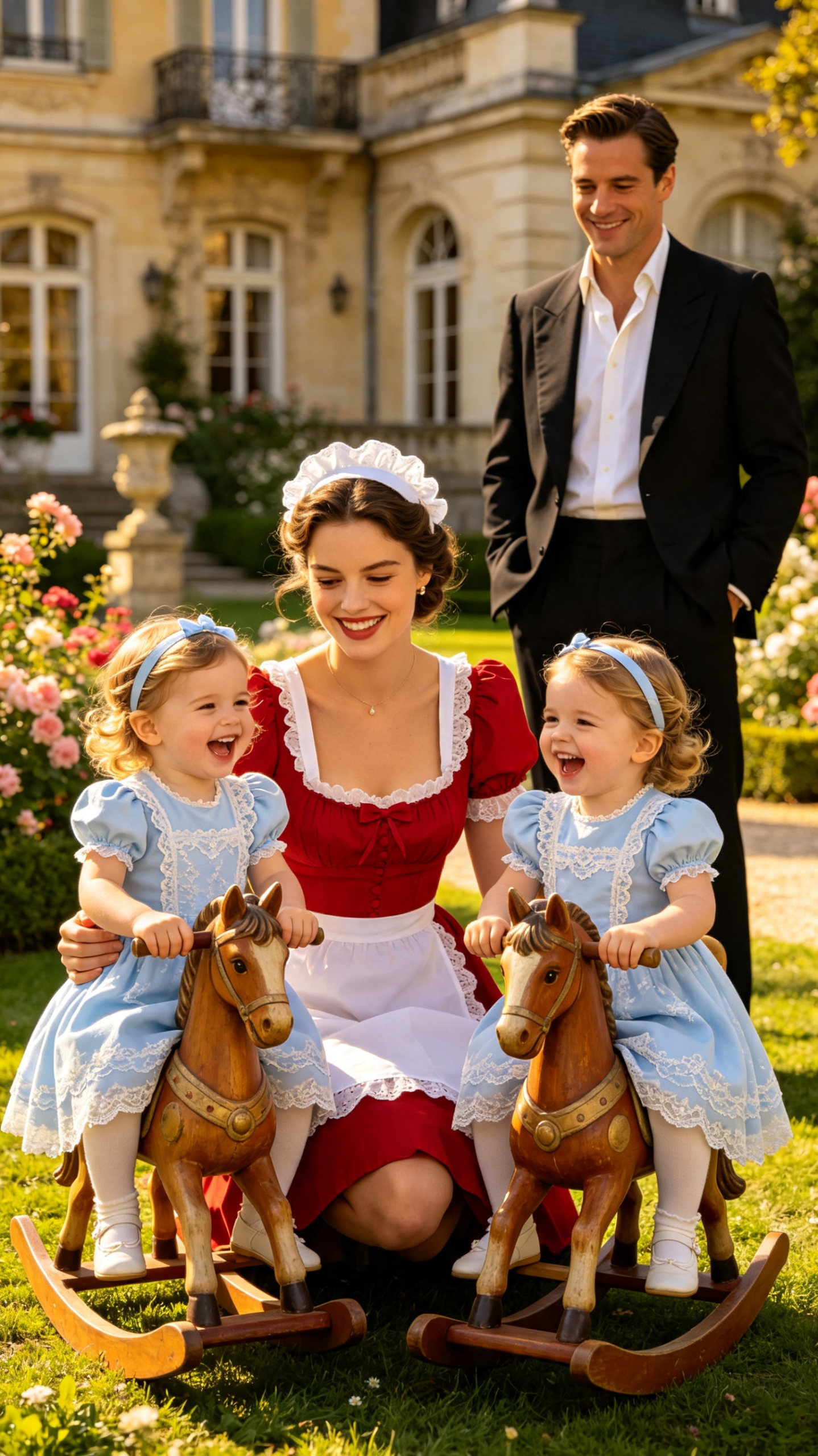
PART 1 — THE SILENCE IN THE HOUSE
The first thing I found was blood on a child’s white bedroom floor. Not much.
Just one small red stain beside a broken doll and a torn blue bow. But in a mansion where two five-year-old girls were supposed to be laughing over heart-shaped pancakes, that tiny stain felt louder than a scream.
I stood frozen in the doorway of Lucía and Luna Alcázar’s bedroom, my cleaning bucket still downstairs by the marble entrance, my hands still smelling faintly of lemon soap. Rain tapped against the tall windows. The air conditioner hummed somewhere in the walls.
And the house was silent.
Not peaceful. Not sleeping. Silent like someone had forced it to be quiet.
“Niñas?” I whispered. My voice broke. No answer.
I had worked inside the Alcázar mansion long enough to know its moods. The second stair creaked when it rained. The kitchen windows rattled before a storm. The nursery door always stuck unless you lifted the handle first.
And the twins? They were never silent.
Lucía sang to her dolls even when she brushed her teeth. Luna whispered secrets to stuffed animals when she thought no one was listening. Together, they filled that enormous mansion with the kind of noise money could never buy.
But that morning, their beds were empty. Their breakfast was untouched. Two glasses of milk sat on the kitchen table with a pale skin forming on top. Two plates of pancakes had gone cold. Two napkins were folded like flowers because Luna loved “fancy mornings.”
I had smiled when I saw them. For one foolish second, I had thought the girls were playing hide-and-seek.
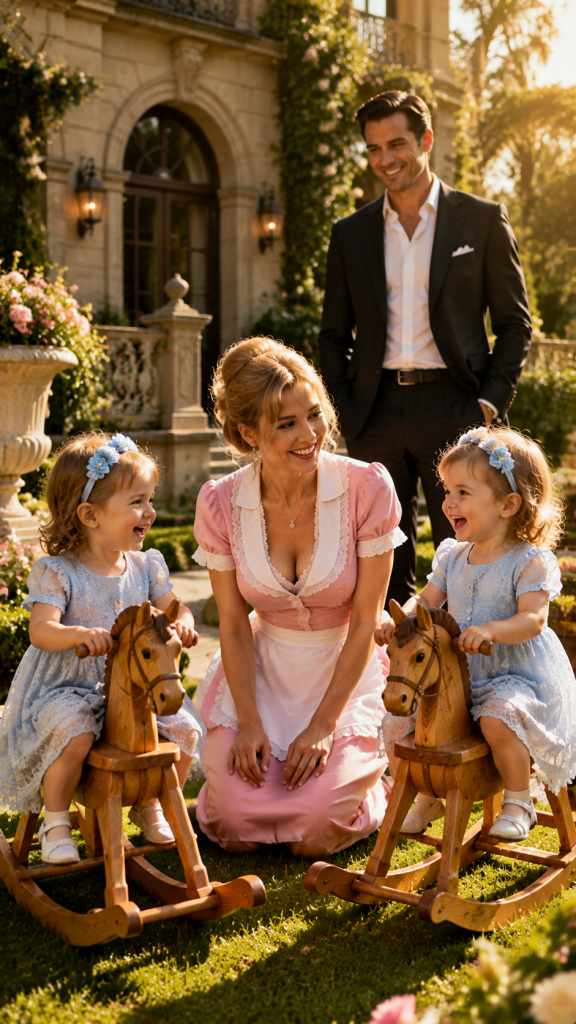
Then I remembered Renata. Don Alonso’s fiancée. Beautiful, polished Renata, with diamond earrings, cream silk blouses, and that sweet perfume that always arrived before she did.
Everyone said she was elegant. I thought she smiled too much. Especially around the girls.
For weeks, Lucía and Luna had changed. They stopped running into their father’s arms when he came home late from business dinners. They stopped asking whether Renata would become their new mother. They stopped leaving drawings on his desk. Once, I found Luna hiding under the breakfast table, clutching her blue ribbon so tightly her knuckles turned white.
When I asked what happened, she said only one thing. “Don’t tell Daddy.”
I should have pushed harder. I should have told Alonso.
But in houses like Alcázar, women like me were paid to clean dust, not suspicion. So I had nodded. I had soothed her. I had braided her hair with the blue ribbon and told myself children became quiet after loss.
Their mother had been dead for a year. That was what everyone said when the girls cried. They miss señora Elena. They need time. They need structure. They need Renata.
I had never believed that last part.
The Alcázar mansion sat at the top of a hill like a palace built by a lonely man trying to prove grief could be defeated with marble. It had twenty-three rooms, six balconies, a private chapel, a glass greenhouse, and a staircase so wide a bride could have walked down it with an orchestra behind her.
But since Elena died, the house had felt hollow. Not empty. Hollow. There is a difference.
Empty houses wait to be filled. Hollow houses keep echoes of what was taken.
I turned slowly inside the bedroom. Two little beds with white canopies. Two pairs of slippers lined neatly beneath them. A shelf of dolls, one missing from the center. A music box open on the dresser, its tiny ballerina bent sideways as if someone had slammed it shut and broken it.
The broken doll on the floor had belonged to Lucía. The blue bow had belonged to Luna. The blood could have belonged to either.
My knees weakened. “Virgencita,” I breathed.
Then I heard it. A sound from beneath the floor. A small bump.
I stopped breathing. Another bump followed. Weak. Desperate. Like tiny hands knocking from under the earth.
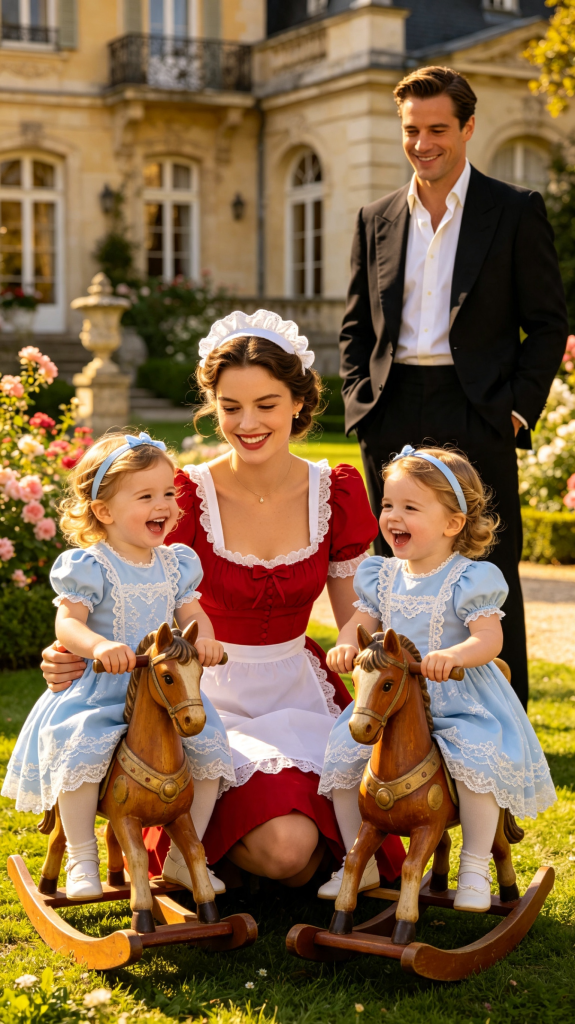
“The basement,” I whispered.
The basement was always locked. Renata told the staff it held old wines and important family documents. She said no one was to enter without her permission.
But I had cleaned rich homes since I was sixteen, and I knew the difference between a locked room and a hidden one. That basement had always felt wrong.
I ran down the service stairs so fast my knees almost gave out. My shoes slipped on the marble. My heart pounded so hard I could hear blood in my ears.
At the basement door, I grabbed the key ring from the laundry hook. One key. Then another. Then another. None fit.
From behind the door came another tiny knock. This one weaker than before.
“Hold on,” I choked. “Please, hold on, my girls.”
I found an iron bar near the gardener’s tools and lifted it with both hands. I was not young. My wrists ached on rainy mornings. My back burned if I carried laundry too long.
But fear made me strong.
I slammed the bar into the lock. Once. Twice. Three times. Wood cracked. Pain shot through my palm. Blood slid between my fingers. I struck it again.
The door burst open.
A smell crawled out first. Damp stone. Old wine. Dust. And fear.
“Lucía!” I called. “Luna!”
For one second, nothing answered. Then came a tiny moan from behind a stack of boxes covered in black cloth.
I shoved the boxes aside, tearing one cloth so hard it ripped down the middle.
And then I saw them. My little girls. Curled together on the cold basement floor. Their wrists tied with a golden silk ribbon. A ribbon I recognized. It had been wrapped around Renata’s perfume box two nights ago.
Luna’s lips were dry. Lucía’s face was swollen from crying. Their dresses were wrinkled and dirty, their skin cold when I touched them.
I dropped to my knees. “Who did this?” I whispered.
Luna shook her head violently. “No. Be quiet.”
That frightened me more than screaming would have.
I untied the ribbon with shaking fingers. It was expensive, smooth, ridiculous against their tiny bruised wrists.
“Mi amor, who did this to you?”
Lucía looked toward the stairs. Her voice came out so small I almost did not hear it. “She said if we screamed, Daddy would die.”
The basement spun. I held her face between my hands. “Who said that?”
Lucía lifted one trembling finger. Toward the door above us. “Renata.”
Before I could move, heels clicked overhead. Slow. Calm. Elegant.
The twins stiffened at the same time. Then Renata’s voice drifted down like poisoned sugar. “Teresa…”
I covered both girls’ mouths gently and pulled them against me.
The heels clicked again. “Where are you?”
The basement had only one main door. And she was coming through it.
I looked around wildly. Wine shelves. Old trunks. Covered boxes. Stone walls wet with rain. Then I saw a tiny window near the ceiling, almost hidden behind a rusted grate.
Too small for me. But not for them.
I dragged a crate beneath it. “Listen carefully,” I whispered. “You will climb out, one first, then the other. You run to the old guard house. Not the front gate. Do you understand?”
Lucía grabbed my sleeve. “What about you?”
My throat closed. I smiled anyway. “I’m coming behind you.”
It was the first lie I ever told them.
I pulled at the rusted grate until my fingers screamed. Metal tore my skin. My blood smeared the wall. Behind me, the basement door creaked open.
Renata was close.
I lifted Luna first. She squeezed through the opening into the rain. Then I lifted Lucía.
She paused halfway through, crying silently. “Teresa, please.” “Run,” I whispered.
Then she disappeared.
For one breath, I thought maybe God had given me enough time.
Then I turned. Renata stood at the bottom of the stairs. She was not alone. Beside her stood a man in a black hat, rainwater dripping from his coat, a pale scar cutting across his neck like a second mouth.
Renata looked at the broken grate. Then at my bleeding hands. Then at the golden ribbon on the floor. And she smiled. “I always said curious employees gave problems.”
I stepped in front of the window. My legs were shaking, but I would rather have died than let her see it. “What were you going to do with them?” I asked.
Renata walked down the last stair slowly, as if entering a dinner party. Her cream suit was perfect. Her lipstick was perfect. Her diamonds caught the basement light.
Nothing about her looked like a woman caught hurting children. That was what terrified me most. “Nothing personal,” she said.
I felt sick.
She tilted her head, almost bored. “Alonso had to learn to obey.”
The man with the scar closed the basement door behind him. The lock clicked.
Renata continued, calm as prayer. “Without his daughters, he would sign anything.”
For a moment, I saw the whole thing clearly. The untouched breakfast. The torn bow. The locked basement. The threats. The way the girls had gone quiet whenever Alonso left.
This was not anger. This was not jealousy. This was a plan. Wrapped in perfume and diamonds.
I thought of Don Alonso, always absent, always tired, always believing money could protect the people he loved.
I thought of the twins outside in the rain, tiny feet running across the wet grass toward the guard house.
Then I heard something. A small cry from outside.
Renata heard it too. Her smile vanished. Slowly, she turned toward the basement window.
The man with the scar took one step forward.
My body moved before my mind did. I grabbed the nearest thing I could reach — a metal can of industrial detergent — and held it like a weapon.
Renata’s eyes narrowed. “Move.”
I did not.
Another cry came from outside. Closer this time. One of the girls had not made it far enough.
The scarred man looked at Renata. She did not raise her voice. She did not need to. She simply whispered, “Bring them back.”
And that was when I realized I had only seconds left to choose who would survive.
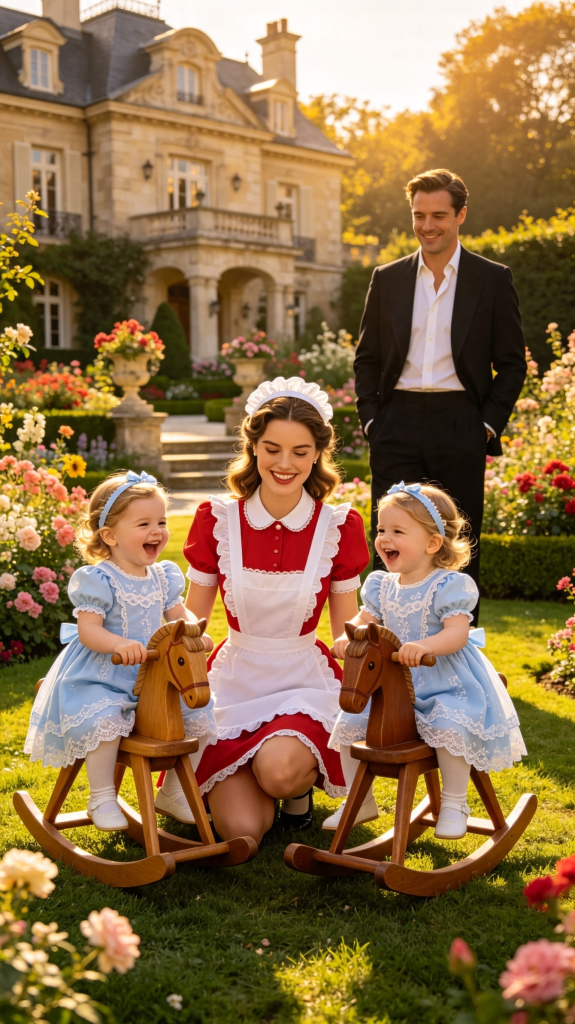
PART 2 — THE THING A POOR WOMAN CAN DO
The scarred man moved first. Not fast. That was the worst part. He moved with the patience of someone who had hurt people before and did not need to hurry. His wet coat brushed the dusty wine crates as he crossed the basement, one gloved hand reaching toward the broken window above me.
I threw the detergent can at his face. It struck his shoulder instead. The lid burst open. A sharp chemical smell filled the air, burning my nose and eyes. White liquid splashed across his black coat and dripped onto the stone floor.
He cursed. Renata stepped back, disgust flashing across her perfect face. “You stupid woman.”
I grabbed another bottle from the shelf. Floor cleaner. Bleach. Something industrial and blue. I did not care. I hurled it too, then another, then a rusted corkscrew, then a broken piece of wood from the smashed door.
I was not fighting like a brave person. I was fighting like a woman who had scrubbed other people’s blood from marble floors and knew exactly how much one body could leave behind.
The scarred man lunged. His hand closed around my arm. Pain exploded up to my shoulder.
I drove my knee into him with everything I had. He grunted. His grip loosened.
I tore away and shoved the crate toward the window, blocking his path. The movement sent agony through my back, white and hot. I nearly fell.
Above us, thunder rolled. Outside, one of the twins cried again. “Luna!” I shouted through the window. “Run!”
Renata slapped me. My head snapped sideways. For one second, the basement went black at the edges.
Then her fingers closed around my jaw, nails digging into my skin. “You think they will love you for this?” she hissed. “You think the rich keep servants who know too much?”
I tasted blood. “I think children should not be tied up in basements.”
Her eyes went flat. All the sweetness left her face.
There are monsters who rage. There are monsters who scream. Renata did neither. She became quieter. Colder. The woman beneath the perfume finally showed herself.
“You people are sentimental about the strangest things,” she said. “You people?” “Poor people. Staff. Women who confuse proximity with family.”
That one landed. Because she knew. She knew how I packed extra fruit in the girls’ school bags. How I warmed their towels after baths. How I braided their hair on mornings when Renata said she was “not in the mood for childish fuss.” How I kept cough syrup in the kitchen because Don Alonso forgot and Renata never noticed.
She knew I loved them. And she thought love was a weakness she could name and dismiss.
The scarred man had recovered. He wiped detergent from his cheek and looked at Renata. “Enough.” His voice was gravel.
He pulled a knife from inside his coat. Not large. Not dramatic. A working knife. Sharp. Familiar.
I backed toward the wall.
Renata glanced at the window. “Do not kill her yet,” she said. “Alonso may need to hear her voice.”
My stomach turned. “What?”
Renata smiled again. That terrible soft smile. “He trusts you, Teresa. He listens when you say the girls are well. He will sign faster if he hears you crying.”
The knife in the scarred man’s hand caught the light.
I thought of my own children then. Not because I had any. Because I had wanted them once. Before my husband drank away our savings and died in a worksite accident after everyone had already decided he was careless enough to deserve it. Before life shrank into rented rooms, aching knees, and envelopes of cash folded carefully in drawers. Before I learned that some women do not become mothers by birth, but by returning to the same house every morning and noticing who has not eaten.
Lucía and Luna had not come from my body. But they had found the empty room in my heart and filled it with noise.
The scarred man came closer. Behind him, on the basement shelf, I saw an old brass bell used once to call staff during wine tastings. Heavy. Cracked at the handle.
I let myself stumble sideways. He followed.
When he reached for me, I grabbed the bell and swung. It struck his temple with a dull, awful sound. He dropped to one knee.
Renata screamed, not in fear but fury.
I ran for the stairs. I got three steps before the man caught my ankle. I fell hard. My chin hit stone. Pain burst through my mouth.
He dragged me down the stairs as I kicked and clawed, my nails scraping the floor. Renata stood above us, breathing hard, eyes bright with hatred.
Then, from outside the basement window, came a new sound. A dog barking. Deep. Furious.
The old guard house had dogs. Not pets. Not the little decorative dogs Renata liked in magazines. Working dogs. Big ones. Trained by the night guards, fed by the cooks, loved secretly by the girls.
My heart lifted. They had reached the guard house. Or at least one of them had.
Renata heard it too. For the first time, fear touched her face. “Go,” she snapped at the scarred man. “Now.”
He looked at me. Renata’s voice sharpened. “I said go.”
He released my ankle and ran up the stairs. I heard the basement door open. Rain rushed in. Then his steps disappeared overhead.
Renata and I were alone.
For three seconds, neither of us moved. Her eyes lowered to the knife the man had dropped when I struck him. Mine did too.
We both moved at once. She was younger. Faster. But I was closer.
My fingers closed around the handle just before hers did. Renata grabbed my wrist. We struggled on the damp stone, silk blouse against cleaning uniform, diamonds against blood. Her perfume filled my nose. Sweet. Expensive. Rotten.
“You ruined everything,” she spat. “No,” I said, forcing the knife away from both of us. “You did.”
She laughed. A hard, ugly sound. “You think Alonso will thank you? You think he will choose you over me? He barely sees those girls unless someone reminds him.”
“Because you made sure of that.” “I did what was necessary.” “For money?” “For survival.”
The word came out sharp enough to surprise me.
Renata’s grip tightened. “You have no idea what men like Alonso do when they stop wanting you. They put you in an apartment. They give you jewelry. They say you are lucky. Then one morning, you are forty, invisible, replaced by a younger girl with brighter teeth.”
“So you tied up children?” “I secured my future.”
Her honesty was worse than lies.
I twisted my wrist. The knife slid across my palm. Heat opened there. Blood spilled over both our hands.
Renata recoiled, and I shoved her away. She struck the wine rack. Bottles trembled. One fell and shattered, red wine spreading across the floor like a second kind of blood.
Then the mansion above us erupted. Voices. Shouting. A dog barking near the terrace. Men running.
Renata froze.
Then came a sound I had never heard in that house before. Don Alonso Alcázar shouting his daughters’ names. “Lucía! Luna!”
Renata’s face changed. Not fear now. Calculation.
She straightened, smoothed her blouse, and looked at the blood on her hand as if it belonged to someone else. Then she turned toward the stairs.
I understood too late. She was going to become the victim.
She ran up the steps screaming. “Alonso! Help me!”
I staggered after her, one hand bleeding, mouth split, knees weak.
By the time I reached the top, the mansion was chaos. Guards filled the hall. The old gardener, Mateo, stood near the service entrance with a shotgun I had never known he owned. Rain blew in through open doors. One of the guard dogs barked from the veranda, held back by a young security man.
And there, in the middle of the marble entrance, Don Alonso knelt with both daughters in his arms. Lucía was sobbing into his shoulder. Luna clung to his neck so tightly her small fingers had gone white.
Alonso looked nothing like the powerful man from newspapers. He looked like a father whose soul had left his body and returned damaged.
His eyes found mine over the girls’ heads. For one second, relief crossed his face. Then he saw the blood. Then he saw Renata.
She stumbled toward him, crying beautifully. “Alonso,” she gasped. “Thank God. Teresa went mad. I found her with the girls. She had a knife. She attacked Manuel. I tried to stop her.”
The house went still. I could not breathe.
Renata held out her blood-smeared hand. My blood. “She was trying to take them,” she whispered. “I think she wanted money.”
Alonso stared at her. Then at me. Everyone stared at me.
Poor Teresa. Cleaning woman Teresa. Woman with no family in the house, no power, no diamonds, no polished grief.
My uniform was torn. My hands were bloody. I had a knife cut across one palm and chemicals on my sleeves. I probably looked wild enough to fit the lie.
Luna lifted her head from Alonso’s shoulder. “No,” she cried.
Renata’s eyes flicked to her. A warning. The child went pale. Silent.
Alonso felt her stiffen. He looked down at his daughter. “Luna?”
She shook her head. Renata began crying harder. “Alonso, please, she frightened them. They are confused. She told them what to say.”
Lucía made a small sound. Not a word. A broken little breath.
I realized then that fear had not left them in the basement. It had followed them upstairs. It had Renata’s perfume.
Alonso stood slowly, still holding Luna, with Lucía pressed to his side. “Teresa,” he said.
His voice was unfamiliar. Careful. “Tell me.”
Two words. Not an accusation. Not yet. But not trust either.
And that hurt more than I expected.
Because I had carried his sleeping daughters from cars when he came home late. I had cleaned fever vomit from their sheets. I had found the birthday candle Elena saved from their first cake and hidden it safely when Renata wanted to throw “old sentimental trash” away.
I had loved inside his house invisibly. And now invisibility had become evidence against me.
“I found blood in their room,” I said. My voice shook. “I found them in the basement. Their wrists were tied. Renata did it. She had Manuel with her. She said if the girls screamed, you would die. She said without your daughters, you would sign anything.”
Renata gave a choked laugh. “Listen to her. She sounds insane.”
Manuel appeared then from the west corridor, one hand pressed to his temple, scar white against his wet skin. He looked at me with hatred. “She hit me,” he said. “She attacked us.”
“Because you were going after the girls,” I shouted.
Renata flinched just enough. Not much. But enough.
Alonso saw it. His eyes narrowed. “What documents?” he asked Renata softly.
She blinked. “What?” “Teresa said I would sign anything. What documents?”
Renata’s tears paused. Only for a fraction. But lies often die in fractions. “I don’t know,” she said.
Manuel shifted near the wall.
Alonso looked at him. “You work for Vargas.”
The name changed the room. Mateo crossed himself. One of the guards reached inside his jacket.
Renata went still.
I did not know then who Vargas was. Later, I would learn. Emilio Vargas. Businessman in public. Predator in private. A man who bought shipping routes, judges, policemen, widows, and silence. A man Alonso had refused to partner with twice. A man who did not take refusal well.
Alonso’s voice went dangerously quiet. “Why is a Vargas man in my house?”
Renata recovered fast. “He came to warn me. About Teresa. He saw her near the basement earlier.”
“That is not what I asked.” “Alonso—” “What documents?”
This time, the question struck like a blade.
Renata’s face hardened. For the first time, she looked directly at the man she had planned to marry and understood that beauty was no longer protecting her.
And that was when Manuel pulled his gun.
Everything happened at once. A guard shouted. Luna screamed. Alonso turned, using his body to shield both girls.
I saw Manuel raise the weapon. I saw Renata step back. I saw, with awful clarity, that Manuel was not aiming at Alonso. He was aiming at Lucía.
Because Renata had been right about one thing. Without his daughters, Alonso would sign anything.
I moved. I do not remember deciding. I only remember the marble rushing beneath my feet, the sound tearing out of me, and the shocked widening of Manuel’s eyes as I threw myself between the gun and the child.
The shot cracked through the foyer. Pain bloomed in my side. Hot. Huge. Impossible.
I fell. Someone screamed my name. The ceiling above me glittered with chandelier light.
For a moment, I thought how strange it was to die under something so beautiful.
Then Luna’s face appeared above mine, wet with tears. “Teresa,” she sobbed.
I wanted to tell her to run. But there was blood in my mouth.
Alonso’s voice roared somewhere above us. Men shouted. Another shot. A body hit the floor. Renata screamed once.
Then the world began to fade at the edges.
Luna’s small hand touched my cheek. “Please don’t go,” she whispered.
I tried to lift my hand. I could not.
So I looked at her as hard as I could. I wanted my eyes to say what my mouth could not. I am here. You are safe. I lied before, but not now.
Then the chandelier light dissolved.
PART 3 — THE TRUTH UNDER THE FLOOR
When I woke, the world was white. White ceiling. White sheets. White bandage wrapped tight around my ribs.
For one foolish moment, I thought I was back in the twins’ bedroom, staring at the white floor where the blood had been.
Then pain found me. It came in deep, burning waves, and I made a sound before I could stop myself.
A chair scraped. “Teresa?”
Don Alonso stood from beside the bed. He looked as if he had not slept in years. His suit jacket was gone. His shirt was wrinkled. His eyes were red. There was gray in his hair I did not remember seeing before.
For several seconds, I could not speak.
He reached for the water glass, then stopped. “May I?”
The question made me want to cry. I nodded.
He helped me drink through a straw, his hand trembling slightly. “You are in the hospital,” he said. “You had surgery. The bullet missed your lung by less than an inch.”
The memory returned in fragments. The foyer. Manuel’s gun. Luna’s face.
“The girls,” I rasped. “They are alive.”
My eyes closed. Something inside me loosened. “They are safe,” he said. “Lucía has a cut on her foot from the grate. Luna is dehydrated and frightened. But they are safe.”
“And Renata?”
Alonso’s face changed. “She is in custody.” “Manuel?” “Dead.”
I looked at him. He did not look away. “One of my guards fired after he shot you.”
Silence settled. Not the mansion silence. A different one. Human. Heavy.
Alonso sat slowly. “I failed them,” he said.
The words came out flat. Almost calm. But I heard the wreckage beneath.
“I was in the house,” he continued. “Every day, I was in that house. I signed papers. Took calls. Flew to meetings. I thought grief was something I could schedule around them. I thought providing for them was the same thing as seeing them.”
I swallowed. Pain moved through me. “They love you,” I said.
His face crumpled. “That makes it worse.”
“No,” I whispered. “That makes it not too late.”
He covered his mouth with one hand. For a long time, he said nothing.
Then, “Why did they call for you?” “What?” “When they woke last night. They asked for you before me.”
I looked at the window. Rain streaked the glass. Of course it was still raining. In stories, rain stops when danger passes. In life, weather does not care.
“I was there in the mornings,” I said. My voice was rough. “That is all.”
“No,” Alonso said softly. “It is not.”
I looked back at him. His eyes held something I did not know what to do with.
Gratitude was easy to distrust. Rich people were often grateful to servants in the way people were grateful to umbrellas: sincerely, briefly, and only during storms.
But this was not that. This was shame. And recognition.
“The basement,” I said. “Why was it locked from the outside?”
His face tightened. “It was Elena’s wine cellar. After she died, I stopped going down there.” “Renata said it held documents.” “Yes.” His jaw clenched. “Vargas wanted me to sign over control of three port warehouses. I refused. Renata had access to my private office. We believe she copied old signatures, created drafts, prepared transfers. If the girls disappeared, she planned to make me believe Vargas had them. Then she would give me the papers as the price for their return.”
“And afterward?”
Alonso’s eyes went cold. “Afterward, she would have married me with enough leverage to own half my company and enough secrets to control the rest.”
A chill passed through me. “She almost did it,” I said. “Yes.”
He lowered his gaze. “And I invited her into their home.”
There was no comfort I could offer that would not be a lie. So I said nothing.
That was when the door opened. Lucía and Luna came in wearing hospital pajamas too large for them, each holding one side of a drawing.
A nurse stood behind them, anxious. “They insisted,” she said.
Alonso stood quickly. “Careful, niñas.”
But they were already moving toward me. Luna climbed into the chair beside my bed. Lucía stood close enough to touch the blanket but not me, afraid of hurting me.
Their faces were pale. Their eyes too old. That made anger burn hotter than pain. Children should not have eyes like that.
“We made this,” Luna whispered. She held up the paper.
It showed a house. A huge white house with blue windows, green grass, yellow sun. In front of it stood four stick figures. Two small girls. One tall man. One woman in a blue cleaning dress.
Above the woman’s head, Lucía had drawn something with red crayon. At first, I thought it was blood. Then I realized it was a cape.
“You’re Super Teresa,” Luna said.
I laughed. It hurt so badly I gasped. Everyone panicked. “I’m fine,” I wheezed. “No more jokes.”
Lucía began to cry. Quietly. Her lower lip trembled, and then she folded in on herself. “I’m sorry,” she said.
My heart broke. “For what, mi amor?” “For crying outside. The bad man heard me. You got hurt because I cried.”
“No.”
The word came out stronger than I expected. Both girls froze.
I pushed through the pain and lifted my hand just enough for her to take it. She did.
“Listen to me,” I said. “You cried because you were scared. That is what children are allowed to do. Grown-ups are supposed to come when children cry.”
Lucía stared at me. “Renata said crying makes people weak.” “Renata lied about many things.”
Luna’s voice was tiny. “Are we bad?”
Alonso made a sound like something breaking.
I reached for her too. “No,” I said. “Never. You are brave. You are loved. And you are never, never responsible for what bad people do.”
Alonso knelt beside them. “I should have told you that every day,” he whispered. “I will now.”
Lucía looked at him. “Are you mad?” “No, my love.” “At us?” “No.” “At Teresa?”
His eyes met mine. “No,” he said. “Never at Teresa.”
Luna leaned against my bed. “Can she come home?”
The question silenced the room.
Alonso looked at me. The nurse looked at the floor. I looked at the twins.
Home. Such a small word for something I had never really owned.
I had rented rooms. Shared apartments. Stayed in servants’ quarters when buses stopped running. I had slept in clean beds and on thin mattresses. I had keys to many houses but claim to none.
Home had always belonged to other people.
“You need rest,” I said gently. “That’s not an answer,” Luna whispered.
She had always been the sharper one.
I smiled despite the ache in my side. “No. It is not.”
Alonso stood slowly. “We will discuss it when Teresa is stronger.”
That should have been the end. It was not.
Because three days later, the police came with questions. Then lawyers. Then officials. Then men in suits who spoke to Alonso in low voices and looked at me as if I were either a hero or an inconvenience, depending on what their jobs required.
Renata confessed to nothing. Of course she did not. She claimed Manuel had acted alone. She claimed I had attacked her. She claimed the twins had been manipulated. She claimed Alonso was grieving and unstable.
Then the security footage was recovered. Not from the basement. Renata had disabled those cameras. From the nursery hallway.
The footage showed her entering the girls’ bedroom at 6:13 in the morning, carrying Luna in her arms while Manuel dragged Lucía behind him. It showed Lucía dropping the blue bow. It showed Renata stepping on the doll. It showed, for one brief second, Luna twisting hard enough to scratch Manuel’s wrist and Lucía striking her foot against the corner of the bed.
That was the blood. One small red stain on the white floor. One tiny wound that started the unraveling of an empire.
Renata’s lawyers changed strategy after that. Alonso did not.
He visited every day. At first, I thought it was guilt. Then I thought it was gratitude.
Then, on the tenth day, he brought a small wooden box and placed it on my hospital table. “What is that?” I asked. “Elena’s.”
I went still. “Why are you giving me your dead wife’s things?” “Because she left this for you.”
The room shifted. “For me?”
He opened the box. Inside was a letter. My name was written on the envelope in handwriting I recognized only from birthday cards and shopping lists. Teresa.
I stared at it. “Elena wrote this?” “Two months before she died,” Alonso said. “I found it yesterday in her desk. There were letters for me. For the girls. And this.”
My fingers trembled as I opened it.
Dear Teresa, If you are reading this, I am gone, and Alonso has finally found the courage to open the things I told him not to ignore.
Forgive him. He is a good man, but good men can be cowards when grief asks them to look directly at what they have lost.
I am writing because there is something I should have said while I was alive. You love my daughters. I saw it before you did. I saw it when Luna had a fever and you sat by her bed all night, pretending it was because the laundry was not finished. I saw it when Lucía refused to eat after my first surgery and you made soup exactly the way my grandmother did, though no one had taught you. I saw it every time I walked into a room and found my girls calmer because you were there.
Thank you.
But there is more. Years ago, before the twins were born, Alonso and I made a legal arrangement. If anything happened to me, and if Alonso became unable to see what the girls needed because grief made him blind, I wanted you named as their guardian advisor. Not nanny. Not servant. Family.
He argued. Of course he argued. Men like Alonso think love can be organized through documents and salaries.
But I knew better. I knew there are women who enter a house to clean it and end up holding its heart together.
I do not know what the future will ask of you. I only know that if my daughters ever need someone to choose them without calculation, it will be you.
Please choose them. With love and trust, Elena Alcázar.
By the end, I could not see. The letter trembled in my hands.
Alonso’s voice was rough. “She knew,” he said.
I pressed the paper to my chest. The hospital room blurred.
For years, I had thought love counted only when the world gave it a title. Mother. Wife. Family. Blood.
But Elena had seen me. Not as staff. Not as a woman in a blue uniform moving quietly between rooms. She had seen the way I loved. And she had named it before anyone else.
I looked at Alonso. His eyes were wet.
“There is more,” he said.
I almost laughed. “More than being shot, framed, and emotionally destroyed by a letter from a dead woman?”
His mouth moved faintly. “Much more.”
He reached into the box and pulled out a second document. Legal papers. Old, notarized, sealed.
My stomach tightened. “What is that?” “Elena amended her will after the twins were born.” He swallowed. “If she died, and if I remarried before the girls turned seven, any marriage contract would be invalid unless approved by the guardianship council named in her private documents.”
I stared at him. “What guardianship council?”
He looked at me. “You.”
The word landed softly. Then heavily.
I sat very still. “Elena gave you authority over whether Renata could legally become part of the girls’ inheritance structure,” Alonso said. “I never knew. My lawyers never knew because Elena sealed it separately. But Renata knew.”
The air went cold. “What?”
“We found copies in her apartment. She knew about the clause. She knew if I married her before the twins turned seven, and if the documents surfaced, you could challenge everything.”
My mouth went dry. “She did not just need you to sign the port warehouses.” “No.”
Alonso’s voice dropped. “She needed you gone.”
The room tilted. The basement. The golden ribbon. The threats.
Renata had not tied up the girls only to control Alonso. She had done it to create a crime. A story. A servant gone mad. A woman dangerous enough to remove.
The plan had not been to kill the girls. It had been to make me look like I might.
My body went cold despite the blanket. “She was going to blame me,” I whispered. “Yes.”
“And after I was arrested…” “She would marry me. Challenge the guardianship clause. Claim Elena was unstable when she signed it. Remove you permanently from the girls’ lives.”
I closed my eyes. Happy then wrecked. That was how truth came sometimes. First, the warmth of Elena’s trust. Then the horror of knowing that trust had made me a target.
Alonso’s voice broke. “Teresa, I am sorry.”
I opened my eyes. He looked smaller than his wealth. Smaller than his name. Just a man surrounded by the ruins of the things he should have noticed.
“Do the girls know?” I asked. “No.” “Good.” “They will someday.” “Yes,”Edited Caption:
The first thing I discovered was a red stain on a child’s white bedroom floor.
The first thing I found was blood on a child’s white bedroom floor. Not much.
