


PART 1
By the time we reached the checkout counter, my husband’s face was completely red, his voice was echoing beneath the fluorescent lights, and the teenage cashier was doing everything she could to avoid making eye contact with us.
“You expect my mother to pay for her own groceries?” Daniel snapped.
He said it so loudly that a woman in the next checkout lane turned around to look.
I stood there with both hands on the cart handle and gave him the calm little smile people have when they have already stopped caring about appearances.
The cart between us was filled with things I had never picked.
Smoked salmon.
Imported French cheese.
Olive oil that cost more than my lawn-mowing shoes.
Two bottles of aged balsamic vinegar.
A gold box of chocolate truffles.
A tin of “proper sardines,” as my mother-in-law Patricia had called them.
And sitting among the milk, bread, and eggs like a tiny black crown was a jar of actual caviar.
Patricia stood at the end of the conveyor belt, her reading glasses resting low on her nose, her silk blouse perfectly smooth, and her expression locked into that wounded, innocent look she had perfected over the years.
Patricia had a way of making entitlement appear like kindness.
It took me six years to understand how dangerous that could be.
The amount appeared on the register.
$1,012.46.
My own groceries would have been around $120.
I already had my card in my hand.
Then I placed it back inside my wallet.
“I’ll pay for my things,” I said calmly. “Patricia can pay for hers.”
Daniel stared at me as if I had just insulted his entire family.
“You can’t be serious. She’s family.”
“Yes,” I said. “She is also retired, has a pension, owns her condo, and clearly has expensive taste.”
Patricia gave a quiet sigh.
“Oh, Claire. I never thought you would make something like this an issue.”
That was Patricia’s favorite move.
She turned her own expectations into my mistake.
I looked at Daniel, the man I had loved for eight years and been married to for six, standing there angry at me while his mother silently watched him fight her battle.
“All right, sweetheart,” I said softly. “Be angry if you need to.”
Then I added,
“But the real surprise is still coming.”
Daniel had no idea what I meant.
Neither did Patricia.
But I did.
My name is Claire.
I was thirty-four years old, and for six years I had been married to a man who loved his mother in a way he confused with loyalty.
At first, Daniel’s devotion seemed sweet.
He called Patricia every Sunday, remembered her half-birthday, drove across town to fix her Wi-Fi, and replaced lightbulbs she could easily reach herself.
I lost my mother when I was young, so seeing a man care about his mother never seemed like a warning sign.
It seemed loving.
I had not yet learned that affection without boundaries can become weakness.
Patricia was sixty-three, retired, financially comfortable, and somehow always the person being wronged.
“After everything I’ve done for this family,” she often said, usually moments before asking for something.
“I’ve always given and given,” she would sigh, usually when nobody had figured out what she wanted.
I bought our house myself two years before I met Daniel.
I spent six years saving enough to afford it.
That house was the first thing in my life that I had truly earned.
When Daniel and I got married, he moved in.
His name was never placed on the deed.
Not because I had some hidden intention.
We simply never talked about it.
Now I understand there are no real accidents in marriage.
There are choices you make openly, and choices you allow to happen quietly.
Patricia noticed the house immediately.
Not with warmth.
With calculation.
The curtains were too dark.
The garden was too untidy.
The herbs above my kitchen sink blocked the natural light.
She delivered every criticism in a helpful tone, making it seem impolite to disagree.
So I learned to redirect.
“That’s interesting, Patricia. I’ll think about it. Have you tried the focaccia?”
Food usually worked.
Patricia enjoyed being served almost as much as she enjoyed being right.
Looking back, I can see the warning signs.
The house listing she sent Daniel with the message,
“Wouldn’t this suit you better?”
The framed picture of only her and Daniel that she placed on our entryway table without asking.
The way she started calling our guest room “my room,” laughing just enough to make it seem like a joke.
Then, one week before Christmas, she stood in my kitchen and said some families worked better when everyone combined resources.
“It’s more efficient,” she said. “More secure.”
I thought she was talking about holiday arrangements.
I had no idea she was preparing for something much bigger.
Three days before the grocery store incident, I found the folder.
I was searching for a water heater receipt in our home office when I opened the bottom drawer of the filing cabinet.
Behind the hanging folders was a plain manila folder.
No label.
Only a penciled number two written in Patricia’s handwriting.
Inside were eleven pages.
Real estate listings covered with her notes.
“Good for two households.”
“Separate entrance important.”
“In-law suite potential.”
Then came a handwritten letter addressed to Daniel.
“My darling boy,” it began.
Patricia wrote that she was worried about the long-term stability of the household.
She had discovered that the deed was only in my name, which she described as a weakness in the family structure.
Her solution was for us to sell my house and purchase a new property owned by Daniel, Patricia, and possibly me.
Possibly.
If I agreed.
An optional guest in my own future.
The next pages were emails between Patricia and a real estate attorney named Gerald Foss.
They discussed how a quitclaim deed could be presented to me as a simple administrative update.
Then came the draft deed.
Our address was typed at the top.
Daniel’s name was listed.
Patricia’s name was listed.
My name appeared only once.
Grantor.
The person who was surrendering everything.
A sticky note was attached.
“D, review before Tuesday. She trusts you. Use that.”
The final page contained a financial breakdown.
Next to “C’s share,” the amount was obvious.
Zero.
I sat on the office floor, the folder resting in my lap, while Daniel laughed downstairs at the television.
That ordinary sound almost shattered me.
Because inside the home I had paid for, decorated, and protected, I was holding evidence that my husband had known for six weeks that his mother was trying to take my house—
And he had stayed silent.
PART 2
The first emotion I felt was not anger.
That came later.
What came first was clarity.
Patricia was not merely demanding.
She was calculated.
And Daniel was not just avoiding an argument.
He was choosing to keep me unaware because it was easier for him.
I returned everything exactly the way I had discovered it.
Then I went downstairs and sat beside my husband for forty minutes while football played on the television.
Before we went to sleep, he kissed the top of my head.
I allowed him to.
Then I stayed awake until after two in the morning, making plans.
The next morning, I contacted Helen Park, the attorney who had managed my home closing years earlier.
I told Daniel I was going out for errands and made the call from my car outside the library.
Helen listened carefully.
Had anything been signed?
No.
Was Patricia living in the house?
No.
Had Daniel contributed to the mortgage in a way that changed ownership rights?
No.
Did I have copies?
Not yet.
“Make them,” Helen said. “And don’t alert anyone until you do.”
She explained that no crime had happened at that point, but the folder proved there was a clear intention behind the plan.
If anyone attempted to pressure me later, having evidence of what they intended would matter.
Then I called my father.
Robert was sixty-one, retired from civil engineering, and the calmest person I knew.
He listened quietly without interrupting.
When I finished, he asked,
“Do you want me there?”
“Not yet,” I said.
“I’ll come when you do.”
For the next two days, I acted carefully.
I copied every page at a shipping store ten miles away.
I photographed everything and stored it inside a password-protected folder.
I created a timeline.
I reviewed my closing paperwork.
Then I observed.
I watched Daniel message his mother while he cooked.
I watched him hesitate whenever I asked ordinary questions.
Once you recognize the pattern, you cannot pretend you don’t see it.
By Saturday, when we entered the grocery store, I was no longer uncertain.
I was prepared.
Patricia pulled out her own list the moment we walked inside.
She led us toward the specialty aisles for “just a few special things.”
Those few things turned into salmon, cheese, crackers, truffles, sardines, balsamic vinegar, and eventually caviar.
She lifted the small black jar from the cooler and said,
“Isn’t this lovely?”
She expected me to become the same person I had been for six years.
The woman who paid whenever Patricia “forgot” her wallet.
The woman who covered the bill when Patricia ordered extra wine.
The woman who allowed her to reorganize my pantry instead of causing an argument.
But that woman did not walk into checkout lane seven that morning.
After the cashier scanned everything and I refused to pay for Patricia’s expensive groceries, the ride home was silent.
Patricia sat rigidly in the back seat.
Daniel held the steering wheel as if it had personally betrayed him.
I stared out the window and thought,
They still don’t know what I know.
At home, the groceries were put away under a different kind of silence.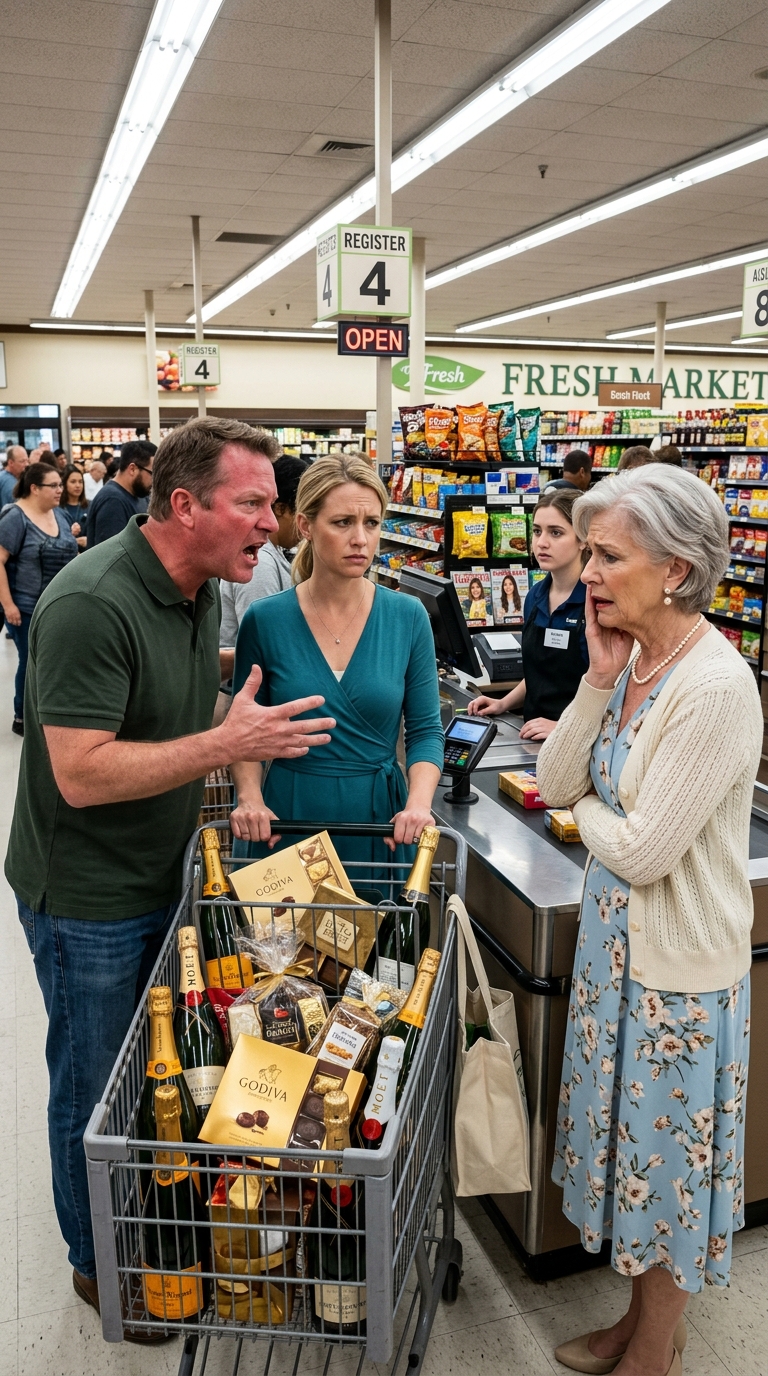
Milk in the refrigerator.
Eggs in the drawer.
Truffles into Patricia’s bag.
Daniel opened and closed the refrigerator twice without removing a single thing.
That was his signal.
He wanted someone else to begin the difficult conversation.
“I think we should talk,” he finally said.
“All right,” I replied.
“Mom didn’t mean to put you in an uncomfortable position. She just gets carried away. You know how she is.”
“She chose caviar,” I said. “That isn’t getting carried away. That’s caviar.”
Patricia raised her chin.
“Claire, I do hope you don’t think I take advantage. I have always tried to support you and Daniel and this household.”
“I know you believe that,” I said.
Something shifted across her face. Not pain.
Recalculation.
“Then what is this really about?” she asked.
“It’s not about groceries.”
“No,” Patricia said softly. “I didn’t think so.”
I flattened the paper bag on the counter.
“I found the folder.”
The kitchen became completely silent.
Daniel’s face lost all color.
Patricia’s expression remained unchanged.
That was how I knew she understood exactly which folder I was talking about.
“The bottom drawer,” I said. “Behind the hanging files. Eleven pages. Real estate listings. A letter to Daniel. Emails with Gerald Foss. A draft quitclaim deed with my name as the grantor. A financial breakdown where my share is zero.”
“Claire,” Daniel started.
I looked directly at him.
“She trusts you. Use that. That was written on the sticky note attached to the deed. In your mother’s handwriting. Addressed to you.”
His silence spoke louder than any denial could have.
“You knew,” I said.
“Mom came to me about six weeks ago,” he admitted, staring at the floor.
“And you didn’t tell me.”
“She asked me not to.”
He realized the meaning of his own words too late.
Patricia stepped forward, her tone becoming sharper.
“You’re being dramatic. Nothing was signed. We were exploring options.”
“There was a partially completed quitclaim deed in my home office.”
“A draft.”
“A plan,” I corrected.
“What happens to Daniel if something happens to you?” she demanded. “What happens if you leave? He has no legal claim to the house he lives in.”
That was a legitimate question.
So I answered.
“There are fair ways to handle that. A direct conversation with me involved. An estate attorney. Honest planning.”
I looked at them both.
“What is not fair is secretly preparing documents and coaching my husband to pressure me into signing them.”
“I was not manipulating anyone,” Patricia said.
“The note said, ‘She trusts you. Use that.’”
For the first time, Patricia’s calm exterior broke.
She was not used to losing control over her own version of events.
And then I finally understood her.
She was afraid of a future she could not command.
Her son living in a house owned by his wife.
A life built without her being at the center of it.
That fear did not justify what she had done.
But after understanding it, I was no longer afraid of her.
“I want you to leave,” I said.
“This is my son’s home.”
“No,” I said. “It isn’t. Not legally. And you know that better than anyone here. That is the entire reason for your plan.”
Patricia looked at Daniel, waiting for him to save her.
For several seconds, he stayed silent.
Then he said,
“I’ll call you tonight, Mom.”
The expression on her face almost made the entire terrible day feel worth it.
Not because I wanted to hurt her.
But because, for the first time in six years, Daniel did not immediately rush toward her needs.
Patricia picked up her coat and walked out with fragile dignity.
A minute later, her car disappeared down the driveway.
Then there was only Daniel and me.
And the quiet sound of the refrigerator.
“Claire,” he said. “I’m sorry.”
“I know,” I said. “But sorry is not the whole conversation.”
He nodded.
“Tonight.”
Right then, I moved my herbs back to the windowsill.
One at a time, I placed every clay pot exactly where I wanted it.
For the first time in a long while, I felt myself returning.
PART 3
That evening, Daniel found me sitting in the armchair beside the window.
Not the couch.
The coffee in my hands had already gone cold.
He told me everything.
Patricia had called him at work six weeks earlier, presenting the entire idea as concern, caution, and sensible planning.
The old fear she had planted in him since childhood took control before logic had a chance.
He told himself he was only looking over information.
Only collecting details.
Only thinking about possibilities.
Small lies good people tell themselves when they are doing something wrong and do not want to admit what it is.
“What about the sticky note?” I asked.
“I saw it,” he said. “I knew it was wrong. I told myself it only meant you and I had a good relationship, that you would hear it better from me.”
He paused.
“But yes. I knew what she meant.”
I asked what he would do if Patricia came to him again with another version of the same plan.
“I’d tell her no,” he said.
“And if she cries?”
Silence filled the room.
A long history stood between us.
Then he answered more quietly.
“I’d tell her no.”
The first answer had been instinct.
The second required effort.
And that mattered.
I told him about Helen.
About the letter that was ready to be sent to Gerald Foss.
Daniel asked me to wait until Saturday.
He wanted to speak with his mother the right way, with me present, and truly stand by his words this time.
I agreed on one condition.
If the conversation turned into minimizing, excuses, or attempts to control the situation, the letter would be sent on Monday.
Saturday morning, Patricia arrived exactly at eleven.
Calm, but noticeably pale.
Daniel did exactly what he promised.
He did not excuse her actions.
He did not reshape them into something more acceptable.
He told her that speaking with an attorney about my house without my knowledge was wrong.
That involving him in secrecy was wrong.
That if she ever attempted something like that again, their relationship would change in ways she would not appreciate.
Eventually, Patricia turned toward me.
“I owe you an apology.”
Her voice did not completely carry the emotion behind the words.
But honest words still have value, even when the feelings behind them take longer to arrive.
I told her that from that point forward, any concerns about our legal or financial arrangements would be discussed openly, with me included.
No private meetings.
No secret paperwork.
No controlling me through my husband.
She said she understood.
Something inside me finally relaxed.
Not trust.
Not forgiveness.
Just the realization that a boundary had finally been stated clearly in front of everyone who needed to hear it.
Sometimes, that is all you receive.
And sometimes, it is enough to create a beginning.
In December, Patricia made one more attempt.
She called Daniel about “revisiting estate planning,” gentler this time, almost emotional.
He told me right away.
Before dinner.
No waiting.
No trying to handle it alone first.
That mattered more than anything Patricia had actually said.
The letter was sent to Gerald Foss on Monday.
We never heard from him again.
Daniel and I attended couples therapy for three months afterward.
Our therapist, Mara, had silver hair and a way of making polite people finally say what they meant.
During our first session, she told Daniel he had prioritized loyalty to his mother over honesty with his wife because he was afraid of the discomfort that honesty would create.
When he started to argue, she said,
“That doesn’t make you evil. It makes you responsible.”
I almost cried in the parking lot afterward because someone who barely knew me had finally explained my hurt in simple words.
I had my own things to face too.
Not boundaries.
I had those now.
My work was understanding why I had accepted so much for so long and mistaken it for maturity.
Why I had confused endurance with being a good person.
Why protecting the peace had so often meant making myself smaller.
“My mother died when I was young,” I told Mara once. “My father was grieving. I became very good at being easy.”
Patricia had benefited from that for years.
Not anymore.
By spring, the smallest changes started feeling huge.
Daniel told me things immediately.
Not only major conversations.
Small remarks too.
If he noticed himself trying to soften something before telling me, he admitted that as well.
He stopped automatically seeing situations from his mother’s point of view first. The first time Patricia became upset because she felt left out of our Easter plans, Daniel calmly told her,
“Claire and I made this decision together.”
Then he told me about it afterward.
I nearly had to sit down from the surprise.
His apologies changed too.
Not, “I’m sorry you felt blindsided.”
But,
“I’m sorry I kept that from you.”
He began taking responsibility for what he had actually done.
Eventually, we handled the deed situation properly.
Not with Patricia.
With Helen.
In her office, with complete honesty, real information, and no hidden motives.
At the end of that meeting, Daniel said we should wait two years, make choices without pressure or guilt, and then revisit it together if it still felt right.
It was fair.
More importantly, it was something we chose freely.
That changed everything.
By May, the Japanese maple in our backyard had grown deep green again.
The herbs were flourishing on the windowsill.
One Friday evening, six months after the grocery store incident, I sat on the porch with iced tea and finally reached page eighteen of a novel that had been untouched on my nightstand since November.
The yard carried the scent of freshly cut grass and garlic drifting out from the kitchen.
Daniel was inside cooking and humming, searching for the skillet I had moved two shelves lower because that was where I wanted it now.
Patricia still came over for dinner sometimes.
Not as often.
Always after asking.
Always respectful in a way she had never tried to be before.
Her politeness still had a sharpness to it.
But it was still politeness.
And sometimes, that is enough.
One evening, she looked at the herbs and said the rosemary smelled wonderful.
“Thank you,” I said. “I grew it.”
That was the entire conversation.
And it was enough too.
A week later, my father drove down for Sunday lunch with greenhouse tomatoes that were grown almost entirely through stubborn determination.
He listened while I shared the newest version of the story.
Daniel mowed the back section of the yard and gave us privacy.
When I finished, Dad simply said,
“You handled it.”
“I did,” I said.
“Your mother would have liked that.”
I almost broke down right there on the porch.
Because of course, I had been thinking about her through all of it.
My mother was never someone who gave long speeches.
But she carried a quiet strength that could not be crossed beyond a certain point.
Sitting there, I realized I had inherited more of her than I had ever allowed myself to believe.
Months later, I went back to that same grocery store by myself.
I pushed my cart through the produce section.
Picked out lemons.
Compared coffee beans.
And felt absolutely no fear.
Near the checkout area, I stopped in front of the refrigerated luxury section and noticed the small jar of caviar.
I laughed quietly.
Then I walked away.
Because some symbols lose their meaning after they have caused all the harm they can.
The issue was never the caviar.
It was never truly about the groceries either.
It had always been about what people believe they can take from you once they have taught you to stay quiet.
I do not know whether Patricia ever completely changed deep down.
Maybe she did not.
But she changed how she treated me.
And sometimes, actions are what matter most.
Daniel did not become flawless either.
Nobody does.
But he became more aware.
More truthful.
More willing to handle someone else’s disappointment instead of sacrificing what truly mattered.
As for me, I stopped mistaking kindness for giving in.
I stopped treating my own discomfort as the thing that mattered least in every situation.
I stopped allowing “family” to become permission for anyone to access my effort, my money, my space, or my home.
The deed remains in my name.
The herbs remain on the windowsill.
The maple turns red every autumn and green every spring, quietly reminding me that roots do not need to be loud to stay strong.
And sometimes, on an ordinary Saturday morning, Daniel and I still go grocery shopping together.
Coffee thermoses sitting in the cup holders.
A short list.
A small debate about pasta brands.
No mother-in-law.
No caviar.
Just the two of us, building a life that almost got silently changed beneath my feet…
…but didn’t.
