

It was the kind of command I had heard my entire life.
“Put on the apron, Emily. The family didn’t come here to watch you sitting at the table like a guest.”
Those were the words my mother, Margaret, spoke while arranging the silverware on the main dining table, treating every polished fork as if it carried more importance than my own dignity.
My father, Harold, had invited the entire family to Thanksgiving dinner at his River Oaks, Houston home. He said he wanted to “bring everyone together like the old days,” even though we had never truly belonged together inside those walls. We had only been carefully presented, dressed appropriately, and taught how to maintain the illusion.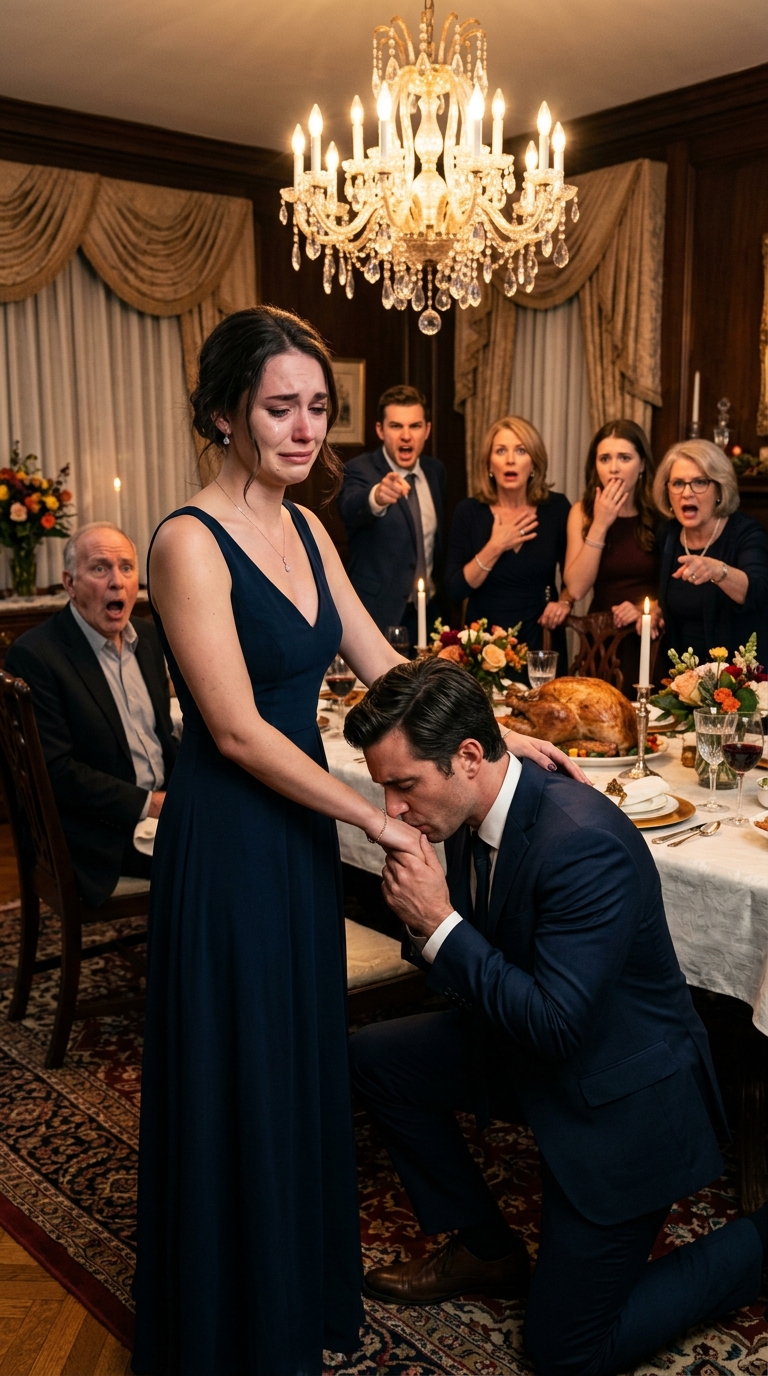
By six that evening, the house was filled with the aroma of roasted turkey, expensive wine, and designer perfume. My sister Claire arrived in an ivory dress, accompanied by her investment banker husband and their twin daughters dressed identically like perfect little dolls behind a store window. My brother Logan entered with a loud laugh, carrying a bottle of craft bourbon he had almost certainly purchased with one of my father’s credit cards. My aunts, uncles, cousins, and influential neighbors arrived with fake embraces, discussing real estate, development projects, politicians, and ski vacations in Aspen.
And I was in the kitchen.
My mother placed the apron into my hands like she was giving me a punishment.
“You know this kitchen better than anyone. Don’t make a scene. Serve, help, and try to look grateful.”
Grateful.
That was what I had been taught to become since I was seventeen.
Grateful for living under their roof.
Grateful for working in the family company without a proper salary.
Grateful for giving up college when my father’s construction business faced trouble and “everyone had to sacrifice,” even though I was the only person who truly lost something.
Claire continued her fashion studies in New York because, according to my mother, “she has presence.”
Logan was handed enough money to create three different businesses, all of which collapsed before he reached thirty.
I learned to prepare invoices, answer endless calls, care for my sick grandmother, and smile whenever people said:
“Emily is the strong one.”
The strong one was simply the person everyone expected to hold everything together without ever asking whether she was exhausted.
So I cooked.
I checked the turkey, warmed the green bean casserole my mother insisted on serving “to keep things traditional,” prepared mashed potatoes, sliced bread, washed dishes, and kept refilling wine glasses.
Every time I entered the dining room, I heard my mother complimenting Claire.
“My beautiful daughter has always known how to shine.”
Then she would turn toward Logan.
“And him—even if he’s a little wild—he was born for business.”
Nobody asked about me.
Nobody noticed that my own plate remained untouched beside the kitchen sink.
Around eight o’clock, while I was scrubbing a burnt serving tray, the doorbell rang.
The dining room instantly became quiet.
First, I heard footsteps approaching through the hallway. Then came the nervous voice of the young housekeeper.
“Mr. Whitmore… someone is here to see you.”
I didn’t even bother looking up. I assumed it was another delayed guest or one of my father’s business associates.
Then the kitchen became completely silent.
A man appeared in the doorway.
He wore a black suit, a dark overcoat, and shoes still carrying drops of rain. He was tall, calm, and carried the effortless authority of someone who never needed to raise his voice to command attention. His eyes moved across the dining room, then into the kitchen, until they stopped on me.
My hands were still damp, my hair was quickly tied back, and a mark of gravy stained my sleeve.
He walked directly toward me.
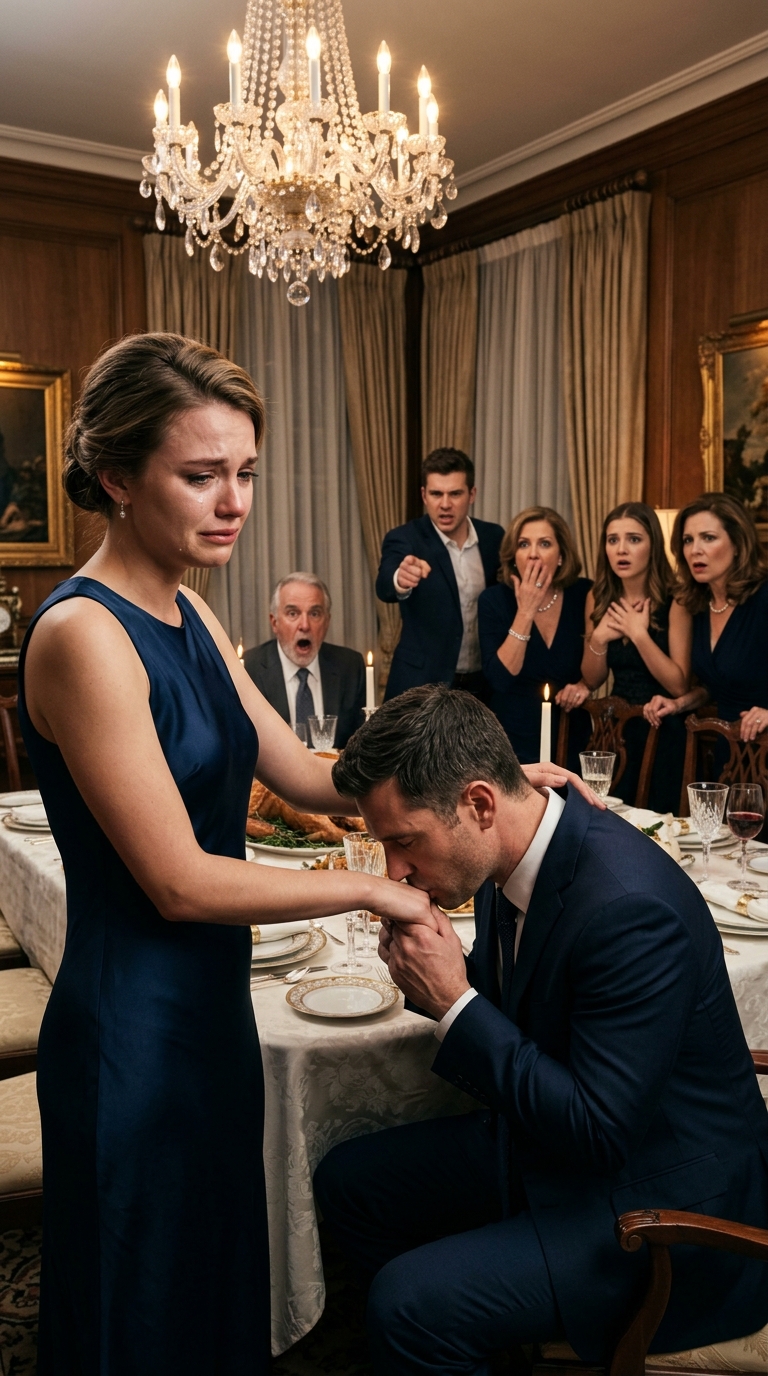
Before I could speak, he gently took my soapy hand, lowered his head, and kissed my knuckles.
“I’m sorry, my love,” he said. “I’m late.”
The entire dining room stopped breathing.
My mother’s face turned pale.
Claire stood up.
Logan muttered a curse.
Because this was not just another guest.
This was Nathan Cole, the owner of Cole Hospitality Group—the hotel magnate my father had spent the last six months trying to secure the biggest contract of his career from.
And he had just called me my love.
My father slowly stood, his face completely drained of color.
“Emily… do you know Mr. Cole?”
Nathan looked at the apron tied around my waist.
Then he looked at the dinner table prepared for everyone except me.
His expression hardened.
“I know her very well,” he said. “She’s my fiancée. And I’d like to know why she’s washing dishes while the rest of you are eating dinner.”
The word fiancée landed like a glass shattering across the table.
No one moved.
My mother opened her mouth, but for once, she had no cruel response ready. Claire stared at my hand as if searching for a ring I had never felt safe wearing around them. Logan forced out an uneasy laugh.
“No way, Emily,” he said. “Since when?”
I took a slow breath.
Nathan and I had been engaged for four months. We met two years earlier at a charity gala in Dallas where I was managing vendors. That night, the sound system failed, the chef threatened to walk out, and a major donor caused chaos in front of three hundred guests. I handled every problem without yelling, crying, or asking anyone for permission.
Nathan noticed me.
He didn’t see “Harold Whitmore’s useful daughter.”
He didn’t see Claire’s forgotten sister.
He saw me.
I kept our relationship private because I knew my family. I knew that once they discovered the truth, my mother would suddenly embrace me in public, my father would start calling me “my little girl” in front of business partners, Claire would ask for advice behind fake smiles, and Logan would start discussing “opportunities we could create together.”
To them, love only mattered if it could become an advantage.
My father reacted first. He stepped forward with the same smile he used whenever money was involved.
“Nathan, there must be some kind of misunderstanding. Emily always likes to help. She enjoys taking care of the house.”
Nathan stared at him.
“She enjoys it?”
My mother gave a nervous laugh.
“Oh, please. Emily exaggerates. Besides, she never told us she was engaged. How were we supposed to know?”
I looked directly at her.
“You didn’t need to know I was engaged to let me sit down and eat.”
The silence afterward felt different.
It was no longer shock.
It was embarrassment trying to hide beneath the table.
Claire folded her arms.
“Don’t act like a victim. Mom only wanted everything to be perfect.”
“Perfect for everyone except me,” I replied.
My father lowered his voice.
“Emily, watch your tone. This is not the time for family drama.”
Nathan moved closer beside me.
“Put on your coat.”
My mother lifted her chin.
“Excuse me?”
“I said Emily should put on her coat.”
“This is a family dinner,” my mother replied.
Nathan looked around the room at the carved turkey, the filled wine glasses, and the chairs occupied by people who had spent years treating me like a servant who happened to share their last name.
“No,” he said. “This is a performance. And she’s done playing her role.”
My father tightened his jaw.
“Nathan, let’s speak like adults. It isn’t wise to mix personal matters with business.”
That was when I finally understood.
Seeing me leave did not hurt him.
Seeing me leave with Nathan did.
I slowly untied the apron and placed it on the counter.
My mother grabbed my arm.
“If you walk out that door, don’t come back expecting us to beg you.”
I looked at her without anger.
That was the part that surprised me most.
I simply no longer had the energy to fight for a place at a table where nobody had ever wanted me seated.
“I’m not coming back to beg for anything.” Claire whispered, “You’ll regret this.”
Nathan responded before I could say anything.
“No. She’ll remember it.”
I headed toward the front door.
As I passed the dining table, everyone suddenly seemed to remember that I had a name. One aunt reached out as if she wanted to touch my shoulder. Logan quietly mentioned something about “not burning bridges.” My father followed me into the foyer.
“Emily, think carefully. That contract supports a lot of people.”
I stopped, my hand resting on the doorknob.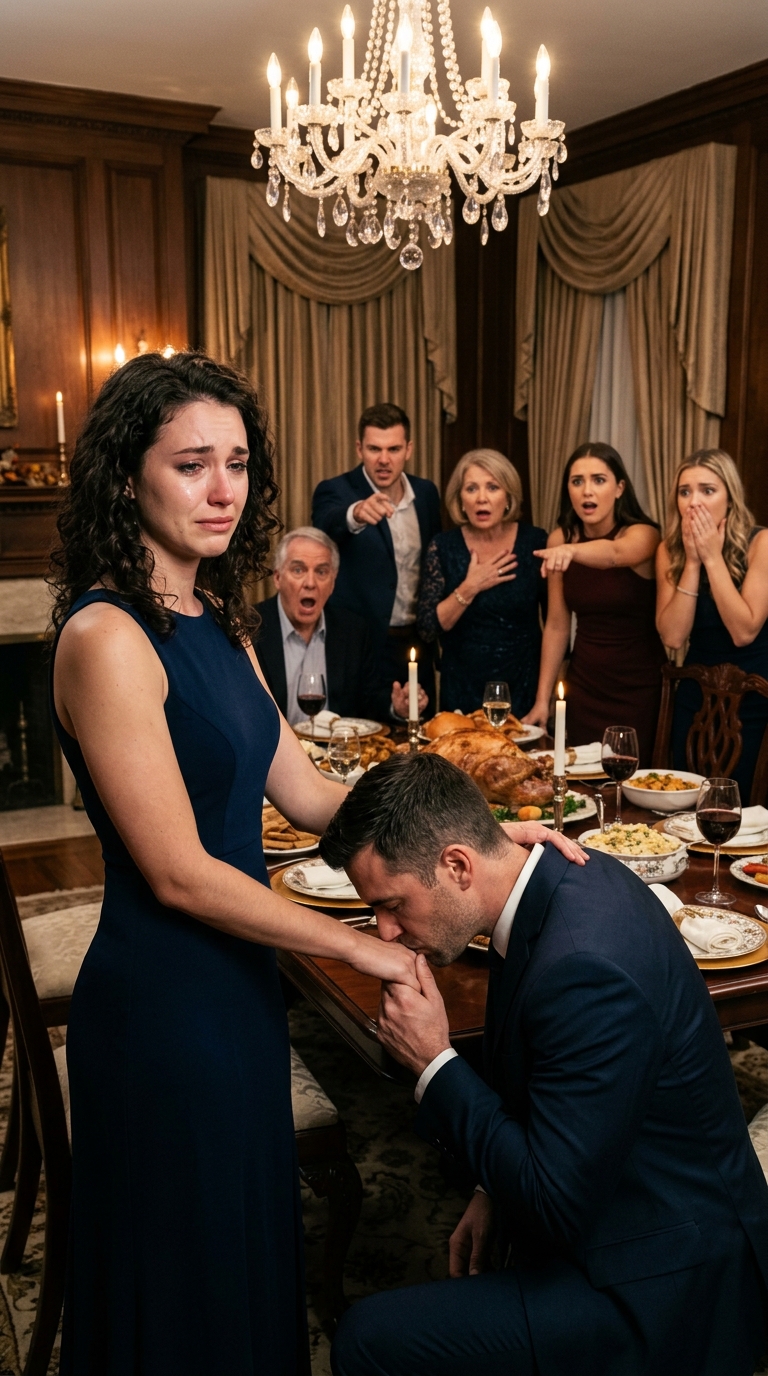
“How interesting, Dad. When I gave up my future to support all of you, nobody asked me to think carefully.”
Outside, the rain fell softly over the trees of River Oaks.
Nathan opened the door of his black SUV.
Before stepping inside, I turned back and looked at the brightly illuminated house.
For years, I believed I was the person being kept away from the family table.
That night, I understood that they were the ones who had been left out of my life.
And the most painful realization for my family wasn’t seeing me walk away.
It was knowing I had discovered the one secret that could bring everything they built crashing down.
The SUV moved through downtown Houston beneath the light rain, the kind that blurred the city lights and made the world outside the window look like a sorrowful film.
I sat silently with my hands folded in my lap, still carrying the scent of the cheap dish soap from the kitchen. Nathan drove without saying a word. He wasn’t relaxed. I knew him well enough to see the tension in his jaw and the way his fingers tightened around the steering wheel.
“I should have gotten there sooner,” he finally said.
I shook my head.
“You arrived when I was finally ready to leave.”
“I didn’t know they were that cruel.”
I looked out the window.
We passed busy restaurants, couples walking beneath shared umbrellas, and families leaving dinner together.
For some people, having a place where they belonged seemed effortless.
“I didn’t want to know either,” I said.
The truth was, for years I had softened my own wounds until they sounded like harmless little memories.
I told Nathan my family was difficult, not that my mother had forced me to serve food at Claire’s engagement party because, “You don’t have a boyfriend, so at least make yourself useful.”
I told him my father was demanding, not that he had asked me to sell my car to cover one of Logan’s debts, only to later announce during lunch that his son was “a fearless entrepreneur.”
I told him about being teased, not about the day my mother said in front of twelve people,
“Emily doesn’t need a new dress. She’s not someone people notice.”
You learn to make your pain smaller so you don’t frighten the people who truly care about you.
We arrived at Nathan’s apartment in Uptown shortly after ten.
It was large, peaceful, warmly lit, and filled with the comforting smell of fresh coffee.
His housekeeper, Mrs. Miller, walked out from the kitchen, looked at my face once, and asked nothing.
“I’m warming up some soup for you, sweetheart,” she said. “A face like that needs more than pride.”
For the first time that entire night, I almost laughed.
Nathan helped me remove my coat.
Underneath, I was still wearing the navy-blue dress I had carefully chosen before my mother covered it with an apron.
He looked at me as if I were the only person who existed in the room.
“You look beautiful.”
“I smell like turkey.”
“Then the turkey was lucky.”
I smiled.
Then my smile broke apart.
I covered my face with my hands and cried.
It wasn’t graceful crying.
It was exhausted.
Ancient.
The kind of tears that seemed to come from the little girl who once waited for her mother to brush her hair with tenderness, from the teenager who gave away her savings without ever hearing thank you, from the woman who kept accepting crumbs because she had mistaken them for family love.
Nathan didn’t tell me to calm down.
He didn’t say, “It’s over now.”
He simply held me, as if he understood that some pain doesn’t need an instant solution.
It only needs a safe place to fall.
Later that night, sitting in his kitchen with a bowl of noodle soup and a sandwich Mrs. Miller prepared because “nobody thinks clearly on an empty stomach,” my phone started vibrating.
Mom.
Dad.
Claire.
Logan.
Aunt Diane.
Even a cousin who never remembered my birthday.
I didn’t answer.
Then my father’s message appeared.
Emily, this has gotten out of control. Call me before you damage something important.
I read it three times.
Something important.
Not my pain.
Not my humiliation.
Not the dinner.
Not the family.
The contract.
Nathan noticed my expression.
“What did he say?”
I handed him my phone.
He read it, then carefully set it back down on the table.
“There it is.”
“What?”
“The only reason he’s worried about you tonight.”
It didn’t hurt because it was unexpected.
It hurt because it was true.
The next morning, my father called Nathan directly.
Before turning on the speaker, Nathan looked at me for permission.
I nodded.
“Nathan,” my father said, using a closeness he had never earned, “I think we should talk man to man.”
Nathan leaned back in his chair.
“Go ahead.”
“Last night was an emotional scene. Emily has always been sensitive. Margaret can be harsh sometimes, but everything she does is for the family.”
I closed my eyes.
“Harold,” Nathan said, “your daughter was washing dishes while all of you ate the dinner she prepared.”
“She wanted to help.”
Nathan looked at me.
“Emily, did you?” For the first time, my voice remained steady.
“No.”
A long silence followed.
My father cleared his throat.
“Well… maybe there was some miscommunication. But we can’t let this poison such an important business partnership.”
Nathan never needed to raise his voice.
“The partnership isn’t happening.”
My father’s silence was heavier than any argument.
“Excuse me?”
“Cole Hospitality Group will not be signing with Whitmore Construction.”
“You can’t make that decision over a family disagreement.”
“I didn’t make it because of a family disagreement.”
“I confirmed it because of a lack of ethics.”
My father inhaled sharply.
Nathan continued.
“We reviewed your financial records. You have suppliers who haven’t been paid in months, permits obtained through questionable channels, and two active labor lawsuits. I only agreed to one final meeting because Emily asked me not to judge her family without hearing them out first.”
My chest tightened.
“She defended you far more than you deserved,” he added.
My father changed his approach.
“Nathan, think this through. Jobs are at stake.”
“What puts jobs at risk is running a company with arrogance while hiding debt under the tablecloth. Good day, Harold.”
He ended the call.
I stared down at my coffee mug.
I waited for the guilt to arrive, because it always had before.
Guilt had been the trained companion of my childhood.
It appeared whenever my mother cried, whenever my father raised his voice, whenever Claire accused me of being selfish, whenever Logan needed money “just one last time.”
But this time, it never came.
Only sadness remained. Sadness that I had spent so much love on people who only searched for me when they needed something.
That very Sunday, my family’s version of what happened began spreading everywhere.
According to my mother, I had planned everything to embarrass her.
According to Claire, I had hidden my engagement because I wanted to make myself look better than them.
According to Logan, Nathan was an arrogant man controlling my decisions.
According to my aunts and uncles, I should apologize “for the sake of peace.”
The only different call came from my grandmother Ruth.
“It’s about time, sweetheart,” she said.
I was speechless.
“You knew?”
“I knew they were using you. I also knew one day you would get tired.”
“Why didn’t you ever say anything?”
My grandmother stayed quiet for several seconds.
“Because I was a coward. Because I thought enduring everything was a virtue. And because in this family, we confuse good women with women who should always be available.”
I cried again.
But those tears didn’t destroy me.
They cleansed something inside me.
A month later, Nathan and I hosted a small dinner at his apartment.
There was no twenty-seat dining table, no expensive crystal glasses, no crowd waiting for me to disappear back into the kitchen.
Mrs. Miller prepared pot roast.
I made an apple pie because I wanted to, not because someone demanded I prove my value.
My grandmother Ruth came.
So did my friends Lauren and Megan.
Nathan’s younger sister Grace came too, hugging me as if we had known each other forever.
When everyone sat down, I noticed something that seemed simple yet meant everything.
There was a chair waiting for me.
Not near the doorway.
Not beside the kitchen.
Not after everyone else had been served.
A chair at the center of the table.
Nathan lifted his glass.
“To Emily,” he said. “Because she found the courage to leave a house where she was needed, and step into a life where she is loved.”
No one laughed at me.
No one told me to hide my tears.
No one asked me to bring more gravy.
Everyone raised their glasses.
On Christmas Eve, my mother sent me a message.
The family is divided. You should come home and fix this.
I stared at the screen for a long time before answering.
I’m willing to talk when you’re ready to tell the truth. I’m not coming back to pretend none of this happened.
She never replied.
Sometimes silence signs confessions too.
Six months later, I married Nathan at a small vineyard in Napa Valley, surrounded by roses, gentle music, and people who spoke my name with happiness.
My father wasn’t invited.
Neither was my mother.
Claire sent an emoji, then deleted it.
Logan posted a story saying, “Family comes first,” right after sending me a text asking for a loan.
My grandmother Ruth sat in the front row wearing a light blue dress, crying openly without trying to hide it.
As I walked toward Nathan, I didn’t feel like I had been saved by a powerful man.
That would have been a beautiful lie.
But it would still have been a lie.
The truth was different.
I started saving myself the night I removed the apron.
Nathan simply opened the door.
During the reception, he took my hand and kissed my knuckles again, exactly like he had done that night in my parents’ kitchen.
“I’m sorry, my love,” he whispered. “I was late.”
I smiled.
“No,” I told him. “You arrived when I was finally ready to choose myself.”
And as the music played and the people who truly loved me laughed around the table, I understood something.
Family isn’t always the people who share your last name.
Sometimes family is the person who notices you are not sitting at the table.
Sometimes it is the person who saves you a seat.
And sometimes it is yourself, when you finally stop abandoning yourself just to make everyone else comfortable.
