

PART 1
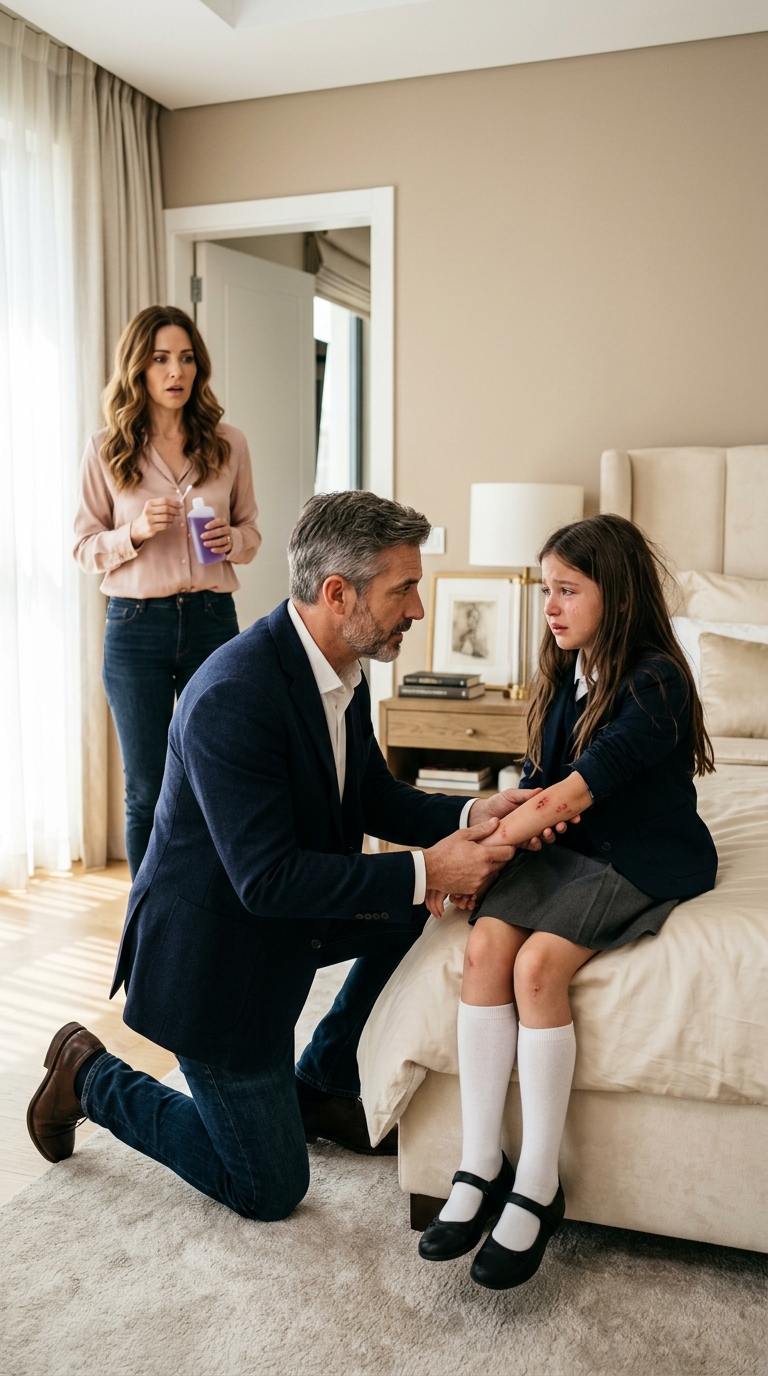
Andrés Salgado believed his daughter Valeria was healing.
Since the death of Elena, his first wife, the seven-year-old girl had changed a great deal. She no longer threw tantrums, no longer asked about her mother every few minutes, no longer cried in front of others.
She brought home straight 10s, greeted people in a soft voice, ate without making a mess, and obeyed at the first request.
To anyone else, she seemed like a model child.
To Andrés, who worked fourteen hours a day running his chain of car dealerships between Santa Fe, Puebla, and Guadalajara, it looked like maturity. Sofía, his new wife, repeated it to him every night with her perfect smile.
“Valeria needed discipline and love. You saw how much she changed. Before, she was glued to Elena’s memory.”
Andrés wanted to believe it.
That Thursday, however, a meeting with investors was canceled at the last minute. For the first time in months, he decided to go home early to their house in Lomas de Chapultepec. He planned to pick Valeria up, take her out for ice cream, and finally keep one of the promises he always ended up postponing.
When he opened the front door, he heard no music, no television, no laughter.
He heard a muffled sob.
It was not a tantrum.
It was a small, tight, strangled cry—the kind made by someone who had already learned that making noise only made things worse.
He climbed the stairs slowly. Valeria’s bedroom door was slightly open.
Then he heard Sofía’s voice.
“If you mention your mother Elena again, you won’t have dinner tonight. And this time I won’t stop at the ruler.”
Andrés felt his stomach drop.
He peered through the gap and froze.
Valeria stood in the middle of the room, still wearing her school uniform. Her back was straight, her arms pressed to her sides, her eyes fixed on the floor. In front of her, Sofía held a thick wooden ruler.
“Hands,” Sofía ordered.
The girl extended her palms without a word of protest.
That automatic gesture broke something inside Andrés.
He threw the door open.
“Don’t you dare touch her!”
Sofía turned, pale for a second, then quickly rearranged her expression.
“Andrés, don’t make a scene. I’m educating her.”
He snatched the ruler from her hand.
“Educating? That’s what you call this?”
Valeria did not run to her father. She did not scream. She did not ask for help.
She simply remained motionless, as though she still needed permission to breathe.
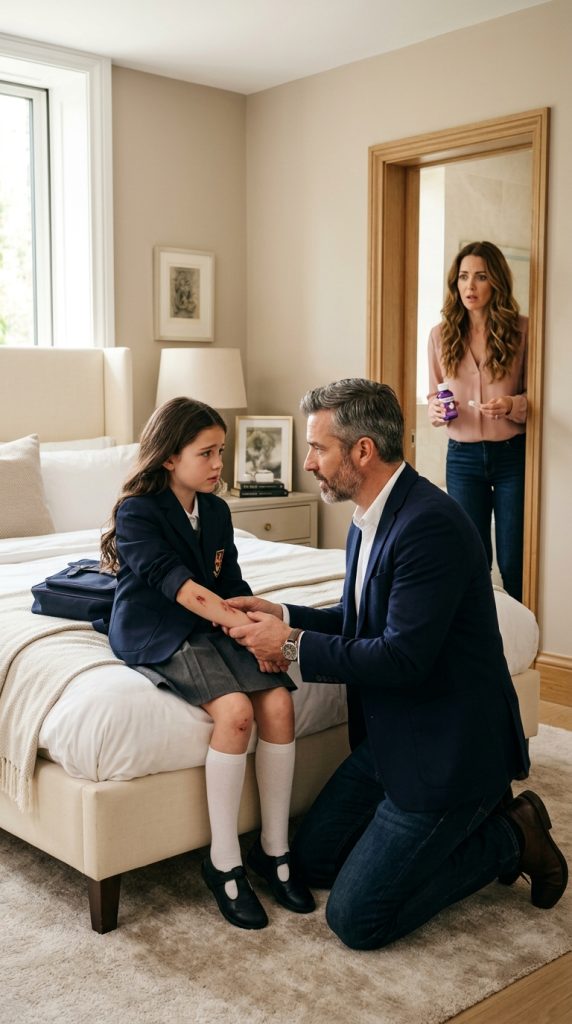
Andrés knelt in front of her.
“My love, look at me. Has Sofía been hitting you with this?”
The girl barely lifted her eyes. Before answering, she glanced at Sofía.
“Tell me the truth,” Andrés whispered. “She can’t hurt you anymore.”
Valeria swallowed.
“Since after the wedding.”
Sofía let out a dry laugh.
“Oh please. She’s a dramatic child. Ever since Elena died she exaggerates everything.”
The little girl flinched at the sound of her mother’s name.
Andrés saw something he had never allowed himself to see: Valeria was not calm. She was terrified.
“What happens when you talk about your mom?” he asked.
“She says the dead don’t matter anymore,” Valeria murmured. “That I should forget her. That now she’s my mom.”
Andrés felt shame wash over him.
For months he had mistaken his daughter’s silence for peace.
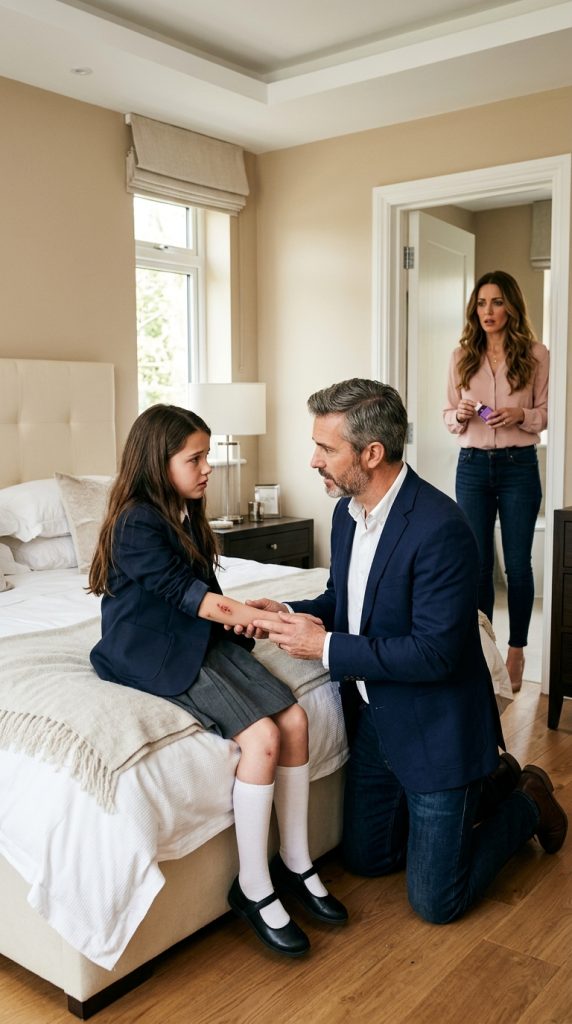
“Show me where she hurt you.”
Valeria hesitated. Then she slowly lifted the hem of her uniform blouse.
Parallel marks ran across her back. Some were red and fresh. Others were faint, almost healed. On her arms, bruises were hidden beneath the sleeves.
Andrés lowered his gaze and noticed a small dark stain on the white cuff of her uniform.
It was not ink.
It was not paint.
It was dried blood.
Sofía walked toward the door.
“Think very carefully about what you’re going to do. Your name, your company, the newspapers… this could destroy you.”
Andrés pulled out his phone.
“I’m thinking about my daughter.”
He dialed 911.
Sofía lunged for the phone, but he shoved her away with a fury he had never felt before.
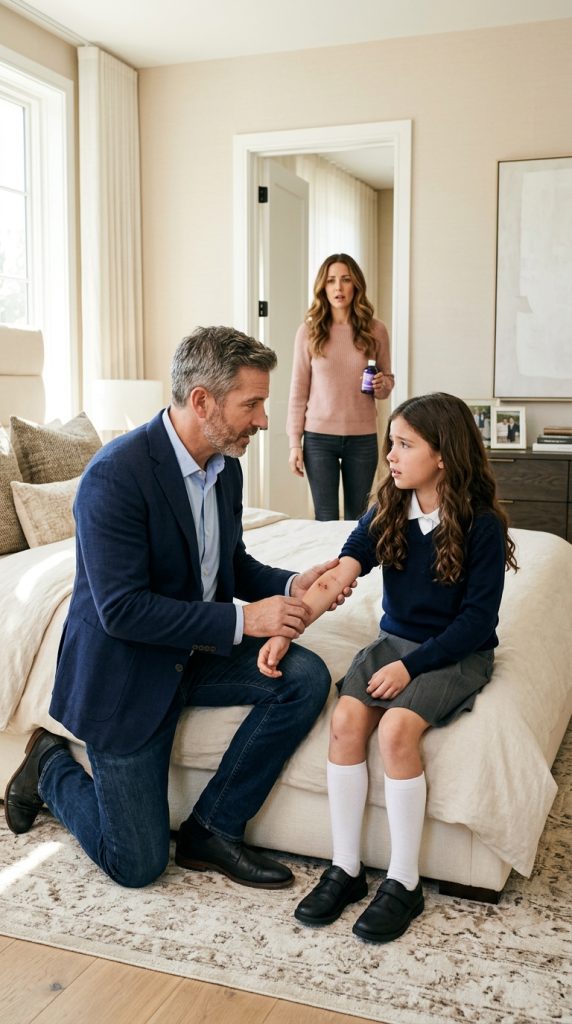
Then Valeria clung to his shirt and said something that emptied the room of air.
“Dad… don’t let her give me the purple syrup again. She says it’s vitamins, but afterward I can’t wake up.”
Andrés looked at Sofía.
For the first time, she did not pretend to be outraged.
Fear appeared on her face.
And what the officers found minutes later in her bathroom made the marks on Valeria’s body seem like only the beginning of a truth too monstrous to believe.
PART 2
The patrol car arrived together with a DIF worker and a paramedic. Sofía was separated from Valeria while the officers searched the room.
The ruler was placed in an evidence bag. A dry stain similar to the one on the uniform marked one edge.
Detective Carolina Méndez spoke to Valeria in a quiet voice, without pressure.
“Where does Sofía keep the syrup?”
“In her bathroom,” the girl answered. “There’s a purple one for sleeping and a pink one for when I cry too much.”
Andrés felt the floor shift beneath him.
Inside the cabinet they found three unmarked bottles. The labels were handwritten: “Nighttime vitamin,” “Calm,” and “Cough.”
None of them were vitamins.
At the children’s hospital, lab tests confirmed that Valeria had sedatives and an anxiolytic in her system—medications that had never been prescribed to her and that could have caused a life-threatening emergency while she slept.
The doctor examined the injuries carefully.
“This didn’t happen once,” she said. “There are signs of repeated punishment over at least eight months.”
Andrés sat beside the gurney, face in his hands.
He had bought a huge house, paid for the best school, filled Valeria’s room with expensive toys. Yet he had left her alone with the wrong person.
That night, Valeria told him more.
Sofía forced her to finish every meal even when her stomach hurt. She made her stand for hours if she moved at the table. She forbade her from inviting friends over because they might see the bruises. When Andrés came home late, she told him Valeria was already asleep.
“I wanted to tell you,” the girl said, “but she said you would send me to boarding school because you always believe adults more than children.”
Andrés cried in front of his daughter.
“I should have seen it. I should have listened to you.”
The hardest blow came when they searched Sofía’s dressing room.
Inside a shoebox they found a notebook filled with dates, punishments, and cold, clinical phrases written like official reports.
“Mentioned Elena: severe correction.”
“Didn’t finish dinner: two hours standing.”
“Asked about her father: full dose.”
They also found messages between Sofía and her sister Verónica, who worked at a pharmacy. The sisters discussed how to obtain prescription medications without prescriptions and how to increase the dosage whenever Valeria “kept asking questions.”
Andrés thought nothing could be worse.
Then the detective showed him a conversation from six days earlier.
Sofía had written:
“When the girl starts seeming unstable, Andrés will agree to send her away. After that everything will be easier.”
Verónica replied:
“And if he finds out something?”
Sofía answered:
“He won’t find out anything. He’s never home.”
The detective looked at Andrés.
“This wasn’t a moment of anger. It was a plan.”
Later they discovered a hidden USB drive in the same box. It contained audio recordings made by Sofía.
In one of them, Valeria could be heard crying in the background while Sofía spoke calmly, as if she were calmly planning a move.
She said the girl still kept photos of Elena, that she refused to call her “Mom,” and that she needed to make Valeria “more docile” before convincing Andrés to send her to a boarding school in the United States.
“Valeria is the only thing still connecting him to Elena,” Sofía’s voice said. “As long as that girl is here, I will always be second.”
The truth was brutal.
Sofía had never wanted to raise Valeria.
She had wanted to erase Elena.
And she had seen a seven-year-old girl as a rival.
At dawn, Valeria woke up in the hospital.
“Is Sofía here?”
“No, my love. She’s been arrested.”
“Can she come back?”
“I’m not going to let her.”
The girl looked at him with a seriousness far beyond her years.
“She used to say she wouldn’t allow things too… and then she did them anyway.”
Andrés understood that promises were no longer enough. He would have to prove safety with actions, not with pretty words.
The next day he filed for divorce, hired a psychologist who specialized in childhood trauma, and restructured his company. He delegated meetings, canceled trips, and changed his schedule so he could take Valeria to school, accompany her to therapy, and eat dinner with her every night.
From preventive detention, Sofía tried to portray herself as the victim. Her lawyer told the press that Andrés was a powerful man fabricating evidence to avoid paying her alimony.
She also suggested that Valeria was “difficult.”
The strategy collapsed quickly.
The prosecutor’s office had medical photographs, toxicology reports, the bottles, the messages, the recordings, and the notebook.
Then Marta, the housekeeper who had worked for the family for fifteen years, came forward.
Her testimony hurt in a different way.
Marta admitted she had suspected something. Once she saw Valeria walking with difficulty. Another time she found the ruler hidden among the towels. But Sofía had threatened to fire her and accuse her son—the driver—of theft.
“I was afraid,” she said through tears. “I thought that if I left, the girl would be completely alone. But staying silent was also leaving her alone.”
Andrés felt rage, yet he could not condemn Marta without also condemning himself.
He too had seen the signs.
Valeria no longer wore sleeveless dresses. She asked permission to go to the bathroom. She ate quickly. She apologized before speaking. She stopped smiling the moment Sofía entered the room.
Everything had been right in front of him.
And he had chosen to believe the comfortable version.
The school also gave a statement. The teacher said that Valeria, once outgoing and participative, now startled whenever anyone raised their voice. The school had sent two emails requesting a meeting, but Sofía had replied that the family was already handling the grief. Andrés had never seen those emails because Sofía had changed the primary contact address on the school records.
Verónica was arrested for obtaining the medications. Her statement revealed one more twist: Sofía had pretended to be affectionate during the courtship and changed completely after the wedding because she was obsessed with keeping the house, the family name, and Elena’s place in the family.
The defense offered a plea deal to spare Valeria from having to face Sofía in court.
Andrés did not decide alone. He spoke first with the psychologist and then with his daughter.
“You can tell your story in a recorded interview. You don’t have to see her.”
Valeria lowered her eyes.
“I don’t want them to ask me why I didn’t scream. I wanted to scream. I was just afraid no one would come.”
Andrés squeezed her hand.
“No one has the right to make you feel guilty for surviving.”
Sofía pleaded guilty but delivered a cold apology.
“I was wrong trying to be a strict mother.”
The judge interrupted her with a firm voice.
“You were not strict. You were cruel. A mother protects without competing and never drugs a child to hide what is happening inside her own home.”
Sofía received more than twenty years in prison and lost all rights to contact Valeria. Verónica received a lighter sentence and was permanently barred from working in pharmacies.
When Andrés returned home, he found Valeria building a city out of blocks in the living room. Sofía had forbidden her from playing there because it “made a mess.”
“It’s over,” he told her. “She can’t come near you anymore.”
Valeria placed a crooked block.
“Am I safe now?”
“Legally, yes. But feeling safe will take time. I’ll be right here while you learn how.”
The girl kept building. The city came out crooked, colorful, imperfect.
Andrés understood that the disorder itself was a victory.
They placed photographs of Elena in the living room and in Valeria’s bedroom. They prepared a box filled with letters, videos, and keepsakes. Some nights the girl cried for her mother. Other nights she told happy stories about her. She no longer had to choose between remembering Elena and loving her father.
One evening at dinner, Valeria left three pieces of broccoli on her plate.
She looked at Andrés with fear.
“I don’t like them.”
“Then don’t eat them.”
“You’re not angry?”
“No.”
Valeria pushed the plate away and burst into tears—not from terror, but from relief. Andrés hugged her and understood that healing could look exactly like this: a little girl crying because she had finally been given permission not to finish her broccoli.
Months later she returned to ballet, invited friends over, and filled the house with laughter, discarded backpacks, and half-empty glasses.
At ten years old, she wrote a school essay titled “The Day Someone Really Looked.” She did not describe every blow. She wrote about the moment her father opened the door, heard her voice, and believed her.
Andrés read it from the last row of the auditorium, crying in silence.
The marks on her back never disappeared completely. But they stopped being Sofía’s secret. They became proof of a truth no one could hide again.
Because danger does not always arrive by breaking down the door.
Sometimes it lives inside the house, smiles in family photographs, and counts on the adults being too busy to notice.
Valeria survived because one afternoon her father came home early.
But her real recovery began the moment Andrés understood that saving his daughter was not a single heroic act.
It is showing up.
It is listening.
It is believing her—always.
And above all, it is never again mistaking an obedient child for a child who is truly okay.
